You are staring at a peptide vendor's website, credit card in hand, wondering if clicking "buy" will put you on the wrong side of the law. The short answer: in the United States, most peptides are legal to purchase for research purposes, but not FDA-approved for human use. The legal landscape varies by country, by peptide, and by how you intend to use it.
| Factor | Status |
|---|---|
| Buying peptides for research (US) | Legal in most states |
| Using peptides on yourself (US) | Gray area; not FDA-approved for human use |
| Prescription peptides (semaglutide, tirzepatide) | Legal with a valid prescription |
| Compounding pharmacy peptides (US) | Legal for Category 1 peptides with a prescription; 19 peptides moved to Category 2 in late 2023 |
| WADA-tested athletes | Most peptides are banned substances |
| Australia | Prescription-only (Schedule 4); no personal importation |
| UK | Legal to buy for personal use; illegal to sell for human consumption without a license |
| EU | Varies by country; generally prescription-only |
| Canada | Not approved; importation for personal use tolerated in small quantities |
The regulatory picture shifted significantly between 2023 and 2026. The FDA peptide crackdown reshaped the entire supply chain. Understanding where the lines are drawn keeps you on the right side of them.

Get your custom peptide protocol:
- Tailored to your body and goals
- Precise dosing and cycle length
- Safe stacking combinations
- Backed by peer-reviewed studies
- Ready in under 2 minutes
US Federal Law: How Peptides Are Classified
Peptides occupy an unusual space in US federal law. They are not scheduled controlled substances like anabolic steroids, which sit on Schedule III of the Controlled Substances Act. They are not dietary supplements, which can be sold over the counter. They are not approved drugs, which require an FDA New Drug Application and years of clinical trials.
Most research peptides fall into a regulatory gap. The Federal Food, Drug, and Cosmetic Act (FDCA) defines a "drug" as any substance intended for use in the diagnosis, cure, treatment, or prevention of disease. A peptide sold "for research purposes only" technically sidesteps this definition because the stated intent is laboratory use, not human consumption.
This distinction matters. Purchasing a vial labeled "not for human use" is legal. Injecting it into yourself moves the act outside the manufacturer's stated intent, but no federal statute criminalizes personal use of non-scheduled research chemicals. The legal risk falls primarily on sellers who market peptides with therapeutic claims, not on individual buyers.
FDA Status: Research Use Only vs. Prescription
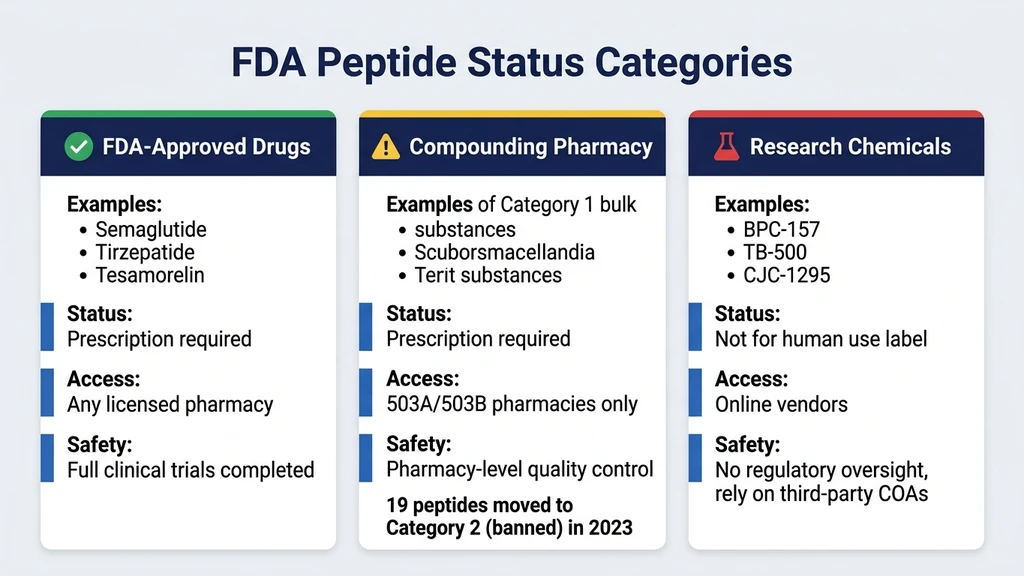
The FDA divides the peptide landscape into three categories that determine what you can legally access.
FDA-Approved Peptide Drugs
A handful of peptides have completed full clinical trials and received FDA approval. Semaglutide (Ozempic, Wegovy) and tirzepatide (Mounjaro, Zepbound) are the most recognized. These are legal with a prescription from a licensed provider. Using them without a prescription is not a criminal offense for the patient, but obtaining them without one typically requires purchasing from unregulated sources.
Other FDA-approved peptides include tesamorelin (Egrifta) for HIV-associated lipodystrophy and gonadorelin for fertility diagnostics. Each approval is narrow, covering only the specific indication studied in clinical trials.
Compounding Pharmacy Peptides
Compounding pharmacies operate under Section 503A and 503B of the FDCA. They can prepare custom formulations using bulk drug substances that appear on the FDA's Category 1 list. A physician writes the prescription. The pharmacy compounds it. The patient receives a legally prepared medication.
In late 2023, the FDA moved 19 peptides from Category 1 to Category 2, including BPC-157, TB-500, CJC-1295, Ipamorelin, Thymosin Alpha-1, and others. Category 2 means "do not compound." Compounding pharmacies cannot legally prepare these peptides, even with a valid prescription. On February 27, 2026, HHS Secretary Robert F. Kennedy Jr. announced plans to reclassify 14 of those 19 peptides back to Category 1, but formal FDA reclassification remains pending as of March 2026 (FDA Bulk Drug Substance Nominations, fda.gov).
Research Chemical Peptides
The term "research chemical" is a commercial label, not a legal classification. Vendors use it to indicate that the product has not undergone FDA review and is sold exclusively for in vitro or animal research. Think of it like buying laboratory-grade reagents from a chemical supply company. The sale is legal. The intended use is scientific investigation.
No federal agency certifies or regulates research peptide purity. A vial labeled "99% pure" has no regulatory body verifying that claim. This is why third-party certificates of analysis (COAs) from independent labs matter. For guidance on evaluating suppliers, see where to buy peptides in 2026.
State-Level Variations in the US
Federal law sets the baseline. Individual states can impose additional restrictions.
| State Action | Example |
|---|---|
| Stricter compounding oversight | New York requires additional state licensing for 503A pharmacies beyond federal standards |
| Telehealth prescribing limits | Several states restrict peptide prescriptions issued via telehealth without an in-person exam |
| Import restrictions | Florida and Texas have prosecuted importers of unapproved drug products, though cases targeted large-scale sellers rather than individual buyers |
| Practice of medicine laws | Some states restrict naturopathic or functional medicine providers from prescribing peptides |
No US state has criminalized personal possession of non-scheduled research peptides. The enforcement focus remains on commercial sellers making therapeutic claims and compounding pharmacies operating outside their legal authority. However, regulations change. Checking your state's pharmacy board website before purchasing is a practical precaution.
International Peptide Laws
Peptide legality varies dramatically across borders. What is freely available in one country may require a prescription or carry criminal penalties in another.
United Kingdom
The UK applies a permissive framework for personal possession. Peptides are not controlled substances under the Misuse of Drugs Act 1971. You can legally buy and possess peptides for personal use. Selling peptides for human consumption without a Medicines and Healthcare products Regulatory Agency (MHRA) license is illegal. This creates a market similar to the US: vendors sell peptides labeled for research, buyers use them personally, and enforcement targets commercial sellers making health claims rather than individual users.
Australia
Australia has the strictest peptide regulations among English-speaking countries. The Therapeutic Goods Administration (TGA) classifies most peptides as Schedule 4 (prescription-only) medicines. Importing peptides without a valid prescription is illegal. The TGA actively intercepts parcels at customs and has issued multiple public warnings about online peptide purchases. In 2024, the TGA reclassified BPC-157 and several growth hormone secretagogues as Schedule 4, closing a loophole that had allowed some peptides to enter as unscheduled goods (TGA, *Scheduling Delegates' Interim Decisions*, 2024).
Personal importation exemptions that apply to some medications do not cover peptides in most cases. Australian residents who want legal access need a prescription from an authorized prescriber.
European Union
EU member states regulate peptides under the European Medicines Agency (EMA) framework, but enforcement varies. Germany and France treat unapproved peptides similarly to unapproved drugs and restrict personal importation. The Netherlands and Czech Republic apply lighter enforcement for small quantities intended for personal use. No EU country has approved non-pharmaceutical peptides for over-the-counter sale.
Cross-border purchasing within the EU is complicated by differing national implementations of the Falsified Medicines Directive (2011/62/EU), which targets counterfeit and unregistered medicinal products.
Canada
Health Canada has not approved most research peptides. Importing unapproved health products violates the Food and Drugs Act. In practice, small quantities shipped to a personal address for personal use are rarely intercepted. Health Canada focuses enforcement on commercial importers and domestic sellers making therapeutic claims. This tolerance is informal, not codified in law, and offers no legal protection if a shipment is seized.
WADA and Sports: Peptides Are Banned
The World Anti-Doping Agency (WADA) bans most peptides under two categories in the 2026 Prohibited List.
| WADA Category | Peptides Covered | Status |
|---|---|---|
| S2: Peptide Hormones, Growth Factors | Growth hormone secretagogues (CJC-1295, Ipamorelin, GHRP-2, GHRP-6, Hexarelin), GH-releasing hormones | Banned in and out of competition |
| S2: Peptide Hormones | TB-500 (Thymosin Beta-4) | Banned since 2010 |
| S4: Hormone and Metabolic Modulators | GLP-1 receptor agonists (semaglutide, tirzepatide) | Under monitoring; not currently prohibited |
| S0: Non-Approved Substances | Any pharmacological substance not addressed elsewhere | Banned by default |
BPC-157 is not explicitly named on the WADA Prohibited List. However, WADA's S0 category bans "any pharmacological substance which is not addressed by any of the subsequent sections of the List and with no current approval by any governmental regulatory health authority for human therapeutic use." Because BPC-157 has no FDA or EMA approval, it falls under S0 by default (WADA, 2026 Prohibited List).
If you compete in any sport governed by WADA, USADA, or a national anti-doping organization, assume all research peptides are prohibited. A positive test carries a minimum two-year ban for a first offense. The burden of proof falls on the athlete to demonstrate how a substance entered their body.
What "Research Chemical" Actually Means Legally
The label "for research purposes only" is a liability shield, not a quality guarantee. It performs two legal functions.
First, it declares intent. The seller states that the product is manufactured for laboratory research, not for human consumption. This shields the seller from FDA enforcement under the FDCA's drug provisions, because the product is not being marketed as a drug.
Second, it shifts responsibility. The moment you inject a research peptide into yourself, the legal framework changes. You are using an unapproved substance in a manner the seller explicitly disclaimed. No federal crime has been committed (the substance is not scheduled), but you have no consumer protection. If the vial contains the wrong peptide, the wrong concentration, or a contaminant, you have no regulatory body to file a complaint with.
Think of it like buying industrial-grade ethanol from a chemical supplier. The purchase is legal. Drinking it is your decision. If the label says "not for human consumption," the supplier bears no liability for what happens next. The parallel is not perfect, but the legal logic is identical: stated intent determines the regulatory category.
This is why sourcing matters more in peptides than in almost any other consumer purchase. For vetting criteria and supplier evaluation, see our peptide safety guide.
Compounding Pharmacies: The Legal Prescription Route
Compounding pharmacies represent the only fully legal pathway for using peptides under medical supervision in the United States. The process works like this: a licensed physician evaluates you, determines that a compounded peptide is medically appropriate, writes a prescription, and a compounding pharmacy prepares the formulation.
Before the 2023 reclassification, this route covered dozens of peptides including BPC-157, Thymosin Alpha-1, CJC-1295, and Ipamorelin. The Category 2 reclassification shut this pathway for 19 compounds.
| Compounding Status (as of March 2026) | Peptides |
|---|---|
| Still legal to compound (Category 1) | Semaglutide (debated), AOD-9604 (pending), select others |
| Banned from compounding (Category 2) | BPC-157, TB-500, CJC-1295, Ipamorelin, GHRP-2, GHRP-6, Thymosin Alpha-1, Semax, Selank, DSIP, KPV, Epithalon, LL-37, Dihexa, MOTS-C, GHK-Cu, Sermorelin, Tesamorelin |
| Reclassification announced (not yet formal) | 14 of the 19 banned peptides (RFK Jr. announcement, Feb 2026) |
| FDA-approved (prescription required) | Semaglutide (Ozempic/Wegovy), tirzepatide (Mounjaro/Zepbound), tesamorelin (Egrifta) |
The semaglutide compounding situation is particularly volatile. The FDA removed semaglutide from the drug shortage list in February 2025 and began enforcement against compounders. Multiple lawsuits from compounding pharmacy trade groups challenged the FDA's determination. As of March 2026, some 503B outsourcing facilities continue compounding semaglutide under legal challenge while 503A pharmacies face stricter enforcement timelines.
For a full timeline of enforcement actions, see the FDA peptide crackdown 2026 breakdown.
Common Legal Mistakes to Avoid
1. Importing peptides into Australia without a prescription. Australian customs actively screens inbound parcels for pharmaceutical products. The TGA reports thousands of seizures annually. Penalties include fines up to AUD $222,000 for individuals importing therapeutic goods without authorization (Therapeutic Goods Act 1989, Section 19B).
2. Competing in tested sports while using any peptide. Even peptides not explicitly named on the WADA list fall under the S0 catch-all provision. "I didn't know it was banned" is not a valid defense under strict liability anti-doping rules. The athlete is responsible for every substance in their body, regardless of intent.
3. Assuming the RFK reclassification is already in effect. The February 2026 announcement was a policy statement, not a regulatory action. Until the FDA formally publishes updated Category 1 designations, compounding pharmacies that resume preparing these peptides face legal exposure. Patients who receive prescriptions for not-yet-reclassified peptides may encounter pharmacy refusals.
4. Buying peptides labeled as "dietary supplements." Peptides are not dietary supplements under the Dietary Supplement Health and Education Act (DSHEA). Any product marketed as a supplement containing injectable peptides is misbranded. The FDA sent over 50 warning letters in September 2025 to companies making supplement claims about peptide products.
Frequently Asked Questions
Is it illegal to buy peptides online in the US?
Buying peptides labeled 'for research purposes only' is legal in the United States. No federal statute criminalizes the purchase of non-scheduled research chemicals. The legal risk falls on sellers who market peptides with therapeutic claims. Individual buyers purchasing small quantities for personal use have not been the target of federal enforcement actions.
Can I get a prescription for BPC-157?
Not currently through standard channels. The FDA moved BPC-157 to Category 2 in late 2023, which prohibits compounding pharmacies from preparing it. HHS Secretary RFK Jr. announced in February 2026 that BPC-157 would return to Category 1, but the formal reclassification has not been published. Until it is, no US compounding pharmacy can legally fill a BPC-157 prescription.
Are peptides legal for bodybuilding?
For recreational lifters who do not compete in tested sports, purchasing research peptides is legal in the US and UK. For athletes competing under WADA, USADA, or any national anti-doping body, most peptides are banned substances. A positive test carries a minimum two-year suspension. If you compete, assume all research peptides are prohibited. See getting started with peptides for beginner guidance.
Can I travel internationally with peptides?
Carrying research peptides across international borders creates significant legal risk. Australia will seize them at customs. EU countries may classify them as unapproved medicines. Even within the US, TSA screening of injectable vials without a prescription label may trigger questions. If you have a legitimate prescription for an FDA-approved peptide like semaglutide, carry the prescription documentation and original pharmacy packaging.
What happens if customs seizes my peptide order?
In the US, customs seizures of small research peptide orders are rare. If it happens, you typically receive a seizure notice and can choose to contest or abandon the package. No criminal charges result from a single personal-quantity seizure. In Australia, the TGA may issue fines up to AUD $222,000 for unauthorized therapeutic goods imports. In the EU, consequences vary by country.
Are compounded semaglutide and tirzepatide still legal?
The legal status is actively contested. The FDA declared the semaglutide shortage over in February 2025 and began enforcement. Multiple lawsuits from compounding pharmacy associations challenged this determination. Some 503B outsourcing facilities continue compounding under legal challenge. Tirzepatide faces similar enforcement timelines. Check with your compounding pharmacy about their current legal position before ordering.
Is it legal to sell peptides?
Selling peptides for research purposes is legal under federal law if no therapeutic claims are made. Selling peptides for human consumption without FDA approval violates the FDCA. The line between these categories is thin: if a website includes dosage recommendations or testimonials about health benefits, the FDA considers that evidence of intent to sell a drug. Over 50 warning letters were issued to sellers in September 2025 alone.
Will the 2026 RFK reclassification make peptides legal again?
The February 2026 announcement covers 14 of the 19 peptides moved to Category 2. If formally implemented, compounding pharmacies could again prepare BPC-157, Thymosin Alpha-1, CJC-1295, and others with a valid prescription. This does not affect research peptide vendors, who operate outside the compounding framework. The five peptides excluded from reclassification have not been publicly identified as of March 2026.
The Bottom Line
Peptide legality depends on three variables: the specific peptide, the country you are in, and what you intend to do with it. In the United States, purchasing research peptides is legal. Using them is a personal decision that falls outside both criminal law and consumer protection. FDA-approved peptides like semaglutide require a prescription. Compounded peptides face a shifting regulatory landscape that may reopen access to 14 previously banned compounds in 2026.
If you compete in tested sports, the answer is simpler: peptides are banned. WADA's S0 provision covers any unapproved substance, regardless of whether it appears by name on the Prohibited List.
For newcomers evaluating their first purchase, start with the peptide safety guide to understand sourcing risks, then review where to buy peptides in 2026 for supplier vetting criteria. Use the peptide interaction checker and peptide cost calculator to plan responsibly.
Helpful Tools
Related Articles
Where to Buy Peptides in 2026
Legitimate routes to buy research peptides in 2026: telehealth, compounding pharmacies, quality verification, and legal status.
AOD 9604 Peptide: What the Evidence Shows
AOD 9604 peptide is a modified hGH fragment. Its 536-patient trial found no significant weight loss vs placebo. Mechanism, real evidence, FDA and WADA status.
Do Peptides Show Up on Drug Tests?
Do peptides show up on drug tests? Standard workplace panels cannot detect them. WADA labs use LC-MS/MS with detection windows from 12h to 10+ days.
GHRP-6 Peptide: Dosage Chart, Benefits & Hunger
GHRP-6 dosage chart (100 to 300 mcg tiers), how the ghrelin mimetic triggers GH release, the hunger effect, CJC-1295 stacking, and honest side effect data.