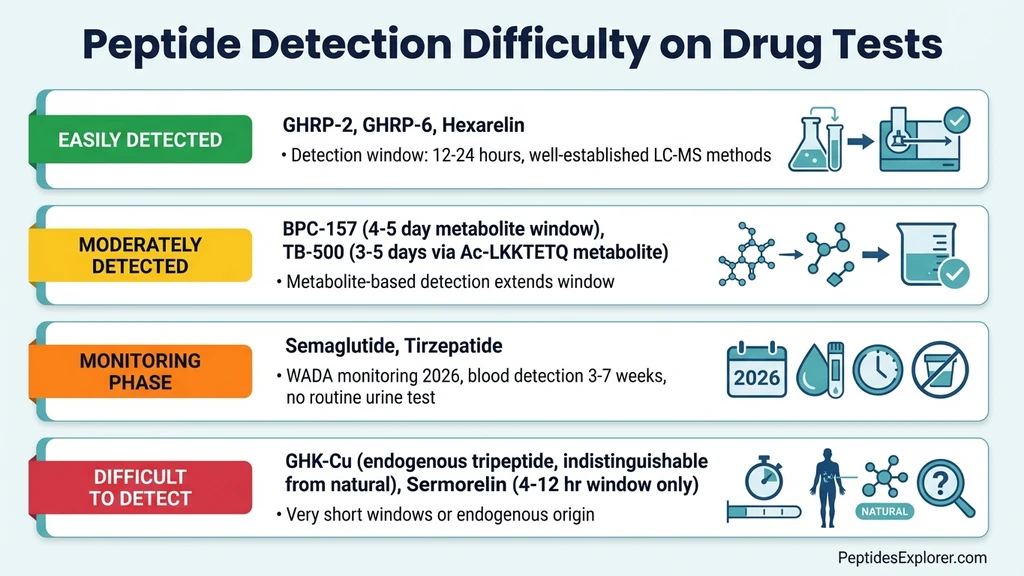
You are using a research peptide and you just got notified about an upcoming drug test. The direct answer: standard workplace drug tests (5-panel, 10-panel, 12-panel) cannot detect peptides. The immunoassay antibodies in those panels target amphetamines, opioids, THC, cocaine, and benzodiazepines. They have zero affinity for peptide molecular structures. You will not fail a workplace drug screen because of BPC-157, TB-500, ipamorelin, or any other research peptide.
Sports anti-doping tests are a different instrument entirely. WADA-accredited laboratories use liquid chromatography coupled with high-resolution mass spectrometry (LC-HRMS) that can identify peptides at concentrations as low as 0.02 ng/mL. If you compete in tested sports, assume every research peptide is detectable.
| Testing Type | Detects Peptides? | Method Used | Cost per Test |
|---|---|---|---|
| 5-panel workplace test | No | Immunoassay | $30-60 |
| 10-panel workplace test | No | Immunoassay | $50-120 |
| DOT/federal workplace test | No | Immunoassay + GC-MS confirmation | $60-150 |
| Military standard panel | No (peptides not targeted) | Immunoassay | $50-100 |
| WADA anti-doping test | Yes | LC-HRMS / LC-MS/MS | $1,000-2,500 |
| USADA targeted test | Yes | LC-HRMS + biomarker panels | $1,500-3,000 |
| Sports federation random test | Yes (if WADA-accredited lab) | LC-HRMS | $1,000-2,500 |
The distinction between these two testing worlds explains why recreational peptide users and competitive athletes face completely different risk profiles. For the full legal framework covering WADA prohibited lists and international regulations, see our peptide legality guide.
Get your custom peptide protocol:
- Tailored to your body and goals
- Precise dosing and cycle length
- Safe stacking combinations
- Backed by peer-reviewed studies
- Ready in under 2 minutes
Detection Windows by Peptide: Quick-Reference Table
Detection windows vary enormously depending on the peptide's half-life, metabolite stability, and whether the test targets urine or blood. Shorter half-life peptides clear faster but may leave detectable metabolites for days.
| Peptide | Half-Life | Urine Detection Window | Blood Detection Window | WADA Detectable? |
|---|---|---|---|---|
| BPC-157 | ~4 hours | 4-5 days (metabolites) | 24-48 hours | Yes (S0 category) |
| TB-500 | ~2.5 hours | 3-5 days (Ac-LKKTETQ metabolite) | 24-72 hours | Yes (S2 category) |
| Ipamorelin | ~2 hours | 6-24 hours (parent); metabolites longer | 12-24 hours | Yes (S2 category) |
| CJC-1295 no DAC | ~30 minutes | 4-12 hours | 2-6 hours | Yes (S2 category) |
| CJC-1295 with DAC | 6-8 days | 7-10+ days | 10-14 days | Yes (S2 category) |
| GHRP-6 | ~20 minutes | Up to 23 hours (parent) | 6-12 hours | Yes (S2 category) |
| GHRP-2 | ~25 minutes | 12-24 hours | 6-12 hours | Yes (S2 category) |
| Hexarelin | ~60 minutes | 12-24 hours | 6-12 hours | Yes (S2 category) |
| Semaglutide | ~7 days | Minimal urinary excretion | 5-7 weeks | Monitored (2026) |
| Tirzepatide | ~5 days | Minimal urinary excretion | 3-5 weeks | Monitored (2026) |
| AOD-9604 | ~30 minutes | 12-48 hours (metabolites extend window) | 4-8 hours | Yes (S2 category) |
| PT-141 | ~2.7 hours | 12-24 hours | 8-16 hours | Yes (S0 category) |
| Melanotan-2 | ~30 minutes | 12-24 hours | 4-8 hours | Yes (S0 category) |
| GHK-Cu | ~minutes (topical) | Not reliably detectable | Not reliably detectable | No (endogenous tripeptide) |
| Sermorelin | ~10-20 minutes | 4-12 hours | 2-6 hours | Yes (S2 category) |
CJC-1295 with DAC stands out. Its Drug Affinity Complex binds to albumin in the bloodstream, extending the half-life from 30 minutes to 6-8 days. That extended half-life means a proportionally wider detection window. A single injection remains traceable in blood for over two weeks (Teichman et al., J Clin Endocrinol Metab, 2006).
How Drug Tests Actually Work: Two Different Technologies
The reason peptides appear on one test and not another comes down to the detection technology. Think of it like two security systems. A standard workplace drug test is a metal detector at a concert: it catches knives and guns but ignores a plastic water bottle. A WADA anti-doping test is an airport full-body scanner connected to a chemical sniffer: it identifies the molecular fingerprint of every substance passing through.
Immunoassay: What Workplace Tests Use
Standard workplace drug panels use immunoassay technology. The test strip contains antibodies engineered to bind specific drug molecules or their metabolites. When THC metabolites in your urine bind to anti-THC antibodies on the strip, the reaction produces a measurable signal. No binding, no signal.
These antibodies are highly specific. An anti-amphetamine antibody recognizes the amphetamine molecular structure. It does not recognize BPC-157, a 15-amino-acid peptide with a completely different shape, size, and charge profile. The molecular weight of methamphetamine is 149 daltons. The molecular weight of BPC-157 is 1,419 daltons. That is a ten-fold size difference. The antibodies cannot physically bind to peptide structures.
Immunoassay panels cost $30-120 per test. They screen for 5, 10, or 12 drug classes. No commercially available immunoassay panel includes peptide-specific antibodies, because there is no regulatory mandate to test for them in the workplace.
LC-HRMS: What Anti-Doping Labs Use
WADA-accredited laboratories use liquid chromatography coupled with high-resolution mass spectrometry (LC-HRMS). This technology does not rely on antibodies. It separates compounds by their physical and chemical properties (liquid chromatography), then identifies each compound by its exact molecular mass and fragmentation pattern (mass spectrometry).
The process works in three stages. First, the sample undergoes solid-phase extraction (SPE) to isolate peptide-sized molecules from the biological matrix. Second, liquid chromatography separates the extracted compounds on a C18 column. Third, high-resolution mass spectrometry measures the mass-to-charge ratio of each compound with accuracy to four decimal places.
Modern instruments achieve limits of detection (LODs) between 0.02 and 0.92 ng/mL for most peptide analytes in urine (Thomas et al., Drug Test Anal, 2022). For context, WADA's Minimum Required Performance Level (MRPL) for small peptides is 2 ng/mL. Current instruments exceed that threshold by a factor of 10 to 100.
Biomarker-Based Detection: The Indirect Approach
Some peptides are detected indirectly through the biological changes they cause rather than through the peptide molecule itself. Growth hormone secretagogues like ipamorelin and CJC-1295 elevate GH and IGF-1 levels. Anti-doping labs measure IGF-1/IGFBP-3 ratios and GH isoform profiles to flag abnormal patterns.
This biomarker approach extends the effective detection window beyond the peptide's own half-life. Ipamorelin clears from urine within 24 hours. But the IGF-1 elevation it triggers can persist for 7-14 days after the last injection. Athletes who stop using GH secretagogues a few days before a test may still produce abnormal biomarker ratios that trigger a targeted follow-up analysis (Holt et al., Bioanalysis, 2015).
Workplace Drug Tests: What They Screen For
The US Department of Transportation (DOT) mandates a 5-panel test for safety-sensitive positions. Most private employers use either the 5-panel or an extended 10-panel. Neither includes peptides.
| Panel Type | Substances Tested | Peptides Included? |
|---|---|---|
| 5-panel (DOT standard) | THC, cocaine, opiates, amphetamines, PCP | No |
| 10-panel | Above + benzodiazepines, barbiturates, methadone, propoxyphene, methaqualone | No |
| 12-panel | Above + MDMA, oxycodone | No |
| Extended panels (rare) | May add kratom, fentanyl, tramadol, EtG | No |
No US employer, federal agency, or insurance company currently requires peptide testing in workplace drug screens. The Substance Abuse and Mental Health Services Administration (SAMHSA) guidelines, which set the federal testing framework, do not include peptides as a target analyte class. Adding peptide detection would require LC-MS/MS equipment costing $200,000-500,000 per instrument, plus trained technicians and validated protocols. The economics do not justify it for workplace screening.
One scenario to watch: some military branches have explored expanded testing panels. The Department of Defense has not added peptides to standard urinalysis panels as of March 2026, but the DoD Instruction 1010.01 grants authority to add substances without public notice. Military members face a higher baseline risk of expanded testing than civilian employees.
Sports Anti-Doping: Which Peptides Get Caught
WADA categorizes banned peptides across multiple sections of the Prohibited List. The detection capability varies by peptide class. Some are trivially easy to catch. Others require the most advanced instruments in the analytical arsenal. For a full breakdown of WADA categories and legal consequences, see our peptide legality guide.
Easily Detected: GH Secretagogues
Growth hormone releasing peptides (GHRPs) like GHRP-2, GHRP-6, and hexarelin are small molecules (under 1,000 daltons) that survive metabolic degradation relatively intact. GHRP-6 is excreted largely unchanged in urine and detectable for up to 23 hours post-administration. GHRP-2 and hexarelin show similar profiles.
WADA-accredited labs have validated methods for all major GH secretagogues with LODs well below the 2 ng/mL MRPL. A 2022 study screened 15 GH secretagogues simultaneously using a single LC-HRMS method with parallel reaction monitoring (PRM), achieving LODs between 0.20 and 0.92 ng/mL (Thomas et al., Drug Test Anal, 2022). These peptides are among the most reliably caught compounds in anti-doping testing.
Moderately Detected: BPC-157 and TB-500
BPC-157 is a 15-amino-acid peptide that degrades into smaller fragments in the body. WADA-funded research has identified stable metabolites detectable in urine for 4-5 days post-administration, with LODs ranging from 0.03 to 0.11 ng/mL using ultra-high-performance liquid chromatography mass spectrometry. These detection limits fall well below WADA's 2 ng/mL MRPL, meaning anti-doping labs have more than sufficient analytical capability to catch BPC-157 use.
TB-500 presents a slightly different challenge. The parent compound is a synthetic version of the LKKTETQ active region of thymosin beta-4. It undergoes serial C-terminal cleavage, but the N-terminal acetylation protects the molecule from degradation at that end. The key metabolite, Ac-LKKTETQ, is detectable at 0.02 ng/mL in urine (Ho et al., J Chromatogr A, 2012). Six confirmed metabolites provide multiple detection targets. The practical detection window is 3-5 days.
Detection in Development: GLP-1 Agonists
Semaglutide and tirzepatide occupy a unique position. They are not banned by WADA as of the 2026 Prohibited List. They sit on WADA's Monitoring Program, which means labs collect data on athlete usage without imposing sanctions.
From January 2026, WADA mandated that accredited labs monitor markers of both semaglutide and tirzepatide in-competition and out-of-competition. Detection uses dried blood spots (DBS) and LC-MS/MS, because these large peptides are minimally excreted in urine. Semaglutide's 7-day half-life means a single injection remains detectable in blood for 5-7 weeks.
If WADA's monitoring data reveals widespread misuse in weight-class sports (boxing, wrestling, weightlifting), these compounds could move to the Prohibited List before the 2028 Los Angeles Olympics. Athletes using prescribed GLP-1 agonists for legitimate medical reasons should maintain documentation in the event of future reclassification.
Difficult to Detect: Endogenous and Ultra-Short Peptides
GHK-Cu is a naturally occurring tripeptide (three amino acids) present in human blood plasma at measurable concentrations. Testing for exogenous GHK-Cu administration is practically impossible because the molecule is identical to the endogenous version. No anti-doping method can distinguish injected GHK-Cu from the body's own supply. GHK-Cu is not on the WADA Prohibited List.
Ultra-short-acting GHRH analogs like sermorelin (half-life 10-20 minutes) and CJC-1295 without DAC (half-life ~30 minutes) clear rapidly. Their detection windows in urine are 4-12 hours. An athlete who injects sermorelin in the evening and provides a urine sample the next morning may fall below detectable thresholds. WADA acknowledges this gap. Larger peptides like sermorelin and CJC-1295 require specialized protocols to reach the expected LOD of 0.5 ng/mL, and not all accredited labs achieve this consistently (Thomas et al., Drug Test Anal, 2022).
The Science of Why Peptides Evade Standard Panels
Three structural features make peptides invisible to immunoassay-based drug tests.
1. Molecular size. Standard drugs of abuse range from 149 daltons (methamphetamine) to 285 daltons (THC). Peptides range from 300 daltons (GHK-Cu) to over 4,000 daltons (semaglutide, ~4,114 daltons). Immunoassay antibodies are designed to bind small-molecule drug shapes. Peptides are physically too large to fit the antibody binding sites.
2. Rapid degradation. Most peptides are broken down by proteases and peptidases in blood and urine within minutes to hours. By the time a urine sample reaches the immunoassay strip, the parent peptide may already be fragmented into individual amino acids, which are normal components of all human urine. Standard tests cannot distinguish these amino acids from dietary protein metabolites.
3. No regulatory mandate. Immunoassay manufacturers build panels to meet SAMHSA and DOT requirements. Adding peptide detection would require developing novel antibodies, validating new assays, and obtaining FDA clearance for each one. There is no market demand. No employer asks for it. No regulation requires it.
For workplace drug testing purposes, peptides function as an entirely separate category from the controlled substances these panels were designed to detect. This is not a loophole. It is a fundamental limitation of the testing technology. The same limitation applies to hundreds of other compounds, from nootropics to most dietary supplements.
Quantified Risk Scenarios: What Happens in Practice
Scenario 1: Recreational BPC-157 user, pre-employment 10-panel test. You have been running BPC-157 subcutaneously at 250 mcg twice daily for a knee injury. Your employer requires a standard 10-panel urine drug screen. The immunoassay has zero capacity to detect BPC-157 or its metabolites. Result: pass. The test would produce the same result whether you injected BPC-157 five minutes or five years before the sample collection.
Scenario 2: College athlete using ipamorelin, random WADA-accredited test. You compete in NCAA Division I track, which follows USADA testing protocols. You inject ipamorelin at 200 mcg before bed. At 6 AM the next morning, a doping control officer arrives for an unannounced urine collection. Ipamorelin's parent compound is detectable in urine for up to 24 hours. The ipamorelin (1-4) free acid metabolite persists even longer. The LC-HRMS screen identifies the metabolite at 0.3 ng/mL, well above the 0.20 ng/mL LOD. Result: positive test. Minimum sanction: two-year suspension from all competition.
Scenario 3: CrossFit competitor using CJC-1295 with DAC, competition-day test. You stopped CJC-1295 with DAC injections 10 days before competition, believing the compound would clear. CJC-1295 DAC binds to serum albumin, extending its half-life to 6-8 days. After 10 days (roughly 1.5 half-lives), approximately 35% of the peak concentration remains in your blood. A blood sample analyzed by LC-MS/MS detects the compound at 1.2 ng/mL. Result: positive test. The DAC modification that makes this peptide convenient (once-weekly dosing) is the same feature that makes it the hardest GH secretagogue to clear before testing.
Scenario 4: Military service member using TB-500 for shoulder injury. You are active-duty military and injected TB-500 for a rotator cuff strain. The standard DoD urinalysis panel does not include peptide testing as of March 2026. However, your command orders an expanded panel after a tip. If the expanded panel uses LC-MS/MS at a WADA-accredited or similarly equipped laboratory, TB-500 metabolites are detectable for 3-5 days. Result: depends entirely on whether the expanded panel specifically targets peptide compounds and how many days have passed since your last injection.
Common Mistakes About Peptide Drug Testing
1. Assuming all drug tests are the same. A 10-panel immunoassay and a WADA LC-HRMS screen share the word "test" and nothing else. The immunoassay costs $50 and detects 10 drug classes. The WADA screen costs $2,000+ and can identify hundreds of compounds at parts-per-trillion concentrations. Knowing which test you face determines your actual risk.
2. Thinking a short half-life means undetectable. A peptide's half-life describes how fast the parent compound clears. Metabolites often persist 5-10 times longer. BPC-157 has a half-life of roughly 4 hours, but its metabolites remain detectable in urine for 4-5 days. The test does not need to find the original molecule. It finds what the molecule left behind.
3. Believing GHK-Cu needs a washout period before any test. GHK-Cu is an endogenous tripeptide. Your body produces it naturally. No drug test, including WADA-level LC-HRMS, can distinguish between injected GHK-Cu and the GHK-Cu already circulating in your blood. No washout is necessary for any testing scenario. The same applies to other endogenous peptides like glutathione.
4. Confusing WADA monitoring with WADA prohibition. Semaglutide and tirzepatide are on WADA's Monitoring Program for 2026. Monitoring means data collection, not sanctions. A positive result for semaglutide does not trigger a suspension. However, monitoring is the step that precedes prohibition. If you are a competitive athlete using a prescribed GLP-1 agonist, document your prescription and therapeutic use now, in case the status changes.
Peptide Safety and Testing: Practical Steps
If you use research peptides and face any form of drug testing, these practical considerations apply.
For workplace drug tests: No action required. Standard immunoassay panels do not detect peptides. This applies to pre-employment screens, random workplace tests, DOT physicals, and insurance-related panels. Continue using peptides per your protocol without concern about standard panels. For general peptide safety guidance, see our peptide safety guide.
For athletes in tested sports: The only safe approach is complete cessation well before the longest possible detection window. For short-acting peptides like GHRP-6 or sermorelin, 48-72 hours may suffice. For CJC-1295 with DAC, three to four weeks is the minimum margin. For semaglutide (if it moves to the Prohibited List), six to eight weeks would be necessary to clear the compound. A better approach: do not use prohibited substances if you compete.
For military personnel: While standard DoD urinalysis panels do not include peptides, the military retains authority to order expanded testing without notice. The conservative assumption is that any substance can be tested for under command-directed protocols. Speak with a JAG officer about the UCMJ implications of using unapproved substances if you have concerns.
For anyone concerned about the FDA's evolving peptide enforcement: The FDA crackdown targets manufacturers and distributors, not individual users. No FDA enforcement action has targeted a consumer for personal possession of research peptides. Drug testing and FDA enforcement operate on entirely separate tracks.
Frequently Asked Questions
Will BPC-157 show up on a standard drug test?
No. Standard workplace drug tests (5-panel, 10-panel, 12-panel) use immunoassay technology that cannot detect peptides. The antibodies in these panels target small molecules like THC (285 daltons) and amphetamines (149 daltons). BPC-157 is 1,419 daltons, roughly 10 times larger. No commercially available immunoassay panel includes peptide-specific antibodies.
How long does BPC-157 stay detectable in urine?
BPC-157 metabolites remain detectable in urine for 4-5 days when analyzed by LC-HRMS with detection limits of 0.03-0.11 ng/mL. The parent compound clears faster due to its approximately 4-hour half-life. Standard workplace tests cannot detect BPC-157 at any time point. Only WADA-accredited laboratories with LC-MS/MS equipment can identify these metabolites.
Can the military test for peptides?
Standard DoD urinalysis panels do not include peptide testing as of March 2026. However, DoD Instruction 1010.01 authorizes commanders to order expanded testing for additional substances without public notice. If the expanded test uses LC-MS/MS technology, peptides become detectable within their respective windows. Active-duty personnel should consult a JAG officer regarding UCMJ implications.
Is semaglutide banned in sports?
Semaglutide is not prohibited by WADA as of the 2026 Prohibited List. It sits on the Monitoring Program, meaning labs collect usage data without imposing sanctions. A positive result for semaglutide does not trigger a suspension. However, WADA could move semaglutide to the Prohibited List before the 2028 LA Olympics if monitoring data shows widespread misuse in weight-class sports.
Which peptides are completely undetectable?
GHK-Cu is effectively undetectable because it is an endogenous tripeptide. Your body produces GHK-Cu naturally, and no test can distinguish injected GHK-Cu from the body's own supply. Other endogenous peptides like glutathione share this characteristic. All synthetic peptides (BPC-157, TB-500, ipamorelin, GHRPs) are detectable by LC-HRMS within their respective detection windows.
How much does a WADA-level drug test cost?
A WADA-accredited anti-doping test costs between $1,000 and $3,000 per sample depending on the panel scope and laboratory. This covers sample collection, chain-of-custody documentation, LC-HRMS analysis, and certified reporting. A standard workplace immunoassay costs $30-120. The 20-fold price difference reflects the difference in equipment ($200,000-500,000 per LC-MS/MS instrument), personnel training, and analytical capability.
Does CJC-1295 with DAC stay detectable longer than CJC-1295 without DAC?
Yes, dramatically. CJC-1295 without DAC has a half-life of roughly 30 minutes and a urine detection window of 4-12 hours. CJC-1295 with DAC binds to serum albumin, extending the half-life to 6-8 days. The blood detection window stretches to 10-14 days. Athletes using the DAC version face the longest detection window of any common GH secretagogue.
Can a hair test detect peptide use?
Hair follicle testing for peptides is not validated or used in any testing program as of March 2026. Hair tests rely on drug metabolites being deposited in the hair shaft via the bloodstream. Peptides are degraded into individual amino acids before meaningful incorporation into hair keratin. No published research has demonstrated reliable peptide detection from hair samples.
The Bottom Line
Standard workplace drug tests cannot detect peptides. The immunoassay technology in 5-panel and 10-panel screens does not recognize peptide molecular structures. This will not change until a regulatory body mandates peptide-specific workplace testing, which no agency has proposed.
WADA-accredited anti-doping laboratories detect peptides with extraordinary precision. LC-HRMS instruments identify BPC-157 metabolites at 0.03 ng/mL, TB-500 fragments at 0.02 ng/mL, and GH secretagogues at 0.20-0.92 ng/mL. Detection windows range from 12 hours (sermorelin) to over 10 days (CJC-1295 with DAC). If you compete in tested sports, the science is clear: these compounds will be found.
For sourcing and safety considerations, start with the peptide safety guide. For legal questions about WADA rules, compounding regulations, and international law, see our peptide legality guide. Use the peptide interaction checker to evaluate potential compound interactions before starting any protocol.
Helpful Tools
Related Articles
AOD 9604 Peptide: What the Evidence Shows
AOD 9604 peptide is a modified hGH fragment. Its 536-patient trial found no significant weight loss vs placebo. Mechanism, real evidence, FDA and WADA status.
Are Peptides Legal? Laws, FDA Status & Key Facts
Are peptides legal in the US, UK, EU, Australia, and Canada? FDA status, state laws, WADA bans, compounding rules, and research chemicals.
Where to Inject IGF-1 LR3: Sites, SubQ vs IM, Rotation
Where to inject IGF-1 LR3: abdomen, thigh or glute, subcutaneous, 29-31G needle. Why site-specific growth is a myth, a rotation map, and the hypoglycemia rule.
When to Take IGF-1 LR3: Best Time & Fed vs Fasted
When to take IGF-1 LR3: post-workout with carbs on training days, morning with breakfast on rest days, never fasted. Half-life, spacing from GH peptides, FAQ.