You started copper peptides expecting glowing skin and instead got breakouts, redness, or irritation, and now you are wondering whether you damaged your face. In most cases the answer is no. GHK-Cu (copper tripeptide-1) rarely causes permanent damage. What you are likely seeing is purging, a reaction to the wrong concentration, a bad product pairing, or a genuine sensitivity. Each has a different cause and a different fix.
| Quick Reference | Details |
|---|---|
| Permanent damage likely? | Rarely; most reactions are temporary |
| Common reactions | Breakouts, redness, dryness, stinging |
| Top cause | Too-high concentration or over-use |
| Purging vs reaction | Purging fades in 4-6 weeks; reactions persist |
| Who's at risk | Sensitive skin, compromised barrier, layering errors |
| First step | Stop, simplify routine, rebuild the barrier |
| When to see a derm | Persistent rash, swelling, or spreading |
This guide explains why copper peptides can backfire and how to recover. It is educational and not a substitute for a dermatologist, especially if you have swelling, a spreading rash, or signs of an allergic reaction.
For the upside, see our GHK-Cu benefits and what do peptides do for skin guides.
Get your custom peptide protocol:
- Tailored to your body and goals
- Precise dosing and cycle length
- Safe stacking combinations
- Backed by peer-reviewed studies
- Ready in under 2 minutes
Why Copper Peptides Can Backfire
Copper peptides are usually gentle, which is why a bad reaction feels so alarming. When skin reacts badly, the cause is almost always one of a handful of fixable problems, not the peptide being inherently harmful.
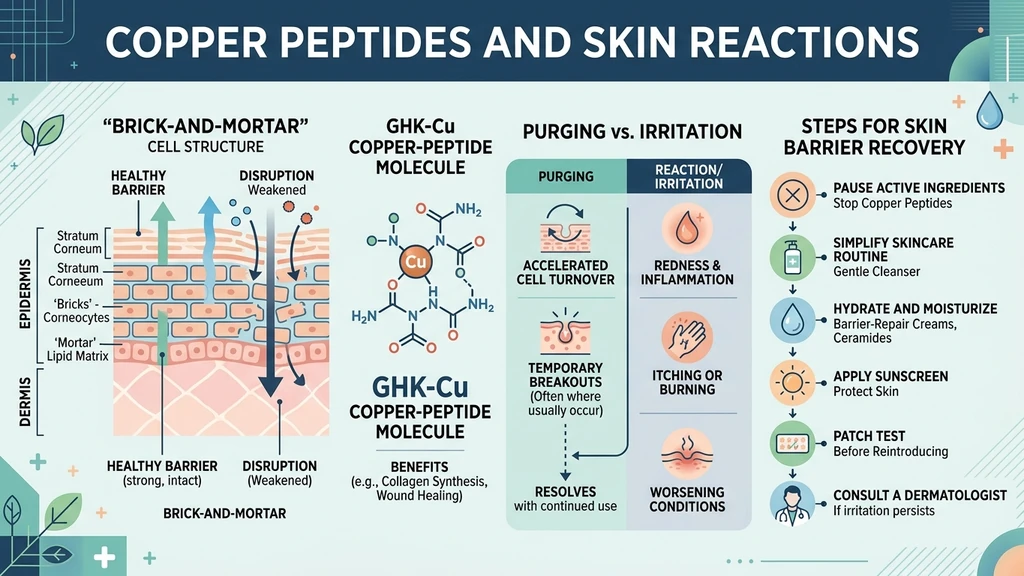
Think of your skin barrier like a brick wall, with skin cells as the bricks and lipids as the mortar. GHK-Cu signals the wall to remodel and rebuild, which is the whole point. But if you push that remodeling too hard, too fast, or while the wall is already damaged, the result looks like the opposite of repair: redness, flaking, and breakouts.
The most common triggers are using too high a concentration, applying too often, layering copper peptides with incompatible actives, or starting on an already compromised barrier. Genuine allergy to copper peptides exists but is uncommon.
GHK-Cu has well-documented roles in wound healing and skin remodeling, including collagen stimulation and antioxidant activity (Pickart & Margolina, Int J Mol Sci, 2018). That same remodeling activity is why an aggressive routine can temporarily make skin look worse before it looks better. See GHK-Cu side effects for the full profile.
Purging vs a True Reaction
The single most useful distinction when copper peptides seem to ruin your skin is whether you are purging or reacting. They look similar but mean opposite things.
| Sign | Purging | True Reaction |
|---|---|---|
| Timing | Starts within days, fades in 4-6 weeks | Persists or worsens over time |
| Location | Where you normally break out | New areas, including unusual spots |
| Type | Small bumps, surfacing congestion | Rash, hives, burning, swelling |
| Trend | Gradually improving | Steady or escalating |
| Fix | Continue gently, wait it out | Stop the product |
Purging happens when active ingredients accelerate skin-cell turnover, pushing existing congestion to the surface faster. It is temporary and tends to clear within a normal skin cycle. A true reaction, by contrast, is your skin objecting to the product and will not improve with continued use.
The decision rule: if it is concentrated in your usual breakout zones and trending better, give it a few weeks. If it is spreading, burning, swelling, or showing up in new places, stop and reassess. When in doubt, stop. See if you stop GHK-Cu what happens for what to expect after discontinuing.
The Most Common Mistakes That Damage Skin
Most "copper peptides ruined my skin" stories trace back to application errors, not the peptide itself. These are the usual culprits.
Concentration too high. Strong copper peptide serums (above roughly 2-3%) can overwhelm sensitive skin. Beginners do better starting low and building tolerance.
Using it too often. Daily or twice-daily use from day one is a common overreach. Starting two or three times a week lets skin adapt.
Layering with strong actives. Copper peptides and direct vitamin C can interact and may reduce each other's effectiveness or irritate skin when layered. Retinoids, strong acids, and benzoyl peroxide stacked on the same routine compound irritation.
Applying on a broken barrier. If your skin is already raw from over-exfoliation, adding an active remodeling agent makes it worse, not better.
Bad product quality. Unstable or contaminated formulations, or the wrong pH, can irritate regardless of how carefully you apply them.
Quantified reality: a 1-2% copper peptide serum used 2-3 times a week on intact skin is well tolerated by most people. The trouble usually starts when one or more of those variables gets pushed too far. Use the peptide interaction checker before stacking products, and see GHK-Cu microneedling for a procedure that amplifies both benefits and risks.
How to Recover Your Skin
If copper peptides have irritated your skin, recovery follows the same barrier-repair logic for almost any over-active routine. The goal is to stop the aggravation and let the wall rebuild.
Step 1: Stop the copper peptides. Pause use entirely until your skin calms. There is no benefit to pushing through a genuine reaction.
Step 2: Strip your routine to basics. Use only a gentle cleanser, a bland moisturizer, and sunscreen. Remove all other actives, including acids, retinoids, and vitamin C, while you heal.
Step 3: Rebuild the barrier. Focus on ceramides, niacinamide, and humectants like hyaluronic acid. These restore the lipid "mortar" between skin cells.
Step 4: Protect from sun. Compromised skin is more vulnerable to UV damage and post-inflammatory pigmentation. Daily SPF is non-negotiable.
Step 5: Reintroduce slowly, if at all. Once skin is fully calm (usually 2-4 weeks), you can decide whether to retry copper peptides at a lower concentration and frequency, or skip them entirely.
Most irritation resolves within a few weeks of stopping. If a rash persists, spreads, or comes with swelling, see a dermatologist to rule out allergic contact dermatitis. See how long does GHK-Cu last for how long the peptide remains active.
Who Is Most at Risk
Some people are far more likely to have copper peptides backfire. Knowing your risk profile helps you decide how cautiously to start.
Sensitive or reactive skin. If your skin flares easily with new products, start at the lowest concentration and frequency.
Compromised barrier. Recent over-exfoliation, active eczema or rosacea, or sunburned skin all raise the odds of a bad reaction.
Heavy active users. If your routine already includes retinoids, acids, and vitamin C, adding copper peptides increases the cumulative irritation load.
Allergy-prone individuals. True copper or peptide allergy is uncommon but real. A patch test on the inner forearm for several days before facial use is a smart precaution.
Aggressive starters. People who begin at high concentration and daily use, expecting faster results, are the most frequent casualties.
The pattern is clear: the more reactive your skin and the more aggressive your routine, the slower and lower you should start. For sensitive-skin conditions specifically, see our peptides for eczema guide, and review the general peptide safety guide.
Should You Quit Copper Peptides for Good?
Not necessarily. A bad first experience usually reflects how you used the product, not a permanent incompatibility. But for some people, quitting is the right call.
Reasons to retry (lower and slower): - The reaction was mild and improving - You started too strong or too often - You were layering incompatible actives - Your barrier was already compromised when you started
Reasons to quit: - You had a true allergic reaction (hives, swelling, burning) - Skin reacted badly even at low concentration and frequency - A dermatologist identified contact dermatitis - You simply have better-tolerated options for your goals
There is no rule that you must use copper peptides. Plenty of effective skincare ingredients exist, and if GHK-Cu does not agree with your skin, switching is reasonable. For other approaches to skin goals, see GHK-Cu hair growth and what do peptides do for skin.
If you do retry, patch test first, start at 1% two to three times weekly, and avoid stacking it with vitamin C or strong exfoliants.
Common Mistakes After a Bad Reaction
Mistake 1: Piling on more products to fix it. Adding spot treatments and actives to irritated skin makes it worse. The fix: strip your routine to the basics and let it heal.
Mistake 2: Pushing through a true reaction. Continuing to use a product that is causing hives or burning risks lasting damage. The fix: stop immediately if symptoms are escalating.
Mistake 3: Skipping sunscreen while healing. Compromised skin pigments and damages easily under UV. The fix: daily SPF without exception.
Mistake 4: Restarting at the same aggressive dose. Returning to high concentration and daily use repeats the original error. The fix: restart low and slow, if at all.
Mistake 5: Assuming permanent damage. Most copper peptide irritation is temporary and resolves with rest. The fix: give skin a few weeks before concluding anything, and see a dermatologist for persistent or spreading reactions.
Frequently Asked Questions
Can copper peptides permanently ruin your skin?
Permanent damage is rare. Most reactions, including breakouts, redness, and dryness, are temporary and resolve within a few weeks of stopping and rebuilding the barrier. The exceptions are true allergic reactions or damage from aggressive layering. If a rash spreads or comes with swelling, see a dermatologist. See GHK-Cu side effects.
Why did copper peptides cause breakouts?
It is often purging, where accelerated cell turnover pushes existing congestion to the surface, which fades in 4-6 weeks. It can also be a reaction to too-high concentration, too-frequent use, or layering with incompatible actives. Purging improves over time; a true reaction worsens. See if you stop GHK-Cu what happens.
How do I know if it's purging or a reaction?
Purging appears in your usual breakout areas, starts within days, and improves over a normal skin cycle. A true reaction spreads to new areas, may burn or swell, and worsens with continued use. If it is escalating or showing hives, stop the product. When in doubt, stop and simplify your routine.
How long does it take for skin to recover?
Most copper peptide irritation resolves within 2-4 weeks of stopping the product and using only a gentle cleanser, bland moisturizer, and sunscreen. Rebuilding the barrier with ceramides and niacinamide speeds recovery. Persistent or spreading reactions warrant a dermatologist visit. See how long does GHK-Cu last.
Can I use copper peptides with vitamin C?
Layering copper peptides directly with vitamin C can reduce each other's effectiveness and may irritate sensitive skin. If you use both, separate them (one morning, one evening) rather than mixing them in the same step. Use our peptide interaction checker before stacking actives.
What concentration of copper peptides is safe to start?
Most people tolerate a 1% GHK-Cu serum used two to three times a week on intact skin. Higher concentrations (above 2-3%) and daily use are common causes of irritation in beginners. Start low and slow, patch test first, and build tolerance gradually. See our peptide safety guide.
Should I stop copper peptides if my skin reacts?
Yes, stop temporarily and let your skin calm. Whether you retry depends on the cause: a mild reaction from aggressive use can warrant a lower-and-slower restart, while a true allergic reaction means quitting for good. There is no obligation to use copper peptides if they do not suit your skin. See what do peptides do for skin.
The Bottom Line
If copper peptides seemed to ruin your skin, the damage is usually temporary and the cause is usually fixable. The most common culprits are too-high concentration, too-frequent use, layering with incompatible actives, or starting on an already compromised barrier. True allergy exists but is uncommon.
The recovery path is straightforward: stop the product, strip your routine to a gentle cleanser, moisturizer, and sunscreen, and rebuild the barrier with ceramides and niacinamide. Most irritation clears within a few weeks. Distinguishing purging from a true reaction tells you whether to wait it out or quit.
If you retry copper peptides, go low and slow, patch test, and avoid stacking with vitamin C or strong exfoliants. Check combinations with the peptide interaction checker, review GHK-Cu benefits to weigh the upside, and see a dermatologist for any persistent, spreading, or swelling reaction.
Helpful Tools
Related Articles
Peptides for Eczema: What Helps?
Peptides for eczema: which ones support skin barrier repair and inflammation, the evidence behind GHK-Cu and KPV, safety cautions, and what they cannot replace.
Does GHK-Cu Cause Liver Damage?
GHK-Cu delivers only 0.3 mg copper per 1 mg dose, far below toxic thresholds. Learn what research says about GHK-Cu liver safety and who should avoid it.
Does GHK-Cu Cause Hair Loss?
GHK-Cu does not cause hair loss. Research shows it promotes hair growth by activating the Wnt/beta-catenin pathway and enlarging miniaturized follicles.
Peptides for Healing: What the Evidence Shows
Peptides for healing by tissue: tendon, bone, wound, gut, post-surgery. Which claims rest on human trials, which rest on rat studies, and what is unsafe.