You have a vial of BPC-157 on the counter and eight weeks of tendon pain behind you. You want to know what actually changes, and when. Here is the honest answer: the strongest published evidence for BPC-157 comes from animal studies, and there is no human trial demonstrating that it heals injuries. A 2025 systematic review screened 544 papers and included 36. Thirty-five were preclinical. One was clinical (Vasireddi et al., HSS Journal, 2025).
That does not mean nothing happens. It means the before-and-after reports you find online describe experiences that no controlled study has confirmed or measured. This page separates the two so you can judge for yourself.
Get your custom peptide protocol:
- Tailored to your body and goals
- Precise dosing and cycle length
- Safe stacking combinations
- Backed by peer-reviewed studies
- Ready in under 2 minutes
What the Evidence Actually Supports
Start with the map before the details. The table below sorts common BPC-157 claims by the strength of evidence behind each one.
| Claim | Strongest evidence | What is missing |
|---|---|---|
| Accelerates tendon healing | Rat Achilles transection studies, plus a cell-migration mechanism study | No human trial |
| Speeds muscle and ligament repair | Multiple rodent injury models | No human trial |
| Protects and heals gut lining | Extensive rat models of ulcer, colitis, and fistula | No human efficacy trial |
| Reduces joint pain | One human case series, uncontrolled | Controls, blinding, sample size |
| Safe by intravenous infusion | One human pilot, 2 participants | Any adequately powered safety study |
| Builds muscle or improves performance | Nothing in humans | Everything |
The pattern repeats across every outcome: strong, consistent animal data and a near-total absence of human evidence. That gap is the single most important fact about this compound, and it shapes everything below.
Why Animal Data Does Not Transfer Automatically
Rat tendon studies use a clean transection, a fixed dose, a controlled diet, and a healthy young animal. Your tendon injury is none of those things. It has a history, a load pattern, and a blood supply shaped by years of use.
Animal models also measure things people cannot easily measure at home: tensile strength at failure, collagen fiber alignment under a microscope, and histology at fixed timepoints. Your before-and-after is pain and function, which are the outcomes the studies did not track.
The Animal Evidence in Detail
The preclinical body of work is genuinely substantial. Most of it comes from a single research group in Zagreb led by Predrag Sikiric, which is worth knowing when you weigh it. Independent replication is thinner than the raw study count suggests.
Tendon: The Mechanism Study
The most cited mechanistic work examined rat Achilles tendon fibroblasts. BPC-157 accelerated the outgrowth of fibroblasts from tendon explants, increased cell survival under oxidative stress, and increased cell migration in a dose-dependent way through the FAK-paxillin pathway (Chang et al., Journal of Applied Physiology, 2011).
Read that carefully. It shows that tendon cells move and survive better in a dish. It does not show that a torn tendon in a person heals faster. Those are different claims separated by roughly fifteen years of trials nobody has run.
Muscle, Ligament, and Bone
Rodent models report improved functional, structural, and biomechanical outcomes after muscle crush, ligament transection, and bone defect injuries. The 2025 systematic review summarised these as consistent across models (Vasireddi et al., HSS Journal, 2025).
The proposed mechanism is angiogenesis. BPC-157 appears to activate VEGFR2 and nitric oxide synthesis through the Akt-eNOS axis, along with ERK1/2 signalling, which would matter most in poorly vascularised tissue such as tendon and the myotendinous junction (McGuire et al., Current Reviews in Musculoskeletal Medicine, 2025). Tissue that heals slowly because blood cannot reach it is exactly where better blood supply would help. That reasoning is sound. It is still reasoning, not a result.
Gut: The Original Research Line
BPC-157 was isolated from gastric juice, and the gut is where the research started. Rat studies cover gastric ulcer, colitis, short bowel syndrome, and intestinal anastomosis healing, with a large review series published by the Sikiric group through 2024 (Sikiric et al., Inflammopharmacology, 2024).
If you are taking BPC-157 for gut symptoms, this is the deepest animal literature available for any of its uses. It is also entirely animal literature. For the practical side of oral dosing, see our guide on taking BPC-157 orally and the comparison of oral versus injectable routes.
Every Human Study That Exists
There are three. All are pilots. Together they enrolled fewer people than a single small phase 1 trial would (McGuire et al., Current Reviews in Musculoskeletal Medicine, 2025).
Intravenous Safety: Two Participants
An IRB-approved pilot infused BPC-157 intravenously into two adults, a 58-year-old man and a 68-year-old woman. Day one delivered 10 mg in saline over an hour, day two delivered 20 mg. Blood work covered cardiac, liver, kidney, thyroid, and glucose markers before and after each infusion.
No adverse effects appeared and no side effects were reported (Lee and Burgess, Alternative Therapies in Health and Medicine, 2025). Two people is not a safety profile. It is a signal that a larger study would be ethical to run.
Intra-articular Knee Pain: One Case Series
A human case series reported pain improvement after BPC-157 injections into the knee. A 2026 review in the American Journal of Sports Medicine assessed it directly and found significant methodological flaws and no control group, which limits what can be concluded from it (Mayfield et al., American Journal of Sports Medicine, 2026).
Uncontrolled pain studies are the hardest to interpret. Pain improves on its own, improves with attention, and improves with the expectation of improvement. Without a control arm there is no way to separate the compound from those three.
Interstitial Cystitis
The third pilot examined BPC-157 in interstitial cystitis. Like the others it reported no adverse effects and lacked the size and design to establish efficacy (McGuire et al., Current Reviews in Musculoskeletal Medicine, 2025).
What No Study Has Measured
The gaps matter as much as the findings, and vendors rarely list them.
- Long-term use. No study has followed humans taking BPC-157 for months or years. Every safety statement you read covers days.
- Oral absorption in humans. Capsules and nasal sprays are sold widely. Human pharmacokinetic data on how much reaches circulation is not published.
- Interaction with other compounds. Stacks are common in practice and absent from the literature. Our peptide stacking guide explains how to think about this without data.
- Effect on healthy tissue. Angiogenesis helps injured tissue. Whether promoting new blood vessel growth carries risk in people with undiagnosed tumours has not been studied.
- Dose response in humans. Every dose you see recommended online is extrapolated from rodent studies or copied from another website.
BPC-157 Before and After: The Reported Timeline
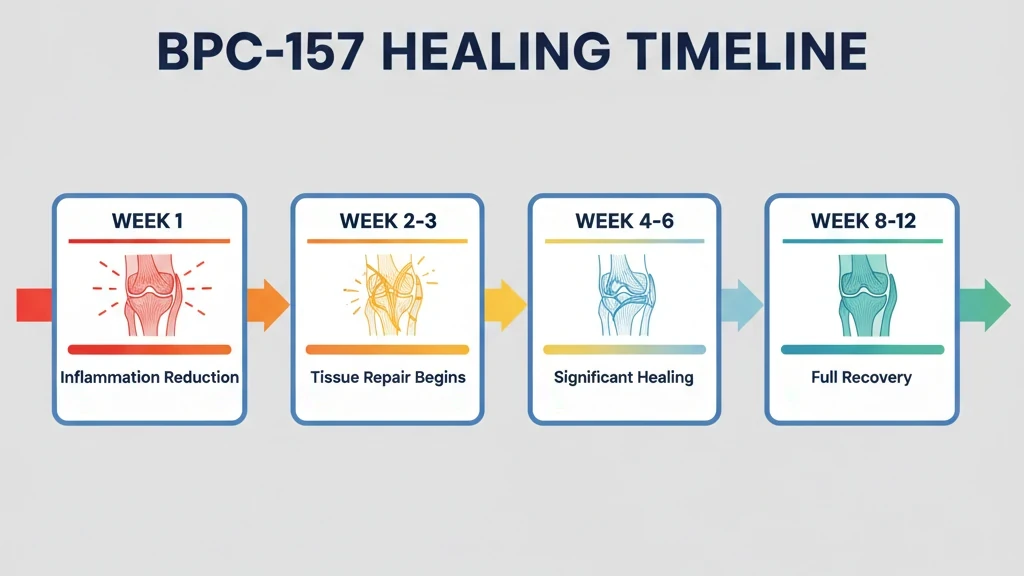
What follows is drawn from what users commonly report, not from clinical measurement. No trial has tracked a week-by-week symptom curve in humans. Treat this as a description of expectations circulating in the community, and read how long BPC-157 takes to work for the same question from the mechanism side.
Weeks 1 to 2: Usually Quiet
Most people report little in the first fortnight. Some describe reduced inflammatory pain and better sleep. Others notice nothing at all, which is the most common outcome at this stage and not a sign the protocol has failed.
If you are treating a tendon, two weeks is far too early to judge. Tendon remodelling takes months even under ideal conditions.
Weeks 3 to 4: The Reported Turn
This is where anecdotal reports cluster. People describe less pain on loading and better range of motion. Gut-focused users often report changes earlier than injury-focused users, which fits the animal literature showing rapid mucosal effects.
Keep in mind that four weeks of relative rest improves most soft tissue injuries on its own. Attributing that recovery to the vial requires a comparison you do not have.
Weeks 5 to 8: Plateau or Progress
Reports diverge here. Some people describe near-complete resolution and return to full activity. Others report that improvement stalled around week four and never went further.
The honest read is that both outcomes are consistent with the absence of controlled data. Injuries that were going to heal, heal. Injuries that need surgery still need surgery.
Beyond 8 Weeks: Unmapped Territory
Most protocols circulating online run 4 to 8 weeks and then stop. There is no evidence base for what continued use does, positive or negative. The compound has never been studied in humans past a few days of exposure.
If you are considering extended use, that decision sits entirely outside published evidence. Discuss it with a clinician who knows your history rather than with a forum.
What Realistic Before-and-After Results Look Like
Instead of testimonials, here are three scenarios that describe how outcomes typically differ. They are illustrative, not case reports.
Scenario 1: Chronic Tendinopathy, Load Managed Properly
You have had lateral elbow pain for five months. You start BPC-157 and simultaneously begin a progressive loading programme, drop the aggravating activity, and sleep more.
You improve. The difficulty is that eccentric loading has actual controlled evidence for tendinopathy, and you changed three variables at once. The realistic conclusion is that you got better and you cannot say which input did it.
Scenario 2: Acute Muscle Strain, No Other Change
You strain a hamstring and start BPC-157 within days, changing nothing else. Recovery feels faster than your last strain.
Grade 1 strains resolve in two to three weeks with no treatment at all. Your comparison is a memory of a previous injury with a different severity, which is the weakest possible control.
Scenario 3: Structural Tear
You have a full-thickness rotator cuff tear confirmed on MRI. You run twelve weeks of BPC-157.
Pain may change. The tear does not reattach. No animal study has shown a fully retracted tendon reattaching to bone without surgery, and no human study has looked. This is the scenario where before-and-after expectations do the most damage, because they delay a repair that gets harder the longer it waits.
Factors That Change What You See
If you are going to run a protocol, the variables below affect your outcome more than the brand of peptide you buy.
Injury Type Sets the Ceiling
Inflammatory and degenerative conditions have room to improve. Structural tears, full ruptures, and bone-on-bone joint damage do not respond to a signalling molecule. Match your expectation to your diagnosis, and get the diagnosis first.
Load Management Does the Heavy Lifting
Tendons remodel in response to mechanical load. Removing the aggravating load and reintroducing it progressively is the intervention with the most robust evidence in the entire field. Anything you take sits on top of that, never instead of it.
Protein, Sleep, and Time
Collagen synthesis needs substrate and recovery. Under-eating protein and sleeping five hours will blunt any healing protocol. Neither is glamorous and both outrank the vial.
Product Quality Is Unverifiable
Research-grade peptides are not manufactured to pharmaceutical standards, and independent testing of the grey market repeatedly finds content that does not match the label. If your vial contains half of what it claims, your before-and-after measures the wrong dose. Our guide on where to buy peptides covers what verification is realistic.
Dosing Context
Every dosing figure circulating for BPC-157 traces back to rodent studies or to other websites. None traces to a human dose-finding trial, because none exists.
Commonly reported protocols use 250 to 500 mcg per day by subcutaneous injection, often split into two administrations, for 4 to 8 weeks. That range is convention, not evidence. Our dosage by body weight guide explains the arithmetic people use, and the BPC-157 dosage calculator does the conversion from milligrams to syringe units so you do not make a tenfold error.
For technique, see how to inject BPC-157 and where to inject. For knee injuries specifically, injection site placement covers the local versus systemic question. If you are reconstituting for the first time, how to reconstitute a peptide and how long reconstituted peptides last prevent the two most common errors.
Oral Versus Injectable
Injectable is what animal studies used for systemic effects. Oral is what the gut literature used for local gut effects, where absorption into the bloodstream is not the point.
Using oral capsules for a tendon injury asks the compound to survive digestion and reach circulation, which no human data supports. Compare the two routes in BPC-157 oral vs injection, and see oral pills and capsule side effects for the practical differences.
Timing and Stacking
When to take BPC-157 covers timing conventions. The most common pairing is with TB-500, discussed in BPC-157 and TB-500 dosage, the side effects of the combination, and the three-way GHK-Cu blend. No human study has evaluated any of these combinations.
Safety Profile
Across all three human pilots, no adverse effects were reported. That is reassuring and thin at the same time, because the total human exposure studied amounts to a handful of people over a handful of days.
Commonly reported effects in the community include injection site irritation, headache, fatigue, and digestive changes. We cover these individually in BPC-157 side effects, headaches, insomnia, diarrhea, blood pressure, and liver concerns.
The theoretical concern worth taking seriously is angiogenesis. A compound that promotes new blood vessel growth is doing something you would not want near an undiagnosed malignancy. No study has examined this in humans either way, which is a reason for caution rather than reassurance.
Who Should Not Use It
Anyone with an active or recent cancer diagnosis, anyone pregnant or breastfeeding, and anyone whose injury has not been imaged. The first two reflect the absence of safety data. The third reflects the risk of medicating a tear that needs a surgeon.
Our peptide safety guide and peptide therapy side effects cover the broader picture.
Legal and Regulatory Status
BPC-157 is not approved by the FDA for any indication, and that has not changed. What has changed is the compounding route. In late 2023 the FDA placed BPC-157 in Category 2 of the 503A framework, covering bulk substances flagged for significant safety risks or insufficient data, which barred compounding pharmacies from preparing it. On 23 July 2026 the FDA's Pharmacy Compounding Advisory Committee voted 8 to 6 to recommend adding BPC-157 to the 503A Bulks List.
A recommendation is not a rule. The FDA is not bound by its advisory committees, and the vote changes nothing about approval status or about what is in a research-grade vial today. Our page on BPC-157 FDA approval status covers the vote and what would have to happen next, and the FDA peptide crackdown covers the wider enforcement picture.
The World Anti-Doping Agency prohibits BPC-157. If you compete under any anti-doping code, use ends your eligibility. See do peptides show up on drug tests for the testing reality, and are peptides legal for the consumer position.
Most BPC-157 sold online is labelled for research use only. That label is what allows it to be sold at all, and it means no regulator has evaluated what is in the vial.
What BPC-157 Will Not Do
Setting this out plainly saves money and, occasionally, joints.
- It will not reattach a fully torn tendon or ligament.
- It will not regrow cartilage in an arthritic joint.
- It will not build muscle. See BPC-157 and muscle growth for why that claim persists without support.
- It will not compensate for continuing to load an injury that needs rest.
- It will not produce the transformation photographs used to sell it, because there are no published before-and-after images from any controlled study.
Common Mistakes
Four errors account for most disappointing outcomes.
Skipping the diagnosis. Running eight weeks on a tear that needed imaging costs you both the money and the window. Get the scan first.
Changing five variables at once. Starting the peptide alongside physiotherapy, rest, and a diet change makes the result uninterpretable. If you want to know whether it works for you, change one thing.
Judging at two weeks. Tendon remodelling is measured in months. Most people who conclude it failed stopped before the reported window even opened.
Trusting the vial contents. Underdosed and mislabelled product is common in a market with no oversight. A protocol built on an unverified vial tests nothing.
How This Compares to Other Peptides
Reading before-and-after content for other compounds shows the same pattern with different amounts of evidence. AOD-9604 before and after has actual phase 2 human trial data, which makes its modest results more trustworthy than BPC-157's dramatic ones. MOTS-c before and after sits closer to BPC-157 on the evidence scale.
For the healing category specifically, see best peptides for tendon repair, peptides for healing, peptides for recovery, and peptides for inflammation. If your interest is gut rather than injury, peptides for gut health and peptides for joint pain are the closer fits. Our overview of peptide before-and-after results applies the same evidence lens across compounds.
BPC-157 vs TB-500 and BPC-157 vs BPC-159 cover the direct comparisons people ask about most.
Frequently Asked Questions
How long does BPC-157 take to show before and after results?
Users commonly report changes between weeks 3 and 4, with more noticeable differences by week 8. No clinical trial has measured this timeline in humans, so these figures come from community reports rather than data. Gut-related changes are often reported earlier than injury-related ones. See how long BPC-157 takes to work for the mechanism behind the delay.
Are there real before and after photos of BPC-157 results?
No controlled study has published before-and-after imaging for BPC-157 in humans. Photographs circulating on vendor sites and social media are unverified and often accompany other interventions such as rest, physiotherapy, or surgery. Treat any image presented as proof with scepticism, and read peptide before-and-after results for context.
Has BPC-157 been tested in humans?
Three pilot studies exist: an intravenous safety study in 2 participants, an uncontrolled case series on knee pain, and a study in interstitial cystitis. A 2025 systematic review of 36 studies found 35 were preclinical and 1 was clinical. There is no human efficacy trial. See BPC-157 FDA approval status for the regulatory consequence.
What dose do people use for the best results?
Commonly reported protocols use 250 to 500 mcg daily by subcutaneous injection for 4 to 8 weeks, often split into two doses. These figures are convention extrapolated from animal studies, not human dose-finding data. Use the BPC-157 dosage calculator to convert milligrams into syringe units accurately.
Does oral BPC-157 work as well as injections?
For gut conditions, oral dosing matches how the animal gut research was conducted, since local action does not require absorption into blood. For tendon or muscle injuries, no human data shows that oral BPC-157 reaches circulation in meaningful amounts. Compare both in BPC-157 oral vs injection.
Can BPC-157 heal a torn tendon without surgery?
No study, animal or human, has shown a fully torn or retracted tendon reattaching without surgical repair. Animal evidence covers healing of surgically transected tendons that were then repaired. If imaging shows a full-thickness tear, delaying surgery makes repair harder. See where to inject BPC-157 for knee injuries for the local versus systemic question.
Is BPC-157 safe long term?
Nobody knows. Total studied human exposure spans a handful of participants over a few days. The three pilot studies reported no adverse effects, which is encouraging but far too small to establish a safety profile. The open theoretical question is whether promoting angiogenesis carries risk. Read BPC-157 side effects for what is reported in practice.
Will BPC-157 make me fail a drug test?
BPC-157 is on the World Anti-Doping Agency prohibited list, so use makes an athlete ineligible under any anti-doping code. Standard workplace drug panels do not screen for it. See do peptides show up on drug tests for which tests detect what.
The Bottom Line
The evidence for BPC-157 is 35 animal studies and 3 human pilots, one of which enrolled two people. That is the whole picture, and it is the reason honest before-and-after content looks different from what vendors publish.
Compounds with weak evidence can still work. They simply have not been shown to, and the difference matters most when you are making a decision about an injury that has a real treatment available. Get the diagnosis, manage the load, and treat anything you take as an experiment with one subject.
If you decide to run a protocol, the BPC-157 dosage calculator and the peptide cost calculator will at least keep the arithmetic and the budget honest.
References: Vasireddi N, et al. Emerging Use of BPC-157 in Orthopaedic Sports Medicine: A Systematic Review. HSS Journal. 2025. PMID: 40756949. | McGuire FP, et al. Regeneration or Risk? A Narrative Review of BPC-157 for Musculoskeletal Healing. Current Reviews in Musculoskeletal Medicine. 2025;18(12):611-619. PMID: 40789979. | Lee E, Burgess K. Safety of Intravenous Infusion of BPC157 in Humans: A Pilot Study. Alternative Therapies in Health and Medicine. 2025;31(5):20-24. PMID: 40131143. | Chang CH, et al. The promoting effect of pentadecapeptide BPC 157 on tendon healing involves tendon outgrowth, cell survival, and cell migration. Journal of Applied Physiology. 2011;110(3):774-780. PMID: 21030672. | Mayfield CK, et al. Injectable Peptide Therapy: A Primer for Orthopaedic and Sports Medicine Physicians. American Journal of Sports Medicine. 2026;54(1):223-229. PMID: 41476424. | Sikiric P, et al. New studies with stable gastric pentadecapeptide protecting gastrointestinal tract. Inflammopharmacology. 2024. PMID: 38980576.
Disclaimer: This article is for educational purposes only and is not medical advice. BPC-157 is not approved by the FDA for any use and is prohibited by the World Anti-Doping Agency. Consult a qualified healthcare provider before using any peptide.
Related Articles
Peptides for Healing: What the Evidence Shows
Peptides for healing by tissue: tendon, bone, wound, gut, post-surgery. Which claims rest on human trials, which rest on rat studies, and what is unsafe.
KPV Peptide Benefits: What the Evidence Shows
KPV peptide benefits ranked by evidence: strong preclinical colitis data, plausible skin effects, weak systemic claims. No registered human trial exists.
MOTS-c Before and After: Results & Timeline
See realistic MOTS-c before and after results, a week-by-week timeline, what the research shows, and the factors that decide whether you respond.
KPV Peptide Dosage Chart by Condition
KPV peptide dosage chart by condition: gut/IBD, skin, and inflammation doses with oral vs subcutaneous routes, reconstitution math, and common mistakes.