Store lyophilized (powder) peptides in the freezer at -20°C for maximum shelf life, or refrigerated at 2-8°C for up to two years. Store reconstituted peptides in the refrigerator and use them within 30 days. Never freeze a peptide once it has been mixed with bacteriostatic water.
That covers 90% of what you need to know. The rest of this guide fills in the details: which peptides are exceptions to the rule, how long you can leave a vial out before it loses potency, what to do when traveling, and how to tell when a peptide has gone bad.
Quick reference:
| Form | Best Storage | Temperature | Shelf Life |
|---|---|---|---|
| Lyophilized (powder) | Freezer | -20°C (-4°F) | 2-5 years |
| Lyophilized (powder) | Refrigerator | 2-8°C (36-46°F) | 1-2 years |
| Lyophilized (powder) | Room temperature | 20-25°C (68-77°F) | 3-6 months |
| Reconstituted (liquid) | Refrigerator | 2-8°C (36-46°F) | 14-30 days |
| Reconstituted (liquid) | Freezer | Never | Destroys peptide |
If you are new to peptides, start with our getting started guide. If you need help mixing your peptide, see how to reconstitute peptides. To work out units and volume once mixed, use the peptide dosage calculator.
Get your custom peptide protocol:
- Tailored to your body and goals
- Precise dosing and cycle length
- Safe stacking combinations
- Backed by peer-reviewed studies
- Ready in under 2 minutes
Do Peptides Need to Be Refrigerated?
Yes. Refrigeration is the minimum recommended storage for any peptide, whether powder or reconstituted. Room temperature storage works for short periods, but heat accelerates degradation through deamidation, oxidation, and aggregation.
Peptides are chains of amino acids held together by peptide bonds. Those bonds are stable under cold, dry conditions. Add heat and moisture, and two things happen: asparagine residues convert to aspartate (deamidation), and methionine residues oxidize. Both reduce potency.
The practical takeaway: a vial sitting in your medicine cabinet at room temperature loses potency faster than one in the fridge. A vial in the fridge loses potency faster than one in the freezer. Cold, dark, and dry is the formula.
Lyophilized (Powder) Peptides
Lyophilized peptides are freeze-dried into a powder or cake. The removal of water makes them remarkably stable. Unopened lyophilized vials stored at -20°C can retain full potency for three to five years.
At refrigerator temperature (2-8°C), expect one to two years of stability. At room temperature (20-25°C), stability drops to three to six months, depending on the specific peptide.
Key rules for powder storage:
- Keep vials sealed until ready to reconstitute
- Store away from light (UV breaks down certain amino acids, especially tryptophan)
- Avoid humidity (moisture initiates degradation even in powder form)
- Do not store in the fridge door (temperature fluctuates every time you open it)
- A desiccant packet in the storage container adds an extra layer of protection
Reconstituted Peptides
Once you add bacteriostatic water to a lyophilized peptide, the clock starts. Refrigerate immediately at 2-8°C and use the vial within 30 days.
Bacteriostatic water contains 0.9% benzyl alcohol, which inhibits microbial growth. This is why reconstituted peptides last longer with bacteriostatic water (28-30 days) than with sterile water (5-7 days). If you reconstituted with plain sterile water, use the vial within one week.
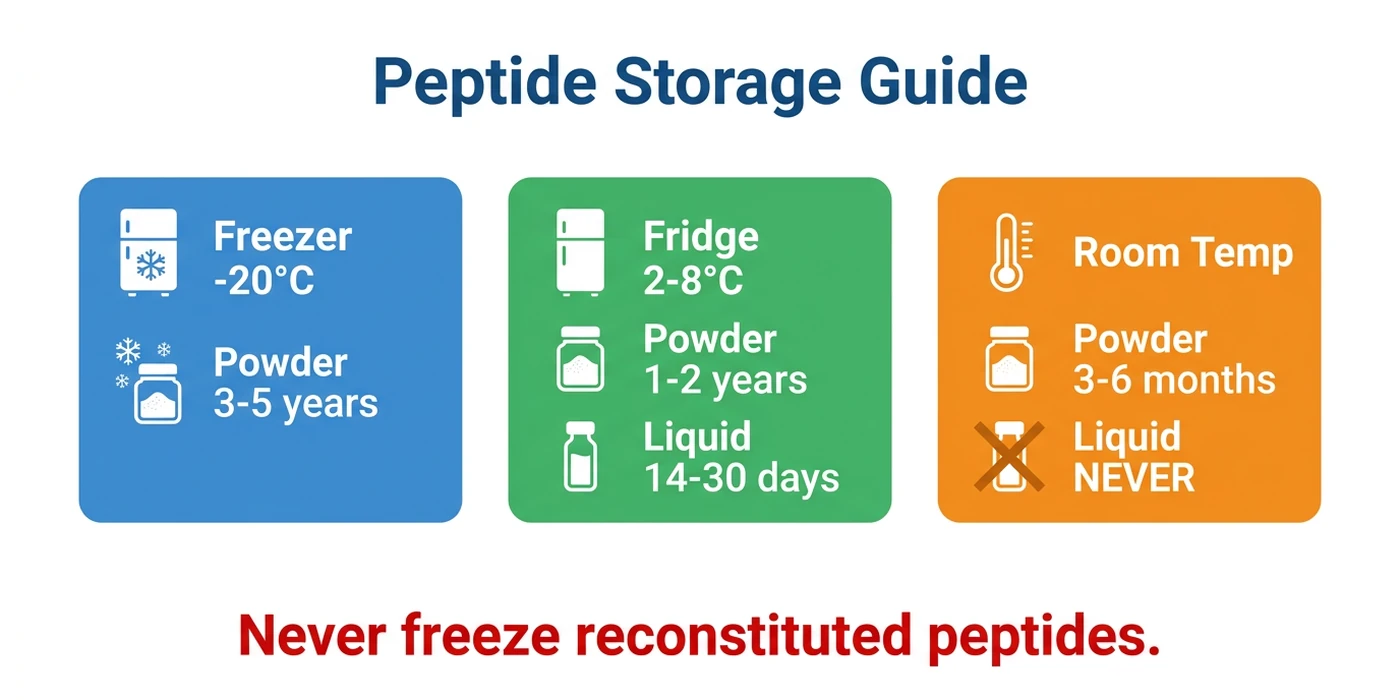
Never freeze a reconstituted peptide. Water expands when it freezes, forming ice crystals that physically shear peptide bonds. The result: a cloudy, degraded solution with reduced or zero potency. This is the single most common storage mistake.
For reconstitution instructions, see our step-by-step reconstitution guide. Use our reconstitution calculator to get exact measurements.
Storage Temperature Guide
Temperature is the single most important variable in peptide storage. Every 10°C increase roughly doubles the rate of chemical degradation. Here is what each temperature range does to your peptides.
Freezer Storage (-20°C / -4°F)
Best for long-term storage of lyophilized peptides. At -20°C, deamidation and oxidation rates drop to near zero. Most peptides retain 95%+ potency for three to five years at this temperature.
A standard kitchen freezer works fine. You do not need a laboratory-grade deep freezer at -80°C, though it would extend shelf life even further.
One caution: do not repeatedly remove a vial from the freezer to check on it. Each freeze-thaw cycle introduces condensation, and moisture is the enemy. Take out only what you plan to reconstitute.
| Peptide Category | Freezer Shelf Life |
|---|---|
| GLP-1 agonists (Semaglutide, Tirzepatide) | 3-5 years |
| Growth hormone secretagogues (CJC-1295, Ipamorelin) | 3-4 years |
| Healing peptides (BPC-157, TB-500) | 3-5 years |
| Copper peptides (GHK-Cu) | 2-3 years (copper oxidizes) |
| Melanocortin peptides (PT-141, Melanotan II) | 3-5 years |
| Nootropic peptides (Selank, Semax) | 2-3 years |
Refrigerator Storage (2-8°C / 36-46°F)
The standard storage temperature for both lyophilized and reconstituted peptides. All reconstituted peptides must be stored here. Lyophilized peptides remain stable for one to two years.
Where in the fridge matters. The back of the middle shelf maintains the most consistent temperature. The door is the worst location: temperature swings 5-10°C every time you open it. The vegetable crisper is acceptable if it stays within range.
Keep peptide vials in a small container or zip-lock bag to protect them from accidental spills and light exposure. If your fridge has a bright interior LED, consider wrapping vials in aluminum foil.
Room Temperature (20-25°C / 68-77°F)
Acceptable only for short-term storage of lyophilized peptides (under three months) or during shipping. Reconstituted peptides should never be stored at room temperature for more than a few hours.
At 25°C, deamidation rates increase significantly. Peptides containing asparagine-glycine (Asn-Gly) sequences are most vulnerable, as this motif degrades fastest at elevated temperatures.
If you receive a peptide shipment at room temperature, this is normal. Lyophilized peptides tolerate days of room-temperature shipping without meaningful potency loss. Refrigerate or freeze upon arrival.
Light and Humidity Protection
UV radiation degrades tryptophan and tyrosine residues. Peptides containing these amino acids (most growth hormone secretagogues, melanocortin peptides) lose potency faster under light exposure.
Practical steps:
- Store vials in the original box or wrap in aluminum foil
- Keep away from windows and direct sunlight
- Use amber vials for reconstituted peptides if available
- Add a silica gel desiccant packet to your storage container
Humidity is the second threat. Lyophilized peptides absorb moisture from the air, which initiates hydrolysis. Keep vials sealed. If you open a vial to reconstitute it, do not leave it open on the counter while you prepare your syringe. Work efficiently: open, reconstitute, close, refrigerate.
Peptide Shelf Life Chart
The table below lists storage conditions and shelf life estimates for all 29 peptides covered on PeptidesExplorer. Shelf life assumes proper storage conditions. Reconstituted shelf life assumes bacteriostatic water was used. If you used sterile water, divide the reconstituted shelf life by four.
| Peptide | Lyophilized (Freezer) | Lyophilized (Fridge) | Reconstituted (Fridge) | Special Notes |
|---|---|---|---|---|
| 5-Amino-1MQ | 3-5 years | 1-2 years | 28-30 days | Stable molecule; standard conditions |
| AOD-9604 | 3-4 years | 1-2 years | 21-28 days | GH fragment; standard handling |
| BPC-157 | 3-5 years | 1-2 years | 28-30 days | Unusually stable; gastric acid resistant |
| Cagrilintide | 3-4 years | 1-2 years | 28-30 days | Long-acting amylin analog |
| CJC-1295 | 3-4 years | 1-2 years | 21-28 days | DAC variant more stable than no-DAC |
| DSIP | 2-3 years | 1 year | 14-21 days | Shorter reconstituted life; use quickly |
| Epithalon | 3-5 years | 1-2 years | 28-30 days | Tetrapeptide; very stable |
| GHK-Cu | 2-3 years | 6-12 months | 21-28 days | Copper ion oxidizes; shorter shelf life |
| GHRP-2 | 3-4 years | 1-2 years | 21-28 days | Standard GH secretagogue |
| GHRP-6 | 3-4 years | 1-2 years | 21-28 days | Standard GH secretagogue |
| Hexarelin | 3-4 years | 1-2 years | 21-28 days | Standard GH secretagogue |
| HGH Fragment 176-191 | 3-4 years | 1-2 years | 21-28 days | GH fragment; standard handling |
| IGF-1 LR3 | 2-3 years | 1 year | 14-21 days | Sensitive to pH changes; handle carefully |
| Ipamorelin | 3-4 years | 1-2 years | 28-30 days | Very stable pentapeptide |
| Kisspeptin | 2-3 years | 1 year | 14-21 days | Research peptide; limited stability data |
| KPV | 3-5 years | 1-2 years | 28-30 days | Tripeptide; very stable |
| Melanotan II | 3-5 years | 1-2 years | 30-40 days | Cyclic structure adds stability |
| MK-677 | 3-5 years | 2 years | N/A (oral) | Non-peptide; oral capsule; no reconstitution |
| MOTS-c | 2-3 years | 1 year | 14-21 days | Mitochondrial peptide; light sensitive |
| NAD+ | 2-3 years | 1 year | 7-14 days | Degrades quickly once reconstituted |
| PT-141 | 3-5 years | 1-2 years | 28-30 days | Cyclic structure; stable |
| Retatrutide | 3-4 years | 1-2 years | 28-30 days | Triple agonist; standard handling |
| Selank | 2-3 years | 1 year | 14-21 days | Often supplied as nasal spray; refrigerate |
| Semaglutide | 3-5 years | 1-2 years | 28-56 days | Very stable; pen formulation lasts longer |
| Semax | 2-3 years | 1 year | 14-21 days | Nasal spray form; refrigerate after opening |
| Sermorelin | 3-4 years | 1-2 years | 21-28 days | Standard GH secretagogue |
| TB-500 | 3-5 years | 1-2 years | 28-30 days | 43 amino acids; stable |
| Thymosin Alpha-1 | 3-5 years | 1-2 years | 28-30 days | 28 amino acids; stable |
| Tirzepatide | 3-5 years | 1-2 years | 28-56 days | Pen formulation very stable; see how long tirzepatide lasts in the fridge |
For dosage information for each of these peptides, see our complete peptide dosage chart.
How to Store Reconstituted Peptides
Reconstituted peptides are far more fragile than their lyophilized counterparts. The moment you add water, hydrolysis begins. Proper handling in the first five minutes after reconstitution determines whether the vial lasts 30 days or 10.
Bacteriostatic Water vs Sterile Water
Always use bacteriostatic water (BAC water) for reconstitution. The 0.9% benzyl alcohol acts as a preservative, preventing bacterial growth and extending shelf life from days to weeks. For specific guidance on BAC water storage, see does bacteriostatic water need to be refrigerated.
| Solvent | Preservative | Reconstituted Shelf Life | Best For |
|---|---|---|---|
| Bacteriostatic water | 0.9% benzyl alcohol | 28-30 days | Multi-dose vials (standard choice) |
| Sterile water | None | 5-7 days | Single-use applications only |
| Normal saline (0.9% NaCl) | None | 5-7 days | IV applications; rare for peptides |
If you accidentally reconstituted with sterile water, use the entire vial within one week. Draw all doses into separate insulin syringes and store the pre-loaded syringes in the fridge. This avoids repeated needle punctures into a preservative-free vial.
Step-by-Step After Reconstitution
- 1.Swirl gently. Never shake a peptide vial. Shaking creates foam and can physically damage peptide chains through shear stress. Swirl or roll between your palms until the powder dissolves completely.
- 1.Inspect the solution. It should be clear and colorless. If you see particles, cloudiness, or color, something went wrong. Do not inject a cloudy solution.
- 1.Label the vial. Write the date of reconstitution, the peptide name, and the concentration (mg/mL) directly on the vial with a fine-tip marker.
- 1.Refrigerate within 5 minutes. Do not leave a reconstituted vial on the counter while you prepare your injection site. Draw your dose, then refrigerate immediately.
- 1.Store upright. Keep the vial upright (stopper facing up) to minimize the surface area of liquid in contact with the rubber stopper. Some stoppers leach trace amounts of silicone or rubber compounds over time.
- 1.Use a clean needle every draw. Never reuse a needle to draw from a vial. Each puncture introduces potential contaminants and enlarges the hole in the stopper.
Can You Freeze Reconstituted Peptides?
No. Freezing a reconstituted peptide destroys it. Ice crystals form during freezing, and these crystals physically break peptide bonds. When thawed, the peptide is partially or fully degraded.
This applies to all reconstituted peptides without exception. Semaglutide pens, BPC-157 vials, TB-500 solutions: none survive freezing intact.
If you have more reconstituted peptide than you can use in 30 days, you over-reconstituted. Next time, use less bacteriostatic water or reconstitute only the vials you need. Use our reconstitution calculator to plan exact volumes.
What Happens If Peptides Are Left Out of the Fridge?
This is one of the most common concerns. You left a vial on the counter overnight, or the fridge lost power during a storm. Is the peptide still good?
The answer depends on form, temperature, and duration.
Potency Loss Timeline
Lyophilized (powder) peptides left at room temperature:
| Duration | Potency Impact | Action |
|---|---|---|
| Under 24 hours | Negligible loss | Refrigerate or freeze; continue use |
| 1-7 days | Minimal loss (1-5%) | Continue use; potency is fine |
| 1-4 weeks | Mild loss (5-15%) | Still usable; refrigerate immediately |
| 1-3 months | Moderate loss (15-30%) | Use with caution; consider replacing |
| 3+ months | Significant loss (30%+) | Replace the vial |
Reconstituted peptides left at room temperature:
| Duration | Potency Impact | Action |
|---|---|---|
| Under 1 hour | Negligible | Refrigerate; continue use |
| 1-4 hours | Minimal loss (1-3%) | Refrigerate; continue use |
| 4-12 hours | Moderate loss (5-15%) | Use within the next few days |
| 12-24 hours | Significant loss (15-30%) | Inspect carefully; use at your discretion |
| 24+ hours | Major loss + bacterial risk | Discard the vial |
Reconstituted peptides degrade much faster because water enables hydrolysis. Bacterial growth is also a concern once the vial warms above 8°C, even with bacteriostatic water.
When to Discard vs When It Is Still Usable
Discard the vial if:
- Reconstituted peptide was left out for more than 24 hours
- The solution has turned cloudy, yellow, or contains visible particles
- The vial has an unusual smell
- You are unsure how long it was left out (when in doubt, discard)
Still usable if:
- Lyophilized powder was left at room temperature for under a month
- Reconstituted peptide was left out for under 4 hours and solution is still clear
- The vial was in an insulated bag during a short power outage (check temperature)
A peptide that has lost 10% potency still works. You will need a slightly higher dose to compensate, or you may notice slightly slower results. A peptide that has been contaminated with bacteria is dangerous. When the question is potency loss versus safety risk, always err on the side of discarding.
Signs Your Peptide Has Gone Bad
Degraded peptides range from slightly less effective to completely inert. In rare cases, bacterial contamination poses a genuine health risk. Know what to look for.
Visual Signs
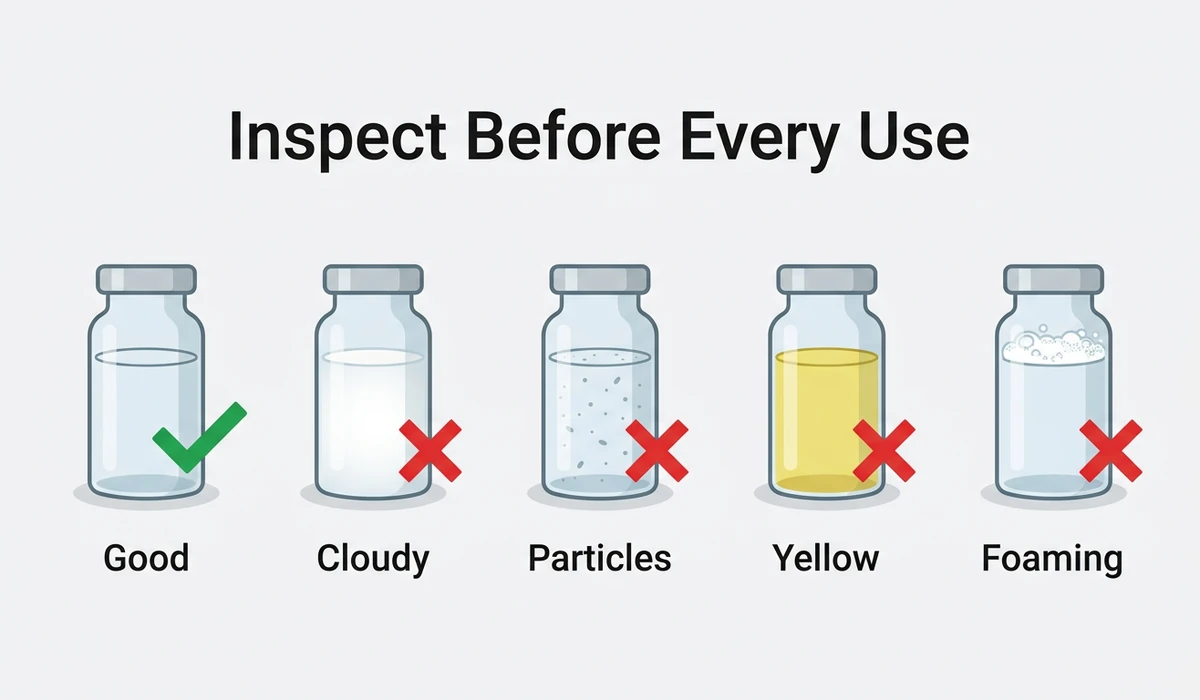
Check every vial before each use:
- Cloudiness. A reconstituted peptide should be perfectly clear, like water. Any haziness indicates aggregation (peptide chains clumping together) or bacterial contamination. Discard.
- Particles. Floating specks, fibers, or sediment mean the peptide has precipitated out of solution. Discard.
- Color change. Most peptide solutions are colorless. A yellow or brown tint indicates oxidation. Discard.
- Foaming. Excessive foam that does not settle suggests protein denaturation. This can happen if the vial was shaken vigorously.
- Rubber fragments. Small black or gray pieces from the stopper can fall into the vial after repeated needle punctures. Discard if visible.
For lyophilized peptides, the powder should be a white to off-white cake or fluffy powder. A yellow or brown powder indicates degradation before you even reconstitute it.
Performance Signs
Sometimes a peptide looks fine but has lost significant potency. Watch for these indicators:
- Reduced effectiveness. A BPC-157 protocol that was working for two weeks suddenly stops producing results. The vial may have degraded.
- Slower onset. Results take noticeably longer than expected based on published timelines. Compare with our dosage chart.
- Injection site reactions. Increased redness, swelling, or pain at the injection site that was not present with a fresh vial. This can indicate bacterial contamination or degradation byproducts.
- No response at proven doses. If you have used a peptide before and know your effective dose, and a new vial produces no response at the same dose, the product is likely degraded or counterfeit.
Track your results. Keep a simple log of dose, date, and subjective response. This makes it much easier to spot a degraded vial versus natural variation in results.
Traveling with Peptides
Traveling with peptides requires temperature management and, depending on the destination, awareness of legal and regulatory considerations.
TSA and Airport Security (Domestic US Travel)
The TSA permits medically necessary liquids, gels, and aerosols in carry-on baggage in quantities exceeding the standard 3.4 oz (100 mL) limit. Peptide vials, bacteriostatic water, and syringes fall under this exemption when they are for personal medical use.
Practical tips:
- Carry peptides in your carry-on bag (not checked luggage, which is not temperature controlled)
- Pack vials, syringes, and BAC water together in a clear zip-lock bag
- No prescription label is required by the TSA, but having one avoids questions
- Declare the items at the security checkpoint if asked
- Insulin syringes are specifically permitted; they do not need to be in original packaging
The TSA screens millions of passengers carrying injectable medications daily. Peptide vials attract less attention than you expect.
International Travel
International travel adds complexity. Each country has its own rules on importing pharmaceuticals, research chemicals, and controlled substances.
General guidelines:
- Carry a prescription or letter from your doctor if possible, even if the peptide is not prescription-only in your country. This provides cover in ambiguous situations.
- Research the destination country's rules. Some countries classify certain peptides (particularly GLP-1 agonists like semaglutide) as prescription-only medications. Carrying them without a prescription may be illegal.
- Keep peptides in original packaging with labels showing the peptide name, purity, and quantity.
- Declare at customs if required. Undeclared medications can be confiscated.
For longer trips (two weeks or more), bring lyophilized vials and bacteriostatic water separately. Reconstitute at your destination. This simplifies temperature management and extends the usable window.
Keeping Peptides Cold While Traveling
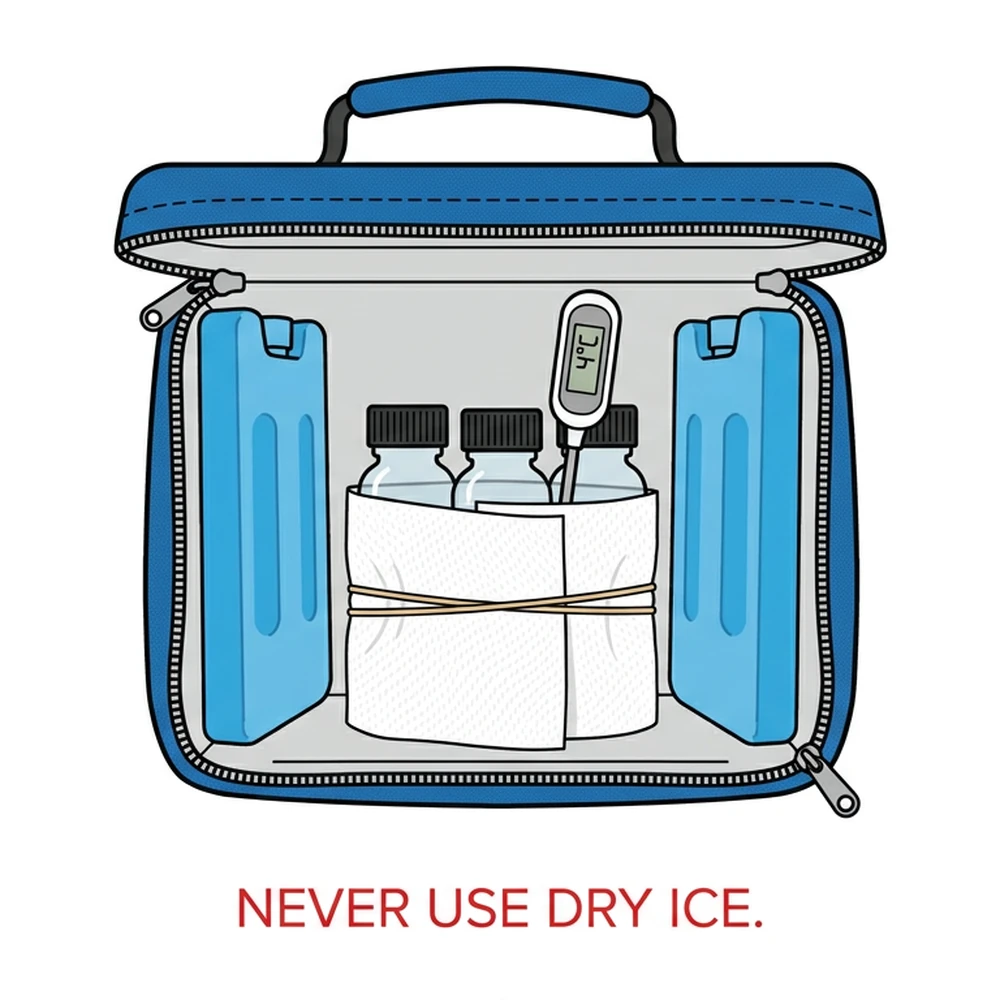
Reconstituted peptides need to stay between 2-8°C. Lyophilized peptides are more forgiving but still benefit from cool storage. Here is what works:
For short trips (under 8 hours): - A small insulated lunch bag with one or two gel ice packs keeps the interior below 8°C for 4-8 hours. - Wrap vials in a paper towel to prevent direct contact with ice packs. Direct contact can freeze the peptide.
For longer trips (8-24 hours): - Use a hard-sided insulated medical cooler. These are designed for insulin and maintain temperature for 12-24 hours. - Add two to three gel packs. Check the internal temperature with a small thermometer.
For extended travel (multi-day): - Bring lyophilized (powder) vials instead of reconstituted ones. Powder tolerates room temperature for days. - Reconstitute upon arrival using a travel-size vial of bacteriostatic water. - If you must bring reconstituted peptides, request a mini-fridge at your hotel.
Never use dry ice. Dry ice (-78°C) will freeze and destroy reconstituted peptides. It is also restricted on most airlines.
Common Storage Mistakes That Ruin Peptides
Most peptide potency loss is preventable. These are the mistakes that destroy product and waste money.
Freeze-Thaw Cycles
Each time a lyophilized peptide is removed from the freezer and returned, condensation forms inside the vial. This moisture initiates degradation.
The solution: do not store all your vials in one bag that you open repeatedly. Separate them. Take out only the vial you intend to reconstitute. If you bought a bulk supply, divide it into individual bags.
For reconstituted peptides, even a single freeze event (accidental or intentional) causes irreversible damage. If your fridge thermostat malfunctions and the back of the fridge hits 0°C, check your vials. Partial freezing still creates ice crystals.
Storing in the Fridge Door
The fridge door is the warmest and most variable zone. Every time you open the door, the temperature swings by 5-10°C. Over weeks, these micro-fluctuations accelerate degradation.
Move peptide vials to the back of the middle shelf, where the temperature is coldest and most stable. This alone can extend reconstituted peptide life by several days.
Direct Sunlight and UV Exposure
Some users store vials on a countertop or desk between injections. Even indirect sunlight through a window degrades light-sensitive amino acids. MOTS-c and peptides containing tryptophan are particularly vulnerable.
The fix is simple: store vials in the fridge or, at minimum, in a dark drawer or cabinet. If you use a vial at a desk, return it to the fridge immediately after drawing your dose.
Reconstituting Too Much at Once
Some users reconstitute their entire supply to save time. This is false economy. You now have multiple vials of liquid with a 30-day clock ticking, instead of stable powder that lasts years.
Reconstitute one vial at a time. When it is nearly empty, reconstitute the next. Use our peptide cost calculator to plan your supply so you buy the right amount of bacteriostatic water.
Shaking the Vial
Shaking creates air bubbles, foam, and mechanical shear stress on the peptide chains. This can cause aggregation and denaturation, particularly with larger peptides like TB-500 (43 amino acids) and Thymosin Alpha-1 (28 amino acids).
Swirl gently. Roll the vial between your palms. Let gravity and time do the work. If the powder does not dissolve after two to three minutes of gentle swirling, let the vial sit in the fridge for 30 minutes and try again.
Peptide Storage FAQ
Frequently Asked Questions
How long do peptides last in the fridge?
Lyophilized (powder) peptides last 1-2 years refrigerated at 2-8°C. Reconstituted peptides last 14-30 days, depending on the specific peptide and whether bacteriostatic water was used. Check the shelf life chart above for peptide-specific timelines.
Can you freeze peptides?
You can freeze lyophilized (powder) peptides at -20°C for maximum shelf life of 3-5 years. Never freeze reconstituted (liquid) peptides. Ice crystals physically break peptide bonds and destroy the product.
What happens if peptides are left out overnight?
Lyophilized peptides left at room temperature overnight lose negligible potency. Reconstituted peptides left out for 8-12 hours may lose 5-15% potency and should be used within a few days. If left out for over 24 hours, discard reconstituted vials due to bacterial contamination risk.
Do peptides expire?
Yes. Lyophilized peptides degrade over time even under ideal conditions, though the process is very slow at freezer temperatures. Reconstituted peptides should be used within 30 days (with bacteriostatic water) or 7 days (with sterile water). Expired peptides lose potency but are not typically dangerous.
How do you store BPC-157?
Store BPC-157 lyophilized powder in the freezer (-20°C) for up to 5 years, or in the fridge (2-8°C) for 1-2 years. Once reconstituted with bacteriostatic water, refrigerate and use within 30 days. BPC-157 is unusually stable due to its gastric acid resistance, but it still degrades under heat and light.
How should semaglutide be stored?
Store unused semaglutide pens or vials in the fridge at 2-8°C. Once in use, semaglutide pens can be kept at room temperature (up to 30°C) for 56 days. Compounded semaglutide vials should be refrigerated and used within 28-56 days after reconstitution. Never freeze semaglutide pens.
Can you travel with peptides on a plane?
Yes. The TSA allows medically necessary injectables, including peptide vials and syringes, in carry-on luggage. Pack them in a clear bag, keep reconstituted vials cold with gel ice packs in an insulated bag, and carry a prescription if possible. For international travel, check the destination country's regulations.
How can you tell if a peptide has gone bad?
Visual signs include cloudiness, floating particles, color change (yellow or brown tint), and excessive foam. Performance signs include reduced effectiveness at previously proven doses and unusual injection site reactions. A clear, colorless solution is the baseline for safe use. When in doubt, discard.
The Bottom Line
Peptide storage comes down to three principles: keep them cold, keep them dark, keep them dry. Lyophilized peptides in the freezer last years. Reconstituted peptides in the fridge last about a month. Anything warmer shortens the clock.
Store vials on the back of the middle fridge shelf, not the door. Reconstitute one vial at a time. Never freeze a liquid peptide. Label every vial with the reconstitution date. Inspect the solution before each use.
These steps protect your investment and ensure every dose delivers full potency. For help calculating exact reconstitution volumes, use our reconstitution calculator. For dosage guidance on all 29 peptides, see our complete peptide dosage chart. For semaglutide-specific storage rules, see does semaglutide need to be refrigerated. For expiration timelines, read does semaglutide expire.
For reconstituted shelf life by peptide type, see how long do reconstituted peptides last. For diluent guidance, see bacteriostatic water vs sterile water, how long does bacteriostatic water last, and where to buy bacteriostatic water. For injection technique, see our peptide injections guide. For sourcing, see where to buy peptides in 2026. For overall safety, see the peptide safety guide. Explore all peptide profiles, dosage calculators, and research tools at PeptidesExplorer.
Related Articles: - How Long Do Reconstituted Peptides Last? - How to Reconstitute Peptides - Bacteriostatic Water vs Sterile Water - Where to Buy Bacteriostatic Water - Getting Started with Peptides
Related Articles
How Long Do Reconstituted Peptides Last?
Reconstituted peptide shelf life by type: BPC-157, semaglutide, TB-500, GHK-Cu. Bac water vs sterile water, storage temps, and signs of degradation.
What Happens If You Use Expired Semaglutide?
Expired semaglutide usually means a weaker dose, not a dangerous one. Real risks by timeframe: 1 week, 1 month, 3 months past expiry and signs.
12 Nootropic Peptides Ranked (2026)
12 nootropic peptides ranked by evidence: Semax, Selank, Cerebrolysin, Dihexa, BPC-157. Mechanisms, dosages, and which ones actually work for focus and memory.
How to Travel With Semaglutide: TSA & Cold Chain
How to travel with semaglutide: TSA rules for Ozempic pens, cold chain packing, customs regs, hotel storage, and time zone dosing tips.