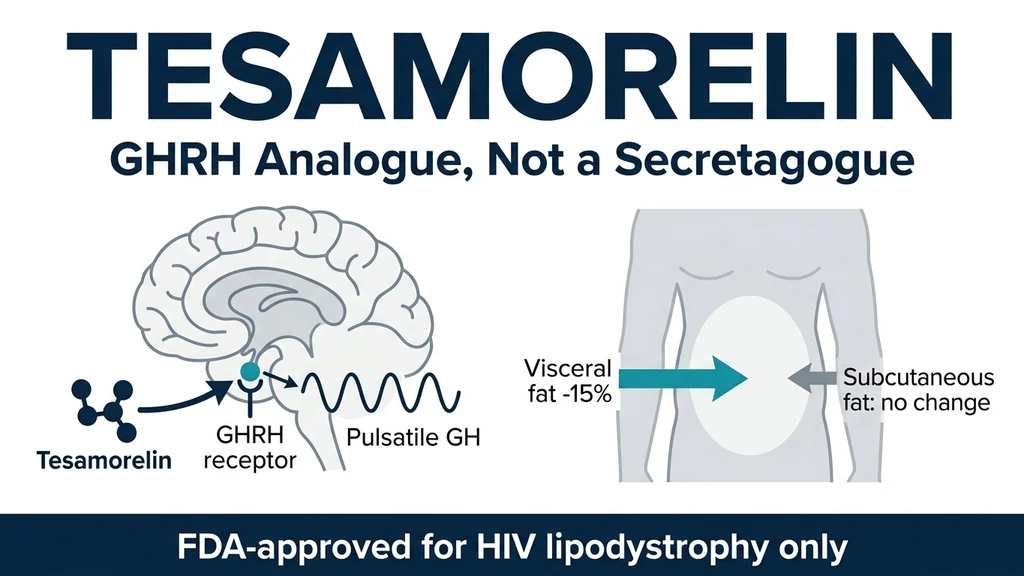
A clinic quoted you a price, or a forum thread promised it strips belly fat. Tesamorelin is a synthetic analogue of growth-hormone-releasing hormone. It signals your pituitary to release more of its own growth hormone. The FDA approved it in 2010 as Egrifta for one narrow use: reducing excess visceral abdominal fat in adults with HIV-associated lipodystrophy. Nothing else.
| Quick Reference | Tesamorelin |
|---|---|
| Drug class | GHRH (1-44) analogue |
| Target receptor | GHRH receptor, pituitary somatotrophs |
| FDA status | Approved (Egrifta, 2010) for HIV lipodystrophy only |
| Current brand | Egrifta WR, approved March 25, 2025 |
| Best-evidenced effect | Visceral fat reduction, roughly 15% at 26 weeks |
| Effect on subcutaneous fat | None (-0.6%, p = 0.08) |
| IGF-1 response | Rises 81% on average |
| Route | Daily subcutaneous injection, abdomen |
| Hard contraindications | Pituitary tumor, active cancer, pregnancy |
| Required monitoring | IGF-1 and blood glucose |
Most of what circulates about tesamorelin online comes from bodybuilding forums that have confused it with ipamorelin or with injected growth hormone. The two mistakes point in opposite directions, and both cost money. This is educational content, not medical advice.
Get your custom peptide protocol:
- Tailored to your body and goals
- Precise dosing and cycle length
- Safe stacking combinations
- Backed by peer-reviewed studies
- Ready in under 2 minutes
What Tesamorelin Actually Is
Tesamorelin is growth-hormone-releasing hormone with a small chemical modification. GHRH is the 44-amino-acid signal your hypothalamus sends to your pituitary several times a day, telling it to fire off a pulse of growth hormone. Native GHRH survives minutes in blood. Tesamorelin adds a trans-3-hexenoic acid group to the N-terminus, which slows enzymatic breakdown enough to make it injectable as a drug (Falutz, Drugs Today, 2011).
Think of a playground swing. Push it in time with the arc it already has and it climbs higher on every pass, still moving at its own rhythm. Grab the chains and haul it to shoulder height and it goes exactly where you put it, whenever you decide, and it no longer swings on its own. Tesamorelin pushes the swing. Injected growth hormone hauls the chains. That distinction is the whole story of HGH or peptides.
Literally: tesamorelin binds the GHRH receptor on pituitary somatotrophs and amplifies the endogenous GH pulses your body was already generating, so secretion stays pulsatile and stays under negative feedback from IGF-1 and somatostatin. Exogenous HGH bypasses the pituitary entirely and produces continuously elevated GH, which is why it suppresses natural production.
This is also where tesamorelin diverges from the peptide it gets confused with. Ipamorelin is a growth hormone secretagogue that works at the ghrelin receptor, a completely separate pathway (Raun et al., Eur J Endocrinol, 1998). CJC-1295 and sermorelin are the peptides that share tesamorelin's GHRH mechanism, which is why forum advice that treats all four as interchangeable produces expensive stacks that push the same receptor twice.
Tesamorelin clears fast. Its elimination half-life is 8 to 11 minutes depending on the formulation, per the FDA label, so the injection is a trigger for a GH pulse rather than a reservoir of drug.
What the FDA Approved, and What It Did Not
The approved indication reads: reduction of excess abdominal fat in HIV-infected adult patients with lipodystrophy. That sentence is the entire legal scope of the drug. It does not say fat loss. It does not say anti-aging, muscle gain, or body recomposition.
The brand has moved through three formulations. Egrifta arrived in 2010. Egrifta SV replaced it in 2019. Egrifta WR, the F8 formulation requiring weekly rather than daily reconstitution, was approved on March 25, 2025 and is the version dispensed today. Same molecule, same indication, less handling at the kitchen counter.
Everything else is off-label. Prescribing off-label is legal for a licensed physician, and buying research-grade tesamorelin from a gray-market supplier is a different matter entirely. For the full regulatory history, dates, and what off-label actually permits, see is tesamorelin FDA approved.
The approved dose is a fixed daily subcutaneous injection into the abdomen, and the milligram figure depends on which formulation you hold. Protocols, titration, cycling, and injection timing live in the tesamorelin dosage for fat loss guide.
The Evidence: What the Trials Actually Measured
Tesamorelin has more human data behind it than every other growth hormone peptide combined. All of the pivotal work was done in HIV-positive adults with visceral fat accumulation, and every efficacy number below comes from that population.
| Study | Population | Design | Key result |
|---|---|---|---|
| Falutz et al., NEJM, 2007 | 412 HIV patients | 2 mg/day vs placebo, 26 weeks | VAT -15.2% vs +5.0% placebo; IGF-1 +81.0%; triglycerides -50 mg/dL |
| Falutz et al., JCEM, 2010 | 806 (pooled phase 3) | 26 weeks + 26-week extension | VAT -24 cm2 vs +2 cm2; subcutaneous fat -2 cm2 (p = 0.08); IGF-1 +108 ng/mL |
| Falutz et al., JAIDS, 2010 | 404 HIV patients | Re-randomised at 6 months | VAT -10.9% at 6 months, -18% at 12 months on continued drug; gains lost after switching to placebo |
| Falutz et al., AIDS, 2005 | 61 HIV patients | Dose-ranging, 1 vs 2 mg, 12 weeks | Trunk fat -9.2% at 2 mg; IGF-1 +65% |
| Stanley et al., Lancet HIV, 2019 | 61 HIV patients with NAFLD | 2 mg/day vs placebo, 12 months | Liver fat fraction -37% relative; 35% vs 4% dropped below the 5% NAFLD threshold |
| Baker et al., Arch Neurol, 2012 | 152 older adults, 66 with MCI | 1 mg/day vs placebo, 20 weeks | Executive function improved (p = 0.005); IGF-1 +117%; body fat -7.4% |
Read down the visceral fat column and then read down the subcutaneous fat entry. In the pooled phase 3 analysis of 806 patients, visceral adipose tissue fell by 24 cm2 of cross-sectional area on CT while abdominal subcutaneous fat moved by 2 cm2 and failed to separate from placebo. The visceral effect is twelve times larger and it is the only one that reached significance.
Visceral fat sits behind the abdominal wall, packed around the liver and intestines. Subcutaneous fat is the layer you pinch. Tesamorelin reduces the first and leaves the second alone, which was the entire point in a patient population already losing subcutaneous fat to lipodystrophy.
The Baker trial is the one people cite for cognition. It ran 20 weeks in adults over 55, used half the approved dose, and measured executive function rather than diagnosis or disease progression. No larger trial has followed it in fourteen years.
Where Tesamorelin Fails People: Three Quantified Scenarios
Scenario 1: buying it for the fat you can pinch. A lean 34-year-old with visible abs and a stubborn lower-belly pinch runs 26 weeks of tesamorelin. That is 182 daily injections. The pooled phase 3 data predicts his abdominal subcutaneous fat will change by roughly 2 cm2 of CT cross-section, an area smaller than a dime, statistically indistinguishable from placebo at p = 0.08. He has almost no visceral fat for the drug to remove, so the 15.4% visceral effect has nothing to act on. The fix: get a waist circumference and, if you can, a CT or DEXA visceral fat estimate before you spend anything. Run the six-month total through the peptide cost calculator before the first vial arrives.
Scenario 2: injecting without a baseline IGF-1. A 45-year-old starts tesamorelin with an unmeasured IGF-1 of 185 ng/mL, comfortably mid-range for his age. The NEJM trial recorded an 81% average rise. His level lands near 335 ng/mL, roughly 70 ng/mL above the top of a typical reference band for a man in his forties. The pooled data shows a mean absolute increase of 108 ng/mL, so the direction is not in doubt. The FDA label instructs clinicians to monitor IGF-1 during therapy and to consider stopping treatment on persistent elevations above 3 standard deviations. Without a baseline draw, there is no way to know which number the second lab result represents. The fix: draw IGF-1 before the first injection, not after the third month.
Scenario 3: stopping and expecting the fat to stay gone. In the 12-month JAIDS trial, patients who took tesamorelin for six months and were then switched to placebo lost their visceral fat reduction rapidly, while those who continued reached roughly 18% below baseline at one year. The 24 cm2 of visceral fat you removed comes back. Tesamorelin holds visceral fat down while you inject it, the way a statin holds LDL down while you swallow it. The fix: treat it as ongoing therapy with a monitoring schedule, or do not start.
Who must not take it at all: anyone with a pituitary tumor, prior pituitary surgery or cranial radiation, any active malignancy, anyone pregnant or planning pregnancy, and anyone with a known hypersensitivity to the drug. Growth hormone and IGF-1 are mitogenic. Raising them in the presence of an active cancer is the scenario the contraindication exists to prevent. Fluid retention, arthralgia, carpal tunnel symptoms, and injection site reactions round out the label warnings, and glucose should be screened before and during treatment.
How to Read an IGF-1 Lab Result
Tesamorelin does not raise growth hormone in a way you can measure conveniently. GH is pulsatile and a random draw tells you almost nothing. IGF-1 is the downstream, stable proxy the label asks you to track, so learning to read the result matters more here than on any other peptide.
Your report shows three things: a number, a unit, and an age-matched reference interval. Check the unit first. Most US labs report ng/mL. Many European labs report nmol/L. Multiply nmol/L by 7.65 to get ng/mL, or multiply ng/mL by 0.131 to go the other way. A value of 26 nmol/L and a value of 199 ng/mL are the same result.
Now the reference interval. IGF-1 falls steadily with age, so "normal" at 30 and "normal" at 65 are different bands. A 300 ng/mL result is unremarkable for a 25-year-old and abnormal for a 70-year-old.
| Age | Typical adult reference interval (ng/mL) |
|---|---|
| 20 to 29 | ~115 to 350 |
| 30 to 39 | ~110 to 300 |
| 40 to 49 | ~95 to 265 |
| 50 to 59 | ~85 to 230 |
| 60 to 69 | ~70 to 210 |
| 70 and over | ~60 to 190 |
Treat that table as orientation only. Reference intervals are assay-specific and vary meaningfully between platforms, which is why large multicenter work was needed to standardise them at all (Bidlingmaier et al., JCEM, 2014). The age band printed on your own report, from the lab that ran your sample, is the only one that counts. Use the same lab and the same assay for every follow-up draw or the trend is noise.
Some reports add an SDS, also called a z-score. It answers one question: how many standard deviations above or below the average for your age and sex is this value. An SDS of 0 is exactly average. +2 puts you near the 97.5th percentile, the top edge of normal. +3 is the threshold the Egrifta label names when it tells clinicians to consider discontinuing treatment on persistent elevation. If your lab does not print an SDS, ask for it, because "high normal" and "+2.8 SDS" can describe the same number and only one of them tells you how close you are to the stop line.
One practical detail: IGF-1 does not require fasting and is not meaningfully affected by time of day, unlike GH itself. Draw it whenever, as long as you draw it consistently. If you also use IGF-1 LR3, an analogue that raises IGF-1 activity directly rather than through the pituitary, understand that stacking it with a GHRH analogue pushes the same axis from two directions. The IGF-1 LR3 dosage calculator covers that compound separately.
Tesamorelin at a Glance: Full Reference Table
| Property | Detail |
|---|---|
| Common name | Tesamorelin, tesamorelin acetate |
| Brand names | Egrifta (2010), Egrifta SV (2019), Egrifta WR (March 25, 2025) |
| Structure | GHRH(1-44) with trans-3-hexenoic acid on the N-terminus |
| Class | GHRH analogue, growth hormone-releasing factor |
| Receptor | GHRH receptor on pituitary somatotrophs |
| GH release pattern | Pulsatile, preserved feedback |
| Elimination half-life | 8 to 11 minutes depending on formulation |
| FDA indication | Reduction of excess abdominal fat in HIV-infected adults with lipodystrophy |
| Route and site | Subcutaneous, abdomen, daily |
| Storage | Refrigerate; reconstituted product handled per label |
| Visceral fat effect | -15.4% treatment effect at 26 weeks (n = 806) |
| Subcutaneous fat effect | -0.6%, p = 0.08, not significant |
| Liver fat effect | -37% relative at 12 months in HIV + NAFLD |
| IGF-1 effect | +81% (NEJM), +108 ng/mL absolute (pooled) |
| Effect after discontinuation | Visceral fat returns toward baseline |
| Contraindications | Pituitary tumor or surgery or cranial radiation, active malignancy, pregnancy, hypersensitivity |
| Monitoring | IGF-1 and glucose, before and during therapy |
| Common adverse events | Injection site reactions, arthralgia, edema, paresthesia |
How tesamorelin sits against the peptides it is compared to. One line each, with the full head-to-head behind each link.
| Compared with | Mechanism difference | Evidence difference | Read |
|---|---|---|---|
| CJC-1295 | Same GHRH receptor; DAC versions give sustained rather than pulsatile exposure | Phase 3 vs early-phase human data only | tesamorelin vs CJC-1295 |
| Ipamorelin | Ghrelin receptor agonist, a different pathway entirely | No visceral fat trial | tesamorelin vs ipamorelin |
| Sermorelin | GHRH(1-29) fragment, shorter and less stable | Older approval, withdrawn from the US market | tesamorelin vs sermorelin vs ipamorelin |
| HGH Fragment 176-191 | Acts on fat cells, not the pituitary | Human data thin | Fat-cell mechanism, no GH axis effect |
Price tracks evidence. Tesamorelin is a branded prescription drug and the GHRH peptides sold as research compounds cost a fraction of it.
Common Mistakes
Mistake 1: expecting subcutaneous fat loss. Buyers read "abdominal fat" in the indication and picture the layer they pinch. The trials measured visceral adipose tissue on CT, and subcutaneous fat did not budge (-2 cm2, p = 0.08). The fix: if your goal is the pinch, tesamorelin is the wrong tool.
Mistake 2: calling it a growth hormone secretagogue. Tesamorelin is a GHRH analogue that works on the pituitary's own release machinery. Ipamorelin, GHRP-2, and MK-677 act at the ghrelin receptor. Stacking two compounds you believe are equivalent doubles the cost and the IGF-1 load, and the CJC-1295 + ipamorelin dosage calculator exists because those two are the pair that genuinely combine across pathways.
Mistake 3: skipping IGF-1 and glucose monitoring. The label requires both. An 81% average IGF-1 rise means a mid-range baseline can exit the reference band inside three months, and glucose intolerance is a named warning. The fix: baseline both, recheck at the interval your prescriber sets.
Mistake 4: sourcing it as a research chemical. Tesamorelin is a prescription drug with a documented approval. Vials sold without one carry no identity, purity, or sterility guarantee, and reconstitution errors compound the problem. See where to buy peptides in 2026 before you trust a supplier.
Frequently Asked Questions
What is tesamorelin used for?
Tesamorelin is FDA-approved for one thing: reducing excess visceral abdominal fat in HIV-infected adults with lipodystrophy. Everything else, including general fat loss and anti-aging use, is off-label with no phase 3 support in those populations. The approval history is covered in is tesamorelin FDA approved.
How does tesamorelin work?
It is a stabilised analogue of growth-hormone-releasing hormone. It binds the GHRH receptor on the pituitary and amplifies your own GH pulses, preserving pulsatile release and IGF-1 feedback rather than overriding them like injected HGH. Ipamorelin uses a separate ghrelin receptor pathway to reach the same hormone.
Does tesamorelin burn subcutaneous fat?
No. In the pooled phase 3 analysis of 806 patients, abdominal subcutaneous fat changed by 2 cm2 and did not separate from placebo (p = 0.08), while visceral fat fell 24 cm2. The drug targets the fat behind your abdominal wall. See tesamorelin dosage for fat loss for what the trials measured.
How much does tesamorelin raise IGF-1?
The NEJM trial recorded an 81% average rise at 26 weeks; the pooled phase 3 data showed a mean increase of 108 ng/mL. That is enough to move a mid-range baseline above the reference band. The label requires IGF-1 monitoring, with discontinuation considered above +3 SDS. Compare with IGF-1 LR3.
Who should not take tesamorelin?
Anyone with a pituitary tumor, prior pituitary surgery, or cranial radiation. Anyone with an active malignancy, since GH and IGF-1 are mitogenic. Anyone pregnant or planning pregnancy. Glucose intolerance is a named warning, so diabetics need screening first. Read the peptide safety guide before starting.
Is tesamorelin better than CJC-1295 or sermorelin?
All three hit the GHRH receptor. Tesamorelin is the only one with phase 3 randomised trials and an active FDA approval; the others rest on early-phase human data. It also costs considerably more. The head-to-head details are in tesamorelin vs CJC-1295.
What happens when you stop tesamorelin?
Visceral fat returns. In the 12-month JAIDS trial, patients switched from tesamorelin to placebo at six months rapidly lost their reduction, while continuers reached about 18% below baseline at one year. It suppresses visceral fat only during active treatment. Estimate an ongoing course with the peptide cost calculator.
Can you stack tesamorelin with other peptides?
Stacking a GHRH analogue with a ghrelin-receptor secretagogue pushes GH from two directions and raises IGF-1 further, which the label already asks you to watch. Adding a direct IGF-1 analogue compounds it again. Check interactions before combining anything on this axis, and read peptide stacking guide.
The Bottom Line
Tesamorelin is a GHRH analogue that amplifies your pituitary's own growth hormone pulses. It is FDA-approved as Egrifta, and only for reducing excess visceral abdominal fat in adults with HIV-associated lipodystrophy. Its pivotal trials cut visceral fat by roughly 15% over 26 weeks and left subcutaneous fat untouched.
That specificity is the whole drug. Visceral fat responds; the layer you pinch does not. IGF-1 climbs 81% on average, which is why the label names pituitary tumors, active cancer, and pregnancy as contraindications and asks for lab monitoring rather than trust.
Get a baseline IGF-1 and glucose before the first injection, use the same lab for every follow-up, and know whether you have visceral fat to lose before you buy 182 days of anything. Read getting started with peptides if this is your first compound, and work with a physician who will order the labs. More peptide profiles, calculators, and evidence reviews at PeptidesExplorer.
Helpful Tools
Related Articles
How to Reconstitute Tesamorelin: Water Volumes & Units
How to reconstitute tesamorelin: bacteriostatic water volumes for 2, 5, 10 and 20 mg vials, U-100 unit math, mixing steps, storage window, and bad-vial signs.
Tesamorelin vs Ipamorelin: Key Differences
Tesamorelin vs ipamorelin: GHRH analog vs ghrelin mimetic. Fat loss data, dosing, side effects, cost, and stacking protocols. PubMed-cited guide.
Tesamorelin Dosage for Fat Loss
Tesamorelin dosage guide for fat loss. FDA-approved 2 mg/day protocol, visceral fat reduction data, cycling strategies, and GH peptide comparisons.
CJC-1295 With DAC: Long-Acting GHRH Analog
CJC-1295 with DAC: 6-8 day half-life, 2-10x GH increase, 1-2 mg weekly. GH bleed effect, desensitization risk, and stacking protocols.