Tesamorelin, sermorelin, and ipamorelin are three growth hormone peptides that work through different mechanisms: tesamorelin and sermorelin are GHRH analogs that bind the GHRH receptor on the pituitary, while ipamorelin is a selective ghrelin receptor agonist. Tesamorelin is the only FDA-approved option, proven to reduce visceral fat by 18% in Phase III trials. Sermorelin most closely mimics natural GH pulses (half-life 10-20 min). Ipamorelin is the cleanest secretagogue documented, releasing GH without affecting cortisol, prolactin, or appetite at any tested dose (Stanley et al., JAMA, 2014; Walker et al., 2006; Raun et al., Endocrinology, 1998). The best choice depends on your primary goal.
| Parameter | Tesamorelin | Sermorelin | Ipamorelin |
|---|---|---|---|
| Type | GHRH analog (44 aa) | GHRH fragment (29 aa) | Selective GHRP (5 aa) |
| Receptor target | GHRH receptor | GHRH receptor | Ghrelin receptor (GHS-R1a) |
| Half-life | 26-38 minutes | 10-20 minutes | ~2 hours |
| Dosing | 2 mg daily | 200-500 mcg daily | 100-300 mcg, 1-3x daily |
| FDA status | Approved (Egrifta SV) | Previously approved (Geref, discontinued) | Never approved |
| Clinical evidence | Phase III RCTs (JAMA, NEJM) | Phase II + historical FDA | Phase I + preclinical |
| Primary strength | Visceral fat reduction | Natural GH rhythm | Selectivity (no cortisol/prolactin) |
| Monthly cost (compounded) | $150-300 | $100-300 | $150-300 |
| Brand cost | ~$3,085 (Egrifta SV) | N/A (discontinued) | N/A |
For ipamorelin protocols, use our CJC-1295/ipamorelin dosage calculator.
All three compounds stimulate GH and IGF-1 elevation. None should be used with active cancer, uncontrolled diabetes, or during pregnancy without physician supervision.
Get your custom peptide protocol:
- Tailored to your body and goals
- Precise dosing and cycle length
- Safe stacking combinations
- Backed by peer-reviewed studies
- Ready in under 2 minutes
What Is Tesamorelin?
Tesamorelin is a modified GHRH analog with 44 amino acids and a trans-3-hexenoic acid group at the N-terminus. It is the active ingredient in Egrifta SV, FDA-approved in 2010 for visceral fat reduction in HIV-associated lipodystrophy. Theratechnologies manufactures the brand product.
The half-life is 26-38 minutes. Daily subcutaneous injection at 2 mg produces a physiological GH pulse that clears within hours. In Phase III trials, 69% of subjects achieved the FDA responder threshold of greater than 8% visceral adipose tissue reduction (Falutz et al., NEJM, 2007).
Tesamorelin also reduced liver fat and improved triglyceride profiles in the Stanley 2014 JAMA study, making it the most metabolically well-characterized GHRH analog available (Stanley et al., JAMA, 2014). For dosing details, see our tesamorelin dosage for fat loss guide.
What Is Sermorelin?
Sermorelin is the first 29 amino acids of endogenous GHRH(1-44), representing the shortest fragment that retains full biological activity at the GHRH receptor. It was previously FDA-approved under the brand name Geref for diagnosis and treatment of pediatric growth hormone deficiency.
Geref was discontinued by its manufacturer due to production challenges, not safety concerns. Sermorelin remains available through compounding pharmacies with a valid prescription. Its half-life of 10-20 minutes is the shortest of the three, producing the most transient and physiologically natural GH pulse.
Walker et al. (2006) demonstrated that sermorelin preserves the pituitary neuroendocrine axis and stimulates endogenous hGH mRNA expression, suggesting it supports rather than suppresses the body's own GH production capacity (Walker et al., Horm Res, 2006). Standard dosing is 200-500 mcg subcutaneously before bed. For safety data, see our is sermorelin safe guide. For body composition effects, see sermorelin for fat loss.
What Is Ipamorelin?
Ipamorelin is a synthetic pentapeptide (5 amino acids: Aib-His-D-2-Nal-D-Phe-Lys-NH2) that acts on the ghrelin receptor (GHS-R1a), not the GHRH receptor. This makes it mechanistically distinct from both tesamorelin and sermorelin, and it is the key reason ipamorelin stacks synergistically with either one.
The Raun 1998 study established ipamorelin as the first selective GH secretagogue. At doses up to 200 times the effective threshold, cortisol, ACTH, prolactin, FSH, LH, and TSH remained unchanged (Raun et al., Endocrinology, 1998). No other GH-releasing compound has matched this selectivity profile.
The half-life is approximately 2 hours, with a GH peak at about 40 minutes post-injection and dose-proportional pharmacokinetics (Johansen et al., Eur J Clin Pharmacol, 1999). Standard dosing is 100-300 mcg subcutaneously, most commonly paired with CJC-1295 for GHRH-GHRP synergy. For the comparison with MK-677 (the oral ghrelin mimetic), see our MK-677 vs ipamorelin guide.
Mechanism of Action: GHRH Receptor vs Ghrelin Receptor
The most important distinction in this three-way comparison is the receptor pathway. Tesamorelin and sermorelin share one pathway. Ipamorelin uses a completely different one.
Tesamorelin and sermorelin are both GHRH receptor agonists. They bind the GHRH receptor on pituitary somatotroph cells, triggering GH synthesis and release. Because they target the same receptor, stacking them together is pharmacologically redundant: the receptor can only respond so many times per hour regardless of how many agonists are competing for it.
Ipamorelin targets the ghrelin receptor (GHS-R1a), which triggers GH release through a separate signaling cascade. When you pair a GHRH analog with ipamorelin, you activate two complementary pathways simultaneously. The GHRH analog stimulates GH production and synthesis. Ipamorelin prompts GH secretion. The result is a GH pulse larger than either compound achieves alone.
| Stacking Pair | Compatible? | Rationale |
|---|---|---|
| Tesamorelin + Ipamorelin | Yes | GHRH + GHRP synergy (different receptors) |
| Sermorelin + Ipamorelin | Yes | GHRH + GHRP synergy (different receptors) |
| Tesamorelin + Sermorelin | No | Both GHRH agonists (same receptor, redundant) |
| Tesamorelin + CJC-1295 | No | Both GHRH agonists (same receptor, redundant) |
| All three together | No | Two GHRH analogs in the mix is redundant |
| Sermorelin + CJC-1295 + Ipamorelin | No | Two GHRH analogs is still redundant |
For stacking guidance, see our peptide stacking guide.
Clinical Evidence Hierarchy
The three peptides sit at different rungs of the clinical evidence ladder. This matters fundamentally for risk assessment and realistic expectations.
Tesamorelin: Phase III (Strongest)
Published in JAMA and the New England Journal of Medicine. Phase III randomized, double-blind, placebo-controlled trials with 412 subjects in the NEJM study alone. Specific outcomes measured by CT scan: 18% visceral fat reduction, liver fat reduction, and triglyceride improvement of approximately 50 mg/dL. Extension data to 52 weeks confirming sustained benefit. FDA approval granted under NDA 022505.
This is gold-standard medical evidence. No other GHRH analog has reached this level of clinical validation. The tesamorelin data is directly applicable; the FDA reviewed and approved it for a specific indication.
Sermorelin: Phase II + Historical FDA Approval
Previously FDA-approved for pediatric GH deficiency under the brand Geref (1997). Multiple clinical studies in adult populations documenting GH stimulation and growth velocity improvements. Walker 2006 demonstrated pituitary-preserving properties that no other GHRH analog has documented. Withdrawn for manufacturing reasons, not safety issues (Prakash & Goa, BioDrugs, 1999).
Sermorelin has moderate clinical evidence. Its historical FDA approval provides a regulatory credibility anchor that ipamorelin lacks. Compounding pharmacies can legally produce sermorelin with a valid prescription.
Ipamorelin: Phase I + Preclinical (Most Limited)
The Raun 1998 selectivity study was conducted in animal models. The Johansen 1999 pharmacokinetic study enrolled human volunteers but measured GH release patterns, not clinical outcomes like body composition or fat reduction. No Phase III trial has been completed. No body composition, fat loss, or anti-aging endpoint has been measured in a randomized human trial for ipamorelin alone.
Ipamorelin's reputation rests on its unique selectivity profile and widespread clinical practice experience. The selectivity data is robust and reproducible. The clinical outcome data at the individual-peptide level is limited. Understanding this distinction is essential for informed use.
Head-to-Head: Fat Loss
For visceral fat reduction, tesamorelin has no competition in this group.
| Fat Loss Metric | Tesamorelin | Sermorelin | Ipamorelin |
|---|---|---|---|
| VAT reduction (proven) | -18% (Phase III CT data) | No direct studies | No direct studies |
| Liver fat reduction | Yes (JAMA 2014) | No data | No data |
| Triglyceride improvement | -50 mg/dL (NEJM 2007) | No direct data | No direct data |
| Mechanism for fat loss | Direct GH stimulation + VAT lipolysis | Indirect via GH elevation | Indirect via GH elevation |
| Evidence level | RCT, n=412 | Clinical practice | Clinical practice |
Sermorelin and ipamorelin both elevate GH, which promotes lipolysis. Practitioners and users report body composition improvements on both. These reports are consistent with GH physiology but are not the same as CT-scan-measured outcomes from controlled trials.
For targeted fat loss with documented results, tesamorelin is the evidence-based choice. For the tesamorelin vs CJC-1295 comparison on fat loss, see our tesamorelin vs CJC-1295 guide. For broader context, see best peptides for weight loss.
Head-to-Head: Sleep Quality
GH secretion peaks during deep sleep, and all three peptides can enhance this natural rhythm when dosed in the evening.
Sermorelin's 10-20-minute half-life produces a sharp, brief GH pulse that most closely resembles the body's own bedtime secretion pattern. Injecting 200-500 mcg before bed amplifies the natural sleep-associated GH surge without prolonged stimulation. Users consistently report deeper sleep and vivid dreams within the first 1-2 weeks.
Ipamorelin's 2-hour half-life provides a slightly longer GH pulse, still well within the physiological window. Evening injection before bed is the standard protocol. The GH pulse aligns with early deep sleep and clears before morning.
Tesamorelin has no dedicated sleep studies. Its 26-38-minute half-life suggests it could improve sleep through GH-mediated mechanisms, but specific sleep architecture data has not been collected.
For the peptide with dedicated sleep clinical data, see our MK-677 vs ipamorelin comparison (MK-677 has a dedicated sleep RCT). For the broader sleep peptide overview, see peptides for sleep.
Head-to-Head: Anti-Aging and Longevity
For long-term use, pituitary preservation is the key variable. You want a compound that supports your body's GH machinery rather than overriding it.
Sermorelin scores highest on this criterion. Walker 2006 showed sermorelin stimulates endogenous hGH mRNA expression, meaning it promotes the pituitary's own production capacity (Walker et al., 2006). Its short half-life and natural pulsatile pattern minimize desensitization risk. Many longevity physicians favor sermorelin for this reason.
Ipamorelin acts on a different receptor entirely, so it does not desensitize the GHRH pathway. Pairing ipamorelin with a GHRH analog may support pituitary function by providing dual-pathway stimulation without overloading either receptor.
Tesamorelin's potency makes it effective for targeted goals but less ideal for indefinite use. Daily dosing at 2 mg represents a stronger pharmacological stimulus than sermorelin's more moderate approach.
| Anti-Aging Factor | Sermorelin | Ipamorelin | Tesamorelin |
|---|---|---|---|
| Pituitary preservation | Best (stimulates hGH mRNA) | Good (different receptor) | Moderate |
| Desensitization risk | Low (short half-life, pulsatile) | Low (separate pathway) | Low-Moderate |
| Natural GH pattern | Most natural (10-20 min) | Pulsatile (2h clearance) | Pulsatile (38 min clearance) |
| Long-term suitability | Best | Good with cycling | Better for defined-goal use |
Head-to-Head: Bodybuilding and Recovery
For muscle recovery and body composition in the context of training, the ipamorelin plus CJC-1295 stack is the most widely used clinical protocol.
Ipamorelin's selectivity means no cortisol elevation. Cortisol is catabolic; any GH secretagogue that elevates cortisol post-training counteracts the anabolic GH signal. GHRP-6 and GHRP-2 both raise cortisol. Ipamorelin does not, at any tested dose.
When paired with CJC-1295 (no DAC), the combination delivers GH pulses through two pathways 2-3 times daily, timed around training and sleep. This protocol produces the highest acute GH spikes of any non-HGH secretagogue approach. For the full stack breakdown, see CJC-1295/ipamorelin benefits.
Tesamorelin's potency makes it effective for recomposition, particularly reducing stubborn visceral fat. Sermorelin works as a gentler starting point suited for beginners or those prioritizing general recovery over maximum GH output. For training-focused context, see peptides for bodybuilding and peptides for muscle growth.
Side Effects Compared
All three peptides are well tolerated at standard doses. The profiles overlap but have meaningful differences.
| Side Effect | Tesamorelin | Sermorelin | Ipamorelin |
|---|---|---|---|
| Injection site reactions | Common | Common | Common |
| Facial flushing | Rare | Common | 15-20% |
| Water retention | 5-10% | Mild | 15-25% (with CJC-1295) |
| Headache | 5-10% | Common (week 1) | 5-10% |
| Nausea | 3-5% | Rare | Rare |
| Cortisol elevation | None | None | None (at any dose, per Raun 1998) |
| Prolactin elevation | None | None | None (at any dose) |
| Appetite increase | Mild | None | Mild |
| Arthralgia | 5-10% | Rare | 5-10% with CJC-1295 |
Ipamorelin's zero cortisol and zero prolactin profile at any dose is unique among all GH secretagogues, including sermorelin and tesamorelin. Sermorelin has the mildest overall side effect profile. Tesamorelin has the most comprehensive safety data from Phase III trials with 52-week follow-up.
All three are better tolerated than exogenous HGH, which causes higher rates of water retention, carpal tunnel syndrome, insulin resistance, and joint pain. For ipamorelin-specific side effect management, see our CJC-1295/ipamorelin side effects guide. For sermorelin safety, see is sermorelin safe.
Cost Comparison
Pricing varies by source, formulation, and whether you use brand or compounded products.
| Peptide | Monthly Cost (Compounded) | Brand Cost | Total with Common Stack |
|---|---|---|---|
| Tesamorelin | $150-300 | ~$3,085 (Egrifta SV) | $150-300 (standalone) |
| Sermorelin | $100-300 | N/A (Geref discontinued) | $100-300 (standalone) |
| Ipamorelin | $150-300 | N/A (not approved) | $250-500 (+ CJC-1295) |
Sermorelin is the most budget-friendly option, requiring no combination compound at standard dosing. Ipamorelin becomes more expensive when paired with CJC-1295, the standard protocol in clinical practice. Tesamorelin at compounded prices is competitive with both alternatives, but brand Egrifta SV is prohibitive for non-HIV patients without insurance coverage.
For sourcing information, see where to buy sermorelin. For reconstitution, use our peptide reconstitution calculator.
Stacking Compatibility Matrix
Stacking GH peptides requires understanding which combinations are synergistic and which are redundant.
| Stack | Compatible? | Rationale |
|---|---|---|
| Sermorelin + Ipamorelin | Yes | GHRH + GHRP; different receptors; synergistic |
| Tesamorelin + Ipamorelin | Yes | GHRH + GHRP; different receptors; synergistic |
| CJC-1295 + Ipamorelin | Yes | GHRH + GHRP; different receptors; most common |
| Tesamorelin + Sermorelin | No | Both GHRH receptor; same pathway; redundant |
| Tesamorelin + CJC-1295 | No | Both GHRH receptor; redundant |
| Sermorelin + CJC-1295 | No | Both GHRH receptor; redundant |
| All three | No | Two GHRH analogs always redundant |
The rule is simple: one GHRH analog plus one GHRP. Never two GHRH analogs together. The GHRH analog (tesamorelin, sermorelin, or CJC-1295) stimulates GH synthesis. The GHRP (ipamorelin) stimulates GH release through the ghrelin receptor. Together they create a GH pulse larger than either alone.
For the complete stacking guide, see peptide stacking guide.
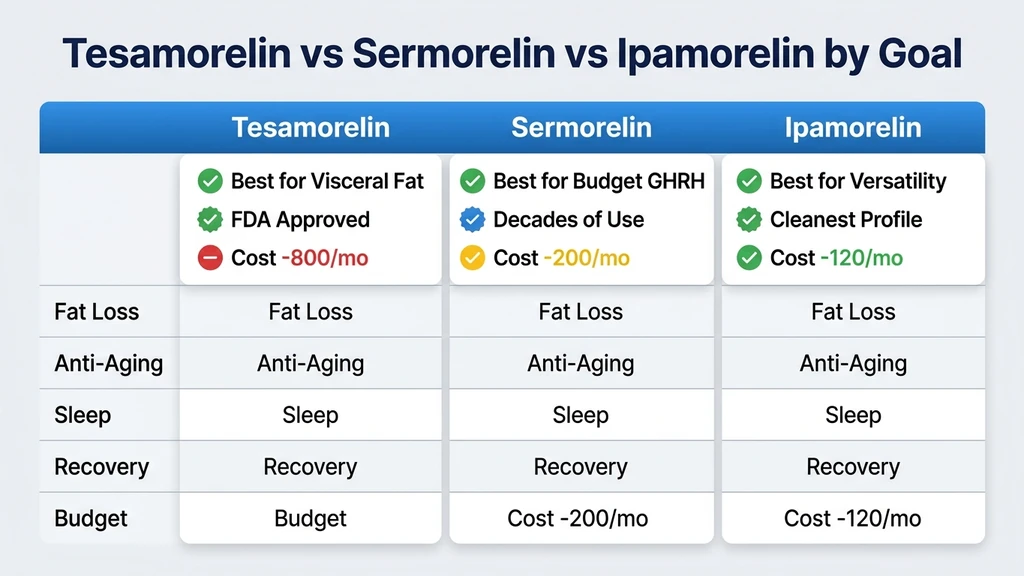
Goal-Based Decision Matrix
This matrix consolidates the comparison into actionable guidance based on your primary goal.
| Goal | Best Choice | Why |
|---|---|---|
| Visceral fat loss | Tesamorelin | Only Phase III data for VAT reduction (-18%) |
| Natural GH restoration | Sermorelin | Shortest half-life; preserves pituitary axis; hGH mRNA stimulation |
| Selective GH boost | Ipamorelin | No cortisol/prolactin at any dose (Raun 1998) |
| Bodybuilding and recovery | Ipamorelin + CJC-1295 | GHRH + GHRP synergy; no cortisol elevation |
| Anti-aging / longevity | Sermorelin | Pituitary-preserving; natural rhythm; lowest risk |
| Sleep improvement | Sermorelin | Mimics natural bedtime GH pulse (10-20 min HL) |
| Budget option | Sermorelin | Lowest compounded cost; no stacking required |
| Medical supervision / FDA anchor | Tesamorelin | Only FDA-approved option |
| Maximum documented evidence | Tesamorelin | Phase III RCTs (JAMA, NEJM) |
| Oral dosing preference | None of these three | Consider MK-677 (oral, with metabolic caveats) |
No single peptide wins every category. For the CJC-1295 comparison within the GHRH class, see CJC-1295 vs sermorelin. For the tesamorelin vs CJC-1295 head-to-head, see tesamorelin vs CJC-1295.
Important Safety Warnings
All three compounds stimulate GH release and elevate IGF-1. Shared precautions apply across the entire class.
Do not use any GH-stimulating peptide with active cancer or a history of hormone-sensitive cancers (prostate, breast, colorectal) without oncologist clearance. Elevated IGF-1 may theoretically promote tumor growth. Monitor IGF-1 levels during use to ensure they remain within the reference range (normal adult: 80-350 ng/mL).
Tesamorelin is Category X in pregnancy and contraindicated in active malignancy per FDA labeling. CJC-1295 and sermorelin lack formal contraindication labeling since they are not FDA-approved, but the same biological precautions apply.
Monitor fasting glucose periodically. GH is a counter-regulatory hormone to insulin. Report persistent edema, joint pain that limits function, or headaches not resolving with hydration to your prescribing physician. For a comprehensive safety overview covering all peptide classes, see our peptide safety guide.
Frequently Asked Questions
What is the difference between sermorelin and ipamorelin?
Sermorelin is a GHRH analog that binds the GHRH receptor on the pituitary. Ipamorelin is a selective GHRP that binds the ghrelin receptor (GHS-R1a). They target different receptors, which is why they stack synergistically. Sermorelin's half-life is 10-20 minutes. Ipamorelin's is about 2 hours. Together, they activate two complementary GH release pathways for additive output. See our CJC-1295/ipamorelin benefits guide for stacking data.
Is tesamorelin the same as sermorelin?
No. Both are GHRH analogs but differ in structure, potency, and evidence base. Tesamorelin has 44 amino acids with a trans-3-hexenoic acid modification and FDA approval for HIV lipodystrophy. Sermorelin is the first 29 amino acids of natural GHRH with historical FDA approval for pediatric GH deficiency. Both target the GHRH receptor, which is why they cannot be stacked together productively.
Which is better for fat loss: tesamorelin or ipamorelin?
For documented visceral fat reduction, tesamorelin is superior. Phase III trials showed 18% VAT reduction measured by CT scan (-34 cm2), with 69% of subjects meeting the responder threshold. Ipamorelin has no published fat loss studies. Its body composition effects are inferred from GH elevation and clinical practice reports. For targeted belly fat reduction with evidence behind it, tesamorelin is the choice.
Can you take sermorelin and ipamorelin together?
Yes. This is one of the most well-established GH peptide stacks. Sermorelin (GHRH receptor agonist) and ipamorelin (ghrelin receptor agonist) activate two distinct GH release pathways, producing a synergistic GH pulse larger than either compound alone. This is the same principle as the CJC-1295/ipamorelin stack. See our peptide stacking guide for protocol details.
Which growth hormone peptide has the fewest side effects?
Ipamorelin has the cleanest documented profile of any GH secretagogue. At doses up to 200 times the effective threshold, it does not elevate cortisol, ACTH, or prolactin (Raun et al., 1998). Sermorelin has the mildest practical side effect profile at clinical doses. Tesamorelin has the most comprehensive safety data from Phase III trials with 52-week follow-up. See our CJC-1295/ipamorelin side effects guide for management protocols.
How do tesamorelin, sermorelin, and ipamorelin compare to HGH?
All three stimulate your pituitary gland to release GH naturally, with a biological ceiling on output. Exogenous HGH bypasses the pituitary entirely, allowing supraphysiologic levels with greater risks: pituitary suppression, more severe water retention, higher carpal tunnel rates (20-40% vs 10-20%), and insulin resistance. These peptides cost $100-300/month compounded vs $500-3,000 for pharmaceutical HGH.
Which GH peptide is best for sleep?
Sermorelin's 10-20-minute half-life produces the most natural bedtime GH pulse, closely mimicking the body's own sleep-associated GH secretion pattern. Ipamorelin before bed also improves sleep through GH-mediated mechanisms. MK-677 (oral, not a peptide) has the only dedicated sleep architecture RCT (50% Stage IV increase), but carries metabolic risks. See peptides for sleep for a broader comparison.
Is ipamorelin FDA approved?
No. Ipamorelin has never been submitted for FDA approval and has no completed Phase III clinical trials. Its evidence base rests on the Raun 1998 animal selectivity study and the Johansen 1999 human pharmacokinetic study. It is available through compounding pharmacies with a valid prescription. This contrasts with tesamorelin (FDA-approved) and sermorelin (historically FDA-approved, now compounded).
Can you stack all three peptides together?
No. Tesamorelin and sermorelin both target the GHRH receptor, making their combination redundant. The GHRH receptor cannot produce more GH simply because two agonists are present simultaneously. The productive approach is to pair ONE GHRH analog (tesamorelin, sermorelin, or CJC-1295) with ipamorelin (ghrelin receptor). Two GHRH analogs waste the second compound.
How long do results take from each peptide?
Sleep improvements typically appear within 1-2 weeks. Recovery and energy improve by weeks 3-4. Body composition changes become measurable by weeks 6-8 on all three. Tesamorelin's Phase III trials measured VAT reduction at 6 months using CT scanning. Full benefits from any GH peptide require consistent use over 2-3 month cycles with appropriate training and nutrition.
The Bottom Line
Tesamorelin, sermorelin, and ipamorelin each fill a distinct role in GH optimization that no other peptide replicates exactly. Tesamorelin brings the only FDA-approved Phase III evidence for visceral fat reduction. Sermorelin offers the most physiologically natural GH pulse pattern with documented pituitary-preserving properties. Ipamorelin provides the cleanest selectivity profile ever documented for a GH secretagogue: GH release without cortisol, prolactin, or appetite disruption.
Your goal determines the answer. Visceral fat with clinical proof: tesamorelin. Natural GH rhythm and longevity: sermorelin. Clean GH release in a stack: ipamorelin plus CJC-1295. No single peptide wins every category; the best protocol matches the compound's evidence base to your specific objective.
Use our CJC-1295/ipamorelin dosage calculator for ipamorelin protocol planning. For the tesamorelin vs CJC-1295 comparison, see our head-to-head guide. For the CJC-1295 vs sermorelin comparison, see our head-to-head analysis. For the oral alternative, see MK-677 vs ipamorelin.
Related Articles
Tesamorelin vs CJC-1295: FDA GHRH vs Research
Tesamorelin vs CJC-1295: FDA GHRH (-18% visceral fat, Phase III) vs research peptide (2-10x GH, Phase I). Cost, dosing, and who picks which.
MK-677 vs Ipamorelin: Oral vs Injectable GH
MK-677 vs ipamorelin: oral ghrelin mimetic (24h half-life, 25-27% glucose rise) vs injectable selective GHRP. Trial data and cost.
Ipamorelin vs Sermorelin: Mechanism, Safety, Cost
Ipamorelin vs sermorelin: ghrelin-receptor agonist vs GHRH analog, 2-hour vs 4-minute half-life, cortisol selectivity, FDA history, cost, and who picks which.
CJC-1295 & Ipamorelin Benefits Explained
CJC-1295 and ipamorelin benefits: fat loss, muscle recovery, sleep, anti-aging, bone density, cognition, and immune support. PubMed-cited guide.