
You have two vials on the counter, both labeled CJC-1295. One contains a Drug Affinity Complex (DAC). The other does not. Same base peptide, same GHRH receptor target, completely different protocols. Choosing the wrong one means either injecting three times a day when once a week would suffice, or flattening your GH pulses when you wanted sharp spikes.
CJC-1295 with DAC binds to albumin, extending its half-life to 6-8 days. You inject 2 mg once or twice per week. CJC-1295 without DAC (Mod GRF 1-29) clears in roughly 30 minutes. You inject 100 mcg two to three times daily. The DAC version produces sustained, elevated GH levels. The no-DAC version produces sharp, pulsatile bursts that mimic your body's natural secretion pattern.
| Feature | CJC-1295 with DAC | CJC-1295 without DAC (Mod GRF 1-29) |
|---|---|---|
| Half-life | 6-8 days | ~30 minutes |
| Injection frequency | 1-2x per week | 2-3x per day |
| GH release pattern | Sustained elevation | Sharp pulsatile bursts |
| Typical dose | 2 mg per injection | 100 mcg per injection |
| Best stacked with | Standalone or with GHRP on select days | Ipamorelin (classic combo) |
| IGF-1 elevation | Sustained, higher baseline | Pulsatile, peaks and troughs |
| Injection convenience | High (weekly) | Low (multiple daily) |
| Mimics natural GH rhythm | No | Yes |
| Cost per month | $40-80 | $30-60 |
| Best for | Convenience, sustained IGF-1 | Precision, natural GH pulsatility |
Both versions are synthetic analogues of growth hormone-releasing hormone with four amino acid substitutions that resist DPP-IV degradation (Teichman et al., J Clin Endocrinol Metab, 2006). The difference is one chemical modification: the DAC group. That modification changes everything about how you use the peptide. Calculate your exact dose with the CJC-1295 + Ipamorelin Dosage Calculator.
Get your custom peptide protocol:
- Tailored to your body and goals
- Precise dosing and cycle length
- Safe stacking combinations
- Backed by peer-reviewed studies
- Ready in under 2 minutes
What Is DAC and Why Does It Change Everything?
DAC stands for Drug Affinity Complex. It is a maleimidopropionic acid group attached to the CJC-1295 peptide chain. After injection, this reactive group forms a covalent bond with serum albumin, the most abundant protein in your blood (Jetté et al., Bioconjug Chem, 2005).
Think of albumin as a freight train running a continuous loop through your bloodstream. CJC-1295 without DAC is a passenger standing on the platform: it arrives, delivers its signal to the pituitary in minutes, and disappears. CJC-1295 with DAC boards the train and rides it for days, delivering its GHRH signal to the pituitary over and over as albumin circulates.
The literal consequence: a single 2 mg injection of CJC-1295 with DAC elevated GH levels for 6 or more days in healthy adults. Mean GH levels increased 2 to 10-fold, and IGF-1 levels rose 1.5 to 3-fold above baseline, remaining elevated for 6-14 days (Teichman et al., J Clin Endocrinol Metab, 2006). Without DAC, the same base peptide clears in roughly 30 minutes, producing a single sharp GH pulse that returns to baseline within 2-3 hours.
How the GHRH Receptor Responds Differently
The pituitary's GHRH receptor was designed for brief signals. Natural GHRH has a half-life of 7-12 minutes. Sermorelin, the first synthetic GHRH analogue, lasts 10-20 minutes. Your pituitary expects a quick tap on the shoulder, not a sustained grip.
When CJC-1295 with DAC provides continuous stimulation, the pituitary releases GH in a blunted, sustained fashion rather than discrete pulses. The total 24-hour GH output may be higher, but the amplitude of individual pulses is lower. This matters because many of GH's downstream effects, including lipolysis and tissue repair, appear to be pulse-amplitude dependent (Jaffe et al., J Clin Invest, 1993).
Without DAC, each injection triggers a discrete, high-amplitude GH spike that resolves within hours. This allows somatostatin (the body's natural GH brake) to reset between pulses, preserving the rhythmic on-off pattern that characterizes healthy GH secretion. For a deeper look at how GH peptides compare, see the peptide dosage chart.
Half-Life Comparison: 30 Minutes vs 8 Days
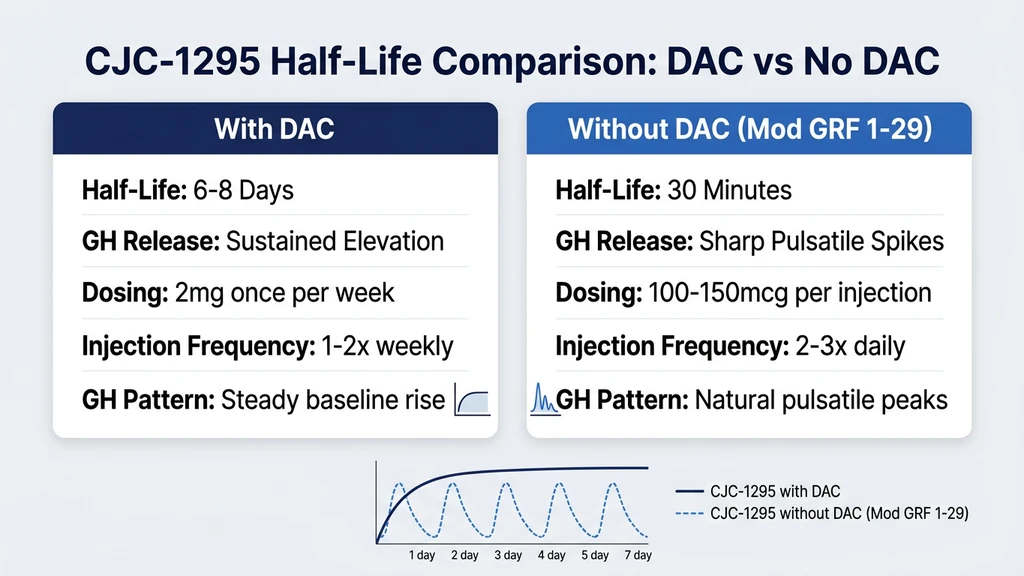
The half-life gap between these two versions is not a minor difference. It is a 230-fold difference that dictates every aspect of the protocol.
| Parameter | CJC-1295 with DAC | CJC-1295 without DAC |
|---|---|---|
| Plasma half-life | 5.8-8.1 days | ~30 minutes |
| Time to peak GH | 2-4 hours | 15-30 minutes |
| GH elevation duration | 6+ days | 2-3 hours |
| IGF-1 elevation duration | 6-14 days | 4-8 hours |
| Steady state reached | After 2-3 weekly doses | After each injection |
| Washout period | 2-3 weeks | Hours |
A study in 21 healthy adults showed that weekly dosing of CJC-1295 with DAC at 30-60 mcg/kg produced dose-dependent IGF-1 increases of 1.5 to 3-fold that persisted for the full dosing interval (Teichman et al., J Clin Endocrinol Metab, 2006). The accumulation effect means that after 2-3 weeks of weekly injections, GH and IGF-1 levels remain continuously elevated rather than cycling up and down.
With the no-DAC version, you control the timing of each GH pulse. Inject before bed: you get a GH surge during deep sleep. Inject in the morning fasted: you get a lipolytic pulse while insulin is low. Miss a dose: your levels are back to baseline within hours. This granular control is why the no-DAC version remains the preferred choice in most research protocols. Track the half-life kinetics with the Peptide Half-Life Tracker.
GH Release Pattern: Pulsatile vs Sustained
Your pituitary naturally releases growth hormone in 6-12 discrete pulses per day, with the largest surge occurring during slow-wave sleep. Between pulses, GH drops to near-zero. This on-off pattern is not a flaw in human biology. It is the signal itself.
Pulsatile GH release activates lipolysis (fat breakdown) more effectively than continuous exposure. A study in GH-deficient adults found that pulsatile GH administration produced greater fat oxidation and protein synthesis than continuous infusion at the same total dose (Giustina & Veldhuis, Endocr Rev, 1998). The liver's GH receptors also appear to respond more robustly to pulse patterns, producing more IGF-1 per unit of GH when signaling arrives in bursts (Tannenbaum et al., Endocrinology, 2003).
CJC-1295 without DAC preserves this pulse architecture. Each injection creates a clean spike, and somatostatin resets the system between doses. Stack it with ipamorelin and you get a pulse 3-5x larger than either peptide alone, because ipamorelin works through the ghrelin receptor (GHSR) while Mod GRF 1-29 works through GHRH receptor. Two doors into the same room.
CJC-1295 with DAC overrides the pulse architecture. The pituitary receives continuous GHRH stimulation, which dampens somatostatin cycling and produces a "GH plateau" rather than spikes. Total GH output over 24 hours may be equal or higher, but the pattern is different. Some users prefer this for convenience. Others find that the sustained pattern produces more water retention and fewer of the discrete benefits associated with sharp pulses.
Which Version Is Better for Specific Goals?
The right version depends on what you are trying to achieve. Here is how each version performs across the most common goals, based on GH physiology and user-reported outcomes.
Anti-Aging and Longevity
Winner: No DAC (Mod GRF 1-29)
Anti-aging benefits from GH peptides come primarily from improved sleep quality, collagen synthesis, and cellular repair. These processes are tied to the natural nocturnal GH pulse that occurs during deep sleep.
The no-DAC version, injected 30 minutes before bed on an empty stomach, amplifies this exact pulse. Users consistently report deeper sleep within the first week. Over 3-6 months, improvements in skin elasticity, hair quality, and recovery capacity follow. The pulsatile pattern keeps somatostatin cycling intact, which research suggests may protect against the insulin resistance associated with sustained GH elevation (Ho et al., J Clin Endocrinol Metab, 1996).
The DAC version provides sustained IGF-1 elevation, which does support collagen production. But the trade-off is higher water retention and a less physiological GH rhythm. For people over 40 aiming to restore youthful GH patterns, the no-DAC version better replicates what their pituitary did at age 25. For age-related peptide strategies, see our guide on peptides for anti-aging goals.
Fat Loss
Winner: No DAC (Mod GRF 1-29)
GH drives lipolysis through hormone-sensitive lipase activation. Pulsatile GH release is more effective at triggering this pathway than continuous exposure. Fasted morning injections of the no-DAC version create a GH spike at precisely the moment when insulin is low, maximizing the fat-burning window.
A practical protocol: inject 100 mcg Mod GRF 1-29 plus 200 mcg ipamorelin first thing in the morning on an empty stomach. Wait 30 minutes before eating. The resulting GH pulse pushes your body toward fat oxidation during the fasting period. For accelerated fat loss, some users add HGH Fragment 176-191 or AOD-9604, which target lipolysis without the full spectrum of GH effects.
The DAC version does elevate GH and supports fat metabolism, but the sustained pattern can also raise fasting glucose over time. If fat loss is the primary target, the pulsatile approach offers better signal-to-noise ratio. For fat-loss-specific peptide protocols, see sermorelin for fat loss and tesamorelin dosage for fat loss.
Muscle Growth and Recovery
Winner: Tie (depends on preference)
Both versions elevate IGF-1, the primary mediator of GH's anabolic effects on muscle. The DAC version provides sustained IGF-1 elevation that keeps muscle protein synthesis rates elevated throughout the week. The no-DAC version produces higher IGF-1 peaks after each injection but with troughs between doses.
For bodybuilders and athletes, the practical difference is small. The no-DAC version is more popular in the community because it pairs cleanly with ipamorelin for powerful GH bursts around training. The DAC version appeals to users who want a steady anabolic backdrop without multiple daily injections. For a broader look at GH peptides for muscle, see peptides for bodybuilding.
Some advanced users combine both: 2 mg CJC-1295 with DAC once weekly for baseline IGF-1 elevation, plus Mod GRF 1-29 with ipamorelin on training days for acute GH pulses. This hybrid approach is the most complex but provides both sustained and pulsatile benefits. Explore stacking options with the Peptide Stack Calculator.
Sleep Quality
Winner: No DAC (Mod GRF 1-29)
The largest natural GH pulse occurs during stage 3 (slow-wave) sleep. Injecting the no-DAC version 30 minutes before bed amplifies this specific pulse without altering the rest of the day's hormonal rhythm. Users report vivid dreams, deeper sleep, and feeling more rested within 5-7 days.
The DAC version elevates GH around the clock, including during sleep. But the nocturnal pulse is not as pronounced because the pituitary is already under sustained GHRH stimulation. Some DAC users report sleep improvements, but the effect is less consistent than with pre-bedtime no-DAC dosing.
For sleep-focused protocols, the no-DAC version at 100 mcg combined with 200 mcg ipamorelin before bed is the standard approach. See the CJC-1295 profile for detailed protocol guidance.
IGF-1 Elevation
Winner: DAC
If your goal is maximizing sustained IGF-1 levels (as confirmed by bloodwork), the DAC version wins. Weekly 2 mg injections produce continuous IGF-1 elevation of 1.5 to 3-fold above baseline that does not drop between doses (Teichman et al., J Clin Endocrinol Metab, 2006).
The no-DAC version produces transient IGF-1 spikes that return to baseline within hours. Over a day with 2-3 injections, total IGF-1 area-under-the-curve is lower than the DAC version's sustained elevation. If your endocrinologist is tracking IGF-1 as a biomarker, the DAC version produces more consistent, interpretable numbers.
The caveat: higher sustained IGF-1 is not always better. Chronically elevated IGF-1 above 300 ng/mL is associated with increased cancer risk in epidemiological studies (Renehan et al., BMJ, 2004). The pulsatile pattern keeps IGF-1 fluctuating within the upper-normal range rather than chronically elevated. Monitor bloodwork every 6-8 weeks. Target IGF-1 of 200-300 ng/mL regardless of which version you use.
Dosage Comparison: Daily Precision vs Weekly Convenience
The dosing protocols for these two versions look nothing alike. Confusing them is one of the most common mistakes in the GH peptide space.
| Parameter | CJC-1295 with DAC | CJC-1295 without DAC (Mod GRF 1-29) |
|---|---|---|
| Standard dose | 2 mg per injection | 100 mcg per injection |
| Frequency | 1-2x per week | 2-3x per day |
| Weekly total | 2-4 mg | 1,400-3,150 mcg (1.4-3.15 mg) |
| Timing | Any time, same day each week | Empty stomach, 1 hr after eating |
| Best timing | Evening for sleep benefit | Morning fasted, post-workout, pre-bed |
| Cycle length | 8-12 weeks on, 4 weeks off | 8-16 weeks on, 4-6 weeks off |
| Stacking dose | Same (2 mg) | 100-150 mcg per injection with GHRP |
| Reconstitution | 2 mL bac water per 2 mg vial | 2-5 mL bac water per 2-5 mg vial |
No-DAC protocol (standard): Inject 100 mcg Mod GRF 1-29 combined with 200-300 mcg ipamorelin in the same syringe, 2-3 times daily. The pre-bed dose is the most important. Inject on an empty stomach: food (especially carbohydrates) raises insulin and blunts GH release. Wait 20-30 minutes after injection before eating.
DAC protocol (standard): Inject 2 mg subcutaneously once per week. Some users split to 1 mg twice weekly for slightly more even GH elevation. Timing relative to meals matters less because the albumin-bound peptide releases its signal continuously. However, some practitioners still recommend evening dosing.
For reconstitution volumes and syringe measurements, use the Peptide Reconstitution Calculator. For general injection technique, see the how to inject peptides guide.
What Happens When You Confuse the Dosages
The 20x difference in standard dosing between these versions creates real danger scenarios when users mix them up.
Scenario 1: Taking DAC Doses of the No-DAC Version
You read that CJC-1295 is dosed at "2 mg per injection" and apply this to the no-DAC version. You inject 2,000 mcg of Mod GRF 1-29, twenty times the standard 100 mcg dose.
The result: a massive, supraphysiological GH surge. Your pituitary dumps its entire stored GH supply. Within hours, you experience intense facial flushing, severe water retention, numbness in your hands and feet, and a pounding headache. Your fasting glucose spikes the next morning because GH at these levels induces acute insulin resistance.
The fix: Mod GRF 1-29 (no DAC) is always dosed in micrograms (mcg), not milligrams (mg). The standard range is 100-150 mcg per injection. If your vial is labeled in milligrams, do the conversion before drawing. Use the CJC-1295 + Ipamorelin Dosage Calculator to avoid this error.
Scenario 2: Taking No-DAC Doses of the DAC Version
You inject 100 mcg of CJC-1295 with DAC instead of the standard 2 mg (2,000 mcg). You are taking one-twentieth of the effective dose.
The result: essentially nothing. At 100 mcg, the albumin-bound peptide concentration is too low to produce meaningful GHRH receptor activation over the 6-8 day half-life. You waste weeks of a protocol wondering why your sleep has not improved and your bloodwork shows no IGF-1 change.
The fix: CJC-1295 with DAC is dosed in milligrams (mg). The standard dose is 2 mg (2,000 mcg) per injection. If your source provides it in a 2 mg vial, the entire vial is one dose. Check the label concentration before reconstituting. For storage guidance after reconstitution, see how to store peptides.
Side Effect Comparison
Both versions share common GH-related side effects because they act on the same receptor. The differences are in severity and pattern.
| Side Effect | CJC-1295 with DAC | CJC-1295 without DAC |
|---|---|---|
| Water retention | Moderate to significant (constant GH) | Mild (pulsatile, resolves between doses) |
| Injection site reaction | Mild redness, occasional nodule | Mild redness, less common |
| Flushing/warmth | Common, lasts hours | Common, resolves in minutes |
| Numbness/tingling (hands) | More common (sustained IGF-1) | Less common (transient IGF-1) |
| Headaches | Moderate in first 1-2 weeks | Mild in first week |
| Increased hunger | Mild | Moderate (especially stacked with GHRP) |
| Vivid dreams | Reported | Frequently reported (pre-bed dosing) |
| Insulin resistance risk | Higher (sustained GH elevation) | Lower (pulsatile, allows insulin reset) |
| Joint stiffness | More common | Less common |
The DAC version's sustained GH elevation is responsible for its heavier side effect profile. Water retention is the most frequently cited complaint: users report 2-5 lbs of water weight gain in the first 2-3 weeks. This typically stabilizes but does not fully resolve while on protocol. The no-DAC version produces transient water retention that clears between doses.
The insulin sensitivity difference deserves attention. Sustained GH elevation opposes insulin action continuously. Pulsatile GH allows insulin sensitivity to recover between pulses. For anyone with prediabetes, metabolic syndrome, or a family history of type 2 diabetes, the no-DAC version carries lower metabolic risk. Monitor fasting glucose and HbA1c every 6-8 weeks regardless of which version you choose.
Both versions share the same contraindications: active cancer (GH and IGF-1 promote cell growth), pregnancy, pituitary disorders, and diabetic retinopathy. See the peptide safety guide for comprehensive contraindication information.
Stacking Considerations: Why Ipamorelin Pairs with No DAC
The CJC-1295 (no DAC) plus ipamorelin stack is the most widely used GH peptide combination in the research community. The pairing works because the two peptides activate different receptor pathways that converge on the same outcome.
Mod GRF 1-29 activates the GHRH receptor on pituitary somatotrophs, telling them to produce and release growth hormone. Ipamorelin activates the ghrelin receptor (GHS-R1a), which triggers the release of stored GH from a separate intracellular signaling cascade. Together, they produce GH pulses 3-5 times larger than either peptide alone (Bowers, J Clin Endocrinol Metab, 1998).
This synergy only works cleanly with the no-DAC version. Why? Because the sharp, time-limited GHRH signal from Mod GRF 1-29 synchronizes precisely with the sharp ghrelin signal from ipamorelin. Both peak at 15-30 minutes post-injection, creating a single coordinated burst. When the DAC version provides continuous GHRH stimulation, the ghrelin pulse from ipamorelin still occurs, but it lacks the coordinated amplification because the GHRH signal never "turns off" to reset.
Some users do stack DAC with ipamorelin, injecting ipamorelin 2-3x daily on top of a weekly DAC injection. This provides a sustained baseline plus acute pulses. The approach is valid but adds complexity and cost without clear evidence of superiority over the no-DAC plus ipamorelin standard.
Other stacking options:
- Mod GRF 1-29 + ipamorelin + BPC-157: For injury recovery with GH support. The elevated GH and IGF-1 accelerate collagen synthesis while BPC-157 drives localized tissue repair. See the peptide stacking guide for timing details.
- Mod GRF 1-29 + ipamorelin + MK-677: MK-677 provides oral, 24-hour ghrelin receptor activation while the injectable stack adds acute pulses. This is a high-GH protocol with more side effects (water retention, hunger from MK-677). See the MK-677 profile for dosing.
- CJC-1295 with DAC + hexarelin: Hexarelin is a more potent GHRP than ipamorelin but raises cortisol and prolactin. This stack is for advanced users only and requires monitoring. Hexarelin also desensitizes faster, limiting cycle length to 4-8 weeks.
For building your own stack, use the Peptide Stack Calculator and the Peptide Interaction Checker.
Cost Comparison: Monthly Expense Breakdown
The total monthly cost depends on the version, dose, and whether you stack with a GHRP.
| Protocol | Monthly Peptide Cost | Supplies (syringes, bac water) | Total Monthly Cost |
|---|---|---|---|
| Mod GRF 1-29 alone (100 mcg 3x/day) | $30-50 | $10-15 | $40-65 |
| Mod GRF 1-29 + ipamorelin (standard) | $50-90 | $15-20 | $65-110 |
| CJC-1295 with DAC alone (2 mg/week) | $35-70 | $5-10 | $40-80 |
| CJC-1295 DAC + ipamorelin (hybrid) | $60-110 | $15-20 | $75-130 |
The DAC version uses less product per month in terms of injection count, but each injection requires a full 2 mg dose. A 2 mg vial is one dose. The no-DAC version uses smaller amounts per injection (100-150 mcg) but requires 60-90 injections per month when dosed three times daily.
Supply costs tip toward the DAC version: fewer syringes, fewer alcohol swabs, less bacteriostatic water. For a 12-week protocol, the DAC version saves roughly $30-50 on supplies alone. For help estimating your total peptide budget, use the Peptide Cost Calculator.
The hidden cost to consider: the no-DAC version is almost always used with ipamorelin, which adds $25-40 per month. The DAC version can be run standalone. When comparing total protocol cost including the GHRP, the two approaches end up within $20-30 per month of each other.
How to Choose: Decision Framework
Your decision comes down to three factors: goals, lifestyle, and experience level.
Choose CJC-1295 without DAC (Mod GRF 1-29) if:
- You want to mimic natural, pulsatile GH release
- You plan to stack with ipamorelin (the gold-standard combo)
- Your primary goals are fat loss, sleep quality, or anti-aging
- You are comfortable with 2-3 daily subcutaneous injections
- You have metabolic concerns (prediabetes, insulin resistance)
- You want granular control over timing (fasted morning, pre-bed)
Choose CJC-1295 with DAC if:
- Injection convenience is your top priority
- You travel frequently and cannot maintain a 3x daily protocol
- Your primary goal is sustained IGF-1 elevation (confirmed by bloodwork)
- You prefer a simpler protocol with fewer daily decisions
- You do not plan to stack with a GHRP
Choose the hybrid approach if:
- You are experienced with peptides and want maximum benefit
- You want sustained baseline IGF-1 plus acute training-day pulses
- You are willing to manage a more complex protocol
- Your budget allows for both peptides plus ipamorelin
For beginners, the no-DAC version with ipamorelin is the standard starting point. It is more forgiving (short half-life means mistakes clear quickly), produces more physiological results, and pairs naturally with the most popular GHRP on the market. See getting started with peptides for a complete beginner framework.
Common Mistakes When Using Either Version
1. Eating Before Injection (No-DAC)
Food raises insulin. Insulin suppresses GH release. Injecting Mod GRF 1-29 within 60 minutes of eating a meal (especially carbohydrates) can reduce the GH pulse by 50% or more. Always inject on an empty stomach: 1 hour after eating minimum, and wait 20-30 minutes after injection before your next meal.
2. Skipping the GHRP with No-DAC
Mod GRF 1-29 alone produces a moderate GH pulse. Paired with ipamorelin, the pulse is 3-5x larger. Running the no-DAC version without a GHRP is like driving in second gear: functional but leaving significant performance on the table.
3. Injecting DAC Too Frequently
Some users inject CJC-1295 with DAC every other day, treating it like the no-DAC version. With a 6-8 day half-life, this accumulates to supraphysiological levels. Water retention becomes severe, and insulin resistance risk climbs. Stick to once or twice weekly maximum.
4. Not Cycling
Both versions can desensitize pituitary GHRH receptors over time. Standard cycling is 8-16 weeks on, 4-6 weeks off. The DAC version may require longer off periods due to its sustained receptor stimulation. Monitor IGF-1 levels to guide your cycling decisions.
5. Storing Reconstituted Vials at Room Temperature
Both versions degrade faster outside the refrigerator. Reconstituted CJC-1295 lasts approximately 21-28 days at 2-8°C. At room temperature, potency drops measurably within 48 hours. See how long do reconstituted peptides last for complete shelf-life data.
CJC-1295 DAC vs No DAC FAQ
Frequently Asked Questions
Is CJC-1295 with DAC or without DAC better for beginners?
Without DAC (Mod GRF 1-29) is better for beginners. Its 30-minute half-life means any side effects or dosing errors clear quickly. It pairs naturally with ipamorelin, the most widely studied GHRP. The short action window also makes it easier to learn how timing, fasting, and stacking affect your GH response. Start at 100 mcg per injection, twice daily.
Can I mix CJC-1295 no DAC and ipamorelin in the same syringe?
Yes. Drawing both peptides into one syringe is standard practice and does not affect potency. Draw ipamorelin first (200-300 mcg), then add Mod GRF 1-29 (100 mcg) from its vial into the same syringe. Inject subcutaneously. This reduces total daily injections from 6 to 3. Use the CJC-1295 + Ipamorelin Dosage Calculator for precise measurements.
How long does it take to see results from CJC-1295?
Sleep improvements appear within 5-7 days with the no-DAC version dosed before bed. Body composition changes (fat loss, muscle tone) become visible around weeks 6-8. IGF-1 elevation shows on bloodwork within 2-4 weeks. Anti-aging effects like improved skin elasticity require 3-6 months of consistent use. The DAC version shows similar timelines but with more gradual onset.
Does CJC-1295 with DAC cause more water retention than no DAC?
Yes. The DAC version produces sustained GH elevation 24 hours a day, which causes continuous sodium and water retention. Users typically report 2-5 lbs of water weight in the first 2-3 weeks. The no-DAC version causes transient water retention that resolves between doses, usually adding less than 2 lbs. Reducing sodium intake and staying hydrated helps manage both versions.
What is the difference between Mod GRF 1-29 and CJC-1295 no DAC?
They are the same peptide. Mod GRF 1-29 (Modified Growth Releasing Factor, amino acids 1-29) is the chemical name. CJC-1295 without DAC is the commercial name. Both refer to a 29-amino-acid GHRH analogue with four amino acid substitutions (Ala2, Ala8, Ala15, Leu27) that resist DPP-IV degradation. The half-life is approximately 30 minutes.
Can I use CJC-1295 with DAC and no DAC at the same time?
Some advanced users run both: 2 mg DAC once weekly for sustained baseline IGF-1, plus 100 mcg no-DAC with 200 mcg ipamorelin on training days for acute GH pulses. This hybrid approach provides both continuous and pulsatile benefits. It is the most expensive and complex protocol. Beginners should start with the no-DAC and ipamorelin stack alone for 2-3 cycles first.
Does CJC-1295 affect insulin sensitivity?
GH opposes insulin action. The DAC version carries higher risk because it elevates GH continuously, giving insulin sensitivity no recovery window. The no-DAC version allows insulin function to normalize between pulses. Monitor fasting glucose and HbA1c every 6-8 weeks. If fasting glucose rises above 100 mg/dL, consider reducing dose or switching to the pulsatile no-DAC version.
How should I store CJC-1295 after reconstitution?
Both versions should be stored at 2-8°C (standard refrigerator) after reconstituting with bacteriostatic water. Reconstituted CJC-1295 maintains potency for approximately 21-28 days. Lyophilized (unreconstituted) powder is stable at room temperature for months and longer when refrigerated. Never freeze reconstituted peptides. See the peptide storage guide for complete details.
The Bottom Line
CJC-1295 with DAC and CJC-1295 without DAC are two versions of the same GHRH analogue separated by a single chemical modification. That modification produces a 230-fold difference in half-life, which determines everything: injection frequency, GH release pattern, side effect profile, stacking compatibility, and which goals each version serves best.
For most users, the no-DAC version (Mod GRF 1-29) combined with ipamorelin remains the gold standard. It produces sharp, physiological GH pulses that support fat loss, sleep quality, recovery, and anti-aging with manageable side effects and lower metabolic risk. The trade-off is 2-3 daily injections on an empty stomach.
The DAC version suits users who prioritize convenience or sustained IGF-1 elevation. One weekly injection replaces a daily routine. For people who travel, dislike multiple injections, or want a simpler protocol, this convenience has real value. Calculate your personalized protocol with the CJC-1295 + Ipamorelin Dosage Calculator. For reconstitution help, use the Peptide Reconstitution Calculator. For storage after mixing, see how to store peptides. For broader GH peptide comparisons, explore the CJC-1295 profile and ipamorelin profile.
This content is for educational purposes. Consult a healthcare provider before starting any peptide protocol.
Helpful Tools
Related Articles
Tesamorelin vs Ipamorelin: Key Differences
Tesamorelin vs ipamorelin: GHRH analog vs ghrelin mimetic. Fat loss data, dosing, side effects, cost, and stacking protocols. PubMed-cited guide.
CJC-1295 Dosage: Complete Protocol Guide
CJC-1295 dosage guide: DAC and no-DAC protocols. Dosing by goal (anti-aging, fat loss, muscle, sleep), ipamorelin stacking, and injection timing.
CJC Peptide: Which CJC-1295 Are You Holding?
CJC peptide explained: CJC-1295 with DAC (6-8 day half-life) versus CJC-1295 no DAC, which is Mod GRF 1-29. How to identify the vial you actually hold.
CJC-1295 & Ipamorelin Benefits Explained
CJC-1295 and ipamorelin benefits: fat loss, muscle recovery, sleep, anti-aging, bone density, cognition, and immune support. PubMed-cited guide.