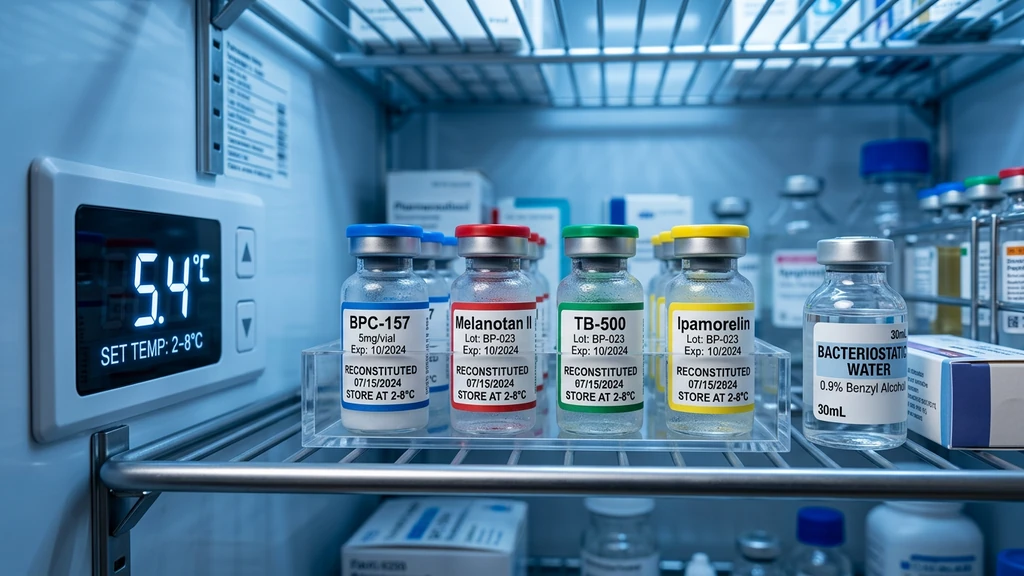
You pulled a reconstituted vial from the fridge and noticed you mixed it nine days ago. Is it still good? Most reconstituted peptides last 21 to 30 days when mixed with bacteriostatic water and stored at 2-8°C (36-46°F). Mix with sterile water instead, and the window shrinks to 24 to 48 hours.
Those numbers cover the majority of research peptides. Shelf life shifts with the specific peptide, the solvent, the storage temperature, and how many times a needle has pierced the stopper. A vial of BPC-157 handled properly holds for a full month. GHK-Cu, with its copper oxidation vulnerability, may lose potency by week three. Semaglutide in a prefilled pen can hold for 56 days.
| Solvent Used | Refrigerated (2-8°C) | Room Temperature |
|---|---|---|
| Bacteriostatic water (0.9% benzyl alcohol) | 21-30 days | Discard after 4-8 hours |
| Sterile water (no preservative) | 24-48 hours | Discard after 1-2 hours |
If you have not reconstituted your peptide yet, see the step-by-step reconstitution guide. Use the reconstitution calculator to determine exact volumes before mixing.
Get your custom peptide protocol:
- Tailored to your body and goals
- Precise dosing and cycle length
- Safe stacking combinations
- Backed by peer-reviewed studies
- Ready in under 2 minutes
19-Peptide Shelf Life Comparison Table
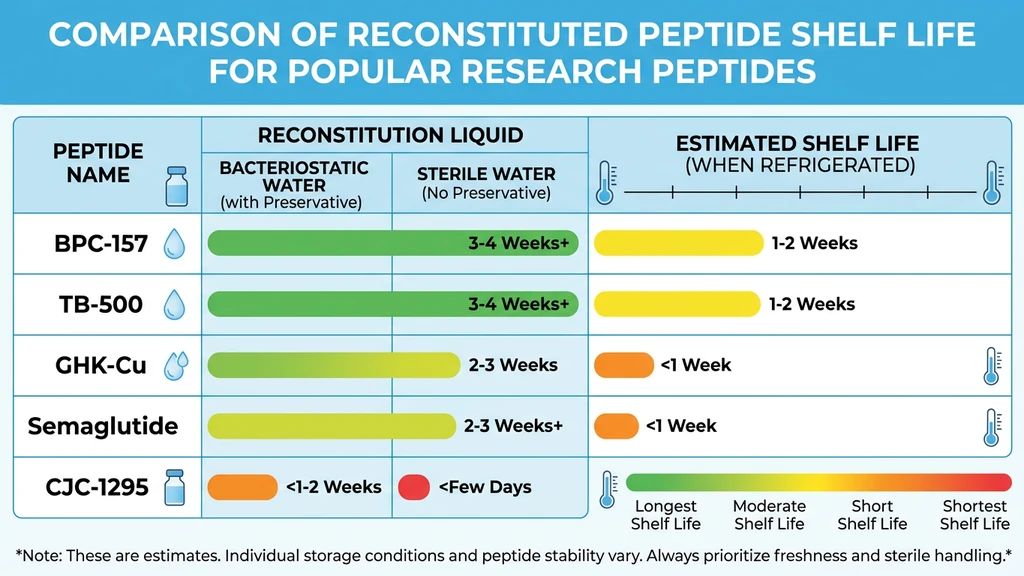
Molecular weight, amino acid composition, cyclic versus linear structure, and oxidation sensitivity all affect how long a reconstituted vial stays potent. All estimates below assume bacteriostatic water and refrigeration at 2-8°C.
| Peptide | Refrigerated Shelf Life (Bac Water) | Room Temp Tolerance | Key Stability Notes |
|---|---|---|---|
| BPC-157 | 28-30 days | 4-6 hours max | Gastric acid resistant; unusually stable |
| TB-500 | 28-30 days | 4-6 hours max | 43 amino acids; stable with gentle handling |
| GHK-Cu | 21-28 days | 2-4 hours max | Copper ion oxidizes; shorter shelf life |
| Semaglutide | 28-56 days | Up to 56 days (pen) | Pen formulations exceptionally stable |
| Tirzepatide | 28-56 days | Up to 28 days (pen) | Similar stability to semaglutide |
| Ipamorelin | 28-30 days | 4-6 hours max | Stable pentapeptide; standard handling |
| CJC-1295 | 21-28 days | 4-6 hours max | DAC variant slightly more stable than no-DAC |
| Sermorelin | 21-28 days | 4-6 hours max | Standard GH secretagogue stability |
| GHRP-6 | 21-28 days | 4-6 hours max | Standard GH secretagogue stability |
| PT-141 | 28-30 days | 4-6 hours max | Cyclic structure adds stability |
| Melanotan II | 30-40 days | 6-8 hours max | Cyclic peptide; among the most stable after mixing |
| Selank | 14-21 days | 2-4 hours max | Often nasal spray; refrigerate after opening |
| Semax | 14-21 days | 2-4 hours max | Nasal spray form; same rules as Selank |
| MOTS-c | 14-21 days | 2-4 hours max | Mitochondrial peptide; light sensitive |
| IGF-1 LR3 | 14-21 days | 2-3 hours max | pH sensitive; degrades faster than most |
| NAD+ | 7-14 days | 1-2 hours max | Degrades rapidly in solution; use quickly |
| Retatrutide | 28-30 days | 4-6 hours max | Triple agonist; standard handling |
| Epithalon | 28-30 days | 4-6 hours max | Tetrapeptide; very stable small molecule |
| Thymosin Alpha-1 | 28-30 days | 4-6 hours max | 28 amino acids; stable under standard conditions |
Cyclic peptides like PT-141 and Melanotan II last the longest. Their ring structure resists hydrolysis better than linear chains. Peptides with copper (GHK-Cu) or sensitive residues (IGF-1 LR3, NAD+) degrade faster.
GLP-1 agonists like semaglutide and tirzepatide are engineered for stability, which is why prefilled pens tolerate weeks at room temperature. For full storage instructions covering both powder and liquid forms, see the peptide storage guide.
Why Some Peptides Degrade Faster Than Others
Think of a peptide chain like a paper chain you made as a kid. Each link is an amino acid. Some chains have links made of thick cardstock: they hold together for weeks in water. Others have links made of tissue paper: moisture dissolves them in days. The literal version: molecular structure determines how fast water and oxygen break bonds in the chain.
Three factors drive the differences in that table.
1. Amino acid sequence. Peptides containing asparagine-glycine (Asn-Gly) motifs undergo deamidation, where asparagine converts to aspartate. This accelerates in aqueous solution and at higher pH. Methionine and cysteine residues are vulnerable to oxidation, especially under light or trace metal exposure (Manning et al., Pharm Res, 2010).
2. Structural type. Cyclic peptides (Melanotan II, PT-141) have their ends joined in a ring. That ring limits the angles of attack for hydrolysis and resists enzymatic breakdown. Linear peptides with exposed N- and C-terminals degrade faster.
3. Metal coordination. GHK-Cu contains a copper(II) ion bound to the peptide backbone. In solution, this copper catalyzes oxidation reactions. The copper can also dissociate from the peptide over time, reducing the active form. GHK-Cu solutions sometimes develop a blue-green tint as copper oxidation progresses (Pickart et al., Int J Mol Sci, 2015).
Bacteriostatic Water vs. Sterile Water
The solvent you use to reconstitute your peptide controls how long the solution lasts. This single choice separates a 30-day window from a 48-hour deadline.
Bacteriostatic Water (Recommended)
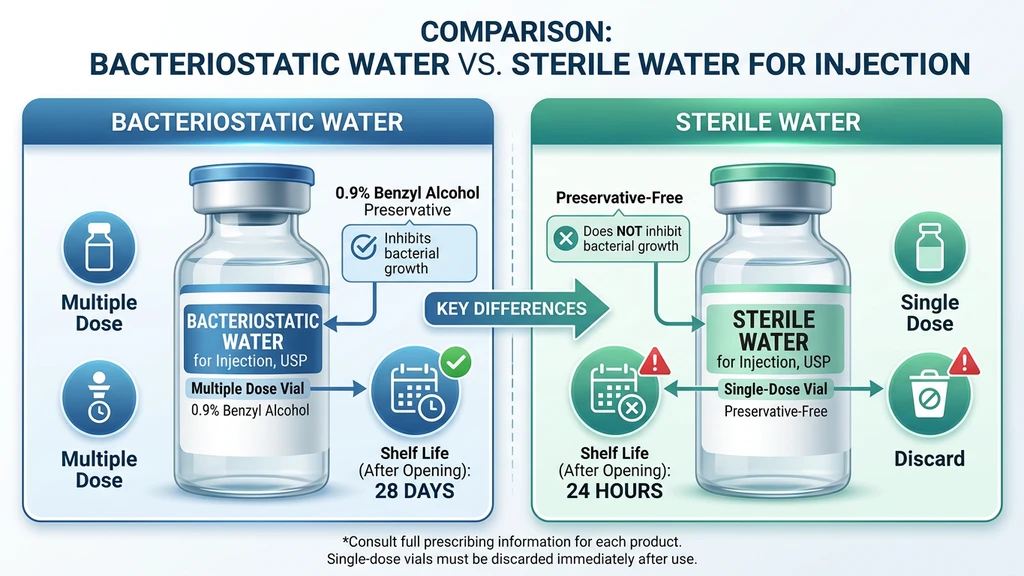
Bacteriostatic water is sterile water with 0.9% benzyl alcohol added as a preservative. The benzyl alcohol inhibits bacterial growth, which is the primary reason reconstituted peptides spoil.
Every time you insert a needle through the vial stopper, you introduce bacteria. In plain sterile water, those bacteria multiply freely. In bacteriostatic water, the benzyl alcohol keeps them suppressed for approximately 28 days (USP Chapter 797, Pharmaceutical Compounding).
One vial of 30 mL bacteriostatic water reconstitutes multiple peptide vials. After puncturing the bac water vial for the first time, mark the date. Discard after 28 days even if water remains. For mixing ratios and volume calculations, use the reconstitution calculator.
Sterile Water (Single-Use Only)
Sterile water for injection contains no preservative. It is bacteria-free when sealed, but the moment a needle breaks the seal, contamination begins with no chemical defense.
Reconstituted shelf life: 24-48 hours refrigerated. Sterile water is appropriate only for single-use laboratory assays where benzyl alcohol may interfere with results.
If you accidentally used sterile water, draw all remaining doses into separate insulin syringes immediately. Cap each syringe, store individually in the refrigerator, and use within 48 hours. This avoids repeated punctures of an unpreserved vial.
Bac Water vs. Sterile Water Comparison
| Factor | Bacteriostatic Water | Sterile Water |
|---|---|---|
| Preservative | 0.9% benzyl alcohol | None |
| Reconstituted peptide shelf life | 21-30 days (refrigerated) | 24-48 hours (refrigerated) |
| Multi-dose use | Yes (up to 28 days) | No (single withdrawal only) |
| Bacterial inhibition | Yes | No |
| Cost per vial | $3-8 (30 mL) | $1-3 (10 mL) |
| Water shelf life after opening | 28 days | Use immediately |
| Best for | Standard peptide reconstitution | Single-dose lab protocols |
A $5 vial of bacteriostatic water protects a $50-200 peptide vial for an entire month. Using sterile water to save a few dollars risks wasting the peptide itself.
How Temperature Affects Reconstituted Peptide Shelf Life
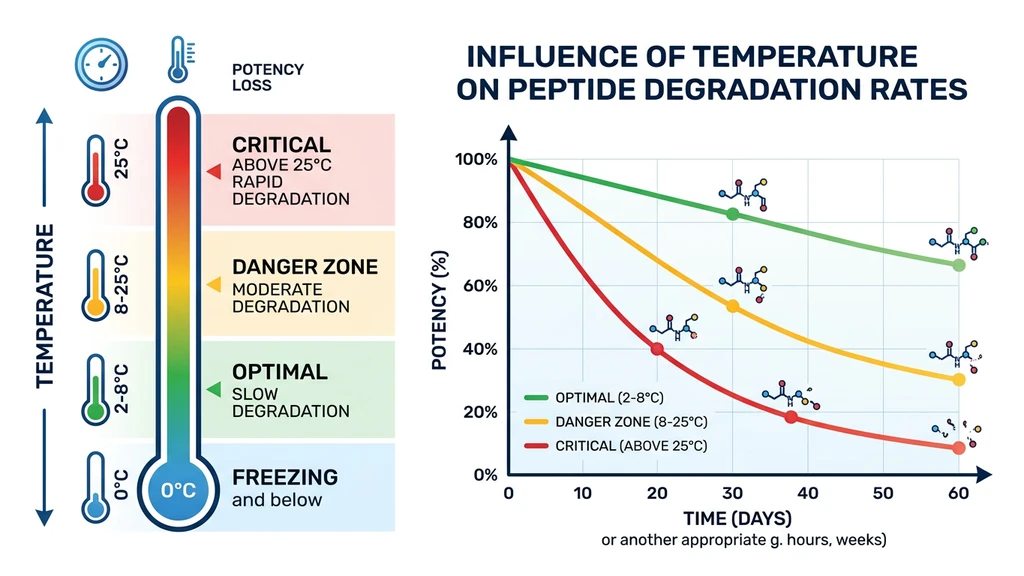
Every 10°C increase roughly doubles the rate of chemical degradation in peptide solutions (Arrhenius principle). Proper refrigeration is mandatory for reconstituted peptides.
Refrigerator (2-8°C): The Standard
All reconstituted peptides belong in the refrigerator. At 2-8°C, hydrolysis and deamidation slow enough to preserve potency for weeks.
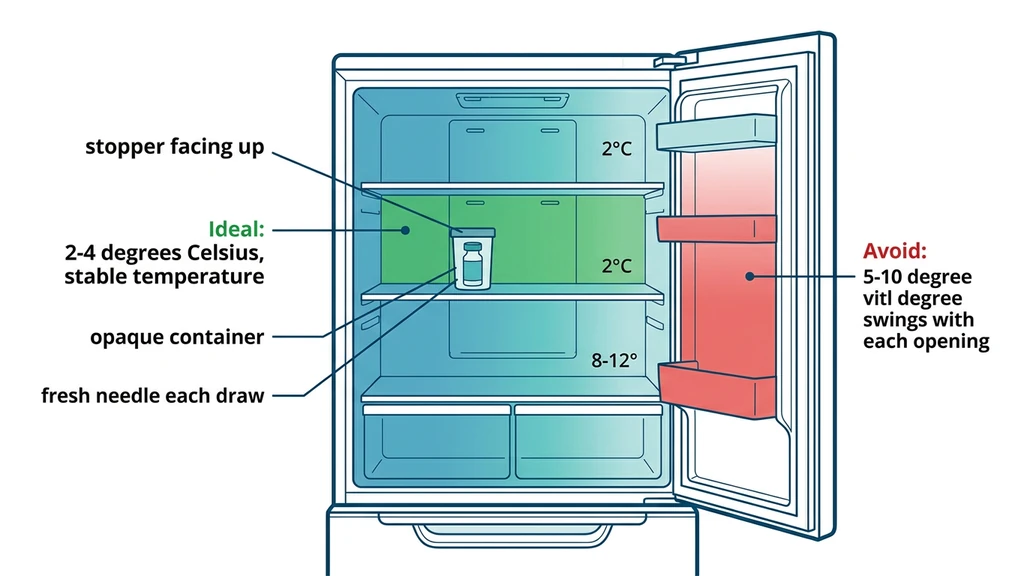
Placement matters. The back of the middle shelf maintains the most consistent temperature. The fridge door swings 5-10°C every time you open it. Over a month, those fluctuations accumulate and shorten shelf life by several days.
Store vials upright with the stopper facing up. This minimizes the surface area of liquid in contact with the rubber, reducing stopper leaching. Place vials in a small container or zip-lock bag for protection against spills and light.
Room Temperature (20-25°C): Limited Window
Reconstituted peptides left at room temperature degrade rapidly. Higher temperature accelerates both chemical breakdown and bacterial growth.
| Duration at Room Temp | Estimated Potency Loss | Recommended Action |
|---|---|---|
| Under 1 hour | Under 1% | Refrigerate; continue use |
| 1-4 hours | 1-5% | Refrigerate; use within a few days |
| 4-12 hours | 5-15% | Inspect carefully; use soon |
| 12-24 hours | 15-30% | Use at your own discretion |
| Over 24 hours | Major loss + bacterial risk | Discard |
You draw your dose and leave the vial on the counter for an hour while you inject. That is fine. Brief exposure causes negligible damage. The danger is forgetting the vial overnight or leaving it in a warm car.
Freezer: Never Freeze Reconstituted Peptides
Freezing a reconstituted peptide destroys it. When water freezes, ice crystals physically shear peptide bonds, breaking the molecule into inactive fragments. This applies to every reconstituted peptide without exception: BPC-157, TB-500, semaglutide pens, GHK-Cu solutions.
If your refrigerator thermostat malfunctions and the back of the fridge reaches 0°C, inspect your vials. Partial freezing still produces ice crystals. If you see any ice, or if the solution appears cloudy after thawing, discard the vial.
Lyophilized (powder) peptides store best in the freezer at -20°C. Powder goes in the freezer. Liquid stays in the fridge.
Semaglutide and Tirzepatide Pen Exceptions
Prefilled pens for semaglutide and tirzepatide are formulated for extended stability at controlled room temperature. Ozempic pens tolerate up to 30°C (86°F) for 56 days after first use (Novo Nordisk prescribing information, 2022). Mounjaro pens allow up to 21 days at room temperature (Eli Lilly prescribing information, 2022).
These pens use pharmaceutical-grade formulations with buffering agents, stabilizers, and preservatives beyond what standard bacteriostatic water reconstitution provides. The extended room-temperature tolerance is a feature of the formulation.
Compounded semaglutide or tirzepatide reconstituted from lyophilized powder with bacteriostatic water does not share this shelf life. Treat compounded versions like any other reconstituted peptide: refrigerate and use within 28-30 days. For tirzepatide-specific refrigeration timelines, see how long tirzepatide lasts in the fridge.
Danger Scenarios: What Happens When Storage Goes Wrong
These scenarios use real numbers. Each shows the exact mistake, the measurable consequence, and the fix.
Scenario 1: You leave a BPC-157 vial on the kitchen counter overnight.
You draw your evening dose at 9 PM and forget to return the vial to the fridge. By 8 AM, the vial has spent 11 hours at 22°C. At that temperature, degradation proceeds roughly 4x faster than at 4°C (based on the Arrhenius rate doubling per 10°C). Potency loss: an estimated 8-15%. Bacterial colony counts in unpreserved media double every 20 minutes at room temperature; even with bac water's benzyl alcohol, 11 hours at 22°C strains the preservative's capacity.
The fix: set a phone timer when you take the vial out. Return it to the fridge within 5 minutes of drawing your dose. If left out under 4 hours, refrigerate and continue. Beyond 12 hours, discard.
Scenario 2: You reconstitute with sterile water instead of bacteriostatic water and use the vial for a week.
Day 1, the solution is clear. By day 4, bacteria that entered through the first needle puncture have been multiplying unopposed. USP Chapter 797 defines beyond-use dates for sterile preparations without preservatives at 48 hours refrigerated. By day 7, bacterial counts may exceed 10^3 CFU/mL, enough to cause injection site infection: redness, swelling, warmth, and potential abscess formation. A study of contaminated injectable preparations found that 23% of multi-dose vials without preservatives showed bacterial growth within 72 hours (Mattner & Gastmeier, Am J Infect Control, 2004).
The fix: always verify "bacteriostatic" on the water vial label before reconstituting. If you already used sterile water, draw all remaining doses into capped syringes, refrigerate, and use within 48 hours. Discard the vial.
Signs Your Reconstituted Peptide Has Degraded
A degraded peptide may look different, perform differently, or both. Some signs are visible. Others require tracking your results over time.
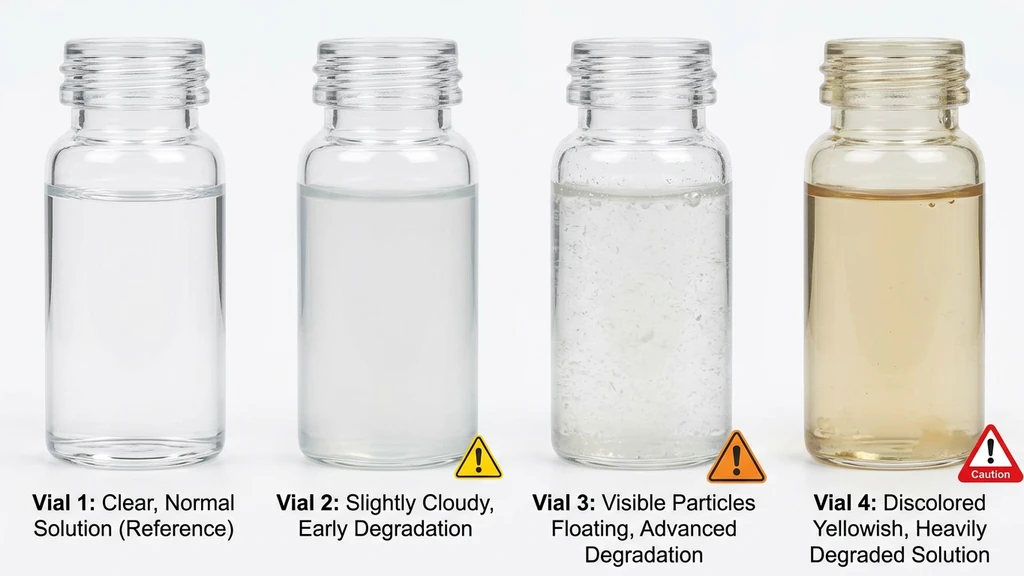
Visual Warning Signs
Check every vial before every use. Hold it up to a light source.
Cloudiness or haziness. A properly reconstituted peptide is perfectly clear. Any opacity indicates aggregation (peptide chains clumping) or bacterial contamination. Discard.
Floating particles. Specks, fibers, or sediment mean the peptide has precipitated out of solution. The active compound is no longer fully dissolved. Potency is severely reduced.
Color change. Most peptide solutions are colorless. A yellow or brown tint signals oxidation, typically affecting tryptophan or tyrosine residues (Manning et al., Pharm Res, 2010). This degradation is irreversible.
Persistent foam. Foam that does not settle within a minute suggests denaturation. This usually results from shaking the vial rather than swirling it.
Performance Warning Signs
Sometimes a vial looks clear but has lost meaningful potency. Track your results.
Reduced effectiveness. A BPC-157 protocol that produced noticeable improvement for two weeks suddenly plateaus. A TB-500 vial that was reducing inflammation stops working at the same dose. If nothing else changed, the vial may have degraded.
Increased injection site reactions. New redness, swelling, or pain at injection sites that was not present with a fresh vial. This may indicate bacterial contamination or degradation byproducts triggering a local immune response. Compare against the timelines in the peptide injections guide.
When to Discard vs. When It Is Still Usable
Discard immediately if:
- The solution is cloudy, discolored, or contains visible particles
- The vial has been at room temperature for over 24 hours
- The vial has an unusual or foul smell
- More than 30 days have passed since reconstitution (with bac water)
- More than 48 hours have passed since reconstitution (with sterile water)
- The solution froze at any point, even partially
Likely still usable if:
- The solution is clear and colorless
- The vial has been consistently refrigerated
- You are within the recommended shelf life window
- A brief room-temperature exposure (under 4 hours) occurred once
When in doubt, discard. A wasted $50 vial costs less than treating an injection site abscess.
Step-by-Step: Maximizing Reconstituted Peptide Shelf Life
Following these steps consistently pushes your reconstituted shelf life to the upper end of its range.
Reconstitution Procedure
1. Confirm your solvent. Read the label on the water vial. It must say "bacteriostatic." The 0.9% benzyl alcohol preservative is what makes the 28-30 day window possible, and proper storage of the water itself matters too — see does bacteriostatic water need to be refrigerated. See the reconstitution guide for the full process.
2. Add water gently. Aim the stream down the inside wall of the peptide vial. Let gravity pull it to the powder.
3. Swirl, never shake. Roll the vial between your palms for 30-60 seconds. Shaking creates foam and can damage peptide chains through mechanical shear stress.
4. Label immediately. Write the reconstitution date, peptide name, and concentration (mg/mL) on the vial with a fine-tip marker. This prevents guesswork and tracks the 30-day expiration.
5. Refrigerate within five minutes. Draw your first dose, then get the vial into the fridge. Do not leave it on the counter while you prepare your injection site.
Storage Rules
1. Store upright. Keep vials with the stopper facing up to minimize the surface area of liquid touching the rubber.
2. Use the back of the middle shelf. Temperature stays between 2-4°C with minimal fluctuation. The fridge door is the worst location.
3. Protect from light. Keep vials in a small opaque container or a zip-lock bag wrapped in foil. UV light degrades tryptophan and tyrosine residues. This matters most for light-sensitive peptides like MOTS-c and Selank.
4. Use a fresh needle every draw. Each puncture introduces contaminants and widens the stopper hole. A wider hole allows more air exchange, accelerating oxidation.
5. Reconstitute one vial at a time. Keep extras as powder in the freezer at -20°C. Powder lasts years. Liquid lasts weeks.
If You Reconstituted Too Much
Calculate how much peptide you need for 30 days before mixing. Use the reconstitution calculator to determine the right volume of bacteriostatic water for your target concentration.
If you already over-reconstituted, use the peptide within the 30-day window at your normal dose. Accept that some will remain. Do not freeze it (this destroys the peptide) and do not extend past 30 days (contamination risk climbs).
For expensive peptides, purchase smaller vial sizes (2 mg or 5 mg instead of 10 mg) if your dosing protocol does not use a full vial within 30 days.
Common Mistakes with Reconstituted Peptides
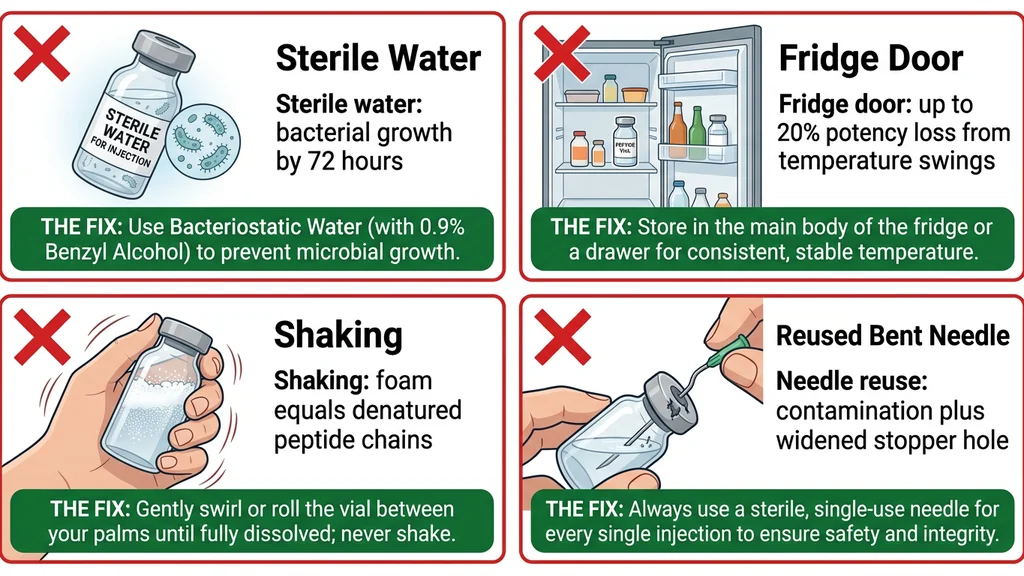
Mistake 1: Using sterile water for a multi-dose vial.
You save $3 on water and lose a $150 peptide vial. Without benzyl alcohol preservative, bacterial contamination can reach unsafe levels within 72 hours (Mattner & Gastmeier, Am J Infect Control, 2004). By the time you draw dose four or five, the vial is a bacterial culture. Always use bacteriostatic water for multi-dose protocols.
Mistake 2: Storing vials in the fridge door.
The door swings open 10-15 times per day in most households. Each opening exposes the vial to a 5-10°C temperature spike. Over 30 days, cumulative thermal stress reduces potency by an estimated 10-20% compared to back-shelf storage. Move your vials to the back of the middle shelf.
Mistake 3: Shaking the vial to dissolve the powder.
Vigorous shaking generates foam and subjects peptide chains to mechanical shear stress. Denatured peptide aggregates form visible clumps or invisible microaggregates that reduce potency. Swirl or roll between your palms for 30-60 seconds instead.
Mistake 4: Reusing needles between draws.
Each needle pass through the stopper widens the puncture channel and deposits bacteria from the needle surface and surrounding air. By the 15th draw with reused needles, stopper integrity is compromised and contamination risk is significantly elevated. Use a new needle every time.
Reconstituted Peptide Shelf Life FAQ
Frequently Asked Questions
How long do reconstituted peptides last in the fridge?
Most reconstituted peptides last 21-30 days in the fridge (2-8°C) when mixed with bacteriostatic water. Cyclic peptides like Melanotan II may last up to 40 days. Sensitive peptides like NAD+ and IGF-1 LR3 should be used within 14-21 days. With sterile water (no preservative), use within 24-48 hours regardless of peptide type.
Can I use a reconstituted peptide after 30 days?
Using a reconstituted peptide past 30 days is not recommended. Potency decreases steadily after the first few weeks, and bacterial contamination risk rises even with bacteriostatic water. If the solution is still clear at day 31-35 and was stored properly, potency may be reduced by 10-20%. Past 35 days, discard the vial.
Why did my reconstituted peptide turn cloudy?
Cloudiness indicates peptide aggregation (chains clumping together) or bacterial contamination. Common causes: temperature fluctuations, shaking the vial, contaminated equipment, or exceeding the shelf life. A cloudy solution should be discarded regardless of cause. Properly handled peptides remain clear throughout their usable life.
Does reconstituted semaglutide last longer than other peptides?
Compounded semaglutide reconstituted with bacteriostatic water follows the standard 28-30 day shelf life. Prefilled pens (Ozempic, Wegovy) use pharmaceutical formulations with added stabilizers allowing up to 56 days of use, including room temperature storage up to 30°C. The extended shelf life comes from the pen formulation, per the Novo Nordisk prescribing information (2022).
What happens if I freeze a reconstituted peptide by accident?
Freezing destroys reconstituted peptides. Ice crystals physically break peptide bonds, producing degraded fragments with reduced or zero potency. If your vial froze even partially (you noticed ice or the solution turned cloudy after thawing), discard it. Only lyophilized (powder) peptides should be stored in the freezer at -20°C.
How do I know if my bacteriostatic water is still good?
Bacteriostatic water lasts 28 days after the first needle puncture, per USP Chapter 797. Mark the date you first pierced the stopper. If the water is clear, colorless, and within 28 days, it is usable. Discard if cloudy, past 28 days, or if you cannot confirm when it was first opened.
Can I store reconstituted peptides at room temperature?
Only pharmaceutical pen formulations (Ozempic, Mounjaro) tolerate room temperature for extended periods. All other reconstituted peptides degrade rapidly above 8°C. At 22°C, degradation proceeds roughly 4x faster than at 4°C. Refrigerate within 5 minutes of drawing your dose.
Is it safe to use a peptide vial that was left out for 6 hours?
At 6 hours at room temperature, estimated potency loss is 5-10%. If the solution is still clear and was reconstituted with bacteriostatic water, refrigerate it and use within a few days. Beyond 12 hours at room temperature, discard. The combination of chemical degradation and bacterial growth makes the risk outweigh the cost of a replacement vial.
The Bottom Line
Reconstituted peptide shelf life follows a predictable rule: 21-30 days with bacteriostatic water, 24-48 hours with sterile water, always refrigerated at 2-8°C. Pharmaceutical pen formulations of semaglutide and tirzepatide are the only exceptions, tolerating room temperature for weeks due to specialized stabilizers.
Maximize shelf life by using bacteriostatic water, refrigerating within minutes of mixing, storing vials upright on the back of the middle fridge shelf, and using a fresh needle for every draw.
Discard any vial that is cloudy, discolored, contains particles, or has exceeded 30 days since mixing. The cost of a replacement vial is always less than the risk of injecting a contaminated solution. For reconstitution volumes and concentration calculations, use the reconstitution calculator. For injection technique and site rotation, read the peptide injections guide. For bacteriostatic water shelf life specifically, see how long does bacteriostatic water last. For choosing the right diluent, read is reconstitution solution the same as bacteriostatic water. For sourcing, see where to buy bacteriostatic water and where to buy peptides in 2026. For all dosage references, see the peptide dosage chart. For broader safety considerations, see the peptide safety guide. New to peptides? Start with our getting started with peptides guide.
Related Articles: - How to Store Peptides - How to Reconstitute Peptides - Bacteriostatic Water vs Sterile Water - Where to Buy Bacteriostatic Water - Peptide Safety Guide
Helpful Tools
Related Articles
Best Peptides for Arthritis: What Evidence Shows
Best peptides for arthritis ranked by evidence: semaglutide knee OA trial, collagen RCTs, BPC-157, TB-500, KPV, thymosin alpha-1. By type, route and red flags.
How to Store Peptides: Full Guide
Learn how to store peptides correctly. Temperature guide, shelf life chart for 29 peptides, reconstituted storage, travel tips, and signs of degradation.
Peptides for Healing: What the Evidence Shows
Peptides for healing by tissue: tendon, bone, wound, gut, post-surgery. Which claims rest on human trials, which rest on rat studies, and what is unsafe.
KLOW Peptide: Benefits, Dosage, and KLOW vs GLOW
KLOW peptide benefits, blend composition (GHK-Cu, BPC-157, TB-500, KPV), per-component dosing math, the copper ceiling, and how KLOW differs from GLOW.