You found a bottle labeled "BPC-157 + TB-500 Capsules" and want to know whether swallowing two peptides in a single pill can actually work. The BPC-157 component has demonstrated oral efficacy for GI healing in animal studies. Oral TB-500 (Thymosin Beta-4 fragment) lacks equivalent evidence for systemic bioavailability, making the capsule blend a lopsided proposition for musculoskeletal targets. BPC-157 survives gastric acid in its arginate form and heals the gut directly regardless of absorption. TB-500, a 43-amino-acid peptide, faces significant enzymatic degradation in the GI tract with no published pharmacokinetic study confirming oral absorption (Goldstein & Kleinman, Expert Opin Biol Ther, 2012).
| Quick Reference | Details |
|---|---|
| What is it? | Oral capsule containing both BPC-157 and TB-500 peptides |
| Common name | Wolverine stack (capsule form) |
| BPC-157 oral evidence | Strong (multiple animal studies, cytoprotection confirmed orally) |
| TB-500 oral evidence | Weak (no published oral PK data; efficacy shown only via injection) |
| Typical capsule dose | 500 mcg BPC-157 + 750-1,500 mcg TB-500 per capsule |
| Recommended protocol | 1-2 capsules daily for 4-8 weeks |
| Best for | GI healing with potential systemic recovery support |
| Key limitation | TB-500 bioavailability via oral route is unproven |
BPC-157 is not FDA-approved. No completed human clinical trial exists for this combination. Consult a healthcare provider before use.
For the injectable version of this stack, see our wolverine peptide stack guide. For combined dosing protocols, see our BPC-157 + TB-500 dosage guide.
Get your custom peptide protocol:
- Tailored to your body and goals
- Precise dosing and cycle length
- Safe stacking combinations
- Backed by peer-reviewed studies
- Ready in under 2 minutes
What Are BPC-157 + TB-500 Capsules?
BPC-157 + TB-500 capsules combine two healing peptides into a single oral dose. The concept originates from the injectable "wolverine stack," named for the comic-book character's regenerative ability. Vendors adapted the injectable combination into capsule form to offer a needle-free alternative.
BPC-157 (Body Protection Compound-157) is a 15-amino-acid peptide derived from human gastric juice. It has extensive animal research demonstrating wound healing, GI protection, and anti-inflammatory effects. Oral administration is well-studied: the peptide was originally discovered in the stomach and retains biological activity when taken by mouth (Sikiric et al., Curr Pharm Des, 2011).
TB-500 is a synthetic fragment of Thymosin Beta-4 (Tb4), a 43-amino-acid protein involved in cell migration, angiogenesis, and tissue repair. Tb4 was tested in human clinical trials for chronic wound healing and dry eye, both via injection or topical application (Philp et al., Ann N Y Acad Sci, 2006). Its oral pharmacology remains uncharacterized.
Most capsule products on the market contain 500 mcg of BPC-157 paired with 750 mcg to 1,500 mcg of TB-500. Some use the BPC-157 arginate form; others use acetate. The TB-500 component is typically the acetate salt.
How BPC-157 and TB-500 Work Together
The two peptides target overlapping but distinct phases of tissue repair. Understanding each one's role explains why researchers and users combine them.
Think of wound healing like rebuilding a damaged road. BPC-157 acts as the emergency repair crew: it stabilizes the surface, patches cracks, and restores basic function quickly. It upregulates VEGF (vascular endothelial growth factor) to build new blood vessels to the damaged area and stabilizes nitric oxide production to maintain blood flow (Hsieh et al., Sci Rep, 2020). BPC-157 works from the ground up, excelling at mucosal and connective tissue repair.
TB-500 is the structural engineering team. It promotes actin polymerization, which is the scaffolding that cells use to migrate into wounded areas (Goldstein & Kleinman, Expert Opin Biol Ther, 2012). It reduces inflammation through downregulation of inflammatory cytokines and supports stem cell differentiation. TB-500 handles the larger-scale remodeling: recruiting new cells, building structural frameworks, modulating the immune response.
Combined, the two peptides address both acute stabilization (BPC-157) and long-term structural repair (TB-500). Animal studies on each peptide individually show accelerated healing of tendons, muscles, and GI tissue. No study has tested the oral combination directly, but the non-overlapping mechanisms provide a logical basis for stacking.
Can Both Peptides Work in Capsule Form?
This is the central question, and the honest answer is: one can, one might not.
BPC-157 Oral Evidence: Strong
BPC-157 was isolated from human gastric juice. It is a stable gastric pentadecapeptide, meaning it resists the acidic, enzyme-rich environment of the stomach better than most peptides. Multiple animal studies have administered BPC-157 orally (in drinking water) and demonstrated healing of gastric ulcers, intestinal anastomoses, and fistulas (Sikiric et al., Gut Liver, 2020).
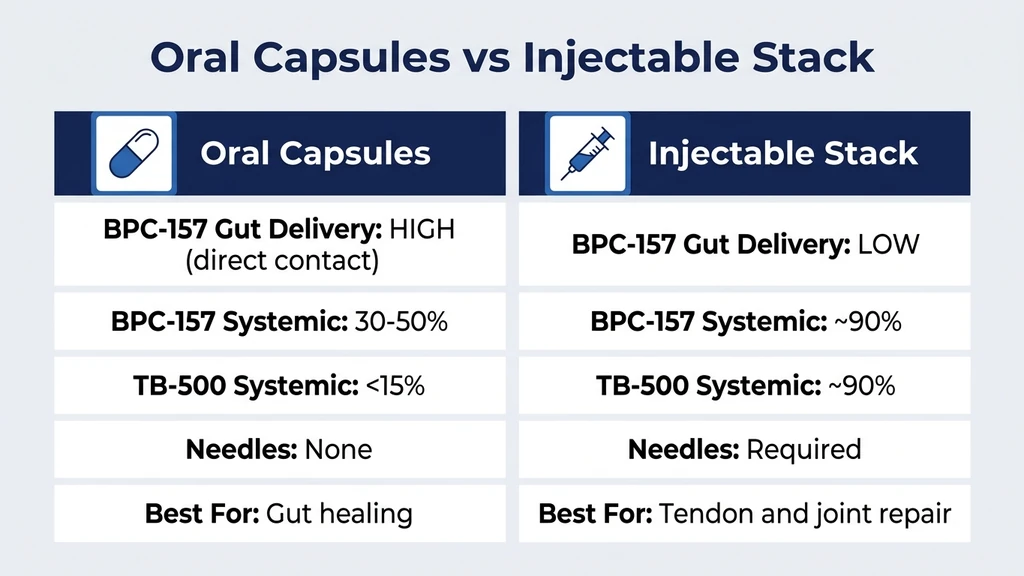
He et al. (2022) measured oral bioavailability at approximately 3% for the acetate form in rats (He et al., Front Pharmacol, 2022). The arginate form may reach up to 90% (per patent data). Even at 3% systemic absorption, the local GI effects are potent because the peptide contacts the gut lining at full dose.
The oral route for BPC-157 is well-supported by published research. It is not a stretch; it is the original administration method in most of Sikiric's foundational studies.
TB-500 Oral Evidence: Weak
TB-500 is a 43-amino-acid peptide, roughly 3x the length of BPC-157. Longer peptides face greater enzymatic degradation in the GI tract: pepsin in the stomach and trypsin and chymotrypsin in the small intestine cleave peptide bonds efficiently.
No published study has measured oral TB-500 bioavailability. The human clinical trials for Thymosin Beta-4 (RegeneRx Biopharmaceuticals) used injection (intracardiac, subcutaneous) or topical eye drops, never oral capsules (Philp et al., Ann N Y Acad Sci, 2006). Sosne et al. tested Tb4 topically for dry eye with positive results (Sosne et al., Ann N Y Acad Sci, 2010), but topical mucosa absorption differs fundamentally from GI absorption.
The absence of evidence is not evidence of absence. TB-500 fragments may retain some biological activity after partial GI degradation. But no data supports this hypothesis. Users buying BPC-157 + TB-500 capsules should understand that the TB-500 component's oral efficacy is unproven.
TB-500 Fragment vs Full-Length Thymosin Beta-4 in Capsules
Most capsule products contain TB-500 (a 17-amino-acid fragment of the full 43-amino-acid Thymosin Beta-4 molecule). Some capsules claim to contain full-length Tb4.
The distinction matters for oral delivery. A 17-amino-acid fragment may resist GI degradation somewhat better than the full 43-amino-acid protein, simply because shorter peptides have fewer cleavage sites. However, no comparative oral bioavailability data exists for either form.
Full-length Tb4 costs more to synthesize. If a vendor is charging significantly less than competitors for "TB-500 capsules," they are likely using a fragment. Check the label for the specific amino acid count or the descriptor "fragment (17-39)" which identifies the active TB-500 region.
What This Means for Capsule Buyers
If you buy a BPC-157 + TB-500 capsule blend, you are getting:
- 1.A well-supported oral BPC-157 dose that delivers local GI effects and some systemic absorption (especially with arginate).
- 2.A dose of TB-500 that may or may not survive digestion in active form.
This does not make the capsule worthless. The BPC-157 alone justifies the purchase for GI-focused goals. But if your primary target is a tendon tear, muscle injury, or joint problem where TB-500's systemic effects matter most, injectable administration delivers the TB-500 component with confirmed bioavailability. See our BPC-157 vs TB-500 comparison for guidance on choosing between the peptides.
Dosage Protocol for BPC-157 + TB-500 Capsules
Most commercial capsule blends come pre-dosed. The following protocol reflects common community practice and vendor recommendations. No clinical trial has validated these specific oral combination doses.
| Phase | Daily Dose | Duration | Notes |
|---|---|---|---|
| Loading | 2 capsules/day (1 AM, 1 PM) | Weeks 1-2 | Higher dose to initiate healing response |
| Standard | 1-2 capsules/day | Weeks 3-6 | Adjust based on response and tolerance |
| Maintenance | 1 capsule/day | Weeks 7-8 | Taper before washout |
| Washout | None | 2-4 weeks | Allow natural homeostasis |
Typical capsule contents: 500 mcg BPC-157 + 750-1,500 mcg TB-500 per capsule.
Timing: Take capsules in the morning with a small meal to reduce GI side effects from BPC-157. If taking two daily, space them 6-8 hours apart (morning and early afternoon). Avoid evening dosing; BPC-157's dopaminergic effects can disrupt sleep.
Cycle length: 4-8 weeks is the standard community protocol. No data supports continuous use beyond 8 weeks. The washout period allows receptor sensitivity to reset and provides a break from any cumulative effects.
For weight-adjusted dosing and injectable protocols, see our detailed BPC-157 + TB-500 dosage guide. Use the BPC-157 dosage calculator and TB-500 dosage calculator for personalized numbers.
Capsule Blend vs Injectable Blend vs Separate Peptides
Three options exist for running the BPC-157 + TB-500 combination. Each has distinct advantages.
| Factor | Capsule Blend | Injectable Blend | Separate Peptides |
|---|---|---|---|
| Convenience | Highest (swallow a pill) | Lowest (reconstitute, draw, inject) | Medium (two separate vials) |
| BPC-157 efficacy (GI) | High | Low (bypasses GI) | High (if oral) or Low (if injectable) |
| TB-500 efficacy (systemic) | Unproven orally | High | High (injectable) |
| Dose flexibility | Low (fixed ratio) | Medium (pre-mixed ratio) | Highest (adjust each independently) |
| Cost (monthly) | $60-120 | $100-180 | $120-200 |
| Needle-free | Yes | No | No (unless oral BPC-157 + injectable TB-500) |
| Evidence basis | Mixed (BPC-157 strong, TB-500 weak) | Strong (both injectable) | Strong (each route proven) |
Best approach for GI healing: Capsule blend. The oral BPC-157 works directly on the gut, and the TB-500 adds potential (if unproven) systemic support.
Best approach for musculoskeletal injury: Separate peptides. Inject TB-500 for confirmed systemic delivery. Take oral BPC-157 for GI support and baseline systemic levels. This hybrid gives you the proven route for each peptide.
Best approach for overall recovery: Injectable blend vial if you are comfortable with injections. Both peptides reach systemic circulation at high bioavailability. See our peptide stacking guide for more combination strategies.
Side Effects of Oral BPC-157 + TB-500
The side effect profile of the capsule blend primarily reflects oral BPC-157, since that component has the stronger evidence base. TB-500-specific oral side effects are poorly documented.
From the BPC-157 component: - Nausea (20-30% of users, first 3-5 days) - Bloating and mild abdominal discomfort (first week) - Loose stools or diarrhea (self-resolving in 5-7 days) - Mild headache (less common than with injectable, ~5-10%) - Appetite changes (variable direction)
For detailed coverage, see our BPC-157 capsule side effects guide.
From the TB-500 component (based on injectable data): - Headache (reported in injectable users, uncertain for oral) - Temporary fatigue or lethargy (first few days) - Mild flu-like symptoms during loading phase - Possible lightheadedness
Combined side effect considerations: the GI side effects from oral BPC-157 are the most likely complaints. TB-500 may contribute additional headache risk if any oral absorption occurs. Users report the first 3-5 days as the adjustment period, with most symptoms resolving by day 7.
For comprehensive stack safety information, see our BPC-157 + TB-500 side effects guide. No serious adverse events have been reported with either peptide in published research. Both peptides lack FDA approval for human use.
What to Look for When Buying Capsules
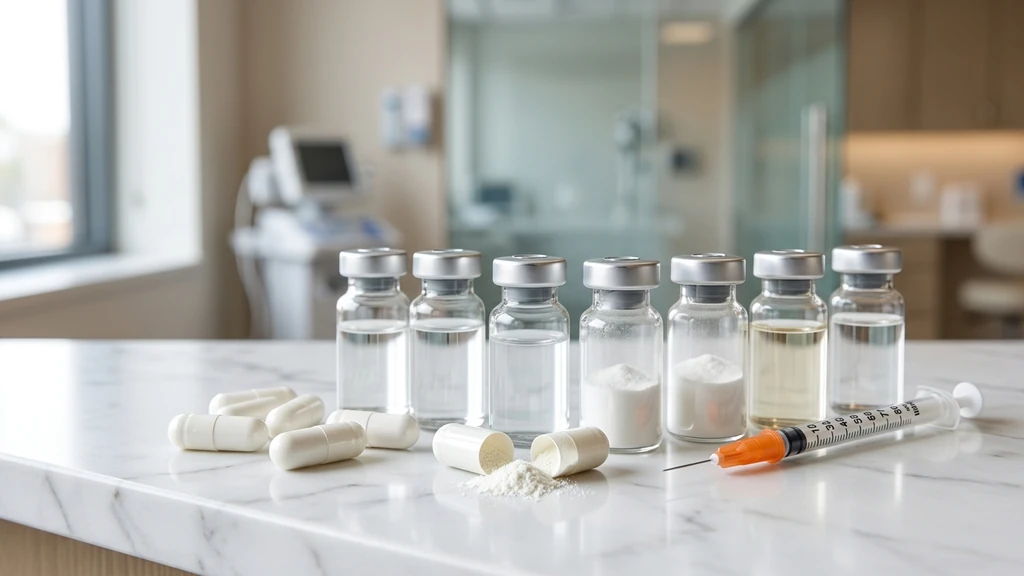
The oral peptide supplement market has minimal regulatory oversight. Quality varies widely between vendors. Six factors separate reliable products from questionable ones.
1. Third-party COA (Certificate of Analysis). The vendor should provide a recent COA from an independent lab showing peptide identity (mass spectrometry), purity (>98%), and absence of heavy metals, endotoxins, and microbial contamination. If the COA is from the vendor's own lab, it carries less weight.
2. BPC-157 form specification. The label should state whether the BPC-157 is acetate or arginate. This distinction affects bioavailability by roughly 30x. Vendors who list only "BPC-157" without specifying the salt form may be using the cheaper acetate while implying arginate-level efficacy.
3. TB-500 fragment vs full-length Tb4. Some capsules contain a TB-500 fragment (the active region of Thymosin Beta-4), while others claim to contain full-length Tb4. Full-length Tb4 is 43 amino acids and more expensive to synthesize. The active fragment (17 amino acids) may resist GI degradation better due to its shorter length.
4. Dose per capsule. Look for exact mcg amounts of each peptide. Proprietary blends that list only total milligrams without specifying the ratio make it impossible to assess individual peptide dosing.
5. Capsule type. Enteric-coated capsules resist stomach acid dissolution and release contents in the small intestine. For BPC-157 acetate, this may improve bioavailability. For BPC-157 arginate (already acid-stable), enteric coating is less critical. Standard gelatin capsules dissolve in the stomach.
6. Storage instructions. Peptides degrade with heat and humidity. Products should specify refrigeration or cool, dry storage. Capsules stored at room temperature in a warehouse for months may have reduced potency.
Readers comparing oral formats may also want to look at how commercial formulas are positioned. One example is Liposomal BPC + TB-500, an oral liposomal formula sold by Dinosaur Nutrition USA. As with any peptide product, review the Supplement Facts, serving details, route of administration, storage requirements, and practitioner guidance before use.
Common Mistakes with BPC-157 + TB-500 Capsules
Mistake 1: Expecting injectable-level results from capsules for musculoskeletal injuries. A user takes capsules for 4 weeks to heal a torn rotator cuff and sees minimal improvement. The BPC-157 component is primarily treating the GI tract at the local level (if acetate), and the TB-500 component's systemic delivery is unproven orally. The fix: for localized tissue injuries, inject TB-500 near the site and use oral BPC-157 for complementary support.
Mistake 2: Taking capsules on an empty stomach and quitting due to nausea. The BPC-157 component causes GI discomfort in 20-30% of users when taken without food. A user abandons the protocol after 2 days of nausea. The fix: take capsules with a small meal and allow 5-7 days of adaptation.
Mistake 3: Buying the cheapest capsule without checking the COA. A user purchases a $30 bottle with no third-party testing. The capsules may contain degraded peptide, incorrect doses, or contaminants. The fix: buy only from vendors who provide independent lab COAs with mass spectrometry data.
Mistake 4: Running capsule cycles longer than 8 weeks without a break. No safety data supports continuous oral peptide use beyond standard cycle lengths. The fix: follow a 4-8 week cycle with a 2-4 week washout before restarting.
Mistake 5: Assuming one capsule contains therapeutic doses of both peptides. Some products are underdosed. A capsule with only 250 mcg BPC-157 and 500 mcg TB-500 delivers less than the typical protocol requires. Check the label and verify against recommended doses in our BPC-157 + TB-500 dosage guide.
Frequently Asked Questions
Do BPC-157 + TB-500 capsules actually work?
The BPC-157 component works for GI healing based on multiple animal studies showing oral efficacy. Systemic effects depend on formulation: arginate (~90% bioavailability) delivers meaningfully; acetate (~3%) delivers minimally to non-GI tissues. The TB-500 component lacks oral bioavailability data. No study has tested the oral combination. For musculoskeletal targets, injectable delivery is more reliable.
What is the wolverine stack in capsule form?
The wolverine stack is BPC-157 combined with TB-500, named for the fictional character's healing ability. Capsule form delivers both peptides orally instead of via injection. Typical capsule doses are 500 mcg BPC-157 plus 750-1,500 mcg TB-500. The capsule version sacrifices confirmed TB-500 bioavailability for convenience. Injectable versions deliver both peptides at 80-95% bioavailability.
How long should I take BPC-157 + TB-500 capsules?
Standard community protocols run 4-8 weeks followed by a 2-4 week washout. A 2-week loading phase (2 capsules daily) transitions to a 4-week standard phase (1-2 capsules daily) and a 2-week maintenance taper (1 capsule daily). No clinical trial has determined optimal cycle length. Continuous use beyond 8 weeks lacks safety data.
Can I open the capsule and take it sublingually?
Technically yes, but sublingual absorption of peptides this size is unpredictable. BPC-157 (15 amino acids) may absorb partially through sublingual mucosa. TB-500 (43 amino acids) is likely too large for efficient sublingual uptake. No study has measured sublingual bioavailability for either peptide. The capsule is designed for gastric dissolution, not sublingual use.
Are BPC-157 + TB-500 capsules safe?
BPC-157 shows no toxicity in extensive animal testing, including oral administration. A human IV pilot used 20,000 mcg BPC-157 with zero adverse events. TB-500 was tested in human injection trials for wounds and dry eye with a favorable safety profile. No study has tested the oral combination in humans. Neither peptide is FDA-approved. Common side effects are mild GI discomfort for the first week. See our BPC-157 TB-500 side effects guide.
Should I take capsules with food or on an empty stomach?
Take with a small meal. BPC-157 causes nausea in 20-30% of users on an empty stomach. Food buffers the peptide against bare gastric mucosa without significantly reducing absorption (local GI effects occur regardless). A few crackers or a piece of fruit is sufficient. If you prioritize maximum systemic absorption with arginate, empty-stomach dosing is theoretically better but increases GI side effect risk.
How do BPC-157 + TB-500 capsules compare to injectable vials?
Injectable vials deliver both peptides at 80-95% bioavailability with peak plasma levels in 15-30 minutes. Capsules deliver BPC-157 effectively for GI targets (and systemically with arginate) but TB-500 oral absorption is unproven. Injectable costs $100-180/month vs $60-120 for capsules. Capsules are more convenient; injectables are more pharmacologically reliable for systemic effects. See our BPC-157 + TB-500 dosage guide.
The Bottom Line
BPC-157 + TB-500 capsules offer a convenient, needle-free way to run the wolverine stack. The trade-off is clear: the BPC-157 component has solid oral evidence and delivers meaningful GI healing plus some systemic absorption (especially in arginate form). The TB-500 component lacks oral pharmacokinetic data, making its contribution uncertain when swallowed rather than injected.
For gut-focused goals, the capsule blend provides genuine value through BPC-157 alone. For musculoskeletal injuries where TB-500's systemic effects matter most, consider a hybrid approach: oral BPC-157 capsules paired with injectable TB-500. This gives each peptide its proven delivery route.
Plan your protocol with the BPC-157 dosage calculator and TB-500 dosage calculator. For complete dosing tables, see our BPC-157 + TB-500 dosage guide. Review BPC-157 + TB-500 side effects before starting any combination protocol. For the injectable wolverine stack overview, see our wolverine peptide stack guide.
Helpful Tools
Related Articles
Peptides for Healing: What the Evidence Shows
Peptides for healing by tissue: tendon, bone, wound, gut, post-surgery. Which claims rest on human trials, which rest on rat studies, and what is unsafe.
KLOW Peptide: Benefits, Dosage, and KLOW vs GLOW
KLOW peptide benefits, blend composition (GHK-Cu, BPC-157, TB-500, KPV), per-component dosing math, the copper ceiling, and how KLOW differs from GLOW.
Regenerative Peptides: Full Guide
Compare the 7 most studied regenerative peptides for tissue repair: BPC-157, TB-500, GHK-Cu, KPV, thymosin alpha-1, MOTS-c, and IGF-1 LR3.
BPC-157 Oral Pills & Capsules: Do They Work?
BPC-157 oral pills deliver 250-500 mcg to the gut. Oral vs injectable vs nasal comparison, dosing protocols, and sourcing guidance.