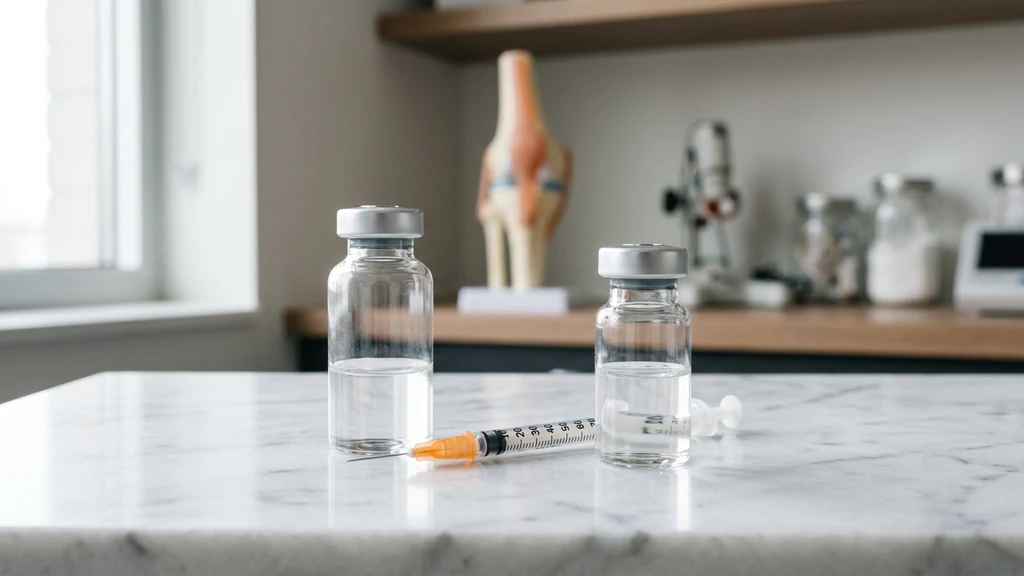
You are staring at two vials in your refrigerator. One is labeled BPC-157. The other says TB-500. Your torn rotator cuff has not improved in three months, and you want to know which peptide will get you back under the barbell faster. BPC-157 is better for single, localized injuries (one tendon, one joint, gut healing). TB-500 is better for systemic repair across multiple injury sites. Most experienced users run both together. For where each fits alongside other repair peptides by tissue type, see peptides for healing.
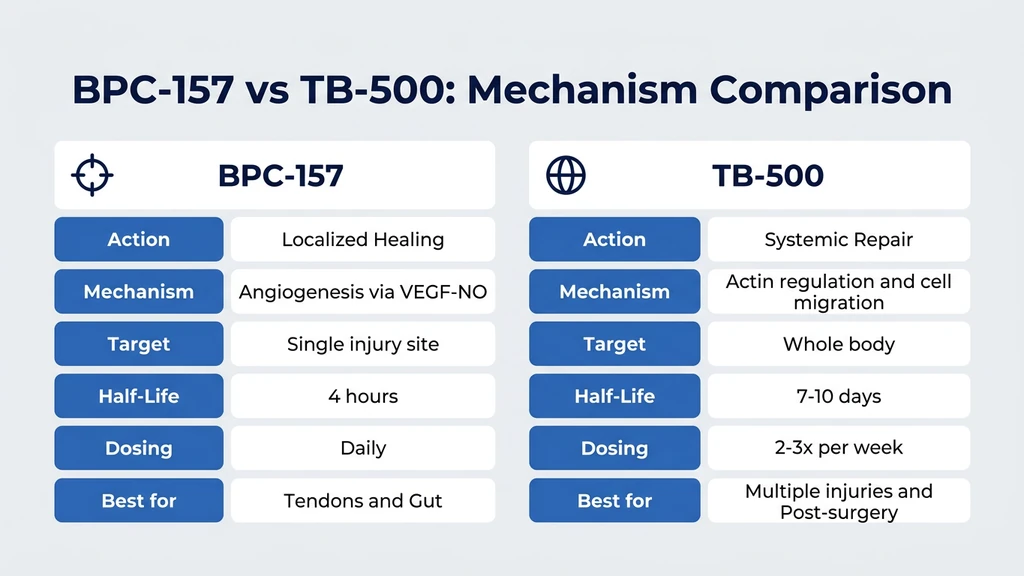
| Feature | BPC-157 | TB-500 |
|---|---|---|
| Full name | Body Protection Compound-157 | Thymosin Beta-4 fragment |
| Primary action | Localized healing via angiogenesis and NO system | Systemic repair via actin regulation and cell migration |
| Best for | Tendon injuries, gut healing, single joint repair | Multiple injuries, post-surgery, systemic inflammation |
| Standard dose | 250-500 mcg/day | 5-10 mg/week (loading), 2.5-5 mg/week (maintenance) |
| Half-life | ~4 hours | ~7-10 days |
| Dosing frequency | Daily (1-2x) | 2-3x per week |
| Route | Subcutaneous or oral | Subcutaneous |
| Monthly cost | $40-80 | $60-120 |
| Evidence level | 1 human trial + 35 animal studies | Preclinical (animal and in vitro) |
| FDA status | Not approved | Not approved |
Both peptides remain investigational. No FDA-approved indication exists for either compound. For dosing calculations, use our BPC-157 dosage calculator or the TB-500 dosage calculator.
Get your custom peptide protocol:
- Tailored to your body and goals
- Precise dosing and cycle length
- Safe stacking combinations
- Backed by peer-reviewed studies
- Ready in under 2 minutes
How Does BPC-157 Work?
BPC-157 is a 15-amino-acid synthetic peptide derived from a protective protein in human gastric juice. Your stomach produces the parent compound (Body Protection Compound) to repair its own lining from the constant assault of hydrochloric acid. The synthetic fragment concentrates that repair signal into a targetable dose.
Three mechanisms drive BPC-157's healing effects.
Angiogenesis: Building Blood Supply to the Injury
BPC-157 upregulates vascular endothelial growth factor (VEGF) expression, the master switch for new blood vessel formation. In a rat model, BPC-157 treatment accelerated gastric ulcer closure by 78% over 14 days compared to controls (Chang et al., *World Journal of Gastroenterology*, 2014; PMID: 24574767).
Tendons and ligaments heal slowly because they have poor blood supply. A healthy muscle receives 10-50 mL of blood per 100 grams of tissue per minute. A tendon receives 1-2 mL. BPC-157 addresses this bottleneck directly by driving capillary growth into avascular tissue. Sikiric et al. confirmed that BPC-157 promotes angiogenesis through the VEGF-NO-cGMP signaling cascade, distinct from TB-500's angiogenic pathway (PMID: 29789352).
Nitric Oxide System: Accelerating Local Blood Flow
BPC-157 modulates the nitric oxide (NO) system, which controls blood vessel dilation and local blood flow. Increased NO at the injury site means more oxygen, more nutrient delivery, and faster waste removal. Seiwerth et al. demonstrated that BPC-157 interacts with the NO system to mediate its protective effects across multiple organ systems, including gastrointestinal, musculoskeletal, and vascular tissues (PMID: 24867927).
Think of a garden hose with a kink in it. BPC-157 straightens the kink. Blood that was trickling through a damaged tendon begins flowing at closer to normal volume. The tissue receives the raw materials it needs to rebuild.
Growth Hormone Receptor Upregulation
BPC-157 increases the expression of growth hormone receptors in injured tissue. This does not raise systemic GH levels. Instead, it makes damaged cells more responsive to the growth hormone already circulating in your blood. The tissue effectively becomes a better listener for repair signals. Staresinic et al. showed that BPC-157 upregulated GH receptor expression in a rat tendon transection model, correlating with improved collagen organization and tensile strength at 72 days post-injury (PMID: 16137775).
For a complete guide on BPC-157 administration routes and injection technique, see how to inject BPC-157. For oral dosing protocols (relevant for gut healing), see can you take BPC-157 orally.
How Does TB-500 Work?
TB-500 is a synthetic fragment of thymosin beta-4, a 43-amino-acid protein found in nearly every cell in the human body. Your platelets release it at wound sites. The concentration of thymosin beta-4 in wound fluid is 15 times higher than in normal plasma (Goldstein et al., *Expert Opinion on Biological Therapy*, 2012; PMID: 22849511).
Where BPC-157 acts like a specialist contractor focused on one building, TB-500 operates like a city planner coordinating reconstruction across an entire district. Three mechanisms explain its systemic reach. For a deeper look at TB-500's full mechanism, see what does TB-500 do.
Actin Regulation: Rebuilding the Cell Skeleton
Actin is the most abundant protein inside your cells. It forms the internal scaffolding that allows cells to move, divide, and maintain their shape. TB-500 binds directly to monomeric G-actin and promotes its controlled polymerization into filamentous F-actin. Safer et al. identified this binding site and demonstrated that TB-500 sequesters actin monomers, preventing chaotic assembly and allowing the organized, directional scaffolding that repair requires (PMID: 9356482).
Without proper actin regulation, cells at a wound edge cannot crawl toward the damage. They sit in place like construction workers without a road to the job site.
Cell Migration: Moving Repair Crews Systemically
TB-500 accelerates the physical movement of repair cells to injury sites across the entire body. Malinda et al. measured a 2 to 3-fold increase in endothelial cell migration at concentrations as low as 100 ng/mL. The same study confirmed increased keratinocyte migration and collagenase activity, which cells need to cut through the extracellular matrix on their way to the wound (PMID: 10233762).
This systemic cell migration is what separates TB-500 from BPC-157. After subcutaneous injection in the abdomen, TB-500 distributes throughout the body. If you have a torn rotator cuff and an aching Achilles tendon simultaneously, TB-500 recruits repair cells to both sites. BPC-157 primarily benefits the area closest to the injection.
Anti-Inflammatory Action and Angiogenesis
TB-500 reduces inflammatory cytokines including IL-1beta, IL-6, and TNF-alpha by 40-60% while preserving the beneficial early inflammatory response needed for debris clearance. Sosne et al. showed that thymosin beta-4 suppressed NF-kB activation in corneal epithelial cells, the master regulator of chronic inflammation (PMID: 17408618).
TB-500 also promotes angiogenesis. Grant et al. found that thymosin beta-4 increased tubular structure formation by 40% in endothelial cell assays (PMID: 10341218). Both peptides build new blood vessels, but through different signaling cascades: BPC-157 works through the VEGF-NO pathway while TB-500 works through actin-mediated endothelial organization.
Which Is Better for Specific Injuries?
The right peptide depends on what you are trying to heal. Below is a condition-by-condition breakdown based on available preclinical evidence and community-reported outcomes.
Tendon Injuries (Tennis Elbow, Achilles, Rotator Cuff)
Winner: BPC-157 (slight edge), but the stack is ideal.
BPC-157 has stronger direct evidence for tendon repair. Staresinic et al. demonstrated that BPC-157 improved tendon-to-bone healing in rats, with treated animals showing 50% greater tensile strength at the repair site compared to controls (PMID: 16137775). Cerovecki et al. confirmed accelerated Achilles tendon healing in a separate rat model, with improved collagen fiber organization visible on histology (PMID: 20225319).
TB-500 also improves tendon repair. Formeister et al. showed greater tensile strength in TB-500-treated rat Achilles tendons at 14 and 30 days. The advantage of combining both: BPC-157 drives local angiogenesis into the avascular tendon while TB-500 recruits repair cells systemically.
For tendon-specific protocols, see our best peptides for tendon repair guide and the peptides for joint pain comparison.
Muscle Tears and Strains
Winner: TB-500.
Muscles have better baseline blood supply than tendons, so BPC-157's angiogenic advantage matters less. TB-500's systemic cell migration and actin regulation become more valuable. Exogenous thymosin beta-4 increased regenerating muscle fibers by 35% at day 14 post-injury in mouse models, with 20% greater cross-sectional area compared to untreated controls.
BPC-157 still contributes: it accelerates local inflammation resolution and supports the NO-mediated vasodilation that muscles need during repair. For muscle-specific applications, see our BPC-157 and muscle growth article.
Joint Pain and Osteoarthritis
Winner: Combination (BPC-157 injected near the joint + TB-500 systemically).
Joint degeneration involves cartilage loss, synovial inflammation, and subchondral bone changes. BPC-157 addresses the local inflammatory component and drives blood supply into the joint capsule. TB-500 reduces systemic inflammatory markers that contribute to multi-joint flares.
Neither peptide regenerates lost cartilage. Adding GHK-Cu for collagen remodeling support rounds out the approach. For the three-peptide blend protocol, see our GHK-Cu, BPC-157, TB-500 blend dosage guide. For localized injection guidance, see where to inject BPC-157 for knee pain.
Gut Healing (IBS, Leaky Gut, Ulcers)
Winner: BPC-157 (by a wide margin).
BPC-157 is derived from gastric juice. Oral BPC-157 bathes the entire GI tract in healing peptides and has direct, published evidence for gastric ulcer repair, NSAID-induced gut damage reversal, and inflammatory bowel protection. Sikiric et al. published over 50 studies documenting BPC-157's cytoprotective effects across the gastrointestinal tract (PMID: 29789352).
TB-500 has no specific gut healing data. It works systemically and may reduce generalized inflammation, but it does not reach the gut lining at therapeutic concentrations after subcutaneous injection. For gut protocols, oral BPC-157 at 500-1000 mcg/day is the established approach. See our peptides for gut health guide.
Post-Surgery Recovery
Winner: TB-500 (slight edge), but combine both for best results.
Surgery creates widespread tissue trauma: severed blood vessels, disrupted fascia, inflammation cascading through multiple tissue layers. TB-500's systemic reach addresses this broad damage pattern. Its 7-10 day half-life means fewer injections during a recovery period when patients want minimal fuss.
BPC-157 is valuable for the specific surgical site. Inject near the incision to drive local angiogenesis and accelerate wound closure. The standard post-surgical protocol starts 5-7 days after the procedure, once initial clotting and acute inflammation have served their purpose.
Consult your surgeon before using any peptide post-operatively. For safety considerations, see our peptide safety guide.
Dosage Comparison: BPC-157 vs TB-500
The dosing philosophy differs fundamentally between these two peptides. BPC-157 has a short half-life and requires daily administration. TB-500 has a long half-life and uses a loading/maintenance approach. The table below provides a side-by-side comparison.
| Parameter | BPC-157 | TB-500 |
|---|---|---|
| Loading dose | Not required | 5-10 mg/week for 4-6 weeks |
| Standard dose | 250-500 mcg/day | 2.5-5 mg/week (maintenance) |
| Severe injury dose | 500 mcg/day | 10 mg/week (loading) |
| Mild injury dose | 250 mcg/day | 5 mg/week (loading) |
| Frequency | 1-2x daily | 2-3x weekly (loading), 1-2x weekly (maintenance) |
| Cycle length | 4-8 weeks | 8-12 weeks total |
| Reconstitution | 5 mg vial + 2.5 mL bac water = 2 mg/mL | 5 mg vial + 2 mL bac water = 2.5 mg/mL |
| Injection route | Subcutaneous (near injury) or oral | Subcutaneous (abdomen or thigh) |
| Units per dose | 12.5-25 units (at 2 mg/mL on insulin syringe) | 100 units / 1 mL (at 2.5 mg/mL for 2.5 mg) |
Why BPC-157 needs daily dosing. Its half-life is roughly 4 hours. By the 8-hour mark, plasma levels have dropped to about 25% of peak. Daily injections maintain therapeutic concentrations at the injury site. Some users split the daily dose into two injections (morning and evening) for more stable levels.
Why TB-500 uses loading/maintenance. Its 7-10 day half-life allows tissue levels to accumulate over weeks. The loading phase saturates the body's repair machinery. Skipping the loading phase is the most common TB-500 dosing mistake. Users who start at maintenance doses (2.5 mg/week) often see no results for 6-8 weeks, then assume the peptide is ineffective.
Use the peptide dosage chart for cross-reference with other compounds, and the peptide reconstitution calculator for exact mixing volumes.
The Classic Healing Stack: BPC-157 + TB-500 Together
Running BPC-157 and TB-500 together is the most popular peptide stack for injury repair. The combination exploits their complementary mechanisms: BPC-157 handles localized repair while TB-500 coordinates systemic healing. Think of it like deploying both a surgeon (BPC-157, precise, localized) and an emergency response team (TB-500, broad, coordinated) to the same crisis.
Combined Protocol:
| Phase | BPC-157 | TB-500 | Duration |
|---|---|---|---|
| Loading | 250-500 mcg/day (daily) | 5-10 mg/week (2-3x weekly) | Weeks 1-4 |
| Maintenance | 250 mcg/day or stop | 2.5-5 mg/week (1-2x weekly) | Weeks 5-8 |
| Extension (severe injuries) | 250 mcg/day | 2.5 mg/week | Weeks 9-12 |
Why the stack outperforms either peptide alone:
BPC-157 drives angiogenesis through the VEGF-NO pathway. TB-500 drives angiogenesis through actin-mediated endothelial organization. Two distinct pathways means more new blood vessels reaching the injury. BPC-157 upregulates growth hormone receptors locally while TB-500 recruits repair cells from distant sites. The overlap is minimal, the synergy is substantial.
Community reports consistently describe faster recovery with the stack: 2-3 weeks for initial improvement versus 4-6 weeks with TB-500 alone. For a rotator cuff tendonitis that has lingered for months, the combined protocol compresses the typical 6-month recovery timeline into 8-12 weeks.
Injection timing and logistics. You can inject both peptides on the same day. BPC-157 goes near the injury (subcutaneous, within a few inches of the damaged tissue). TB-500 goes in the abdomen or thigh. Separate syringes, separate sites. Do not mix them in the same syringe, as stability data for the combination does not exist.
For three-peptide stacks that add GHK-Cu for collagen remodeling, see the peptide stacking guide. Use the peptide stack calculator to plan multi-compound protocols and the peptide interaction checker to verify compatibility.
Cost Comparison: BPC-157 vs TB-500
Peptide costs vary by supplier, purity, and region. The figures below reflect typical US market pricing for research-grade peptides in early 2026.
| Cost Factor | BPC-157 | TB-500 |
|---|---|---|
| Price per vial | $25-40 (5 mg) | $35-60 (5 mg) |
| Daily/weekly cost | ~$2-5/day (at 250-500 mcg/day) | ~$7-15/week (at 5 mg/week) |
| Monthly cost | $40-80 | $60-120 |
| 8-week cycle cost | $80-160 | $120-240 |
| Stacked (both) monthly | $100-200 combined | |
| Bacteriostatic water | $10-15 per 30 mL vial | Same |
| Syringes (100-pack) | $15-20 | Same |
BPC-157 is the cheaper peptide per month. TB-500 costs more because the doses are measured in milligrams rather than micrograms. A single 5 mg vial of BPC-157 lasts 10-20 days at standard dosing. A single 5 mg vial of TB-500 lasts about one week during the loading phase.
The combined stack runs $100-200 per month. For a typical 8-week protocol addressing a moderate tendon injury, expect a total spend of $200-400. Compare that to a single cortisone injection ($150-300 plus the office visit), which masks pain without promoting structural repair.
Cost-saving tip. Buy BPC-157 and TB-500 in 10 mg vials when available. Larger vials reduce the per-milligram price by 15-25%. Store unreconstituted vials in the freezer for maximum shelf life. See how to store peptides and how long do reconstituted peptides last for storage protocols.
Common Mistakes When Choosing Between BPC-157 and TB-500
1. Using TB-500 alone for gut healing. TB-500 has no published evidence for gastrointestinal repair. Its systemic distribution after subcutaneous injection does not deliver meaningful concentrations to the gut lining. BPC-157 taken orally at 500-1000 mcg/day is the correct choice for IBS, leaky gut, and ulcer healing. Using TB-500 for this purpose wastes $60-120 per month with no expected benefit.
2. Skipping the TB-500 loading phase. Starting TB-500 at the maintenance dose (2.5 mg/week) is the most common protocol error. The 7-10 day half-life means tissue levels build slowly. Without a 4-6 week loading phase at 5-10 mg/week, you may wait 8-10 weeks before serum concentrations reach the therapeutic range. By then, most people have given up and blamed the peptide.
3. Injecting BPC-157 only in the abdomen for a localized injury. BPC-157 has a 4-hour half-life. Plasma levels drop quickly. Injecting in the abdomen when the injury is in your knee means the highest peptide concentration is far from the tissue that needs it. Inject subcutaneously within 2-3 inches of the injury for best results. Sikiric et al. documented superior localized outcomes when BPC-157 was administered near the damage site (PMID: 29789352).
4. Stopping BPC-157 after two weeks because you "feel better." Pain reduction often precedes structural repair. BPC-157 reduces inflammation within days, which relieves pain. Collagen remodeling and tendon strengthening take 4-8 weeks. Stopping at week 2 because the pain is gone is like removing the scaffolding before the concrete has cured.
Safety and Side Effects Compared
Both peptides have favorable safety profiles in animal studies. Neither has completed large-scale human safety trials.
| Safety Factor | BPC-157 | TB-500 |
|---|---|---|
| Evidence base | 1 small human trial (corneal), 35+ animal studies | No human trials; 30+ animal/in vitro studies |
| Reported side effects | Mild nausea (oral), injection site redness, occasional fatigue | Injection site irritation, occasional headache |
| Cancer concern | Lower theoretical risk (localized action) | Higher theoretical concern (promotes systemic cell proliferation, migration, angiogenesis) |
| Blood thinner interaction | Unknown (NO system interaction possible) | Unknown (affects platelet function via actin) |
| Pregnancy | Contraindicated (unstudied) | Contraindicated (Tb4 role in embryonic development) |
| WADA status | Not explicitly banned (gray area) | Banned since 2010 |
The cancer question. TB-500 promotes cell proliferation, cell migration, and angiogenesis. These are the same three processes tumors exploit. No study has shown TB-500 causes cancer. But individuals with active malignancies, recent cancer history, or elevated cancer biomarkers should avoid TB-500 until human safety data addresses this question directly. BPC-157 carries less theoretical risk because it acts locally rather than systemically, though caution still applies.
Both peptides are not FDA approved for human use. This content is educational. Consult a healthcare provider before starting any peptide protocol. For comprehensive safety information, see our peptide safety guide.
How to Choose: Decision Framework
Choose BPC-157 alone if: - You have a single, localized injury (one tendon, one joint) - Your primary goal is gut healing (IBS, leaky gut, ulcers, NSAID damage) - You prefer daily dosing over a loading/maintenance schedule - Budget is tight ($40-80/month vs $100-200 for the stack) - You are needle-averse (oral BPC-157 is an option for gut issues)
Choose TB-500 alone if: - You have multiple injuries across different body parts - You want systemic recovery support during heavy training - Your injury involves large tissue areas (major muscle tears, post-surgery) - You prefer less frequent injections (2-3x per week vs daily)
Choose both (the healing stack) if: - You have a moderate to severe tendon or ligament injury - You want the fastest possible recovery timeline - You are recovering from surgery - Budget allows $100-200/month - You have been on one peptide for 4+ weeks with partial results
For BPC-157 dosing by body weight, see BPC-157 dosage for a 200 lb male. For women-specific protocols, see BPC-157 benefits for women. For the full stacking protocol with additional compounds, see the peptide stacking guide.
Frequently Asked Questions
Can I take BPC-157 and TB-500 at the same time?
Yes. The combination is the most popular healing stack in peptide therapy. BPC-157 handles localized repair (angiogenesis, NO system) while TB-500 coordinates systemic healing (actin regulation, cell migration). Inject them on the same day using separate syringes and separate sites. BPC-157 goes near the injury; TB-500 goes subcutaneously in the abdomen. Do not mix them in one syringe.
Which is better for tendon injuries: BPC-157 or TB-500?
BPC-157 has stronger direct evidence for tendon repair, including studies showing 50% greater tensile strength at the repair site in rat models (Staresinic et al.). For a single tendon injury, BPC-157 at 250-500 mcg/day injected near the tendon is the first choice. For severe tendon injuries, adding TB-500 at 5-10 mg/week during a loading phase accelerates recovery by addressing systemic factors.
How long does the BPC-157 and TB-500 stack take to work?
Most users report initial pain reduction within 7-14 days. Significant structural healing typically occurs by weeks 3-4 with the combined stack, compared to 4-6 weeks with TB-500 alone. Full tendon repair requires 6-12 weeks depending on severity. The loading phase is critical: skipping it delays all timelines by 3-4 weeks.
Is BPC-157 or TB-500 better for gut healing?
BPC-157 is the clear winner for gut healing. It is derived from gastric juice, remains stable in stomach acid, and has over 50 published studies documenting gastrointestinal protection. Oral BPC-157 at 500-1000 mcg/day delivers the peptide directly to the gut lining. TB-500 has no published gut healing data and does not reach the GI tract at therapeutic levels after subcutaneous injection.
What is the cost of running BPC-157 and TB-500 together?
The combined stack costs $100-200 per month at typical US research-grade pricing. BPC-157 runs $40-80/month (250-500 mcg/day from $25-40 per 5 mg vial). TB-500 runs $60-120/month (5-10 mg/week loading from $35-60 per 5 mg vial). A full 8-week protocol costs $200-400 total, including bacteriostatic water and syringes.
Does TB-500 work locally like BPC-157?
No. TB-500 distributes systemically after subcutaneous injection, regardless of the injection site. Its 7-10 day half-life allows it to circulate throughout the body and recruit repair cells to all damaged tissues. BPC-157 has a 4-hour half-life and works best when injected within 2-3 inches of the specific injury. This difference is why they complement each other in a stack.
Are BPC-157 and TB-500 legal?
Neither peptide is FDA approved for human use. Both are sold as research chemicals in the United States. TB-500 has been explicitly banned by WADA since 2010 for competitive athletes. BPC-157 occupies a regulatory gray area. The FDA's increased scrutiny of compounding pharmacies since 2024 has affected availability. See the FDA peptide crackdown article for current regulatory context.
Can I use BPC-157 orally and TB-500 by injection together?
Yes. This is a practical combination for people with both gut issues and a musculoskeletal injury. Oral BPC-157 at 500-1000 mcg/day heals the GI tract directly, while subcutaneous TB-500 at 5-10 mg/week addresses the structural injury systemically. The routes are independent and there is no known interaction between oral BPC-157 and injected TB-500.
The Bottom Line
BPC-157 is the localized healer: best for single tendon injuries, gut repair, and targeted joint recovery. TB-500 is the systemic coordinator: best for multiple injuries, post-surgical recovery, and broad tissue repair. Together, they form the most widely used peptide healing stack, compressing recovery timelines by addressing both local and systemic repair pathways simultaneously.
The practical decision is straightforward. Single injury with a tight budget: start with BPC-157 at 250-500 mcg/day. Multiple injuries or post-surgery: add TB-500 at 5-10 mg/week for a 4-6 week loading phase. Gut healing: oral BPC-157 only.
Use the BPC-157 dosage calculator and TB-500 dosage calculator to plan your protocol. For multi-compound stacking with GHK-Cu, see the peptide stacking guide and the peptide stack calculator. For overall safety guidelines, consult the peptide safety guide. For real-world healing timelines, see our BPC-157 before and after results.
Helpful Tools
Related Articles
How Long Does BPC-157 Take to Work?
BPC-157 timelines: gut healing 1-2 weeks, pain relief 1-2 weeks, tendon repair 4-8 weeks, bone healing 6-12 weeks. Factors that speed results.
BPC-157 TB-500 Side Effects: Stack Safety Data
BPC-157 TB-500 stack side effects: headaches, fatigue weeks 1-2, anaphylaxis risk, cancer screening tips. Week-by-week timeline inside.
BPC-157 TB-500 Dosage: Combined Protocol
BPC-157 TB-500 dosage: 250-500 mcg BPC-157 + 2-2.5 mg TB-500 daily. Weight-adjusted charts, injury-type matrix, blend vial math, and cycle timing.
BPC-157 TB-500 Capsules: Oral Blend Guide
BPC-157 TB-500 capsules: oral bioavailability data, dosage protocols, side effects, and buyer checklist. TB-500 oral evidence gap explained.