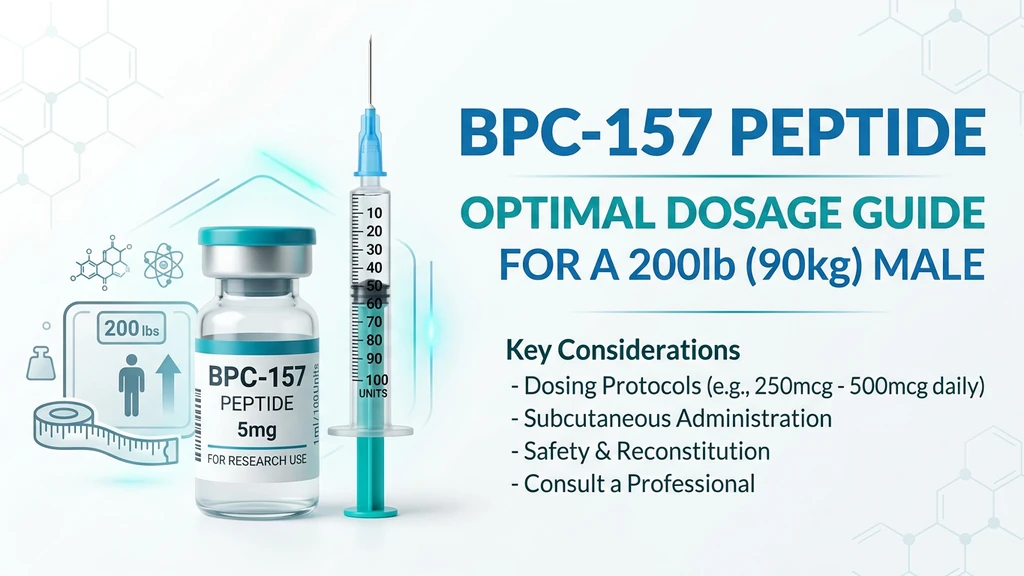
You weigh 200 pounds and you are holding a vial of BPC-157. You want to know how much to inject. The answer: 250 to 500mcg per day, subcutaneous. A 150lb male uses the same dose. So does a 250lb male. Peptide dosing does not scale with body weight.
| Body Weight | Daily Dose | Frequency | Typical Cycle |
|---|---|---|---|
| Under 150lb | 250mcg | Once daily | 4 to 6 weeks |
| 150 to 200lb | 250 to 500mcg | Once or twice daily | 4 to 8 weeks |
| 200 to 250lb | 250 to 500mcg | Once or twice daily | 4 to 8 weeks |
| Over 250lb | 500mcg | Once or twice daily | 6 to 8 weeks |
The dose column is identical across every row. That is the point. The BPC-157 dosage calculator converts your chosen dose into exact syringe units based on your vial concentration.
BPC-157 is not FDA-approved for any medical use. Consult a licensed healthcare provider before using any peptide.
Get your custom peptide protocol:
- Tailored to your body and goals
- Precise dosing and cycle length
- Safe stacking combinations
- Backed by peer-reviewed studies
- Ready in under 2 minutes
Why Body Weight Does Not Determine BPC-157 Dosage
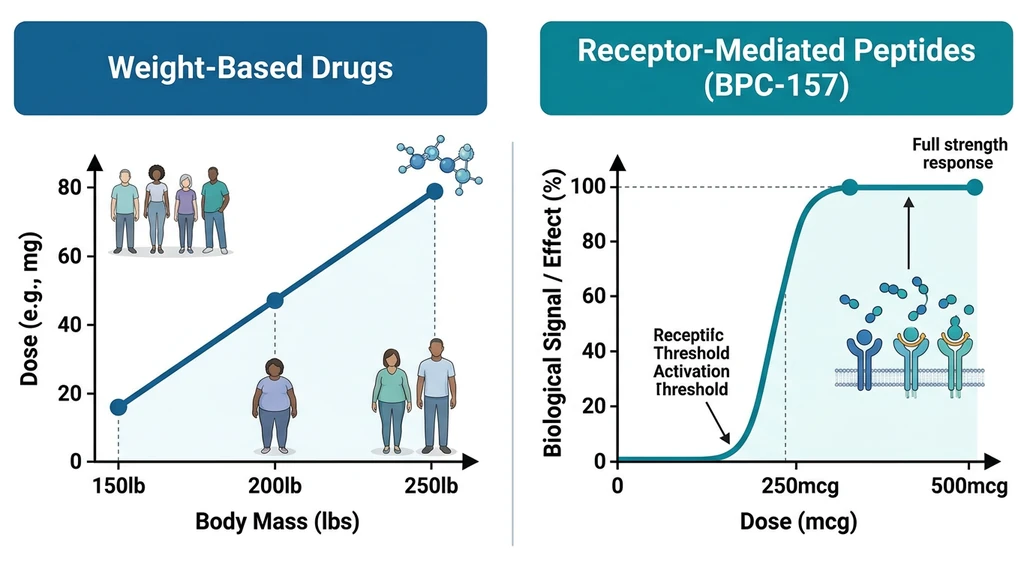
Think of a light switch. Flipping the switch with one finger or with your whole hand produces the same result: the light turns on. Pressing harder does not make it brighter. BPC-157 works the same way. It binds to receptors in injured tissue and triggers a repair cascade. Once the receptor is activated, the signal fires at full strength. More peptide does not amplify the response.
The literal biology: BPC-157 is a 15-amino-acid fragment of the gastric protein BPC (Body Protection Compound). It modulates the nitric oxide system, upregulates VEGF, FGF, and EGF, and activates the FAK-paxillin pathway (Seiwerth et al., Curr Pharm Des, 2018; PubMed 29998800). These are receptor-mediated processes. Doubling the dose does not double the healing rate.
Most drugs scale with body mass because they depend on plasma concentration. Antibiotics need a target blood level; a larger body has more blood to fill. BPC-157 bypasses that logic entirely. It reaches injured tissue, binds receptors, and triggers downstream signaling. Receptor density in a torn tendon does not increase because you weigh 200 pounds instead of 150.
What Animal Studies Show About Weight-Based Dosing
Rat studies use 10mcg/kg, the standard preclinical dose (Chang et al., Life Sci, 2011; PubMed 21030672). For a 250g rat, that is 2.5mcg. Translating to humans requires body surface area (BSA) scaling per FDA guidance: divide the rat dose by 6.2.
10mcg/kg in a rat converts to roughly 1.6mcg/kg in a human. For a 91kg (200lb) male: 1.6 x 91 = approximately 146mcg per day. That falls at the low end of the 200 to 500mcg range used in clinical practice.
A 2022 pharmacokinetic study in rats and dogs found linear pharmacokinetics across all tested doses, with an elimination half-life under 30 minutes (Zhang et al., Front Pharmacol, 2022; PMC 9794587). Repeated dosing did not alter these parameters. Flat-dose protocols hold up across species.
Flat Dosing in Human Data
The only human clinical data available used flat dosing. A 2025 pilot safety study administered 10mg and 20mg intravenous infusions of BPC-157 to healthy adults with no adverse effects (Staresinic et al., 2025; PubMed 40131143). These doses were identical for all participants regardless of body weight.
In clinical practice, peptide therapy providers prescribe BPC-157 at flat doses of 250 to 500mcg per day for all adults. A 130lb woman and a 250lb man receive the same dose. The rationale: receptor density in an injured tendon does not increase with body mass.
| Factor | Weight-Based Drugs (e.g., Antibiotics) | Signaling Peptides (e.g., BPC-157) |
|---|---|---|
| Mechanism | Plasma concentration dependent | Receptor-mediated signaling |
| Dose scaling | Proportional to body mass | Flat dose (threshold-based) |
| 200lb vs 150lb male | Higher dose needed | Same dose |
| Clinical dosing | mg/kg calculation | Fixed mcg range |
| Rationale | More plasma volume to fill | Same receptor density in target tissue |
Standard BPC-157 Protocol for a 200lb Male
The protocol below reflects animal research and peptide therapy clinic practice. No large-scale human clinical trial has established a definitive optimal dose. These recommendations rest on preclinical evidence and clinical experience.
Dosage by Goal
| Goal | Daily Dose | Frequency | Duration | Notes |
|---|---|---|---|---|
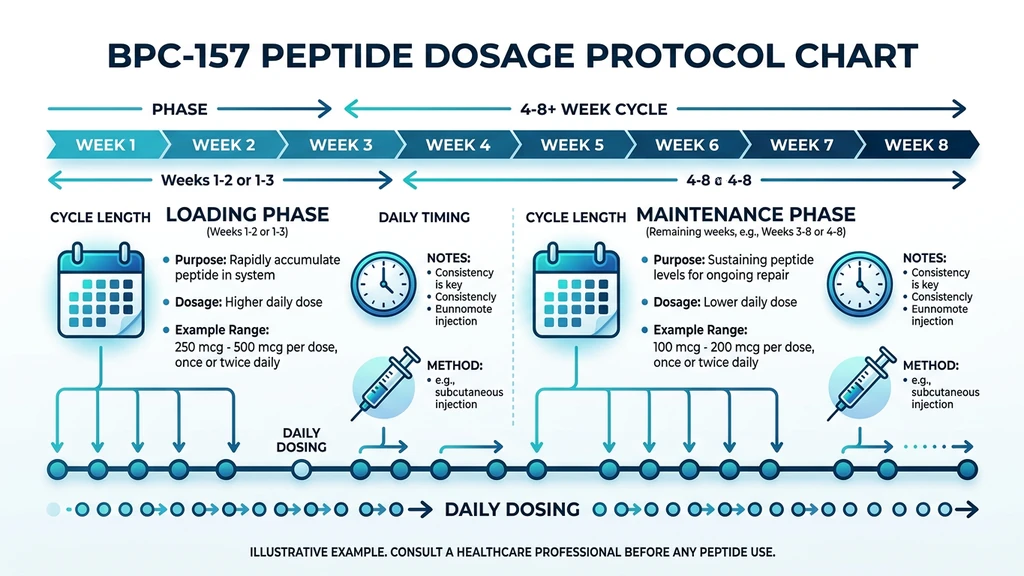
| Mild injury (tendonitis, strain) | 250mcg | Once daily | 4 to 6 weeks | Inject near injury site |
| Moderate injury (partial tear, chronic tendonitis) | 500mcg | Once daily or 250mcg 2x/day | 6 to 8 weeks | Split dosing may improve coverage |
| Severe injury (post-surgical, full tear) | 500mcg | Twice daily (1000mcg total) | 8 to 12 weeks | Higher end of research range |
| Gut healing (IBS, leaky gut, ulcers) | 250 to 500mcg | Once or twice daily (oral) | 4 to 8 weeks | Oral route preferred for GI targets |
| General recovery | 250mcg | Once daily | 4 weeks on, 2 weeks off | Lowest effective dose |
Start at 250mcg per day for the first week. If well tolerated, increase to 500mcg per day in week two. Most users settle at 500mcg daily for injury healing.
The BPC-157 dosage calculator converts your chosen dose into exact injection volumes based on your reconstitution concentration.
Injection Method and Sites
Route: Subcutaneous injection is the standard for BPC-157.
Preferred sites: Abdomen (2 inches from the navel) for ease. Near the injury for targeted delivery. Thigh or upper arm as rotation alternatives. For a lumbar strain or disc problem, the site logic has its own rules, mapped in where to inject BPC-157 for back pain.
Needle: 29 to 31 gauge insulin syringe, 0.5 inch length. For a 200lb male with moderate subcutaneous fat, 0.5 inches reaches the subcutaneous layer in the abdomen without entering muscle.
Technique: Pinch a fold of skin. Insert the needle at a 45-degree angle. Inject slowly. Count to five before withdrawing. Rotate sites daily to prevent tissue irritation. For a complete walkthrough, see the peptide injection guide.
Timing and Frequency
BPC-157 has a plasma half-life under 30 minutes (Zhang et al., Front Pharmacol, 2022; PMC 9794587). The peptide clears fast, but the downstream cellular processes it triggers (collagen synthesis, angiogenesis, growth factor release) persist for hours.
Once daily (250 to 500mcg): The simplest protocol. Inject at the same time each day, morning or evening.
Twice daily (250mcg morning + 250mcg evening): Provides a second signaling pulse. Some practitioners recommend split dosing for severe injuries or post-surgical recovery.
Timing relative to food: No established interaction with meals for injectable BPC-157. For oral BPC-157, take on an empty stomach.
Timing relative to exercise: Inject at least 30 minutes before or after training. Some users prefer post-workout injection to align with the body's natural repair window.
BPC-157 Reconstitution for a 5mg Vial
BPC-157 ships as a lyophilized (freeze-dried) powder. You reconstitute it with bacteriostatic water before injection. The most common vial size is 5mg. The amount of water you add determines the concentration, which determines how much liquid you draw per dose.
Reconstitution Math: 5mg Vial
| Bacteriostatic Water Added | Concentration | Volume for 250mcg | Volume for 500mcg | Doses per Vial (at 250mcg) | Doses per Vial (at 500mcg) |
|---|---|---|---|---|---|
| 1mL | 5000mcg/mL | 0.05mL (5 units) | 0.10mL (10 units) | 20 doses | 10 doses |
| 2mL | 2500mcg/mL | 0.10mL (10 units) | 0.20mL (20 units) | 20 doses | 10 doses |
| 2.5mL | 2000mcg/mL | 0.125mL (12.5 units) | 0.25mL (25 units) | 20 doses | 10 doses |
Recommended setup for 500mcg/day: Add 2mL of bacteriostatic water to a 5mg vial. Draw 20 units on an insulin syringe per injection. One vial lasts 10 days.
For a 30-day cycle at 500mcg/day, you need three 5mg vials. At 250mcg/day, three vials cover 60 days. The peptide reconstitution calculator handles custom calculations.
Step-by-Step Reconstitution
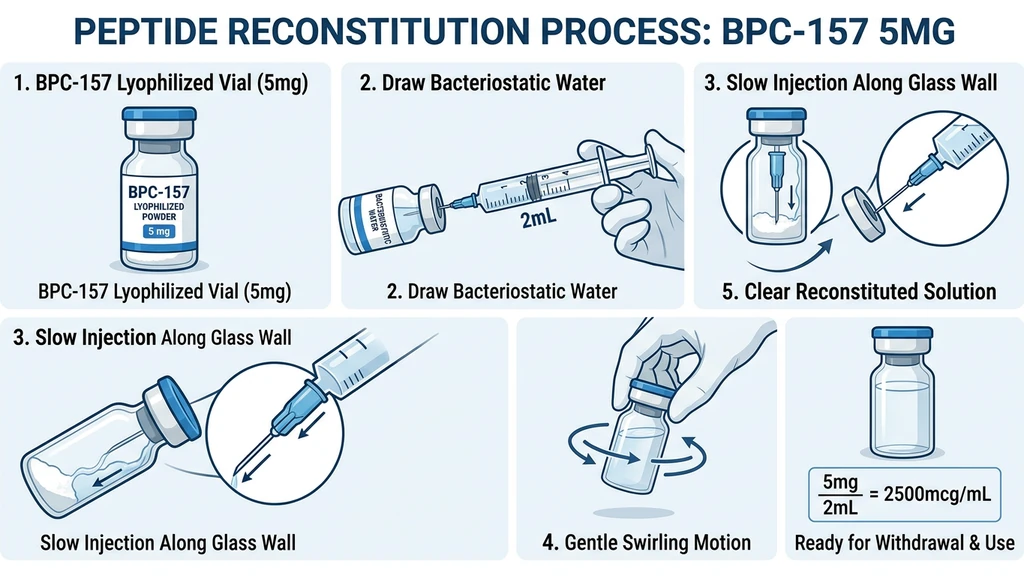
- 1.Remove the plastic cap from the BPC-157 vial. Wipe the rubber stopper with an alcohol swab.
- 2.Draw 2mL of bacteriostatic water into a sterile syringe.
- 3.Insert the needle through the stopper at an angle. Aim the stream at the glass wall, not directly onto the powder cake.
- 4.Push the plunger slowly. Let the water trickle down the vial wall. Rushing fractures the peptide structure.
- 5.Remove the syringe. Gently swirl the vial until the powder dissolves. The solution should be clear and colorless. If it is cloudy, the peptide may be degraded.
- 6.Label the vial with the date, concentration (2500mcg/mL), and "refrigerate."
- 7.Store at 2 to 8 degrees Celsius. Reconstituted BPC-157 remains stable for approximately 30 days.
Never freeze reconstituted peptides. Never expose the vial to temperatures above 25 degrees Celsius or direct sunlight. For full storage guidelines, see how to store peptides. For solvent guidance, see bacteriostatic water vs sterile water and how long does bacteriostatic water last.
Danger Scenarios: When BPC-157 Protocols Go Wrong
These errors happen regularly in peptide communities. Each one carries quantified consequences.
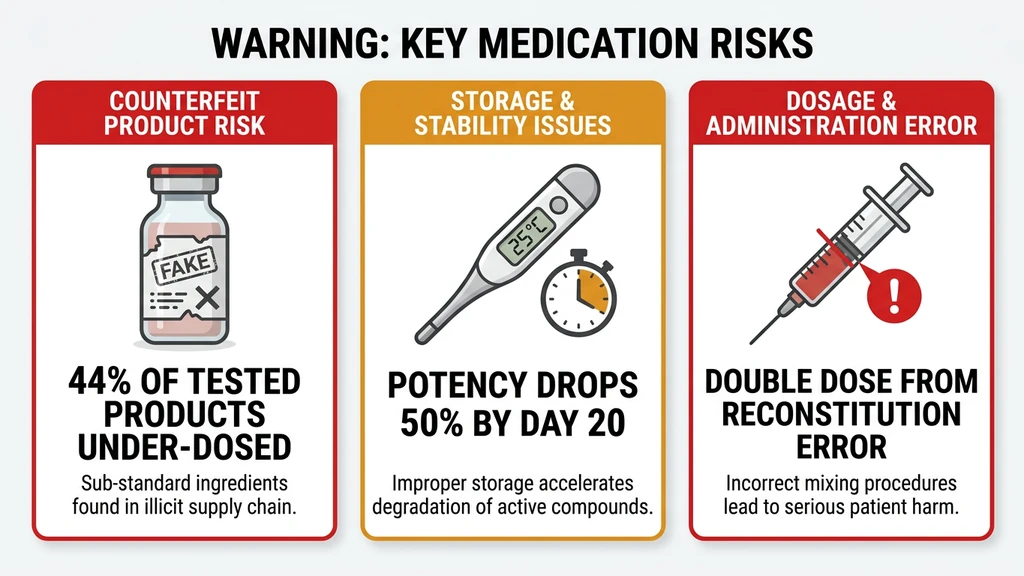
Scenario 1: Degraded peptide, wasted cycle.
You buy BPC-157 from an unverified vendor to save $30 per vial. The product arrives without a certificate of analysis (COA). You run 500mcg per day for 8 weeks. Total spend: roughly $150 for three vials plus $40 for bacteriostatic water and syringes. After 8 weeks, zero improvement. A 2020 analysis of online peptide vendors found that 44% of tested products contained less peptide than labeled, and 15% contained no active compound at all (van Dorsten et al., Drug Test Anal, 2020; PubMed 32323447). Two months of daily injections with a counterfeit product delivers nothing but needle marks.
The fix: Purchase only from vendors providing third-party COAs with batch-specific HPLC purity results. Compounding pharmacies with state licenses are the safest source.
Scenario 2: Room-temperature storage destroys potency mid-cycle.
You reconstitute a 5mg vial with 2mL of bacteriostatic water. Proper storage at 2 to 8 degrees Celsius keeps the peptide stable for 30 days. Instead, you leave the vial on your bathroom counter at 22 to 25 degrees Celsius. Peptide degradation accelerates exponentially with heat. By day 10, you may be injecting a partially degraded solution. By day 20, potency can drop below 50% of the original concentration. Your 500mcg dose becomes 250mcg or less, but you have no way to measure the loss.
The fix: Store reconstituted vials in the refrigerator. Transport in an insulated pouch with an ice pack if you travel. If a vial has been at room temperature for more than 4 hours, discard it. For the full timeline of how quickly powder and solution lose potency, see does BPC-157 expire.
Scenario 3: Wrong reconstitution volume, doubled dose.
You intend to add 2mL of bacteriostatic water to a 5mg vial, giving you 2500mcg/mL. You accidentally draw only 1mL. Now your concentration is 5000mcg/mL. You draw your usual 20 units, expecting 500mcg. Actual dose: 1000mcg. That is double your target. While BPC-157 has no identified toxic dose (Vasireddi et al., Cureus, 2025; PMC 12313605), doubling the dose wastes peptide, cuts your vial's lifespan in half, and provides no additional benefit because receptor binding saturates at the standard range.
The fix: Verify the water volume before injecting through the stopper. Mark your syringe draw line. Double-check the math: 5mg vial / 2mL water = 2500mcg/mL. Use the peptide reconstitution calculator to confirm.
BPC-157 Cycle Length and Protocol Variations
BPC-157 has shown no toxicity at any dose tested in animal models. A 2025 systematic review covering 36 studies from 1993 to 2024 reported no lethal dose across a range of 6mcg/kg to 20mg/kg (Vasireddi et al., Cureus, 2025; PMC 12313605). The 2025 human pilot study found no adverse events at intravenous doses of 20mg, which is 40 times the typical subcutaneous dose (Staresinic et al., 2025; PubMed 40131143).
Cycling on and off remains standard practice to maintain receptor sensitivity and guard against unknown long-term effects.
Recommended Cycle Lengths
| Protocol | Cycle On | Cycle Off | Total Duration | Best For |
|---|---|---|---|---|
| Standard healing | 4 to 6 weeks | 2 weeks | 6 to 8 weeks | Tendonitis, mild strains |
| Extended healing | 8 to 12 weeks | 4 weeks | 12 to 16 weeks | Post-surgical, chronic injuries |
| Gut repair | 4 to 8 weeks | 4 weeks | 8 to 12 weeks | IBS, ulcers, leaky gut |
| Stacked with TB-500 | 6 to 8 weeks | 4 weeks | 10 to 12 weeks | Severe tendon/ligament injury |
| Maintenance | 4 weeks on, 2 weeks off | Repeating | Ongoing | Athletes, chronic conditions |
A 200lb male recovering from a rotator cuff tendon injury would run 500mcg per day for 8 weeks, take 4 weeks off, then reassess. If symptoms persist, a second cycle at the same dose is standard.
Signs Your Protocol Is Working
Week 1 to 2: Reduced pain and inflammation at the injury site. Some users report improved sleep quality. These early changes indicate repair signaling has initiated.
Week 3 to 4: Noticeable improvement in range of motion and strength. Chronic pain that has persisted for months often begins to shift during this window.
Week 5 to 8: Structural healing progresses. Tendons and ligaments show measurable improvement. Gut issues typically show significant symptom reduction by week 4 to 6.
If you experience zero improvement after 4 weeks at 500mcg per day, the problem is almost certainly not your body weight. Degraded product, incorrect reconstitution, improper storage, or a condition requiring medical intervention are far more likely causes. See BPC-157 before and after results for detailed outcome timelines.
BPC-157 Stacks for a 200lb Male
BPC-157 pairs well with other healing peptides. Stacking does not change the BPC-157 dose. A 200lb male uses the same 250 to 500mcg regardless of additional compounds in the protocol.
BPC-157 + TB-500 (Most Popular Stack)
BPC-157 provides localized healing through angiogenesis and growth factor stimulation. TB-500 provides systemic repair through thymosin beta-4 mediated cell migration and anti-inflammatory signaling.
| Peptide | Loading (Weeks 1 to 4) | Maintenance (Weeks 5 to 8) |
|---|---|---|
| BPC-157 | 500mcg/day SubQ | 250mcg/day SubQ |
| TB-500 | 5 to 10mg/week (split 2 to 3 doses) | 2.5 to 5mg/week (1 to 2 doses) |
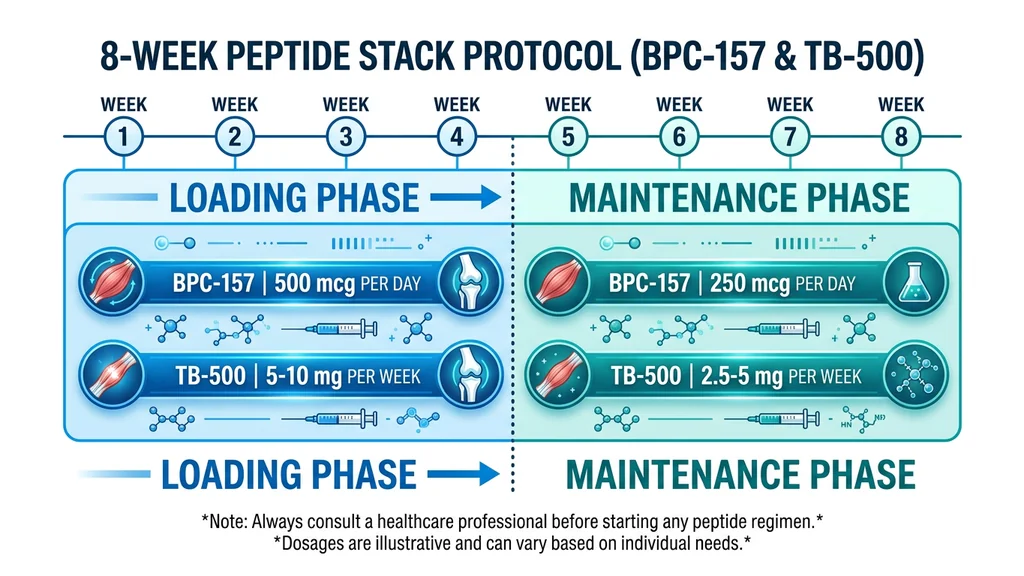
For detailed TB-500 protocols, see the TB-500 dosage chart. For blending these peptides, see the GHK-Cu, BPC-157, TB-500 blend guide.
BPC-157 + GHK-Cu
For collagen-heavy injuries (tendons, ligaments, skin wounds) or anti-aging protocols, GHK-Cu enhances collagen synthesis. GHK-Cu modulates over 4,000 genes related to tissue repair (Pickart & Margolina, Int J Mol Sci, 2018; PMC 6073405).
| Peptide | Daily Dose | Duration |
|---|---|---|
| BPC-157 | 500mcg SubQ | 6 to 8 weeks |
| GHK-Cu | 1 to 2mg SubQ | 6 to 8 weeks |
Inject at the same time using separate syringes. Do not mix peptides in the same syringe unless using a pre-made blend from a compounding pharmacy. For GHK-Cu dosing details, see the GHK-Cu dosage guide.
Oral BPC-157 for Gut Healing
A 200lb male targeting gut issues (IBS, gastric ulcers, intestinal permeability) should consider oral BPC-157. BPC-157 is a gastric peptide, stable in stomach acid, and directly contacts the GI lining when taken orally.
Oral dosing runs higher than injectable due to lower systemic bioavailability: 500 to 1000mcg per day on an empty stomach, in capsule form.
For a full comparison of routes, see can you take BPC-157 orally?.
Safety, Side Effects, and Contraindications
BPC-157 has an unusually clean safety profile. A 2025 systematic review of 36 studies found no lethal dose and no reported toxicity at any tested amount, across multiple routes and animal models (Vasireddi et al., Cureus, 2025; PMC 12313605).
The 2025 human pilot study tested intravenous BPC-157 at 10mg and 20mg (20 to 40 times the typical subcutaneous dose) with no adverse events. Vital signs, ECG, liver function, kidney function, thyroid, and metabolic panels remained normal (Staresinic et al., 2025; PubMed 40131143).
The total number of human subjects studied remains under 30. Rare side effects would not appear in such small samples.
Reported Side Effects
Common (mild, typically resolve within days): - Injection site redness or minor swelling - Mild nausea (more common with oral dosing) - Temporary lightheadedness after injection - Minor digestive changes (bloating, loose stool)
Uncommon (reported anecdotally, not confirmed in published studies): - Headache - Fatigue during the first few days - Feeling of warmth or flushing after injection
No serious adverse events have been reported in published research at standard doses. For a full breakdown, see BPC-157 side effects.
Contraindications
Active cancer or history of cancer: BPC-157 promotes angiogenesis and upregulates growth factors. In theory, this could accelerate tumor growth. No studies have confirmed this risk, but most practitioners treat active malignancy as a contraindication (Seiwerth et al., Curr Pharm Des, 2018; PubMed 29998800).
Pregnancy and breastfeeding: No safety data exists. Avoid use entirely.
Blood clotting disorders or anticoagulant use: BPC-157 interacts with the nitric oxide system and may influence platelet aggregation. Consult your physician if you take blood thinners.
Children and adolescents: No pediatric data. Not recommended.
Common Mistakes and Their Consequences
Mistake 1: Increasing dose because of body weight.
A 220lb male reads a forum post claiming he needs 750mcg "because of his size." He runs 750mcg per day for 6 weeks instead of 500mcg. He burns through vials 50% faster, spending an extra $60 to $90 per cycle. The extra peptide provides no additional receptor activation. The repair cascade fires the same way at 500mcg. His results are identical to the 160lb man on 500mcg, but his wallet is lighter.
Mistake 2: Using non-bacteriostatic water for reconstitution.
Regular sterile water lacks the 0.9% benzyl alcohol preservative that inhibits bacterial growth. After 3 to 5 days, bacteria begin colonizing the vial. By day 10, you are injecting contaminated solution. Symptoms range from injection site infection (redness, swelling, warmth) to systemic infection requiring antibiotics. Bacteriostatic water costs $5 to $8 per vial. Skipping it risks your entire cycle and your health.
Mistake 3: Skipping the off-cycle.
You feel great at week 6 and decide to keep going indefinitely. Continuous receptor stimulation without breaks risks receptor downregulation: the receptors become less sensitive to the peptide. When you finally do take a break and restart, the same 500mcg dose may produce a weaker response. The standard 2 to 4 week off-cycle exists for a reason.
Mistake 4: Storing the vial at room temperature.
You leave the reconstituted vial on your nightstand for convenience. Peptide degradation accelerates above 8 degrees Celsius. After two weeks at room temperature, potency drops measurably. You complete the vial thinking you are getting 500mcg per injection, but the actual dose has decayed to an unknown fraction. Store in the refrigerator. Every time.
When a Larger Person Might Consider a Higher Dose
There is one scenario where body size could theoretically matter: diffusion distance. A 200lb male with a deep injury (hip joint, deep muscle tear) has more tissue between the subcutaneous injection site and the target. The peptide must travel through more mass.
In practice, this effect is minimal. BPC-157 enters systemic circulation after subcutaneous injection and distributes throughout the body. Injecting near the injury site addresses diffusion distance more effectively than increasing the dose.
If a 200lb male has not responded to 500mcg per day after 4 full weeks, some practitioners increase to 750mcg per day. This sits at the upper boundary of commonly reported protocols and warrants medical supervision. Before increasing dose, rule out peptide quality issues, storage errors, and reconstitution mistakes first.
Frequently Asked Questions
Does a 200lb male need more BPC-157 than a 150lb male?
No. BPC-157 works through receptor binding, not plasma concentration. The standard dose of 250 to 500mcg per day applies to all adults regardless of weight. Animal research uses 10mcg/kg in rats, but FDA body surface area scaling converts this to approximately 146mcg for a 91kg human, which falls within the same flat-dose range used clinically.
How many 5mg vials does a 200lb male need for one cycle?
At 500mcg per day with 2mL bacteriostatic water per vial, each 5mg vial provides 10 doses (10 days). A 4-week cycle requires 3 vials. A 6-week cycle requires about 4 vials. An 8-week cycle requires 5 to 6 vials. At 250mcg per day, these numbers are halved.
Can I take BPC-157 orally instead of injecting?
Yes. BPC-157 is stable in stomach acid and effective orally. Oral dosing is preferred for gut conditions (IBS, ulcers, intestinal permeability) because the peptide directly contacts the GI lining. For injury healing, subcutaneous injection delivers higher bioavailability (roughly 90% vs. 30 to 50% oral). Oral doses run higher: 500 to 1000mcg per day.
What happens if I take too much BPC-157?
No toxic dose has been identified in any published study. A 2025 systematic review of 36 studies found no lethal dose across 6mcg/kg to 20mg/kg in multiple animal models. A human pilot study administered 20mg intravenously (40x the typical subcutaneous dose) with no adverse events. Exceeding 500mcg per day wastes peptide without additional benefit.
Should I inject BPC-157 near the injury or in my abdomen?
Both work. BPC-157 enters systemic circulation from any subcutaneous site. Injecting near the injury may provide higher local concentration during initial diffusion. Abdominal injection is easier and equally effective for systemic healing. For gut conditions, oral administration outperforms either injection site.
How long does a reconstituted BPC-157 vial last?
Approximately 30 days when stored at 2 to 8 degrees Celsius in the refrigerator. At room temperature, degradation accelerates and potency drops measurably within 10 to 14 days. Always use bacteriostatic water (not sterile water) for reconstitution. The benzyl alcohol preservative inhibits bacterial growth throughout the 30-day window.
Can I stack BPC-157 with TB-500?
Yes. The BPC-157 plus TB-500 stack is the most popular combination for injury recovery. BPC-157 stays at 500mcg per day. TB-500 runs at 5 to 10mg per week during loading (weeks 1 to 4) and 2.5 to 5mg per week during maintenance (weeks 5 to 8). Stacking does not change the BPC-157 dose.
Is BPC-157 safe for long-term use?
No long-term human safety data exists. Animal studies show no toxicity across 36 published studies spanning 1993 to 2024. The standard approach is cycling: 4 to 8 weeks on, 2 to 4 weeks off. Continuous use without breaks risks receptor downregulation, which may reduce the peptide's effectiveness over time.
The Bottom Line
A 200lb male uses 250 to 500mcg of BPC-157 per day. A 150lb male uses the same dose. A 250lb male uses the same dose. Peptide dosing is receptor-mediated, not weight-dependent.
Start at 250mcg per day, increase to 500mcg if tolerated, run for 4 to 8 weeks, then take 2 to 4 weeks off. Reconstitute a 5mg vial with 2mL of bacteriostatic water. Draw 20 units per 500mcg injection.
What matters more than your weight: peptide quality from a verified source, proper refrigerated storage, consistent technique, and patience for at least 4 weeks before expecting results. Use the BPC-157 dosage calculator to dial in your exact injection volumes.
Related Guides: - How to Inject BPC-157 - step-by-step injection technique - Where to Inject BPC-157 for Knee Pain - targeted injection for knee injuries - BPC-157 and Alcohol - safety data for social drinkers on a protocol - Does BPC-157 Cause Insomnia? - sleep effects and timing strategies - Does BPC-157 Cause Liver Damage? - liver safety reassurance from animal studies - Peptide Safety Guide - comprehensive safety reference for all peptide protocols
Related Articles
BPC-157 Dosage Per Body Weight (Chart)
BPC-157 dosage by body weight: 1.6-10 mcg/kg. Full chart for 120-280 lbs, injection vs oral doses, and why most use flat 250-500 mcg.
BPC-157 TB-500 Dosage: Combined Protocol
BPC-157 TB-500 dosage: 250-500 mcg BPC-157 + 2-2.5 mg TB-500 daily. Weight-adjusted charts, injury-type matrix, blend vial math, and cycle timing.
GHK-Cu + BPC-157 + TB-500 Blend Dosage
GHK-Cu + BPC-157 + TB-500 blend dosage chart for 70 mg and 42 mg vials. Per-injection breakdown in mcg, reconstitution steps, and cycling protocol.
GHK-Cu Dosage: Protocols & Charts
GHK-Cu dosage guide with injection protocols by goal (skin, hair, healing), reconstitution steps, dosage charts, side effects, and before/after timeline.