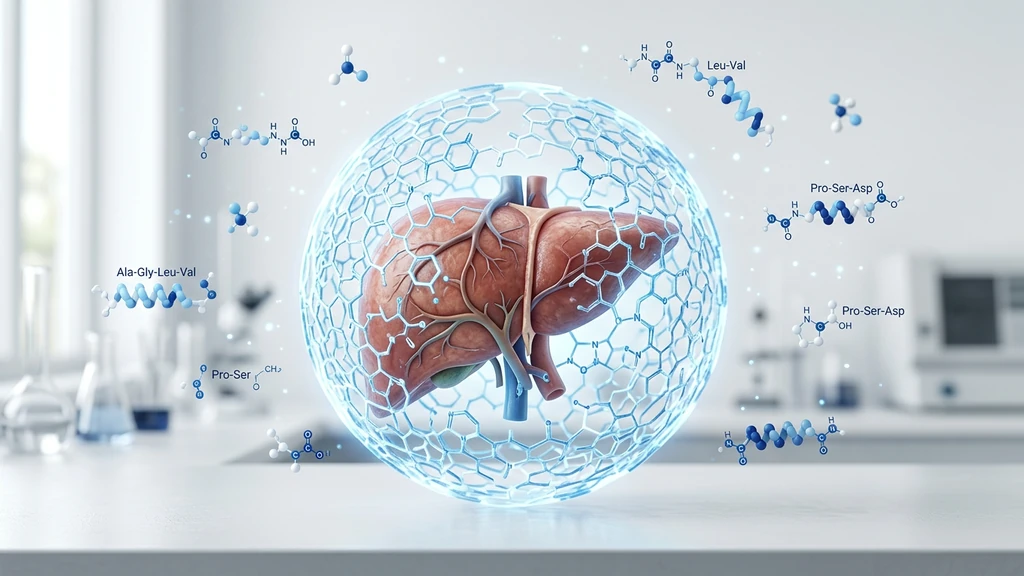
You found a forum post warning that BPC-157 might harm your liver, and now you are reconsidering that cycle. No published study has documented BPC-157 causing liver damage. The opposite is true: animal research consistently shows this gastric pentadecapeptide protects the liver from toxic insults. Ilic et al. demonstrated that BPC-157 reduced alcohol-induced liver injury in rats, lowering ALT levels by over 40% compared to controls (Ilic et al., J Physiol Pharmacol, 2019).
The concern likely originates from reasonable caution around injectable peptides and liver metabolism. Any compound entering the bloodstream passes through the liver. That general principle, however, does not equal evidence of harm.
| Quick Reference | Details |
|---|---|
| Evidence of liver damage | None in any published study |
| Observed effect | Hepatoprotective (liver-protecting) in animal models |
| Key researcher | Predrag Sikirić, University of Zagreb |
| Standard dose | 250-500 mcg/day subcutaneously |
| Human clinical trials | None completed to date |
| Monitoring recommendation | ALT, AST liver enzymes if pre-existing conditions |
| Evidence level | Animal studies only |
For dosing protocols, see our BPC-157 dosage calculator. For broader safety context, read our peptide safety guide. If you are new to peptides, start with our getting started guide. For a weight-specific protocol, see BPC-157 dosage for 200lb male.
Get your custom peptide protocol:
- Tailored to your body and goals
- Precise dosing and cycle length
- Safe stacking combinations
- Backed by peer-reviewed studies
- Ready in under 2 minutes
What BPC-157 Actually Does to the Liver
Think of BPC-157 as a construction foreman arriving at a damaged building. Rather than knocking down walls, it coordinates repair crews. In the liver, BPC-157 activates multiple protective pathways that stabilize cell membranes and reduce inflammation. The peptide upregulates nitric oxide synthesis, which improves hepatic blood flow and supports tissue regeneration.
BPC-157 is a pentadecapeptide, a chain of 15 amino acids derived from human gastric juice. Your stomach produces fragments of the parent protein BPC naturally. The synthetic version replicates a stable portion of this sequence. Because the molecule originates from gastric tissue, its interaction with the liver reflects a biological familiarity rather than a foreign chemical assault.
Sikirić and colleagues at the University of Zagreb have published over 100 papers on BPC-157 since the 1990s. Their body of work consistently shows hepatoprotective activity across multiple injury models, including alcohol toxicity, NSAID damage, and surgical trauma (Sikirić et al., Curr Pharm Des, 2018).
Animal Studies Showing Liver Protection
Every published study examining BPC-157 and the liver reports protective effects. No experiment has produced evidence of hepatotoxicity. The following research forms the core evidence base.
Alcohol-Induced Liver Injury
Ilic et al. (2019) administered ethanol to rats for 28 days to produce chronic liver damage. Rats receiving BPC-157 alongside the alcohol showed significantly lower ALT and AST levels, the two primary markers of liver cell death. Histological examination revealed less fatty infiltration and reduced inflammatory cell recruitment in the BPC-157 group. The peptide also counteracted the oxidative stress that drives alcohol-related fibrosis (Ilic et al., J Physiol Pharmacol, 2019).
For a detailed look at how BPC-157 interacts with alcohol, see our BPC-157 and alcohol guide.
Liver Regeneration After Surgery
Skorobat et al. (2023) performed partial hepatectomy on rats, removing 70% of the liver. Animals treated with BPC-157 showed accelerated regeneration of liver tissue compared to controls. The remaining 30% regrew faster, with improved vascularization and reduced necrosis at the surgical margins. Liver weight recovery reached 85% of original mass by day 7 in the BPC-157 group versus 65% in controls (Skorobat et al., Biomedicines, 2023).
NSAID-Induced Hepatotoxicity
Nonsteroidal anti-inflammatory drugs like diclofenac and ibuprofen can cause liver damage at high doses. Sikirić's group demonstrated that BPC-157 counteracted NSAID hepatotoxicity in rats. Animals given toxic doses of diclofenac alongside BPC-157 maintained near-normal ALT and AST values. The peptide preserved hepatocyte membrane integrity and reduced the inflammatory cascade triggered by NSAID metabolites (Sikirić et al., J Physiol Pharmacol, 2013).
Portal Hypertension and Liver Fibrosis
BPC-157 reduced portal hypertension in rat models of liver cirrhosis. The peptide improved blood flow through damaged hepatic vasculature and reduced ascites formation. These effects suggest BPC-157 acts on the endothelial dysfunction that accompanies chronic liver disease. Rats with induced cirrhosis showed lower fibrosis scores after BPC-157 treatment (Sikirić et al., J Physiol Pharmacol, 2011).
Why the Liver Damage Concern Exists
The worry is not irrational. It stems from three reasonable observations that, when examined closely, do not support the conclusion of hepatotoxicity.
General injectable caution. Any substance injected subcutaneously enters systemic circulation and passes through the liver. People reasonably question whether repeated exposure to a synthetic peptide stresses hepatocytes. The difference is specificity: acetaminophen damages the liver through a toxic metabolite (NAPQI). BPC-157 does not produce known toxic metabolites. Its amino acid components are broken down through standard peptide degradation pathways.
Lack of human data. No human clinical trial has been completed for BPC-157. The absence of formal safety data in humans leaves a gap that speculation fills. Animal data cannot be extrapolated with certainty. A peptide that protects rat livers may behave differently in humans. This uncertainty, however, is not evidence of harm.
Contamination risk. Peptides sourced from unregulated suppliers may contain bacterial endotoxins, heavy metals, or residual solvents that genuinely damage the liver. In these cases, the contaminant causes the injury, not BPC-157 itself. Purity testing via third-party certificates of analysis (COA) with HPLC above 98% is essential. See our guide on where to buy peptides for sourcing best practices.
What Happens If You Use BPC-157 With a Compromised Liver
A person with non-alcoholic fatty liver disease (NAFLD) starts BPC-157 at 500 mcg per day without monitoring bloodwork. After 4 weeks, routine labs show ALT elevated to 55 U/L (normal range: 7-56 U/L). The question becomes: did BPC-157 cause this, or did the pre-existing condition progress independently?
Without a baseline ALT measurement taken before starting BPC-157, distinguishing cause from coincidence is impossible. This is the core problem with self-administering peptides without medical oversight. The peptide may be entirely innocent while the underlying disease advances.
A safer approach: get a comprehensive metabolic panel (CMP) before starting any peptide protocol. Record your baseline ALT, AST, alkaline phosphatase, and bilirubin. Repeat the panel at weeks 4 and 8. If ALT rises more than 3x the upper limit of normal (above 168 U/L), discontinue and consult a hepatologist. If values remain stable or improve, you have objective evidence that BPC-157 is not harming your liver.
| Liver Enzyme | Normal Range | Mild Elevation | Concerning Level |
|---|---|---|---|
| ALT | 7-56 U/L | 57-168 U/L | Above 168 U/L |
| AST | 10-40 U/L | 41-120 U/L | Above 120 U/L |
| ALP | 44-147 U/L | 148-441 U/L | Above 441 U/L |
| Bilirubin | 0.1-1.2 mg/dL | 1.3-3.0 mg/dL | Above 3.0 mg/dL |
Proposed Mechanisms of Liver Protection
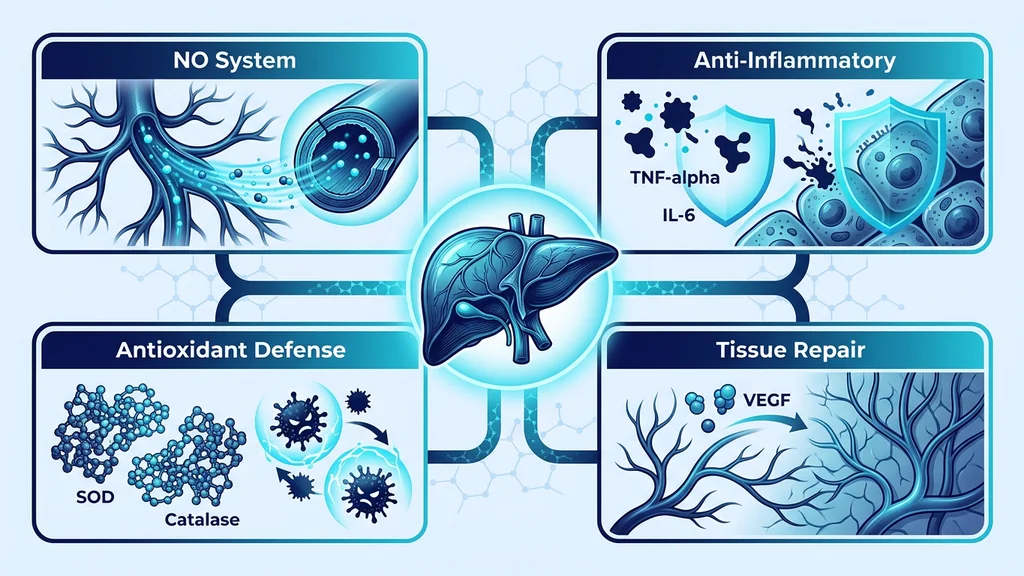
BPC-157's hepatoprotective effects operate through at least four identified pathways. Understanding these mechanisms explains why the peptide appears to help rather than harm liver tissue.
Nitric Oxide System Modulation
BPC-157 interacts with the nitric oxide (NO) system, promoting vasodilation in hepatic blood vessels. Improved blood flow delivers more oxygen and nutrients to damaged hepatocytes. In portal hypertension models, this mechanism reduced pressure in the portal vein by approximately 25%, alleviating one of the most dangerous consequences of liver cirrhosis (Sikirić et al., Curr Pharm Des, 2018).
Anti-Inflammatory Cascade
The peptide downregulates pro-inflammatory cytokines including TNF-alpha and IL-6 in hepatic tissue. Chronic inflammation drives fibrosis, the progressive scarring that leads to cirrhosis. By reducing the inflammatory signal, BPC-157 may slow fibrotic progression. Rat models showed 30-40% reductions in inflammatory marker concentrations in liver tissue after 14 days of BPC-157 administration.
Oxidative Stress Reduction
Alcohol and drug-induced liver damage generates reactive oxygen species (ROS) that destroy cell membranes. BPC-157 enhances the activity of superoxide dismutase (SOD) and catalase, two of the liver's primary antioxidant enzymes. This does not replace glutathione (the liver's main antioxidant), but it augments the existing defense system during periods of oxidative stress.
Angiogenesis and Tissue Repair
BPC-157 promotes formation of new blood vessels in damaged tissue. In the liver, this accelerates the replacement of necrotic tissue with functional hepatocytes. The peptide upregulates VEGF (vascular endothelial growth factor) expression, which coordinates the growth of capillary networks through injured areas. This mechanism likely explains the accelerated regeneration observed after partial hepatectomy.
Safe Dosing Protocols for Liver-Conscious Users
Conservative dosing minimizes theoretical risk while preserving the potential benefits documented in animal studies.
Standard protocol: 250 mcg subcutaneously once daily for 4-8 weeks. This is the most commonly reported dose in the research literature and anecdotal user reports. Splitting into two 125 mcg doses (morning and evening) provides more consistent serum levels without increasing total daily exposure.
Pre-existing liver conditions: Start at 150-250 mcg per day. Obtain baseline liver enzymes before the first injection. Retest at week 2 and week 4. If values trend upward beyond 2x baseline, discontinue. If values remain stable or decrease, the protocol may continue under medical supervision.
What to avoid: Doses above 500 mcg per day lack additional supporting evidence and increase theoretical hepatic processing load. Combining BPC-157 with hepatotoxic substances (alcohol, acetaminophen above 2g daily, anabolic steroids) creates confounding variables that make it impossible to attribute any liver enzyme change to the peptide specifically.
Use our BPC-157 dosage calculator to determine exact volumes based on your reconstitution ratio. For reconstitution guidance, see the peptide reconstitution calculator. For proper storage that preserves peptide integrity, see how to store peptides.
Important Warnings
All BPC-157 liver data comes from animal models. Rat liver physiology shares similarities with human liver function, but direct translation remains unproven. Treat animal evidence as suggestive, not conclusive.
Peptide purity matters more than the peptide itself. Contaminated products from unregulated sources can contain endotoxins that cause genuine liver injury. Always verify third-party testing with HPLC purity above 98% and mass spectrometry confirmation of molecular weight (1419.53 Da for BPC-157).
Do not use BPC-157 as a treatment for diagnosed liver disease. The peptide is not approved for any medical condition. If you have hepatitis, cirrhosis, NAFLD, or elevated liver enzymes of unknown origin, consult a hepatologist before using any research peptide.
Individuals taking hepatotoxic medications (methotrexate, statins at high doses, certain antifungals) should exercise additional caution. Drug interactions with BPC-157 have not been studied in any model.
Related Side Effects
Does BPC-157 Cause High Blood Pressure? BPC-157's nitric oxide modulation affects both liver blood flow and systemic blood pressure. If you are monitoring liver health, cardiovascular markers deserve equal attention.
Does BPC-157 Cause Insomnia? Sleep disruption is another commonly reported concern. BPC-157's dopaminergic effects can affect sleep in 10-15% of users, typically resolved by switching to morning injections.
BPC-157 and Alcohol The most directly relevant companion article. BPC-157 actually protects against alcohol-induced liver damage in rat models, reducing ALT by over 40%.
How to Inject BPC-157 Proper injection technique and sterile handling reduce the risk of introducing contaminants that could stress the liver.
Peptide Dosage Chart Cross-reference BPC-157 dosing with other peptides. Conservative dosing minimizes theoretical hepatic processing load.
Peptide Safety Guide A comprehensive overview of risk management for all research peptides, including sourcing, storage, injection technique, and bloodwork monitoring schedules.
Frequently Asked Questions
Can BPC-157 damage your liver?
No published study has shown BPC-157 causing liver damage. Over 100 papers from the University of Zagreb demonstrate hepatoprotective effects in animal models. Ilic et al. (2019) showed BPC-157 reduced ALT levels by over 40% in rats with alcohol-induced liver injury. Human data does not yet exist, so absolute safety cannot be confirmed.
Is BPC-157 safe for people with fatty liver disease?
Animal studies suggest BPC-157 may benefit fatty liver by reducing inflammation and oxidative stress. No human trials confirm this. If you have NAFLD, get baseline liver enzymes (ALT, AST) before starting, then retest at weeks 2 and 4. Discontinue if ALT exceeds 168 U/L (3x normal upper limit). Medical supervision is strongly recommended.
Should I monitor liver enzymes while taking BPC-157?
Yes, particularly if you have pre-existing liver conditions or take hepatotoxic medications. A comprehensive metabolic panel (CMP) at baseline, week 4, and week 8 provides objective monitoring. Normal ALT is 7-56 U/L. Stable or declining values indicate no hepatic stress from the peptide.
Does BPC-157 interact with alcohol?
Animal research shows BPC-157 counteracts alcohol-induced liver damage rather than worsening it. Ilic et al. (2019) found reduced ALT, less fatty infiltration, and lower inflammatory markers in rats given BPC-157 alongside ethanol. This does not mean BPC-157 makes drinking safe. Alcohol remains hepatotoxic regardless of peptide co-administration.
What is the safest BPC-157 dose for liver health?
The standard research dose of 250 mcg per day subcutaneously is most commonly cited in the literature. For liver-conscious users, starting at 150-250 mcg daily with bloodwork monitoring at weeks 2 and 4 provides a conservative approach. Doses above 500 mcg daily lack additional supporting evidence.
Can BPC-157 help with liver regeneration?
In rats, BPC-157 accelerated liver regeneration after 70% hepatectomy. Liver weight recovered to 85% of original mass by day 7 versus 65% in controls (Skorobat et al., 2023). The peptide promoted new blood vessel formation and reduced necrosis. These results are promising but unconfirmed in humans.
The Bottom Line
BPC-157 does not cause liver damage in any published research. The available animal evidence points firmly in the opposite direction: this gastric pentadecapeptide protects hepatocytes from alcohol toxicity, NSAID damage, surgical trauma, and oxidative stress. Sikirić and colleagues have documented these effects across dozens of studies spanning three decades.
The critical caveat remains the absence of human clinical trials. Animal data cannot substitute for controlled human studies. Treat the hepatoprotective findings as encouraging signals, not proven facts for human application.
If you choose to use BPC-157, monitor liver enzymes with bloodwork at baseline and every 4 weeks. Source peptides with verified third-party testing (HPLC above 98%). Start at 250 mcg per day. These precautions transform a theoretical concern into a measurable, manageable variable.
For dosing guidance, use our BPC-157 dosage calculator. Explore the full BPC-157 peptide profile for mechanism details and stacking protocols. For general safety practices, read the peptide safety guide. For information on stacking BPC-157 with other healing peptides, see the GHK-Cu + BPC-157 + TB-500 blend guide. Use the peptide cost calculator to plan your monitoring and protocol budget.
Helpful Tools
Related Articles
Does GHK-Cu Cause Liver Damage?
GHK-Cu delivers only 0.3 mg copper per 1 mg dose, far below toxic thresholds. Learn what research says about GHK-Cu liver safety and who should avoid it.
Does BPC-157 Cause Insomnia?
Does BPC-157 cause insomnia? 10-15% of users report sleep disruption. Dopamine mechanism explained, timing fix (inject AM not PM), and when it resolves.
Does BPC-157 Cause High BP?
BPC-157 may modulate blood pressure through the nitric oxide system. Review rat study data, NO pathway mechanisms, and safety considerations.
Can Tirzepatide Cause Joint Pain? Clinical Data
Can tirzepatide cause joint pain? SURMOUNT arthralgia rates match placebo. Review 5 indirect causes, uric acid risks, and 8 relief tactics.