You have a vial of lyophilized peptide sitting in your refrigerator. The powder needs to be mixed with bacteriostatic water before you can use it. The vial did not come with water, and your local pharmacy may not stock it. You need a reliable source, fast.
Bacteriostatic water for injection is available from compounding pharmacies, licensed medical supply companies, and established online retailers. A standard 30 mL vial of USP-grade bacteriostatic water costs between $3 and $15, depending on the source. The critical requirement is USP designation and 0.9% benzyl alcohol as the preservative. Anything sold without these specifications is not suitable for injection.
The rest of this guide covers every legitimate source, price comparisons, what to look for on the label, how to spot counterfeits, and how much water you actually need per peptide vial. For instant reconstitution math once you have your water, use the Peptide Reconstitution Calculator.
*This article is for research and educational purposes only. It is not medical advice. Consult a licensed healthcare provider before reconstituting or injecting any peptide or medication.*
Get your custom peptide protocol:
- Tailored to your body and goals
- Precise dosing and cycle length
- Safe stacking combinations
- Backed by peer-reviewed studies
- Ready in under 2 minutes
Where to Buy Bacteriostatic Water: Source Comparison
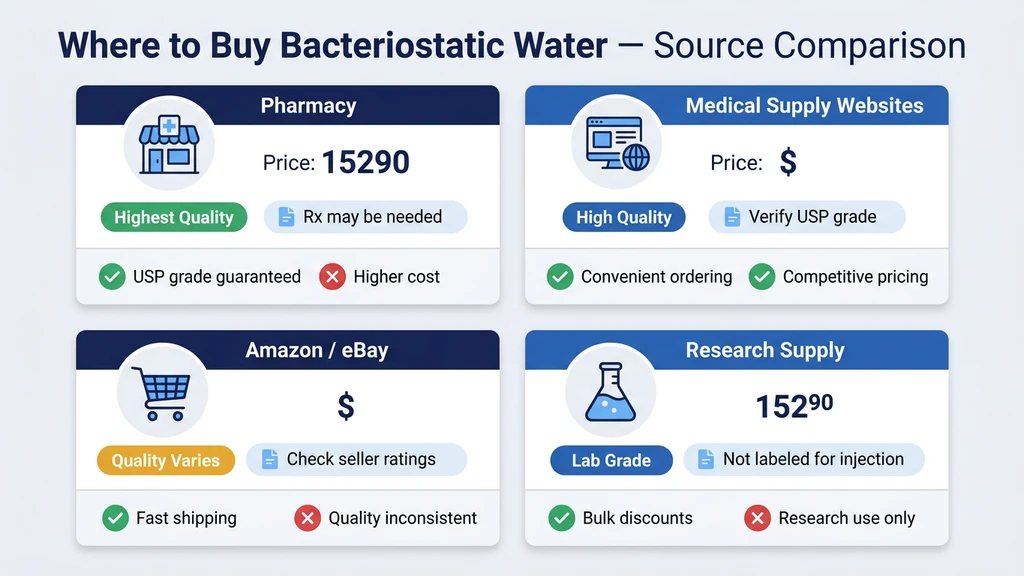
Seven source categories sell bacteriostatic water for injection. Each has distinct trade-offs in price, authenticity assurance, and convenience.
| Source Type | Pros | Cons | Price Range (30 mL) |
|---|---|---|---|
| Compounding pharmacy (with Rx) | Verified USP grade, pharmacist oversight | Requires prescription, limited hours | $5-$10 |
| Retail pharmacy (CVS, Walgreens) | Trusted brand, immediate pickup | Often out of stock, may require Rx | $8-$15 |
| Licensed medical supply company | Bulk pricing, consistent stock | Minimum order quantities, shipping time | $3-$8 |
| Online peptide supplier | Ships with peptide orders, convenient | Quality varies, verify vendor reputation | $4-$12 |
| Amazon / general e-commerce | Fast shipping, reviews available | Counterfeit risk, unverified sellers | $5-$15 |
| Veterinary supply | No prescription needed in most states | Not labeled for human use | $3-$6 |
| International pharmacy | Lower prices | Customs delays, regulatory gray area | $2-$5 |
The safest option is a compounding pharmacy that fills your peptide prescription. They dispense USP-grade bacteriostatic water with a proper lot number and expiration date. If you do not have a prescription, licensed medical supply companies are the next best choice.
Compounding and Retail Pharmacies
Compounding pharmacies that dispense tirzepatide, semaglutide, or other injectable peptides almost always carry bacteriostatic water. Many include it with the prescription at no additional charge. Ask when you place the order.
Retail chains (CVS, Walgreens, Rite Aid) stock bacteriostatic water in some locations, but availability is inconsistent. The product sits behind the pharmacy counter, not on the shelf. You may need to ask the pharmacist directly. Some states require a prescription. Others sell it over the counter as a medical supply.
If your pharmacy does not carry it, ask them to order it. Hospira (now Pfizer) manufactures the most widely distributed USP-grade bacteriostatic water in the United States. The NDC number is 00409-1966-05 for the 30 mL vial. Providing this number speeds up the order.
Online Medical Supply Companies
Licensed medical supply retailers sell bacteriostatic water without a prescription in most jurisdictions. These companies operate under state pharmacy board oversight and supply hospitals, clinics, and home health agencies.
When ordering online, verify three things before placing the order. First, the product listing must state "USP" on the label. Second, the company should display a physical address and phone number. Third, check whether the business holds a state license for distributing medical supplies. A company that sells bacteriostatic water alongside wound care supplies, syringes, and medical equipment is far more credible than one selling it next to supplements and workout gear.
Shipping matters. Bacteriostatic water does not require cold shipping. It is stable at room temperature (15 to 30 degrees Celsius) for its entire shelf life. Any seller charging extra for "cold pack shipping" on bacteriostatic water alone is adding unnecessary cost.
What to Look for on the Label
A legitimate bacteriostatic water vial carries specific markings. Missing any of these is a reason to return the product.
Required label elements:
- "Bacteriostatic Water for Injection, USP" as the product name. The "USP" designation means the product meets United States Pharmacopeia standards for purity, sterility, and composition. Water labeled simply "sterile water" or "purified water" is not the same product.
- "0.9% Benzyl Alcohol" listed as the preservative. This is the antimicrobial agent that makes multi-dose use safe. The concentration is standardized at 0.9% (9 mg/mL). Some manufacturers list it as "9 mg per mL" instead of a percentage. Both mean the same thing.
- Lot number and expiration date. Every pharmaceutical-grade product carries batch traceability. A vial without a lot number cannot be verified if a quality issue arises.
- Manufacturer name and NDC number. The National Drug Code identifies the product, manufacturer, and package size. Hospira/Pfizer NDC 00409-1966-05 is the most common in the US market.
- "For intravenous, intramuscular, or subcutaneous use" or similar injection route statement.
- "Single-dose" or "multi-dose" designation. Bacteriostatic water is a multi-dose product by definition. The benzyl alcohol preservative is what permits repeated needle punctures over the vial's use life.
A vial that says "for research use only" or "not for human use" has not undergone the same quality controls as a USP-designated pharmaceutical product. Some peptide research suppliers sell water labeled this way. It may be identical in composition, but the manufacturing oversight is different.
Benzyl Alcohol: Why 0.9% Matters
Benzyl alcohol at 0.9% concentration inhibits bacterial and fungal growth inside the vial after each needle puncture. This is the reason bacteriostatic water can be used for up to 28 days after the first puncture, while plain sterile water must be discarded within 24 hours.
The safety profile of benzyl alcohol at this concentration is well established. A 2001 review in the International Journal of Toxicology concluded that benzyl alcohol is safe for use as a preservative in injectable formulations at concentrations up to 2% (Nair, Int J Toxicol, 2001). The 0.9% used in bacteriostatic water sits well below this threshold.
One important exception: benzyl alcohol is contraindicated in neonates (newborns). The "gasping syndrome" reported in premature infants exposed to high cumulative doses of benzyl alcohol in the 1980s led to this restriction (Gershanik et al., J Pediatr, 1982). For adult use in reconstitution volumes typical of peptide preparation (1 to 3 mL), the benzyl alcohol exposure is minimal and well within established safety limits.
Bacteriostatic Water vs Sterile Water: Which Do You Need?
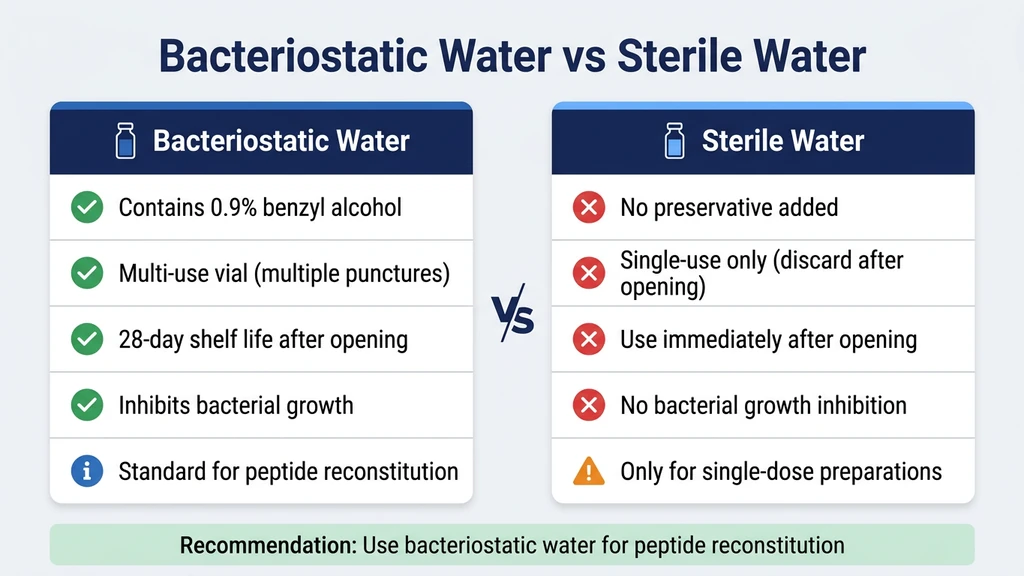
This distinction determines whether your reconstituted peptide stays safe for weeks or becomes a contamination risk within hours. The two products look identical. Clear liquid, same volume, same vial shape. The difference is entirely chemical.
| Feature | Bacteriostatic Water (BAC) | Sterile Water for Injection |
|---|---|---|
| Preservative | 0.9% benzyl alcohol | None |
| Multi-dose use | Yes (up to 28 days) | No (single use only) |
| Needle punctures | Multiple punctures safe | One puncture, then discard |
| Storage after opening | Room temp or refrigerated | Discard unused portion |
| Best for | Any vial drawn from multiple times | Single-use compounding |
| Shelf life (unopened) | 2-3 years | 2-3 years |
| Price (30 mL) | $3-$15 | $1-$5 |
When you need bacteriostatic water: Any time you plan to draw more than one dose from the same vial. This covers virtually all peptide reconstitution scenarios. A 10 mg vial of tirzepatide at 2.5 mg per week provides four doses over four weeks. Each dose requires a needle puncture. Without the benzyl alcohol preservative, bacteria introduced during the first puncture have 28 days to multiply unchecked.
When sterile water is acceptable: Single-dose vials consumed entirely in one injection. Some clinical settings use sterile water for this purpose. For home peptide reconstitution, bacteriostatic water is the standard regardless of vial size.
For a detailed walkthrough of water volumes by peptide, see how much bacteriostatic water for semaglutide.
How Much Bacteriostatic Water Do You Need?
A single 30 mL vial of bacteriostatic water is enough to reconstitute 10 to 30 peptide vials, depending on how much water you add per vial. Most people overestimate how much they need.
Water volume per reconstitution by peptide type:
| Peptide | Typical Vial Size | Recommended BAC Water | Resulting Concentration | Vials per 30 mL Bottle |
|---|---|---|---|---|
| Tirzepatide | 10 mg | 1 mL | 10 mg/mL | 30 |
| Semaglutide | 5 mg | 1 mL | 5 mg/mL | 30 |
| BPC-157 | 5 mg | 2 mL | 2.5 mg/mL | 15 |
| TB-500 | 5 mg | 2 mL | 2.5 mg/mL | 15 |
| GHK-Cu | 50 mg | 2 mL | 25 mg/mL | 15 |
One 30 mL bottle covers months of peptide use for most protocols. Buying two bottles "just in case" is reasonable. Buying ten is unnecessary unless you run a research operation.
After the first needle puncture, use the bacteriostatic water within 28 days. The preservative inhibits bacterial growth, but it does not sterilize indefinitely. Mark the date you first punctured the vial and discard it at day 28 regardless of remaining volume.
For exact water-to-peptide ratios at your specific vial size, the Peptide Reconstitution Calculator handles every combination.
Storage Requirements and Shelf Life
Bacteriostatic water is stable at controlled room temperature (15 to 30 degrees Celsius, or 59 to 86 degrees Fahrenheit). It does not require refrigeration before or after opening. This makes it one of the simplest supplies in a peptide protocol to store.
Unopened vial: - Store at room temperature away from direct sunlight - Shelf life: printed expiration date, typically 2 to 3 years from manufacture - Do not freeze. Ice expansion can crack the glass vial or compromise the rubber stopper seal - Keep in original packaging to protect from light
After first needle puncture: - Use within 28 days - Room temperature storage remains acceptable - Refrigeration is fine but not required - Write the date of first puncture on the vial with a permanent marker
What degrades bacteriostatic water: - UV light breaks down benzyl alcohol over extended exposure. A vial left on a windowsill for weeks may lose preservative effectiveness. Store in a drawer, cabinet, or box. - Temperatures above 40 degrees Celsius (104 degrees Fahrenheit) accelerate benzyl alcohol degradation. A car dashboard in summer can exceed 70 degrees Celsius. Never leave bacteriostatic water in a vehicle. - Contamination from non-sterile needles or improper technique. Always swab the stopper with 70% isopropyl alcohol before each puncture.
The reconstituted peptide itself has stricter storage requirements. Once you mix bacteriostatic water into a peptide vial, refrigerate at 2 to 8 degrees Celsius. For complete guidance on peptide storage, see how to store peptides and how long do reconstituted peptides last.
Red Flags: How to Spot Counterfeit or Substandard Product
Counterfeit bacteriostatic water exists. The product is inexpensive, which limits the financial incentive for counterfeiting, but low-quality imitations still circulate, particularly on general e-commerce platforms and from unverified overseas sellers.
Red flag 1: No USP designation on the label. If the label says "bacteriostatic water" but omits "USP," the product has not been manufactured under United States Pharmacopeia standards. USP certification requires validated sterilization, endotoxin testing, and composition verification. Without it, you are trusting the manufacturer's word alone.
Red flag 2: Missing or illegible lot number. Pharmaceutical manufacturers track every batch. A vial without a lot number cannot be traced if a contamination event occurs. Legitimate manufacturers print lot numbers in clear, permanent ink, not on a sticker that peels off.
Red flag 3: Damaged or missing flip-top seal. The aluminum crimp seal with a colored flip-top cap should be intact and seated flush against the glass. A loose, dented, or missing seal suggests the vial was opened, tampered with, or improperly sealed during manufacturing.
Red flag 4: Cloudiness, particles, or discoloration. Bacteriostatic water is clear and colorless. Hold the vial up to a light. Any haze, floating particles, or yellow tint means the product is contaminated or degraded. Do not use it.
Red flag 5: Price far below market range. A 30 mL vial for $1 from an unverified seller warrants skepticism. The manufacturing, sterilization, and packaging costs for a USP-grade injectable product have a floor. Prices below $2 to $3 per vial often indicate non-USP product relabeled as pharmaceutical grade.
Red flag 6: "For research use only" labeling. This language signals the product was not manufactured under the same GMP (Good Manufacturing Practice) controls required for injectable pharmaceuticals. The water may be chemically identical, but the quality assurance process is less rigorous. For injection purposes, USP-grade product is the standard.
If you order from a reputable peptide supplier, bacteriostatic water purchased alongside your peptides is typically sourced from the same pharmaceutical-grade supply chain. Vendors with established track records and transparent sourcing are less likely to cut corners on a $5 accessory product.
Legal Considerations by Country
Bacteriostatic water is a pharmaceutical product, not a controlled substance. Its legal status varies by jurisdiction, but it is not restricted in the same way that prescription medications are.
United States: Bacteriostatic water is available without a prescription in most states when purchased from a medical supply company. Some retail pharmacies treat it as a behind-the-counter item and may ask for a prescription, but this is store policy, not federal law. It is not a scheduled substance under the DEA or FDA.
Canada: Available without prescription from pharmacies and medical supply companies. Health Canada classifies it as a medical device/pharmaceutical supply rather than a drug.
United Kingdom: Available from pharmacies and medical supply retailers. No prescription required. The MHRA (Medicines and Healthcare products Regulatory Agency) regulates its manufacture but not its sale to consumers.
Australia: Available from pharmacies. The TGA (Therapeutic Goods Administration) regulates manufacturing standards. Some pharmacies sell it over the counter; others may request a prescription depending on state regulations.
European Union: Regulations vary by member state. Generally available from pharmacies without prescription. Product must meet European Pharmacopoeia (Ph. Eur.) standards, the EU equivalent of USP.
In all jurisdictions, the water itself is legal. The peptides you reconstitute with it may have different legal classifications. The water is the solvent, not the active compound. For current information on peptide legality, see the FDA peptide crackdown guide.
Common Mistakes When Buying Bacteriostatic Water
Four purchasing errors account for most problems people encounter with bacteriostatic water. Each is avoidable with basic knowledge.
Mistake 1: Buying sterile water instead of bacteriostatic water. The names sound similar. The products are fundamentally different. Sterile water has no preservative. If you use it to reconstitute a multi-dose peptide vial, bacteria can grow unchecked after the first needle puncture. By the third or fourth draw, the solution may carry a clinically relevant bacterial load. Always confirm "bacteriostatic" and "benzyl alcohol" appear on the label.
Mistake 2: Buying more than you can use in 28 days after opening. An opened 30 mL vial should be discarded 28 days after the first puncture. If your reconstitution schedule means you will use only 5 mL of bacteriostatic water per month, one 30 mL vial still covers that month. But you will discard the remaining 25 mL at day 28. Smaller vials (10 mL) exist for lower-volume users and reduce waste, though they cost more per milliliter.
Mistake 3: Storing bacteriostatic water in a hot environment. Heat accelerates degradation of benzyl alcohol. A vial stored on a shelf in a climate-controlled room lasts until its printed expiration date. A vial left in a garage, car, or near a heat source may lose preservative effectiveness months before expiration. Room temperature is fine. Hot is not.
Mistake 4: Reusing the same drawing needle repeatedly on the BAC water vial. Each needle puncture introduces potential contamination. Use a fresh, sterile needle every time you draw from the bacteriostatic water vial. This is the same sterile technique required when drawing from peptide vials. Needles are inexpensive. Contamination is not. For a complete overview of injection supplies and technique, see the peptide safety guide.
Step-by-Step: How to Use Bacteriostatic Water for Peptide Reconstitution
Once you have your bacteriostatic water, the reconstitution process is the same for every lyophilized peptide. The technique takes under five minutes.
- 1.Gather supplies. You need the bacteriostatic water vial, the peptide vial, a drawing syringe (3 mL with 18 to 21 gauge needle), alcohol swabs, and a permanent marker. Have your target water volume calculated before you start. The Peptide Reconstitution Calculator provides the exact volume for any peptide and vial size.
- 1.Swab both stoppers. Wipe the rubber stopper of the bacteriostatic water vial and the peptide vial with separate alcohol swabs. Let each air dry for 10 seconds.
- 1.Draw the bacteriostatic water. Insert the drawing needle into the BAC water vial. Invert the vial. Pull the plunger to your target volume. Tap the syringe barrel to dislodge air bubbles and push them back into the vial.
- 1.Inject water into the peptide vial. Push the needle through the peptide vial stopper. Aim the needle tip at the inside glass wall, not directly onto the powder. Release the water slowly over 30 to 60 seconds. Let it trickle down the glass and pool beneath the lyophilized powder.
- 1.Swirl gently. Hold the vial between thumb and forefinger and rotate in slow circles. Never shake. Most peptide powders dissolve within 1 to 3 minutes. If powder remains, set the vial upright in the refrigerator for 10 to 15 minutes, then swirl again.
- 1.Inspect. The solution should be clear and colorless. Hold it up to a light. Discard if cloudy, discolored, or containing particles.
- 1.Label and refrigerate. Write the peptide name, concentration, and today's date on the vial. Store at 2 to 8 degrees Celsius. The reconstituted solution is ready for dosing.
For peptide-specific reconstitution guides, see how to reconstitute tirzepatide, how to reconstitute GHK-Cu, or the general peptide stacking guide for multi-peptide protocols.
Frequently Asked Questions
Can I buy bacteriostatic water over the counter?
In most US states, yes. Bacteriostatic water is not a controlled substance. Medical supply companies, some retail pharmacies, and online retailers sell it without a prescription. Availability at retail pharmacies (CVS, Walgreens) varies by location and store policy. If the pharmacy does not stock it, ask the pharmacist to order Hospira/Pfizer NDC 00409-1966-05.
How much does bacteriostatic water cost?
A 30 mL vial of USP-grade bacteriostatic water costs $3 to $15 depending on the source. Medical supply companies offer the lowest prices ($3 to $8). Retail pharmacies charge $8 to $15. One 30 mL vial reconstitutes 10 to 30 peptide vials, making it one of the least expensive components in any peptide protocol.
Is bacteriostatic water the same as sterile water?
No. Bacteriostatic water contains 0.9% benzyl alcohol as a preservative that inhibits bacterial growth. Sterile water contains no preservative. Bacteriostatic water is safe for multi-dose use over 28 days. Sterile water must be used within 24 hours of opening. For any vial you plan to draw from more than once, bacteriostatic water is the correct choice.
How long does bacteriostatic water last after opening?
Use bacteriostatic water within 28 days of the first needle puncture. The 0.9% benzyl alcohol preservative inhibits bacterial growth during this window but does not sterilize indefinitely. Unopened vials last until the printed expiration date, typically 2 to 3 years from manufacture. Store at room temperature away from direct sunlight and heat.
Can I use bacteriostatic water for semaglutide and tirzepatide?
Yes. Bacteriostatic water is the standard solvent for reconstituting both semaglutide and tirzepatide, as well as BPC-157, TB-500, GHK-Cu, and virtually every lyophilized peptide. One 30 mL bottle works for all peptide types. Clean the stopper with an alcohol swab and use a fresh syringe for each vial.
Does bacteriostatic water need to be refrigerated?
No. Bacteriostatic water is stable at controlled room temperature (15 to 30 degrees Celsius) both before and after opening. Refrigeration is acceptable but not required. Avoid temperatures above 40 degrees Celsius, which degrade the benzyl alcohol preservative. The reconstituted peptide solution, however, must be refrigerated at 2 to 8 degrees Celsius.
How much bacteriostatic water do I add to a peptide vial?
The volume depends on the peptide type and your target concentration. Common volumes: 1 mL for a 10 mg tirzepatide vial (10 mg/mL), 1 mL for a 5 mg semaglutide vial (5 mg/mL), and 2 mL for a 5 mg BPC-157 vial (2.5 mg/mL). Use the Peptide Reconstitution Calculator at peptidesexplorer.com for exact volumes at any vial size.
Is it safe to buy bacteriostatic water on Amazon?
It can be, but exercise caution. Verify the seller is a licensed medical supply company, the product label states "USP" and lists 0.9% benzyl alcohol, and the vial has a lot number and expiration date. Avoid listings from unknown third-party sellers with no verifiable business address. Counterfeit risk is higher on general e-commerce platforms than at licensed medical supply retailers.
The Bottom Line
Bacteriostatic water for injection is available from compounding pharmacies, licensed medical supply companies, and established online retailers. A 30 mL vial of USP-grade product costs $3 to $15 and provides enough water to reconstitute dozens of peptide vials.
The non-negotiable requirements are the USP designation and 0.9% benzyl alcohol preservative listed on the label. Without these, the product has not met pharmaceutical manufacturing standards for injectable use. Verify the lot number, expiration date, and manufacturer name before purchasing.
For exact water volumes when reconstituting your specific peptide, use the Peptide Reconstitution Calculator. For storage guidance after reconstitution, see how to store peptides. For shelf life data by peptide type, read how long do reconstituted peptides last.
Related articles: - Bacteriostatic Water vs Sterile Water — detailed comparison of diluent types for peptide reconstitution - How Long Does Bacteriostatic Water Last? — shelf life guide with USP 797 rules - How to Reconstitute Tirzepatide — step-by-step mixing guide with concentration tables - How Much Bacteriostatic Water for Semaglutide — water volumes and concentration guide - How to Take BPC-157 — reconstitution, injection, and dosing protocol - Where to Buy Peptides in 2026 — vetted supplier directory - Peptide Safety Guide — injection technique and sterile handling
More from this series: - Does Bacteriostatic Water Need to Be Refrigerated? — storage rules for opened and unopened vials - How to Reconstitute Retatrutide — step-by-step reconstitution for the triple agonist - How Long Does Tirzepatide Last in the Fridge? — refrigeration timelines for reconstituted and lyophilized tirzepatide - How Many mg Is 20 Units of Tirzepatide? — unit-to-mg conversion for compounded tirzepatide - How Many mg Is 40 Units of Semaglutide? — unit-to-mg conversion for compounded semaglutide
Related Articles
Reconstitution Solution vs Bac Water
Reconstitution solution is a broad category. Bacteriostatic water is one type. Compare bac water, sterile water, and saline for peptide mixing.
How to Reconstitute Retatrutide
How to reconstitute retatrutide step by step for 5mg, 10mg, and 20mg vials. Concentration tables, BAC water volumes, syringe units per dose, and storage guide.
How to Reconstitute Tirzepatide
How to reconstitute tirzepatide step by step for 5mg, 10mg, 15mg, and 30mg vials. Concentration tables, BAC water volumes, syringe units, and storage guide.
How to Reconstitute GHK-Cu: Guide
How to reconstitute GHK-Cu step by step for 50mg and 100mg vials. Concentration table, bacteriostatic water volumes, syringe units, and storage instructions.