You just drew 40 units of compounded semaglutide into your insulin syringe. Or maybe your provider told you to inject 40 units and you want to know what dose that actually is before the needle touches your skin. Either way, you need one number: the milligrams.
Here is your answer: 40 units of semaglutide = 0.4 mL of liquid, and the milligrams depend entirely on your vial's concentration. At 2 mg/mL, 40 units is 0.8 mg. At 2.5 mg/mL, it is 1.0 mg. At 5 mg/mL, it is 2.0 mg. At 10 mg/mL, it is 4.0 mg. Same syringe reading, five different doses. The concentration printed on your vial label determines which one you are actually injecting.
If you want the answer instantly for any unit count, the Semaglutide Dosage Calculator does the math in seconds.
Get your custom peptide protocol:
- Tailored to your body and goals
- Precise dosing and cycle length
- Safe stacking combinations
- Backed by peer-reviewed studies
- Ready in under 2 minutes
40 Units of Semaglutide in mg: Quick Reference Table
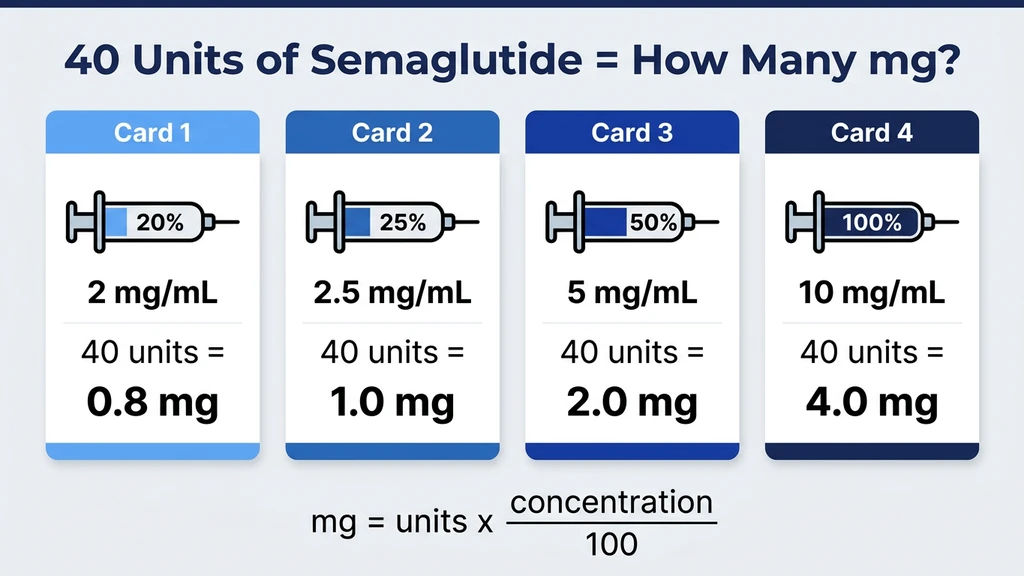
Find your vial concentration in the left column. The right column shows exactly how many milligrams you get when you draw 40 units.
| Your Vial Concentration | 40 Units = This Many mg |
|---|---|
| 2 mg/mL | 0.8 mg |
| 2.5 mg/mL | 1.0 mg |
| 3 mg/mL | 1.2 mg |
| 5 mg/mL | 2.0 mg |
| 10 mg/mL | 4.0 mg |
If you do not know your concentration, stop. Do not inject. Flip the vial over and read the label. It will say something like "Semaglutide 5 mg/mL." If the label shows a total, such as "10 mg / 2 mL," divide: 10 divided by 2 = 5 mg/mL. If the label is unclear, call your pharmacy.
The most common compounded semaglutide concentrations are 2 mg/mL and 5 mg/mL. If your vial is 5 mg/mL, 40 units delivers exactly 2.0 mg of semaglutide. At 2 mg/mL, that same syringe draw delivers only 0.8 mg. The difference between these two outcomes is a 2.5-fold gap in actual drug exposure. If you are comparing semaglutide with tirzepatide, the same concentration principle applies. Our semaglutide vs. tirzepatide conversion guide explains how doses map between the two drugs.
Why the Same Units Give You Different Milligrams
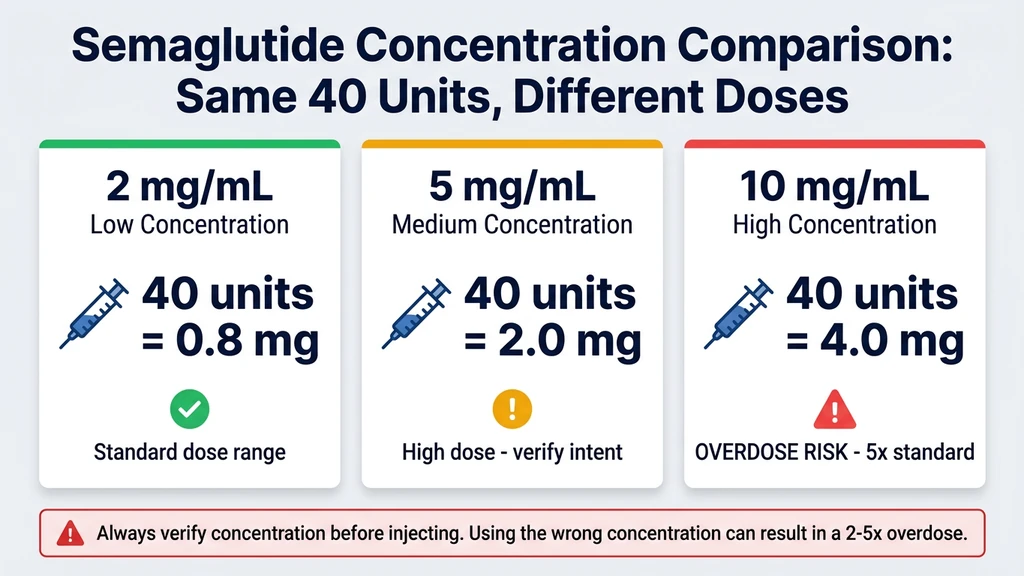
Think of it like salt in water. A tablespoon of ocean water contains about 0.5 grams of salt. A tablespoon from the Dead Sea contains roughly 3.4 grams. Same tablespoon, same volume of liquid, but the saltier water packs more salt per sip.
Your syringe works exactly like that tablespoon. When you draw 40 units, you pull in 0.4 mL of liquid regardless of concentration. A 2 mg/mL vial has 0.8 mg of semaglutide dissolved in that 0.4 mL. A 5 mg/mL vial has 2.0 mg in the same volume. A 10 mg/mL vial has 4.0 mg. The liquid is more concentrated, so each unit of volume contains more drug.
The syringe measures volume. The vial label tells you the concentration. You need both numbers to know your actual milligram dose. Neither one alone gives you the answer. This same principle applies to every injectable peptide. If you use BPC-157, TB-500, or GHK-Cu, the concentration-to-dose relationship works identically.
The Conversion Formula (One Equation, Every Dose)
You need one formula. It works for 40 units, 25 units, 10 units, or any other number on your syringe:
mg = (Units ÷ 100) × Concentration in mg/mL
Walk through it with 40 units at 5 mg/mL:
- 1.Convert units to mL: 40 units ÷ 100 = 0.4 mL. Every U-100 insulin syringe splits 1 mL into 100 units. So 40 units means you have pulled 0.4 mL of liquid into the barrel.
- 2.Multiply by concentration: 0.4 mL × 5 mg/mL = 2.0 mg. Each milliliter contains 5 mg of semaglutide, and you have 0.4 of a milliliter.
Two steps. Now the same calculation at 2 mg/mL:
- 1.40 units ÷ 100 = 0.4 mL
- 2.0.4 mL × 2 mg/mL = 0.8 mg
Notice what happened. The volume stayed at 0.4 mL both times. Only the concentration changed, and so the milligrams changed with it.
You can also reverse this formula to figure out how many units to draw for a specific mg dose. The reverse formula: Units = (Dose in mg ÷ Concentration) × 100. For the full semaglutide dosage chart in mL, see our comprehensive reference guide. If you use tirzepatide, the same formula applies; see our tirzepatide dosage chart in units for those conversions.
What Happens When You Get the Concentration Wrong
This is not a theoretical exercise. Concentration mix-ups are the single most dangerous mistake with compounded semaglutide, and they produce real consequences.
Scenario 1: Drawing 40 units from a 5 mg/mL vial when you think it is 2 mg/mL.
You believe you are injecting 0.8 mg, a common early titration dose. You are actually injecting 2.0 mg. That is 2.5 times your intended dose. At 2.0 mg, semaglutide produces significantly more GI side effects than at lower doses. The SUSTAIN 1 trial documented nausea in 20% of patients at the 1.0 mg dose (Sorli et al., Diabetes Care, 2017). At 2.0 mg when your body expects 0.8 mg, severe nausea, vomiting, and diarrhea lasting 48 to 72 hours are likely. If you experience this, review the symptom timeline in our semaglutide nausea guide.
Scenario 2: Drawing 40 units from a 2 mg/mL vial when you should be using a 5 mg/mL vial.
Your intended dose is 2.0 mg. You get 0.8 mg. That is 60% less drug than your prescription calls for. Your weight loss slows or stalls completely, and you have no idea why. If your scale has flatlined, check your concentration before assuming the drug stopped working. Our guide on why semaglutide weight loss stalls covers other plateau causes.
Scenario 3: Your pharmacy switches concentrations between refills.
Your first vial is 2.5 mg/mL. You draw 40 units and get 1.0 mg. Three months later, the refill arrives at 5 mg/mL. You draw 40 units out of habit. You just doubled your dose to 2.0 mg overnight. At the 2.4 mg maintenance dose level, semaglutide suppresses appetite strongly enough that caloric intake can drop dangerously low if you are not eating intentionally (Blundell et al., Diabetes Obes Metab, 2023).
The fix for all three scenarios: read the label on every new vial and recalculate. Write your concentration and unit count on a sticky note attached to the vial. Ten seconds of checking prevents every one of these mistakes.
How to Read Your Semaglutide Vial Label
Compounding pharmacies label vials in several formats. Here is how to interpret each:
- "Semaglutide 5 mg/mL": Your concentration is 5 mg/mL. Straightforward.
- "5mg/ml": Same thing, written without spaces.
- "10 mg / 2 mL": Total drug divided by total liquid. 10 ÷ 2 = 5 mg/mL.
- "25 mg / 5 mL": Same math. 25 ÷ 5 = 5 mg/mL.
- "Semaglutide 2.5mg/ml (5mg/2ml)": Both numbers say the same thing. Use 2.5 mg/mL.
If your label shows a total amount and a total volume separated by a slash, always divide the mg number by the mL number. That gives your concentration. If you reconstituted the vial yourself from lyophilized powder, the concentration depends on how much bacteriostatic water you added.
How to Read Your Insulin Syringe at the 40-Unit Mark
Finding the 40-unit line on your syringe is easy on paper. In practice, with tiny markings, poor lighting, and no reading glasses handy, it gets tricky. Here is what the 40-unit mark looks like on each syringe size.
1 mL syringe (100 units max)
This is the largest common insulin syringe. Each small graduation line represents 2 units. Numbers are printed every 10 units: 10, 20, 30, 40, 50, and so on. The 40-unit mark has a number printed right on the barrel. Draw the plunger until the top edge of the black rubber stopper sits flat against the "40" line. This syringe is the easiest to use for 40-unit draws because the mark is clearly labeled.
0.5 mL syringe (50 units max)
Each small line represents 1 unit. Numbers appear every 5 or 10 units depending on the brand. The 40-unit mark sits near the top of the barrel, 10 units from the maximum. This syringe gives better precision than the 1 mL version for this particular draw because the markings are larger relative to the barrel diameter.
0.3 mL syringe (30 units max)
This syringe maxes out at 30 units. You cannot draw 40 units with it. If your dose requires 40 units, you need a 0.5 mL or 1 mL syringe.
The rule for 40 units: a 0.5 mL syringe is the best balance of capacity and precision. A 1 mL syringe works fine but has coarser markings. A 0.3 mL syringe is physically too small.
Reading tip: Hold the syringe at eye level with the needle pointing up. The meniscus (the slight curve at the top of the liquid) should sit with its flat bottom edge touching the 40-unit line. Do not read from an angle. Parallax distortion can shift your reading by 1 to 2 units, which translates to a real dosing error. For a broader introduction to syringe technique and injection safety, see the peptide safety guide.
Full Conversion Table: Common Unit Counts at Every Concentration
You will not always draw 40 units. As your dose titrates up, your provider may change the unit count or switch your concentration. This table covers the most common draws for semaglutide at every standard compounded concentration.
| Units Drawn | 2 mg/mL | 2.5 mg/mL | 3 mg/mL | 5 mg/mL | 10 mg/mL |
|---|---|---|---|---|---|
| 5 units | 0.1 mg | 0.125 mg | 0.15 mg | 0.25 mg | 0.5 mg |
| 10 units | 0.2 mg | 0.25 mg | 0.3 mg | 0.5 mg | 1.0 mg |
| 20 units | 0.4 mg | 0.5 mg | 0.6 mg | 1.0 mg | 2.0 mg |
| 25 units | 0.5 mg | 0.625 mg | 0.75 mg | 1.25 mg | 2.5 mg |
| 40 units | 0.8 mg | 1.0 mg | 1.2 mg | 2.0 mg | 4.0 mg |
| 50 units | 1.0 mg | 1.25 mg | 1.5 mg | 2.5 mg | 5.0 mg |
| 60 units | 1.2 mg | 1.5 mg | 1.8 mg | 3.0 mg | 6.0 mg |
| 80 units | 1.6 mg | 2.0 mg | 2.4 mg | 4.0 mg | 8.0 mg |
| 100 units | 2.0 mg | 2.5 mg | 3.0 mg | 5.0 mg | 10.0 mg |
The standard FDA-approved semaglutide titration schedule for weight management (Wegovy) follows this path: 0.25 mg for weeks 1 to 4, 0.5 mg for weeks 5 to 8, 1.0 mg for weeks 9 to 12, 1.7 mg for weeks 13 to 16, and 2.4 mg from week 17 onward (FDA Wegovy Label, 2021). For a visual guide to these dose increases, see the semaglutide dosage chart.
Look at the 2.5 mg/mL column. At that concentration, the titration maps neatly onto round unit numbers: 10 units for 0.25 mg, 20 units for 0.5 mg, 40 units for 1.0 mg. This is why many compounding pharmacies prefer 2.5 mg/mL. The math stays clean at every dose step. For a broader reference covering all peptide doses, see the peptide dosage chart.
Semaglutide Units vs. Insulin Units: They Are Not the Same Drug
A question that trips up people who are also on insulin: "Are semaglutide units the same as insulin units?"
No. And confusing the two is dangerous.
An insulin unit is a standardized biological measure. One unit of insulin lowers blood glucose by a specific amount in a standard test. Every vial of U-100 insulin contains exactly 100 international units per mL, calibrated by biological activity.
A semaglutide "unit" on your syringe is purely a volume measurement. When you draw 40 units of semaglutide, you are measuring 0.4 mL of liquid. The syringe does not know what is inside it. It cannot tell the difference between semaglutide, insulin, saline, or coffee. It just measures volume.
This distinction matters if you use both medications. Drawing "40 units" from an insulin vial gives you 40 international units of insulin, a specific pharmacological dose. Drawing "40 units" from a semaglutide vial gives you 0.4 mL of liquid, and the drug dose depends on concentration. Never interchange dosing instructions between the two. An insulin dose of 40 units has nothing in common with a semaglutide draw of 40 units.
Semaglutide was originally developed for type 2 diabetes management, where it demonstrated a 1.5 to 1.8 percentage point reduction in HbA1c at the 1.0 mg weekly dose (Marso et al., N Engl J Med, 2016). If your provider has you on both semaglutide and insulin, keep the vials physically separated and labeled. Some patients use colored tape or markers to avoid a mix-up. For proper vial organization and storage, see how to store peptides.
Common Mistakes With 40-Unit Draws (And How to Fix Them)
Mistake #1: Assuming all vials have the same concentration.
You find a forum post saying "40 units = 1.0 mg." That is only true at 2.5 mg/mL. If your vial is 5 mg/mL, 40 units is 2.0 mg. If it is 10 mg/mL, 40 units is 4.0 mg. Never use someone else's conversion without checking it against your own vial label. The Semaglutide Dosage Calculator calculates the correct value for your specific concentration.
Mistake #2: Using a U-40 syringe instead of U-100.
U-40 syringes exist for certain veterinary insulins. They pack 40 units into 1 mL instead of 100. If you accidentally use a U-40 syringe and draw to the "40" mark, you are pulling in 1.0 mL of liquid instead of 0.4 mL. At 5 mg/mL, that means 5.0 mg of semaglutide instead of 2.0 mg. That is a 2.5x overdose. Always confirm your syringe says "U-100" on the packaging.
Mistake #3: Not accounting for air bubbles.
Air bubbles in the syringe barrel displace liquid. If you draw to the 40-unit line but 3 units of that space is air, you only have 37 units of semaglutide solution. At 5 mg/mL, you lose 0.15 mg per draw. Over a month of weekly injections, that adds up to 0.6 mg of lost drug. Tap the barrel with your fingernail to float bubbles to the top, push them out, and redraw to 40.
Mistake #4: Drawing from a reconstituted vial past its stability window.
Compounded semaglutide stored at room temperature degrades faster than refrigerated product. If you leave a reconstituted vial on your bathroom counter for two weeks, the actual drug concentration drops below what the label says. Your 40 units delivers fewer milligrams than the math predicts. For storage guidelines, see our guide on how long reconstituted peptides last and how to store peptides properly. Keep compounded semaglutide refrigerated at 2 to 8 degrees Celsius. Sourcing matters too: review where to buy peptides in 2026 to find reputable compounding pharmacies.
Practical Dosing Tips for Compounded Semaglutide
Choose the right concentration for clean unit numbers.
If your provider prescribes 1.0 mg weekly, a 2.5 mg/mL vial lets you draw exactly 40 units. No fractions. No eyeballing between lines. A 5 mg/mL vial would require 20 units for the same dose, also clean. A 3 mg/mL vial would require 33.3 units, which is impossible to draw precisely. When you have a choice, pick the concentration that gives you round numbers at your current dose. Review the full semaglutide dosage chart to find the cleanest match.
Rotate your injection sites.
Subcutaneous semaglutide goes into the abdomen (at least 2 inches from the navel), front of the thigh, or back of the upper arm. Rotate between these areas each week. Repeated injections in the same spot can cause lipohypertrophy, small lumps of fat under the skin that alter drug absorption and make your dose unpredictable. Semaglutide's once-weekly dosing makes rotation simple: pick three spots and cycle through them. If you are new to self-injection, our getting started with peptides guide covers technique from scratch.
Time your injection consistently.
Semaglutide has a half-life of approximately 7 days, which supports once-weekly dosing (Kapitza et al., J Clin Pharmacol, 2015). Inject on the same day each week. If you miss your day, inject as soon as you remember, as long as your next scheduled dose is at least 2 days away. If you are within 2 days of your next dose, skip the missed one.
Track your doses.
Write the date, unit count, and concentration for each injection in a notebook or phone app. This log becomes critical if you experience unexpected side effects (did the concentration change?) or a weight loss plateau (are you actually getting the right dose?). If weight loss stalls, our semaglutide troubleshooting guide walks through every possible cause.
Manage GI side effects proactively.
Nausea is the most common side effect of semaglutide, reported in 44.2% of participants in the STEP 1 trial at the 2.4 mg dose (Wilding et al., N Engl J Med, 2021). The slow titration schedule exists specifically to minimize this. If your provider has you at 40 units, they have likely built in titration time. Do not increase your dose faster than the schedule allows, even if you feel fine. Fatigue and hair thinning are also reported at higher doses and are worth monitoring.
Frequently Asked Questions
How many mg is 40 units of semaglutide at 5 mg/mL?
2.0 mg. The math: 40 units = 0.4 mL of liquid, and 0.4 mL times 5 mg/mL = 2.0 mg. This is the most common compounded concentration, and 2.0 mg is the fourth step in the standard Wegovy titration schedule, typically reached at weeks 13 to 16.
How many mg is 40 units of semaglutide at 2.5 mg/mL?
1.0 mg. At 2.5 mg/mL, 0.4 mL of liquid contains 1.0 mg of semaglutide. This is the third step in the standard titration (weeks 9 to 12). The 2.5 mg/mL concentration produces clean, round unit numbers at every standard dose level.
How many mg is 40 units of semaglutide at 2 mg/mL?
0.8 mg. At 2 mg/mL, 0.4 mL contains only 0.8 mg. This falls between standard titration steps (0.5 mg and 1.0 mg), so confirm with your provider that 0.8 mg is your intended dose. If they prescribed 1.0 mg, you need 50 units at this concentration.
Is 40 units the same as 0.4 mL?
Yes, on a U-100 insulin syringe. U-100 means 100 units per milliliter. So 40 units = 40/100 = 0.4 mL. This volume conversion is always the same regardless of what drug is in the syringe. The milligram dose, however, changes with concentration.
What is the standard semaglutide dose for weight loss?
The FDA-approved maintenance dose for weight management (Wegovy) is 2.4 mg once weekly. You reach it through a 16-week titration: 0.25 mg, 0.5 mg, 1.0 mg, 1.7 mg, then 2.4 mg. At 5 mg/mL, the 2.4 mg maintenance dose requires 48 units per injection.
Can I use the same syringe for semaglutide and insulin?
You can use the same type of syringe (U-100 insulin syringes work for both), but never the same individual syringe. Each injection requires a new, sterile syringe. Also, semaglutide dose instructions refer to volume-based units, while insulin dose instructions refer to biological international units. Do not interchange the numbers.
How do I know what concentration my semaglutide is?
Read the vial label. It will say something like '5 mg/mL' or show a total such as '10 mg / 2 mL' (divide: 10 divided by 2 = 5 mg/mL). If you reconstituted lyophilized powder yourself, divide the total mg of powder by the mL of bacteriostatic water you added. A 5 mg vial mixed with 2 mL of water gives 2.5 mg/mL.
What if my provider prescribed units but I need to know the mg?
Use the formula: mg = (units divided by 100) times your concentration in mg/mL. For 40 units at 5 mg/mL: (40 divided by 100) times 5 = 2.0 mg. If you cannot find your concentration or the math does not match a standard semaglutide dose (0.25, 0.5, 1.0, 1.7, or 2.4 mg), call your pharmacy to confirm.
The Bottom Line
Forty units of semaglutide is 0.4 mL of liquid. The milligrams depend on concentration: 0.8 mg at 2 mg/mL, 1.0 mg at 2.5 mg/mL, 2.0 mg at 5 mg/mL, or 4.0 mg at 10 mg/mL. The formula: mg = (units ÷ 100) × concentration.
Your unit number is meaningless without your concentration. If the vial changes, the math changes. Check the label. Do the calculation. Write it down.
Skip the arithmetic entirely with the Semaglutide Dosage Calculator. For help preparing your vials from lyophilized powder, the Peptide Reconstitution Calculator walks you through the process step by step. If you are mixing your own vials, our guide on how much bacteriostatic water to add covers exact volumes for every vial size. And if your provider is considering switching you to tirzepatide, see the semaglutide to tirzepatide conversion guide to understand how your dose translates between drugs.
Related articles: - How Many mg Is 20 Units of Tirzepatide? — the same unit-to-mg conversion guide for compounded tirzepatide - How Long Do Semaglutide Side Effects Last? — clinical timelines for nausea, fatigue, and GI symptoms - How Long Does Semaglutide Stay in Your System? — half-life and elimination timeline after your last dose - Where to Buy Bacteriostatic Water for Injection — sourcing guide for reconstitution supplies - How to Reconstitute Retatrutide — step-by-step mixing guide for the triple agonist - Does Bacteriostatic Water Need to Be Refrigerated? — storage rules for your reconstitution water - How to Microdose Semaglutide — low-dose protocols with unit-to-mg calculations - Compound Semaglutide With B12 — unit conversions for B12-enhanced compounded vials
Related Articles
Semaglutide Titration Schedule: 6-Month Plan
Week-by-week semaglutide titration from 0.25 to 2.4 mg. Based on STEP trial data. When to extend, down-titrate, or restart after missing doses.
How Many Units Is 7.5 mg of Tirzepatide?
7.5 mg of tirzepatide equals 75 units (10 mg/mL), 37.5 units (20 mg/mL), or 18.75 units (40 mg/mL). Conversion table and syringe guide included.
Semaglutide to Tirzepatide Switching
Switching semaglutide to tirzepatide? Clinical dose equivalence table, step-by-step protocol, titration schedule, and common mistakes to avoid.
How Many Units Is 2.5 mg Tirzepatide?
2.5 mg of tirzepatide is 25 units at 10 mg/mL, 12.5 units at 20 mg/mL, or 50 units at 5 mg/mL. Conversion table with syringe instructions.