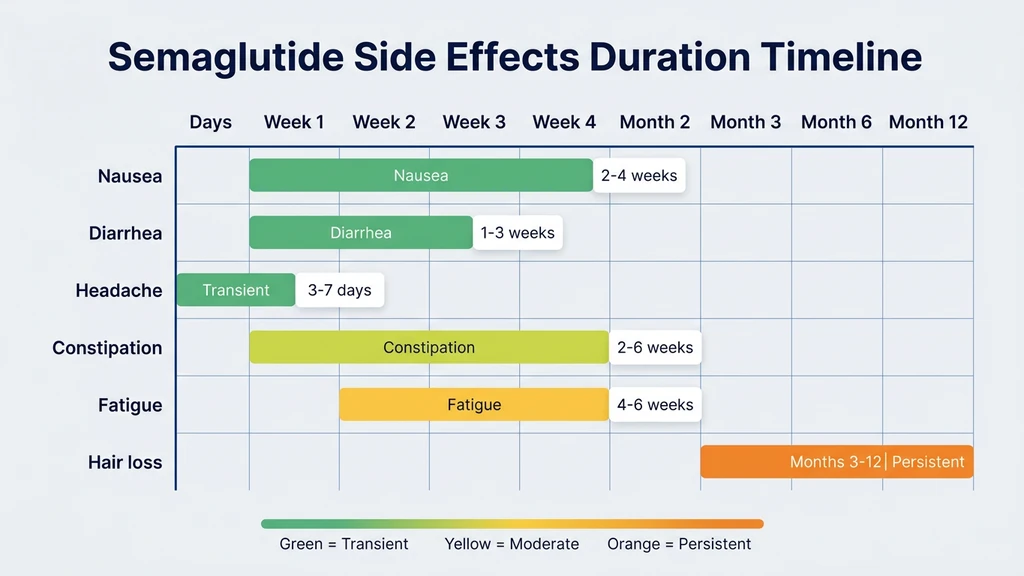
You increased your semaglutide dose two days ago. Now you are dealing with nausea, loose stools, and a headache that will not quit. The question is whether this is temporary or permanent. Most semaglutide side effects resolve within 2 to 4 weeks as your body adjusts to each dose level. The STEP 1 trial found that only 7% of participants discontinued due to adverse events, meaning 93% tolerated the drug through completion (Wilding et al., NEJM 2021).
The timeline varies by symptom. Nausea peaks in days 2 to 5 and fades within 2 to 4 weeks. Diarrhea follows a similar pattern. Fatigue can linger for 4 to 6 weeks. Hair loss, if it occurs, does not start until months 3 to 6 and may persist for the duration of treatment.
| Side Effect | Typical Onset | Typical Duration | Resolution Rate |
|---|---|---|---|
| Nausea | 24-72 hours after dose increase | 2-4 weeks at stable dose | ~80% resolve by week 8 |
| Diarrhea | Days 1-5 after dose increase | 1-3 weeks | ~75% resolve by week 6 |
| Constipation | Week 1-2 of treatment | 2-6 weeks (may persist) | ~60% resolve; 40% ongoing |
| Fatigue | Week 1-3 of treatment | 4-6 weeks | ~70% resolve by week 8 |
| Headache | 24-48 hours after dose increase | 3-7 days per episode | ~90% resolve quickly |
| Injection site reaction | Within hours of injection | 1-3 days per episode | ~95% resolve rapidly |
| Hair loss (telogen effluvium) | Months 3-6 of treatment | 6-12 months | Variable; often reverses after stabilization |
For dosing protocols that minimize side effects, see our semaglutide dosage chart. For reconstitution guidance, see how much bacteriostatic water for semaglutide.
Get your custom peptide protocol:
- Tailored to your body and goals
- Precise dosing and cycle length
- Safe stacking combinations
- Backed by peer-reviewed studies
- Ready in under 2 minutes
Why Semaglutide Side Effects Are Temporary for Most People
Think of your GLP-1 receptors like a thermostat set to a low temperature for decades. Semaglutide cranks the dial to high. The system overreacts at first: nausea, gut disruption, headaches. Over 2 to 4 weeks, the thermostat recalibrates. Your brain and gut adapt to the new signal level, and the overreaction fades.
The scientific term is receptor desensitization. GLP-1 receptors in the area postrema (the brain's nausea center) and the gastrointestinal tract downregulate their response to sustained stimulation. The drug is still working. The receptors simply stop sounding the alarm at full volume.
This is why the dose-escalation schedule exists. Each 4-week interval at 0.25 mg, then 0.5 mg, then 1.0 mg, then 1.7 mg, then 2.4 mg gives the receptors time to adapt before the next increase. Skipping a dose level is like cranking the thermostat from 60 to 90 in one move. The system cannot keep up (Nauck et al., 2021).
Nausea: The Most Common and Most Studied Side Effect
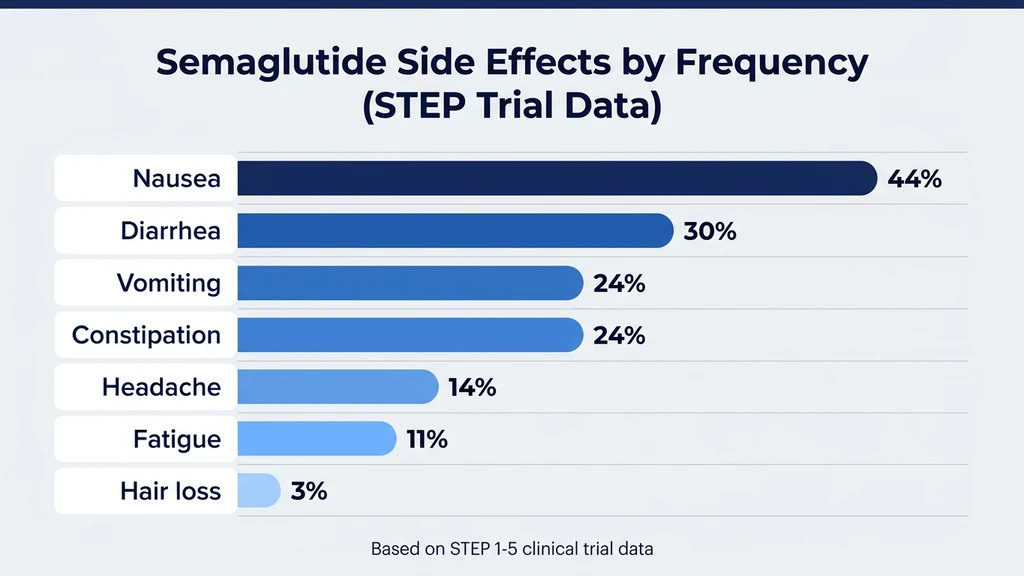
Nausea is the side effect that dominates early treatment. The STEP 1 trial reported it in 44.2% of semaglutide users at the 2.4 mg dose versus 17.4% on placebo. That 44.2% number sounds alarming until you examine the timeline and severity data.
When Nausea Starts
Nausea appears within 24 to 72 hours of the first injection or each dose escalation. The 0.5 mg to 1.0 mg jump is typically the worst because it represents the largest proportional increase. Two mechanisms fire simultaneously: semaglutide activates GLP-1 receptors in the area postrema, and it slows gastric emptying by 30 to 40%. Food sits in the stomach longer than the brain expects, triggering a stop-eating signal that, pushed further, becomes nausea.
For a detailed breakdown of the nausea mechanism, see our guide on does semaglutide cause nausea.
When Nausea Stops
Nausea peaks in days 2 to 5 at each new dose level. By day 7 to 10, most users describe a steady decline. After 2 to 4 weeks at the same dose, nausea drops to mild or absent for the majority. The STEP 2 trial in type 2 diabetes patients found a lower overall nausea rate (33.6%) partly because some investigators used slower titration schedules (Davies et al., Lancet 2021).
At maintenance, only 10 to 15% of users report ongoing nausea. Of the initial 44.2% who experienced it, roughly 80% described resolution or near-resolution by 6 to 8 weeks at their final dose. The remaining 20% had persistent but mild symptoms that did not require discontinuation.
What Predicts Longer-Lasting Nausea
Three factors extend nausea duration. First, skipping dose levels. A user who jumps from 0.25 mg to 1.0 mg bypasses the receptor adaptation that the 0.5 mg step provides. Second, large or fatty meals during titration. With gastric emptying slowed by a third, a heavy dinner sits in the stomach for 5+ hours. Third, individual variation in GLP-1 receptor density. Some people have more receptors in the area postrema. They experience stronger initial nausea but the same 2 to 4 week resolution timeline.
Gastrointestinal Side Effects: Diarrhea, Constipation, and Bloating
The gut bears the brunt of semaglutide's mechanism. Slowed gastric emptying and altered intestinal motility produce a range of GI symptoms beyond nausea. Each follows its own timeline.
Diarrhea: 1 to 3 Weeks
Diarrhea affected 30.4% of semaglutide users in the STEP 1 trial versus 15.7% on placebo. It typically starts within the first 5 days of a dose increase and resolves within 1 to 3 weeks. The mechanism involves altered bile acid metabolism and changes in intestinal water secretion triggered by GLP-1 receptor activation in the gut wall.
Most cases are mild: 2 to 4 loose stools per day, resolving without intervention. Staying hydrated and avoiding high-fiber meals during the first week at a new dose helps. Persistent diarrhea beyond 3 weeks at the same dose is uncommon and warrants discussion with a prescriber.
Constipation: 2 to 6 Weeks, Sometimes Persistent
Constipation occurred in 24.2% of STEP 1 participants on semaglutide. Unlike diarrhea, constipation can persist at maintenance doses. Slowed gastric emptying means slowed colonic transit too. Food moves through the entire GI tract more slowly, and the colon absorbs more water from stool.
About 60% of users see constipation resolve within 6 weeks. The remaining 40% manage it throughout treatment with fiber supplementation (psyllium husk, 5 to 10 g daily), adequate water intake (2.5+ liters daily), and magnesium citrate (200 to 400 mg at bedtime). For users also considering tirzepatide, see our guide on does tirzepatide cause constipation.
Bloating and Abdominal Discomfort: 1 to 4 Weeks
Bloating is a direct consequence of delayed gastric emptying. Food fermenting longer in the stomach produces gas. This symptom tracks closely with nausea: it peaks in the first week at a new dose and fades within 2 to 4 weeks. Eating smaller, more frequent meals (4 to 5 per day instead of 2 to 3) reduces gastric distension and the bloating it causes.
Fatigue, Headache, and Other Systemic Side Effects
Not all semaglutide side effects originate in the gut. Several systemic symptoms appear during treatment, each with a distinct timeline.
Fatigue: 4 to 6 Weeks
Fatigue affected 11.0% of users in the STEP 1 trial. It has two causes. The first is reduced caloric intake. Semaglutide suppresses appetite by 30 to 40%, and users who cut calories too aggressively experience an energy deficit that manifests as persistent tiredness. The second is the metabolic shift from glucose-dominant to fat-dominant fuel use during rapid weight loss.
Fatigue tends to be worst in weeks 2 to 6, then gradually improves as the body adapts to lower caloric intake. Ensuring adequate protein (1.2 to 1.6 g per kg of body weight daily) and not dropping below 1,200 calories per day helps prevent severe fatigue. For a deeper look, see does semaglutide cause fatigue.
Headache: 3 to 7 Days Per Episode
Headaches affected 14.4% of semaglutide users in the STEP 1 trial. They are typically tension-type, occurring within 24 to 48 hours of a dose increase, and resolving within 3 to 7 days. The most common trigger is dehydration. Semaglutide reduces food and fluid intake simultaneously, and many users unknowingly drink less water than before. A second trigger is blood sugar fluctuation during the first weeks as the body adjusts to lower glucose levels.
Drinking 2 to 3 liters of water daily and maintaining consistent meal timing reduces headache frequency. Persistent headaches beyond 10 days at a stable dose are atypical and should be evaluated. For similar headache patterns with tirzepatide, see does tirzepatide cause headaches.
Dizziness: 1 to 2 Weeks
Dizziness affected 7.5% of STEP 1 participants. It correlates with dehydration and reduced caloric intake rather than a direct drug effect. Users who maintain hydration and eat regularly report minimal dizziness. It resolves within 1 to 2 weeks for most people as fluid intake habits adjust.
Hair Loss: A Delayed and Distinct Timeline
Hair loss follows a completely different pattern from other semaglutide side effects. It does not appear during the first weeks. It is not caused by GLP-1 receptor activation. And it does not resolve the same way.
The STEP 1 trial reported hair loss (alopecia) in 3.0% of semaglutide users versus 0.9% on placebo. The mechanism is telogen effluvium: rapid weight loss shifts hair follicles from the growth phase (anagen) into the resting phase (telogen). When these follicles release their hair 3 to 6 months later, shedding becomes visible. The trigger is caloric deficit and nutritional stress, not semaglutide itself.
Telogen effluvium typically lasts 6 to 12 months. Hair regrowth begins once weight stabilizes and nutrition normalizes. Ensuring adequate protein, iron, zinc, and biotin during weight loss can reduce severity. For a complete analysis, see does semaglutide cause hair loss.
This delayed timeline means users who experience hair loss at month 4 should not attribute it to a recent dose change. The trigger was the caloric deficit that began months earlier.
How Dose Escalation Affects Side Effect Duration
The standard semaglutide titration schedule for weight management (Wegovy) follows five steps: 0.25 mg for 4 weeks, 0.5 mg for 4 weeks, 1.0 mg for 4 weeks, 1.7 mg for 4 weeks, then 2.4 mg maintenance. Each step roughly doubles the dose, and each step can restart the side effect cycle.
Side Effects Reset at Each Dose Increase
A user who is nausea-free at 0.5 mg may experience 5 to 7 days of nausea when moving to 1.0 mg. This is normal. The receptors adapted to 0.5 mg and now face a new, higher signal. The 2 to 4 week adaptation restarts. By the third or fourth dose increase, most users notice that the side effect intensity and duration decrease. The receptors adapt faster with each cycle.
Use our semaglutide dosage calculator to plan your titration schedule and anticipate these reset points.
Slower Titration Reduces Side Effect Duration
The SUSTAIN 7 trial compared semaglutide 0.5 mg and 1.0 mg in type 2 diabetes. The 0.5 mg group had a nausea rate of 21.8% versus 22.5% for the 1.0 mg group, but the lower-dose group reported shorter episodes and milder severity (Ahmann et al., Diabetes Care 2018).
If side effects are intolerable at a new dose, staying at the current level for an extra 4 to 8 weeks is a valid strategy. There is no clinical penalty for slower titration. Weight loss continues at lower doses. The only cost is reaching the target dose later.
When Dose Reduction Is Necessary
About 4 to 7% of users cannot tolerate the 2.4 mg maintenance dose and settle at 1.7 mg or 1.0 mg. This is not a failure. The STEP 3 trial showed clinically meaningful weight loss (10%+ body weight) even at submaximal doses (Wadden et al., JAMA 2021). If side effects persist beyond 6 weeks at the same dose, a step-down conversation with the prescriber is appropriate.
For users not losing weight on semaglutide, dose tolerance should be weighed against metabolic response. A dose you can tolerate consistently outperforms a higher dose you skip or abandon. Alcohol can compound GI side effects during titration; see our guide on drinking on tirzepatide for interactions that apply across GLP-1 agonists.
Transient vs. Persistent Side Effects
Side effects fall into two categories. Understanding which is which prevents unnecessary alarm.
Transient Side Effects (Resolve with Adaptation)
Nausea, diarrhea, headache, dizziness, and injection site reactions are transient. They appear during dose escalation, peak in the first week, and resolve within 2 to 4 weeks at a stable dose. These effects reflect the body's adjustment to new GLP-1 receptor stimulation levels. They are not signs of damage.
The SUSTAIN 6 cardiovascular outcomes trial followed semaglutide users for 104 weeks. GI side effects were concentrated in the first 16 weeks (the titration period) and declined steadily thereafter (Marso et al., NEJM 2016).
Persistent Side Effects (May Require Management)
Constipation, appetite suppression, and hair loss can persist throughout treatment. Constipation is a direct consequence of slowed gut transit. As long as the drug is active, colonic transit remains slower than baseline. Appetite suppression is the therapeutic effect itself, so it persists by design.
Hair loss from telogen effluvium is triggered by the weight loss, not the drug. It persists until weight stabilizes and nutritional status normalizes. Users on maintenance doses with stable weight typically see regrowth within 6 to 12 months of weight plateau.
Red Flags That Require Immediate Medical Attention
Some symptoms are not typical side effects. They require urgent evaluation:
Severe abdominal pain radiating to the back may indicate pancreatitis. Incidence in trials was 0.1 to 0.3%. Vomiting more than 3 times per day or inability to keep fluids down for 24+ hours risks dehydration and acute kidney injury. Sudden vision changes could signal diabetic retinopathy progression (observed in SUSTAIN 6 at higher rates in the semaglutide group). Allergic reactions including facial swelling, difficulty breathing, or widespread rash require emergency care.
These are rare. But distinguishing them from expected side effects matters. For comprehensive safety information, see our peptide safety guide.
Strategies to Shorten Side Effect Duration
Five approaches have clinical or strong anecdotal support for reducing how long side effects last.
Follow the Titration Schedule Without Skipping
This is the single most effective strategy. Each 4-week interval allows receptor adaptation. Skipping from 0.25 mg to 1.0 mg quadruples the dose in one step. Users who skip report 2 to 3 times longer nausea duration and are more likely to abandon treatment entirely. The semaglutide dosage chart in mL covers each titration step with exact volumes.
Adjust Meal Size and Frequency
Switch from 2 to 3 large meals to 4 to 5 smaller ones during titration. With gastric emptying slowed by 30 to 40%, a full plate produces distension, nausea, and bloating. Smaller portions move through faster. Stop eating before feeling full. Semaglutide amplifies satiety signals beyond what you expect, and overshoot leads to nausea.
Prioritize Hydration
Dehydration worsens headache, dizziness, fatigue, and constipation. Semaglutide reduces food and fluid intake simultaneously. Many users do not realize they are drinking less. Aim for 2.5 to 3 liters of water daily. Electrolyte supplements (sodium, potassium, magnesium) help during the first month of significant caloric reduction.
Maintain Adequate Protein Intake
Protein at 1.2 to 1.6 g per kg of body weight daily protects against fatigue, muscle loss, and hair shedding. Rapid weight loss without adequate protein accelerates telogen effluvium and deepens the energy deficit. A protein shake or lean meat at every meal is a practical target during the appetite-suppressed phase.
Time Your Injection Strategically
Some users inject before bed so the initial nausea peak occurs during sleep. Others inject in the morning to monitor symptoms throughout the day. No clinical trial has compared injection timing, but community data suggests bedtime injection reduces perceived nausea duration for some. Try one timing for 4 weeks, then switch if needed. Timing does not affect weight loss efficacy.
Frequently Asked Questions
How long do semaglutide side effects last after stopping?
Semaglutide has a half-life of approximately 7 days. After your last injection, drug levels take 5 to 7 weeks to clear fully. GI side effects (nausea, diarrhea) typically resolve within 1 to 2 weeks of stopping. Constipation improves within 2 to 3 weeks. Hair loss may continue for 3 to 6 months because telogen effluvium follows its own biological cycle independent of the drug.
Do semaglutide side effects get better over time?
Yes, for most users. The STEP 1 trial showed GI side effects concentrated during titration (weeks 1 to 16) with steady decline thereafter. By 6 to 8 weeks at a stable maintenance dose, approximately 80% of users who experienced nausea report minimal or no symptoms. Receptor desensitization drives this improvement.
Which semaglutide side effects are permanent?
No semaglutide side effects are classified as permanent in clinical trials. Constipation may persist during treatment but resolves after discontinuation. Hair loss from telogen effluvium is self-limiting and reverses within 6 to 12 months once weight stabilizes. Pancreatitis (0.1 to 0.3% incidence) can cause lasting damage if not treated promptly, which is why severe abdominal pain requires immediate evaluation.
Is nausea worse with Ozempic or Wegovy?
Ozempic (max 2.0 mg) and Wegovy (max 2.4 mg) contain the same molecule. Nausea rates are identical at equivalent doses. Wegovy reaches a higher maximum dose, so users at 2.4 mg experience slightly more nausea than users capped at 2.0 mg Ozempic. The titration schedule is the primary determinant of nausea severity, not the brand name.
Can I take anti-nausea medication with semaglutide?
Yes. Ondansetron (Zofran) 4 to 8 mg is commonly prescribed during dose escalation. It blocks serotonin 5-HT3 receptors in the vomiting center with no known drug interaction with semaglutide. Ginger supplements (250 mg capsules, 3 to 4 times daily) are a non-prescription alternative with clinical evidence for nausea reduction. Use both short-term during titration, not as ongoing crutches.
How long does semaglutide fatigue last?
Fatigue typically lasts 4 to 6 weeks from treatment initiation. It results from caloric deficit and metabolic adaptation, not direct drug toxicity. Users who maintain adequate protein (1.2 to 1.6 g/kg daily) and avoid dropping below 1,200 calories per day report shorter fatigue duration. Persistent fatigue beyond 8 weeks warrants blood work to rule out thyroid dysfunction or nutritional deficiencies.
Does semaglutide cause diarrhea, and how long does it last?
Diarrhea affected 30.4% of STEP 1 participants on semaglutide versus 15.7% on placebo. It typically appears within 1 to 5 days of a dose increase and resolves within 1 to 3 weeks. Most cases are mild (2 to 4 loose stools daily). Staying hydrated and avoiding high-fat meals during the first week at a new dose reduces severity. Persistent diarrhea beyond 3 weeks is uncommon.
Will semaglutide side effects come back if I increase my dose?
Side effects can recur with each dose escalation. Nausea, diarrhea, and headache may reappear for 5 to 10 days when moving to a higher dose. The intensity and duration typically decrease with successive increases because the receptors adapt faster with repeated exposure. By the third or fourth dose step, most users experience milder and shorter episodes than at the initial dose.
The Bottom Line
Most semaglutide side effects are dose-dependent and time-limited. Nausea, diarrhea, headache, and dizziness concentrate during the titration phase and resolve within 2 to 4 weeks at each stable dose. Constipation may require ongoing management. Hair loss follows a separate 6 to 12 month cycle driven by weight loss rather than the drug itself.
The 4-week dose-escalation schedule is your primary defense against prolonged side effects. Do not skip dose levels. Eat smaller meals, drink 2.5+ liters daily, maintain adequate protein, and give each dose 4 full weeks before escalating. If symptoms persist beyond 6 weeks at the same dose, talk to your prescriber about extending the interval, reducing the dose, or trying a microdosing semaglutide approach.
Use our semaglutide dosage calculator to plan your titration. For dosing volumes, see the semaglutide dosage chart in mL. For mixing instructions, see how much bacteriostatic water for semaglutide. Compare options with our semaglutide vs tirzepatide conversion guide.
Related articles: - How Long Does Semaglutide Stay in Your System? — half-life, elimination timeline, and what happens after stopping - How Many mg Is 40 Units of Semaglutide? — unit-to-mg conversion for compounded semaglutide - Does Tirzepatide Make You Tired? — fatigue data and fixes for the dual GIP/GLP-1 agonist - How Long Does Tirzepatide Stay in Your System? — 5-day half-life comparison with semaglutide - Where to Buy Bacteriostatic Water for Injection — sourcing guide for reconstitution supplies - Does Bacteriostatic Water Need to Be Refrigerated? — storage rules after opening - Semaglutide Before and After — month-by-month results showing side effect resolution alongside weight loss - Compound Semaglutide With B12 — B12-enhanced formulations and their effect on side effect management
Related Articles
Does Semaglutide Cause Heartburn?
Does semaglutide cause heartburn? Yes, in 1.9-5% of users. Delayed gastric emptying mechanism, GERD differences, and 7 ways to manage it.
Can Semaglutide Cause Depression?
Clinical trials show semaglutide does not increase depression risk. FDA cleared GLP-1 drugs of suicidality concerns in 2025. Evidence and mechanisms.
Can Semaglutide Cause Diarrhea?
Diarrhea affects 8-30% of semaglutide users depending on dose. Learn the GLP-1 mechanism, STEP trial incidence data, timeline, and 6 management strategies.
Semaglutide Nausea Relief: 9 Proven Tips
Relieve semaglutide nausea with 9 actionable strategies: ondansetron dosing, ginger protocols, dietary timing, acupressure, and when to call your doctor.