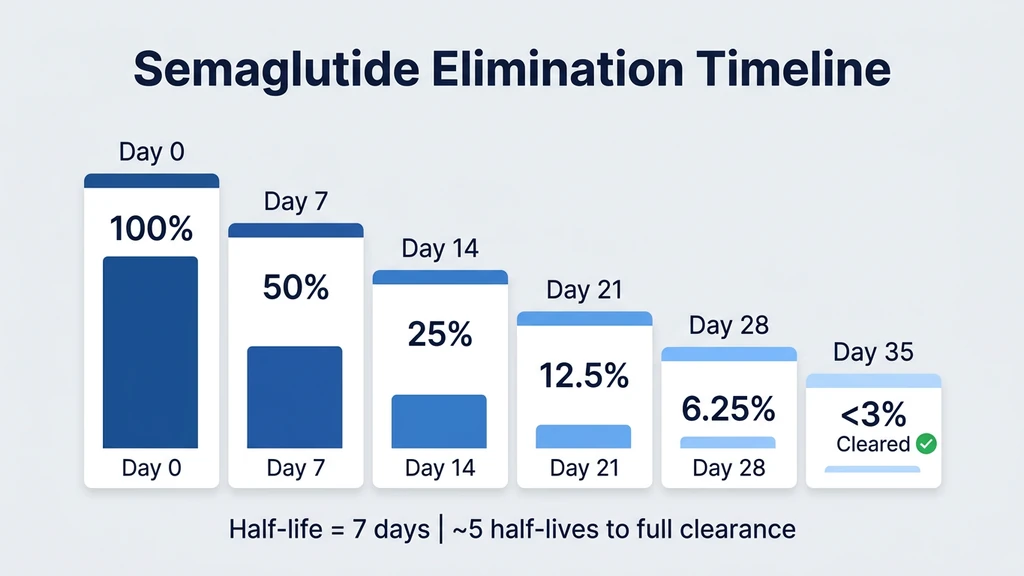
You took your last semaglutide injection five days ago. You still feel the appetite suppression. You are wondering when it fully leaves your body. Semaglutide stays in your system for approximately 5 weeks after your final injection. Its elimination half-life is 7 days, meaning every 7 days the drug concentration drops by half. After 5 half-lives (roughly 35 days), less than 3.2% of the last dose remains. Most people stop noticing appetite effects 2 to 3 weeks after their final dose.
Pharmacokinetic data from the Ozempic prescribing information confirms the 7-day half-life in humans at steady state (FDA Ozempic Label, 2017).
| Time After Last Dose | Approximate % Remaining | Effects Still Active? |
|---|---|---|
| 0 days (injection day) | 100% | Full appetite suppression, blood sugar control |
| 7 days (1 half-life) | 50% | Strong appetite suppression, GI effects present |
| 14 days (2 half-lives) | 25% | Moderate appetite suppression, reduced nausea |
| 21 days (3 half-lives) | 12.5% | Mild appetite effects, hunger returning |
| 28 days (4 half-lives) | 6.25% | Minimal drug effect, appetite near baseline |
| 35 days (5 half-lives) | 3.1% | Drug considered cleared from the body |
For dosing protocols while on treatment, see our semaglutide dosage chart. For mixing instructions, see our bacteriostatic water guide for semaglutide.
Get your custom peptide protocol:
- Tailored to your body and goals
- Precise dosing and cycle length
- Safe stacking combinations
- Backed by peer-reviewed studies
- Ready in under 2 minutes
Why Does Semaglutide Stay So Long? The 7-Day Half-Life Explained
Most injectable drugs clear the body in hours. Insulin, for example, works for 4 to 6 hours. Semaglutide persists for weeks. The difference is structural.
Think of it like a buoy attached to a heavy anchor. Natural GLP-1 floats free in your bloodstream and gets broken down by the enzyme DPP-4 within 2 minutes. Semaglutide has a fatty acid chain (a C-18 acyl group) bolted to its backbone. That chain latches onto albumin, the most abundant protein in your blood. While bound to albumin, enzymes cannot reach it. The drug drifts slowly through your circulation, releasing from albumin, activating GLP-1 receptors, and rebinding.
This albumin-binding mechanism extends the half-life from 2 minutes to 7 days: a 5,000-fold increase. A single weekly injection maintains steady drug levels because the next dose arrives before the previous one fully clears. At steady state (after 4 to 5 weeks of weekly dosing), peak-to-trough fluctuation is only about 30% (Kapitza et al., 2015).
The 7-day half-life is also why side effects like nausea and fatigue tend to persist between doses rather than spiking and fading the way they would with a short-acting drug.
The Full Elimination Timeline: From Last Injection to Zero
Pharmacologists define "cleared from the system" as fewer than 5 half-lives, when less than 3.2% of the drug remains. For semaglutide, that translates to approximately 35 days.
But clearance does not proceed in a straight line. You feel the effects fading in stages.
Days 1-7: Full Drug Activity
During the first week after your last dose, semaglutide blood levels are still near steady-state concentrations. Appetite suppression is at full strength. Blood sugar control remains intact for diabetic users. GI side effects (if present) continue. This is the window where most people feel no change at all and might not realize they have stopped treatment.
Days 8-14: Appetite Begins Returning
Drug levels have dropped to roughly 50% of peak. Some people begin noticing subtle shifts. Food starts occupying more mental space. Portions that felt satisfying a week ago start feeling small. Blood sugar control weakens slightly in type 2 diabetes patients. Nausea, if it was present, typically fades during this window.
Days 15-21: Hunger Returns
At 25% remaining, the appetite suppression that defined daily life on semaglutide fades noticeably. Most users report a clear return of hunger signals by the end of week 3. Gastric emptying speed normalizes. Food moves through the stomach at pre-treatment rates, and the prolonged fullness after small meals disappears. This is the phase where weight regain risk begins if eating habits have not been restructured.
Days 22-35: Near-Complete Clearance
Between 6.25% and 3.1% of the drug remains. Pharmacologically, semaglutide is effectively gone. Blood glucose levels return to pre-treatment values. Appetite and metabolic rate are no longer influenced by the drug. After day 35, any lingering effects are due to behavioral or metabolic changes you made during treatment, not the molecule itself.
Factors That Speed Up or Slow Down Clearance
The 7-day half-life is a population average. Your personal clearance rate depends on several physiological variables. The Ozempic clinical pharmacology data identifies the following modifiers (FDA Ozempic Label, 2017).
Kidney Function
Semaglutide is not cleared through the kidneys the way many drugs are. It is broken down by general proteolytic degradation throughout the body. Mild to moderate kidney impairment (eGFR 30-89) does not significantly alter the half-life. Severe kidney impairment (eGFR below 30) was studied in a small cohort, and no dose adjustment was required. However, users with severe kidney disease should be monitored for nausea and vomiting, which can worsen dehydration and kidney function (FDA Ozempic Label, 2017).
Body Weight
Heavier individuals have a larger volume of distribution. The drug disperses across more tissue, which can slightly slow elimination. A 120 kg person may take a few days longer to fully clear the drug compared to a 70 kg person. The difference is modest and does not require dose adjustment, but it explains why some users report lingering appetite suppression into week 4 while others feel baseline hunger by week 2. Use our semaglutide dosage calculator to determine the right dose for your weight.
Dose and Duration of Treatment
Higher doses (2.0 mg Ozempic, 2.4 mg Wegovy) mean more drug in the body at the time of the last injection. The half-life does not change, but the absolute amount that needs clearing is greater. A person stopping from 2.4 mg will have measurable drug levels slightly longer than someone stopping from 0.5 mg. Duration of treatment also matters: steady-state accumulation takes 4 to 5 weeks of weekly dosing, so someone who used semaglutide for only 2 weeks never reached peak accumulation and will clear faster.
Liver Function
Hepatic impairment was studied across mild, moderate, and severe classifications. The half-life was not clinically different from healthy subjects. Semaglutide degradation relies on general protein catabolism, not hepatic CYP450 enzymes. This means liver disease does not trap semaglutide in your system, and no dose adjustment is needed for hepatic impairment (Granhall et al., 2018).
Age
Elderly patients (65+) show slightly reduced clearance in population pharmacokinetic models. The difference is not large enough to warrant dose adjustment, but a 75-year-old may retain detectable drug levels 2 to 3 days longer than a 35-year-old at the same dose. This aligns with general age-related reductions in metabolic rate and protein turnover.
Oral Semaglutide (Rybelsus) vs. Injectable: Clearance Differences
Oral semaglutide (Rybelsus, used for type 2 diabetes) has the same active molecule but a different pharmacokinetic profile. The tablet includes SNAC (sodium N-[8-(2-hydroxybenzoyl)amino] caprylate), an absorption enhancer that helps semaglutide cross the stomach lining.
The half-life of oral semaglutide is approximately 1 week, similar to injectable. The key difference is bioavailability. Only about 1% of the oral dose reaches systemic circulation. The remaining 99% is degraded in the GI tract. That is why oral doses are measured in milligrams (3 mg, 7 mg, 14 mg) while injectable doses are in sub-milligram ranges (0.25 mg to 2.4 mg).
Once absorbed, the oral form binds to albumin and follows the same elimination pathway. Total clearance time after stopping oral semaglutide is approximately the same: 5 weeks. The practical difference is that oral semaglutide at 14 mg daily achieves lower steady-state plasma concentrations than injectable 1.0 mg weekly. Users stopping oral semaglutide may therefore notice appetite returning slightly sooner (Granhall et al., 2019).
For those comparing GLP-1 options, see our semaglutide to tirzepatide switching guide.
Drug Testing and Semaglutide Detection
Standard workplace drug tests (5-panel and 10-panel urine screens) do not test for semaglutide. These panels screen for amphetamines, cannabinoids, cocaine, opiates, and PCP. GLP-1 receptor agonists are not controlled substances and are not included.
Specialized clinical assays can detect semaglutide in blood using liquid chromatography-tandem mass spectrometry (LC-MS/MS). These tests are used in research settings and clinical trials, not in employment screening.
Athletic drug testing through WADA (World Anti-Doping Agency) does not prohibit semaglutide. It is not listed on the 2025 or 2026 Prohibited List. There is no performance-enhancing classification for GLP-1 agonists.
If you are undergoing pre-surgical screening, inform your surgical team that you are taking semaglutide. The concern is not the drug test result but the delayed gastric emptying. The American Society of Anesthesiologists recommends holding GLP-1 agonists before procedures requiring general anesthesia due to aspiration risk. The recommendation is to skip the dose in the week before surgery for weekly formulations (ASA Consensus Statement, 2023).
What Happens When You Stop Semaglutide
The STEP 1 extension study tracked participants who stopped semaglutide at 68 weeks. By week 120 (one year after stopping), they had regained two-thirds of the weight they lost (Wilding et al., 2022). This is not because the drug lingered. It cleared within 5 weeks. The weight came back because the biological drivers of obesity, elevated hunger hormones, reduced metabolic rate, and altered reward signaling, returned once the GLP-1 receptor stimulation stopped.
Appetite Rebound
Ghrelin (the hunger hormone) and other appetite-regulating peptides recalibrate within 4 to 6 weeks of stopping. Many users describe week 3 as the turning point: the moment food stops feeling optional and starts feeling urgent again. This is not a failure of willpower. It is a measurable hormonal shift. Users who had been on semaglutide for longer durations often report a sharper rebound, possibly because the contrast between suppressed and unsuppressed appetite is more dramatic.
If you are not losing weight on semaglutide before stopping, troubleshoot the protocol before discontinuing. Once you stop, the window for GLP-1-assisted habit formation closes.
Blood Sugar Changes
Type 2 diabetes patients who stop semaglutide see HbA1c values rise toward pre-treatment levels within 8 to 12 weeks. The drug's glucose-lowering effects (insulin secretion enhancement, glucagon suppression) vanish with the molecule. Patients should coordinate discontinuation with their endocrinologist to ensure alternative glucose management is in place before the drug fully clears.
Side Effects After Stopping
The good news about the long half-life: side effects fade gradually rather than vanishing overnight. Nausea resolves within 1 to 2 weeks of the last injection. Fatigue improves as caloric intake normalizes and hunger returns. Hair loss related to rapid weight loss may continue for 2 to 4 months after stopping because telogen effluvium operates on a delayed cycle. New hair growth typically begins 6 to 12 months after weight stabilization.
Switching Between GLP-1 Medications: Washout Periods
If you are switching from semaglutide to tirzepatide (Mounjaro/Zepbound), or from semaglutide to another GLP-1 agonist like liraglutide, the washout period matters. Starting a new GLP-1 drug while semaglutide is still active means stacking receptor stimulation, which amplifies side effects.
Semaglutide to Tirzepatide
Most prescribers recommend starting tirzepatide one week after the last semaglutide injection. This means some overlap: roughly 50% of semaglutide remains when the first tirzepatide dose is given. The overlap is intentional. It prevents a gap in GLP-1 coverage that would cause appetite rebound and blood sugar spikes.
Start tirzepatide at the lowest dose (2.5 mg) regardless of your previous semaglutide dose. Even with residual semaglutide, the dual GIP/GLP-1 mechanism of tirzepatide introduces a new pathway your body has not adapted to. Jumping to a higher tirzepatide dose risks severe nausea and vomiting. For the full switching protocol, see our semaglutide to tirzepatide conversion guide.
Semaglutide to Liraglutide (or Other Daily GLP-1s)
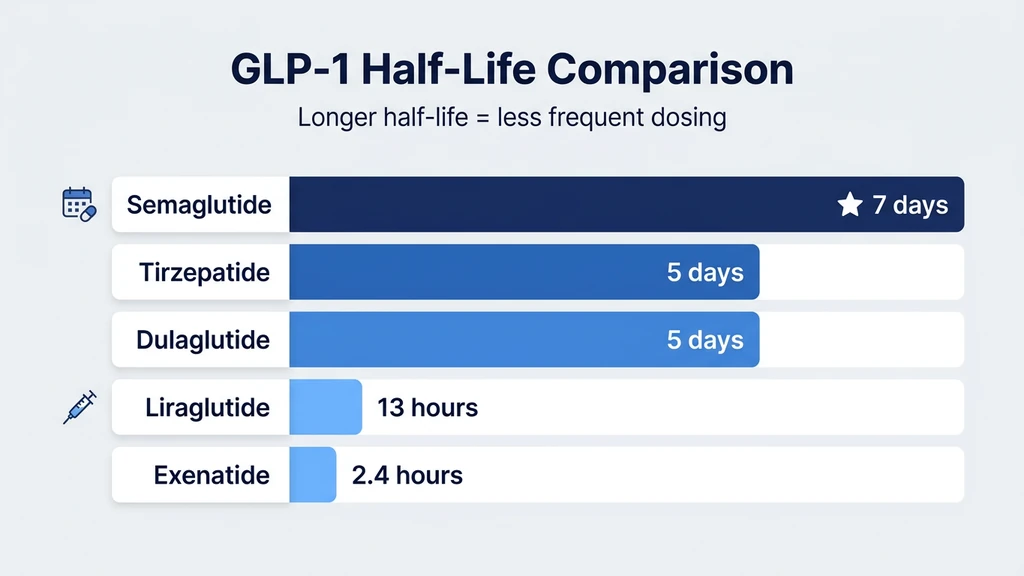
Liraglutide (Saxenda, Victoza) has a 13-hour half-life and clears in about 3 days. When switching from weekly semaglutide to daily liraglutide, wait at least 2 weeks after the last semaglutide injection. This allows semaglutide levels to drop to roughly 25%, reducing the risk of compounded GI side effects. Start liraglutide at 0.6 mg daily and titrate normally.
Semaglutide to Retatrutide
Retatrutide is a triple agonist (GLP-1/GIP/glucagon) in late-stage clinical trials. Its half-life is approximately 6 days. If switching from semaglutide to retatrutide, apply the same one-week washout used for tirzepatide. Start at the lowest retatrutide dose. The glucagon receptor component adds a new metabolic pathway, and side effects may differ from what you experienced on semaglutide. For dosing details, see our retatrutide dosage guide.
Important Safety Considerations
The long half-life of semaglutide has practical implications that go beyond pharmacology.
Pre-surgical planning. The ASA recommends holding semaglutide for at least one week before elective surgery requiring anesthesia. Delayed gastric emptying increases aspiration risk during intubation. For procedures involving deep sedation, some anesthesiologists prefer a 2-week hold. Inform your surgical team about your last injection date, not just that you take semaglutide (ASA, 2023).
Pregnancy planning. Semaglutide is category X in pregnancy (contraindicated). Novo Nordisk recommends discontinuing semaglutide at least 2 months before planned conception. This exceeds the 5-week clearance timeline by a margin, providing a safety buffer. Animal studies showed fetal abnormalities at high doses. No human pregnancy data exists, and the 2-month washout is the conservative standard (FDA Ozempic Label, 2017).
Drug interactions. Because semaglutide slows gastric emptying, it can delay absorption of oral medications taken at the same time. This includes oral contraceptives, antibiotics, and thyroid medication (levothyroxine). The interaction persists until gastric emptying normalizes, roughly 2 to 3 weeks after the last injection. If you are stopping semaglutide and adjusting other medications, account for this transition period.
Alcohol. Semaglutide does not interact with alcohol pharmacologically, but the reduced food intake it causes means alcohol hits harder. This effect fades as the drug clears and appetite returns. For detailed guidance on alcohol and GLP-1 agonists, see our guide on drinking on tirzepatide, which covers interactions that apply to semaglutide users as well. See our peptide safety guide for broader safety considerations.
Frequently Asked Questions
How long does semaglutide stay in your system after stopping?
Semaglutide stays in your system for approximately 5 weeks (35 days) after your last injection. The half-life is 7 days, so the drug concentration halves each week. After 5 half-lives, less than 3.2% remains. Most people stop noticing appetite suppression by weeks 2 to 3.
Does semaglutide show up on a drug test?
No. Standard workplace drug tests (5-panel, 10-panel) do not screen for semaglutide or any GLP-1 receptor agonists. Semaglutide is not a controlled substance. WADA does not prohibit it for athletes. Only specialized clinical research assays can detect it in blood.
How long does Ozempic stay in your system vs Wegovy?
The same duration: approximately 5 weeks. Ozempic (max 2.0 mg) and Wegovy (max 2.4 mg) contain the same molecule, semaglutide. The half-life is 7 days for both. Higher Wegovy doses mean slightly more drug at the time of stopping, but total clearance time is functionally identical.
Can I start tirzepatide right after stopping semaglutide?
Most prescribers start tirzepatide one week after the last semaglutide injection. Some semaglutide (about 50%) remains at that point, which is intentional to prevent a coverage gap. Always start tirzepatide at 2.5 mg regardless of your prior semaglutide dose to minimize compounded GI side effects.
How long before surgery should I stop semaglutide?
The American Society of Anesthesiologists recommends skipping the dose in the week before surgery requiring general anesthesia. Some anesthesiologists prefer a 2-week hold. The concern is delayed gastric emptying and aspiration risk during intubation. Tell your surgical team your exact last injection date.
How long after stopping semaglutide will I regain weight?
Appetite returns within 2 to 3 weeks as the drug clears. The STEP 1 extension study showed participants regained two-thirds of lost weight within one year of stopping. Weight regain is driven by the return of pre-treatment hunger hormones, not the drug leaving. Sustained behavioral changes during treatment reduce regain.
Does oral semaglutide (Rybelsus) clear faster than the injection?
No. Oral semaglutide has a similar half-life of approximately one week. Total clearance is about 5 weeks for both forms. The key difference is that oral semaglutide achieves lower plasma levels due to 1% bioavailability, so appetite suppression may fade slightly sooner after stopping.
How long should I wait to get pregnant after stopping semaglutide?
Novo Nordisk recommends stopping semaglutide at least 2 months before planned conception. This exceeds the 5-week pharmacokinetic clearance by a safety margin. Semaglutide is contraindicated in pregnancy based on animal studies showing fetal harm. No human pregnancy data exists.
The Bottom Line
Semaglutide stays in your system for approximately 5 weeks after your last injection. The 7-day half-life, created by the drug's albumin-binding design, means concentration halves each week until less than 3.2% remains at day 35.
The practical implication: plan around the timeline. Stop 1 to 2 weeks before switching to another GLP-1 agonist. Stop at least 1 week before surgery. Stop 2 months before planned pregnancy. Expect appetite to return by week 3 and prepare for it with the habits you built during treatment.
Use our semaglutide dosage calculator for dosing during active treatment. For side effect management, see our guides on nausea, fatigue, and hair loss. Explore all peptide profiles and tools at PeptidesExplorer.
Related articles: - How Long Does Tirzepatide Stay in Your System? — 5-day half-life comparison and switching protocols — clinical timelines for nausea, fatigue, and GI symptoms - How Many mg Is 40 Units of Semaglutide? — unit-to-mg conversion for compounded semaglutide — fatigue data for the dual agonist with semaglutide comparison - Where to Buy Bacteriostatic Water for Injection — sourcing guide for reconstitution supplies - Does Bacteriostatic Water Need to Be Refrigerated? — storage rules for your reconstitution water
Related Articles
Tirzepatide: How Long in Your System?
Tirzepatide has a half-life of ~5 days and takes ~25 days to fully clear your system. See the elimination timeline and factors affecting clearance.
Retatrutide vs Semaglutide: Results, Risks, Cost
Retatrutide vs semaglutide (Ozempic, Wegovy): 24.2% vs 14.9% trial weight loss, side effects, heart rate, dosing cadence, cost, FDA status, and how to switch.
Does Semaglutide Cause Heartburn?
Does semaglutide cause heartburn? Yes, in 1.9-5% of users. Delayed gastric emptying mechanism, GERD differences, and 7 ways to manage it.
Can Semaglutide Cause Depression?
Clinical trials show semaglutide does not increase depression risk. FDA cleared GLP-1 drugs of suicidality concerns in 2025. Evidence and mechanisms.