You are holding a compounded semaglutide vial. No pre-filled pen. No click-and-inject. Just a vial, a syringe, and a dose in milligrams that you need to convert to milliliters.
Your provider wrote "0.25 mg weekly" on the prescription. The syringe in your hand shows units and mL markings. The vial label says 5 mg/mL. You need to know exactly how much liquid to draw.
Here is your answer: at 5 mg/mL, 0.25 mg of semaglutide = 0.05 mL (5 units on an insulin syringe). That number shifts with every different concentration. A 2.5 mg/mL vial doubles the draw volume to 0.10 mL. A 10 mg/mL vial cuts it in half to 0.025 mL. Get the concentration wrong, and you inject twice or half your intended dose.
The full chart for every dose and every concentration is below. If you want your number instantly, use the Semaglutide Dosage Calculator.
Get your custom peptide protocol:
- Tailored to your body and goals
- Precise dosing and cycle length
- Safe stacking combinations
- Backed by peer-reviewed studies
- Ready in under 2 minutes
Master Semaglutide Dosage Chart: Every Dose at Every Concentration
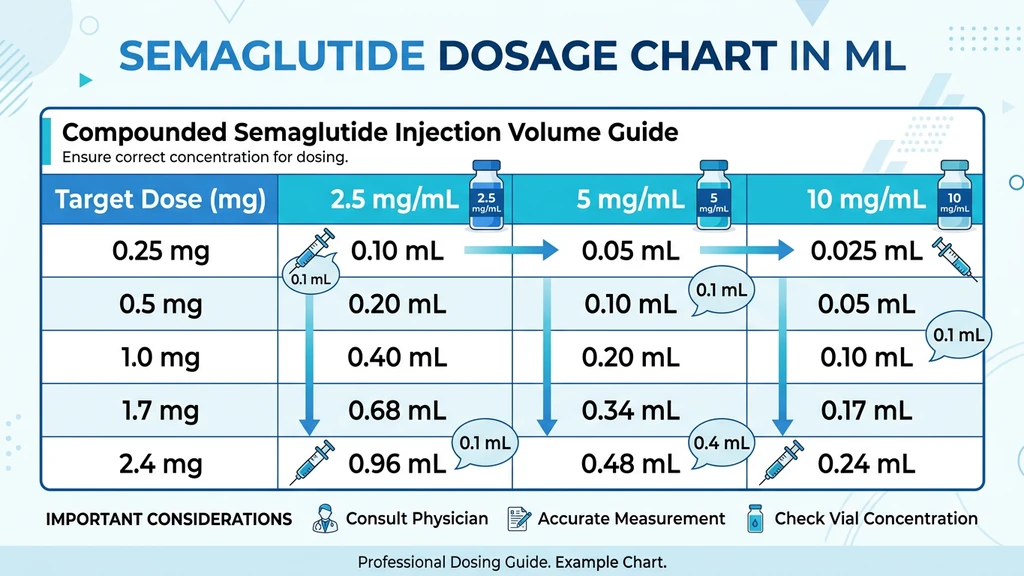
Find your vial concentration across the top row. Find your prescribed dose on the left. The intersection gives you both the mL to draw and the equivalent units on a U-100 insulin syringe.
| Dose (mg) | 2 mg/mL | 2.5 mg/mL | 5 mg/mL | 10 mg/mL |
|---|---|---|---|---|
| 0.25 mg | 0.125 mL (12.5 units) | 0.10 mL (10 units) | 0.05 mL (5 units) | 0.025 mL (2.5 units) |
| 0.5 mg | 0.25 mL (25 units) | 0.20 mL (20 units) | 0.10 mL (10 units) | 0.05 mL (5 units) |
| 1.0 mg | 0.50 mL (50 units) | 0.40 mL (40 units) | 0.20 mL (20 units) | 0.10 mL (10 units) |
| 1.7 mg | 0.85 mL (85 units) | 0.68 mL (68 units) | 0.34 mL (34 units) | 0.17 mL (17 units) |
| 2.4 mg | 1.20 mL (120 units)* | 0.96 mL (96 units) | 0.48 mL (48 units) | 0.24 mL (24 units) |
*Exceeds a standard 100-unit (1 mL) insulin syringe. You need a higher concentration vial or a larger syringe for this dose at 2 mg/mL.
If you do not know your concentration, stop. Flip the vial and read the label. It will say something like "Semaglutide 5 mg/mL" or show a total amount and volume (such as "10 mg / 2 mL," which means 5 mg/mL). If the label is unclear, call your pharmacy before drawing anything.
Bookmark this chart. You will return to it at every dose increase during your titration. For a faster lookup, the Semaglutide Dosage Calculator calculates any dose at any concentration in seconds.
How Concentration Changes Your Draw Volume
Think of it like orange juice concentrate. A small spoonful of frozen concentrate and a full glass of diluted juice both contain the same amount of vitamin C. The concentrate packs more into less liquid. Your semaglutide vial works the same way.
A 10 mg/mL vial is the concentrate. A 2.5 mg/mL vial is the diluted version. Both contain semaglutide. The difference is how much liquid you pull into the syringe to get the same milligram dose.
The formula is two steps:
Step 1: mL = Dose (mg) / Concentration (mg/mL) Step 2: Units = mL x 100
For a detailed walkthrough of what 40 units means at various concentrations, see our guide on how many mg is 40 units of semaglutide. Walk through it with 0.5 mg at 5 mg/mL:
- 1.0.5 mg / 5 mg/mL = 0.10 mL
- 2.0.10 mL x 100 = 10 units
Now the same dose at 2.5 mg/mL:
- 1.0.5 mg / 2.5 mg/mL = 0.20 mL
- 2.0.20 mL x 100 = 20 units
The concentration halved (from 5 to 2.5), and the draw volume doubled (from 0.10 to 0.20 mL). This pattern always holds. Double the concentration, half the volume. Half the concentration, double the volume. Once you understand this relationship, you can calculate any dose at any concentration without a chart.
For automatic conversions, the Peptide Unit Converter handles every combination.
5 mg Vial Dosage Chart (Most Common Compounded Form)
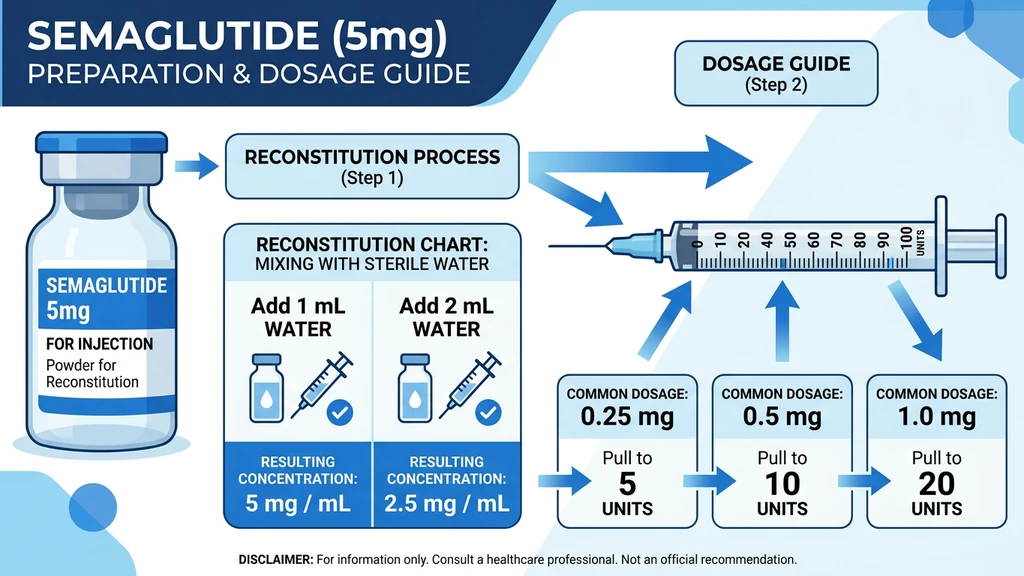
The 5 mg semaglutide vial is the most widely dispensed compounded format. The concentration depends on how much bacteriostatic water was added during reconstitution. Two reconstitution volumes are standard:
5 mg vial reconstituted with 1 mL of bacteriostatic water = 5 mg/mL
| Dose | mL to Draw | Units on Syringe | Doses per Vial |
|---|---|---|---|
| 0.25 mg | 0.05 mL | 5 units | 20 doses |
| 0.5 mg | 0.10 mL | 10 units | 10 doses |
| 1.0 mg | 0.20 mL | 20 units | 5 doses |
| 1.7 mg | 0.34 mL | 34 units | 2 doses (with 0.32 mL left over) |
| 2.4 mg | 0.48 mL | 48 units | 2 doses (with 0.04 mL left over) |
5 mg vial reconstituted with 2 mL of bacteriostatic water = 2.5 mg/mL
| Dose | mL to Draw | Units on Syringe | Doses per Vial |
|---|---|---|---|
| 0.25 mg | 0.10 mL | 10 units | 20 doses |
| 0.5 mg | 0.20 mL | 20 units | 10 doses |
| 1.0 mg | 0.40 mL | 40 units | 5 doses |
| 1.7 mg | 0.68 mL | 68 units | 2 doses (with 0.64 mL left over) |
| 2.4 mg | 0.96 mL | 96 units | 2 doses (with 0.08 mL left over) |
Most compounding pharmacies reconstitute with 1 mL, producing the 5 mg/mL concentration. If your pharmacy shipped the vial already reconstituted, the label will state the concentration directly. If you received a lyophilized (freeze-dried) powder with a separate vial of bacteriostatic water, the concentration depends on how much water you add. See our semaglutide bac water mixing guide for step-by-step instructions or the Peptide Reconstitution Calculator for exact volumes.
At 5 mg/mL, the starting dose of 0.25 mg requires only 5 units. This is a very small volume. Use a 0.3 mL insulin syringe (30-unit syringe) for best precision at this level. On a 1 mL syringe, 5 units is barely visible.
10 mg Vial Dosage Chart
The 10 mg vial contains twice the total semaglutide. Higher-dose patients and longer titration courses benefit from fewer vials overall.
10 mg vial reconstituted with 1 mL of bacteriostatic water = 10 mg/mL
| Dose | mL to Draw | Units on Syringe | Doses per Vial |
|---|---|---|---|
| 0.25 mg | 0.025 mL | 2.5 units | 40 doses |
| 0.5 mg | 0.05 mL | 5 units | 20 doses |
| 1.0 mg | 0.10 mL | 10 units | 10 doses |
| 1.7 mg | 0.17 mL | 17 units | 5 doses (with 0.15 mL left over) |
| 2.4 mg | 0.24 mL | 24 units | 4 doses (with 0.04 mL left over) |
10 mg vial reconstituted with 2 mL of bacteriostatic water = 5 mg/mL
| Dose | mL to Draw | Units on Syringe | Doses per Vial |
|---|---|---|---|
| 0.25 mg | 0.05 mL | 5 units | 40 doses |
| 0.5 mg | 0.10 mL | 10 units | 20 doses |
| 1.0 mg | 0.20 mL | 20 units | 10 doses |
| 1.7 mg | 0.34 mL | 34 units | 5 doses (with 0.30 mL left over) |
| 2.4 mg | 0.48 mL | 48 units | 4 doses (with 0.08 mL left over) |
At 10 mg/mL, the 0.25 mg starting dose requires only 2.5 units. Standard insulin syringes mark every 1 unit. Hitting 2.5 means drawing to exactly halfway between the 2 and 3 unit lines. This is difficult to do accurately. If your vial is 10 mg/mL and you are starting at 0.25 mg, consider a half-unit insulin syringe (sometimes labeled "Lo-Dose") or reconstitute with 2 mL to get 5 mg/mL instead.
For higher doses, the 10 mg/mL concentration keeps draw volumes small and comfortable. At 2.4 mg, you draw only 24 units. Compare that to 96 units at 2.5 mg/mL. Smaller volumes mean less liquid under the skin, less injection-site discomfort, and faster absorption.
Semaglutide Titration Schedule with mL and Units
The standard semaglutide titration follows a slow ramp designed to minimize gastrointestinal side effects. Each dose level lasts 4 weeks before the next increase. Your provider may adjust this timeline based on tolerability.
| Weeks | Dose | At 2.5 mg/mL | At 5 mg/mL | At 10 mg/mL |
|---|---|---|---|---|
| 1 to 4 | 0.25 mg | 0.10 mL (10 units) | 0.05 mL (5 units) | 0.025 mL (2.5 units) |
| 5 to 8 | 0.5 mg | 0.20 mL (20 units) | 0.10 mL (10 units) | 0.05 mL (5 units) |
| 9 to 12 | 1.0 mg | 0.40 mL (40 units) | 0.20 mL (20 units) | 0.10 mL (10 units) |
| 13 to 16 | 1.7 mg | 0.68 mL (68 units) | 0.34 mL (34 units) | 0.17 mL (17 units) |
| 17 onward | 2.4 mg | 0.96 mL (96 units) | 0.48 mL (48 units) | 0.24 mL (24 units) |
The 2.4 mg maintenance dose is the target for weight management per the Wegovy prescribing information (Novo Nordisk, 2021). For type 2 diabetes, the Ozempic prescribing information (Novo Nordisk, 2023) sets the maintenance dose at 1.0 mg, with a maximum of 2.0 mg. Your provider determines which endpoint applies to you.
Notice how the numbers grow at each step. From 0.25 mg to 0.5 mg, the volume doubles. From 0.5 mg to 1.0 mg, it doubles again. But from 1.0 mg to 1.7 mg, it increases by 70%. And from 1.7 mg to 2.4 mg, it increases by about 41%. The increments are not uniform. Each increase adds less proportional change, which is why side effects tend to be worst during the early dose jumps.
If nausea or vomiting becomes severe at any step, most providers extend that dose level for an additional 4 weeks before increasing. Do not increase the dose on your own. The titration exists for a reason. For a timeline of when side effects typically resolve, see how long do semaglutide side effects last.
For more on peptide weight loss options beyond semaglutide, see Best Peptides for Weight Loss.
Reading Your Syringe for Semaglutide
Insulin syringes come in three sizes. Each one suits different semaglutide doses and concentrations. The wrong syringe makes accurate dosing nearly impossible.
0.3 mL syringe (30 units max)
The barrel is marked from 0 to 30 units. Each small line equals 1 unit on standard syringes, or 0.5 units on half-unit ("Lo-Dose") models. Numbers appear every 5 units: 5, 10, 15, 20, 25, 30. This syringe is best when your draw volume is under 0.25 mL (25 units). At 5 mg/mL, it handles every dose from 0.25 mg (5 units) through 0.5 mg (10 units) with excellent precision. The thin barrel makes tiny differences between lines visible and easy to read.
0.5 mL syringe (50 units max)
Lines run from 0 to 50 units. Each small line equals 1 unit. Numbers appear every 5 or 10 units depending on the brand. This is the best general-purpose choice for most semaglutide users. It covers the entire titration from 0.25 mg to 2.4 mg at both 5 mg/mL and 10 mg/mL concentrations. At 5 mg/mL, 2.4 mg requires 48 units, which fits comfortably. You can see each individual unit line without squinting.
1 mL syringe (100 units max)
Lines run from 0 to 100 units. Each small line equals 2 units on most brands. Individual unit markings do not exist. For a 5-unit draw (0.25 mg at 5 mg/mL), you are trying to hit the halfway point between the 4 and 6 unit lines. Imprecise. Only reach for this syringe when your dose requires more than 50 units. At 2.5 mg/mL, the 1.7 mg dose (68 units) and 2.4 mg dose (96 units) both need this size.
The rule: use the smallest syringe that fits your dose. Smaller barrel = more lines per unit = more accuracy. When your dose changes during titration, reassess whether your syringe size still works.
For a complete injection walkthrough, read Peptide Injections: Complete Guide. If you are considering switching to tirzepatide, see the semaglutide to tirzepatide conversion guide.
How Long Does Reconstituted Semaglutide Last?
Most compounding pharmacies label reconstituted semaglutide with a 28-day beyond-use date (BUD) per USP <797> compounding standards. For a breakdown of expiration dates on the vial itself, see does semaglutide expire. This means the vial should be used within 28 days after the first time bacteriostatic water is added to the powder, or 28 days after the pharmacy reconstituted it. The clock starts the moment liquid meets powder.
Store your reconstituted vial in the refrigerator at 2 to 8 degrees Celsius (36 to 46 degrees Fahrenheit). Keep it upright. Do not store it in the freezer. Freezing semaglutide can damage the peptide structure, causing aggregation and loss of potency.
Between injections, leave the vial in the refrigerator with the cap on — see does semaglutide need to be refrigerated for full details. Brief exposure to room temperature during your weekly draw is fine. Avoid leaving the vial out on the counter for extended periods or in direct sunlight.
Signs your reconstituted semaglutide has degraded:
- Cloudiness. Fresh semaglutide solution is clear and colorless. Any haze or milky appearance indicates protein aggregation.
- Particles. Visible specks floating in the liquid mean the peptide is breaking down.
- Color change. Any yellow, brown, or other discoloration suggests chemical degradation.
- Unusual smell. Bacteriostatic water has a faint benzyl alcohol scent. Anything beyond that is suspect.
If your vial shows any of these signs, discard it. Do not attempt to use it. The potency is unreliable and injection of aggregated protein can cause injection-site reactions.
One practical note: at the 0.25 mg starting dose with a 5 mg/mL concentration, a single 5 mg vial holds 20 doses. That is 20 weeks of weekly injections. You will exceed the 28-day window long before you finish the vial. Plan your reconstitution volume so that each vial is consumed within the expiration window. The Peptide Reconstitution Calculator helps you match your vial size, dose, and reconstitution volume to avoid waste.
For detailed storage guidelines across all peptide types, see How to Store Peptides.
Danger Scenarios: What Happens When Concentration Math Goes Wrong
These are not hypothetical. Concentration errors are the most common dosing mistake with compounded semaglutide, and both scenarios below produce real clinical consequences.
Scenario 1: Double dose from misremembered reconstitution volume
You reconstituted your 5 mg vial with 1 mL of bacteriostatic water, producing a concentration of 5 mg/mL. A few days later, when you draw your first dose, you misremember and think you added 2 mL (which would make 2.5 mg/mL). You calculate: 0.5 mg / 2.5 mg/mL = 0.20 mL. You draw 20 units. But the actual concentration is 5 mg/mL, so 0.20 mL contains 1.0 mg. You just injected double your intended 0.5 mg dose. At the early titration stage, this triggers the dose-dependent GI adverse effects documented in the Ozempic prescribing information (Novo Nordisk, 2023): nausea (15.8 to 20.3%), vomiting (5 to 9.2%), and diarrhea (8.5 to 8.8%), all amplified by the sudden dose jump.
Scenario 2: Quadruple dose from ignoring a concentration change
You have been using a 2.5 mg/mL vial and drawing 0.40 mL (40 units) for your 1.0 mg weekly dose. Your pharmacy sends a refill, but this time the vial is 10 mg/mL. You do not read the new label. You draw 40 units out of habit. At 10 mg/mL, 0.40 mL contains 4.0 mg. You injected four times your intended dose. This is equivalent to jumping from week 9 of titration straight past the maximum maintenance dose. Prolonged vomiting and severe abdominal cramping are expected at this exposure level. The STEP 1 trial (Wilding et al., N Engl J Med, 2021) documented these effects even with proper titration. A 4x dose skip bypasses all titration protection. Medical attention may be needed.
The fix for both: write the concentration on the vial with a permanent marker the moment you reconstitute or receive it. Read that number before every draw. Check it against your calculation. Ten seconds of verification prevents days of misery.
For reconstitution instructions and volume planning, see How to Reconstitute Peptides.
Four Common Semaglutide Dosing Mistakes and How to Fix Them
Mistake #1: Using someone else's unit number from a forum or group chat.
A Facebook group member posts "I draw 10 units for 0.5 mg." You draw 10 units. Their vial is 5 mg/mL. Yours is 2.5 mg/mL. At your concentration, 10 units (0.10 mL) contains only 0.25 mg. You underdose by half and wonder why the medication stopped working. Fix: always calculate based on the concentration printed on your own vial. Ignore other people's unit numbers.
Mistake #2: Confusing total vial content with concentration.
Your vial label says "5 mg / 2 mL." You see the "5" and assume the concentration is 5 mg/mL. The actual concentration is 5 / 2 = 2.5 mg/mL. Every dose you draw is half as strong as you intended. You end up doubling your draw volume instinctively because the medication "does not seem to be working," and accidentally reach the right dose through trial and error while having no idea why. Fix: if the label shows two numbers separated by a slash (mg / mL), divide the first by the second. That is your concentration.
Mistake #3: Using a 1 mL syringe for a 5-unit draw.
On a 1 mL (100-unit) insulin syringe, each small graduation line represents 2 units. There is no individual marking for 5 units. You are guessing at the midpoint between the 4 and 6 lines. A slight misread either way means a 20 to 40 percent dosing error at this scale. Fix: switch to a 0.3 mL (30-unit) syringe. Every unit has its own line. Five units falls exactly on the "5" mark. No guesswork.
Mistake #4: Not accounting for dead space in the syringe needle.
Standard insulin syringes have dead space in the needle hub, typically 0.02 to 0.05 mL of liquid that remains after you fully depress the plunger. Over multiple draws from the same vial, this loss accumulates. After 10 draws, you may have lost the equivalent of half a dose. Fix: use low dead space syringes (often labeled "LDS" or "fixed needle") that minimize this gap to under 0.005 mL. Alternatively, account for the loss by slightly overfilling and pushing to the correct unit mark before injecting.
Frequently Asked Questions
How many mL is 0.25 mg of semaglutide?
It depends on your vial concentration. At 5 mg/mL: 0.05 mL (5 units). At 2.5 mg/mL: 0.10 mL (10 units). At 10 mg/mL: 0.025 mL (2.5 units). Divide your dose (0.25) by the concentration on your label to get the exact mL. Then multiply by 100 for syringe units.
How many units is 0.5 mg of semaglutide?
At 5 mg/mL (the most common compounded concentration): 10 units. At 2.5 mg/mL: 20 units. At 10 mg/mL: 5 units. The formula is (0.5 / concentration) x 100. Always verify the concentration on your specific vial before drawing.
How long does compounded semaglutide last after mixing?
Most compounding pharmacies assign a 28-day beyond-use date after reconstitution. Store the vial in the refrigerator at 2 to 8 degrees Celsius. Do not freeze. If the solution turns cloudy, develops particles, or changes color before 28 days, discard it immediately.
What concentration is my compounded semaglutide?
Read your vial label. It will state the concentration directly (for example, '5 mg/mL') or give a total amount and volume (for example, '10 mg / 2 mL'). If you see two numbers separated by a slash, divide milligrams by milliliters to get mg/mL. If your pharmacy shipped lyophilized powder with separate water, the concentration depends on the volume you added.
Can I use a regular syringe instead of an insulin syringe?
Technically possible, but strongly discouraged. Standard 3 mL or 5 mL syringes have coarse graduation marks designed for large volumes. Measuring 0.05 mL (5 units) on a 3 mL syringe is like measuring a pinch of salt with a tablespoon. Insulin syringes are built for sub-milliliter accuracy with thin needles designed for subcutaneous injection. Always use a U-100 insulin syringe.
How do I store reconstituted semaglutide?
Refrigerate at 2 to 8 degrees Celsius (36 to 46 degrees Fahrenheit). Keep the vial upright with the cap on. Do not freeze, as freezing damages the peptide. Brief room-temperature exposure during your weekly draw is acceptable. Avoid direct sunlight and prolonged heat. Discard any unused solution after 28 days.
What is the standard semaglutide titration schedule?
Weeks 1 to 4: 0.25 mg weekly. Weeks 5 to 8: 0.5 mg. Weeks 9 to 12: 1.0 mg. Weeks 13 to 16: 1.7 mg. Weeks 17 onward: 2.4 mg (weight management target). Each level lasts 4 weeks to minimize GI side effects. Your provider may extend any step if needed.
How many doses are in a 5 mg vial of semaglutide?
It depends on your dose. At 0.25 mg per dose: 20 doses (5 / 0.25 = 20). At 0.5 mg: 10 doses. At 1.0 mg: 5 doses. At 1.7 mg: roughly 2.9 doses. At 2.4 mg: roughly 2 doses. Note that a 5 mg vial at the 0.25 mg starting dose holds 20 weeks of supply, far exceeding the 28-day shelf life after reconstitution.
The Bottom Line
At 5 mg/mL, the most common compounded concentration, your semaglutide doses convert to: 0.25 mg = 0.05 mL (5 units), 0.5 mg = 0.10 mL (10 units), 1.0 mg = 0.20 mL (20 units), 1.7 mg = 0.34 mL (34 units), 2.4 mg = 0.48 mL (48 units). The formula: mL = dose in mg divided by concentration in mg/mL. Multiply by 100 for syringe units.
Your concentration determines your volume. If the concentration changes, every number in your routine changes with it. Check the vial label before every draw. Write the concentration on the vial if it helps.
Skip the arithmetic entirely with the Semaglutide Dosage Calculator. For reconstitution volumes and vial planning, use the Peptide Reconstitution Calculator. For a complete timeline of what to expect at each dose level, read how long does semaglutide take to work.
Related Articles: - Tirzepatide Dosage Chart in Units — the tirzepatide equivalent of this chart - Not Losing Weight on Semaglutide? — troubleshooting stalls at each dose - How Long Does Semaglutide Stay in Your System? — pharmacokinetics and clearance - Peptide Safety Guide — comprehensive safety reference - How to Microdose Semaglutide — sub-standard dosing protocol and volume calculations - Compound Semaglutide With B12 — dosing considerations for B12-enhanced formulations - Semaglutide Before and After — clinical results at each dose level
Related Articles
Semaglutide Titration Schedule: 6-Month Plan
Week-by-week semaglutide titration from 0.25 to 2.4 mg. Based on STEP trial data. When to extend, down-titrate, or restart after missing doses.
Semaglutide to Tirzepatide Switching
Switching semaglutide to tirzepatide? Clinical dose equivalence table, step-by-step protocol, titration schedule, and common mistakes to avoid.
Why Is My Semaglutide Red? Color Guide
Red or pink semaglutide means vitamin B12 was added by a compounding pharmacy. Brand Ozempic/Wegovy is always clear. Learn when color signals degradation.
Retatrutide vs Semaglutide: Results, Risks, Cost
Retatrutide vs semaglutide (Ozempic, Wegovy): 24.2% vs 14.9% trial weight loss, side effects, heart rate, dosing cadence, cost, FDA status, and how to switch.