You are staring at a compounded tirzepatide vial. The label says milligrams per milliliter. The syringe in your hand says units. Your prescriber told you a dose in milligrams. At 10 mg/mL (the most common concentration), 2.5 mg = 25 units, 5 mg = 50 units, and 10 mg = 100 units. The formula: (dose in mg ÷ concentration in mg/mL) × 100.
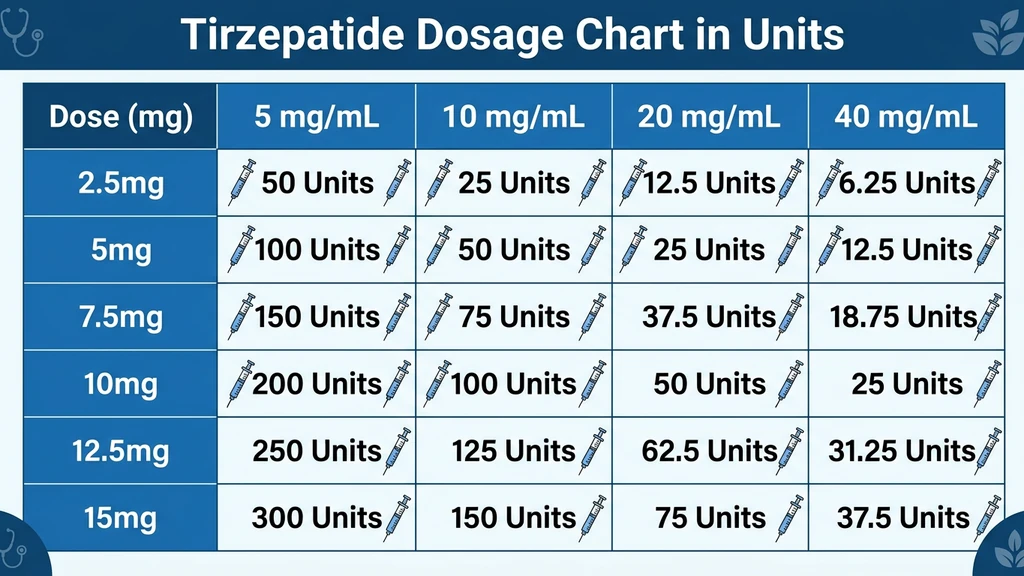
Here is every dose at every common concentration in one table. Bookmark this page.
| Dose | 5 mg/mL | 10 mg/mL | 20 mg/mL | 40 mg/mL |
|---|---|---|---|---|
| 2.5 mg | 50 units | 25 units | 12.5 units | 6.25 units |
| 5 mg | 100 units | 50 units | 25 units | 12.5 units |
| 7.5 mg | 150 units* | 75 units | 37.5 units | 18.75 units |
| 10 mg | 200 units* | 100 units | 50 units | 25 units |
| 12.5 mg | 250 units* | 125 units* | 62.5 units | 31.25 units |
| 15 mg | 300 units* | 150 units* | 75 units | 37.5 units |
*Exceeds a standard 100-unit syringe. Use a higher concentration vial or split into two injections.*
If you want an instant answer for your specific vial, the Tirzepatide Dosage Calculator does the math in seconds.
Get your custom peptide protocol:
- Tailored to your body and goals
- Precise dosing and cycle length
- Safe stacking combinations
- Backed by peer-reviewed studies
- Ready in under 2 minutes
How Units, Milligrams, and Milliliters Connect
Think of espresso versus drip coffee. A single espresso shot and a full mug of pour-over can deliver identical caffeine. The espresso is more concentrated: same drug, smaller volume. If someone says "consume 100 mg of caffeine," the amount of liquid you drink depends entirely on which cup is in front of you.
Tirzepatide vials work the same way. Your prescribed dose is always in milligrams. The vial dissolves those milligrams into a liquid at a specific concentration (mg/mL). Your syringe measures that liquid in units, where 100 units equals 1 mL.
The formula that ties all three together:
Units = (Dose in mg ÷ Concentration in mg/mL) × 100
If your vial requires reconstitution, see our guide on how to reconstitute tirzepatide before proceeding. Walk through a real example. Your dose is 5 mg. Your vial reads 10 mg/mL:
- 1.5 mg ÷ 10 mg/mL = 0.5 mL of liquid
- 2.0.5 mL × 100 = 50 units on your syringe
Two steps. The same formula works for every dose at every concentration. Swap in your numbers and you have your answer. For a specific walkthrough of what 20 units delivers at each concentration, see how many mg is 20 units of tirzepatide. If math is not your thing, the Peptide Unit Converter handles it for you.
Tirzepatide Dosage by Concentration
Each concentration requires a different number of units for the same milligram dose. The sections below break down every dose at each of the four common compounded concentrations. Find the one printed on your vial label and use that table.
At 5 mg/mL
This is the least concentrated formulation. You need the most liquid per dose, which means higher unit draws and larger syringes. Most users at 5 mg/mL will need a 1 mL (100-unit) syringe. Doses above 5 mg exceed the 100-unit syringe capacity.
| Dose | Units to Draw | Volume (mL) | Syringe Needed |
|---|---|---|---|
| 2.5 mg | 50 units | 0.50 mL | 0.5 mL or 1 mL |
| 5 mg | 100 units | 1.00 mL | 1 mL |
| 7.5 mg | 150 units* | 1.50 mL | Exceeds syringe |
| 10 mg | 200 units* | 2.00 mL | Exceeds syringe |
*At 5 mg/mL, doses above 5 mg do not fit in a single 1 mL syringe. Ask your pharmacy for a higher concentration.*
If you are prescribed 7.5 mg or above and your pharmacy sent a 5 mg/mL vial, call them. Splitting a single dose across two syringe draws introduces extra room for error. A 10 or 20 mg/mL vial solves the problem entirely. For help determining the right reconstitution volume, use the Peptide Reconstitution Calculator.
At 10 mg/mL (Most Common)
The 10 mg/mL concentration is what most compounding pharmacies ship. If you are unsure of your concentration, it is likely this one, but always read the label before drawing. Store your vial properly between uses — see how long does tirzepatide last in the fridge.
| Dose | Units to Draw | Volume (mL) | Syringe Needed |
|---|---|---|---|
| 2.5 mg | 25 units | 0.25 mL | 0.3 mL or 0.5 mL |
| 5 mg | 50 units | 0.50 mL | 0.5 mL or 1 mL |
| 7.5 mg | 75 units | 0.75 mL | 1 mL |
| 10 mg | 100 units | 1.00 mL | 1 mL |
| 12.5 mg | 125 units* | 1.25 mL | Exceeds syringe |
| 15 mg | 150 units* | 1.50 mL | Exceeds syringe |
*Doses above 10 mg exceed a 100-unit syringe at this concentration. You will need a 20 mg/mL or 40 mg/mL vial at higher doses.*
At 10 mg/mL, a 0.5 mL syringe gives you excellent precision for 2.5 and 5 mg doses. Switch to a 1 mL syringe once you titrate to 7.5 mg. For a deeper walkthrough on the starting dose, see How Many Units Is 2.5 mg of Tirzepatide.
At 20 mg/mL
Higher concentration means smaller draws. Every dose from 2.5 through 15 mg fits inside a single 1 mL syringe at 20 mg/mL, making this a practical choice for the full titration schedule.
| Dose | Units to Draw | Volume (mL) | Syringe Needed |
|---|---|---|---|
| 2.5 mg | 12.5 units | 0.125 mL | 0.3 mL |
| 5 mg | 25 units | 0.25 mL | 0.3 mL or 0.5 mL |
| 7.5 mg | 37.5 units | 0.375 mL | 0.5 mL |
| 10 mg | 50 units | 0.50 mL | 0.5 mL or 1 mL |
| 12.5 mg | 62.5 units | 0.625 mL | 1 mL |
| 15 mg | 75 units | 0.75 mL | 1 mL |
At 20 mg/mL, the 2.5 mg dose requires only 12.5 units. That is the midpoint between the 12 and 13 unit marks on a standard 0.3 mL syringe. If you find this difficult to see, use a half-unit (Lo-Dose) syringe. The 0.5 unit graduations make 12.5 straightforward.
At 40 mg/mL
The most concentrated formulation. Draws are tiny, which means extreme precision matters. A small measurement error translates to a large dosing error because each unit contains more drug.
| Dose | Units to Draw | Volume (mL) | Syringe Needed |
|---|---|---|---|
| 2.5 mg | 6.25 units | 0.0625 mL | 0.3 mL (half-unit) |
| 5 mg | 12.5 units | 0.125 mL | 0.3 mL |
| 7.5 mg | 18.75 units | 0.1875 mL | 0.3 mL |
| 10 mg | 25 units | 0.25 mL | 0.3 mL or 0.5 mL |
| 12.5 mg | 31.25 units | 0.3125 mL | 0.5 mL |
| 15 mg | 37.5 units | 0.375 mL | 0.5 mL |
Look at the 2.5 mg draw: 6.25 units. That is six and a quarter tick marks on a standard syringe. At this scale, a single unit of error means you are off by 0.4 mg. A half-unit (Lo-Dose) 0.3 mL syringe is not optional here. It is required for safe, accurate dosing.
How Many mL Is Each Tirzepatide Dose
Some providers prescribe in milliliters instead of milligrams. Others ask you to confirm the volume before injecting. This table converts every dose to mL at each concentration.
| Dose | 5 mg/mL | 10 mg/mL | 20 mg/mL | 40 mg/mL |
|---|---|---|---|---|
| 2.5 mg | 0.50 mL | 0.25 mL | 0.125 mL | 0.0625 mL |
| 5 mg | 1.00 mL | 0.50 mL | 0.25 mL | 0.125 mL |
| 7.5 mg | 1.50 mL | 0.75 mL | 0.375 mL | 0.1875 mL |
| 10 mg | 2.00 mL | 1.00 mL | 0.50 mL | 0.25 mL |
| 12.5 mg | 2.50 mL | 1.25 mL | 0.625 mL | 0.3125 mL |
| 15 mg | 3.00 mL | 1.50 mL | 0.75 mL | 0.375 mL |
To convert mL to units, multiply by 100. To convert units to mL, divide by 100. The relationship is always: 1 mL = 100 units on a U-100 insulin syringe.
If your provider says "inject 0.25 mL" and your vial is 10 mg/mL, that is 0.25 × 10 = 2.5 mg, which is 25 units. The three numbers (mL, mg, units) always point to the same dose when the math is done correctly.
Reading Your Insulin Syringe
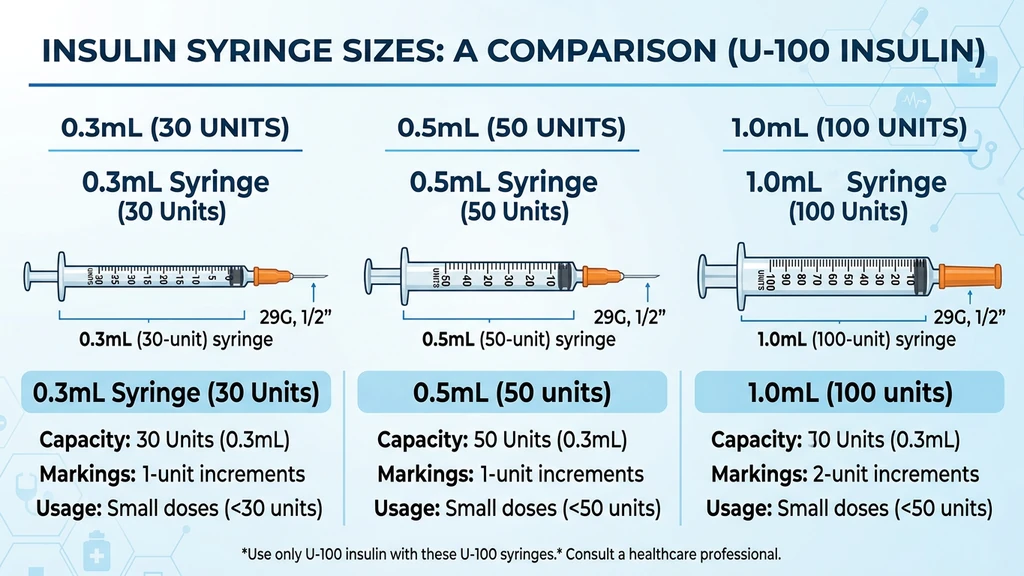
The syringe barrel has tiny etched lines running from the plunger tip to the needle end. Each line represents a fixed number of units. The total capacity of the syringe determines how many lines you get and how far apart they sit.
0.3 mL syringe (30 units max)
Each small line marks 1 unit. Printed numbers appear at 5, 10, 15, 20, 25, and 30. The lines are widely spaced, which makes fractional draws (6.25 or 12.5 units) visible. This is your best option for 20 and 40 mg/mL concentrations where draws are small and precision is critical. Half-unit versions subdivide each unit line into two, giving you 0.5-unit accuracy.
0.5 mL syringe (50 units max)
Each small line marks 1 unit. Numbers print every 5 or 10 units depending on the manufacturer. The halfway point of the barrel is exactly 25 units. At 10 mg/mL, this syringe covers the 2.5 mg (25 units) and 5 mg (50 units) doses cleanly. It is the most practical syringe for most tirzepatide users during the first two titration steps.
1 mL syringe (100 units max)
Each small line marks 2 units. There are no individual unit lines. The 25-unit mark sits one quarter of the way up the barrel, between the printed 20 and 30. Accuracy drops because you are estimating between wider tick marks. Reserve this syringe for draws above 50 units, such as 75 or 100 units at 10 mg/mL.
Choosing the right syringe: always use the smallest syringe that holds your entire dose. Smaller barrel means more lines per unit, more lines means better accuracy. For a full guide on injection technique, see Peptide Injections: Complete Guide.
Danger Scenarios: When Concentration Errors Double or Quadruple Your Dose
These are not theoretical. These exact mistakes happen every week in online tirzepatide communities. Each scenario shows the math, the multiplier, and the physical consequence.
Scenario 1: Your pharmacy changes concentration without telling you.
You have been using a 10 mg/mL vial for months. You draw 50 units for your 5 mg dose every week. Your pharmacy sends a refill at 20 mg/mL. The vial looks the same. You do not read the label. You draw 50 units.
50 units at 20 mg/mL = 10 mg. That is double your intended dose. At the 5 mg titration level, a sudden 10 mg injection triggers severe nausea, protracted vomiting, and watery diarrhea. In the SURPASS trials, nausea occurred in 12 to 24% of patients even at properly titrated doses (Frias et al., N Engl J Med, 2021). A sudden double dose amplifies these effects and can cause dehydration requiring IV fluids. For more on GI side effects, see does tirzepatide cause constipation.
The fix: read your vial label every time you open a new one. Write the concentration on the outside of the box with a marker. Recalculate your units if anything changed.
Scenario 2: You copy a dose from an online forum.
Someone on Reddit says "I draw 25 units for my 2.5 mg." Their vial is 10 mg/mL. Yours is 40 mg/mL. You draw 25 units.
25 units at 40 mg/mL = 10 mg. That is four times your starting dose. A 10 mg bolus in a tirzepatide-naive person can cause severe nausea and vomiting. The Mounjaro prescribing information (Eli Lilly, 2022) lists nausea, diarrhea, and vomiting as the most common adverse reactions, with rates increasing at higher doses. A 4x overdose in a naive patient is emergency-room territory.
The fix: never use another person's unit number. Their number only works for their vial. Calculate from your own label using (dose ÷ concentration) × 100. Or use the Tirzepatide Dosage Calculator with your vial's specific concentration.
Scenario 3: You confuse a U-40 syringe for a U-100.
U-40 syringes are designed for veterinary insulin. They have 40 units per mL instead of 100. You buy them online because they were cheaper. You draw "25 units" on the U-40 syringe for your 2.5 mg dose at 10 mg/mL.
25 units on a U-40 syringe = 0.625 mL. At 10 mg/mL, 0.625 mL contains 6.25 mg. That is 2.5 times your intended dose. The syringe looks right. The number says 25. But the volume is completely wrong.
The fix: check the syringe packaging. It must say "U-100" or "100 units/mL." If it says U-40 or does not specify, throw it away and order U-100 insulin syringes.
Four Common Mistakes and How to Avoid Them
Mistake 1: Not recalculating when switching vials.
Your first vial is 10 mg/mL. Your refill arrives at 20 mg/mL. You draw the same 50 units. Actual dose: 10 mg instead of 5 mg, a 2x overdose. GI side effects escalate within hours. Check your vial label, verify it has not expired, and recalculate. Every new vial gets a fresh calculation. No exceptions.
Mistake 2: Using a 1 mL syringe for a 12.5-unit draw.
At 20 mg/mL, the 2.5 mg dose is 12.5 units. On a 1 mL syringe, that falls between the 10 and 14 tick marks (each mark = 2 units). You are guessing. A 0.3 mL syringe has individual unit markings, and 12.5 sits clearly between 12 and 13. Precision requires the right tool.
Mistake 3: Rounding fractional units up or down.
At 40 mg/mL, the 7.5 mg dose is 18.75 units. You round to 19. That adds 0.25 units, which is 0.1 mg. Over a single injection, the error is small. But if you consistently round up across every dose at this concentration, you run slightly above target week after week. Use a half-unit syringe to eliminate the guesswork. For vials and reconstitution, the Peptide Reconstitution Calculator helps you verify your setup before drawing.
Mistake 4: Assuming "units" means the same thing across all medications.
Insulin units measure biological activity. Tirzepatide units on a syringe measure volume. When you draw "25 units" of tirzepatide, you are drawing 0.25 mL of liquid. The number of milligrams in that liquid depends on your vial concentration. If someone who uses insulin says "I draw 25 units," their 25 units and your 25 units mean entirely different things medically. Focus on your milligram dose and your vial's mg/mL, then convert. The same principle applies when converting semaglutide doses — units are always concentration-dependent.
Frequently Asked Questions
How many units is 2.5 mg of tirzepatide?
At 10 mg/mL: 25 units. At 20 mg/mL: 12.5 units. At 5 mg/mL: 50 units. At 40 mg/mL: 6.25 units. The formula is (2.5 ÷ concentration) × 100. Your answer changes completely depending on what concentration is printed on your vial label.
How many units is 5 mg of tirzepatide?
At 10 mg/mL: 50 units. At 20 mg/mL: 25 units. At 40 mg/mL: 12.5 units. At 5 mg/mL: 100 units (a full 1 mL syringe). Apply the formula: (5 ÷ concentration) × 100. Most users at 10 mg/mL should use a 0.5 mL or 1 mL syringe for this dose.
How many units is 7.5 mg of tirzepatide?
At 10 mg/mL: 75 units. At 20 mg/mL: 37.5 units. At 40 mg/mL: 18.75 units. The 5 mg/mL concentration requires 150 units, which exceeds a standard syringe. If your vial is 10 mg/mL, use a 1 mL syringe and draw to the 75-unit mark.
What is the difference between units and milligrams?
Milligrams measure the weight of the tirzepatide drug itself. Units measure the volume of liquid in your syringe (100 units = 1 mL on a U-100 syringe). The number of units you need to get a specific milligram dose depends on how concentrated the liquid is. A 10 mg/mL vial needs more units per dose than a 20 mg/mL vial.
Which syringe should I use for tirzepatide?
Use the smallest U-100 insulin syringe that fits your dose. For draws under 30 units (common at 20 and 40 mg/mL), use a 0.3 mL syringe. For draws of 25 to 50 units (common at 10 mg/mL), use a 0.5 mL syringe. For draws above 50 units, use a 1 mL syringe. Smaller syringes have finer markings and better accuracy.
How many units is 10 mg of tirzepatide?
At 10 mg/mL: 100 units (a full 1 mL syringe). At 20 mg/mL: 50 units. At 40 mg/mL: 25 units. If your vial is 10 mg/mL, the 10 mg dose maxes out a standard syringe. Ask your pharmacy about switching to 20 mg/mL when you titrate to this level.
Can I use the same syringe for all concentrations?
You can use any U-100 insulin syringe for any concentration. The syringe does not know or care what is inside it. But you must use the right size for accuracy. Drawing 6.25 units on a 1 mL syringe is nearly impossible to do precisely. Match the syringe size to the volume of your draw, and always recalculate units when your concentration changes.
How many units is 15 mg of tirzepatide?
At 20 mg/mL: 75 units. At 40 mg/mL: 37.5 units. At 10 mg/mL: 150 units, which exceeds a 100-unit syringe and requires a higher concentration vial. The 15 mg dose is the maximum approved tirzepatide dose per the Mounjaro/Zepbound prescribing information (Eli Lilly). Most patients at this level use 20 or 40 mg/mL vials.
The Bottom Line
Every tirzepatide dose converts to a specific number of units, and that number changes when your vial concentration changes. The master table above covers all six doses (2.5 through 15 mg) at all four common concentrations (5, 10, 20, and 40 mg/mL). One formula governs every cell in that table: (dose in mg ÷ concentration in mg/mL) × 100 = units.
Read your vial label before every injection. Recalculate when anything changes. Use the smallest syringe that fits your draw.
Skip the arithmetic entirely with the Tirzepatide Dosage Calculator. For vial preparation, see the Peptide Reconstitution Calculator. For injection technique, read the Peptide Injections: Complete Guide. For a week-by-week results timeline at each dose, see how long does tirzepatide take to work. For maintenance dosing after reaching your target weight, read tirzepatide maintenance dose after weight loss.
Related Articles: - Semaglutide to Tirzepatide Switching Guide — dose equivalence if switching medications - Semaglutide Dosage Chart in mL — the semaglutide equivalent of this chart - Why Am I Not Losing Weight on Tirzepatide? — troubleshooting weight loss stalls - Does Tirzepatide Burn Fat? — the science behind fat loss at each dose - How to Inject Tirzepatide — step-by-step injection guide with syringe markings - Tirzepatide Cost With Insurance — 2026 pricing by dose level
Related Articles
How Many Units Is 7.5 mg of Tirzepatide?
7.5 mg of tirzepatide equals 75 units (10 mg/mL), 37.5 units (20 mg/mL), or 18.75 units (40 mg/mL). Conversion table and syringe guide included.
How Many Units Is 2.5 mg Tirzepatide?
2.5 mg of tirzepatide is 25 units at 10 mg/mL, 12.5 units at 20 mg/mL, or 50 units at 5 mg/mL. Conversion table with syringe instructions.
How Many Units Is 12.5 mg of Tirzepatide?
How many units is 12.5 mg of tirzepatide? 125 units at 10 mg/mL, 62.5 at 20 mg/mL, 31.25 at 40 mg/mL. Conversion chart and syringe guide.
Tirzepatide Maintenance Dose Guide
Most patients maintain on 5-10 mg tirzepatide weekly after reaching goal weight. SURMOUNT-4 data shows stopping leads to 50-67% weight regain within 12 months.