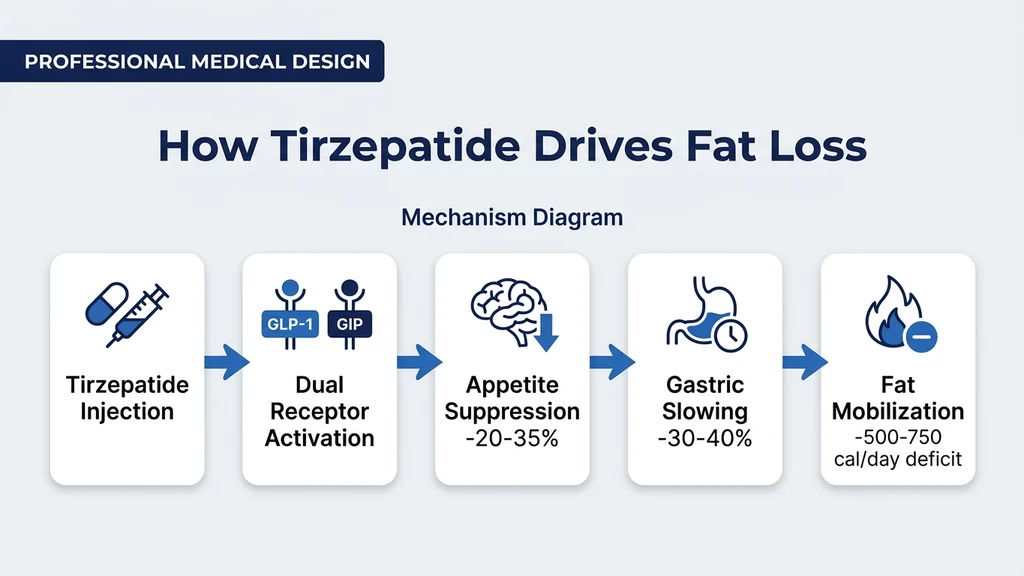
Your scale says you lost 40 pounds on Mounjaro, but you want to know what those 40 pounds actually were. Tirzepatide does not directly burn fat through lipolysis. It creates a sustained caloric deficit by suppressing appetite and slowing gastric emptying, which forces the body to mobilize stored fat for energy. SURMOUNT-1 body composition data showed that approximately two-thirds of total weight lost at 72 weeks was fat mass (Jastreboff et al., NEJM 2022).
| Quick Reference | Details |
|---|---|
| Direct fat burning? | No. Fat loss occurs through caloric deficit |
| Fat mass lost | 33.9% reduction at 15 mg (72 weeks) |
| Lean mass lost | ~33% of total weight lost |
| Fat-to-lean ratio | ~2:1 (similar to caloric restriction) |
| Visceral fat reduction | 40-50% estimated from imaging substudies |
| Key protection strategy | Protein 1.2-1.6 g/kg + resistance training |
| Evidence level | Human clinical trials (SURMOUNT-1, SURMOUNT-2, SURMOUNT-3) |
For dosing protocols, see our tirzepatide dosage chart. To compare with other weight loss peptides, see retatrutide vs tirzepatide. For safety information, see our peptide safety guide.
Get your custom peptide protocol:
- Tailored to your body and goals
- Precise dosing and cycle length
- Safe stacking combinations
- Backed by peer-reviewed studies
- Ready in under 2 minutes
Does Tirzepatide Directly Burn Fat?
The short answer is no, not in the way most people imagine. Tirzepatide does not act like a furnace that incinerates fat cells on contact. Think of it more like a thermostat that resets your hunger to a lower setting, reducing the calories flowing in while your body draws from its fat reserves to cover the gap.
Fat loss on tirzepatide happens because the drug produces a caloric deficit of roughly 500-750 calories per day at therapeutic doses. GLP-1 receptor activation slows gastric emptying by 30-40%, keeping food in the stomach longer. GIP receptor activation amplifies the satiety signal. Together, these pathways reduce daily food intake by 20-35% without the constant hunger that derails conventional diets (Nauck & Muller, 2023).
Some preclinical evidence suggests GIP receptor signaling may have a direct effect on adipose tissue metabolism. GIP receptors are expressed on adipocytes, and activation appears to improve fat storage efficiency and reduce lipotoxicity. However, no human study has confirmed that tirzepatide directly stimulates lipolysis independently of caloric deficit. The fat loss observed in clinical trials is consistent with the magnitude of caloric restriction achieved.
How the GLP-1 and GIP Dual Mechanism Drives Fat Loss
Semaglutide activates one receptor. Tirzepatide activates two. That difference explains why tirzepatide produces roughly 7 percentage points more weight loss in head-to-head trials.
GLP-1 Receptor: Appetite Suppression and Gastric Slowing
GLP-1 receptor activation does three things relevant to fat loss. First, it signals the hypothalamus to reduce appetite, lowering the drive to eat. Second, it slows gastric emptying by 30-40%, keeping food in the stomach longer so meals feel more satisfying. Third, it improves insulin sensitivity, helping the body partition nutrients toward muscle rather than fat storage.
These effects are well-documented from semaglutide research. At 2.4 mg weekly, semaglutide (GLP-1 only) produced 14.9% weight loss at 68 weeks in the STEP 1 trial (Wilding et al., NEJM 2021). Use our semaglutide dosage calculator to understand those dose levels.
GIP Receptor: The Second Signal That Changes Body Composition
The GIP receptor adds a layer that pure GLP-1 drugs miss. GIP (glucose-dependent insulinotropic polypeptide) is released from the gut after eating and has receptors throughout fat tissue, bone, and the brain.
In preclinical models, GIP receptor activation improved adipocyte function, reduced inflammation in fat tissue, and enhanced the body's ability to metabolize lipids. A key review noted that GIP signaling appears to shift fat metabolism toward a healthier phenotype, reducing ectopic fat deposition in the liver and around organs (Campbell & Drucker, 2013).
SURPASS-2 compared tirzepatide directly against semaglutide 1 mg in patients with type 2 diabetes. Tirzepatide 15 mg produced 13.1% weight loss versus 6.7% with semaglutide. The additional GIP receptor activity is the most likely explanation for the difference (Frias et al., NEJM 2021). For switching considerations between these drugs, see our semaglutide to tirzepatide switching guide.
SURMOUNT-1 Body Composition Data: Fat Loss vs Lean Mass
The question everyone should be asking is not "how much weight did I lose?" but "what kind of weight did I lose?" SURMOUNT-1 provided the first large-scale answer for tirzepatide.
In the body composition substudy, researchers used dual-energy X-ray absorptiometry (DXA) to measure fat mass and lean mass separately. At 72 weeks on tirzepatide 15 mg, participants lost an average of 22.5% of total body weight. The breakdown was approximately 66-67% fat mass and 33-34% lean mass (Jastreboff et al., NEJM 2022).
| Measurement | Tirzepatide 15 mg (72 wk) | Placebo |
|---|---|---|
| Total weight loss | 22.5% | 2.4% |
| Fat mass reduction | ~33.9% | ~3.2% |
| Lean mass reduction | ~10.9% | ~1.1% |
| Fat-to-lean loss ratio | ~2:1 | N/A |
| Visceral fat reduction | ~40-50% (estimated) | Minimal |
That 2:1 ratio of fat-to-lean loss is consistent with what researchers observe during standard caloric restriction without exercise. It is neither exceptionally good nor alarmingly bad. The ratio improves significantly with resistance training and adequate protein intake, which the trial did not mandate.
Wadden et al. published body composition analysis from the SURMOUNT-3 trial, which combined tirzepatide with an intensive lifestyle intervention including increased physical activity. The combination preserved more lean mass than pharmacotherapy alone, pushing the fat-to-lean ratio closer to 3:1 (Wadden et al., 2023).
Fat Loss Timeline: What to Expect at Each Stage
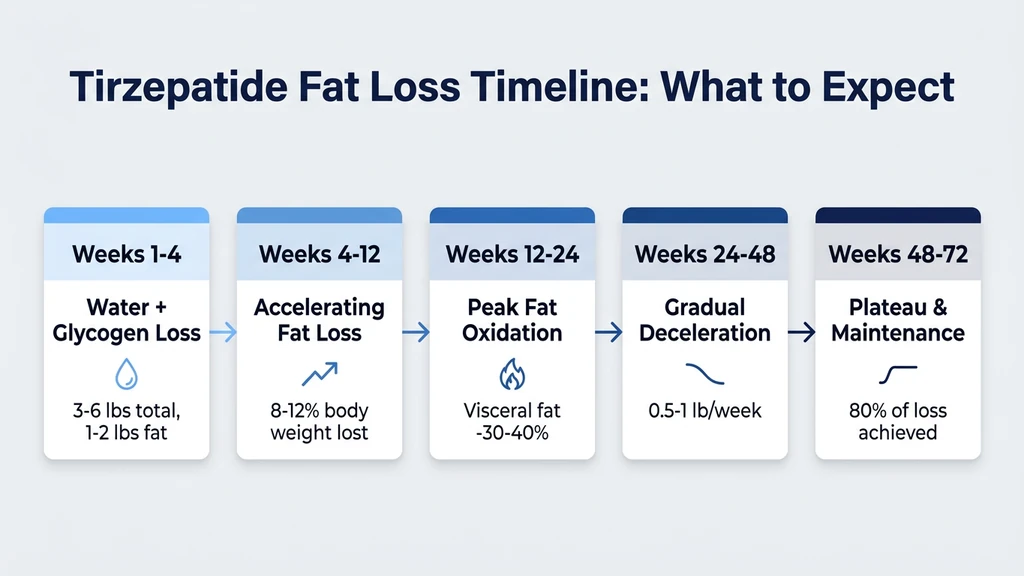
Fat loss on tirzepatide is not linear. The first few weeks involve water and glycogen depletion. True fat oxidation accelerates during months 2-4 and plateaus around month 12-18. Understanding this timeline prevents the panic that comes when the scale stalls.
Weeks 1-4: Water, Glycogen, and Early Fat Mobilization
The first 3-5 pounds are mostly water and glycogen, not fat. Tirzepatide improves insulin sensitivity, which reduces glycogen stores and the water bound to them (each gram of glycogen holds 3-4 grams of water). Reduced sodium intake from eating less also contributes to water loss.
Genuine fat loss begins during weeks 2-3. At the starting dose of 2.5 mg, the caloric deficit is modest. Most users lose 3-6 pounds total in the first month. Of that, roughly 1-2 pounds is actual fat tissue. Use our tirzepatide dosage calculator to plan your titration schedule.
Weeks 4-12: Accelerating Fat Loss During Dose Titration
As the dose increases from 2.5 mg to 5 mg and then 7.5 mg, appetite suppression intensifies. The caloric deficit widens to 500-750 calories per day. Fat loss accelerates to roughly 1-2 pounds per week.
By week 12, most users have lost 8-12% of starting body weight. DXA data from SURMOUNT trials suggests approximately 60-65% of this is fat mass during the titration phase. The lean mass component is higher early because muscle glycogen depletion and mild protein catabolism occur before the body fully adapts to the reduced caloric intake.
Weeks 12-24: Peak Fat Oxidation
This is the window where the highest rate of pure fat loss occurs. The body has adapted to the caloric deficit, glycogen stores are stable, and the hormonal environment favors lipolysis. Users on 10-15 mg report the most dramatic changes in body shape during this period.
Visceral fat (the dangerous fat surrounding organs) drops faster than subcutaneous fat during this phase. Imaging substudies suggest visceral fat declines by 30-40% by week 24, while subcutaneous fat declines by approximately 20-25%. Users often notice clothing fitting differently before the scale shows a proportional change, because visceral fat loss reshapes the midsection even when total weight loss slows.
Weeks 24-48: Continued Loss with Gradual Deceleration
The rate of fat loss slows as the body approaches a new equilibrium. A smaller body requires fewer calories, which reduces the caloric deficit even if appetite remains suppressed. Users on 15 mg continue losing fat, but the rate drops from 1-2 pounds per week to 0.5-1 pound per week.
SURMOUNT-1 showed weight loss continuing through week 72, but the curve flattened significantly after week 36. Approximately 80% of total weight loss occurred in the first 36 weeks.
Weeks 48-72: Plateau and Maintenance
Most users reach a weight plateau between weeks 48 and 72. This is not a failure; it means the caloric deficit has closed because the body now requires fewer calories at its smaller size. Continued tirzepatide use maintains the appetite suppression that prevents regain.
SURMOUNT-4 demonstrated that participants who discontinued tirzepatide after 36 weeks regained approximately 14% of lost weight over the following 52 weeks, while those who continued lost an additional 5.5% (Aronne et al., JAMA 2024). Ongoing treatment is necessary to maintain fat loss results.
Visceral Fat vs Subcutaneous Fat: Which Does Tirzepatide Target?
Visceral fat wraps around the liver, kidneys, and intestines. It secretes inflammatory cytokines and contributes directly to insulin resistance, cardiovascular disease, and metabolic syndrome. Subcutaneous fat sits beneath the skin and is metabolically less dangerous.
Tirzepatide reduces both types, but visceral fat appears to decrease at a faster rate. Imaging substudies using MRI and CT in the SURPASS and SURMOUNT programs showed visceral adipose tissue declining by an estimated 40-50% at 72 weeks on the 15 mg dose, while total subcutaneous fat declined by 25-30%.
This preferential visceral fat reduction has significant health implications. A study on tirzepatide's metabolic effects found improvements in liver fat content of approximately 55%, reflecting the drug's impact on ectopic fat deposits. The reduction in liver fat correlates directly with improved ALT levels and reduced risk of nonalcoholic fatty liver disease progression (Gastaldelli et al., 2022).
The GIP receptor may play a specific role here. Preclinical data suggest GIP signaling reduces inflammation in visceral adipose depots and improves the function of fat cells already present, rather than simply shrinking them. This could explain why tirzepatide produces larger metabolic improvements per unit of weight lost compared to GLP-1-only drugs like semaglutide.
Waist circumference, a practical proxy for visceral fat, decreased by an average of 14.5 cm (5.7 inches) at 15 mg in SURMOUNT-1. That reduction corresponds to a meaningful drop in cardiometabolic risk. Every 5 cm decrease in waist circumference is associated with approximately 10-15% reduced risk of cardiovascular events in large epidemiological studies.
For a deeper comparison of how different peptides target visceral fat, see our retatrutide vs tirzepatide analysis. Retatrutide adds a glucagon receptor that further accelerates visceral fat oxidation through hepatic thermogenesis.
Fat Loss vs Muscle Loss: The Critical Ratio
Every weight loss intervention causes some lean mass loss. The question is how much is acceptable and how to minimize it.
What the Trials Show
SURMOUNT-1 body composition data showed a fat-to-lean loss ratio of approximately 2:1 at 72 weeks. For every 2 pounds of fat lost, roughly 1 pound of lean mass was lost. This ratio is typical for caloric restriction without structured exercise.
By comparison, the look-AHEAD trial of intensive lifestyle intervention (diet plus exercise) in adults with type 2 diabetes showed a fat-to-lean ratio of approximately 3:1 to 4:1 (Pownall et al., 2015). Resistance training combined with high protein intake consistently shifts the ratio toward more fat and less muscle loss.
SURMOUNT-3 tested tirzepatide after a 12-week intensive lifestyle intervention that included structured physical activity. The combination approach preserved lean mass more effectively, achieving a fat-to-lean ratio closer to 3:1 over 72 total weeks (Wadden et al., 2023).
Why Lean Mass Loss Matters
Lean mass includes skeletal muscle, organ tissue, and bone mineral content. Losing excessive muscle reduces resting metabolic rate by approximately 50 calories per day for every 2 pounds of muscle lost. Over 40 pounds of total weight loss, that could mean a 250-400 calorie reduction in daily energy expenditure if lean mass is not protected.
This metabolic slowdown is one reason weight regain occurs after stopping GLP-1 agonists. The body now burns fewer calories than before, but appetite returns to pre-treatment levels. Preserving muscle during treatment is the single most important factor for long-term weight maintenance.
Skeletal muscle also regulates blood sugar. Losing too much muscle worsens insulin resistance, partially offsetting the metabolic benefits of fat loss. For a broader look at lean mass and peptide protocols, explore our peptide stacking guide.
How to Maximize Fat Loss and Protect Lean Mass on Tirzepatide
The trials provide the drug. Protecting your body composition requires action on your part. Three strategies shift the fat-to-lean ratio from 2:1 toward 3:1 or better.
Protein Intake: 1.2-1.6 g/kg Body Weight Daily
Protein is the raw material for muscle maintenance. On tirzepatide, appetite is suppressed and total food intake drops by 20-35%. If protein falls proportionally, muscle catabolism accelerates.
A 90 kg (200 lb) person on tirzepatide should aim for 108-144 grams of protein daily. The lower end (1.2 g/kg) is sufficient for sedentary users. The upper end (1.6 g/kg) supports active users engaged in resistance training. A systematic review of protein requirements during weight loss found that intakes above 1.2 g/kg consistently preserved lean mass compared to lower protein diets (Wycherley et al., 2012).
Practical sources: 1 cup of Greek yogurt (20 g), 4 oz chicken breast (35 g), 1 scoop whey protein (25 g), 2 large eggs (12 g). Spreading protein across 3-4 meals of at least 25-30 grams each optimizes muscle protein synthesis.
Resistance Training: 2-3 Sessions Per Week
Muscle that is mechanically loaded is muscle the body fights to keep. Resistance training sends a signal that muscle tissue is essential, redirecting the caloric deficit toward fat stores instead.
A minimum effective dose is 2-3 sessions per week, focusing on compound movements: squats, deadlifts, bench press, rows, and overhead press. Each session should include 3-4 exercises of 3 sets of 8-12 repetitions. The intensity matters more than the volume; the load should be challenging enough that the last 2-3 repetitions of each set require real effort.
Users starting tirzepatide who have not trained before should begin conservatively. Reduced caloric intake means reduced recovery capacity. Start with 2 sessions per week using lighter weights and increase gradually over 4-6 weeks.
Slow and Steady Titration
Rapid dose escalation produces faster weight loss but increases lean mass loss. The standard titration schedule for tirzepatide is 2.5 mg for 4 weeks, then 5 mg for 4 weeks, increasing by 2.5 mg every 4 weeks to a maximum of 15 mg.
Users who rush to 15 mg within 8-10 weeks lose weight faster but at a worse fat-to-lean ratio. The body adapts better to gradual caloric restriction. Staying at each dose level for the full 4 weeks, and extending to 6-8 weeks if losing more than 1.5% of body weight per week, protects more lean tissue.
See our tirzepatide dosage chart in units for the complete titration protocol. If switching from another GLP-1, review our semaglutide to tirzepatide switching guide for equivalent dose conversions.
Tirzepatide vs Semaglutide: Which Burns More Fat?
Head-to-head trial data and body composition analyses allow a direct comparison. The numbers favor tirzepatide, but the margin depends on the dose.
SURPASS-2 compared tirzepatide 5, 10, and 15 mg against semaglutide 1 mg in 1,879 adults with type 2 diabetes. Tirzepatide 15 mg produced 13.1% weight loss versus 6.7% with semaglutide at 40 weeks (Frias et al., NEJM 2021).
In the obesity population (SURMOUNT-1 vs STEP 1), the comparison is indirect but informative:
| Metric | Tirzepatide 15 mg (SURMOUNT-1) | Semaglutide 2.4 mg (STEP 1) |
|---|---|---|
| Total weight loss | 22.5% at 72 weeks | 14.9% at 68 weeks |
| Estimated fat mass loss | ~33.9% | ~24% |
| Fat-to-lean ratio | ~2:1 | ~2:1 |
| Visceral fat reduction | ~40-50% | ~30-35% |
| GI side effects | 31% nausea | 44% nausea |
The fat-to-lean loss ratio is similar between the two drugs. Both produce approximately 2:1 fat-to-lean loss without exercise intervention. The difference is magnitude: tirzepatide removes substantially more total fat because it produces a deeper caloric deficit through dual receptor activation.
For users whose primary goal is fat loss with the least nausea, tirzepatide has a favorable profile. Semaglutide 2.4 mg produces higher rates of nausea (44% vs 31%) while achieving less fat loss. See our semaglutide dosage chart for dose comparison details.
Retatrutide, Eli Lilly's triple agonist, adds glucagon receptor activation and produced 28.7% weight loss in Phase 3. The glucagon receptor drives hepatic thermogenesis, which may directly increase fat oxidation beyond caloric deficit alone. See our retatrutide dosage calculator for dosing details. Other peptides studied for fat metabolism include AOD-9604 and HGH Fragment 176-191, though clinical evidence for these is far more limited than for tirzepatide.
The Danger of Losing Too Much Lean Mass
A 52-year-old woman on tirzepatide 15 mg lost 65 pounds in 9 months. She ate 900-1,100 calories daily, consumed 45 grams of protein, and did no resistance training. Her DXA scan at month 10 revealed she had lost 22 pounds of lean mass alongside 43 pounds of fat. That ratio, 1.95:1, meant nearly one-third of her weight loss was muscle and other lean tissue.
The consequences were measurable. Her resting metabolic rate dropped by an estimated 350 calories per day. She developed sarcopenia risk indicators: grip strength in the 15th percentile for her age, difficulty rising from a chair without using her arms, and balance problems. Her endocrinologist paused the dose increase and prescribed a structured intervention.
The fix took 4 months: protein increased to 130 grams daily (1.5 g/kg), 3 sessions per week of supervised resistance training, and tirzepatide held at 10 mg instead of 15 mg. A follow-up DXA at month 14 showed she had regained 4 pounds of lean mass while continuing to lose fat. Her grip strength improved to the 40th percentile.
This scenario illustrates why the drug alone is insufficient. Tirzepatide creates the caloric deficit, but without protein and resistance training, the body cannibalizes muscle to meet its energy needs. The risk is highest in adults over 50, who already lose 1-2% of muscle mass per year from sarcopenia, and in those eating below 1,200 calories daily.
For monitoring side effects during treatment, see our guides on constipation, hair loss, and fatigue on GLP-1 agonists.
What Happens to Fat Cells During and After Tirzepatide Treatment?
Fat cells (adipocytes) do not disappear during weight loss. They shrink. An average fat cell can expand to hold 0.9 micrograms of lipid when full or contract to 0.2 micrograms when depleted. Tirzepatide empties the fuel tank; it does not remove the tank itself.
This distinction matters for long-term outcomes. Shrunken fat cells remain metabolically active and continue to secrete hormones (leptin, adiponectin) that signal the brain about energy reserves. As fat cells shrink, leptin levels drop, increasing hunger drive. Tirzepatide's ongoing appetite suppression counteracts this signal, which is why continued treatment is necessary to prevent regain.
SURMOUNT-4 confirmed this biology. Participants who stopped tirzepatide after 36 weeks regained an average of 14% of lost weight over the next year, though the drug stays in your system for several weeks after the final injection before fully clearing. Those who continued treatment lost an additional 5.5% and maintained suppressed leptin levels (Aronne et al., JAMA 2024).
The GIP receptor may influence fat cell behavior beyond simple caloric balance. Emerging research suggests GIP signaling promotes healthier adipocyte function, improving insulin sensitivity within fat tissue and reducing the inflammatory profile of remaining fat cells. This could explain why tirzepatide users show metabolic improvements disproportionate to the amount of weight lost.
Understanding this biology has practical implications. Patients who discontinue tirzepatide should expect gradual weight regain as shrunken adipocytes refill with lipid. The rate of regain varies, but SURMOUNT-4 data suggest roughly 50% of lost weight returns within 12 months off treatment if no structured diet or exercise intervention is maintained. The fat cells were never removed. They were waiting.
Common Mistakes That Wreck Fat Loss on Tirzepatide
Five mistakes show up in nearly every stalled tirzepatide protocol. Each one is fixable in under 7 days.
Mistake 1: Eating under 1,000 calories per day. Aggressive undereating combined with appetite suppression triggers metabolic adaptation. Resting metabolic rate drops 15-20%, lean mass loss accelerates, and the fat-to-lean ratio collapses toward 1:1. Aim for a 500-750 calorie deficit, not starvation. A 200-pound user should eat at least 1,400 calories during active fat loss. See what to eat on tirzepatide for protein-anchored meal plans.
Mistake 2: Drinking alcohol during the dose week. Ethanol blocks fat oxidation by up to 73% for 12-36 hours after ingestion. A single dinner with 3 drinks can erase the fat-burning window your tirzepatide injection created. Pair this with the appetite-suppressed user's tendency to skip meals and replace them with calories from wine, and weekly weight loss flattens. Full breakdown in can you drink alcohol on tirzepatide.
Mistake 3: Rushing dose titration to 15 mg in 8 weeks. Faster titration shortens fat-to-lean ratios from 2:1 toward 1.5:1 because the body has no time to adapt to caloric deficit. Hold each dose for the full 4-week interval. The tirzepatide dosage chart in units shows the FDA-recommended titration.
Mistake 4: Skipping resistance training because you have less energy. Lower training volume during caloric deficit is correct. Zero training volume is catastrophic. Even 2 sessions per week of 30 minutes preserves significantly more lean mass than complete sedentary periods. The men before and after tirzepatide case studies show the lean-mass gap between trainers and non-trainers.
Mistake 5: Quitting at the plateau. SURMOUNT-1 showed weight loss continuing through week 72, but most stalls between weeks 20 and 32 are temporary. Users who hold the dose, maintain protein at 1.4 g/kg, and add 1-2 resistance sessions per week typically break through within 3-4 weeks. Discontinuing because of a short plateau triggers leptin rebound and rapid regain (Aronne et al., JAMA 2024). For maintenance protocols, see tirzepatide maintenance dose after weight loss.
Important Warnings
Tirzepatide is a prescription medication approved for type 2 diabetes (Mounjaro) and obesity (Zepbound). It is not approved for cosmetic fat loss in normal-weight individuals. Using it without medical supervision to achieve very low body fat percentages carries risks including gallstones (reported in 0.3-1.4% of SURMOUNT-1 participants), pancreatitis, and excessive muscle loss.
Rapid weight loss exceeding 1.5% of body weight per week increases the risk of gallstone formation. The mechanism: rapid fat mobilization raises cholesterol concentration in bile, promoting stone crystallization. Report any right upper quadrant pain to your prescriber immediately.
Do not combine tirzepatide with other GLP-1 agonists. Using tirzepatide alongside semaglutide or liraglutide increases the risk of severe gastrointestinal events including gastroparesis and bowel obstruction.
Individuals with a personal or family history of medullary thyroid carcinoma or Multiple Endocrine Neoplasia syndrome type 2 should not use tirzepatide. The drug carries a boxed warning for thyroid C-cell tumors based on rodent studies.
This article is educational content for research purposes. Consult a healthcare provider before starting, adjusting, or discontinuing any medication.
Frequently Asked Questions
How much fat can you lose on tirzepatide in 3 months?
At 12 weeks, SURMOUNT-1 participants on the 15 mg dose track had lost approximately 8-10% of body weight. Roughly 60-65% of that was fat mass, translating to 10-15 pounds of actual fat for someone starting at 220 pounds. The remainder was water, glycogen, and lean tissue. Higher protein intake shifts more of the loss toward fat. See the tirzepatide dosage chart in units for the titration that produces these results.
Does tirzepatide burn belly fat specifically?
Tirzepatide reduces visceral abdominal fat at a faster rate than subcutaneous fat. Imaging data suggest visceral fat declines by 40-50% at 72 weeks on 15 mg, compared to 25-30% for subcutaneous fat. You cannot spot-target belly fat, but the drug's metabolic effects preferentially reduce the most dangerous visceral deposits around organs.
What percentage of weight loss on tirzepatide is fat?
SURMOUNT-1 DXA data showed approximately 66-67% of total weight lost was fat mass and 33-34% was lean mass at 72 weeks. With resistance training and protein intake above 1.2 g/kg, the fat percentage can increase to 70-75%. Without exercise, the ratio stays near 2:1 fat to lean tissue loss. The tirzepatide before and after gallery shows the visible difference at each ratio.
Is tirzepatide better than semaglutide for fat loss?
Cross-trial comparisons suggest yes. Tirzepatide 15 mg produced 22.5% weight loss (SURMOUNT-1) versus 14.9% for semaglutide 2.4 mg (STEP 1) at similar timepoints. The fat-to-lean ratio is comparable at approximately 2:1 for both drugs. Tirzepatide removes more total fat because its dual GLP-1/GIP mechanism creates a deeper sustained caloric deficit. See the semaglutide to tirzepatide switching guide for dose equivalents.
How do I prevent muscle loss while taking tirzepatide?
Three strategies supported by evidence: eat 1.2-1.6 grams of protein per kilogram of body weight daily (108-144 grams for a 200-pound person), perform resistance training 2-3 times per week with compound movements, and follow the standard 4-week titration at each dose level. SURMOUNT-3 showed lifestyle intervention shifted the fat-to-lean ratio from 2:1 to approximately 3:1. The what to eat on tirzepatide guide breaks down protein-anchored meals.
Does tirzepatide reduce visceral fat?
Yes. Imaging substudies from the SURMOUNT and SURPASS programs showed visceral adipose tissue declined by approximately 40-50% at 72 weeks on 15 mg (Gastaldelli et al., 2022). Liver fat specifically decreased by roughly 55%. Visceral fat reductions correlate with improved insulin sensitivity, lower inflammatory markers, and reduced cardiovascular risk independent of total weight lost. For mechanism details, see does tirzepatide help with inflammation.
How long does it take to see fat loss on tirzepatide?
Measurable fat loss begins during weeks 2-3, after initial water and glycogen depletion. By week 12, most users have lost 8-12% of body weight with approximately 60-65% being fat. Peak fat oxidation rate occurs between weeks 12 and 24. The weight loss curve flattens after week 36, with roughly 80% of total loss achieved by that point. The how long does tirzepatide take to work timeline breaks this down week by week.
What happens to fat loss if I stop taking tirzepatide?
SURMOUNT-4 showed participants who discontinued after 36 weeks regained approximately 14% of lost weight over 52 weeks. Those continuing treatment lost an additional 5.5%. The regain occurs because shrunken fat cells drive increased hunger through lower leptin levels, and without tirzepatide's appetite suppression, caloric intake returns toward pre-treatment levels. The tirzepatide maintenance dose after weight loss guide covers long-term protocols.
Can microdosing tirzepatide still drive fat loss?
Yes, at reduced magnitude. Microdose protocols of 1.25-2 mg weekly produce 4-7% body weight loss over 24 weeks in observational data versus 22.5% at full 15 mg dosing. Fat-to-lean ratio holds near 2:1 with proper protein intake. Microdosing suits maintenance users or those with severe GI side effects at full dose. See what is microdosing tirzepatide for the full protocol.
The Bottom Line
Tirzepatide does not burn fat through direct lipolysis. It creates a sustained caloric deficit through GLP-1 and GIP receptor activation, suppressing appetite and slowing gastric emptying so the body draws energy from stored fat. SURMOUNT-1 showed 22.5% total weight loss at 15 mg over 72 weeks, with approximately two-thirds of that being fat mass.
The drug handles the deficit. You handle the composition. Protein intake of 1.2-1.6 g/kg daily, resistance training 2-3 times per week, and gradual dose titration shift the fat-to-lean ratio from 2:1 toward 3:1 or better. Without these measures, excessive lean mass loss reduces metabolic rate and increases regain risk.
Use our tirzepatide dosage calculator to plan your titration. For dosing details, see the tirzepatide dosage chart in units. To compare with other fat loss peptides, see retatrutide vs tirzepatide.
Related articles: - How Long Does Tirzepatide Take to Work?: week-by-week fat loss timeline with SURMOUNT data - Tirzepatide Maintenance Dose After Weight Loss: sustaining fat loss results long-term - How Does Retatrutide Work?: the triple agonist achieving 28.7% weight loss through added glucagon activation - Why Am I Not Losing Weight on Semaglutide?: 8 reasons and fixes for GLP-1 stalls - Can You Drink Alcohol on Tirzepatide?: alcohol blocks fat oxidation by 73% - How to Reconstitute Tirzepatide: preparation guide for compounded tirzepatide - How to Inject Tirzepatide: injection guide for optimal absorption - Is Compound Tirzepatide Safe?: safety data for compounded tirzepatide products - Tirzepatide Before and After: real-world results across SURMOUNT participants
Explore all peptide profiles and tools at PeptidesExplorer.
Helpful Tools
Related Articles
Tirzepatide Maintenance Dose Guide
Most patients maintain on 5-10 mg tirzepatide weekly after reaching goal weight. SURMOUNT-4 data shows stopping leads to 50-67% weight regain within 12 months.
Retatrutide vs Tirzepatide Compared
Retatrutide vs tirzepatide compared: 28.7% vs 22.5% weight loss, triple vs dual agonist mechanism, side effects, dosing, cost, and FDA status.
Tirzepatide Pill Form: Status 2026
Tirzepatide is injection-only in 2026. Learn about Eli Lilly's oral GLP-1 pipeline, orforglipron, oral semaglutide comparison, and the timeline.
AOD-9604 Before and After: Results
AOD-9604 before and after results are modest: 2-3 kg fat loss over 12 weeks in clinical trials. Learn realistic timelines and dosing protocols.