Your doctor wrote the prescription three weeks ago. The pharmacy quoted $1,050 per month for brand-name Mounjaro, and your insurance denied the claim. A compounding pharmacy across town offered the same active ingredient for $350. You hesitated. Compounded tirzepatide can be safe when sourced from a properly licensed, inspected compounding pharmacy, but it carries real risks that brand-name versions do not. The FDA has authorized compounding of tirzepatide only during official drug shortage periods under strict regulatory conditions, and quality varies dramatically between providers.
The critical distinction is between FDA-registered 503B outsourcing facilities, which operate under federal oversight with current good manufacturing practice (cGMP) requirements, and 503A pharmacies, which compound on a patient-specific basis under state-level regulation with far less standardized quality control (FDA, 2024). Neither type produces an FDA-approved product, but the gap in oversight between the two is enormous.
| Quick Reference | Details |
|---|---|
| Legal basis | FDA 503A (patient-specific) and 503B (outsourcing facilities) under FD&C Act |
| Shortage status | Tirzepatide was on the FDA Drug Shortage List from December 2022 through 2024; resolved in late 2024 |
| Key risks | Sterility failures, potency variability, sub-therapeutic dosing, contamination |
| Verification | PCAB accreditation, state board licensing, third-party potency testing |
| Brand alternative | Mounjaro (diabetes) / Zepbound (obesity), FDA-approved with full quality assurance |
| Cost difference | Brand: $900-1,100/month; Compounded: $150-450/month |
| Bottom line | Safe from a verified 503B facility during shortage; risky from unvetted sources |
For proper handling of any tirzepatide product, see our how to reconstitute tirzepatide guide and peptide safety guide.
Get your custom peptide protocol:
- Tailored to your body and goals
- Precise dosing and cycle length
- Safe stacking combinations
- Backed by peer-reviewed studies
- Ready in under 2 minutes
What Is Compounded Tirzepatide?
Compounded tirzepatide is the same active molecule as brand-name Mounjaro and Zepbound, prepared by a compounding pharmacy rather than by the original manufacturer (Eli Lilly). The pharmacist combines tirzepatide base or salt form with sterile excipients to create an injectable solution, typically in a multi-dose vial rather than the pre-filled pen used for the brand product.
Compounding pharmacies have existed for decades. They fill a legitimate medical need: creating custom formulations when commercial products are unavailable, when a patient has an allergy to an inactive ingredient, or when a specific dose is not commercially manufactured. The practice is regulated under Sections 503A and 503B of the Federal Food, Drug, and Cosmetic Act (FDA Compounding Policy, 2023).
The surge in compounded tirzepatide began in late 2022 when Eli Lilly could not meet demand. The FDA placed tirzepatide on its Drug Shortage List in December 2022, which legally opened the door for compounding pharmacies to produce it. Demand for compounded versions exploded because brand-name Mounjaro costs $900 to $1,100 per month without insurance, while compounded versions range from $150 to $450 per month.
This is where the safety question begins. Brand-name Mounjaro undergoes years of FDA review, uses validated manufacturing processes, and is subject to batch-by-batch release testing. Compounded tirzepatide has none of those safeguards built in by default, though well-run compounding pharmacies implement many of them voluntarily.
For a broader view of the regulatory landscape affecting peptide access, see our FDA peptide crackdown 2026 article and where to buy peptides in 2026.
FDA 503A vs 503B: Two Very Different Safety Standards
Not all compounding pharmacies operate under the same rules. The distinction between 503A and 503B determines the level of oversight your compounded tirzepatide receives, and it matters more than most patients realize.
503A Pharmacies: Patient-Specific Compounding
Section 503A pharmacies are traditional compounding pharmacies. They prepare medications for individual patients based on a valid prescription. They operate under state pharmacy board regulation rather than direct FDA oversight. The pharmacist compounds a specific dose for a specific patient after receiving a prescription from a licensed prescriber.
The advantages: flexibility, personalized dosing, and local accessibility. A 503A pharmacy can prepare a 3.75 mg dose of tirzepatide that is not commercially available, or formulate a solution without a specific preservative if a patient is allergic.
The limitations: no requirement for FDA registration, no mandatory cGMP compliance, no batch-level potency or sterility release testing, and limited federal inspection authority. Quality depends almost entirely on the individual pharmacy's internal standards and the rigor of their state board's enforcement. A 2023 FDA survey of compounding pharmacies found that 28% of tested sterile preparations failed quality standards, with failures including sub-potent active ingredients, contamination, and incorrect pH (FDA Compounding Survey, 2023).
State regulation varies enormously. California's Board of Pharmacy conducts unannounced inspections of sterile compounding facilities. Other states may inspect only upon license renewal or complaint. The result is a patchwork of quality assurance that leaves patients guessing about what they are actually injecting.
503B Outsourcing Facilities: Federal Oversight
Section 503B outsourcing facilities represent a higher standard. Created by the Drug Quality and Security Act of 2013 (in response to the 2012 New England Compounding Center meningitis outbreak that killed 76 people), 503B facilities must register with the FDA, submit to regular FDA inspections, comply with cGMP requirements, and report adverse events.
503B facilities can compound without patient-specific prescriptions, producing larger batches for healthcare facilities and providers. This batch production model enables and requires more rigorous quality testing: every batch undergoes potency verification, sterility testing, endotoxin testing, and stability studies.
The FDA maintains a public list of registered 503B outsourcing facilities. As of early 2026, approximately 80 facilities hold active 503B registration. Many have received FDA warning letters or been found deficient during inspections, which the FDA publishes publicly (FDA 503B Facility List, 2024). Checking whether your compounding pharmacy is a registered 503B, and whether it has received any warning letters, takes 10 minutes on the FDA website and is the single most important safety step you can take.
For patients weighing compounded versus brand, the safest compounded option is always from a 503B outsourcing facility with a clean FDA inspection history and PCAB accreditation.
The FDA Shortage Timeline: When Compounding Was Legal
The legality of compounding tirzepatide hinges on one question: is the drug on the FDA's Drug Shortage List? The timeline of that shortage determination directly affects whether your compounded tirzepatide was produced legally.
December 2022: Tirzepatide Added to Shortage List
Demand for Mounjaro outpaced Eli Lilly's manufacturing capacity within months of the drug's June 2022 launch. The FDA officially listed tirzepatide as in shortage, citing intermittent supply constraints across multiple dose strengths. This designation activated the legal pathway for compounding pharmacies to produce tirzepatide copies.
2023: Shortage Intensifies
Throughout 2023, multiple dose strengths remained unavailable for weeks at a time. Compounding pharmacies scaled production rapidly. Some telehealth platforms built entire business models around prescribing compounded tirzepatide paired with their affiliated compounding pharmacies. Monthly prescriptions for compounded GLP-1 agonists grew by an estimated 300-400% during this period.
Early 2024: Eli Lilly Expands Manufacturing
Eli Lilly invested over $5 billion in new manufacturing facilities. Supply of brand-name Mounjaro and the newly approved Zepbound (tirzepatide for obesity) began stabilizing. The FDA indicated that certain dose strengths were no longer in shortage.
Late 2024: Shortage Designation Resolved
The FDA determined that the tirzepatide shortage had been resolved. This resolution triggered a critical legal shift: compounding pharmacies could no longer produce copies of tirzepatide under the shortage exemption. The FDA issued guidance giving compounders a transition period to wind down production (FDA Shortage Resolution Notice, 2024).
2025-2026: Legal Gray Zone
Multiple compounding pharmacies and telehealth companies challenged the FDA's shortage resolution in federal court. Some obtained temporary restraining orders allowing continued compounding. The legal landscape remains in flux, with ongoing litigation between the compounding industry and the FDA. Patients receiving compounded tirzepatide in this period should understand that the legal basis for their product may be contested.
| Timeline | Shortage Status | Compounding Legal? |
|---|---|---|
| Before Dec 2022 | No shortage | No (standard rules apply) |
| Dec 2022 - Late 2024 | Active shortage | Yes (503A and 503B) |
| Late 2024 - Present | Shortage resolved | Contested; litigation ongoing |
For current peptide sourcing options, see where to buy peptides in 2026 and peptide sciences alternatives.
Quality Risks: What Can Go Wrong with Compounded Tirzepatide
The core safety question is not whether tirzepatide itself is safe. It has robust Phase 3 clinical trial data supporting its efficacy and safety profile (Jastreboff et al., NEJM 2022). The question is whether a specific compounding pharmacy can reliably produce a sterile, accurately dosed product. Three categories of risk dominate.
Sterility Failures
Injectable medications must be sterile. Contamination with bacteria, fungi, or endotoxins can cause infections ranging from localized injection site abscesses to systemic sepsis and death. The 2012 NECC meningitis outbreak remains the most devastating example: contaminated methylprednisolone injections from a single compounding pharmacy killed 76 patients and sickened 793 (CDC MMWR, 2013).
Sterile compounding requires ISO-classified clean rooms, laminar airflow hoods, trained personnel following aseptic technique, and environmental monitoring. A 503B facility must validate its sterilization processes and test every batch for sterility before release. A 503A pharmacy may or may not perform these steps, depending on state requirements and internal policy.
The FDA's 2023 survey tested 189 sterile compounded products from 40 pharmacies. Sterility failures were identified in 11% of samples (FDA Compounding Survey, 2023). While not all of these were tirzepatide products, the failure rate illustrates the baseline risk of compounded injectables. When you receive a vial of compounded tirzepatide, you are trusting that the pharmacy's aseptic practices are flawless every single time.
Proper storage matters too. See how to store peptides and how long does tirzepatide last in the fridge for guidelines on maintaining product integrity after purchase.
Potency Variability
A vial labeled "10 mg/mL tirzepatide" should contain exactly that amount. In brand-name Mounjaro, it does, within the tight tolerances mandated by FDA-approved specifications (typically 90-110% of labeled potency). Compounded products are not held to the same standard by default.
The FDA's testing found that 17% of compounded sterile preparations contained less than 90% of the labeled active ingredient, and 4% contained less than 75% (FDA Compounding Survey, 2023). A patient expecting 5 mg of tirzepatide who receives 3.75 mg will experience reduced efficacy. A patient expecting 5 mg who receives 6.5 mg may experience amplified side effects: more nausea, more vomiting, and potentially dangerous gastroparesis.
Sub-potent product is the more common failure mode. Tirzepatide is a complex 39-amino-acid peptide with a C20 fatty diacid moiety. Synthesizing or handling it improperly degrades the molecule, reducing effective potency. Patients on compounded tirzepatide who plateau or wonder why they are not losing weight should consider potency variability as a possible explanation.
Some compounding pharmacies use tirzepatide salt forms (such as tirzepatide sodium) rather than the free base. The salt form has different molecular weight, meaning dosing calculations must account for the conversion. If a pharmacy labels its product without adjusting for the salt factor, the actual active dose will differ from what the label states. Ask your pharmacy whether they use free base or salt form, and whether their labeling reflects the active peptide content.
Purity and Contamination
Beyond sterility (absence of living microorganisms) and potency (correct amount of active ingredient), purity matters. Compounded tirzepatide may contain synthesis-related impurities, degradation products, residual solvents, or particulate matter that would not pass FDA specifications for an approved product.
Tirzepatide synthesis requires solid-phase peptide synthesis followed by conjugation of the fatty acid chain. Each step can introduce impurities: truncated peptide sequences, deamidation products, oxidized variants, or racemized amino acids. Brand-name manufacturing validates removal of these impurities to below specified limits. Compounding pharmacies sourcing tirzepatide active pharmaceutical ingredient (API) from third-party suppliers may not perform the same level of impurity characterization.
The source of API is a critical variable. Reputable suppliers provide certificates of analysis (CoAs) with HPLC purity data, residual solvent testing, and endotoxin results. Some pharmacies source from overseas suppliers with limited regulatory oversight, where CoAs may not reflect the actual product quality. A 2024 analysis of peptide APIs sold online found that 23% did not match their labeled identity or purity (Cohen et al., 2024).
Brand vs Compounded: Mounjaro and Zepbound Compared
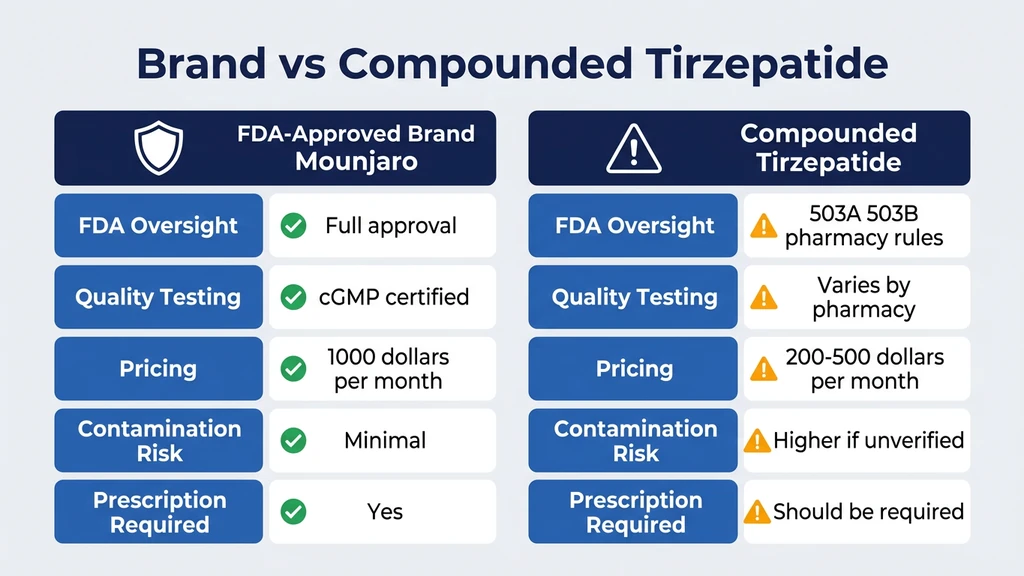
Understanding the differences between FDA-approved brand products and compounded versions helps frame the safety discussion in concrete terms.
| Factor | Mounjaro / Zepbound (Brand) | Compounded Tirzepatide (503B) | Compounded Tirzepatide (503A) |
|---|---|---|---|
| FDA approved | Yes | No | No |
| FDA inspected | Yes (manufacturer) | Yes (facility) | No (state only) |
| cGMP required | Yes | Yes | No |
| Batch testing | Every batch | Every batch | Varies |
| Sterility testing | USP <71> required | USP <71> required | Varies by state |
| Potency tolerance | 90-110% of label | Typically 90-110% | Not standardized |
| Beyond-use dating | Extensive stability data | Limited stability data | Often extrapolated |
| Delivery device | Pre-filled pen (KwikPen) | Multi-dose vial + syringe | Multi-dose vial + syringe |
| Cost (monthly) | $900-1,100 | $250-450 | $150-350 |
| Insurance coverage | Sometimes (with PA) | Rarely | Rarely |
| Adverse event reporting | Required (MedWatch) | Required (503B) | Not required |
Delivery device differences matter more than patients expect. Brand-name Mounjaro uses a single-use pre-filled autoinjector pen. The dose is pre-set, the needle is hidden, and contamination risk from repeated vial access is eliminated. Compounded tirzepatide arrives in a multi-dose vial. The patient draws each dose using a syringe, puncturing the vial stopper multiple times over weeks. Each puncture introduces potential contamination if aseptic technique is imperfect.
For patients who need to prepare injectable peptides from vials, proper technique is essential. See how to reconstitute tirzepatide, bacteriostatic water vs sterile water, and where to buy bacteriostatic water for injection. Understanding is reconstitution solution the same as bacteriostatic water is also important for safe preparation.
Efficacy should be identical if potency is accurate. Tirzepatide is tirzepatide. The SURMOUNT trials demonstrated 15-22.5% body weight loss at 72 weeks (Jastreboff et al., 2022). If a compounded product delivers the correct dose of pure, stable tirzepatide, the clinical effect should match. The question is always whether it does deliver that correct dose.
For those comparing costs, our peptide cost calculator helps estimate long-term expenses across different sources.
How to Verify a Compounding Pharmacy
If you choose compounded tirzepatide, verification is not optional. It is the difference between a safe product and a gamble. Follow this checklist before filling a prescription.
Check 503B Registration with the FDA
The FDA maintains a searchable database of registered 503B outsourcing facilities. If a pharmacy claims to be a 503B facility, verify the claim directly on the FDA website. The registration should be current, not lapsed. While 503A pharmacies can legally compound tirzepatide during a shortage, a 503B facility offers a higher baseline of quality assurance.
Also search the FDA's warning letter database. A 503B facility that received a warning letter for sterility violations, potency failures, or insanitary conditions should be avoided regardless of whether the issues have reportedly been corrected. Warning letters indicate systemic problems that take years to fully resolve.
Verify PCAB Accreditation
The Pharmacy Compounding Accreditation Board (PCAB) is an independent accreditation body that evaluates compounding pharmacies against USP standards for sterile and non-sterile compounding. PCAB accreditation is voluntary and requires on-site inspections, documentation review, and ongoing compliance monitoring.
Only about 3% of compounding pharmacies in the United States hold PCAB accreditation. It is the strongest third-party validation of quality available. A PCAB-accredited pharmacy has been independently verified to meet USP <797> (sterile compounding) and USP <795> (non-sterile compounding) standards.
Check accreditation status at the PCAB website. If a pharmacy claims accreditation, verify it directly rather than relying on their marketing.
Request Third-Party Testing Documentation
Ask the pharmacy for certificates of analysis (CoAs) for their tirzepatide product. A legitimate pharmacy should be able to provide:
- 1.Potency testing results showing the actual concentration matches the label claim within 90-110%
- 2.Sterility testing per USP <71> confirming no microbial contamination
- 3.Endotoxin testing per USP <85> below the limit for injectable products
- 4.Identity testing confirming the active ingredient is tirzepatide (not a related peptide or degradation product)
If a pharmacy cannot or will not provide these documents, that is a disqualifying red flag. Reputable pharmacies proactively share testing data because it demonstrates quality and builds trust.
Beyond-use dating (BUD) should also be supported by stability studies. Ask how long the product is stable after compounding and what data supports that dating. A pharmacy that assigns a 6-month BUD without stability data to support it is guessing.
Confirm State Licensing and Inspection History
Every compounding pharmacy must hold a valid license from the state board of pharmacy in the state where it operates. Many states also require a separate sterile compounding license or endorsement. Contact your state board to verify:
- Active license status
- Sterile compounding authorization
- Inspection history and any disciplinary actions
- Whether the pharmacy has received any citations or fines
Some states publish inspection reports online. Others require a public records request. Either way, this information is publicly available and worth the effort to obtain.
Reported Adverse Events with Compounded Tirzepatide
Distinguishing adverse events caused by tirzepatide (the molecule) from those caused by compounding quality issues is difficult but critical. The known side effect profile of tirzepatide from clinical trials includes nausea (19-33%), diarrhea (12-21%), vomiting (6-13%), constipation (6-12%), and injection site reactions (2-7%) (Frias et al., 2021). These occur with brand-name product and are expected pharmacological effects.
Adverse events that suggest a compounding quality problem rather than a drug effect include:
Injection site infections or abscesses. Brand-name Mounjaro injection site reactions are typically mild redness or itching. An infection with swelling, warmth, pus, or fever suggests bacterial contamination of the compounded product. Multiple reports to state boards have documented injection site infections from compounded GLP-1 agonists, though published data quantifying the incidence remains limited.
Inconsistent effects between vials. If one vial produces the expected appetite suppression and weight loss, but the next vial from the same pharmacy produces noticeably weaker effects, potency variability is the likely explanation. This does not happen with brand-name product because each pen contains a precisely calibrated dose.
Unexpected systemic reactions. Fever, chills, or flu-like symptoms within hours of injection are not typical tirzepatide side effects. They may indicate endotoxin contamination (pyrogens in the compounded solution) or an immune reaction to impurities in the API. These reactions warrant immediate medical evaluation and reporting to the pharmacy and state board.
Unusual injection pain. Brand-name Mounjaro injections are relatively painless due to optimized formulation pH and osmolality. Compounded solutions that burn or sting on injection may have incorrect pH, inappropriate preservatives, or excessive particulate matter. While not dangerous in isolation, injection pain signals a formulation that has not been optimized for subcutaneous delivery.
The FDA Adverse Event Reporting System (FAERS) collects reports on compounded products, but reporting is voluntary for patients and 503A pharmacies. Underreporting is a recognized problem. The true incidence of quality-related adverse events from compounded tirzepatide is almost certainly higher than what appears in federal databases.
For more on tirzepatide side effects, see does tirzepatide cause headaches and does tirzepatide make you tired.
9 Red Flags: When to Walk Away from a Compounding Pharmacy
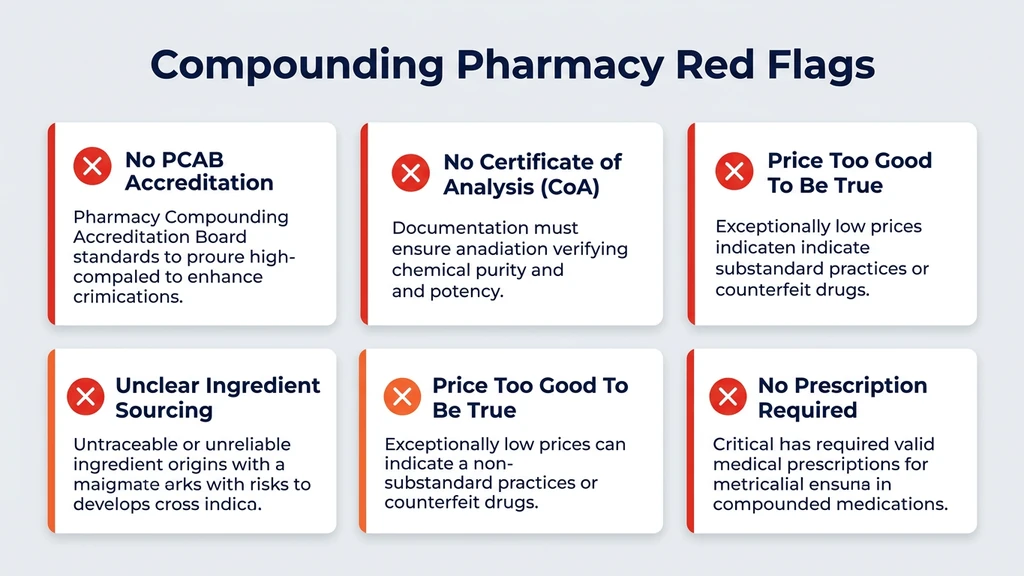
These warning signs indicate a compounding pharmacy that may not meet the quality standards needed for a safe injectable product. Any single red flag warrants serious caution. Multiple red flags mean you should find another source.
1. No prescription required. Tirzepatide is a prescription medication. Any pharmacy or website selling it without requiring a valid prescription from a licensed prescriber is operating illegally. This includes "research chemical" sellers who label products "not for human use" while clearly marketing to patients.
2. Unable to provide certificates of analysis. If you request potency, sterility, and endotoxin testing results and the pharmacy cannot produce them, their quality assurance is inadequate for injectable products. A legitimate compounding pharmacy tests every batch and can share results within 24-48 hours.
3. Prices dramatically below market. Compounded tirzepatide has a floor cost based on API acquisition, sterile compounding labor, quality testing, and facility overhead. If a pharmacy charges $50-75 per month when competitors charge $250-400, the price suggests they are cutting corners on ingredients, testing, or both.
4. No physical pharmacy address or state license visible. An online-only operation with no verifiable physical location, no displayed state pharmacy license number, and no named pharmacist-in-charge is likely operating outside regulatory frameworks. Verify the address exists and the license is active.
5. Claims of FDA approval for compounded product. No compounded medication is FDA-approved. A pharmacy claiming their compounded tirzepatide is "FDA-approved" or "equivalent to Mounjaro" is making false claims that violate federal law. Compounding is legally permitted under specific conditions, but the resulting product is never FDA-approved.
6. Ships tirzepatide without cold-chain packaging. Tirzepatide is a peptide that degrades at elevated temperatures. Compounded solutions should ship in insulated packaging with cold packs and a temperature indicator. A vial that arrives warm has likely lost potency. See does tirzepatide expire for stability information.
7. Assigns beyond-use dating longer than supported by stability data. If a pharmacy assigns a 6-month or 12-month beyond-use date to a compounded tirzepatide solution without stability studies to support it, they are guessing about product integrity. USP <797> requires that BUD be supported by stability data. Without it, the default BUD for compounded sterile preparations is much shorter.
8. Uses tirzepatide salt forms without adjusting the label. Some compounding pharmacies use tirzepatide sodium rather than the free base. If the label says "5 mg tirzepatide" but the vial contains 5 mg of tirzepatide sodium, the actual active peptide content is lower due to the sodium salt's higher molecular weight. A reputable pharmacy labels the active peptide content, not the salt weight.
9. No adverse event reporting process. Ask the pharmacy how they handle adverse event reports. A 503B facility is required to report to the FDA. A pharmacy that has no process for receiving and investigating patient complaints about product quality lacks a fundamental quality system.
When Compounded Tirzepatide Is Appropriate
Despite the risks, compounded tirzepatide serves legitimate purposes for certain patient populations. The answer to "is it safe" is not a blanket yes or no but depends entirely on the source, the context, and the alternatives available.
When brand-name product is genuinely unavailable. During active FDA-designated shortages, compounded tirzepatide from a verified 503B facility fills a real medical need. Patients who have already started treatment and cannot access their dose through commercial channels face medical risks from abrupt discontinuation, including rebound weight gain and glycemic destabilization. Compounding during verified shortages is precisely the scenario Congress intended when creating the 503B framework.
When cost is a genuine barrier to treatment. At $1,000+ per month without insurance, brand-name tirzepatide is inaccessible to many patients who would benefit from it. A compounded product from a verified, accredited pharmacy at $250-400 per month democratizes access to a medication with strong clinical evidence. The cost-quality tradeoff is real, but it is manageable when patients choose high-quality compounders.
When a specific dose or formulation is needed. Mounjaro comes in fixed dose pens (2.5, 5, 7.5, 10, 12.5, and 15 mg). Some patients benefit from intermediate doses (3.75 mg, 6.25 mg) during slow titration, or from formulations that exclude specific excipients. Compounding enables this customization. For titration planning, see our tirzepatide dosage chart and calculator to understand how dose units translate: how many units is 2.5 mg of tirzepatide and how many mg is 20 units of tirzepatide.
When compounding is NOT appropriate:
It is not appropriate when brand-name product is readily available and affordable (through insurance or manufacturer programs). Eli Lilly's savings programs and the commercial availability of Zepbound have reduced the access gap significantly. If you can get brand-name Mounjaro or Zepbound at a comparable price, the FDA-approved product is always the safer choice.
It is not appropriate from unverified sources. An online seller without pharmacy licensure, a "research chemical" vendor, or a pharmacy that cannot demonstrate quality testing is not a safe source regardless of price. The potential consequences of contaminated or sub-potent injectable medication outweigh any cost savings.
What to Monitor While Using Compounded Tirzepatide
If you proceed with compounded tirzepatide from a verified source, active monitoring helps catch quality issues before they cause harm.
Track your response consistency. Keep a log of appetite suppression, weight loss trajectory, and side effects for each vial. Significant variation between vials from the same pharmacy, such as strong appetite suppression from one vial and minimal effect from the next, suggests potency inconsistency. Report this to your prescriber and pharmacy immediately.
Inspect every vial before use. Hold the vial up to light. The solution should be clear and colorless (or slightly opalescent, depending on formulation). Visible particles, cloudiness, discoloration, or precipitates indicate degradation or contamination. Do not use a vial that looks different from previous ones. Return it to the pharmacy for investigation and replacement.
Monitor injection sites for 48-72 hours. Mild redness that resolves within a few hours is normal. Progressive swelling, warmth, hardness, or tenderness developing 24-72 hours after injection suggests a local infection. Fever accompanying injection site changes requires same-day medical evaluation.
Check expiration and storage. Verify the beyond-use date on each vial. Store compounded tirzepatide per the pharmacy's instructions, typically refrigerated at 2-8 degrees Celsius. Once a vial has been punctured, use it within the timeframe specified. See how long does tirzepatide last in the fridge and how to store peptides for detailed storage guidance.
Schedule regular lab work. Monitor HbA1c (if diabetic), fasting glucose, lipid panel, kidney and liver function, and weight at regular intervals as discussed with your prescriber. These markers confirm the medication is working as expected. Unexpected lab changes may signal potency issues or the need to adjust your dose.
For expected treatment timelines, see how long does tirzepatide take to work and tirzepatide maintenance dose after weight loss.
Switching Between Brand and Compounded Tirzepatide
Patients sometimes switch between brand and compounded tirzepatide due to supply, cost, or insurance changes. This transition requires attention to dosing accuracy.
Brand to compounded. The primary risk is potency mismatch. If you were taking 10 mg of brand-name Mounjaro and switch to a compounded vial labeled 10 mg, the actual dose may differ if the compounded product has potency outside the 90-110% range. Start by monitoring your response closely for the first 2-3 weeks on the new source. If appetite suppression feels significantly stronger or weaker than before, discuss it with your prescriber.
Compounded to brand. This transition is generally smoother because brand-name potency is tightly controlled. However, if your compounded product was sub-potent (delivering, say, 7.5 mg when labeled as 10 mg), switching to a full-potency 10 mg brand pen may feel like a dose increase. Side effects, particularly nausea and GI symptoms, may temporarily intensify.
Dose unit conversions. Compounded tirzepatide in vials is measured in milligrams drawn into a syringe, while brand-name Mounjaro is dispensed as a fixed-dose pen. Make sure you understand the concentration of your compounded product (mg/mL) and how many units to draw. See how many units is 2.5 mg of tirzepatide and how many mg is 20 units of tirzepatide for conversion references. Our tirzepatide dosage calculator handles these conversions automatically.
For patients considering a broader medication switch, see our semaglutide to tirzepatide switching guide.
Important Warnings
Compounded tirzepatide is not FDA-approved. While the active molecule is the same as Mounjaro and Zepbound, the compounded product has not undergone FDA review for safety, efficacy, or quality. Patients using compounded tirzepatide do so with the understanding that they accept additional risk compared to the brand-name product.
Never use compounded tirzepatide without a valid prescription from a licensed healthcare provider. Self-prescribing or obtaining tirzepatide from non-pharmacy sources exposes you to unquantifiable risk from unverified products.
Report any suspected adverse events to your prescriber, the compounding pharmacy, and the FDA's MedWatch program. Your report may protect other patients from a defective batch.
Pregnant or breastfeeding individuals should not use tirzepatide in any form. Animal studies have shown embryofetal toxicity, and there are no adequate human data (Eli Lilly Mounjaro Prescribing Information, 2024).
Patients with a personal or family history of medullary thyroid carcinoma or multiple endocrine neoplasia syndrome type 2 should not use tirzepatide. This contraindication applies to both brand and compounded forms.
If you experience severe injection site reactions, signs of infection, or anaphylaxis after a compounded injection, seek emergency medical care. Do not use remaining product from the same vial. Retain the vial for potential testing if requested by your healthcare provider or the pharmacy.
For comprehensive safety information, see our peptide safety guide.
Frequently Asked Questions
Is compounded tirzepatide the same as Mounjaro?
The active ingredient is the same molecule, but the products are different. Mounjaro is FDA-approved, manufactured under strict cGMP, and delivered in a pre-filled pen. Compounded tirzepatide is not FDA-approved, varies in quality by pharmacy, and comes in multi-dose vials requiring manual drawing with a syringe. Efficacy should be equivalent if potency is accurate, but quality assurance differs significantly.
How do I know if a compounding pharmacy is legitimate?
Verify four things: FDA 503B registration (searchable on the FDA website), PCAB accreditation (only about 3% of compounders hold this), active state pharmacy license with sterile compounding authorization, and willingness to provide certificates of analysis showing potency, sterility, and endotoxin testing for each batch. If any of these cannot be confirmed, find another pharmacy.
Can I still get compounded tirzepatide after the shortage ended?
The legal status is contested. The FDA resolved the tirzepatide shortage in late 2024, which normally ends the compounding exemption. However, several compounding pharmacies and industry groups obtained court orders allowing continued production. The situation remains in litigation as of early 2026. Availability depends on your state and your pharmacy's legal position.
What is the difference between a 503A and 503B compounding pharmacy?
A 503A pharmacy compounds patient-specific prescriptions under state regulation without mandatory FDA registration or cGMP compliance. A 503B outsourcing facility registers with the FDA, submits to federal inspections, follows cGMP, and must test every batch for potency and sterility. For injectable medications like tirzepatide, 503B facilities offer substantially higher quality assurance.
Is compounded tirzepatide cheaper than Mounjaro?
Yes, significantly. Brand-name Mounjaro costs $900 to $1,100 per month without insurance. Compounded tirzepatide ranges from $150 to $450 per month depending on the pharmacy, dose, and supply volume. The cost savings are real but come with trade-offs in quality assurance, device convenience, and regulatory protection that patients should weigh carefully.
What side effects are specific to compounded tirzepatide?
Standard tirzepatide side effects (nausea, diarrhea, constipation) occur regardless of source. Side effects unique to compounding quality issues include injection site infections, inconsistent efficacy between vials, unusual injection pain or burning, and systemic reactions like fever or chills from endotoxin contamination. Report any unexpected reactions to your pharmacy and prescriber immediately.
Should I switch from compounded to brand-name tirzepatide?
If brand-name Mounjaro or Zepbound becomes accessible through insurance, manufacturer savings programs, or improved availability, switching to the FDA-approved product eliminates compounding-related quality risks. Monitor for temporarily increased side effects if your compounded product was sub-potent, as the brand dose will be more precisely calibrated.
How should I store compounded tirzepatide?
Refrigerate compounded tirzepatide at 2-8 degrees Celsius (36-46 degrees Fahrenheit). Do not freeze. Protect from light. Once a vial is punctured, use it within the beyond-use period specified by the pharmacy, typically 28-30 days. Discard any vial that appears cloudy, discolored, or contains visible particles. Always verify the beyond-use date on the label before each injection.
The Bottom Line
Compounded tirzepatide occupies a complicated space between accessible medicine and unregulated risk. The molecule itself has strong clinical evidence: Phase 3 trials demonstrated 15-22.5% body weight reduction with a well-characterized side effect profile (Jastreboff et al., 2022). The safety question is not about tirzepatide but about the compounding process that produces it.
From a PCAB-accredited 503B outsourcing facility with clean FDA inspection reports and batch-level testing documentation, compounded tirzepatide can be a reasonable option when brand-name product is unavailable or unaffordable. From an unverified source without quality testing, transparent licensing, or proper storage, it is a gamble with an injectable medication that goes directly into your body.
Do the verification work before filling a prescription. Check 503B registration. Confirm PCAB accreditation. Request certificates of analysis. Inspect every vial. Track your response. Report anomalies to your prescriber and pharmacy. These steps take effort but they are the difference between safe compounding and dangerous compounding.
Use our tirzepatide dosage calculator to plan your titration and our peptide cost calculator to compare long-term costs. For dosing references, see the tirzepatide dosage chart in units.
Related articles: - How to Reconstitute Tirzepatide — step-by-step preparation for vial-based tirzepatide - FDA Peptide Crackdown 2026 — the regulatory landscape affecting compounded peptides - Peptide Safety Guide — comprehensive safety protocols for all injectable peptides - Does Tirzepatide Cause Headaches? — managing common side effects regardless of source - How Long Does Tirzepatide Take to Work? — expected timelines for weight loss and glycemic improvement - Semaglutide to Tirzepatide Switching Guide — protocols for transitioning between GLP-1 agonists
Explore all peptide profiles and tools at PeptidesExplorer.
Helpful Tools
Related Articles
Does Compounded Tirzepatide Work? Real Data
Does compounded tirzepatide work? Review SURMOUNT data, salt form differences (base, acetate, sodium), potency gaps, and FDA status in 2026.
Alcohol on Tirzepatide: Risks
Alcohol and tirzepatide: no absolute contraindication, but risks include hypoglycemia, prolonged intoxication, and stalled weight loss.
Cheapest Tirzepatide: Every Route Priced (2026)
The cheapest tirzepatide in 2026: manufacturer self-pay vials from $299/month, $25 insured copays, true cost per milligram, and why compounded copies ended.
Tirzepatide Cost With Insurance (2026)
Tirzepatide costs $550-$1,060/month at list price. With commercial insurance, copays range from $25-$150/month. Mounjaro, Zepbound, Medicare breakdown.