You are holding a vial of compounded tirzepatide in one hand and an insulin syringe in the other. Your provider said "inject 2.5 mg once a week." But the syringe does not say milligrams anywhere on it. It says *units*. And you have no idea how many units to draw.
This is the single most common question people ask when they switch from a brand-name Mounjaro or Zepbound pen to a compounded vial. The pen did the thinking for you: click, inject, done. The vial does not.
Here is your answer: at 10 mg/mL (the most common compounded concentration), 2.5 mg of tirzepatide = 25 units. That number changes completely depending on your vial concentration. Get it wrong, and you could inject double or quadruple your intended dose.
This guide walks you through the exact conversion for every concentration, shows you how to read your syringe correctly, and explains the one concept you need to never get this wrong again. If you want your answer instantly, use the Tirzepatide Dosage Calculator.
Get your custom peptide protocol:
- Tailored to your body and goals
- Precise dosing and cycle length
- Safe stacking combinations
- Backed by peer-reviewed studies
- Ready in under 2 minutes
The Quick Answer: 2.5 mg in Units for Every Concentration
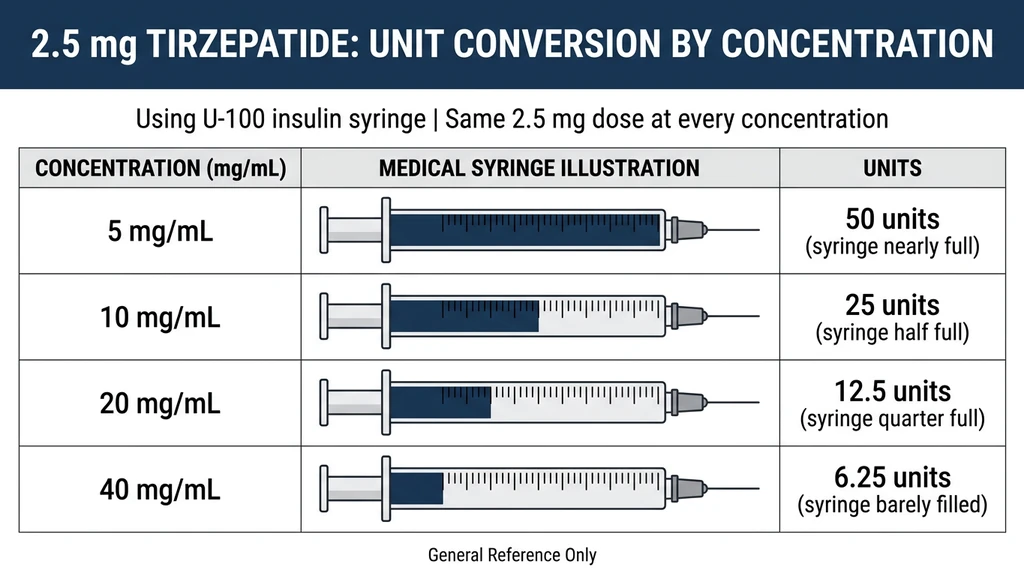
Before we explain anything, here is what you came for. Find your vial concentration in the left column, then draw to the number in the right column:
| Your Vial Says | Draw This Many Units |
|---|---|
| 5 mg/mL | 50 units |
| 10 mg/mL | 25 units |
| 20 mg/mL | 12.5 units |
| 40 mg/mL | 6.25 units |
| 60 mg/mL | 4.2 units |
If you do not know your concentration, stop here. Do not guess. Flip the vial over and read the label. It will say something like "Tirzepatide 10 mg/mL" or "10mg/ml." If the label says "100 mg / 10 mL," divide: 100 ÷ 10 = 10 mg/mL. If you still cannot tell, call your pharmacy before you inject.
Most compounding pharmacies ship tirzepatide at 10 mg/mL. If that is your concentration, draw to the 25 unit line on your syringe and you are done. But keep reading. Understanding *why* it is 25 units could save you from a serious dosing error later.
Why Concentration Changes Everything
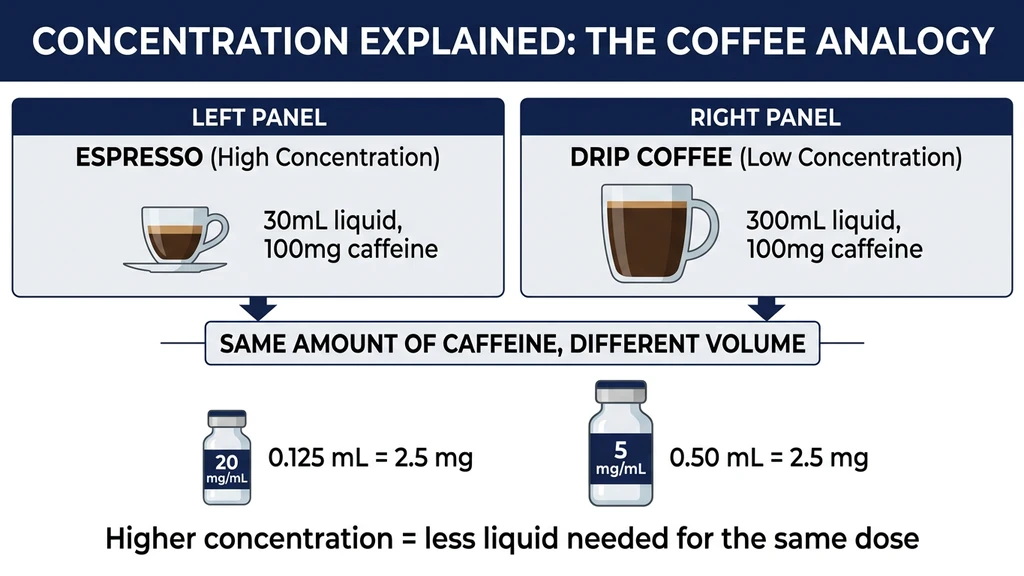
Think of it like coffee. A single shot of espresso and a large mug of drip coffee can both contain the same amount of caffeine. The espresso is just more concentrated: more caffeine packed into less liquid. If someone told you "drink 100 mg of caffeine" and handed you an espresso, you would take a small sip. If they handed you drip coffee, you would need a larger amount to reach the same 100 mg.
Tirzepatide works the same way. Your dose is always 2.5 mg of the actual drug. But depending on how concentrated the liquid in your vial is, you need more or less liquid to get those 2.5 mg out.
Here is the part that matters: the syringe does not measure milligrams. It measures volume, meaning how much liquid you pull in. An insulin syringe labels that volume in "units" (where 100 units = 1 mL of liquid). So the question "how many units is 2.5 mg?" really means "how much liquid do I need to pull into this syringe to get 2.5 mg of tirzepatide?"
The answer depends entirely on how much tirzepatide is dissolved in each drop of that liquid.
The Math (Simpler Than You Think)
You only need one formula. Once you understand it, you can calculate any dose at any concentration for the rest of your treatment:
Units = (Your dose in mg ÷ Your vial concentration in mg/mL) × 100
Walk through it with 2.5 mg at 10 mg/mL:
- 1.Divide your dose by your concentration: 2.5 mg ÷ 10 mg/mL = 0.25 mL. This tells you that 2.5 mg of tirzepatide lives inside 0.25 mL of liquid in your vial.
- 2.Multiply by 100 to convert mL to units: 0.25 mL × 100 = 25 units. Your insulin syringe splits every 1 mL into 100 units. So 0.25 mL = 25 units.
Two steps. Now the same thing at 20 mg/mL:
- 1.2.5 mg ÷ 20 mg/mL = 0.125 mL
- 2.0.125 × 100 = 12.5 units
Notice what happened: the concentration doubled (from 10 to 20), and the units got cut exactly in half (from 25 to 12.5). The liquid is twice as strong, so you need half as much. This pattern always holds. If you ever switch to a vial with double the concentration, draw half the units.
You can use this formula for every dose on your titration schedule: 5 mg, 7.5 mg, 10 mg, all the way up to 15 mg. Swap in the new dose number. For a worked example at the next common syringe marking, see how many mg is 20 units of tirzepatide.
What Happens If You Get the Concentration Wrong
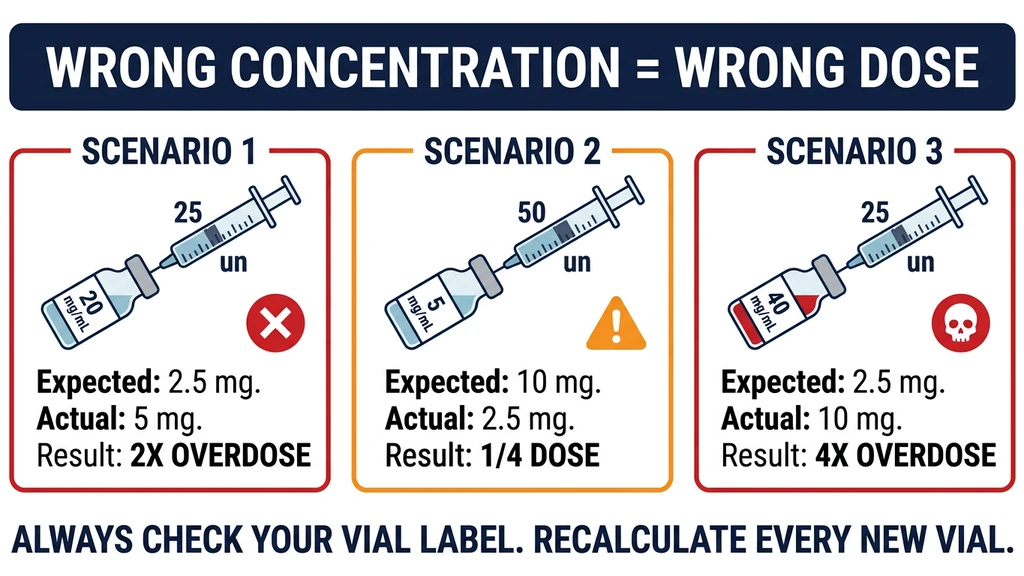
This is not hypothetical. This is the most dangerous mistake you can make with compounded tirzepatide, and it happens more often than you would think.
Scenario 1: You have been using a 10 mg/mL vial. You draw 25 units every week and everything is fine. Your pharmacy sends a new batch, but this time it is 20 mg/mL. You do not notice the label change. You draw 25 units like always. You just injected 5 mg instead of 2.5 mg, double your dose. At the starting phase of treatment, this can cause severe nausea, vomiting, and diarrhea that lasts for days.
Scenario 2: You are on a 10 mg dose, drawing from a 20 mg/mL vial (50 units). You run out and your pharmacy switches you to a 5 mg/mL vial. If you still draw 50 units, you only get 2.5 mg. That is one quarter of your intended dose. Your weight loss stalls and you have no idea why.
Scenario 3: Someone in an online forum tells you "I draw 25 units for my 2.5 mg dose." You have a 40 mg/mL vial. If you follow their advice, you inject 10 mg, four times your starting dose. This is an emergency-room level overdose that can cause dangerous hypoglycemia, especially if you are also on insulin or sulfonylureas.
The lesson: never copy someone else's units. Their number only works for their concentration. Your concentration, your calculation.
How to Read Your Vial Label
Your vial label might display the concentration in several ways. Here is how to interpret each one:
- "Tirzepatide 10 mg/mL": Straightforward. Your concentration is 10 mg/mL.
- "10mg/ml": Same thing, written without spaces.
- "100 mg / 10 mL": This is total drug ÷ total liquid. Divide: 100 ÷ 10 = 10 mg/mL.
- "50 mg / 5 mL": Same principle. 50 ÷ 5 = 10 mg/mL.
- "Tirzepatide 20mg/ml, 60mg/3ml": Both numbers say the same thing. 60 ÷ 3 = 20 mg/mL.
If you see a total amount and a total volume separated by a slash, always divide the mg number by the mL number. That gives you your concentration. Write it on the vial with a marker if it helps.
Brand-Name Pens vs. Compounded Vials
If you are reading this, you are almost certainly using a compounded tirzepatide vial. Here is why the distinction matters.
Brand-name tirzepatide (Mounjaro for type 2 diabetes, Zepbound for weight management) comes in pre-filled, single-dose pens. Each pen contains exactly one dose. You dial it, click it, and inject. The pen measures for you. There are no units to calculate, no concentrations to check, and no syringes involved.
Compounded tirzepatide comes in multi-dose vials. A compounding pharmacy creates the solution and fills a vial containing multiple doses. You draw each dose yourself with an insulin syringe. Unit conversion becomes your responsibility.
Compounded vials exist because brand-name pens can cost over $1,000/month without insurance. Compounded versions cost significantly less. The trade-off: you are now the one who has to get the math right. Compare costs with our Peptide Cost Calculator.
If you ever switch between compounded and brand-name, or between pharmacies that use different concentrations, recalculate. Do not assume your old unit number still applies. For a full dose-by-dose reference, see the tirzepatide dosage chart in units.
How to Read an Insulin Syringe (The Part Nobody Explains)
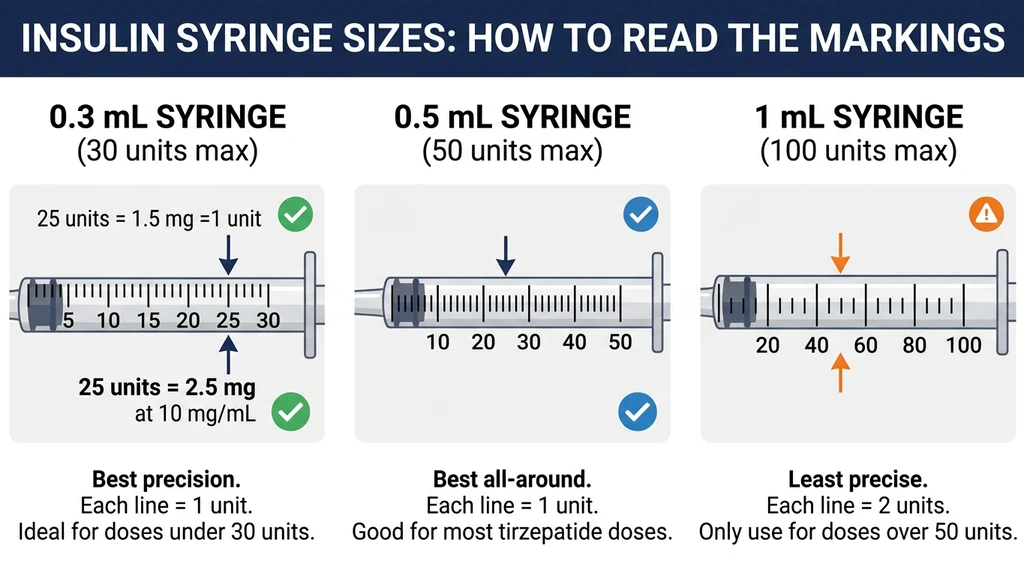
Your insulin syringe has tiny lines running up the barrel. Each line represents a specific number of units. The spacing and numbering change depending on the syringe size, and this is where most confusion happens.
0.3 mL syringe (30 units max) The lines go from 0 to 30. Each small line equals 1 unit on most brands, or 0.5 units on half-unit syringes. The numbers printed on the barrel appear every 5 units: 5, 10, 15, 20, 25, 30. For 25 units, count to the 5th numbered line (the "25" mark). For 12.5 units, go halfway between 12 and 13. This syringe gives you the most precision for small doses. Ideal for 20 mg/mL and 40 mg/mL concentrations.
0.5 mL syringe (50 units max) Lines go from 0 to 50. Each small line equals 1 unit. Numbers appear every 5 or 10 units depending on the brand. For 25 units, draw to the halfway point of the syringe. Easy to see, hard to get wrong. This is the best all-around choice for most tirzepatide users at 10 mg/mL.
1 mL syringe (100 units max) Lines go from 0 to 100. Each small line equals 2 units. This is the tricky part: there are no individual unit markings. For 25 units, count to the line halfway between 20 and 30. For 12.5 units, you are trying to hit a quarter of the way between 10 and 20. Very imprecise. Only use this syringe if your dose requires more than 50 units (for example, a 10 mg/mL vial at 7.5 mg or higher).
The rule: use the smallest syringe that fits your dose. Smaller syringe means more lines per unit, which means more accuracy. If you are drawing 25 units, a 0.5 mL syringe is perfect. If you are drawing 12.5 units, switch to a 0.3 mL syringe where you can clearly see each unit line.
Step by Step: Drawing and Injecting 2.5 mg of Tirzepatide
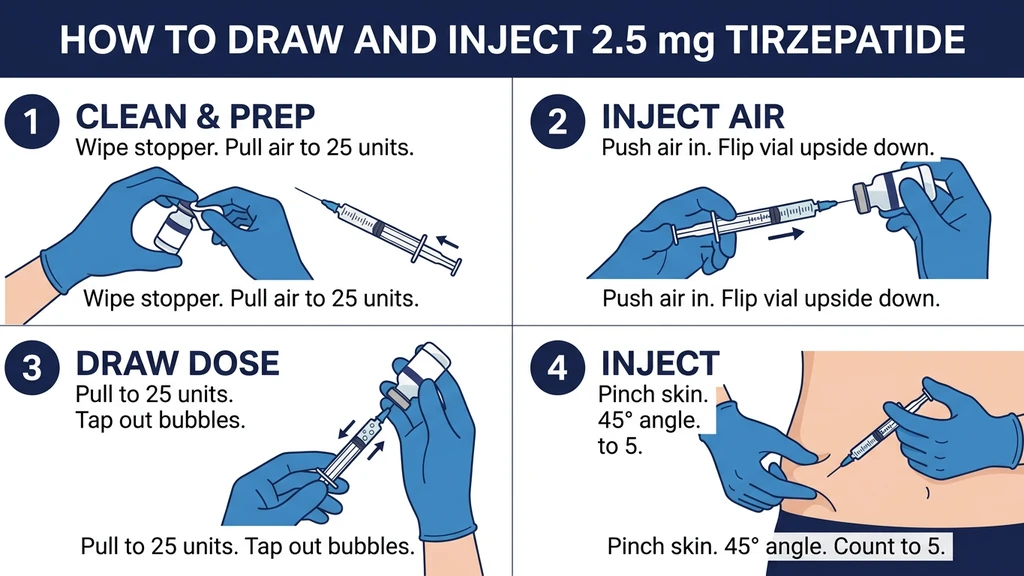
This walkthrough uses a 10 mg/mL vial and a 0.5 mL (50-unit) insulin syringe. Your target is 25 units.
1. Wash your hands. Soap and water, 20 seconds. Dry them completely.
2. Check your vial. Read the label and confirm the concentration. Look at the liquid. It should be clear and colorless. If it is cloudy, discolored, or has particles floating in it, do not use it.
3. Wipe the vial stopper. Rub the rubber stopper with an alcohol swab. Let it air dry for 10 seconds. Do not blow on it.
4. Prime the syringe with air. Pull the plunger back to the 25-unit mark. You are pulling air into the syringe on purpose. You will inject this air into the vial to equalize the pressure, which makes drawing liquid much easier.
5. Insert the needle and inject air. Push the needle straight through the center of the rubber stopper. Press the plunger all the way down to push the air into the vial.
6. Flip the vial upside down. With the needle still inside, invert the vial so it hangs above the syringe. The liquid should cover the needle tip.
7. Pull the plunger to 25 units. Slowly draw the liquid down to the 25-unit line. Pull slightly past 25, then push back up to exactly 25. This helps remove tiny air bubbles.
8. Check for bubbles. Look at the liquid in the barrel. If you see air bubbles, tap the side of the syringe with your fingernail. They will float up to the needle end. Push the plunger gently to squirt them back into the vial, then pull down to 25 units again. Repeat until the liquid is bubble-free.
9. Remove the needle from the vial. Pull straight out. You are ready to inject.
10. Choose your injection site. Abdomen (at least 2 inches from your navel), front of your thigh, or back of your upper arm. Rotate sites each week to avoid lumps under the skin.
11. Pinch and inject. Pinch a fold of skin, insert the needle at a 45- to 90-degree angle (90 degrees if you have enough subcutaneous fat), and press the plunger slowly and steadily. Count to 5 after the plunger is fully down before withdrawing the needle.
For a detailed injection tutorial, see Peptide Injections: Complete Guide. Or skip the math entirely: the Tirzepatide Dosage Calculator will calculate your exact units in seconds.
Full Conversion Table: Every Tirzepatide Dose at Every Concentration
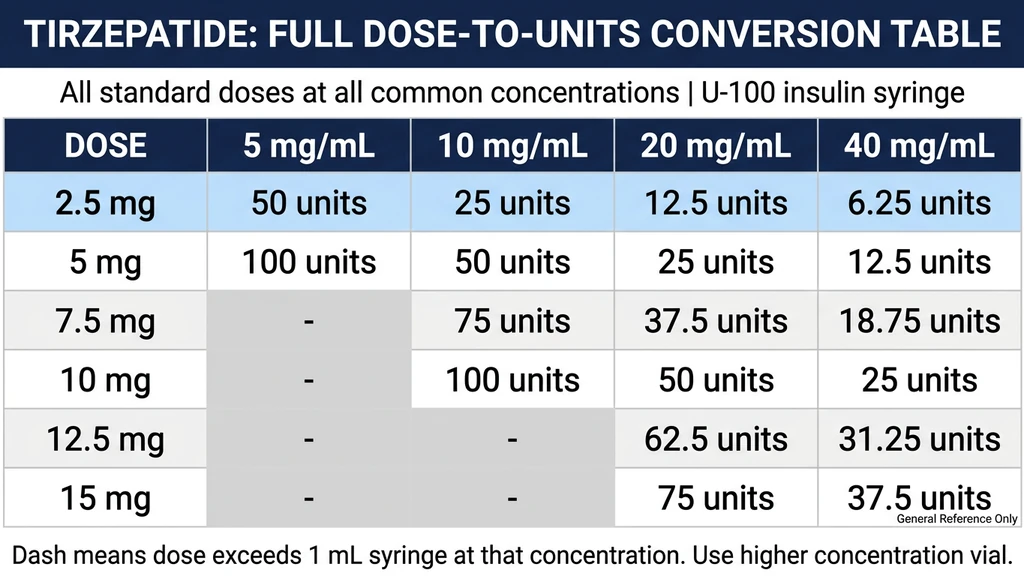
You will not stay at 2.5 mg forever. The standard tirzepatide titration goes 2.5 → 5 → 7.5 → 10 → 12.5 → 15 mg, increasing every 4 weeks. Bookmark this table. You will come back to it at every dose increase.
| Dose | 5 mg/mL | 10 mg/mL | 20 mg/mL | 40 mg/mL |
|---|---|---|---|---|
| 2.5 mg | 50 units | 25 units | 12.5 units | 6.25 units |
| 5 mg | 100 units | 50 units | 25 units | 12.5 units |
| 7.5 mg | * | 75 units | 37.5 units | 18.75 units |
| 10 mg | * | 100 units | 50 units | 25 units |
| 12.5 mg | * | * | 62.5 units | 31.25 units |
| 15 mg | * | * | 75 units | 37.5 units |
An asterisk (*) means the dose exceeds a 1 mL (100-unit) syringe at that concentration. You need a higher concentration vial.
Notice how the table works: every time the concentration doubles (moving one column to the right), the units get cut in half. The drug amount is identical. You are just getting it in a smaller volume of more concentrated liquid.
3 Mistakes That Lead to Wrong Doses (And How to Avoid Them)
Mistake #1: Copying someone else's units from the internet.
A Reddit post says "I draw 25 units for 2.5 mg." You draw 25 units. But their vial is 10 mg/mL and yours is 40 mg/mL. You just injected 10 mg. Four times your dose. Always calculate based on YOUR vial concentration. Never use someone else's number without checking it against your own label.
Mistake #2: Using a U-40 syringe instead of a U-100.
U-100 syringes have 100 units per mL. U-40 syringes (used for some veterinary insulins) have 40 units per mL. The unit markings look similar but represent completely different volumes. Drawing "25 units" on a U-40 syringe gives you 0.625 mL instead of 0.25 mL. That is 2.5 times too much liquid. At 10 mg/mL, that means 6.25 mg instead of 2.5 mg. Always confirm your syringe says "U-100" on the packaging or barrel.
Mistake #3: Not recalculating when you get a new vial.
Your pharmacy might change concentrations between batches. Your first shipment might be 10 mg/mL and your refill might be 20 mg/mL. If you draw the same number of units without checking, your dose doubles. Check the label, verify it has not expired, and confirm proper storage in the fridge. Make it a habit: every time you open a new vial, read the label and recalculate. It takes 10 seconds and prevents the most common dosing error.
Frequently Asked Questions
How many units is 2.5 mg of tirzepatide at 10 mg/mL?
25 units. The math: 2.5 ÷ 10 = 0.25 mL, and 0.25 mL × 100 = 25 units on a U-100 insulin syringe. This is the most common scenario because most compounding pharmacies use 10 mg/mL.
How many units is 2.5 mg of tirzepatide at 20 mg/mL?
12.5 units. The liquid is twice as concentrated, so you need half the volume. On your syringe, draw to the line exactly halfway between the 12 and 13 unit marks. A 0.3 mL syringe with individual unit markings makes this easiest to see.
How many units is 2.5 mg of tirzepatide at 5 mg/mL?
50 units. At 5 mg/mL the liquid is less concentrated, so you need more of it. Use a 0.5 mL (50-unit) syringe and draw to the very top, or use a 1 mL syringe and draw to the 50-unit mark.
Is 2.5 mg the right starting dose for tirzepatide?
Yes. The FDA-approved starting dose for both Mounjaro (type 2 diabetes) and Zepbound (weight management) is 2.5 mg injected once weekly for the first 4 weeks. This initiation period lets your body adjust and minimizes GI side effects like constipation and nausea. After 4 weeks, the dose typically increases to 5 mg. For a week-by-week timeline of what to expect, see how long does tirzepatide take to work.
Can I use a regular syringe instead of an insulin syringe?
You could, but you should not. A standard 3 mL syringe has wide, coarse markings. Trying to measure 0.25 mL accurately on a syringe designed for 3 mL is like measuring a teaspoon with a measuring cup. Insulin syringes are built for small volumes, with fine unit markings and thin needles made for subcutaneous injection. Use a U-100 insulin syringe.
What if my syringe does not show half-unit marks?
Most standard insulin syringes mark every 1 unit, which is enough for doses like 25 or 50 units. The one tricky dose is 12.5 units at 20 mg/mL, where you need to eyeball the midpoint between 12 and 13. If this concerns you, buy half-unit insulin syringes (sometimes labeled 'Lo-Dose'). They have markings every 0.5 units, and 12.5 is easy to hit.
How many mL is 2.5 mg of tirzepatide?
It depends on your concentration. At 10 mg/mL: 0.25 mL. At 20 mg/mL: 0.125 mL. At 5 mg/mL: 0.50 mL. Divide your dose (2.5 mg) by the concentration on your vial label to get milliliters. Then multiply by 100 to convert to syringe units.
I switched pharmacies and my new vial has a different concentration. What do I do?
Recalculate using the formula: Units = (2.5 ÷ new concentration) × 100. For example, if you moved from 10 mg/mL (25 units) to 20 mg/mL, your new draw is 12.5 units. Never assume your old unit number is correct with a new vial. Check the label, do the math, then draw.
The Bottom Line
At 10 mg/mL, 2.5 mg of tirzepatide is 25 units. At 20 mg/mL, it is 12.5 units. At 5 mg/mL, it is 50 units. The formula: (dose ÷ concentration) × 100.
Your unit number is tied to your concentration. If the concentration changes, the units change. Check every vial, every time.
Want to skip the math? The Tirzepatide Dosage Calculator does the conversion instantly for any dose and concentration. For help preparing your vials, see the Peptide Reconstitution Calculator.
Related Articles: - How to Reconstitute Tirzepatide — vial preparation before your first draw - Semaglutide to Tirzepatide Conversion — dose equivalence if switching from semaglutide - Tirzepatide Maintenance Dose After Weight Loss — what comes after the starting dose — troubleshooting at the 2.5 mg dose - How to Inject Tirzepatide — step-by-step injection guide after drawing your dose - Is Compound Tirzepatide Safe? — safety considerations for compounded tirzepatide
Related Articles
How Many Units Is 7.5 mg of Tirzepatide?
7.5 mg of tirzepatide equals 75 units (10 mg/mL), 37.5 units (20 mg/mL), or 18.75 units (40 mg/mL). Conversion table and syringe guide included.
How Many Units Is 12.5 mg of Tirzepatide?
How many units is 12.5 mg of tirzepatide? 125 units at 10 mg/mL, 62.5 at 20 mg/mL, 31.25 at 40 mg/mL. Conversion chart and syringe guide.
Tirzepatide Maintenance Dose Guide
Most patients maintain on 5-10 mg tirzepatide weekly after reaching goal weight. SURMOUNT-4 data shows stopping leads to 50-67% weight regain within 12 months.
Semaglutide to Tirzepatide Switching
Switching semaglutide to tirzepatide? Clinical dose equivalence table, step-by-step protocol, titration schedule, and common mistakes to avoid.