You just drew 20 units from your tirzepatide vial and paused. The syringe says units. Your prescription says milligrams. Those are two different measurement systems, and you need to know whether 20 units actually matches your prescribed dose before you inject.
Here is the short answer: 20 units of tirzepatide delivers a different milligram amount depending on your vial's concentration. At 5 mg/mL, 20 units = 1 mg. At 10 mg/mL, 20 units = 2 mg. At 20 mg/mL, 20 units = 4 mg. That single number on your syringe could mean any of those doses. The concentration on your vial label is the only way to know which one you are getting.
Use the Tirzepatide Dosage Calculator for instant results, or keep reading to understand the math, read your syringe correctly, and avoid the dosing errors that send people to urgent care.
Get your custom peptide protocol:
- Tailored to your body and goals
- Precise dosing and cycle length
- Safe stacking combinations
- Backed by peer-reviewed studies
- Ready in under 2 minutes
20 Units in Milligrams: Quick-Reference Conversion Table
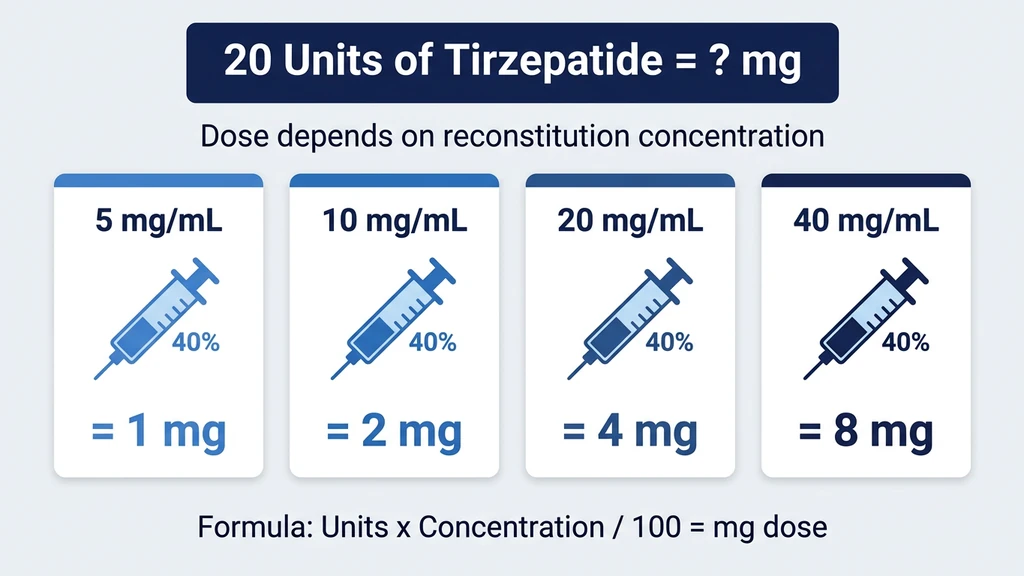
Find your vial concentration in the left column. The right column tells you how many milligrams 20 units delivers:
| Your Vial Concentration | 20 Units = This Many mg |
|---|---|
| 5 mg/mL | 1 mg |
| 10 mg/mL | 2 mg |
| 20 mg/mL | 4 mg |
| 40 mg/mL | 8 mg |
| 60 mg/mL | 12 mg |
Those five numbers represent five completely different doses. At 5 mg/mL, 20 units is a sub-therapeutic amount, below the 2.5 mg starting dose recommended in clinical trials (Jastreboff et al., *N Engl J Med*, 2022). At 60 mg/mL, the same 20 units delivers 12 mg, a dose reserved for patients who have titrated up over months.
If you do not know your concentration, do not inject. Flip the vial over. The label will read something like "Tirzepatide 10 mg/mL" or "10mg/ml." If it says "100 mg / 10 mL," divide: 100 ÷ 10 = 10 mg/mL. Still unsure? Call your compounding pharmacy. For a deeper look at reading tirzepatide vial labels and concentrations, see the tirzepatide dosage chart in units.
Why the Same 20 Units Can Mean 1 mg or 12 mg
Think of it like liquid cold medicine. A children's formula contains 5 mg of active ingredient per teaspoon. An adult extra-strength formula contains 15 mg per teaspoon. Same spoon, same volume of liquid. Completely different drug amounts. If you gave a child the adult formula "because it's the same teaspoon," you would deliver three times the intended dose.
Tirzepatide works the same way. The "teaspoon" is your insulin syringe. The "formula strength" is the concentration printed on your vial. Twenty units always means the same volume of liquid: 0.20 mL. But a 5 mg/mL vial puts 1 mg of tirzepatide into that 0.20 mL, while a 20 mg/mL vial packs 4 mg into the same 0.20 mL. Four times the drug, identical appearance in the syringe.
Here is the literal fact: an insulin syringe measures volume, not drug quantity. One hundred units equals 1 mL of liquid. Twenty units equals 0.20 mL. The concentration on your vial determines how many milligrams of tirzepatide are dissolved in each milliliter of liquid. Change the concentration, and 20 units becomes a different dose.
Understanding this concept prevents every dosing error covered in this article. For a worked example going the other direction, from milligrams to units, see how many units is 2.5 mg of tirzepatide.
The Conversion Formula: Units to Milligrams
You need one formula. It works for any number of units at any concentration:
mg = (Units ÷ 100) × Concentration in mg/mL
Walk through 20 units at 10 mg/mL:
- 1.Divide units by 100 to get milliliters: 20 ÷ 100 = 0.20 mL. This tells you that 20 units is 0.20 mL of liquid.
- 2.Multiply by your concentration: 0.20 mL × 10 mg/mL = 2 mg. This tells you that 0.20 mL of a 10 mg/mL solution contains 2 mg of tirzepatide.
Now the same formula at 5 mg/mL:
- 1.20 ÷ 100 = 0.20 mL
- 2.0.20 mL × 5 mg/mL = 1 mg
And at 20 mg/mL:
- 1.20 ÷ 100 = 0.20 mL
- 2.0.20 mL × 20 mg/mL = 4 mg
The volume never changes. Twenty units is always 0.20 mL. Only the milligrams change because the concentration changes. This is the same formula used in the Tirzepatide Dosage Calculator, just reversed.
If you want to go the other direction, from a prescribed mg dose to units, the companion formula is: Units = (Dose in mg ÷ Concentration) × 100. Both formulas are two steps of arithmetic.
How Reconstitution Volume Determines Your Concentration
If you are reconstituting lyophilized (freeze-dried) tirzepatide yourself, the amount of bacteriostatic water you add directly sets the concentration. This is where most home-preparation errors begin.
A common compounded vial contains 10 mg of tirzepatide powder. Here is what happens with different water volumes:
| Water Added | Resulting Concentration | 20 Units Delivers |
|---|---|---|
| 1 mL | 10 mg/mL | 2 mg |
| 2 mL | 5 mg/mL | 1 mg |
| 0.5 mL | 20 mg/mL | 4 mg |
Adding more water dilutes the solution. Adding less water concentrates it. The total drug in the vial stays the same. Only the concentration per milliliter changes.
For a 30 mg vial, common in multi-dose prescriptions, the same principle applies:
| Water Added | Resulting Concentration | 20 Units Delivers |
|---|---|---|
| 3 mL | 10 mg/mL | 2 mg |
| 1.5 mL | 20 mg/mL | 4 mg |
| 6 mL | 5 mg/mL | 1 mg |
If you reconstitute a 30 mg vial with 3 mL of water, you get 10 mg/mL. Twenty units from that vial is 2 mg. But if you accidentally add only 1.5 mL, the concentration jumps to 20 mg/mL. Now 20 units delivers 4 mg. Same vial, same syringe draw, double the dose. Proper reconstitution also depends on using quality solvent; see how much bacteriostatic water for semaglutide for solvent principles that apply to all GLP-1 peptides.
For step-by-step reconstitution instructions specific to tirzepatide, see how to reconstitute tirzepatide. The Peptide Reconstitution Calculator will compute exact volumes for any vial size.
What Happens When You Get It Wrong: Danger Scenarios
These scenarios are based on real confusion patterns reported in online patient communities. Each one involves someone drawing 20 units from the wrong concentration.
Scenario 1: Accidental double dose from a pharmacy switch.
You have been drawing 20 units from a 5 mg/mL vial to get your 1 mg dose (a sub-2.5 mg starting dose some providers use for sensitive patients). Your pharmacy sends a refill at 10 mg/mL. You draw 20 units without reading the new label. You just injected 2 mg instead of 1 mg. That is double your prescribed dose. For someone who was started on a low dose because of GI sensitivity, this can trigger severe nausea and vomiting lasting 48 to 72 hours. Tirzepatide activates GIP and GLP-1 receptors simultaneously, slowing gastric emptying in a dose-dependent manner (Willard et al., *Diabetes Care*, 2020). Double the dose means significantly stronger gastric slowing.
Scenario 2: Quadruple overdose from copying online advice.
Someone on a forum says "I draw 20 units for my 2 mg dose." They have a 10 mg/mL vial. You have a 40 mg/mL vial. You draw 20 units. You just injected 8 mg, not 2 mg. That is four times the intended dose, equivalent to skipping months of titration. The SURMOUNT-1 trial titrated patients gradually for a reason: jumping to higher doses without adaptation increases the risk of severe gastrointestinal adverse events, including nausea (affecting up to 33% of participants at higher doses), diarrhea, and vomiting (Jastreboff et al., *N Engl J Med*, 2022).
Scenario 3: Under-dosing from wrong reconstitution.
You reconstitute a 10 mg vial with 4 mL of bacteriostatic water instead of 2 mL. Your intended concentration was 5 mg/mL, but you actually created 2.5 mg/mL. You draw 20 units expecting 1 mg. You actually get 0.5 mg. That is half your prescribed dose. At that level, therapeutic effects are negligible. Your weight loss stalls, and you cannot figure out why. The fix: always measure reconstitution water with a clean syringe, not by eyeballing the vial.
The pattern across all three scenarios: the syringe reading looked correct. The error was invisible. The only safeguard is confirming your concentration before every draw.
How to Verify Your Concentration Before Every Injection
Build this into a 15-second pre-injection habit:
- 1.Pick up the vial. Read the concentration printed on the label. Say the number out loud. "Ten milligrams per mL."
- 2.Match it to your calculation. If your target dose is 2.5 mg at 10 mg/mL, you should draw 25 units. If your target is 2 mg at 10 mg/mL, you should draw 20 units.
- 3.Check the vial against your last vial. If you just opened a new vial, compare the label to the old one. If the concentration changed, recalculate before you draw.
This takes less time than washing your hands. It eliminates the most common source of dosing error with compounded tirzepatide.
How to Read 20 Units on Your Insulin Syringe
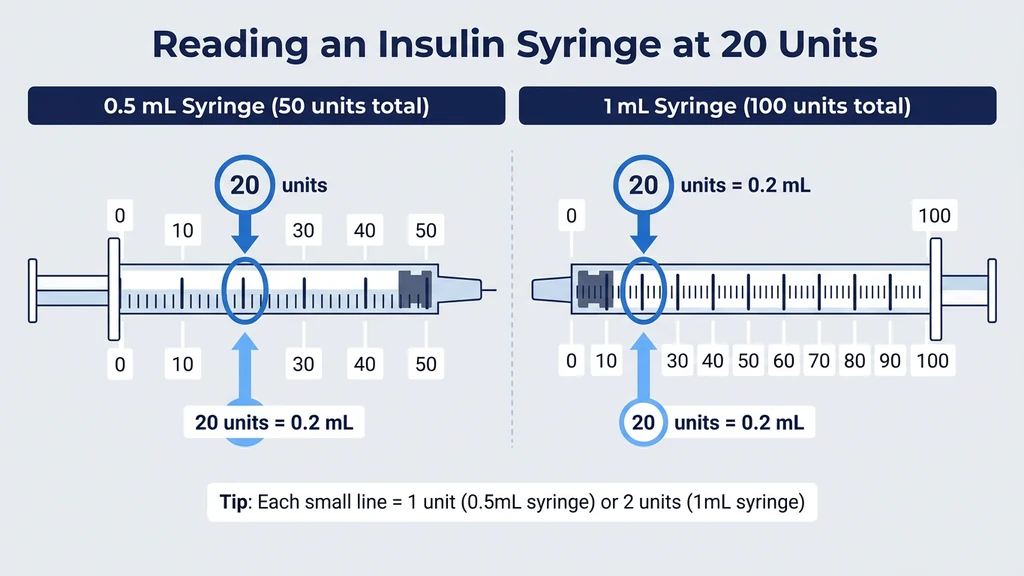
The number 20 is straightforward to find on every standard insulin syringe size. Here is how it looks on each one.
0.3 mL syringe (30 units max)
This syringe has numbered markings at 5, 10, 15, 20, 25, and 30. Each small line between numbers equals 1 unit (or 0.5 units on half-unit syringes). Draw to the printed "20" mark. No guesswork. This syringe works well for 20 units because the markings are spaced widely enough to read clearly.
0.5 mL syringe (50 units max)
Numbered at every 5 or 10 units, depending on the brand. The "20" mark sits at 40% of the barrel length. Each small line equals 1 unit. Pull the plunger until the top of the rubber stopper aligns with the 20-unit line. Confirm by holding the syringe at eye level with the numbers facing you.
1 mL syringe (100 units max)
Each small line equals 2 units. The "20" mark is printed on the barrel. Draw to it directly. This syringe is less precise for odd numbers (like 15 or 25), but 20 is a printed number, so accuracy is not an issue here. Still, if your dose is consistently 20 units or less, a 0.3 mL or 0.5 mL syringe gives you finer markings and a better view.
The rule: always use the smallest syringe that holds your dose. Smaller syringes have more graduation lines per unit, which means better precision. For 20 units, a 0.3 mL syringe is ideal. A 0.5 mL syringe is also excellent. A 1 mL syringe works but offers less visual resolution.
For a full syringe-reading walkthrough covering all sizes, see the tirzepatide dosage chart in units.
Full Conversion Table: Common Unit Draws at Every Concentration
This table covers the most common unit amounts drawn from compounded tirzepatide vials. Find your unit draw in the left column and your concentration across the top. The cell gives you the milligram dose.
| Units Drawn | 5 mg/mL | 10 mg/mL | 20 mg/mL | 40 mg/mL |
|---|---|---|---|---|
| 5 units | 0.25 mg | 0.5 mg | 1 mg | 2 mg |
| 10 units | 0.5 mg | 1 mg | 2 mg | 4 mg |
| 12.5 units | 0.625 mg | 1.25 mg | 2.5 mg | 5 mg |
| 15 units | 0.75 mg | 1.5 mg | 3 mg | 6 mg |
| 20 units | 1 mg | 2 mg | 4 mg | 8 mg |
| 25 units | 1.25 mg | 2.5 mg | 5 mg | 10 mg |
| 30 units | 1.5 mg | 3 mg | 6 mg | 12 mg |
| 40 units | 2 mg | 4 mg | 8 mg | 16 mg* |
| 50 units | 2.5 mg | 5 mg | 10 mg | 20 mg* |
| 75 units | 3.75 mg | 7.5 mg | 15 mg | 30 mg* |
| 100 units | 5 mg | 10 mg | 20 mg* | 40 mg* |
An asterisk (*) marks doses that exceed the FDA-approved maximum of 15 mg weekly. Doses above 15 mg are not part of standard clinical protocols.
Notice the pattern: moving one column to the right (doubling the concentration) doubles the milligrams for the same unit draw. This is the same relationship, just viewed from the units side instead of the milligrams side. The companion article on how many units is 2.5 mg of tirzepatide shows the same table organized by target dose.
Common Compounded Tirzepatide Concentrations and What 20 Units Means
Compounding pharmacies do not all use the same concentration. Some ship ready-to-inject liquid. Others ship lyophilized powder that you reconstitute yourself. Here is what you are likely to encounter.
5 mg/mL (common for low-dose protocols)
This is a dilute concentration often used for patients starting at 2.5 mg. Twenty units from a 5 mg/mL vial delivers 1 mg. That is below the standard 2.5 mg starting dose. If your provider prescribed 2.5 mg and your vial is 5 mg/mL, you need 50 units, not 20.
10 mg/mL (the most common concentration)
Most compounding pharmacies ship tirzepatide at this concentration. Twenty units delivers 2 mg. This is slightly below the 2.5 mg starting dose. Some providers prescribe 2 mg for an even gentler start, particularly for patients prone to GI side effects. If your prescription says 2.5 mg, draw 25 units from a 10 mg/mL vial, not 20.
20 mg/mL (common for higher doses)
Twenty units from a 20 mg/mL vial delivers 4 mg. This is between the first and second titration steps. Some providers use 20 mg/mL so that higher doses (10 mg, 12.5 mg, 15 mg) fit within a single syringe draw. At this concentration, even small drawing errors have outsized consequences. A 5-unit error means a 1 mg dose discrepancy.
40 mg/mL (high concentration, less common)
Twenty units delivers 8 mg. This concentration is typically reserved for patients on 10 mg or 15 mg weekly who want smaller injection volumes. The margin for error is extremely thin. A 2.5-unit drawing error equals a 1 mg dose difference. Use a 0.3 mL syringe for maximum precision.
For a comparison of all tirzepatide doses and concentrations, see the tirzepatide dosage chart in units. To understand how tirzepatide compares to semaglutide in dosing structure, see the semaglutide-to-tirzepatide conversion guide.
Step-by-Step: Calculating and Drawing Your Exact Dose
This walkthrough uses a 10 mg/mL vial, a 0.5 mL (50-unit) insulin syringe, and a target dose of 2 mg (which is 20 units at this concentration). Adjust the numbers for your own prescription.
1. Confirm your prescribed dose. Check your prescription or provider instructions. It will say a number in milligrams. For this example: 2 mg.
2. Read your vial concentration. Flip the vial. It says 10 mg/mL. Write this on a sticky note if it helps you remember.
3. Calculate units. Use the formula: Units = (Dose ÷ Concentration) × 100. So: (2 ÷ 10) × 100 = 20 units. Or use the Tirzepatide Dosage Calculator to skip the math.
4. Wash your hands. Soap and water, 20 seconds. Dry completely.
5. Wipe the vial stopper. Swab the rubber stopper with an alcohol pad. Let it air dry for 10 seconds. Do not blow on it.
6. Prime the syringe with air. Pull the plunger back to 20 units. This loads air into the barrel.
7. Inject air into the vial. Push the needle through the stopper. Press the plunger down to push air in. This equalizes pressure and makes drawing easier.
8. Flip the vial and draw. Invert the vial. Pull the plunger slowly past 20 units, then push back up to exactly 20. The top edge of the rubber stopper should align with the 20-unit line.
9. Remove bubbles. If you see air in the barrel, tap the syringe with your fingernail. Bubbles rise to the needle end. Push them back into the vial, then redraw to 20 units.
10. Inject subcutaneously. Choose your site: abdomen (2+ inches from the navel), front of thigh, or back of upper arm. Pinch a fold of skin, insert the needle at 45 to 90 degrees, and press the plunger steadily. Count to 5 before withdrawing. Rotate sites weekly to prevent lipodystrophy.
For a complete guide on tirzepatide reconstitution and injection, see how to reconstitute tirzepatide. The reconstitution calculator helps you measure the exact bacteriostatic water volume.
4 Mistakes That Lead to Wrong Tirzepatide Doses
Mistake #1: Assuming 20 units is always the same dose.
It is not. Twenty units at 5 mg/mL = 1 mg. Twenty units at 20 mg/mL = 4 mg. That is a 4x difference. Every unit count is meaningless without the concentration. When someone online says "I draw 20 units," their number only applies to their specific vial. Your vial may be completely different.
Mistake #2: Not recalculating after switching pharmacies or vial batches.
Your first shipment arrives at 10 mg/mL. You draw 20 units for 2 mg. Three months later, your pharmacy switches to 20 mg/mL without prominently announcing the change. You draw 20 units out of habit. You just doubled your dose to 4 mg. This is the most frequently reported source of unexpected tirzepatide side effects in patient forums. Check the label on every new vial. A vial of tirzepatide that has expired or changed concentration looks identical to a fresh one.
Mistake #3: Using a U-40 syringe instead of U-100.
U-100 insulin syringes measure 100 units per mL. U-40 syringes (used for some pet insulins) measure 40 units per mL. Drawing "20 units" on a U-40 syringe gives you 0.50 mL instead of 0.20 mL. At 10 mg/mL, that is 5 mg instead of 2 mg, a 2.5x overdose. Always confirm your syringe packaging says "U-100."
Mistake #4: Eyeballing reconstitution water volume.
If you reconstitute your own vials, adding slightly more or less water changes the concentration. A 10 mg vial with 1 mL of water is 10 mg/mL. With 1.5 mL (because you did not measure carefully), it becomes 6.67 mg/mL. Now 20 units delivers 1.33 mg instead of 2 mg. Use a clean syringe to measure bacteriostatic water. Never pour from the water bottle directly.
Cross-Reference: How 20 Units Fits into the Tirzepatide Titration Schedule
The FDA-approved tirzepatide titration for both Mounjaro (type 2 diabetes) and Zepbound (weight management) follows this schedule:
| Week | Prescribed Dose | Units at 10 mg/mL | Units at 20 mg/mL |
|---|---|---|---|
| 1-4 | 2.5 mg | 25 units | 12.5 units |
| 5-8 | 5 mg | 50 units | 25 units |
| 9-12 | 7.5 mg | 75 units | 37.5 units |
| 13-16 | 10 mg | 100 units | 50 units |
| 17-20 | 12.5 mg | * | 62.5 units |
| 21+ | 15 mg | * | 75 units |
An asterisk (*) means the dose exceeds a 1 mL syringe at that concentration.
Twenty units at 10 mg/mL (2 mg) falls slightly below the 2.5 mg starting dose. Some clinicians use this as a "pre-titration" step for patients with a history of severe GI reactions. Twenty units at 20 mg/mL (4 mg) falls between the first and second titration steps, which is not a standard prescribed dose.
If your provider told you to draw 20 units and your vial is 10 mg/mL, your dose is 2 mg. Confirm this matches your prescription. If your prescription says 2.5 mg and your vial is 10 mg/mL, you need 25 units, not 20.
Tirzepatide's dual GIP/GLP-1 agonism produces dose-dependent effects on appetite, gastric emptying, and insulin secretion (Frías et al., *N Engl J Med*, 2021). Proper titration reduces the incidence of nausea, headaches, and constipation. Does tirzepatide burn fat independently? Clinical evidence suggests it promotes fat oxidation beyond appetite suppression alone, but these effects scale with dose.
Frequently Asked Questions
How many mg is 20 units of tirzepatide at 10 mg/mL?
2 mg. The math: 20 units = 0.20 mL. At 10 mg/mL, 0.20 mL contains 2 mg of tirzepatide. This is slightly below the standard 2.5 mg starting dose. If your provider prescribed 2.5 mg at 10 mg/mL, you need 25 units, not 20.
How many mg is 20 units of tirzepatide at 5 mg/mL?
1 mg. At 5 mg/mL, each unit of liquid contains less dissolved tirzepatide, so 20 units (0.20 mL) delivers only 1 mg. This is below the minimum recommended starting dose of 2.5 mg per the SURMOUNT-1 trial protocol.
How many mg is 20 units of tirzepatide at 20 mg/mL?
4 mg. At 20 mg/mL, the solution is twice as concentrated as 10 mg/mL. Twenty units delivers 4 mg, which falls between the 2.5 mg and 5 mg titration steps. Confirm with your prescriber that 4 mg is your intended dose before injecting.
Is 20 units the same as 2 mg of tirzepatide?
Only at 10 mg/mL. At 5 mg/mL, 20 units is 1 mg. At 20 mg/mL, 20 units is 4 mg. The unit-to-mg conversion always depends on concentration. Never assume 20 units equals a specific milligram amount without checking your vial label.
How do I convert tirzepatide units to mg?
Use this formula: mg = (Units ÷ 100) × Concentration. For 20 units at 10 mg/mL: (20 ÷ 100) × 10 = 2 mg. For 20 units at 20 mg/mL: (20 ÷ 100) × 20 = 4 mg. The Tirzepatide Dosage Calculator at peptidesexplorer.com does this instantly.
What size syringe should I use to draw 20 units of tirzepatide?
A 0.3 mL (30-unit) insulin syringe is ideal for 20 units. The "20" is a printed number on this syringe, so alignment is precise. A 0.5 mL syringe also works well. Avoid a 1 mL syringe if possible because its wider barrel makes small volumes harder to read accurately.
Can I drink alcohol while taking tirzepatide?
Alcohol is not strictly contraindicated, but it increases the risk of nausea and hypoglycemia. Tirzepatide slows gastric emptying, which means alcohol stays in the stomach longer and may intensify its effects. Most providers recommend limiting intake. See the full guide on whether you can drink on tirzepatide for details.
How do I know if my compounded tirzepatide concentration changed?
Read the vial label before every injection. Compounding pharmacies can change concentration between refills without prominent warning. Compare your new vial's label to the previous one. If the mg/mL number changed, recalculate your units using the formula: Units = (Dose in mg ÷ Concentration) × 100.
The Bottom Line
Twenty units of tirzepatide is 1 mg at 5 mg/mL, 2 mg at 10 mg/mL, or 4 mg at 20 mg/mL. The concentration on your vial label determines the answer. No concentration, no answer.
The formula takes 10 seconds: mg = (Units ÷ 100) × Concentration. Learn it once and you can verify every dose for the rest of your treatment.
Skip the math entirely with the Tirzepatide Dosage Calculator. For help preparing your vials, use the Peptide Reconstitution Calculator. And if you are converting from semaglutide to tirzepatide, the switching guide covers equivalent dosing.
Related articles: - How Many mg Is 40 Units of Semaglutide? — the same unit-to-mg conversion guide for compounded semaglutide - Does Tirzepatide Make You Tired? — fatigue data, causes, and 8 fixes for tirzepatide users - How Long Does Tirzepatide Stay in Your System? — half-life and clearance timeline - How Long Does Tirzepatide Last in the Fridge? — storage timelines for reconstituted and lyophilized forms - How to Reconstitute Retatrutide — step-by-step mixing guide for the triple agonist - Where to Buy Bacteriostatic Water for Injection — sourcing guide for reconstitution supplies - How to Inject Tirzepatide — injection guide after calculating your dose - Tirzepatide Cost With Insurance — 2026 pricing and insurance coverage
Related Articles
How Many Units Is 7.5 mg of Tirzepatide?
7.5 mg of tirzepatide equals 75 units (10 mg/mL), 37.5 units (20 mg/mL), or 18.75 units (40 mg/mL). Conversion table and syringe guide included.
How Many Units Is 2.5 mg Tirzepatide?
2.5 mg of tirzepatide is 25 units at 10 mg/mL, 12.5 units at 20 mg/mL, or 50 units at 5 mg/mL. Conversion table with syringe instructions.
How Many Units Is 12.5 mg of Tirzepatide?
How many units is 12.5 mg of tirzepatide? 125 units at 10 mg/mL, 62.5 at 20 mg/mL, 31.25 at 40 mg/mL. Conversion chart and syringe guide.
Tirzepatide Maintenance Dose Guide
Most patients maintain on 5-10 mg tirzepatide weekly after reaching goal weight. SURMOUNT-4 data shows stopping leads to 50-67% weight regain within 12 months.