You have a lyophilized semaglutide vial, a bottle of bacteriostatic water, and zero instructions. The vial says 5mg. The water says 30mL. How much do you add?
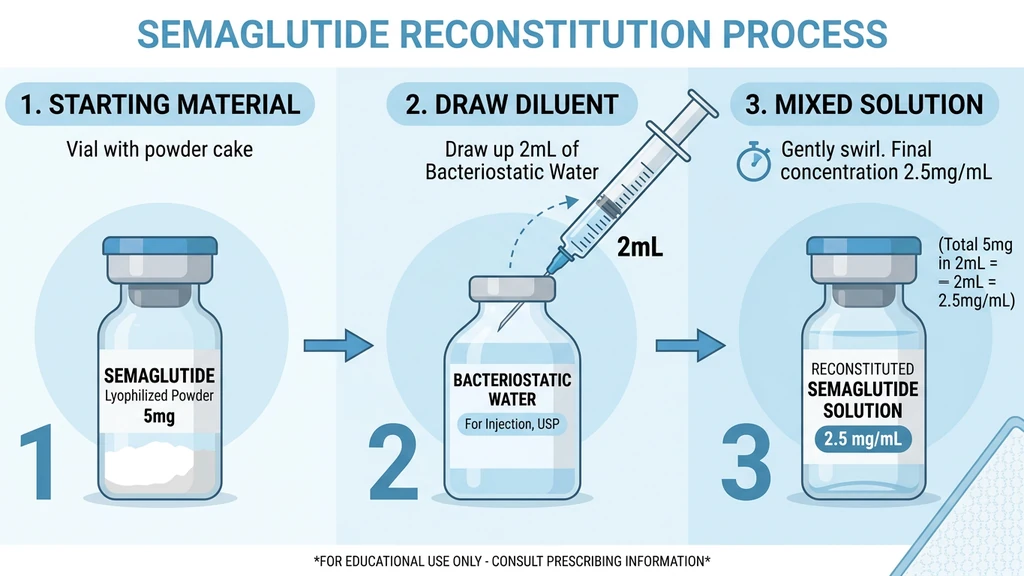
For a 5mg vial, add 2mL of bacteriostatic water. This gives you a concentration of 2.5 mg/mL, the easiest to dose with a standard insulin syringe. At this concentration, each 10 units on your syringe equals 0.25 mg of semaglutide. Clean numbers. No guesswork.
Use our Peptide Reconstitution Calculator to verify your math for any vial size and water volume combination.
Get your custom peptide protocol:
- Tailored to your body and goals
- Precise dosing and cycle length
- Safe stacking combinations
- Backed by peer-reviewed studies
- Ready in under 2 minutes
Quick Reference: Semaglutide Mixing Chart
This table covers the two most common vial sizes and the two most practical water volumes for each.
| Vial Size | Water to Add | Concentration | Volume per 0.25 mg | Volume per 0.5 mg |
|---|---|---|---|---|
| 5 mg | 2 mL | 2.5 mg/mL | 0.10 mL (10 units) | 0.20 mL (20 units) |
| 5 mg | 1 mL | 5 mg/mL | 0.05 mL (5 units) | 0.10 mL (10 units) |
| 10 mg | 2 mL | 5 mg/mL | 0.05 mL (5 units) | 0.10 mL (10 units) |
| 10 mg | 1 mL | 10 mg/mL | 0.025 mL (2.5 units) | 0.05 mL (5 units) |
The 2 mL water option produces the most forgiving concentration for both vial sizes. Larger draw volumes mean a small error on the syringe translates to a smaller dosing error. If you are new to compounded semaglutide, use 2 mL.
For a complete weekly dosing schedule with titration steps, see our semaglutide dosage chart. For a detailed breakdown of what different unit markings mean, see how many mg is 40 units of semaglutide.
Why Water Volume Matters
Imagine you are making lemonade from a packet. One packet in a small glass gives you intense, concentrated lemonade. The same packet in a pitcher gives you mild, diluted lemonade. The amount of lemon flavor is identical. The concentration is different.
The same principle applies to reconstitution. The formula is simple: Concentration = Vial mg / Water mL. A 5 mg vial with 1 mL of water gives you 5 mg/mL. The same 5 mg vial with 2 mL of water gives you 2.5 mg/mL. The total semaglutide in the vial has not changed. The amount you need to draw per dose has.
More water means a lower concentration, which means a larger draw volume per dose. Larger draw volumes are easier to measure accurately on an insulin syringe. This is why 2 mL is the recommended starting point for most people.
Step-by-Step Mixing for a 5 mg Vial
Gather your supplies before starting: one 5 mg semaglutide vial, bacteriostatic water (see our guide on where to buy bacteriostatic water if you need a source), one 3 mL mixing syringe with an 18-gauge needle, alcohol swabs, and a marker for labeling. The entire process takes about two minutes.
- 1.Clean the vial stopper with an alcohol swab. Let it dry 10 seconds. Clean the bacteriostatic water stopper the same way.
- 1.Draw 2 mL of bacteriostatic water into a clean syringe. Pull the plunger to the 2 mL mark. Tap out any large air bubbles.
- 1.Insert the needle through the stopper at a 45-degree angle. Angle matters. A straight-down puncture can core the rubber and drop fragments into the vial.
- 1.Push the plunger slowly. Aim the stream at the glass wall, not directly onto the powder cake. Direct impact can denature the peptide. Let the water trickle down the glass and pool at the bottom.
- 1.Remove the syringe. Do not shake the vial. Shaking creates foam and can damage the peptide through agitation. Gently swirl the vial between your thumb and forefinger for 30 to 60 seconds.
- 1.If powder remains, set the vial upright in the refrigerator. Most lyophilized semaglutide dissolves fully within 5 to 10 minutes of cold rest. Do not use heat.
- 1.Label the vial with a marker: "Semaglutide 2.5 mg/mL" and today's date. Reconstituted semaglutide remains stable for 28 days refrigerated at 2-8°C. For detailed storage guidelines, see our peptide storage guide. For specifics on semaglutide refrigeration requirements, see does semaglutide need to be refrigerated.
Your vial now contains 2 mL of semaglutide at 2.5 mg/mL. Every 10 units on a U-100 insulin syringe equals 0.25 mg.
Step-by-Step Mixing for a 10 mg Vial
The process is identical to the 5 mg vial. The only difference is the resulting concentration.
With 2 mL of bacteriostatic water: You get 5 mg/mL. This is a practical concentration. A 0.5 mg dose requires 10 units on your syringe.
With 1 mL of bacteriostatic water: You get 10 mg/mL. This is very concentrated. A 0.5 mg dose requires only 5 units. Small volumes are harder to measure precisely, so this option is best for experienced users with high-quality 0.3 mL insulin syringes.
Follow the same seven steps from the 5 mg section above. The only change is your label. Write "Semaglutide 5 mg/mL" or "Semaglutide 10 mg/mL" depending on the water volume you chose.
The 2 mL option is recommended for 10 mg vials as well. You will use the vial faster at higher doses, so the larger volume does not create a storage problem. For reconstitution math on any vial size, use the Peptide Reconstitution Calculator.
Concentration Table: Water Added vs. Resulting Strength
This expanded table covers every practical water volume and shows the exact draw volume for each dose in the standard titration schedule. All volumes assume a U-100 insulin syringe where 1 mL = 100 units.
| Vial | Water (mL) | Concentration | 0.25 mg = | 0.5 mg = | 1.0 mg = | 1.7 mg = | 2.4 mg = |
|---|---|---|---|---|---|---|---|
| 5 mg | 0.5 mL | 10 mg/mL | 2.5 units | 5 units | 10 units | 17 units | 24 units |
| 5 mg | 1 mL | 5 mg/mL | 5 units | 10 units | 20 units | 34 units | 48 units |
| 5 mg | 2 mL | 2.5 mg/mL | 10 units | 20 units | 40 units | 68 units | 96 units |
| 10 mg | 1 mL | 10 mg/mL | 2.5 units | 5 units | 10 units | 17 units | 24 units |
| 10 mg | 2 mL | 5 mg/mL | 5 units | 10 units | 20 units | 34 units | 48 units |
Notice the pattern: 5 mg with 0.5 mL produces the same concentration as 10 mg with 1 mL. And 5 mg with 1 mL matches 10 mg with 2 mL. The ratio between peptide mass and water volume is all that matters.
At 2.5 mg/mL (5 mg vial with 2 mL water), even the highest standard dose of 2.4 mg fits within a 1 mL syringe at 96 units. This is why 2 mL is the most versatile water volume for a 5 mg vial.
Use the Semaglutide Dosage Calculator to calculate your specific weekly dose based on your titration week.
Drawing Your Dose After Mixing
Accurate dosing depends on the right syringe and clean technique. Here is the process step by step.
Choosing your syringe. Use a 0.3 mL (30-unit) insulin syringe for doses under 15 units. The finer graduation marks make small volumes easier to read. Use a 0.5 mL (50-unit) or 1 mL (100-unit) syringe for larger volumes. All syringes should be U-100, 29 to 31 gauge.
Drawing the dose:
- 1.Roll the vial gently between your palms to ensure uniform concentration. Do not shake.
- 2.Clean the vial stopper with an alcohol swab.
- 3.Draw air into the syringe equal to the volume you plan to withdraw. For a 20-unit dose, pull the plunger to the 20-unit mark.
- 4.Insert the needle through the stopper and push the air into the vial. This equalizes pressure and prevents a vacuum from forming.
- 5.Invert the vial so the stopper faces down. Pull the plunger past your target dose by a few units.
- 6.Tap the syringe barrel with your fingernail to move any air bubbles to the top (near the needle). Push the plunger gently until the air is expelled and the plunger sits exactly at your target mark.
- 7.Withdraw the needle from the vial.
The air bubble technique in step 3 through 4 prevents the vial from building negative pressure over multiple draws. Skipping it makes each subsequent draw harder and less accurate. For full injection instructions, see our peptide injection guide.
Quantified Danger Scenarios
Mixing errors have real consequences. Two scenarios illustrate why precision matters.
Scenario 1: Half the water, double the dose. You add 1 mL of water to a 5 mg vial instead of 2 mL. Your concentration is now 5 mg/mL instead of 2.5 mg/mL. You draw to the 20-unit mark thinking you are getting 0.5 mg (correct at 2.5 mg/mL). You actually inject 1.0 mg. That is double your intended dose and the equivalent of jumping four weeks ahead in your titration schedule. Expect severe nausea and vomiting lasting 48 to 72 hours. Some users report being unable to eat solid food for two days after an accidental double dose.
Scenario 2: Wrong syringe scale. You reconstitute correctly at 2.5 mg/mL but use a 1 mL tuberculin syringe (marked in mL, not units) instead of a U-100 insulin syringe. You need 0.25 mg, which is 0.10 mL. You misread the tuberculin markings and draw 1.0 mL, thinking the "1" means 10 units. You inject the entire remaining contents: 2.5 mg in a single shot. That is ten times your intended starting dose and exceeds the maximum prescribed dose. Emergency-room-level gastrointestinal distress is likely, including persistent vomiting, dehydration, and the potential need for IV fluids.
Both scenarios are preventable. Write the concentration on the vial immediately after mixing. Double-check your syringe type before drawing. If you are unsure, use the Peptide Reconstitution Calculator to confirm the exact volume for your dose.
Common Mistakes and How to Avoid Them
Four errors account for the majority of problems with semaglutide reconstitution. Each has a straightforward fix.
Mistake 1: Spraying water directly onto the powder. The stream of water hits the lyophilized cake with enough force to denature fragile peptide bonds. The result is a vial with reduced potency that looks perfectly normal. You will not know anything went wrong until the dose feels weaker than expected. Fix: always aim the stream at the glass wall and let the water trickle down.
Mistake 2: Shaking the vial to dissolve the powder. Vigorous shaking creates air bubbles and foam. The agitation can also fragment peptide chains. Fix: swirl gently for 30 to 60 seconds. If the powder does not dissolve, refrigerate the vial for 10 minutes and swirl again. Patience dissolves what force cannot.
Mistake 3: Using sterile water instead of bacteriostatic water. Sterile water contains no preservative. Once you puncture the stopper and introduce a needle, bacteria can enter the vial. Without benzyl alcohol to inhibit growth, the solution becomes a contamination risk within days. Fix: always use bacteriostatic water (0.9% benzyl alcohol). For a detailed comparison, see bacteriostatic water vs sterile water. If you accidentally reconstituted with sterile water, use the vial within 5 to 7 days and discard the remainder. See our reconstitution guide for more details on water types.
Mistake 4: Forgetting to label the vial. A vial of clear liquid looks identical at 2.5 mg/mL and 5 mg/mL. If you reconstitute multiple peptides or multiple vials, an unlabeled vial is a dosing error waiting to happen. Fix: label immediately after mixing. Write the peptide name, concentration, and date. Use a piece of tape or a fine-point marker directly on the glass.
Frequently Asked Questions
How much bacteriostatic water for a 5mg semaglutide vial?
Add 2 mL of bacteriostatic water to a 5 mg semaglutide vial. This produces a concentration of 2.5 mg/mL. At this concentration, a 0.25 mg dose equals 10 units (0.10 mL) on a U-100 insulin syringe, and a 0.5 mg dose equals 20 units (0.20 mL). You can also add 1 mL for a 5 mg/mL concentration, but the smaller draw volumes are harder to measure accurately.
Can I use sterile water instead of bacteriostatic water?
You can, but it shortens the usable life of your vial from 28 days to about 5 to 7 days. Bacteriostatic water contains 0.9% benzyl alcohol, which prevents bacterial growth after each needle puncture. Sterile water has no preservative. If you use sterile water, store the vial at 2-8°C, draw doses with a fresh needle each time, and discard any remaining solution after one week.
How long does mixed semaglutide last in the fridge?
Reconstituted semaglutide mixed with bacteriostatic water lasts 28 days when stored at 2-8°C (standard refrigerator temperature). Do not freeze it. Do not store it in the fridge door where temperatures fluctuate. If the solution turns cloudy, develops particles, or changes color at any point before 28 days, discard it. Clear and colorless means the peptide is still intact. For a detailed breakdown of shelf life, see does semaglutide expire.
What if I added too much water?
Adding extra water does not ruin the peptide. It simply lowers the concentration. If you added 3 mL to a 5 mg vial instead of 2 mL, your concentration is 1.67 mg/mL instead of 2.5 mg/mL. Recalculate your draw volume: dose in mg divided by 1.67 mg/mL equals volume in mL. For a 0.5 mg dose, that is 0.30 mL (30 units). The peptide is fully intact. Only the math changes.
Do I need to refrigerate bacteriostatic water?
Unopened bacteriostatic water does not require refrigeration. For a detailed breakdown of storage requirements, see does bacteriostatic water need to be refrigerated. To understand shelf life limits, read how long does bacteriostatic water last. Once opened or punctured, refrigerate it and use within 28 days. The benzyl alcohol preservative remains effective at room temperature, but refrigeration extends the sterility window after the seal is broken.
How do I know my semaglutide is fully dissolved?
Hold the vial up to a light source and tilt it slowly. Fully dissolved semaglutide is completely clear and colorless, identical in appearance to the bacteriostatic water before mixing. Any visible particles, cloudiness, or swirling streaks indicate undissolved powder. Swirl gently and wait. If particles remain after 15 minutes of refrigerated rest, the peptide may be degraded. Do not inject a cloudy solution.
The Bottom Line
The standard recommendation is 2 mL of bacteriostatic water for a 5 mg vial (2.5 mg/mL) and 2 mL for a 10 mg vial (5 mg/mL). These concentrations produce draw volumes large enough to dose accurately with common insulin syringes.
Write the concentration and date on every vial you mix. Use the correct syringe. Confirm your math before every injection.
Verify any reconstitution calculation with the Peptide Reconstitution Calculator and find your weekly dose schedule using the Semaglutide Dosage Calculator.
Related Articles: - How Long Does Semaglutide Take to Work? — timeline for results after reconstitution - How Long Do Reconstituted Peptides Last? — shelf life after mixing - Is Reconstitution Solution the Same as Bacteriostatic Water? — water type comparison - Getting Started with Peptides — complete beginner guide - Peptide Dosage Chart — reference for all peptide doses - Compound Semaglutide With B12 — mixing considerations for B12-enhanced semaglutide - Semaglutide Before and After — clinical results by month after proper reconstitution
Related Articles
How to Microdose Semaglutide: Guide
Learn how to microdose semaglutide at 0.1-0.25 mg for appetite control with fewer side effects. Covers protocols, measuring small doses, evidence, and risks.
Semaglutide Titration Schedule: 6-Month Plan
Week-by-week semaglutide titration from 0.25 to 2.4 mg. Based on STEP trial data. When to extend, down-titrate, or restart after missing doses.
Where to Buy Bacteriostatic Water
Where to buy bacteriostatic water for injection from pharmacies, medical suppliers, and online retailers. USP grade requirements and prices.
How to Reconstitute Retatrutide
How to reconstitute retatrutide step by step for 5mg, 10mg, and 20mg vials. Concentration tables, BAC water volumes, syringe units per dose, and storage guide.