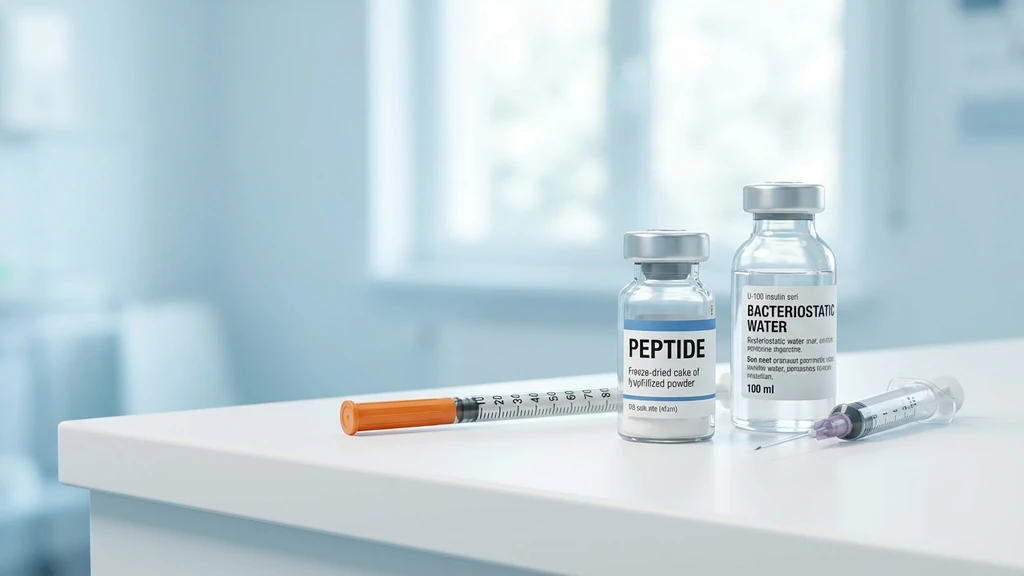
You are holding a vial of lyophilized semaglutide and a bottle of bacteriostatic water. Your provider said "inject 0.5 mg." The syringe says units, not milligrams. For a 5 mg vial, add 2 mL of bacteriostatic water for a 2.5 mg/mL concentration. At this concentration, 0.5 mg equals 20 IU on an insulin syringe. For a 10 mg vial, add 2 mL for 5 mg/mL or 3 mL for 3.33 mg/mL. Never shake the vial. Gently swirl until dissolved. Store refrigerated at 36-46F for up to 28 days.
| Quick Reference | Details |
|---|---|
| 5 mg vial + 2 mL BAC water | 2.5 mg/mL concentration |
| 10 mg vial + 2 mL BAC water | 5 mg/mL concentration |
| Universal formula | Concentration = Peptide (mg) / Water (mL) |
| Unit formula | IU = (Dose mg / Concentration mg/mL) x 100 |
| Storage | Refrigerate 36-46F (2-8C) |
| Shelf life | 28 days (conservative) |
| Never | Shake, freeze, or leave at room temperature |
For instant calculations, use our peptide reconstitution calculator or semaglutide dosage calculator.
Get your custom peptide protocol:
- Tailored to your body and goals
- Precise dosing and cycle length
- Safe stacking combinations
- Backed by peer-reviewed studies
- Ready in under 2 minutes
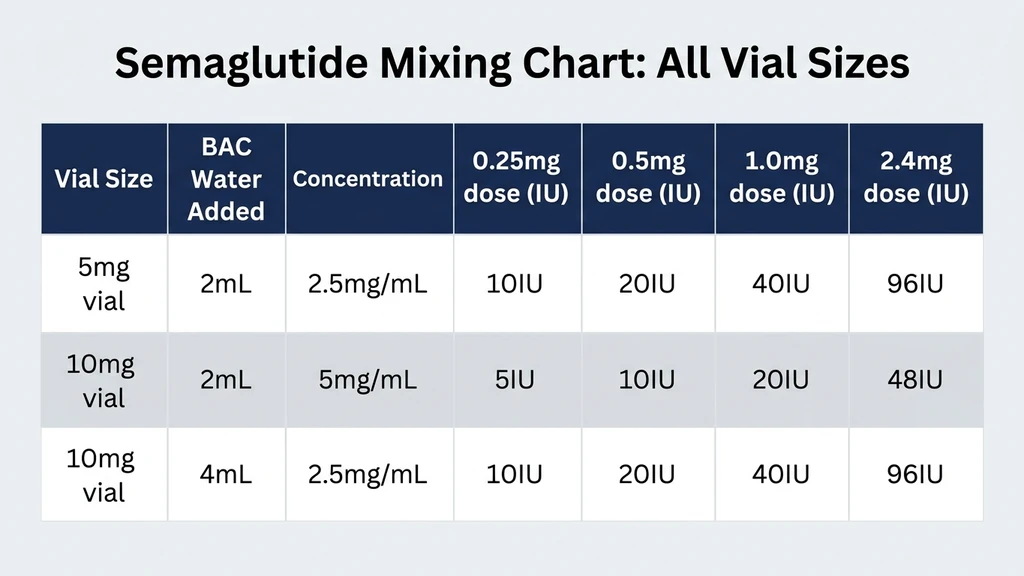
Quick Reference: Semaglutide Mixing Charts
The charts below cover every standard vial size. Find your vial, choose your preferred dilution, and read across for the IU markings at each dose level.
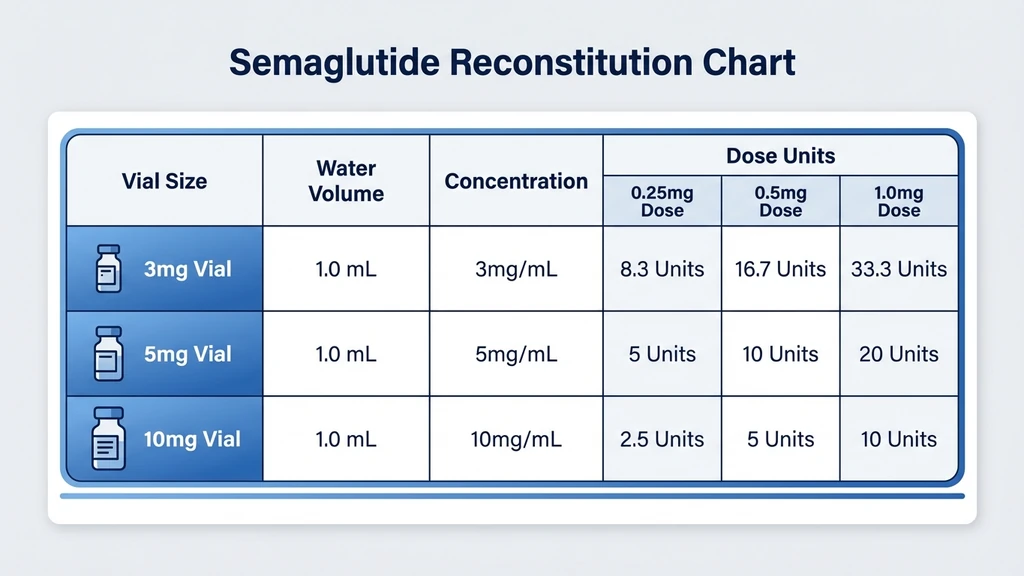
3 mg Vial Mixing Chart
The 3 mg vial is the smallest standard size. It provides limited doses before requiring a new vial, best suited for the initial titration weeks.
| BAC Water | Concentration | 0.25 mg | 0.5 mg | 1.0 mg | Total Doses at 0.25 mg |
|---|---|---|---|---|---|
| 1 mL | 3.0 mg/mL | 8.3 IU | 16.7 IU | 33.3 IU | 12 doses |
| 1.5 mL | 2.0 mg/mL | 12.5 IU | 25 IU | 50 IU | 12 doses |
| 2 mL | 1.5 mg/mL | 16.7 IU | 33.3 IU | 66.7 IU | 12 doses |
Recommendation: Add 1.5 mL for a 2.0 mg/mL concentration. This gives clean 12.5 IU increments for the 0.25 mg starting dose and 25 IU for 0.5 mg. Both are easy to read on a U-100 insulin syringe.
5 mg Vial Mixing Chart
The 5 mg vial is the most popular size for the initial 8-week titration (4 weeks at 0.25 mg + 4 weeks at 0.5 mg). One vial at the right dilution covers this entire period.
| BAC Water | Concentration | 0.25 mg | 0.5 mg | 1.0 mg | 2.4 mg | Total Doses at 0.25 mg |
|---|---|---|---|---|---|---|
| 1 mL | 5.0 mg/mL | 5 IU | 10 IU | 20 IU | 48 IU | 20 doses |
| 2 mL | 2.5 mg/mL | 10 IU | 20 IU | 40 IU | 96 IU | 20 doses |
| 2.5 mL | 2.0 mg/mL | 12.5 IU | 25 IU | 50 IU | 120 IU* | 20 doses |
*120 IU exceeds the capacity of a standard 100 IU syringe. Use a 1 mL syringe or split into two injections.
Recommendation: Add 2 mL for a 2.5 mg/mL concentration. At this dilution, 0.25 mg = 10 IU and 0.5 mg = 20 IU. These are the cleanest measurements on an insulin syringe. This is the most commonly used mixing ratio for semaglutide. For a deeper dive, see our how much bacteriostatic water for semaglutide guide.
10 mg Vial Mixing Chart
The 10 mg vial is the most cost-effective option for ongoing treatment. It provides enough semaglutide for 8-20+ weeks depending on dose.
| BAC Water | Concentration | 0.25 mg | 0.5 mg | 1.0 mg | 1.7 mg | 2.4 mg |
|---|---|---|---|---|---|---|
| 2 mL | 5.0 mg/mL | 5 IU | 10 IU | 20 IU | 34 IU | 48 IU |
| 3 mL | 3.33 mg/mL | 7.5 IU | 15 IU | 30 IU | 51 IU | 72 IU |
| 4 mL | 2.5 mg/mL | 10 IU | 20 IU | 40 IU | 68 IU | 96 IU |
| 5 mL | 2.0 mg/mL | 12.5 IU | 25 IU | 50 IU | 85 IU | 120 IU* |
Low volume (2 mL): Higher concentration means smaller injection volumes. Better for men who want minimal fluid under the skin. Harder to measure very small doses accurately.
High volume (4-5 mL): Lower concentration means easier measurement at low doses. Larger injection volume. Good for the 0.25-0.5 mg starting phase.
Recommendation for most users: 3 mL or 4 mL. At 3 mL (3.33 mg/mL), the doses produce clean measurements. At 4 mL (2.5 mg/mL), you get the same concentrations as the popular 5 mg + 2 mL mixing ratio.
15 mg Vial Mixing Chart
The 15 mg vial is least common but offers maximum doses per vial. It is best for maintenance doses of 1.0 mg or higher.
| BAC Water | Concentration | 0.5 mg | 1.0 mg | 1.7 mg | 2.4 mg |
|---|---|---|---|---|---|
| 3 mL | 5.0 mg/mL | 10 IU | 20 IU | 34 IU | 48 IU |
| 5 mL | 3.0 mg/mL | 16.7 IU | 33.3 IU | 56.7 IU | 80 IU |
| 6 mL | 2.5 mg/mL | 20 IU | 40 IU | 68 IU | 96 IU |
Recommendation: Add 3 mL for a 5 mg/mL concentration if you are at 1.0 mg or higher. The low volume keeps injections small. Add 6 mL for 2.5 mg/mL if you need to dose at 0.5 mg or want easier measurement.
The Math Behind the Charts
Two formulas power every mixing chart. Memorize them and you can calculate any concentration for any vial size.
Formula 1: Concentration Concentration (mg/mL) = Total peptide (mg) / Total water (mL)
Example: 10 mg vial + 4 mL BAC water = 10 / 4 = 2.5 mg/mL
Formula 2: Units per dose Units (IU) = (Desired dose in mg / Concentration in mg/mL) x 100
Example: 0.5 mg dose at 2.5 mg/mL = (0.5 / 2.5) x 100 = 20 IU
The "x 100" exists because insulin syringes are calibrated in 100 units per 1 mL. Drawing to the 20 IU mark on a U-100 syringe means drawing 0.20 mL of liquid. At 2.5 mg/mL, 0.20 mL contains exactly 0.5 mg of semaglutide.
For instant math, use our peptide reconstitution calculator. See also our guide on how many mg is 40 units of semaglutide.
Step-by-Step Reconstitution Instructions
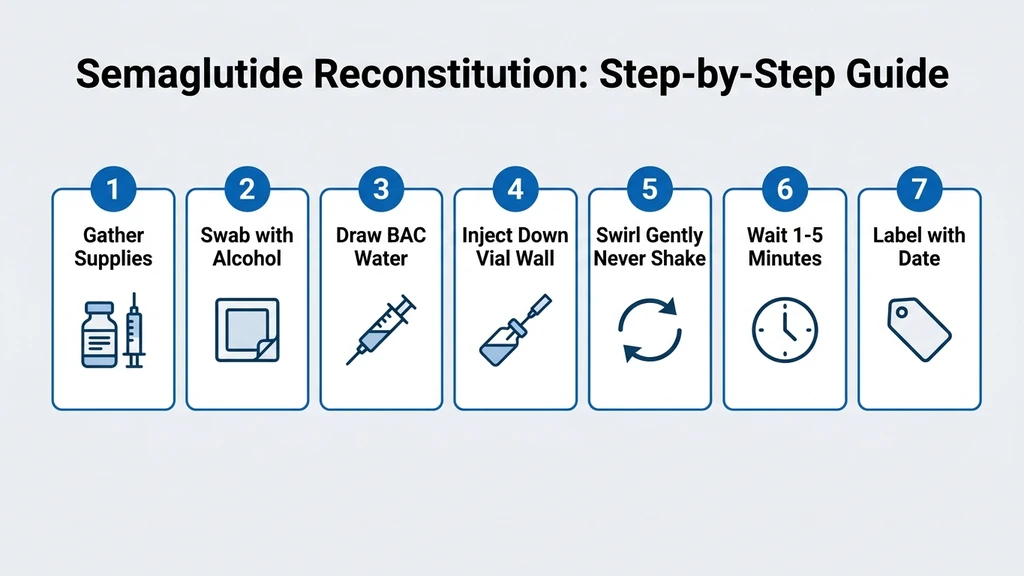
Follow these 7 steps every time you reconstitute a new vial. Deviating from proper technique can damage the peptide or introduce contamination.
1. Gather Your Supplies
You need: the semaglutide vial (lyophilized powder), a vial of bacteriostatic water, a 3 mL syringe with a drawing needle (18-21 gauge), alcohol swabs, and an insulin syringe (U-100, 29-31 gauge) for future dosing.
Do not use sterile water for multi-dose vials. Bacteriostatic water contains 0.9% benzyl alcohol as a preservative. Without it, bacteria can grow in the vial after the first needle puncture. Read our bacteriostatic water vs sterile water guide and where to buy bacteriostatic water.
2. Clean Everything with Alcohol Swabs
Wipe the rubber stopper of both the semaglutide vial and the bacteriostatic water vial with separate alcohol swabs. Let them air dry for 10 seconds. Do not blow on them. This step prevents bacterial contamination.
3. Draw Bacteriostatic Water into the Syringe
Using the 3 mL syringe, draw your target volume of bacteriostatic water. For a 5 mg vial, draw 2 mL. For a 10 mg vial, draw your chosen volume (2-5 mL). Pull back slowly and check for air bubbles. Tap the syringe barrel to float any bubbles to the top and push them out.
4. Inject Water Slowly Down the Vial Wall
Insert the needle through the semaglutide vial stopper at an angle. Aim the stream of water at the glass wall, not directly onto the powder cake. Release the plunger slowly, allowing the water to trickle down the side.
Direct impact on the powder can denature the peptide. The gentler the introduction, the better the dissolution.
5. Swirl Gently: Never Shake
Remove the syringe. Hold the vial between your palms and roll it gently for 30 seconds. Then swirl in small circles. The powder should dissolve gradually over 1-5 minutes.
Shaking creates foam and can denature the peptide through mechanical stress. If you see foam, you shook too hard. Set the vial down and wait for the foam to settle before using.
6. Wait for Full Dissolution
The solution should be completely clear and colorless. No particles, no cloudiness, no undissolved powder. If particles remain after 5 minutes of gentle swirling, set the vial in the refrigerator for 10 minutes and swirl again.
Do not use the solution if it remains cloudy or contains visible particles after 30 minutes. This may indicate a degraded peptide.
7. Label the Vial
Write on the vial or attach a label with: - Date of reconstitution - Concentration (mg/mL) - Discard date (28 days from reconstitution)
This prevents dosing errors when you have multiple vials in the refrigerator. Learn more about shelf life in our how long do reconstituted peptides last guide.
How to Choose the Right Mixing Ratio
The "right" ratio depends on your dose, your syringe, and your preference for injection volume.
| Factor | Low Volume (2 mL) | Medium Volume (3-4 mL) | High Volume (5 mL) |
|---|---|---|---|
| Concentration | Higher | Medium | Lower |
| Injection volume | Smaller | Medium | Larger |
| Measurement precision | Lower at small doses | Good at all doses | Best at small doses |
| Best for | Maintenance doses (1.0+ mg) | All doses | Starting titration (0.25 mg) |
| Doses per vial | Same | Same | Same |
Beginners starting at 0.25 mg: Use a higher water volume (4-5 mL for 10 mg vial) so the IU measurement is larger and easier to read. Drawing 10 IU is more accurate than drawing 5 IU.
Experienced users at 1.0+ mg: Use lower water volume (2-3 mL) to keep injection volumes small. At 5 mg/mL, a 1.0 mg dose is only 20 IU (0.20 mL).
If unsure: The 2.5 mg/mL concentration (5 mg + 2 mL or 10 mg + 4 mL) is the most widely used standard. It balances measurement accuracy with injection volume. Read our semaglutide dosage chart in mL for more detail.
Semaglutide Titration Schedule
The standard semaglutide dose escalation follows the same protocol used in clinical trials (STEP trials for Wegovy, SUSTAIN trials for Ozempic). Each tier lasts a minimum of 4 weeks.
| Week | Dose | IU at 2.5 mg/mL | Semaglutide Used Per Week | 10 mg Vial Lasts |
|---|---|---|---|---|
| 1-4 | 0.25 mg | 10 IU | 0.25 mg | 40 weeks |
| 5-8 | 0.5 mg | 20 IU | 0.5 mg | 20 weeks |
| 9-12 | 1.0 mg | 40 IU | 1.0 mg | 10 weeks |
| 13-16 | 1.7 mg | 68 IU | 1.7 mg | ~6 weeks |
| 17+ | 2.4 mg | 96 IU | 2.4 mg | ~4 weeks |
Do not skip tiers. Each 4-week hold allows your GI system to adapt to the current dose. Jumping from 0.5 mg to 1.7 mg doubles the nausea and diarrhea risk. Slow escalation reduces GI side effects by approximately 50%.
Cost optimization: A single 10 mg vial at 0.25 mg/week lasts 40 weeks. At the maximum 2.4 mg/week, it lasts about 4 weeks. Most users spend 8-16 weeks in the lower dose tiers, making the first vial or two very economical. For microdosing approaches, see our how to microdose semaglutide guide.
Storage After Reconstitution
Proper storage preserves peptide integrity. Semaglutide is a relatively stable peptide, but temperature abuse degrades it rapidly.
| Storage Condition | Shelf Life | Notes |
|---|---|---|
| Refrigerated (36-46F / 2-8C) | 28 days (conservative) | Recommended standard |
| Refrigerated with BAC water | Up to 56 days | Some data supports extended life |
| Room temperature (68-77F) | 24-48 hours max | Only for brief transport |
| Frozen | Do not freeze | Ice crystals damage peptide structure |
| Direct sunlight | Never | UV degrades semaglutide rapidly |
Best practice: Store the reconstituted vial upright in the main compartment of your refrigerator (not the door, which fluctuates in temperature). Keep it away from freezer vents. If the solution turns cloudy, develops particles, or changes color, discard it.
Read our does semaglutide need to be refrigerated and does semaglutide expire guides for details. For bacteriostatic water shelf life, see how long does bacteriostatic water last.
Common Mistakes to Avoid
Six errors that compromise safety or waste expensive peptide.
Using Sterile Water Instead of Bacteriostatic Water
Sterile water contains no preservative. After the first needle puncture, bacteria can enter and multiply in the vial. A multi-dose vial reconstituted with sterile water becomes a contamination risk within 24 hours. Always use bacteriostatic water for multi-dose vials. See our is reconstitution solution the same as bacteriostatic water guide.
Shaking the Vial
Shaking denatures proteins through mechanical stress. The foam you see after shaking is denatured semaglutide that will not work. Gentle swirling dissolves the powder without damaging the peptide chain. Patience here preserves your investment.
Using the Wrong Syringe
U-100 insulin syringes are calibrated for 100 units per mL. Using a U-40 syringe (40 units per mL) with the same markings delivers 2.5x the intended dose. A 20 IU measurement on a U-40 syringe actually draws 0.50 mL instead of 0.20 mL. This is a 250% overdose.
Always verify "U-100" on the syringe packaging. Use 29-31 gauge needles for subcutaneous injection.
Injecting Water Too Fast
Blasting water directly onto the powder cake creates foam and may denature the peptide. Aim the stream at the vial wall. Release the plunger slowly over 10-15 seconds. The water should trickle down the glass and pool at the bottom, gradually dissolving the powder.
Storing at Room Temperature
Reconstituted semaglutide degrades significantly at room temperature. Even 24 hours at 77F reduces potency. A vial left on the counter overnight should be refrigerated immediately and used within the next few days. Repeated temperature excursions compound the damage.
Reusing Needles
A needle that has punctured skin once is no longer sterile. Reusing needles increases infection risk and causes more injection-site pain (the tip bends and dulls after the first use). Insulin needles cost pennies. Use a new one every time.
Compounded vs Lyophilized Semaglutide
Two forms of semaglutide exist in the market beyond brand-name Ozempic and Wegovy.
Lyophilized (freeze-dried) powder: This is what the mixing charts above apply to. You reconstitute it yourself with bacteriostatic water. It offers the most flexibility in concentration choice and is the standard for research-grade semaglutide.
Compounded liquid: Pre-mixed by a compounding pharmacy at a specific concentration (commonly 2.5 mg/mL or 5 mg/mL). No reconstitution needed. May contain additional ingredients like B12, L-carnitine, or preservatives. The FDA has raised concerns about compounded semaglutide formulations, specifically regarding salt form (sodium vs acetate) and purity standards.
| Factor | Lyophilized | Compounded |
|---|---|---|
| Reconstitution | Required (you mix) | Not needed (pre-mixed) |
| Flexibility | Choose your concentration | Fixed concentration |
| Stability | Stable as powder for months | 28-56 days once mixed |
| FDA concern level | Moderate (purity varies) | Higher (salt form issues) |
| Cost | Generally lower | Variable |
| Additives | None (just peptide + BAC water) | May contain B12, etc. |
If using compounded semaglutide, verify the concentration with your pharmacy and adjust the dosing math accordingly. Our compound semaglutide with B12 guide covers these formulations. For the reconstitution guide covering all peptides, see how to reconstitute peptide.
Frequently Asked Questions
How much bacteriostatic water do I add to 5 mg semaglutide?
Add 2 mL for a 2.5 mg/mL concentration (the most common ratio). At this concentration, a 0.25 mg dose equals 10 IU and a 0.5 mg dose equals 20 IU on a U-100 insulin syringe. Alternatively, add 2.5 mL for a 2.0 mg/mL concentration with slightly easier measurement.
How long does reconstituted semaglutide last?
When stored refrigerated at 36-46F (2-8C), reconstituted semaglutide with bacteriostatic water lasts 28 days conservatively and up to 56 days based on stability data. Never freeze. Discard if the solution becomes cloudy, develops particles, or changes color.
Can I use sterile water instead of bacteriostatic water?
For multi-dose vials, always use bacteriostatic water. The 0.9% benzyl alcohol preservative prevents bacterial contamination across multiple needle punctures. Sterile water is only appropriate for single-use vials consumed immediately after reconstitution.
How do I calculate my semaglutide dose in units?
Units = (Desired dose in mg / Concentration in mg/mL) x 100. Example: 0.5 mg at 2.5 mg/mL = (0.5 / 2.5) x 100 = 20 IU. Draw to the 20 mark on a U-100 insulin syringe. Use our reconstitution calculator for instant results.
What happens if I shake the semaglutide vial?
Shaking denatures the semaglutide through mechanical stress, creating foam that consists of damaged peptide. The foamy portion will not produce full therapeutic effects. If you accidentally shake, set the vial down for 30 minutes to let foam settle, then gently swirl. Always swirl, never shake.
How do I know which mixing ratio to use?
Match the ratio to your dose level. Starting at 0.25 mg? Use more water (lower concentration) for easier measurement. At 1.0 mg or higher? Use less water (higher concentration) for smaller injection volume. The 2.5 mg/mL standard (5 mg + 2 mL or 10 mg + 4 mL) works well at all dose tiers.
How many weeks does a 10 mg vial of semaglutide last?
It depends on your dose tier. At 0.25 mg/week: 40 weeks. At 0.5 mg/week: 20 weeks. At 1.0 mg/week: 10 weeks. At 1.7 mg/week: about 6 weeks. At 2.4 mg/week: about 4 weeks. Note that reconstituted solution should be used within 28-56 days regardless of remaining volume.
Can I travel with reconstituted semaglutide?
Yes, but maintain the cold chain. Use an insulated travel case with ice packs. Keep the vial between 36-46F. Room temperature exposure should not exceed 24 hours. TSA allows injectable medications with proper labeling. Carry a copy of your prescription or pharmacy receipt.
The Bottom Line
Semaglutide reconstitution follows two simple formulas: concentration equals peptide divided by water, and units equal dose divided by concentration times 100. For the most common setup, add 2 mL of bacteriostatic water to a 5 mg vial for 2.5 mg/mL. At this concentration, 0.25 mg = 10 IU, 0.5 mg = 20 IU, and 1.0 mg = 40 IU.
Follow the 7-step reconstitution process: gather supplies, clean stoppers, draw water, inject down the wall, swirl gently, wait for dissolution, and label the vial. Store refrigerated at 36-46F. Use within 28 days. Never shake, freeze, or leave at room temperature.
Use our peptide reconstitution calculator for instant mixing math and our semaglutide dosage calculator for titration planning. For broader semaglutide guidance, see our semaglutide dosage chart in mL and how much bacteriostatic water for semaglutide.
Related Articles
Microdosing GLP-1: What It Is and the Risks
Microdosing GLP-1 means dosing below the range trials tested. What the dose-response data shows, how it differs from titration, and the cost and safety risks.
Retatrutide Dosage: Titration Schedule
Retatrutide dosage chart with weekly titration schedule. Phase 2 & 3 trial data: up to 28.7% weight loss at 12 mg. Dose escalation and side effects.
Ipamorelin Dosage: Solo Protocols, Timing & Unit Math
Ipamorelin dosage: 200-300 mcg subcutaneous, 1-3x daily, bedtime fasted. Charts by goal and weight, saturation dose, reconstitution units, safety data.
Sermorelin Dosage Chart by Goal & Weight
Sermorelin dosage chart: 200-500 mcg nightly before bed. Doses by goal and body weight, unit conversions for every vial size, timing, and titration.