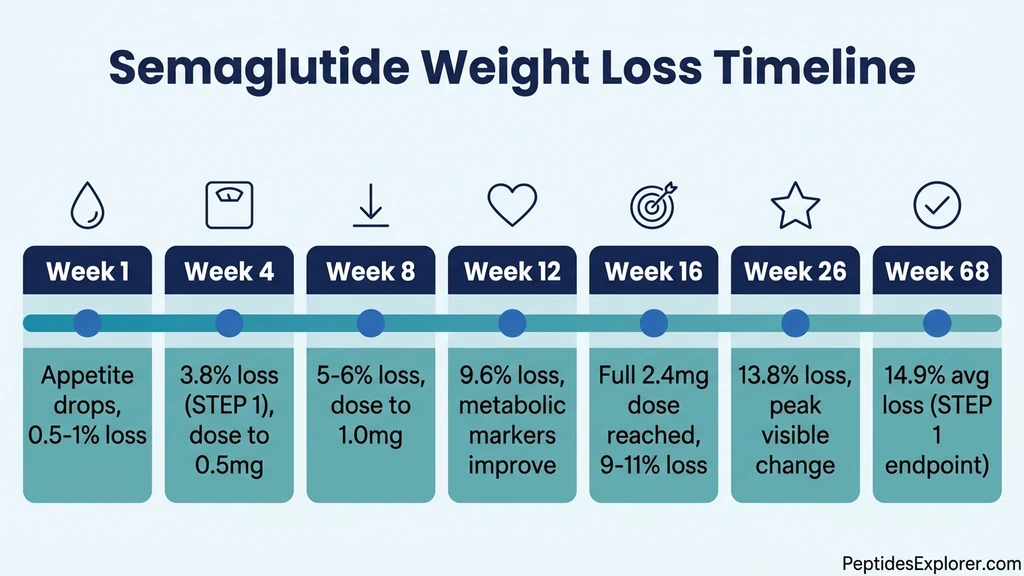
You injected your first dose of semaglutide three days ago. You stepped on the scale this morning and nothing changed. You are wondering if the drug is working at all. Semaglutide begins suppressing appetite within 24 to 72 hours of the first injection. Measurable weight loss typically appears at 4 to 8 weeks. Significant results, the kind that change how your clothes fit and how your bloodwork reads, arrive at 12 to 16 weeks. The STEP 1 trial documented an average of 14.9% total body weight loss at 68 weeks on the 2.4 mg dose (Wilding et al., NEJM, 2021).
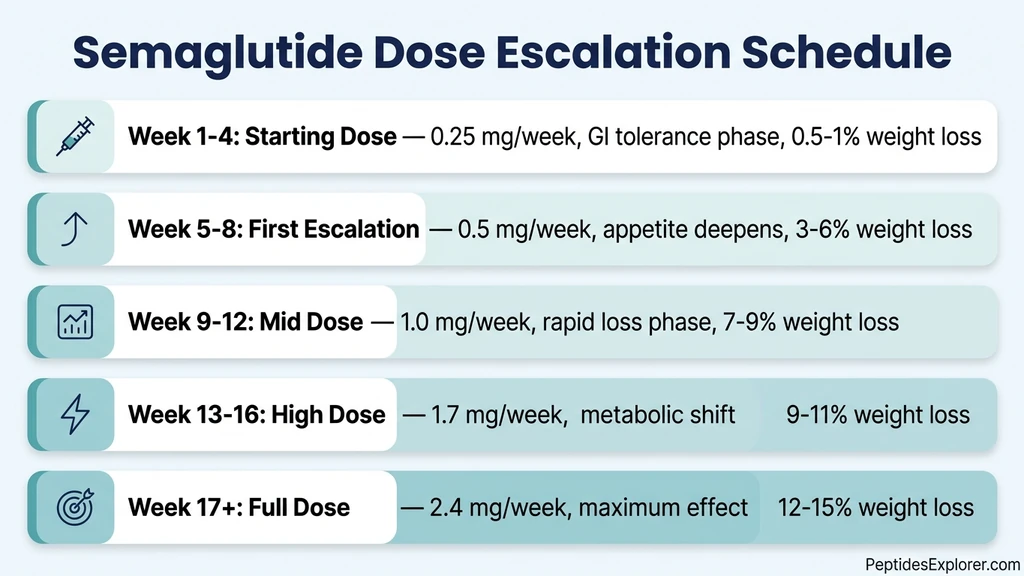
The slow start is by design. Semaglutide uses a dose-escalation schedule that takes 16 to 20 weeks to reach the full therapeutic dose. You are not on the real dose yet. Each step up brings stronger appetite suppression, more weight loss, and a body that has adapted to tolerate the drug with fewer GI side effects.
| Timeframe | What You Feel | Typical Weight Loss | Dose (Wegovy) |
|---|---|---|---|
| Week 1 | Reduced appetite, possible nausea | 0-1 lb | 0.25 mg |
| Weeks 2-4 | Smaller portions feel satisfying, food noise quiets | 2-4 lbs | 0.25 mg |
| Weeks 5-8 | Consistent appetite suppression, cravings fade | 4-8 lbs | 0.5 mg |
| Weeks 9-12 | Noticeable body composition changes | 8-12 lbs | 1.0 mg |
| Weeks 13-16 | Clothes fit differently, energy improves | 12-18 lbs | 1.7 mg |
| Weeks 17-20 | Full therapeutic effect begins | 15-22 lbs | 2.4 mg |
| Weeks 20-68 | Continued loss, plateaus and adjustments | 25-45+ lbs | 2.4 mg |
For dosing specifics at each escalation step, see our semaglutide dosage chart. For reconstitution of compounded semaglutide, see the bacteriostatic water mixing guide.
Get your custom peptide protocol:
- Tailored to your body and goals
- Precise dosing and cycle length
- Safe stacking combinations
- Backed by peer-reviewed studies
- Ready in under 2 minutes
Week-by-Week Timeline: What to Expect at Each Stage
The experience of semaglutide unfolds in distinct phases. Each one feels different. Understanding the sequence prevents the most common mistake: quitting before the drug reaches its full working dose.
Weeks 1-4: The Appetizer Phase (0.25 mg)
The first injection is 0.25 mg, one-tenth of the full Wegovy dose. This is not a therapeutic dose for weight loss. It is a starter dose designed to let your gut adapt to GLP-1 receptor activation.
Within 24 to 72 hours, most people notice a shift. Food loses some of its pull. The mental chatter about what to eat next, sometimes called "food noise," gets quieter. You might eat half a sandwich and feel done. A meal that used to disappear in 10 minutes now takes 25.
Weight loss at this stage is modest: 1 to 4 pounds over the month, mostly from eating less rather than from metabolic changes. Some people lose nothing. That is normal. The 0.25 mg dose produces blood levels well below the threshold where the STEP trials measured significant weight loss (Blundell et al., Diabetes Obes Metab, 2022).
The most common side effect at this stage is nausea. It affects roughly 44% of users in clinical trials, though most describe it as mild. Eating smaller meals, avoiding greasy food, and staying hydrated reduces it substantially.
Weeks 5-8: Appetite Suppression Strengthens (0.5 mg)
The dose doubles to 0.5 mg at week 5. This is where the shift becomes undeniable. Hunger signals dampen further. Cravings for high-calorie foods, especially sugar and fried food, weaken. Many people report that the psychological relationship with food changes: eating becomes functional rather than recreational.
Weight loss accelerates. The STEP 1 trial showed participants losing approximately 5% of body weight by week 8 (Wilding et al., NEJM, 2021). For a 220 lb person, that is 11 pounds. For a 180 lb person, roughly 9 pounds.
Gastric emptying slows noticeably at this dose. Food sits in the stomach longer, extending the feeling of fullness after meals. This is the mechanism behind both the appetite suppression and the GI side effects. If nausea was present at 0.25 mg, it often improves by week 5 because the body has adapted to GLP-1 stimulation. New nausea can appear briefly after the dose increase, then settle within a week.
Weeks 9-16: Visible Changes Begin (1.0-1.7 mg)
The dose escalates to 1.0 mg at week 9 and 1.7 mg at week 13. This is the inflection zone. Weight loss that was gradual becomes visible. Faces look leaner. Waistbands loosen. People who have not seen you in a few weeks start commenting.
By week 12, average weight loss in the STEP trials reached 8 to 10% of starting body weight. Metabolic markers shift: fasting blood glucose drops, triglycerides fall, blood pressure improves. For people with type 2 diabetes, HbA1c reductions of 1.0 to 1.5 percentage points are typical at these doses (Davies et al., Lancet, 2021).
Fatigue can appear during this phase. It is usually caloric, not pharmacological. When you eat 500 to 800 fewer calories per day, energy dips are expected. Ensuring adequate protein intake (0.7 to 1.0 g per pound of lean body mass) and not skipping meals prevents most of it.
This is also when hair thinning can start. Rapid weight loss triggers telogen effluvium, a temporary shedding that peaks 2 to 4 months after the weight loss begins. The hair loss is caused by the caloric deficit, not the drug molecule itself.
Weeks 17-20: Full Dose Reached (2.4 mg)
The final escalation to 2.4 mg occurs at week 17 for Wegovy. This is the dose used in the STEP clinical trials. Appetite suppression is at its strongest. Most users report that hunger is no longer a meaningful obstacle. The challenge shifts from resisting food to remembering to eat enough.
Steady-state blood levels are reached approximately 4 to 5 weeks after starting any given dose. At 2.4 mg, steady state arrives around week 21 to 22. This means the full pharmacological effect is not achieved until roughly 5 months after the first injection.
At week 20, average weight loss in STEP 1 was approximately 12 to 13% of starting body weight. But the trajectory is still declining. The drug continues working for months beyond this point.
Weeks 20-68: The Long Game
Weight loss continues throughout the first year and beyond. The STEP 1 trial, the largest semaglutide weight loss trial, ran for 68 weeks (about 16 months). At the endpoint, participants on 2.4 mg semaglutide lost an average of 14.9% of body weight, compared to 2.4% in the placebo group (Wilding et al., NEJM, 2021).
The rate of loss slows after month 6. This is not a plateau in the traditional sense. It is the body reaching a new equilibrium where caloric intake (reduced by semaglutide) matches caloric expenditure (reduced by lower body weight). The drug is still working. The math has simply rebalanced.
The STEP 5 trial extended treatment to 104 weeks (2 years) and found that weight loss was maintained, with an average of 15.2% total body weight reduction at the endpoint (Garvey et al., Nat Med, 2022). Longer treatment did not produce dramatically more weight loss, but it prevented regain.
Why the Dose Escalation Schedule Matters
Think of semaglutide dose escalation like adjusting to altitude. A mountaineer does not fly from sea level to 18,000 feet and start climbing. The body needs time at intermediate camps to produce more red blood cells and adapt to lower oxygen. Jumping straight to the summit causes altitude sickness. Semaglutide works the same way. Each dose step lets your GI tract adapt to stronger GLP-1 stimulation before the next increase.
The escalation schedule for Wegovy is: 0.25 mg for 4 weeks, 0.5 mg for 4 weeks, 1.0 mg for 4 weeks, 1.7 mg for 4 weeks, then 2.4 mg ongoing. The Ozempic schedule (for type 2 diabetes) follows a similar pattern: 0.25 mg for 4 weeks, 0.5 mg for 4 weeks, then either 1.0 mg or 2.0 mg ongoing.
Skipping steps or accelerating the schedule is the most common cause of severe nausea, vomiting, and early discontinuation. In the STEP trials, patients who followed the escalation schedule had a 4.5% discontinuation rate due to GI side effects. Real-world data from prescribers who rush the schedule report discontinuation rates 2 to 3 times higher.
The escalation schedule also explains why many people feel the drug "stopped working" at a lower dose and then see renewed progress after the next step up. Each increase restores the gap between your current GLP-1 stimulation and what your body has adapted to. Use our semaglutide dosage calculator to verify your current dose in the escalation sequence.
Factors That Speed Up or Slow Down Results
The STEP trial averages are population means. Individual timelines vary by weeks in either direction. The following factors explain most of the variance.
Starting Weight and BMI
Heavier individuals tend to lose more total pounds but a similar percentage of body weight. A person starting at 300 lbs might lose 45 lbs (15%) while a person starting at 180 lbs loses 27 lbs (15%). The absolute number differs, but the metabolic impact is comparable. Higher starting weights also produce faster initial losses because the caloric deficit created by reduced appetite is proportionally larger when baseline intake is higher.
Insulin Resistance and Metabolic Status
People with type 2 diabetes or significant insulin resistance tend to lose weight more slowly on semaglutide. The STEP 2 trial (semaglutide in type 2 diabetes) showed 9.6% weight loss at 68 weeks, compared to 14.9% in the non-diabetic STEP 1 population (Davies et al., Lancet, 2021). Insulin resistance impairs the body's ability to mobilize fat stores. The drug still works, but results take longer to become visible. Blood sugar improvements, however, often appear within the first 4 weeks.
Diet Quality and Protein Intake
Semaglutide reduces how much you eat. It does not control what you eat. People who prioritize protein (0.7 to 1.0 g per pound of lean body mass) lose more fat and less muscle. Those who eat low-protein, high-carb diets despite reduced portions lose weight on the scale but sacrifice muscle mass, which slows metabolism and increases the likelihood of regain after stopping. For strategies to optimize nutrition on semaglutide, see our guide on not losing weight on semaglutide.
Physical Activity
Exercise accelerates fat loss and preserves lean mass during semaglutide treatment. The STEP 3 trial added intensive behavioral therapy (including structured exercise) to semaglutide 2.4 mg. Participants lost 16.0% of body weight at 68 weeks, compared to 14.9% with semaglutide alone (Wadden et al., JAMA, 2021). Resistance training is particularly valuable because semaglutide-induced caloric deficits can accelerate muscle loss in sedentary users.
Genetics and GLP-1 Receptor Sensitivity
Some people are "super responders" who lose 20% or more of body weight. Others plateau at 8 to 10%. Genetic variation in GLP-1 receptor density, gut motility, and appetite-regulating circuits explains much of this spread. There is no way to predict your response before starting. The first 8 weeks give the best early signal: people who lose 5% or more by week 8 tend to achieve the best long-term results.
Concurrent Medications
Certain medications counteract semaglutide's weight loss effects. Insulin, sulfonylureas, and some antidepressants (mirtazapine, olanzapine) promote weight gain through independent pathways. Beta-blockers reduce metabolic rate. If you are taking any of these, weight loss may be slower and total loss may be lower. Discuss alternatives with your prescriber rather than increasing the semaglutide dose beyond the recommended schedule. Check potential interactions with our peptide interaction checker.
What to Expect at Each Dose: Effects Beyond the Scale
Weight is the most visible metric, but semaglutide changes multiple systems simultaneously. Tracking these markers gives a more accurate picture of whether the drug is working, especially during the early weeks when the scale moves slowly.
Appetite and Food Behavior
Appetite suppression is the earliest effect and the most reliable sign the drug is active. By day 3 to 5 after the first injection, most users notice reduced hunger between meals, smaller portion satisfaction, and less preoccupation with food. At 0.25 mg, this effect is subtle. At 1.0 mg and above, it becomes dominant. Many users describe it as the absence of a signal rather than the presence of one: you simply stop thinking about food between meals.
The STEP 1 study included food craving questionnaires. Participants on semaglutide reported 15 to 25% reductions in craving intensity for sweet, savory, and high-fat foods compared to placebo (Blundell et al., Diabetes Obes Metab, 2022). This effect strengthened with dose increases and persisted at 68 weeks.
Blood Sugar and Metabolic Markers
For people with type 2 diabetes, fasting glucose improvements appear within 1 to 2 weeks. HbA1c, which reflects average blood sugar over 3 months, shows meaningful reductions by week 8 to 12. The SUSTAIN trials documented HbA1c reductions of 1.5 to 1.8 percentage points at the 1.0 mg dose (Ahren et al., Lancet Diabetes Endocrinol, 2017).
Even in non-diabetic users, fasting insulin levels decrease as weight drops, indicating improved insulin sensitivity. Triglycerides fall by 12 to 20%. LDL cholesterol drops modestly. These changes are secondary to weight loss and typically become measurable after 8 to 12 weeks.
Blood Pressure and Cardiovascular Markers
Systolic blood pressure decreases by 3 to 6 mmHg on average over 68 weeks of treatment. The SELECT trial, which studied semaglutide 2.4 mg in 17,604 overweight adults with cardiovascular disease, found a 20% reduction in major adverse cardiovascular events (heart attack, stroke, cardiovascular death) compared to placebo (Lincoff et al., NEJM, 2023). Blood pressure improvements typically become measurable after 12 to 16 weeks.
Energy and Mood
The relationship between semaglutide and energy is biphasic. During the first 4 to 8 weeks, fatigue is common because the body adjusts to lower caloric intake. After 8 to 12 weeks, most users report improved energy as excess weight decreases, sleep quality improves (especially if sleep apnea was present), and blood sugar stabilizes. Mood improvements are reported frequently, though the mechanism is debated: some is likely from weight loss itself, some from improved metabolic health, and some potentially from direct central GLP-1 receptor effects.
When Semaglutide Seems Like It Is Not Working
Not everyone responds to semaglutide on the expected timeline. Before concluding the drug has failed, check these five common causes of slow response.
1. You have not reached the therapeutic dose. If you are still in the 0.25 mg or 0.5 mg phase, you are not at the dose that produced the STEP trial results. Most of the weight loss in clinical trials occurred at 1.7 mg and 2.4 mg. Patience through the escalation is essential.
2. You are eating through the appetite suppression. Semaglutide reduces hunger. It does not prevent eating. If you eat for reasons other than hunger (boredom, stress, social pressure, habit), the drug's appetite signal gets overridden. Behavioral awareness of why you eat is the complement to pharmacological appetite reduction.
3. Caloric drinks are offsetting the deficit. Semaglutide blunts appetite for food but does not fully suppress the desire for beverages. Alcohol, sugary coffee drinks, juice, and soda can add 300 to 800 calories daily without triggering the fullness signals the drug enhances. Liquid calories bypass the delayed gastric emptying that makes solid food satiating. See our guide on drinking on tirzepatide, which covers principles that apply equally to semaglutide.
4. A concurrent medication is promoting weight gain. Insulin, sulfonylureas, thiazolidinediones, certain antidepressants, antipsychotics, and corticosteroids all promote weight gain. These drugs can partially or fully counteract semaglutide's effects. A medication review with your prescriber may reveal adjustable factors.
5. Your expectations are misaligned with clinical data. The average loss at 68 weeks is 15%. That means half of participants lost less than 15%. Some lost 5 to 8%, which is still medically significant (reducing diabetes risk, improving blood pressure, decreasing liver fat). Weight loss is not linear: weeks of no change followed by a sudden 3-pound drop are normal.
For a detailed troubleshooting protocol, read our full guide on not losing weight on semaglutide.
Semaglutide for Diabetes vs. Weight Loss: Different Timelines
Semaglutide is sold under different brand names for different indications. The dose, the escalation schedule, and the timeline for results differ between them.
Ozempic (type 2 diabetes): Maximum dose of 1.0 mg or 2.0 mg weekly. The primary target is blood sugar control, not weight loss. Blood sugar improvements (fasting glucose) appear within 1 to 2 weeks. HbA1c reaches its nadir at 12 to 16 weeks. Weight loss occurs as a secondary effect: 6 to 10% at 40 weeks in the SUSTAIN trials (Ahren et al., Lancet Diabetes Endocrinol, 2017).
Wegovy (weight management): Maximum dose of 2.4 mg weekly. The escalation takes 16 weeks to complete. Weight loss is the primary endpoint. The STEP trials documented 14.9% weight loss at 68 weeks. Results take longer because the escalation is slower and the target dose is higher.
Oral semaglutide (Rybelsus): Doses of 3 mg, 7 mg, and 14 mg daily. Bioavailability is only about 1%, so much higher milligram doses are needed. Blood sugar control is comparable to injectable Ozempic at the 14 mg dose. Weight loss is more modest: 4 to 5% at 26 weeks. Results appear on a similar timeline but plateau at a lower level.
For comparing semaglutide to tirzepatide (Mounjaro/Zepbound), which works through dual GIP/GLP-1 mechanisms, see our semaglutide to tirzepatide switching guide. For retatrutide, the triple agonist in clinical trials, results timelines are covered in our retatrutide dosage guide.
How Long Does Semaglutide Stay in Your System Between Doses?
Semaglutide has a 7-day half-life, which is why it works as a weekly injection. After each dose, drug levels peak at 1 to 3 days and then decline slowly over the week. At steady state (reached after 4 to 5 weeks of consistent weekly dosing), the peak-to-trough fluctuation is only about 30% (Kapitza et al., 2015). This means the drug is always active between doses. You are never in a "drug-free" window during weekly treatment.
The 7-day half-life also means the drug accumulates over the first 4 to 5 weeks at each dose level. When you step up from 0.5 mg to 1.0 mg, it takes another 4 to 5 weeks to reach the new steady state. This accumulation effect is why the full impact of each dose increase is not felt immediately but builds over a month.
If you are curious about what happens after stopping, see our detailed guide on how long semaglutide stays in your system. For a breakdown of side effect duration at each phase, read how long semaglutide side effects last.
Realistic Expectations: What the Clinical Trials Actually Show
Marketing and social media create distorted expectations. Before-and-after photos show the best responders. Clinical trials show the full distribution. For a detailed breakdown of what real clinical outcomes look like month by month, see semaglutide before and after.
The STEP 1 trial results at 68 weeks (2.4 mg semaglutide vs. placebo) break down as follows:
| Outcome | Semaglutide 2.4 mg | Placebo |
|---|---|---|
| Average weight loss | 14.9% | 2.4% |
| Lost 5% or more | 86.4% | 31.5% |
| Lost 10% or more | 69.1% | 12.0% |
| Lost 15% or more | 50.5% | 4.9% |
| Lost 20% or more | 32.0% | 1.7% |
Source: Wilding et al., NEJM, 2021
The median tells a different story than the mean. Half of participants lost more than 15%. But half lost less. One in seven did not reach even 5% weight loss, the threshold considered clinically meaningful. Roughly one in three achieved the dramatic 20%+ losses that dominate social media.
These numbers represent 68 weeks of consistent treatment at the full dose. Many real-world users start later, miss doses, struggle with side effects, or stop and restart. Real-world data from pharmacy claims shows average persistence on semaglutide is only 6 to 9 months, well short of the 16-month trial duration.
The SELECT cardiovascular outcomes trial provides additional context. Among 17,604 adults with overweight or obesity and established cardiovascular disease, semaglutide 2.4 mg reduced major cardiovascular events by 20% (Lincoff et al., NEJM, 2023). Weight loss in this older, sicker population averaged 9.4%, lower than STEP 1, but the cardiovascular benefits were significant regardless of the amount of weight lost.
For those considering alternatives, tirzepatide (Mounjaro/Zepbound) produced higher average weight loss in head-to-head comparisons: 20.2% vs. 13.7% for semaglutide at 72 weeks in the SURMOUNT-5 trial. Our retatrutide vs. tirzepatide comparison covers the next generation of GLP-1 based medications.
How to Track Your Progress Accurately
The scale is a noisy measurement. Daily weight fluctuates by 2 to 5 pounds based on water retention, sodium intake, bowel contents, and hormonal cycles. Here are more reliable tracking methods.
Weekly weigh-ins, same conditions. Weigh yourself once per week, on the same day, at the same time (morning, after urination, before eating), wearing the same clothing. Record the number. Do not react to any single reading. Look at the trend over 4-week blocks.
Waist circumference. Measure at the navel with a flexible tape. This captures visceral fat loss, which semaglutide targets preferentially. A decrease in waist circumference with stable weight means you are losing fat and gaining or maintaining muscle.
Progress photos. Take front, side, and back photos every 4 weeks in the same lighting and clothing. Visual changes often precede scale changes because body composition shifts (fat to muscle ratios) are not captured by weight alone.
Lab work. Request bloodwork at baseline, 12 weeks, and 6 months. Track fasting glucose, HbA1c, lipid panel, liver enzymes (ALT, AST), and inflammatory markers (CRP). These numbers quantify metabolic improvement even when the scale stalls. Our peptide safety guide covers recommended monitoring protocols.
Clothing fit. The most underrated metric. If your belt moves in a notch, your waistband loosens, or your shirts fit differently in the midsection, semaglutide is working. These changes reflect inches lost, which matter more than pounds.
How Semaglutide Compares to Other GLP-1 Medications
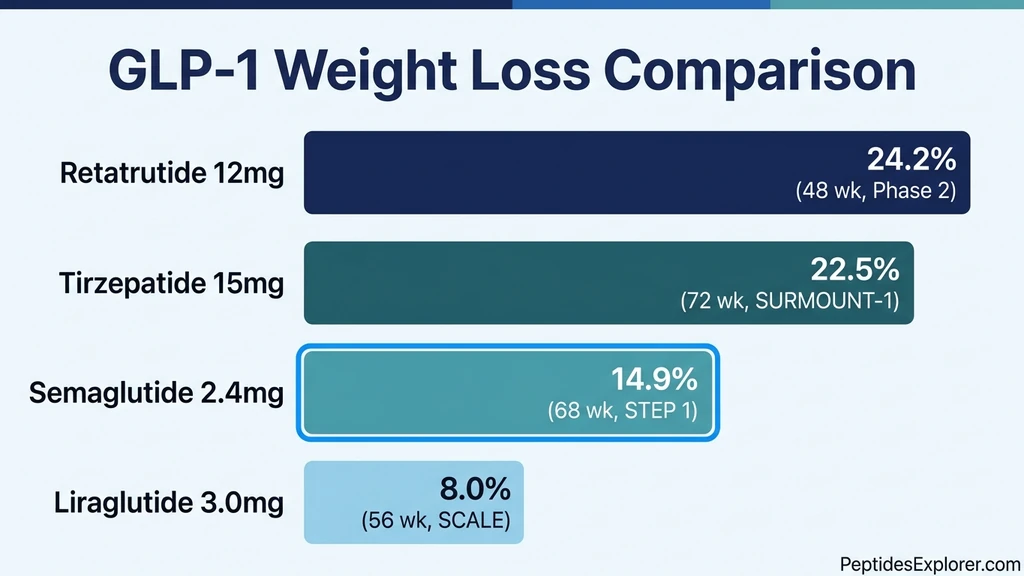
Semaglutide is not the only GLP-1 receptor agonist. Understanding how it compares helps set realistic expectations for speed and magnitude of results.
| Medication | Mechanism | Avg Weight Loss (Trial Duration) | Time to See Results |
|---|---|---|---|
| Semaglutide 2.4 mg (Wegovy) | GLP-1 agonist | 14.9% (68 weeks, STEP 1) | 2-4 weeks |
| Tirzepatide 15 mg (Zepbound) | GLP-1 + GIP agonist | 22.5% (72 weeks, SURMOUNT-1) | 2-4 weeks |
| Liraglutide 3.0 mg (Saxenda) | GLP-1 agonist (daily) | 8.0% (56 weeks, SCALE) | 2-4 weeks |
| Retatrutide 12 mg | GLP-1 + GIP + glucagon agonist | 24.2% (48 weeks, Phase 2) | 2-4 weeks |
All GLP-1 medications begin suppressing appetite within the first week. The differences show up in the magnitude of weight loss over time, not in how quickly the initial effects appear. Tirzepatide produces roughly 50% more weight loss than semaglutide at maximum doses through added GIP receptor activation. For users who started on semaglutide and want to try tirzepatide, the switching guide covers the dose conversion. For retatrutide, the triple agonist in clinical trials, results timelines are covered in our retatrutide dosage guide.
Frequently Asked Questions
How long does semaglutide take to work for weight loss?
Most people notice appetite suppression within the first week. Measurable weight loss (3 to 5 pounds) typically appears by weeks 4 to 8. Significant results (10%+ body weight) require 4 to 6 months of consistent treatment at escalating doses. The STEP 1 trial showed 14.9% average weight loss at 68 weeks on 2.4 mg.
Why am I not losing weight on semaglutide after 2 weeks?
At 2 weeks, you are on the lowest dose (0.25 mg), which is one-tenth of the therapeutic dose. This starter dose is for GI adaptation, not weight loss. Clinical trial data shows minimal weight loss at this dose. Weight loss accelerates at 0.5 mg and becomes substantial at 1.0 mg and above.
How long does it take for semaglutide to suppress appetite?
Appetite suppression begins within 24 to 72 hours of the first injection. You may notice smaller portions feeling satisfying, reduced food cravings, and less mental preoccupation with food. The effect strengthens with each dose increase during the 16 to 20 week escalation schedule.
How much weight can I lose on semaglutide in 3 months?
At 3 months (12 weeks), you will have reached the 1.0 mg dose in the Wegovy escalation schedule. Average weight loss at this point is 8 to 10% of starting body weight. For a 200 lb person, that is 16 to 20 lbs. Individual results range from 5% to 15% depending on diet, exercise, and metabolic factors.
Does semaglutide work faster at higher doses?
Higher doses produce more weight loss overall, but the escalation schedule should not be rushed. Jumping to 2.4 mg without the 16-week ramp-up causes severe nausea and vomiting in most people and leads to higher discontinuation rates. The escalation exists because gradual GI adaptation produces better long-term adherence and outcomes.
How do I know if semaglutide is working?
The earliest sign is reduced appetite and food noise within the first week. By week 4, most users eat 20 to 30% less without effort. By week 8, the scale should show a downward trend. If you have lost less than 3% of body weight by week 12, discuss dose adjustment with your prescriber.
Is semaglutide faster than tirzepatide for weight loss?
Tirzepatide produces faster and greater weight loss in head-to-head comparisons. The SURMOUNT-5 trial showed 20.2% weight loss with tirzepatide vs. 13.7% with semaglutide at 72 weeks. Both drugs follow dose-escalation schedules, and both show appetite suppression within the first week.
What happens if I stop semaglutide early?
Stopping before reaching the full dose means you never received the therapeutic effect tested in clinical trials. Appetite returns within 2 to 3 weeks as the drug clears. The STEP 1 extension study showed participants regained two-thirds of lost weight within one year of stopping. Semaglutide stays in your system for approximately 5 weeks after the last injection.
The Bottom Line
Semaglutide works in phases: appetite suppression within days, measurable weight loss at 4 to 8 weeks, and significant body composition changes at 12 to 16 weeks. The dose-escalation schedule takes 16 to 20 weeks to complete, and the full pharmacological effect is not reached until approximately 5 months after the first injection.
The single most important factor is patience through the escalation. The 0.25 mg and 0.5 mg doses are adaptation phases, not the real treatment. Results at these doses underrepresent what the drug will eventually deliver. The STEP trials showed 14.9% average body weight loss at 68 weeks, with 86% of participants losing at least 5%.
Use our semaglutide dosage calculator to verify your dose during escalation. For side effect management during the early weeks, see our guides on nausea, fatigue, and hair loss. For mixing compounded semaglutide, use our bacteriostatic water guide. If weight loss stalls, our troubleshooting guide covers the most common fixable causes.
Related articles: - How Long Does Tirzepatide Take to Work? — parallel week-by-week timeline for the dual agonist - Why Am I Not Losing Weight on Tirzepatide? — troubleshooting guide if results stall after switching - Does Semaglutide Need to Be Refrigerated? — storage guide to maintain potency through titration - Does Semaglutide Expire? — shelf life data for all semaglutide forms - Tirzepatide Maintenance Dose After Weight Loss — sustaining results after reaching target weight - Semaglutide Dosage Chart (mL) — complete dosing reference for compounded and brand-name semaglutide - Semaglutide Before and After — clinical results by month with trial data - How to Microdose Semaglutide — low-dose protocol for gradual titration - Compound Semaglutide With B12 — benefits and safety of B12-enhanced formulations
Related Articles
Retatrutide vs Semaglutide: Results, Risks, Cost
Retatrutide vs semaglutide (Ozempic, Wegovy): 24.2% vs 14.9% trial weight loss, side effects, heart rate, dosing cadence, cost, FDA status, and how to switch.
Not Losing Weight on Semaglutide?
Not losing weight on semaglutide? 5-10% of users are non-responders. Learn 8 fixable reasons, STEP trial data, and a 4-week troubleshooting plan.
What Color Is Semaglutide? Clear vs Cloudy
What color is semaglutide? Properly reconstituted is clear. Yellow tint is fine, red means added B12, cloudy means discard. Safe-use rules.
Does Semaglutide Cause Heartburn?
Does semaglutide cause heartburn? Yes, in 1.9-5% of users. Delayed gastric emptying mechanism, GERD differences, and 7 ways to manage it.