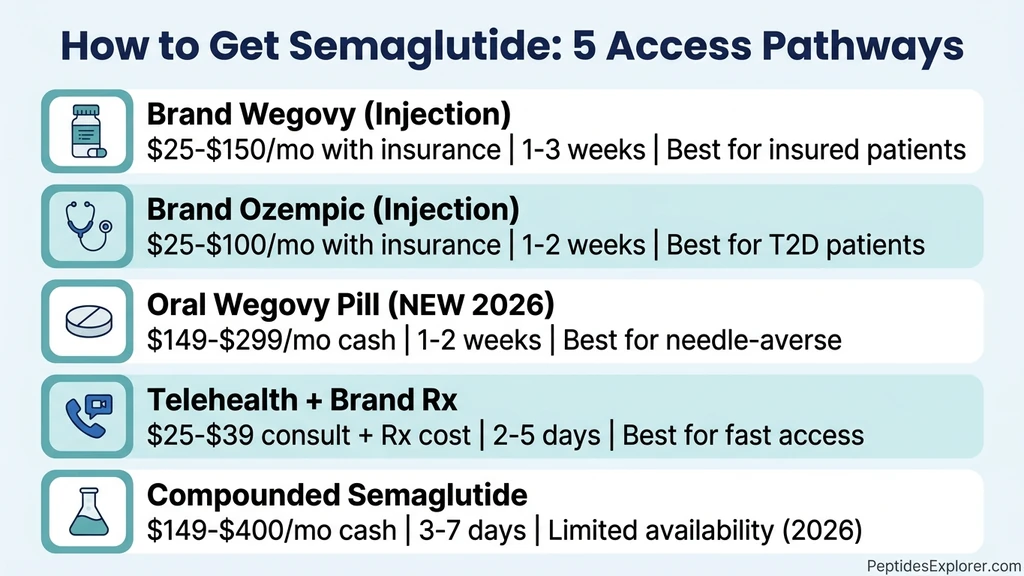
You want semaglutide for weight loss, and the options feel overwhelming. You can get semaglutide through three pathways: a brand-name prescription (Wegovy or Ozempic), a telehealth consultation with home delivery, or the new oral Wegovy pill approved in late 2025. Each pathway has different eligibility thresholds, costs, and timelines. The STEP 1 trial proved semaglutide 2.4 mg produces 14.9% mean body weight loss at 68 weeks (Wilding et al., *NEJM*, 2021). Getting access to that result starts with knowing which door to walk through.
| Access Pathway | Monthly Cost (2026) | Requires Insurance? | Speed to First Dose | Best For |
|---|---|---|---|---|
| Brand Wegovy (injection) | $25-$150 with insurance; $1,300+ cash | Recommended | 1-3 weeks | Patients with commercial insurance |
| Brand Ozempic (injection) | $25-$100 with insurance; $900+ cash | Recommended | 1-2 weeks | Type 2 diabetes patients |
| Oral Wegovy pill | $149-$299/month (Novo Nordisk offer) | Optional | 1-2 weeks | Needle-averse patients |
| Telehealth + brand Rx | $25-$39 consult + Rx cost | Varies | 2-5 days | Patients wanting fast access |
| Compounded semaglutide | $149-$400/month | No | 3-7 days | Cash-pay patients (limited availability) |
Use the semaglutide dosage calculator to estimate your starting dose and injection volume before your first appointment.
Get your custom peptide protocol:
- Tailored to your body and goals
- Precise dosing and cycle length
- Safe stacking combinations
- Backed by peer-reviewed studies
- Ready in under 2 minutes
Who Qualifies for Semaglutide? BMI and Medical Criteria
Think of semaglutide eligibility like airport security. There are two lanes. The first lane is straightforward: a BMI of 30 or above gets you through with no additional documentation. The second lane requires a BMI of 27 or above plus at least one weight-related condition: type 2 diabetes, hypertension, dyslipidemia, or obstructive sleep apnea. Without meeting one of those two thresholds, no prescriber can legally write the script.
The FDA approved Wegovy (semaglutide 2.4 mg) in June 2021 for chronic weight management in adults with obesity (BMI 30 or greater) or overweight (BMI 27 or greater) with at least one weight-related comorbidity. Ozempic carries a separate indication for type 2 diabetes management, though prescribers often use it off-label for weight loss at lower doses.
| Eligibility Criterion | Wegovy (Weight Loss) | Ozempic (Type 2 Diabetes) |
|---|---|---|
| BMI 30+ (no comorbidity needed) | Approved | Off-label for weight loss |
| BMI 27-29.9 + comorbidity | Approved | Off-label for weight loss |
| BMI 27-29.9, no comorbidity | Not eligible | Not eligible |
| BMI under 27 | Not eligible | Not eligible |
| Type 2 diabetes, any BMI | Can use for weight + glycemic control | Approved indication |
| Age requirement | 12+ years (FDA expanded 2022) | 18+ years |
How BMI Is Calculated and When It Misleads
BMI divides your weight in kilograms by height in meters squared. A 5'10" person weighing 209 lbs hits a BMI of 30.0. A 5'4" person weighing 174 lbs also hits 30.0. The formula is simple, but it has blind spots.
Muscular individuals often register a BMI of 27-30 despite low body fat. A 2016 analysis of 40,420 adults found BMI misclassified 54 million Americans as "unhealthy" who had normal cardiometabolic markers (Tomiyama et al., *Int J Obes*, 2016). Your prescriber may use waist circumference (over 40 inches for men, over 35 inches for women) or body composition data alongside BMI to determine eligibility.
If your BMI falls between 27 and 30, document your weight-related conditions before the appointment. Bring lab results showing elevated A1C, fasting glucose, lipid panels, or a sleep study confirming apnea. Insurance companies often require this documentation for prior authorization.
Medical Conditions That Strengthen Your Case
The following diagnoses qualify as weight-related comorbidities for semaglutide eligibility:
- Type 2 diabetes (A1C 6.5% or above, or on glucose-lowering medication)
- Hypertension (blood pressure 130/80 or above, or on antihypertensives)
- Dyslipidemia (LDL above 130, triglycerides above 150, or on statins)
- Obstructive sleep apnea (documented by polysomnography or home sleep test)
- Cardiovascular disease (prior MI, stroke, or peripheral artery disease)
- Non-alcoholic fatty liver disease (elevated ALT/AST with imaging evidence)
Medicare Part D now covers Wegovy for patients with BMI over 27 and established cardiovascular disease, following the SELECT trial results showing a 20% reduction in major adverse cardiovascular events (Lincoff et al., *NEJM*, 2023). This expanded access began in early 2026.
Pathway 1: Brand-Name Prescription Through Your Doctor
The most reliable route to semaglutide is a face-to-face visit with your primary care physician, endocrinologist, or obesity medicine specialist. Your doctor submits a prior authorization to your insurance, writes the prescription, and sends it to a specialty pharmacy. This pathway offers the highest insurance approval rates because your provider can submit detailed clinical documentation.
Step-by-Step: Getting a Prescription In Person
Step 1: Schedule the right appointment type. Request a "weight management consultation" or "metabolic health visit," not a general check-up. This signals medical necessity and ensures adequate time (20-30 minutes vs. 10).
Step 2: Bring documentation. Arrive with recent lab work (within 90 days): fasting glucose, A1C, lipid panel, liver enzymes. Bring your weight history if available. A documented pattern of weight gain over 2+ years strengthens prior authorization requests.
Step 3: Discuss medication options. Your doctor will evaluate whether Wegovy (weight loss indication) or Ozempic (diabetes indication) fits your clinical profile. If you have type 2 diabetes, Ozempic often gets faster insurance approval because it is the on-label use.
Step 4: Prior authorization submission. Your doctor's office submits clinical documentation to your insurance company. This typically includes BMI, comorbidities, prior weight-loss attempts (diet, exercise, other medications), and lab results. Response time: 3-14 business days.
Step 5: Pharmacy fulfillment. Once approved, the prescription routes to a specialty pharmacy (CVS Specialty, Accredo, or OptumRx are common). Specialty pharmacies ship temperature-controlled medication directly to your home. First shipment usually arrives within 5-7 business days.
For patients who need to reconstitute their own peptides, brand-name Wegovy and Ozempic come in pre-filled pens that require zero mixing. You dial the dose and inject.
What Happens If Insurance Denies Your Prior Authorization
Denials are common. A 2023 survey found 35% of initial prior authorizations for GLP-1 medications were denied (KFF Health Tracking Poll, 2023). Do not accept the first denial as final.
Appeal Step 1: Peer-to-peer review. Your doctor calls the insurance company's medical director to discuss your case. This overturns roughly 40-50% of initial denials.
Appeal Step 2: Written appeal. Submit a formal letter of medical necessity with supporting literature. Include the STEP 1 trial data showing 14.9% weight loss and the SELECT trial showing cardiovascular risk reduction. Attach all lab work and comorbidity documentation.
Appeal Step 3: External review. If the internal appeal fails, most states allow an independent external review by a physician not employed by the insurer. This is your strongest tool.
If all appeals fail, ask your prescriber about switching to Ozempic under the type 2 diabetes indication (if applicable) or explore the telehealth and cash-pay pathways below.
Pathway 2: Telehealth Consultations with Home Delivery
Telehealth platforms compress the entire process into 48-72 hours. You complete an online health questionnaire, have a video or asynchronous consultation with a licensed prescriber, and receive medication shipped to your door. This pathway works best if you already know you meet the BMI criteria and want to skip the 2-3 week in-person scheduling delay.
How Telehealth Semaglutide Prescriptions Work
Step 1: Choose a platform. Legitimate telehealth providers employ board-certified physicians or nurse practitioners licensed in your state. They require a real medical evaluation, not just a questionnaire.
Step 2: Complete intake forms. You will enter your height, weight, medical history, current medications, and allergies. Most platforms require recent lab work or will order labs through a partner laboratory.
Step 3: Video or asynchronous consultation. A licensed prescriber reviews your information and determines eligibility. Some platforms use synchronous video calls (15-20 minutes). Others use asynchronous review where the provider evaluates your file and follows up via messaging.
Step 4: Prescription and shipping. If approved, the prescriber writes a prescription to either a retail pharmacy (if you have insurance) or a partner pharmacy. Medication ships in temperature-controlled packaging. Delivery: 2-5 business days.
Step 5: Ongoing monitoring. Reputable platforms require monthly check-ins to monitor weight, side effects, and dose titration. If you experience nausea or fatigue, your telehealth provider adjusts the protocol remotely.
Red Flags in Telehealth GLP-1 Providers
Not all online semaglutide providers operate ethically. Watch for these warning signs:
- No medical evaluation required. Any platform that ships semaglutide without a provider consultation is operating illegally. A prescription requires a patient-provider relationship.
- No lab work requested. Semaglutide is contraindicated with a personal or family history of medullary thyroid carcinoma or MEN2 syndrome. Providers who skip screening put you at risk.
- "Guaranteed approval" language. Legitimate providers deny patients who do not meet eligibility criteria. If everyone gets approved, the medical evaluation is a rubber stamp.
- No ongoing follow-up. Monthly monitoring during dose titration catches problems early. Platforms that prescribe and disappear are cutting corners.
- Unusually low prices for brand-name medication. If someone offers "Wegovy" at $99/month, it is not brand-name Wegovy. It may be compounded semaglutide marketed under a misleading name.
Pathway 3: Oral Wegovy Pill (New for 2026)
The FDA approved oral Wegovy (semaglutide tablets) for chronic weight management in late 2025, making it the first GLP-1 pill approved for obesity. Pharmacies began stocking it in January 2026. This changes the access equation for the estimated 25% of eligible patients who avoid treatment because of needle aversion.
The OASIS 4 trial demonstrated that oral semaglutide 25 mg daily produced 16.6% mean weight loss at 64 weeks in adults with obesity, comparable to the injectable formulation (Novo Nordisk press release, 2025). The pill works through the same GLP-1 receptor mechanism as the injection.
How to Get the Oral Wegovy Pill
The prescription process mirrors injectable Wegovy: same BMI criteria, same prior authorization requirements, same insurance pathways. The difference is in dosing and administration.
Starting dose: 1.5 mg daily for 4 weeks, then escalating to 4 mg, 8 mg, 15 mg, and finally 25 mg. The titration schedule spans approximately 16 weeks.
How to take it: Swallow the tablet whole with no more than 4 oz (120 mL) of plain water on an empty stomach. Wait at least 30 minutes before eating, drinking, or taking other oral medications. The tablet uses a proprietary absorption enhancer (SNAC) that requires an empty stomach to work. Taking it with food reduces absorption by up to 40%.
Cost: Novo Nordisk launched oral Wegovy at $149/month for the 1.5 mg and 4 mg starting doses through an introductory offer (valid through August 2026). The 25 mg maintenance dose is $299/month cash price. With commercial insurance and a savings card, copays may drop to $25/month.
This format eliminates the need for injection supplies, refrigeration protocols, and reconstitution steps. For patients already comfortable with injections, the injectable dosage chart in mL remains the standard reference.
Pathway 4: Compounded Semaglutide (What You Must Know)
Compounded semaglutide occupied a gray zone during the 2023-2025 FDA shortage. Now that the shortage has officially ended (February 2025), the legal landscape has shifted. Understanding this pathway requires separating what was allowed from what is currently permitted.
The FDA Shortage Timeline and Current Status
The FDA added semaglutide to the drug shortage list in March 2023 as demand outpaced Novo Nordisk's manufacturing capacity. During the shortage, compounding pharmacies were legally permitted to produce semaglutide under Section 503A (patient-specific prescriptions) and Section 503B (outsourcing facilities) of the Federal Food, Drug, and Cosmetic Act.
The FDA removed semaglutide from the shortage list on February 21, 2025. Following this: - 503A compounding pharmacies had until April 22, 2025 to stop compounding semaglutide injections - 503B outsourcing facilities had until May 22, 2025
As of March 2026, compounding pharmacies can only produce semaglutide in limited circumstances: patient-specific prescriptions where the prescriber documents that a commercially available product is not medically suitable for a specific patient (e.g., allergy to an inactive ingredient in brand-name formulations). Bulk compounding for general dispensing is no longer legal.
Safety Concerns with Compounded Semaglutide
The FDA does not review compounded medications for safety, efficacy, or manufacturing quality. This creates measurable risks.
Danger scenario 1: Dosing inaccuracy. A 2024 FDA analysis of compounded semaglutide products found that some contained less than 50% of the labeled dose, while others contained significantly more. A patient expecting 0.25 mg who receives 0.5 mg will experience doubled side effects: severe nausea, vomiting, and potential dehydration. The side effects timeline assumes accurate dosing. Inaccurate compounding breaks that timeline.
Danger scenario 2: Contamination. The FDA issued warnings about compounded semaglutide products containing salt forms (semaglutide sodium and semaglutide acetate) that have never been studied in clinical trials. These altered molecular forms may produce different pharmacokinetics: faster absorption, unpredictable blood levels, or reduced efficacy. Novo Nordisk's brand products use the base peptide form tested in all STEP trials.
If you currently use compounded semaglutide, discuss transitioning to a brand-name product with your prescriber. The semaglutide dosage chart can help you map your current compounded dose to the equivalent brand-name pen dose. Some patients combine compounded semaglutide with B12; confirm with your provider whether your new brand-name protocol should include separate B12 supplementation.
How Much Does Semaglutide Cost in 2026?
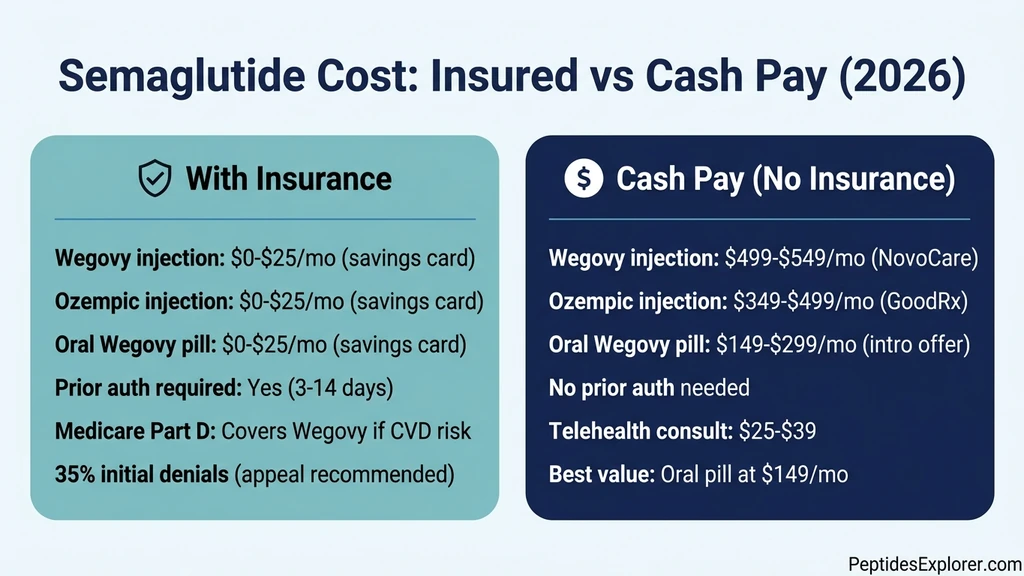
Cost is the single biggest barrier to semaglutide access. A 2024 KFF survey found that 1 in 4 adults who wanted GLP-1 medications did not pursue them because of price. The good news: 2026 pricing has improved across every pathway.
Brand-Name Pricing Breakdown
| Medication | List Price (monthly) | With Insurance + Savings Card | Cash Price (GoodRx/NovoCare) |
|---|---|---|---|
| Wegovy 2.4 mg injection | $1,349 | $0-$25 | $499-$549 |
| Ozempic 0.5-2 mg injection | $968 | $0-$25 | $349-$499 |
| Oral Wegovy 25 mg pill | $1,200 (est.) | $0-$25 | $149-$299 (intro offer) |
| Rybelsus 14 mg tablet | $936 | $0-$25 | $400-$500 |
Novo Nordisk savings cards reduce the copay to $0-$25/month for commercially insured patients. These cards are free to enroll and cover up to 24 fills. They do not work with Medicare, Medicaid, or other government insurance programs.
NovoCare Pharmacy offers direct-to-patient fulfillment with cash-pay pricing below retail. Wegovy injection at $499/month and Ozempic at $349-$499/month depending on dose.
GoodRx and similar discount programs negotiate lower cash prices at retail pharmacies. Pricing varies by pharmacy and ZIP code. Check multiple pharmacies before filling.
Insurance Coverage: What Actually Gets Approved
Commercial insurance: Coverage rates for semaglutide have improved since the SELECT cardiovascular trial results. Most large employer plans now cover Wegovy with prior authorization. Copays with manufacturer savings cards: $0-$25/month.
Medicare Part D: Now covers Wegovy for patients with BMI over 27 and established cardiovascular disease or high cardiovascular risk. This expansion, driven by the Inflation Reduction Act provisions and SELECT trial data, began rolling out in early 2026. Standard Part D cost-sharing applies.
Medicaid: Coverage varies dramatically by state. As of March 2026, approximately 20 states cover anti-obesity medications through Medicaid, but each has different prior authorization requirements, preferred drug lists, and step therapy mandates (requiring patients to fail cheaper medications first).
No insurance: The oral Wegovy introductory offer ($149-$299/month) is the most affordable brand-name option for uninsured patients. NovoCare Pharmacy direct pricing is the next best alternative.
If cost remains prohibitive, ask your prescriber about switching to tirzepatide, which may have different formulary placement on your specific insurance plan.
Step-by-Step: Your First Week on Semaglutide
You filled the prescription. The pen (or pill bottle) is in your hand. Here is exactly what the first seven days look like.
Day 1: Your First Dose
If using injectable Wegovy or Ozempic: 1. Remove the pen from the refrigerator 30 minutes before injection. Cold medication stings more. 2. Wash your hands. Clean the injection site (abdomen, thigh, or upper arm) with an alcohol swab. 3. Attach a new needle to the pen. Prime it according to the package insert (for first-time use only). 4. Dial to your starting dose: 0.25 mg for Ozempic, 0.25 mg for Wegovy. 5. Pinch a fold of skin. Insert the needle at a 90-degree angle. Press the dose button and hold for 6 seconds after the click. 6. Remove the needle. Do not rub the site. 7. Dispose of the needle in a sharps container. Cap the pen and return it to the refrigerator.
If using oral Wegovy: 1. Take the 1.5 mg tablet first thing in the morning on a completely empty stomach. 2. Swallow whole with no more than 4 oz of plain water. No coffee, no juice. 3. Wait 30 minutes before eating, drinking anything else, or taking other medications.
For a deeper look at unit-to-milligram conversions, see how many mg is 40 units of semaglutide.
Days 2-7: What to Expect
Appetite suppression begins within 24-48 hours for most patients. You will notice reduced hunger at mealtimes and earlier satiety. This is the GLP-1 receptor agonism working on the hypothalamus. Do not force yourself to eat large meals. Shift to smaller, more frequent meals.
Nausea affects approximately 44% of patients during the first dose level (Wilding et al., *NEJM*, 2021). It typically peaks at 24-48 hours post-injection and resolves within 3-5 days. Bland foods, small portions, and adequate hydration reduce severity. If nausea is significant, read how to relieve nausea from semaglutide for a 9-strategy protocol.
Injection site reactions are mild in 95%+ of cases: slight redness, minor swelling, or a small bruise. Rotate injection sites weekly.
No immediate weight loss. The first week on 0.25 mg is a titration dose designed to acclimate your GI system. Meaningful weight loss typically begins at the 1.0 mg dose level or higher. Read how long does semaglutide take to work for realistic timelines by dose level.
What not to do: Do not increase the dose faster than the prescribed schedule. Do not skip meals entirely (this worsens nausea). Do not drink alcohol during the first week. Keep the pen refrigerated. Check does semaglutide need to be refrigerated for exact temperature ranges and travel protocols.
Comprehensive Semaglutide Access Reference Table
| Question | Answer |
|---|---|
| Minimum BMI for Wegovy | 30 (or 27 with comorbidity) |
| Minimum BMI for Ozempic (on-label) | No BMI minimum; requires type 2 diabetes diagnosis |
| Age requirement | 12+ for Wegovy; 18+ for Ozempic |
| Prescription required? | Yes, all forms |
| Available without insurance? | Yes, via NovoCare, GoodRx, or telehealth cash-pay |
| Cheapest brand-name option (2026) | Oral Wegovy pill at $149/month (intro offer) |
| Insurance prior authorization needed? | Almost always for Wegovy; sometimes for Ozempic |
| Average prior authorization wait time | 3-14 business days |
| Telehealth consultation cost | $0-$39 depending on platform |
| Compounded semaglutide legal status (2026) | Restricted; only patient-specific 503A scripts with documented medical need |
| Available forms | Pre-filled injection pen, oral tablet |
| Refrigeration required? | Yes for injections; no for oral tablets |
| Starting dose (injection) | 0.25 mg weekly |
| Starting dose (oral) | 1.5 mg daily |
| Time to maintenance dose | 16-20 weeks |
| Half-life | Approximately 7 days (injection); similar for oral at steady state |
For before-and-after results at different dose levels and timelines, see our visual progress guide. If you are not losing weight on semaglutide after reaching the maintenance dose, review the troubleshooting checklist.
Common Mistakes When Getting Semaglutide
Mistake 1: Accepting the first insurance denial without appealing. A 2023 KFF analysis found that 35% of initial prior authorizations for GLP-1 medications are denied. But nearly half of those denials are overturned on appeal. The peer-to-peer review (your doctor calling the insurance medical director) is the single most effective step. Patients who skip the appeal process leave access on the table.
Mistake 2: Buying "semaglutide" from unregulated online sources. The FDA has issued multiple warnings about counterfeit and substandard semaglutide sold through social media, overseas pharmacies, and unlicensed websites. Some products contain no active ingredient at all. Others contain semaglutide salt forms never tested in humans. Only obtain semaglutide through a licensed U.S. pharmacy with a valid prescription. If the price seems too good to be true, the product is not what it claims. Check does semaglutide expire to verify proper dating on any product you receive.
Mistake 3: Starting at too high a dose because of impatience. The 0.25 mg starting dose produces minimal weight loss. Some patients, eager for faster results, convince telehealth providers to start at 0.5 mg or higher. This nearly doubles the rate of severe nausea and GI side effects, increasing the chance of discontinuation. The titration schedule exists because the STEP trials validated it. Follow it. For patients who want gradual approaches, microdosing semaglutide is a structured alternative.
Mistake 4: Not tracking your mixing ratios with compounded products. Patients using compounded semaglutide from vials (before the shortage ended) often miscalculate reconstitution volumes. Adding 2 mL of bacteriostatic water to a 5 mg vial produces a concentration of 2.5 mg/mL. Drawing 0.1 mL delivers 0.25 mg. Getting this wrong means getting the wrong dose every single week. Use a reconstitution calculator to verify before every draw.
Semaglutide vs. Other GLP-1 Options: Quick Comparison
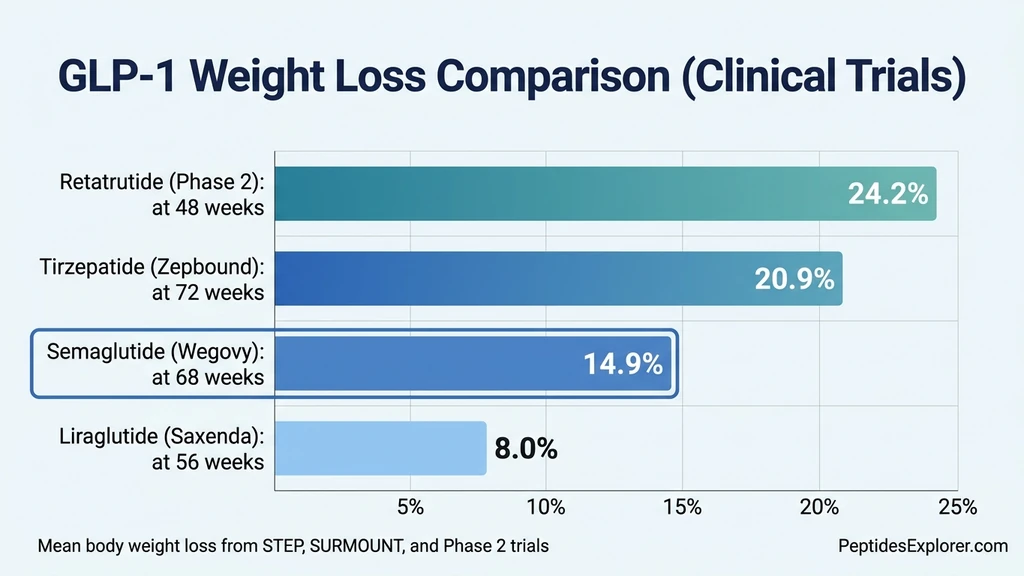
If semaglutide is unavailable, too expensive, or not covered by your plan, these alternatives target the same GLP-1 pathway.
| Medication | Mechanism | Weekly Weight Loss (STEP/SURMOUNT trials) | Monthly Cost Range | Form |
|---|---|---|---|---|
| Semaglutide (Wegovy) | GLP-1 agonist | 14.9% at 68 weeks | $149-$1,349 | Injection or pill |
| Tirzepatide (Zepbound) | GLP-1 + GIP dual agonist | 20.9% at 72 weeks | $150-$1,060 | Injection |
| Liraglutide (Saxenda) | GLP-1 agonist (daily) | 8% at 56 weeks | $200-$1,349 | Daily injection |
| Retatrutide (Phase 3) | GLP-1 + GIP + glucagon triple agonist | 24.2% at 48 weeks (Phase 2) | Not yet available | Injection (clinical trials) |
Tirzepatide produces greater mean weight loss in head-to-head comparisons. If your insurance covers Zepbound but not Wegovy, switching from semaglutide to tirzepatide may be the practical choice. Semaglutide stays in your system for approximately five weeks after the last dose, so your prescriber will time the transition accordingly.
Frequently Asked Questions
Can I get semaglutide without a prescription?
No. Semaglutide is a prescription-only medication in all forms: injectable Wegovy, injectable Ozempic, oral Wegovy pill, and Rybelsus. Any website selling semaglutide without requiring a medical evaluation is operating illegally. A licensed prescriber must evaluate your BMI, medical history, and contraindications before writing a script. Start with your primary care doctor or a telehealth consultation that includes a real provider evaluation.
How long does it take to get approved for semaglutide?
Telehealth platforms can prescribe within 24-72 hours if you meet eligibility criteria. In-person prescriptions with insurance prior authorization take 1-3 weeks. If your insurer denies the initial request, the appeal process adds another 2-4 weeks. Bring recent lab work to your first appointment to avoid delays. The semaglutide dosage calculator helps you prepare dose questions in advance.
Is compounded semaglutide still available in 2026?
In very limited circumstances. The FDA removed semaglutide from the drug shortage list in February 2025, ending the broad compounding allowances. As of 2026, only 503A pharmacies can compound patient-specific prescriptions when a prescriber documents that brand-name products are medically unsuitable (e.g., excipient allergy). Bulk compounding for general dispensing is no longer legal. If you used compounded semaglutide with B12, discuss brand-name alternatives with your provider.
What is the cheapest way to get semaglutide in 2026?
The oral Wegovy pill at $149/month (Novo Nordisk introductory offer for 1.5 mg and 4 mg doses) is the lowest-cost brand-name option for cash-pay patients. With commercial insurance plus a manufacturer savings card, copays drop to $0-$25/month for any formulation. NovoCare Pharmacy offers injectable Wegovy at $499/month for uninsured patients. Check before-and-after results to set realistic expectations for your investment.
Does Medicare cover semaglutide for weight loss?
Medicare Part D now covers Wegovy for patients with BMI over 27 and established cardiovascular disease or high cardiovascular risk. This expansion followed the SELECT trial showing a 20% reduction in major cardiovascular events. Standard Part D cost-sharing applies (no manufacturer savings card). If you do not meet the cardiovascular criteria, Medicare does not yet cover semaglutide solely for weight loss. Talk to your prescriber about documenting side effects duration and cardiovascular risk factors.
Can I switch from Ozempic to Wegovy?
Yes, with your prescriber's guidance. Ozempic maxes out at 2 mg weekly; Wegovy goes up to 2.4 mg. If you started Ozempic off-label for weight loss and want the higher approved dose, your doctor can transition you. Insurance may require a new prior authorization for Wegovy. The active ingredient is identical, so no washout period is needed. Use the semaglutide dosage chart in mL to map equivalent doses during the switch.
How do I store semaglutide after I receive it?
Unopened injectable pens: refrigerate at 36-46 degrees F (2-8 degrees C). After first use, Ozempic pens can stay at room temperature (up to 86 degrees F) for 56 days; Wegovy pens for 28 days. Oral Wegovy tablets: store at room temperature, no refrigeration needed. Never freeze injectable semaglutide. If your pen was accidentally left out, check does semaglutide expire for stability windows and temperature exposure limits.
What happens if I stop taking semaglutide?
Weight regain is common. The STEP 4 trial found that patients who stopped semaglutide at week 20 regained two-thirds of their lost weight by week 68, while those who continued maintained their losses (Rubino et al., *JAMA*, 2021). Semaglutide has a 7-day half-life and stays in your system for approximately five weeks after the last injection. Appetite gradually returns over 2-4 weeks as the drug clears.
The Bottom Line
Getting semaglutide in 2026 is more accessible than at any point since the drug's approval. Brand-name injections remain the gold standard, with insurance copays as low as $0-$25/month. The new oral Wegovy pill opens the door for needle-averse patients at $149-$299/month cash price. Telehealth platforms compress the prescription timeline from weeks to days.
Your action plan: calculate your BMI, gather recent lab work, and choose your pathway. Insured patients should start with their primary care doctor for the highest prior authorization approval rate. Cash-pay patients should explore the oral Wegovy introductory offer or NovoCare Pharmacy direct pricing. In every case, work with a licensed prescriber who monitors your progress monthly.
Use the semaglutide dosage calculator to estimate your starting dose. Review semaglutide before-and-after results for realistic timeline expectations. If you experience side effects during titration, the nausea relief guide and fatigue management strategies provide specific protocols.
Take our peptide quiz to see which GLP-1 pathway matches your goals, insurance status, and medical profile.
Related Articles: - Semaglutide Before and After: real results by dose level and timeline - Semaglutide Dosage Chart in mL: complete injection volume reference - How to Microdose Semaglutide: low-dose protocol for sensitive patients - Semaglutide to Tirzepatide Switching Guide: when and how to transition - Not Losing Weight on Semaglutide: troubleshooting stalls at any dose - Compound Semaglutide with B12: what the combination adds and when it matters
Helpful Tools
Related Articles
Can You Drink on Semaglutide? Risks
Can you drink on semaglutide? No ban, but risks include hypoglycemia, prolonged intoxication, 73% fat-burn suppression, and worse GI side effects.
How Much Is Semaglutide? 2026 Cost Breakdown
Semaglutide costs $149-$1,349/month depending on formulation. Compare Wegovy, Ozempic, compounded, and oral prices with savings strategies.
Semaglutide Before and After Results
Semaglutide before and after results from STEP clinical trials: 5% weight loss at 2 months, 10% at 4 months, and 14.9% at 16 months.
How Long Does Semaglutide Take to Work?
Semaglutide reduces appetite within days, produces measurable weight loss at 4-8 weeks, and delivers significant results by 12-16 weeks.