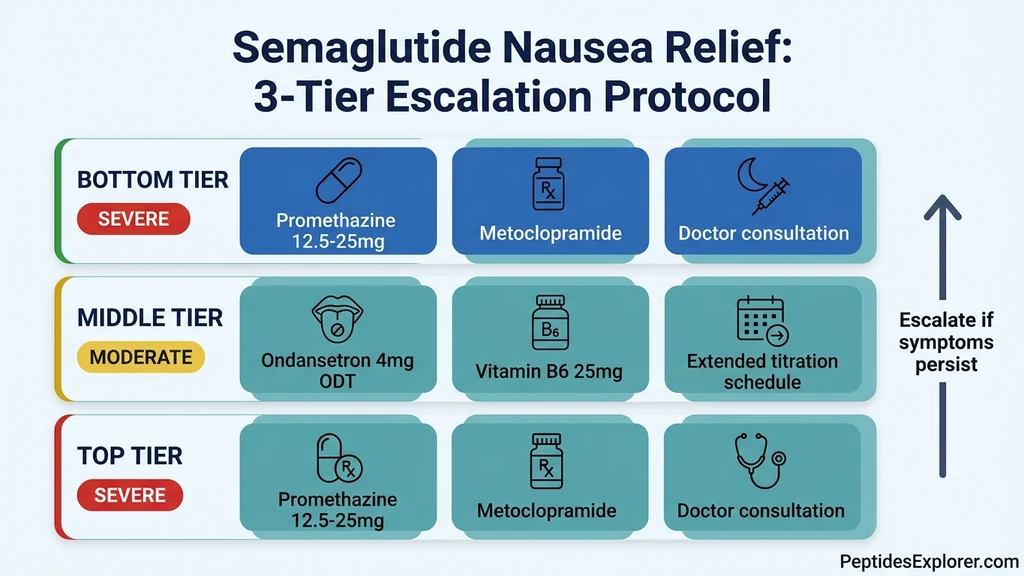
You took your semaglutide injection 18 hours ago. A wave of queasiness hits as you open the fridge. Breakfast is not happening. You can relieve semaglutide nausea right now. Ondansetron 4 mg dissolves on your tongue and blocks the vomiting reflex within 30 minutes. Ginger capsules at 250 mg cut nausea severity by 40% in clinical trials. Acupressure at the P6 wrist point works in under 5 minutes for one-third of users. This article gives you nine specific protocols to stop the nausea, not just understand it.
If you want to know *why* semaglutide causes nausea (the mechanism, the timeline, the clinical data), read does semaglutide cause nausea. This guide assumes you already know the cause. You need the fix.
| Nausea Relief Method | How Fast It Works | Best For | Evidence Level |
|---|---|---|---|
| Ondansetron (Zofran) 4 mg | 15-30 minutes | Moderate to severe nausea | Rx, clinical trials |
| Promethazine 12.5-25 mg | 20-30 minutes | Severe nausea with vomiting | Rx, clinical trials |
| Ginger 250 mg capsules | 30-60 minutes | Mild to moderate nausea | OTC, systematic reviews |
| P6 acupressure wristband | Under 5 minutes | Mild nausea, drug-free option | OTC, Cochrane review |
| Vitamin B6 25 mg | 1-3 days (cumulative) | Ongoing low-grade nausea | OTC, RCTs |
| Bedtime injection timing | Next dose cycle | Preventing peak nausea | Clinical practice |
| Small frequent meals | Same day | Gastric distension nausea | Expert consensus |
| Bland food protocol | Same day | Dose escalation weeks | Expert consensus |
| Extended titration | Next dose cycle | Recurrent severe nausea | Clinical trials |
Use our semaglutide dosage calculator to confirm your current dose before adjusting timing or titration.
Get your custom peptide protocol:
- Tailored to your body and goals
- Precise dosing and cycle length
- Safe stacking combinations
- Backed by peer-reviewed studies
- Ready in under 2 minutes
Prescription Antiemetics: The Fastest Relief
When nausea is moderate to severe, over-the-counter remedies are not enough. Two prescription medications work directly on the brain pathways that semaglutide activates.
Ondansetron (Zofran): First-Line Choice
Ondansetron blocks serotonin 5-HT3 receptors in the area postrema, the same brain region where semaglutide triggers the vomiting reflex. It works centrally and peripherally through vagus nerve terminals in the gut (Ondansetron, StatPearls 2024).
Protocol: Take 4 mg orally dissolving tablet (ODT) at the first sign of nausea. The tablet dissolves on the tongue without water. Repeat every 8 hours if needed, up to 12 mg per day. No known drug interactions with semaglutide.
Timing hack: If nausea always peaks the morning after injection, take 4 mg prophylactically before bed on injection night. A study of GLP-1 agonist users found prophylactic antiemetics reduced nausea incidence by over 50% compared to no premedication (Calara et al., 2011).
Side effects are mild: headache in 9-11% of users, constipation in 5-9%. Constipation matters because semaglutide already slows gut transit. Drink extra water and increase fiber on days you take ondansetron.
Promethazine (Phenergan): For Refractory Nausea
When ondansetron is not enough, promethazine attacks nausea through a different pathway. It blocks dopamine receptors, histamine H1 receptors, and muscarinic receptors in the brain's chemoreceptor trigger zone (Promethazine, StatPearls 2024).
Protocol: 12.5-25 mg orally every 4-6 hours as needed. Start with 12.5 mg. Low-dose promethazine (6.25-12.5 mg IV) relieved nausea and vomiting at one hour in 68-74% of patients (Braude et al., 2006).
The trade-off: Promethazine causes significant drowsiness. In a head-to-head trial, promethazine produced equivalent nausea relief to ondansetron but far more sedation (Barrett et al., 2008). Take it at night or when you can sleep. Do not drive.
Combining both: Your prescriber may recommend ondansetron during the day and promethazine at bedtime. The combination covers serotonin and dopamine pathways simultaneously. This dual approach is common in oncology antiemetic protocols and applies well to GLP-1 nausea during dose escalation.
Metoclopramide: A Specialized Option
Metoclopramide (Reglan) speeds up gastric emptying, directly countering semaglutide's gut-slowing effect. A prescriber may consider it when nausea is primarily driven by food sitting in the stomach for hours. Typical dose is 10 mg before meals.
This is not a first-line option. Metoclopramide carries a black box warning for tardive dyskinesia with prolonged use. Limit it to short courses (5-7 days) during the worst dose transitions. Your prescriber will weigh the risks.
Ginger: The Best Over-the-Counter Antiemetic
Think of ginger as the ibuprofen of nausea relief. It is not as powerful as prescription drugs, but it is available without a visit, backed by real data, and safe for daily use. Ginger contains gingerols and shogaols that block serotonin receptors in the gut and accelerate gastric emptying. Both actions directly oppose what semaglutide does to your digestive system.
A systematic review of randomized clinical trials confirmed ginger's antiemetic effect across multiple settings: postoperative nausea, chemotherapy-induced nausea, and pregnancy nausea (Ernst & Pittler, 2000). A 2021 meta-analysis of 10 trials found ginger significantly reduced acute nausea severity (Crichton et al., 2021).
Dosing protocol: - Capsules: 250 mg standardized ginger extract, 3-4 times daily with meals. Total: 750-1,000 mg per day. Look for products standardized to 5% gingerols. - Fresh ginger tea: Slice 1 inch (2.5 cm) of fresh ginger root. Steep in 8 oz boiling water for 10 minutes. Drink 2-3 cups daily. Add lemon if tolerated. Avoid added sugar during nausea episodes. - Ginger chews or candies: Keep in your pocket for acute waves. Less potent than capsules but faster relief. Chew at the first hint of queasiness.
What does not work: Ginger ale contains almost no real ginger. The carbonation may temporarily soothe but provides no antiemetic benefit. Use actual ginger products.
Start ginger the day before your injection and continue for 3-4 days after. This covers the peak nausea window. You can use ginger alongside ondansetron. They work through different receptor pathways with no interaction.
P6 Acupressure: Drug-Free Relief in Minutes
The P6 (Neiguan) point sits on your inner wrist, two thumb-widths below the wrist crease, between the two tendons. Pressing it reduces nausea by modulating vagal nerve signaling to the brainstem.
This is not folk medicine. A Cochrane review of 26 trials with over 3,000 patients found P6 stimulation superior to sham treatment for both nausea and vomiting (Lee & Fan, 2009). A pilot study specifically on GLP-1 medication users found one-third of participants experienced nausea relief within 5 minutes of wearing acupressure wristbands (PubMed, 2024).
How to apply: 1. Turn your palm face-up. Place three fingers across your wrist starting from the wrist crease. 2. The P6 point is just below your index finger, between the two tendons running up your forearm. You can feel the tendons by flexing your wrist slightly. 3. Press firmly with your thumb for 2-3 minutes. You should feel a dull ache, not sharp pain. 4. Switch to the other wrist and repeat.
Wristbands: Sea-Band and similar acupressure wristbands apply constant pressure to P6. Wear them starting the morning after your injection. They cost $5-10 at any pharmacy. No side effects. No drug interactions. You can wear them alongside any medication protocol.
P6 acupressure works best for mild to moderate nausea. If you are vomiting, reach for ondansetron first and use acupressure as an adjunct.
Vitamin B6: The Slow-Build Anti-Nausea Supplement
Vitamin B6 (pyridoxine) does not stop nausea in the moment. It builds up over 1-3 days of regular dosing and reduces baseline nausea severity. A randomized, double-blind, placebo-controlled trial found that 25 mg of vitamin B6 every 8 hours for 72 hours significantly reduced nausea: only 8 of 31 patients in the B6 group still had vomiting versus 15 of 28 on placebo (Vutyavanich et al., 1995).
Protocol: 25 mg three times daily, taken with meals. Total: 75 mg per day. Doses up to 200 mg per day are safe without neurological side effects (StatPearls, Vitamin B6). The active metabolite, pyridoxal 5-phosphate (PLP), appears to be the antiemetic form (Matok et al., 2014).
When to use it: Start B6 two days before a planned dose increase. Continue daily through the first two weeks at the new dose. This is a background strategy, not a rescue medication. Pair it with ginger or ondansetron for acute episodes.
B6 is available at any pharmacy without a prescription. It is the only vitamin with consistent antiemetic data across multiple randomized trials.
Injection Timing: Sleep Through the Worst of It
Semaglutide nausea typically peaks 12-24 hours after injection. If you inject at 8 AM on Saturday, nausea hits hardest Saturday night through Sunday morning. If you inject at 9 PM on Friday, peak nausea occurs while you sleep Friday night and into Saturday morning. You wake up through the worst of it.
The bedtime protocol: 1. Eat a small, bland dinner by 6 PM. 2. Inject semaglutide at 9-10 PM. 3. Go to bed within 30-60 minutes of injection. 4. Keep crackers and water on your nightstand. 5. Eat a small, plain breakfast when you wake (toast, banana, rice).
This does not eliminate nausea. Semaglutide has a 7-day half-life, so some queasiness can appear any time during the week. But shifting the acute peak to sleeping hours makes the first 24-48 hours more tolerable.
Pick your worst day: Some users inject Thursday evening so Friday (the most common peak nausea day) falls on a workday where distraction helps. Others inject Friday evening so the worst hits on a weekend when they can rest. Choose the day that aligns with your schedule. Once you pick a day, keep it consistent. Your body adapts to the rhythm.
For details on how injection timing relates to dose levels, see the semaglutide dosage chart in mL.
The Anti-Nausea Diet: What to Eat and When
Semaglutide slows gastric emptying by 30-40%. A normal-sized meal that clears your stomach in 2 hours now takes 3-4. The extra time creates distension, triggers stretch receptors, and fires the nausea signal. Your eating strategy must account for a stomach that empties at half speed.
A multidisciplinary expert consensus on managing GLP-1 GI adverse events emphasized dietary modifications as a first-line intervention, particularly smaller meals and avoidance of high-fat foods (Trujillo et al., 2022).
The Small-Meal Schedule
Split your daily intake into 5-6 small meals instead of 2-3 large ones. Each meal should fit on a salad plate, not a dinner plate. Stop eating the moment you feel satisfied, not full. Semaglutide amplifies fullness signals. What feels like "almost full" becomes "overfull" 10 minutes later.
Sample schedule: - 7 AM: 2 scrambled eggs + 1 slice toast - 10 AM: Greek yogurt + handful of berries - 12:30 PM: 3 oz grilled chicken + steamed vegetables + 1/2 cup rice - 3:30 PM: Apple slices + 1 tablespoon almond butter - 6 PM: 3 oz baked fish + roasted sweet potato + green salad - 8 PM (optional): Small banana or handful of crackers
Total calories stay adequate (1,200-1,800 per day depending on your targets) but no single meal overwhelms a slow-emptying stomach.
Foods That Reduce Nausea
Bland, starchy foods absorb gastric acid and empty faster. During dose escalation weeks, lean toward these: - Plain rice, plain pasta, boiled potatoes - Toast (dry or with a thin layer of butter) - Bananas, applesauce, plain crackers - Chicken broth or bone broth (sip warm, not hot) - Boiled or steamed chicken breast
Cold foods produce fewer nausea-triggering aromas than hot foods. A cold chicken wrap may sit better than a hot stir-fry. Temperature matters.
Foods That Make Nausea Worse
Fatty, fried, and rich foods take the longest to digest. With gastric emptying already slowed by 30-40%, these create hours of distension: - Fried chicken, french fries, onion rings - Creamy sauces, butter-heavy dishes, full-fat cheese - Red meat (steak, burgers) in large portions - Spicy foods (capsaicin can irritate an already-sensitized stomach) - Very sweet desserts (delay emptying further)
Alcohol compounds the problem. It irritates gastric mucosa and impairs the already-delayed gastric motility. Avoid alcohol during dose escalation weeks entirely.
Hydration Protocol
Dehydration worsens nausea. If nausea reduces your food intake, you are also drinking less. Sip water steadily throughout the day. Do not gulp large amounts at once, as that stretches the stomach.
Targets: 64-80 oz (2-2.5 liters) of water daily. Add electrolytes if vomiting occurs: a pinch of salt and a squeeze of lemon in water, or a low-sugar electrolyte drink. Avoid carbonated beverages if they increase bloating for you.
Drink between meals, not during them. Liquid taken with food increases gastric volume and slows emptying further.
Extended Titration: The Most Underused Strategy
The standard semaglutide titration schedule increases the dose every 4 weeks: 0.25 mg, 0.5 mg, 1.0 mg, 1.7 mg, 2.4 mg. The STEP 2 trial used a slower titration in some patients and reported a nausea rate of 33.6% versus 44.2% in STEP 1 (Davies et al., 2021). Slower escalation produced 25% less nausea.
If nausea is severe at any dose level, you have three options:
- 1.Stay at the current dose for 8 weeks instead of 4. The extra 4 weeks lets your brain's GLP-1 receptors fully downregulate. Many prescribers now use 6-8 week intervals as standard practice.
- 2.Add an intermediate step. Between 0.5 mg and 1.0 mg, some compounding pharmacies can prepare 0.75 mg. Between 1.0 mg and 1.7 mg, try 1.25 mg. Smaller jumps produce less nausea. If using compounded semaglutide, discuss intermediate dosing with your prescriber.
- 3.Microdose. Some users stay at sub-standard doses permanently. A 0.5 mg maintenance dose still suppresses appetite and produces weight loss, just at a slower rate. Read our guide on how to microdose semaglutide for the protocol.
The weight loss still happens at lower doses. A STEP 1 sub-analysis found that participants who experienced GI adverse events (including those who slowed titration) achieved comparable 68-week weight loss to those without GI events (Wharton et al., 2022). Slowing down does not sacrifice results.
Check your exact dose and volume with our semaglutide dosage calculator.
Physical Strategies That Work Immediately
These require no pills, no prescriptions, and no preparation. Use them for mild nausea or alongside medications for moderate episodes.
Stay Upright After Eating
Gravity moves food from your stomach into the small intestine. Lying down traps it. Sit upright or stand for at least 30 minutes after every meal. A gentle 10-15 minute walk after dinner is even better. Walking stimulates gastric motility and counteracts semaglutide's slowing effect.
Do not exercise intensely within 2 hours of eating. Heavy exertion redirects blood flow away from the gut, further delaying digestion.
Cool Air and Cold Compresses
Nausea often comes with a warm, flushed sensation. Step outside into cool air. Place a cold, damp cloth on the back of your neck or forehead. Open a window. The vagal response to cold stimulation can interrupt the nausea signal within minutes.
Controlled Breathing
Slow, deep breathing activates the parasympathetic nervous system and reduces the urgency of the nausea reflex. Inhale through your nose for 4 seconds, hold for 2 seconds, exhale through your mouth for 6 seconds. Repeat for 2-3 minutes. This works best at the first hint of nausea, before it escalates.
When to Call Your Doctor: Red Flags
Most semaglutide nausea is uncomfortable but not dangerous. These situations require medical attention:
Call your prescriber within 24 hours if: - Nausea persists beyond 6 weeks at the same dose (may indicate gastroparesis) - You cannot eat enough to reach 1,000 calories per day for 3+ consecutive days - You notice signs of dehydration: dark urine, dizziness when standing, dry mouth - Nausea worsens instead of improving after the first week at a dose level
Go to urgent care or the ER if: - Vomiting more than 3 times in a single day - Cannot keep any fluids down for 12+ hours - Severe abdominal pain radiating to the back (possible pancreatitis, 0.1-0.3% incidence with semaglutide) - Blood in vomit or stool - Heart palpitations with persistent vomiting (electrolyte imbalance)
Persistent vomiting causes dehydration and electrolyte imbalances that can cascade into acute kidney injury. Semaglutide stays in your system for about five weeks, so stopping the drug does not bring immediate relief. Your prescriber may need to provide IV fluids and monitor electrolytes while the drug clears.
Semaglutide is contraindicated with a personal or family history of medullary thyroid carcinoma or MEN2 syndrome. If you develop neck swelling or difficulty swallowing alongside nausea, seek immediate evaluation.
Building Your Personal Anti-Nausea Protocol
No single strategy works for everyone. Build a layered protocol based on your nausea severity.
Mild nausea (can eat, can work, just uncomfortable): 1. Ginger capsules 250 mg, 3x daily with meals 2. P6 acupressure wristbands on injection day + 2 days after 3. Small frequent meals, bland food focus 4. Bedtime injection timing
Moderate nausea (eating is difficult, low energy, affects daily function): 1. Everything from the mild protocol 2. Ondansetron 4 mg as needed, up to 3x daily 3. Vitamin B6 25 mg, 3x daily starting 2 days before injection 4. Extended titration: 6-8 weeks per dose level instead of 4
Severe nausea (vomiting, cannot eat, considering stopping semaglutide): 1. Ondansetron 4 mg prophylactically before bed on injection night 2. Promethazine 12.5-25 mg at bedtime if ondansetron alone is insufficient 3. Contact your prescriber about adding an intermediate dose step 4. Consider microdosing semaglutide at a lower maintenance dose 5. If nausea is contributing to fatigue, address caloric intake first
Print this protocol. Tape it to your fridge. Refer to it each injection day until you are past the titration phase.
Common Mistakes That Make Nausea Worse
Mistake 1: Skipping meals to avoid nausea. An empty stomach produces more gastric acid with nowhere to go. That acid irritates the stomach lining and worsens nausea. Eat small amounts even when you do not feel hungry. Two crackers and a sip of broth are better than nothing.
Mistake 2: Escalating the dose on schedule despite severe nausea. The 4-week titration is a guideline, not a mandate. If nausea is severe at 0.5 mg, increasing to 1.0 mg will make it worse. Stay at the current dose until symptoms are manageable. Your prescriber expects dose adjustments.
Mistake 3: Using ginger ale instead of real ginger. Commercial ginger ale contains negligible gingerols. Some brands contain zero real ginger. You need 750-1,000 mg per day of actual ginger extract for antiemetic benefit. Capsules, fresh root, or ginger chews. Not soda.
Mistake 4: Drinking large amounts of water with meals. Water adds volume to a stomach that already empties slowly. Sip between meals, not during them. If you need a drink with food, take small sips. Save your main hydration for the gaps between eating.
Frequently Asked Questions
What is the fastest way to relieve semaglutide nausea?
Ondansetron (Zofran) 4 mg orally dissolving tablet works within 15-30 minutes by blocking serotonin receptors in the brain's vomiting center. It requires a prescription. For immediate non-drug relief, apply firm pressure to the P6 acupressure point on your inner wrist for 2-3 minutes. One-third of users report improvement within 5 minutes.
Can I take Zofran every day while on semaglutide?
Ondansetron (Zofran) is safe for short-term daily use during dose escalation at 4 mg up to 3 times per day (12 mg max). No drug interactions exist with semaglutide. Most prescribers recommend limiting daily use to the first 1-2 weeks at each new dose level. If you need it daily beyond 4 weeks, discuss extended titration with your prescriber.
Does ginger actually help with semaglutide nausea?
Yes. Ginger (750-1,000 mg per day of standardized extract) reduces nausea severity by blocking serotonin receptors in the gut and speeding gastric emptying. A Cochrane-level systematic review confirmed efficacy across multiple nausea types. Use capsules standardized to 5% gingerols, not ginger ale, which contains negligible active compounds.
Should I inject semaglutide in the morning or at night to avoid nausea?
Inject at bedtime (9-10 PM). Nausea peaks 12-24 hours after injection, so a nighttime dose shifts the worst window into sleeping hours. Eat a small, bland dinner by 6 PM before injecting. Keep crackers and water on your nightstand. Injection timing does not affect weight loss efficacy.
Is it safe to take promethazine with semaglutide?
Yes. Promethazine 12.5-25 mg is safe alongside semaglutide with no known drug interactions. It blocks dopamine and histamine receptors, complementing ondansetron's serotonin blockade. The main side effect is significant drowsiness. Take it at bedtime only. Do not drive after taking promethazine.
Will slowing my semaglutide titration reduce nausea?
Significantly. The STEP 2 trial used slower titration and reported 33.6% nausea versus 44.2% in STEP 1, a 25% reduction. Staying at each dose for 6-8 weeks instead of 4 weeks gives GLP-1 receptors more time to adapt. Weight loss outcomes remain comparable at 68 weeks regardless of titration speed.
What foods should I avoid on semaglutide to prevent nausea?
Avoid fatty, fried, and rich foods. Semaglutide slows gastric emptying by 30-40%, and fat takes the longest to digest. A greasy meal can sit in your stomach for 5+ hours, causing severe distension and nausea. Favor lean proteins, plain starches (rice, toast, potatoes), and cooked vegetables during dose escalation weeks.
When should I go to the ER for semaglutide nausea?
Go to urgent care or the ER if you vomit more than 3 times in one day, cannot keep fluids down for 12+ hours, have severe abdominal pain radiating to your back (possible pancreatitis), or notice blood in your vomit. Persistent vomiting causes dehydration and electrolyte imbalances that can progress to acute kidney injury.
The Bottom Line
Semaglutide nausea responds to a layered approach. Start with the basics: bedtime injection, small frequent meals, bland foods during dose escalation. Add ginger capsules (250 mg, 3-4 times daily) and P6 acupressure wristbands. If nausea remains moderate to severe, ask your prescriber for ondansetron 4 mg as needed. For refractory cases, promethazine at bedtime or extended titration intervals solve most remaining problems.
The nausea is temporary. It peaks during dose transitions and resolves for 80-90% of users within 6-8 weeks at a stable dose. Slowing your titration does not compromise long-term weight loss. Going slower is almost always the right call.
Use our semaglutide dosage calculator to plan your next dose step. For the full dose-by-dose schedule, see the semaglutide dosage chart in mL. If nausea is causing fatigue, read does semaglutide cause fatigue for energy recovery strategies.
Related Articles: - Does Semaglutide Cause Nausea? — mechanism, timeline, and clinical trial data - How to Microdose Semaglutide — low-dose protocol that minimizes GI side effects - How Long Do Semaglutide Side Effects Last? — week-by-week resolution timeline - Not Losing Weight on Semaglutide — when nausea-driven undereating causes stalls - Semaglutide Mixing Chart — correct reconstitution to avoid concentration errors
Related Articles
Does Semaglutide Cause Heartburn?
Does semaglutide cause heartburn? Yes, in 1.9-5% of users. Delayed gastric emptying mechanism, GERD differences, and 7 ways to manage it.
Can Semaglutide Cause Depression?
Clinical trials show semaglutide does not increase depression risk. FDA cleared GLP-1 drugs of suicidality concerns in 2025. Evidence and mechanisms.
Can Semaglutide Cause Diarrhea?
Diarrhea affects 8-30% of semaglutide users depending on dose. Learn the GLP-1 mechanism, STEP trial incidence data, timeline, and 6 management strategies.
Semaglutide Side Effects Duration
Most semaglutide side effects resolve within 2-4 weeks as your body adjusts. See clinical timelines for nausea, diarrhea, constipation, and fatigue.