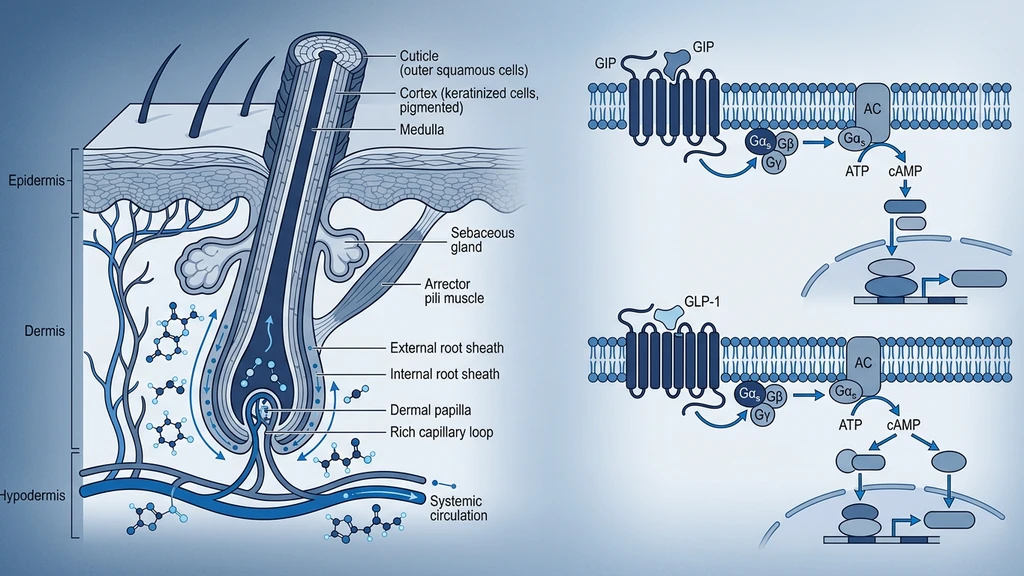
You are five months into Mounjaro. Down 45 pounds. Your hairbrush is collecting more than usual, and the part in your hair looks wider than it did last month. Tirzepatide does not directly cause hair loss. The SURMOUNT-1 trial reported thinning in 5.7% of users at 15 mg, compared to 1.0% on placebo (Jastreboff et al., NEJM 2022). The culprit is rapid weight loss triggering telogen effluvium, not the drug. Regrowth is expected within 6-12 months of weight stabilization.
| Quick Reference | Details |
|---|---|
| Prevalence | 2.8% (5 mg), 4.1% (10 mg), 5.7% (15 mg) |
| Cause | Rapid weight loss, not tirzepatide itself |
| Onset | Months 3-5 |
| Peak shedding | Months 5-7 |
| Resolution | 9-18 months (self-limiting) |
| Key prevention | Protein: 1.0g per pound body weight |
| Evidence level | Human clinical trials (SURMOUNT-1, SURMOUNT-4) |
For dosing protocols, see our tirzepatide dosage chart. For safety information, see our peptide safety guide.
Get your custom peptide protocol:
- Tailored to your body and goals
- Precise dosing and cycle length
- Safe stacking combinations
- Backed by peer-reviewed studies
- Ready in under 2 minutes
What Causes Hair Loss on Tirzepatide?
Your body runs like a company during layoffs. When revenue (calories) drops sharply, non-essential departments close first. Hair growth is the first to go. The heart, brain, and liver keep their full staff. Follicles get mothballed.
Tirzepatide produces 22.5% average weight loss at 15 mg — see does tirzepatide burn fat for the mechanism — the most aggressive caloric deficit of any GLP-1 drug on the market. That speed forces the body to prioritize survival over cosmetics. Hair follicles shift from anagen (growth) to telogen (rest) prematurely. After 2-3 months in telogen, affected hairs shed in a wave.

The dose-dependent pattern from SURMOUNT-1 confirms the weight loss connection:
| Tirzepatide Dose | Hair Thinning | Average Weight Loss | Placebo |
|---|---|---|---|
| 5 mg | 2.8% | 16.0% | 1.0% |
| 10 mg | 4.1% | 21.4% | 1.0% |
| 15 mg | 5.7% | 22.5% | 1.0% |
Higher doses produce more weight loss, which produces more shedding. The drug is not toxic to follicles. The deficit is.
The Cost of Ignoring Protein During Rapid Weight Loss
A woman on tirzepatide 15 mg lost 22% of her body weight in 7 months. She ate roughly 1,100 calories daily with only 40 grams of protein. By month 6, she had lost an estimated 35-40% of visible hair volume. Her ferritin was 12 ng/mL (below the 30 ng/mL threshold for hair health).
At 1.0g protein per pound body weight, her target was 140 grams daily. She was eating less than a third of that. Supplementing iron, increasing protein to 120 grams via shakes and Greek yogurt, and holding at 10 mg instead of escalating to 15 mg slowed the shedding within 6 weeks.
SURMOUNT-1 showed 10 mg delivers 21.4% weight loss versus 22.5% at 15 mg. That is 1.1 percentage points of weight loss traded for a meaningfully lower thinning rate: 4.1% versus 5.7%. For users who prioritize hair retention, the math favors 10 mg. Rapid weight loss has other transient costs too, including the joint aches covered in can tirzepatide cause joint pain.
When Does Tirzepatide Hair Loss Start and Stop?
Hair thinning follows the same biological clock as any rapid weight loss, delayed by the 2-3 month telogen phase.
Onset: Months 3-5
Shedding appears 3-5 months after starting tirzepatide, as cumulative weight loss exceeds 10-15% of body weight. The delay is biological: follicles enter telogen immediately when stressed, but the resting phase lasts 2-3 months before hair falls out. Thinning in month 5 was triggered by weight loss in months 2-3.
Peak: Months 5-7
Shedding is heaviest during peak weight loss velocity, typically at the 10-15 mg dose range. The caloric deficit is largest. Weight is dropping fastest. SURMOUNT-1 showed higher doses consistently produced more thinning.
Resolution: Months 9-18
Shedding slows as weight loss decelerates. Full regrowth within 12-18 months. SURMOUNT-4 (88 weeks) demonstrated stable hair loss rates after the first year, confirming the condition is self-limiting even with continued treatment (Wadden et al., 2023).
When to See a Dermatologist
Telogen effluvium causes uniform thinning. Distinct patches suggest alopecia areata, a different condition. Seek evaluation if shedding persists 6+ months after weight stabilizes, or if you also experience fatigue and cold intolerance (possible thyroid involvement).
How to Minimize Hair Loss on Tirzepatide
Four strategies reduce the severity and duration of thinning.
Maximize Protein Intake
Aim for 1.0 gram per pound of body weight daily. Hair is 95% keratin, a protein. Tirzepatide suppresses appetite aggressively, making this target hard to hit. If the appetite suppression is stalling your weight loss entirely, see why am I not losing weight on tirzepatide. Prioritize protein at every meal: Greek yogurt, eggs, chicken, fish. Use whey shakes to bridge gaps. Protein is the single most important nutrient for follicle maintenance during weight loss.
Consider Staying at 10 mg
If hair thinning matters to you, discuss holding at 10 mg rather than escalating to 15 mg. SURMOUNT-1 data: 21.4% weight loss at 10 mg versus 22.5% at 15 mg. Only 1.1 percentage points of difference in weight loss. But 4.1% thinning versus 5.7%. The marginal weight loss may not justify the added shedding.
Supplement Strategically
Biotin (5,000 mcg/day) supports keratin synthesis. Zinc (30 mg/day) is essential for follicle cycling. Iron: supplement only if bloodwork confirms deficiency. Vitamin D below 30 ng/mL correlates with thinning. A comprehensive review confirmed that protein, iron, zinc, and caloric restriction are all independent risk factors for telogen effluvium (Almohanna et al., 2019).
Biotin interferes with thyroid function tests and troponin assays. Tell your lab before blood draws.
Apply Topical Minoxidil
5% minoxidil extends the anagen phase and stimulates regrowth. Start when shedding becomes noticeable. Results take 3-4 months. Both men and women can use the 5% formulation. Minoxidil treats the symptom while the cause (caloric deficit) resolves naturally as weight loss slows.
How Does Tirzepatide Compare to Semaglutide for Hair Loss?
SURMOUNT-1 reported 5.7% thinning at tirzepatide 15 mg. STEP 1 reported 3.0% at semaglutide 2.4 mg. The difference tracks with weight loss magnitude, not drug mechanism.
| Drug | Dose | Hair Thinning | Max Weight Loss |
|---|---|---|---|
| Tirzepatide | 15 mg | 5.7% | 22.5% |
| Tirzepatide | 10 mg | 4.1% | 21.4% |
| Semaglutide | 2.4 mg | 3.0% | 14.9% |
Per pound lost, shedding rates are comparable. Switching from tirzepatide to semaglutide for hair alone is unlikely to help if you are still losing weight at a similar pace. The follicle responds to the caloric deficit, not to which drug created it. For a full comparison, see our switching guide.
What Does the Research Say?
SURMOUNT-1 (Jastreboff et al., 2022) 2,539 participants. Alopecia in 5.7% (15 mg), 4.1% (10 mg), 2.8% (5 mg), 1.0% (placebo). Dose-dependent pattern mirrors weight loss, not pharmacology (PubMed).
SURMOUNT-4 (Wadden et al., 2023) 88-week data. Hair loss rates stabilized after year one. Self-limiting even with continued treatment. Switching to placebo caused weight regain but did not accelerate hair recovery (PubMed).
Nutritional Factors Review (Almohanna et al., 2019) Protein deficiency, iron deficiency, zinc deficiency, and caloric restriction are independent telogen effluvium risk factors. All four co-occur during GLP-1 agonist weight loss (PubMed).
Important Warnings
Tirzepatide produces more aggressive weight loss than semaglutide. Hair thinning may be slightly more common. This is a trade-off of greater efficacy, not a danger signal.
Do not reduce your dose or stop treatment for hair thinning alone without discussing with your prescriber. Tirzepatide stays in your system for weeks, so stopping does not provide immediate relief from shedding. Metabolic benefits of sustained weight loss outweigh temporary cosmetic changes.
Women with hair loss and menstrual irregularities on tirzepatide should request thyroid and hormonal testing. Rapid weight loss can unmask subclinical thyroid dysfunction or PCOS. If fatigue accompanies the hair loss, thyroid testing is especially important. Menstrual changes also matter for contraception, since tirzepatide weakens oral birth control; see tirzepatide and pregnancy for the stopping window and planning rules.
Biotin supplements interfere with thyroid function tests and troponin assays. Inform your lab before blood draws.
Related Side Effects
Does Semaglutide Cause Hair Loss? Semaglutide shows 3-5% telogen effluvium, slightly lower than tirzepatide due to less aggressive weight loss. Same management strategies apply.
Constipation (6-12%) reduces nutrient absorption, compounding the deficiencies that worsen thinning. Adequate fiber and hydration address both.
Fatigue and hair loss share caloric deficit as a root cause across GLP-1 agonists. Both signal insufficient nutrition.
Frequently Asked Questions
Does Mounjaro cause hair loss?
Mounjaro (tirzepatide) is associated with hair thinning in 2.8-5.7% of users depending on dose, per SURMOUNT-1 data. The thinning results from rapid weight loss triggering telogen effluvium, not from tirzepatide itself. The same pattern occurs after bariatric surgery or any significant weight loss.
Is tirzepatide hair loss worse than semaglutide?
Slightly higher in absolute terms: 5.7% at 15 mg versus 3.0% for semaglutide 2.4 mg. But tirzepatide produces more weight loss (22.5% vs 14.9%). Per pound lost, shedding rates are comparable. The follicle responds to the deficit, not the drug.
Will my hair grow back after tirzepatide?
Yes, in over 95% of cases. Telogen effluvium is self-limiting. Follicles re-enter the growth phase within 3-6 months once weight loss slows and nutrition improves. Full density recovery takes 12-18 months. SURMOUNT-4 confirmed stabilization after year one.
At what tirzepatide dose does hair loss start?
SURMOUNT-1 shows a dose-dependent pattern: 2.8% at 5 mg, 4.1% at 10 mg, 5.7% at 15 mg. The correlation is with total weight loss, not dose directly. A patient losing 15% body weight on 10 mg faces similar risk to one losing 15% on 5 mg. Speed of loss drives the difference.
Should I take biotin while on tirzepatide?
Biotin (5,000 mcg/day) supports keratin synthesis, though evidence for preventing telogen effluvium specifically is limited. Protein intake (1g per pound body weight) and correcting iron or vitamin D deficiency matter more. Biotin is safe but not a substitute for adequate nutrition. Tell your lab before blood draws.
The Bottom Line
Tirzepatide does not damage hair follicles. The 5.7% thinning rate at 15 mg reflects rapid weight loss, not drug toxicity. The same pattern follows bariatric surgery and crash diets.
Maintain protein at 1.0g per pound body weight. Consider whether the marginal benefit of 15 mg over 10 mg justifies the higher thinning rate (5.7% vs 4.1% for only 1.1 percentage points more weight loss). Get bloodwork at week 6 for iron and vitamin D. Topical minoxidil accelerates regrowth.
Use our tirzepatide dosage calculator to plan your titration. For dosing details, see our tirzepatide dosage chart in units.
Related Articles: - Can You Drink on Tirzepatide? — alcohol depletes B vitamins and zinc needed for hair health - Tirzepatide Maintenance Dose After Weight Loss — hair stabilizes at maintenance dose — GI issues reduce nutrient absorption - How Long Does Tirzepatide Take to Work? — timeline for weight loss and side effects - Tirzepatide Cost With Insurance — maintaining treatment continuity to prevent weight cycling
Related Articles
Does Tirzepatide Cause Insomnia?
Does tirzepatide cause insomnia? Trials say no, but 5 indirect pathways explain lost sleep. GI, blood sugar, and caloric deficit fixes.
Does Tirzepatide Affect Your Period?
Does tirzepatide affect your period? Yes, via rapid fat loss and estrogen shifts. Cycle changes, PCOS fertility, and birth control warning.
Can Tirzepatide Cause Joint Pain? Clinical Data
Can tirzepatide cause joint pain? SURMOUNT arthralgia rates match placebo. Review 5 indirect causes, uric acid risks, and 8 relief tactics.
Does Tirzepatide Cause Muscle Loss?
SURMOUNT-1 DEXA data: 25% of tirzepatide weight loss is lean mass (5.6 kg at 72 weeks). Protein targets, resistance training, and supplements.