You are holding a vial of lyophilized GHK-Cu and a bottle of bacteriostatic water. To reconstitute, draw the water into a syringe, direct the stream against the glass wall of the peptide vial, and swirl gently until dissolved. The process takes under five minutes.
One rule specific to GHK-Cu (glycyl-L-histidyl-L-lysine copper): never use normal saline. Sodium chloride displaces the copper(II) ion from the tripeptide, reducing potency. Bacteriostatic water is the correct solvent. Below you will find concentration tables for both 50mg and 100mg vials, syringe unit conversions, and the five mistakes that ruin potency.
For any vial size and water volume combination, use the Peptide Reconstitution Calculator for instant math.
*This article is for research and educational purposes only. It is not medical advice. Consult a healthcare provider before acting on any information here.*
Get your custom peptide protocol:
- Tailored to your body and goals
- Precise dosing and cycle length
- Safe stacking combinations
- Backed by peer-reviewed studies
- Ready in under 2 minutes
What You Need
Gather these supplies before you start:
- GHK-Cu lyophilized vial (50mg or 100mg)
- Bacteriostatic water (0.9% benzyl alcohol)
- 3mL or 5mL syringe with needle for drawing BAC water
- Insulin syringes (29 to 31 gauge) for dosing
- Alcohol swabs
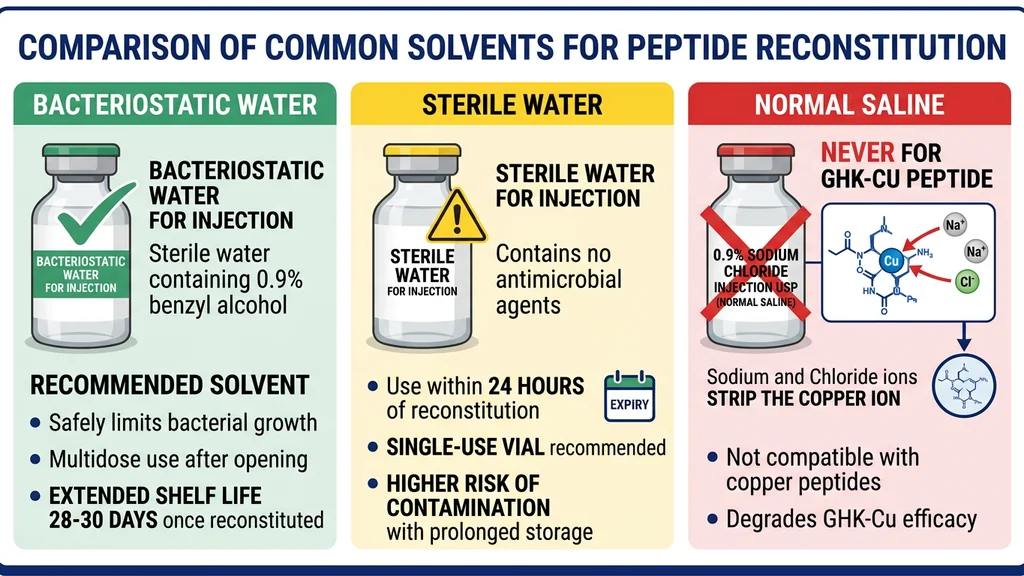
Why Bacteriostatic Water, Not Sterile Water or Saline
Bacteriostatic water contains 0.9% benzyl alcohol, which inhibits bacterial growth and keeps the reconstituted solution usable for 28 to 30 days. This is the standard choice. For a full comparison, see bacteriostatic water vs sterile water. To find a reliable source, see where to buy bacteriostatic water.
Sterile water contains no preservative. Use the entire vial within 24 hours or discard it. Acceptable in a pinch, but impractical for multi-dose vials. See how long do reconstituted peptides last for detailed shelf life guidance.
Normal saline: never for GHK-Cu. This is specific to copper-bound peptides. The sodium chloride ions compete with histidine for copper coordination, potentially stripping the copper(II) ion from the GHK tripeptide. Without copper, the peptide loses its biological activity. Most other peptides tolerate saline. GHK-Cu does not (Pickart et al., 2015).
GHK-Cu Reconstitution: Step by Step
Follow these six steps. The entire process takes two to five minutes.
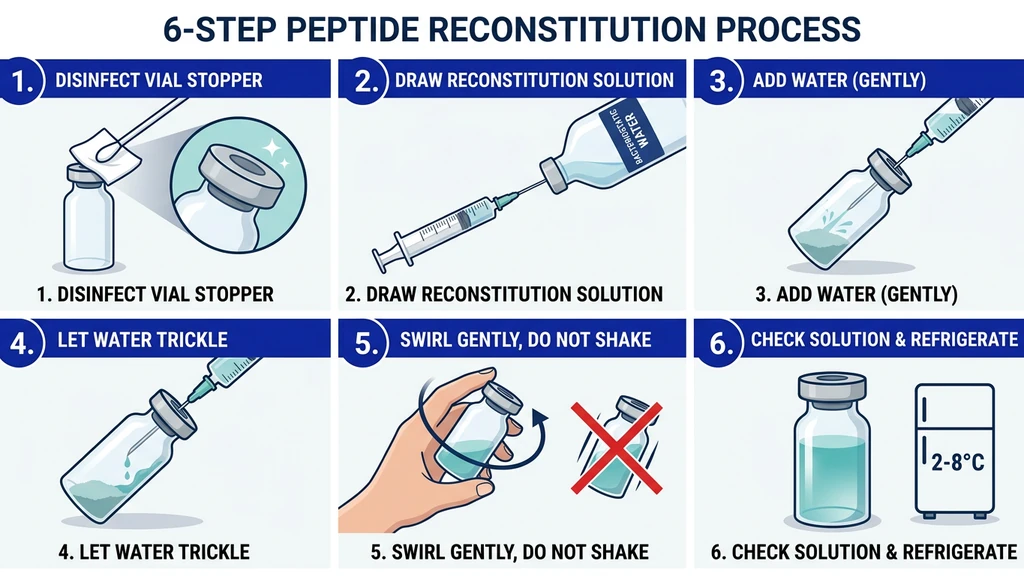
- 1.Wipe both vial stoppers with alcohol swabs. Let them air dry for 10 seconds.
- 1.Draw bacteriostatic water into a syringe. See the concentration table below to choose your volume.
- 1.Insert the needle at an angle into the GHK-Cu vial. Aim the stream at the glass wall, not directly onto the powder.
- 1.Release the water slowly over 30 to 60 seconds. Let it trickle down the inside wall and pool at the bottom.
- 1.Remove the syringe. Gently swirl the vial in a circular motion until the powder dissolves completely. Never shake. Mechanical shearing denatures the peptide. Dissolution takes 1 to 3 minutes.
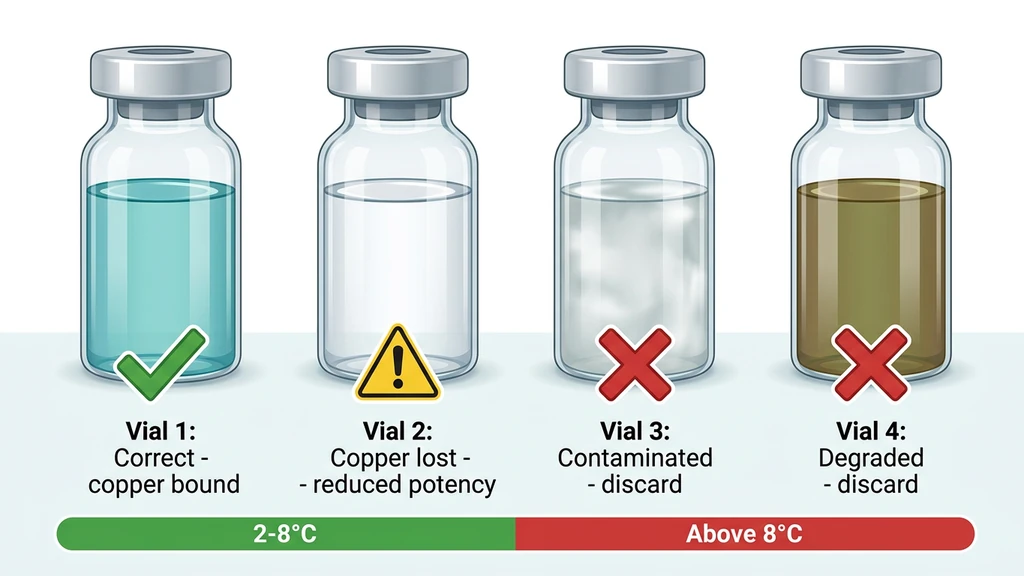
- 1.Verify and store. The solution should be clear with a faint blue-green tint. This color comes from the copper(II) ion and confirms the copper remains bound to the peptide. Refrigerate immediately at 2 to 8°C.
Discard the solution if it is cloudy, contains particles, or turns brown or dark green. These signs indicate degradation or contamination. Loss of the blue-green tint means copper has dissociated from the peptide, reducing potency.
For a general guide covering all peptides, see How to Reconstitute Peptides. For injection technique after reconstitution, see the Peptide Injection Guide for Beginners.
Concentration Table: 50mg and 100mg Vials
The formula is straightforward: Concentration (mg/mL) = Vial size (mg) / Water added (mL). This table covers both vial sizes at three common water volumes.
| Vial Size | BAC Water Added | Concentration | Volume per 1mg Dose | Volume per 2mg Dose | Syringe Units (U-100) per 2mg |
|---|---|---|---|---|---|
| 50 mg | 2 mL | 25 mg/mL | 0.04 mL | 0.08 mL | 8 units |
| 50 mg | 3 mL | 16.67 mg/mL | 0.06 mL | 0.12 mL | 12 units |
| 50 mg | 5 mL | 10 mg/mL | 0.10 mL | 0.20 mL | 20 units |
| 100 mg | 2 mL | 50 mg/mL | 0.02 mL | 0.04 mL | 4 units |
| 100 mg | 3 mL | 33.3 mg/mL | 0.03 mL | 0.06 mL | 6 units |
| 100 mg | 5 mL | 20 mg/mL | 0.05 mL | 0.10 mL | 10 units |
Recommended: For most users, 50mg + 5mL (10 mg/mL) offers the best balance of accuracy and convenience. Larger draw volumes leave more room for syringe reading error, which means smaller dosing mistakes.
For any vial size and water volume, use the Peptide Reconstitution Calculator.
How Many Doses Per Vial?
This table shows total doses per vial at common daily dosages, along with practical cycle coverage using a 5-on, 2-off injection schedule.
| Vial Size | Daily Dose | Days per Vial | Cycle Coverage (5 on / 2 off) |
|---|---|---|---|
| 50 mg | 1 mg | 50 days | ~10 weeks |
| 50 mg | 2 mg | 25 days | ~5 weeks |
| 100 mg | 1 mg | 100 days | ~20 weeks |
| 100 mg | 2 mg | 50 days | ~10 weeks |
Reconstituted GHK-Cu stays stable for 28 to 30 days when refrigerated with bacteriostatic water. A 100mg vial at 1mg per day contains more doses than the solution's shelf life allows. Three options: increase the daily dose, use a 50mg vial that matches your cycle length, or split the reconstituted solution into sterile sub-vials if your supplier provides them.
For complete protocols by goal (skin rejuvenation, hair growth, wound healing), see the GHK-Cu Dosage Guide. For injection scheduling, see the GHK-Cu injection frequency guide.
Storage After Reconstitution
Reconstituted solution: Refrigerate at 2 to 8°C (36 to 46°F), protected from light. Stable up to 28 to 30 days with bacteriostatic water. Do not freeze the reconstituted solution. Ice crystal formation denatures the peptide.
Unreconstituted powder: Store in the freezer at -20°C for months to years. Unopened vials tolerate room temperature for several weeks. Keep the desiccant packet in the storage container.
pH stability: GHK-Cu is stable at pH 5.0 to 6.5. Bacteriostatic water (pH ~5.7) falls within this range. Avoid mixing GHK-Cu with acidic solutions such as vitamin C or AHA/BHA serums for topical use. A pH below 4.0 causes copper dissociation and renders the peptide inactive.
For storage guidance across all peptides, see How to Store Peptides. For information on how long does bacteriostatic water last and does bacteriostatic water need to be refrigerated, see our dedicated guides.
How to Read Your Insulin Syringe for GHK-Cu
Most people reconstitute correctly but then draw the wrong amount. The syringe is where dosing errors happen. Understanding the markings prevents every downstream mistake.
An insulin syringe is calibrated in "units," not milligrams. A U-100 syringe has 100 units per 1 mL. Each unit equals 0.01 mL. When you see "draw to 20 units," that means draw to the 0.20 mL line.
Three common insulin syringe sizes:
| Syringe Size | Total Units | Best For | Smallest Marking |
|---|---|---|---|
| 0.3 mL (30 units) | 30 | High-concentration solutions, small doses | 0.5 units |
| 0.5 mL (50 units) | 50 | Most GHK-Cu dosing | 1 unit |
| 1.0 mL (100 units) | 100 | Low-concentration solutions, large draws | 2 units |
For GHK-Cu at 10 mg/mL (50mg vial + 5mL water), a 2mg dose requires 20 units. A 0.5 mL syringe handles this easily with clear markings at every unit. A 1.0 mL syringe works too but the markings are closer together and harder to read precisely.
For GHK-Cu at 25 mg/mL (50mg vial + 2mL water), a 2mg dose requires only 8 units. A 0.3 mL syringe with half-unit markings gives the best precision at this small volume. On a 1.0 mL syringe, the difference between 8 and 10 units is barely visible, and that 2-unit error means 0.5 mg of extra peptide per injection.
The principle: match the syringe to the draw volume. Smaller draw volumes need smaller syringes. If your dose falls below 10 units, switch to a 0.3 mL syringe. If it is above 30 units, use a 1.0 mL syringe. The Peptide Unit Converter shows exact unit counts for any concentration.
What Happens If You Get the Concentration Wrong
Reconstitution errors produce silent dosing errors. You inject what you think is the right amount, but the concentration is off and the actual dose is wrong. Two scenarios illustrate the danger.
Scenario 1: Half the water, double the dose. You have a 50mg vial. You intend to add 5 mL of bacteriostatic water for a 10 mg/mL solution. But you accidentally add only 2.5 mL. The actual concentration is now 20 mg/mL. When you draw 20 units for your 2mg dose, you are actually injecting 4 mg. That is double the intended dose, every single injection, for the entire vial. At standard doses, GHK-Cu sits roughly 300-fold below the toxic threshold. Doubling the dose is not dangerous in the acute sense, but it wastes peptide, shortens your vial life by half, and increases cumulative copper exposure unnecessarily.
Scenario 2: Wrong vial size assumption. You have a 100mg vial but follow a reconstitution guide written for 50mg vials. You add 5 mL of water expecting 10 mg/mL. The actual concentration is 20 mg/mL. Every injection delivers twice what you planned. Over a 30-day cycle at 2mg per day, you would inject 120 mg instead of 60 mg. The vial runs out in 15 days instead of 25.
The fix for both: Always check the vial label before adding water. Confirm the peptide mass (printed on the vial and the box), then calculate or verify with the Peptide Reconstitution Calculator. Write the concentration and reconstitution date on the vial with a marker. This 10-second habit prevents every concentration error.
How to verify after reconstitution. If you suspect the concentration is wrong, the math works backwards too. Divide the total peptide content by the concentration you measured. If you added 5 mL to a 50mg vial and the calculator says 10 mg/mL, that confirms the math. If the numbers do not match, you added the wrong volume. Unfortunately, once reconstituted, you cannot undo the dilution. You can only adjust your draw volume going forward using the corrected concentration.
GHK-Cu vs Other Peptides: Reconstitution Differences
GHK-Cu reconstitution follows the same basic process as any lyophilized peptide, but three details are unique to copper-bound peptides. This table compares GHK-Cu to the most common peptides you might reconstitute alongside it.
| Factor | GHK-Cu | BPC-157 | TB-500 | Semaglutide |
|---|---|---|---|---|
| Saline compatible? | No (strips copper) | Yes | Yes | Yes |
| Preferred solvent | BAC water only | BAC water or saline | BAC water or saline | BAC water |
| Solution color | Blue-green tint | Clear/colorless | Clear/colorless | Clear/colorless |
| Visual degradation sign | Color loss, brown shift | Cloudiness | Cloudiness | Cloudiness |
| pH sensitivity | Unstable below 4.0 | Stable 2.0 to 8.0 | Stable 3.0 to 8.0 | Stable 7.0 to 8.0 |
| Shake tolerance | Low (swirl only) | Moderate | Moderate | Low (swirl only) |
| Shelf life (reconstituted) | 28-30 days at 2-8°C | 28-30 days at 2-8°C | 28-30 days at 2-8°C | 28 days at 2-8°C |
The saline restriction is the critical difference. If you reconstitute multiple peptides in the same session, keep the saline away from GHK-Cu vials entirely. Label your solvents clearly. A single accidental saline reconstitution renders the entire vial of GHK-Cu less effective.
The blue-green color is unique to GHK-Cu and acts as a built-in quality indicator. No other common peptide provides this visual confirmation that the active compound is intact. Use it. Check the color every time you draw a dose.
For users running a GHK-Cu + BPC-157 + TB-500 blend, the blend vial is pre-mixed and the solvent choice is already accounted for. Reconstitute the blend with bacteriostatic water per the blend dosage guide.
Troubleshooting Common Problems
The powder will not dissolve. GHK-Cu typically dissolves within 1 to 3 minutes of gentle swirling. If clumps persist after 5 minutes, the water likely hit the powder cake directly during injection. Set the vial upright and let it sit for 10 minutes. Then swirl again. Do not shake. If it still will not dissolve after 15 minutes, the peptide may have degraded during shipping or storage. Check the expiration date and storage conditions.
Foam on top of the solution. Small bubbles are normal and dissipate within a few minutes. A thick layer of foam indicates you either shook the vial or injected the water too forcefully. Let the vial sit undisturbed for 10 to 15 minutes. The foam will settle. Draw from beneath the foam layer when dosing.
No blue-green tint. A completely clear, colorless solution after dissolving GHK-Cu suggests the copper ion has dissociated from the tripeptide. Possible causes: contamination with saline, exposure to acidic solutions (pH below 4.0), or degraded peptide that lost its copper during storage. Potency is likely reduced. If you are certain you used bacteriostatic water and the vial was stored correctly, the peptide may have been compromised before purchase. Contact the supplier.
Solution turns brown or dark green over time. This indicates oxidative degradation of the copper complex. Causes include light exposure, temperature above 8°C for extended periods, or contamination. Discard the vial. This is not a potency reduction; it is a chemical change that produces breakdown products you should not inject.
Rubber stopper fragments in the solution. Coring occurs when the needle punches a small piece of rubber into the vial. Prevention: insert the needle at a 45-degree angle with the bevel facing up, then straighten to 90 degrees once through. If you see fragments, draw the solution through a 0.22 micron syringe filter before injecting. Better yet, discard and reconstitute a new vial if you have one available.
5 Mistakes That Ruin GHK-Cu Potency
- 1.Shaking the vial. Mechanical shearing denatures the peptide. Always swirl gently in a circular motion.
- 1.Using normal saline. Sodium chloride interferes with copper chelation, stripping the copper(II) ion from the GHK tripeptide. Use only bacteriostatic water.
- 1.Spraying water directly onto the powder. Direct impact causes clumping and foaming. Aim the stream at the glass wall and let it trickle down.
- 1.Storing at room temperature. Reconstituted GHK-Cu degrades rapidly above 8°C. Refrigerate immediately after mixing and between every use.
- 1.Ignoring color changes. Fresh GHK-Cu solution has a faint blue-green tint from the copper(II) ion. Loss of color, cloudiness, or a brown shift means degradation. Discard the vial.
Frequently Asked Questions
How much bacteriostatic water do I add to a 50mg GHK-Cu vial?
Add 5 mL of bacteriostatic water for a 10 mg/mL concentration, which is the most practical for dosing. At this concentration, a 2mg dose equals 0.20 mL (20 units on an insulin syringe). You can also add 2 mL for 25 mg/mL or 3 mL for 16.67 mg/mL depending on your precision needs.
How much bacteriostatic water do I add to a 100mg GHK-Cu vial?
Add 5 mL for a 20 mg/mL concentration, or 3 mL for 33.3 mg/mL. The 5 mL option produces larger, easier-to-read draw volumes. At 20 mg/mL, a 2mg dose is 0.10 mL (10 units on a U-100 insulin syringe).
Why does reconstituted GHK-Cu look blue or blue-green?
The blue-green tint comes from the copper(II) ion bound to the GHK tripeptide. This is normal and expected. A clear, colorless solution may indicate the copper has dissociated, which reduces the peptide's biological activity.
Can I use sterile water instead of bacteriostatic water?
Yes, but you must use the entire vial within 24 hours because sterile water contains no preservative. Bacteriostatic water (0.9% benzyl alcohol) inhibits bacterial growth and extends shelf life to 28 to 30 days refrigerated.
Can I use normal saline to reconstitute GHK-Cu?
No. Unlike most peptides, GHK-Cu should not be reconstituted with normal saline. The sodium chloride ions interfere with copper chelation, potentially displacing the copper(II) ion from the tripeptide and reducing potency. Use bacteriostatic water only.
How long does reconstituted GHK-Cu last?
Up to 28 to 30 days when reconstituted with bacteriostatic water and stored refrigerated at 2 to 8°C. With sterile water, use within 24 hours. Discard if the solution loses its blue-green tint, becomes cloudy, or develops visible particles.
What syringe size should I use for GHK-Cu?
A 0.5 mL (50-unit) insulin syringe works for most GHK-Cu concentrations. If your dose is below 10 units (high-concentration solutions like 25 mg/mL), switch to a 0.3 mL syringe with half-unit markings for better precision. Use 29 to 31 gauge needles for subcutaneous injection.
Can I reconstitute GHK-Cu and BPC-157 with the same bacteriostatic water?
Yes. The same bottle of bacteriostatic water works for all peptides. The difference is that GHK-Cu cannot tolerate normal saline, while BPC-157 and TB-500 can use either solvent. If you reconstitute multiple peptides, keep saline away from GHK-Cu vials entirely.
The Bottom Line
GHK-Cu reconstitution is a five-minute process. Add bacteriostatic water to the vial, aim at the glass wall, swirl gently, and refrigerate. The blue-green tint confirms the copper remains bound to the peptide. Verify your concentration math using the Peptide Reconstitution Calculator.
Once reconstituted, GHK-Cu is ready for subcutaneous injection. For protocols by goal, dosage charts, and cycling schedules, see the complete GHK-Cu Dosage Guide. For the full peptide profile and research bibliography, visit the GHK-Cu peptide page.
Related Guides: - GHK-Cu Microneedling Protocol - topical application after reconstitution for skin and hair - GHK-Cu Nasal Spray - DIY nasal spray preparation from reconstituted GHK-Cu - Does GHK-Cu Cause Liver Damage? - copper safety at standard doses - GHK-Cu Hair Growth Guide - protocols specifically for hair restoration - Peptide Cost Calculator - calculate your per-dose cost based on vial size
Related Articles
How to Reconstitute Retatrutide
How to reconstitute retatrutide step by step for 5mg, 10mg, and 20mg vials. Concentration tables, BAC water volumes, syringe units per dose, and storage guide.
How to Reconstitute Tirzepatide
How to reconstitute tirzepatide step by step for 5mg, 10mg, 15mg, and 30mg vials. Concentration tables, BAC water volumes, syringe units, and storage guide.
How to Reconstitute Cagrilintide (5 mg, 10 mg)
How to reconstitute cagrilintide: bacteriostatic water for 5 mg and 10 mg vials, mg to units on a U-100 syringe, fridge storage and the 28-day clock.
How to Reconstitute Tesamorelin: Water Volumes & Units
How to reconstitute tesamorelin: bacteriostatic water volumes for 2, 5, 10 and 20 mg vials, U-100 unit math, mixing steps, storage window, and bad-vial signs.