You have a dermapen in one hand and a bottle of GHK-Cu serum in the other. The protocol is straightforward: 0.25 to 0.5 mm needle depth for maintenance, 1.0 mm for anti-aging, 1.5 mm for scar revision, followed by immediate application of 0.05% GHK-Cu serum while micro-channels remain open (roughly 10 to 15 minutes). Sessions are spaced every 4 to 6 weeks.
The combination matters because GHK-Cu (glycyl-L-histidyl-L-lysine copper) cannot permeate intact human skin. A 2015 Pharmaceutical Research study confirmed this: after microneedle treatment, 134 nmol of peptide and 705 nmol of copper permeated through skin over 9 hours. Without microneedles, permeation was near zero (Li et al. 2015, PubMed 25690343). Microneedling is what makes topical GHK-Cu delivery work.
GHK-Cu is not FDA-approved for any medical use. Topical forms remain Category 1 (eligible for compounding); injectable GHK-Cu is Category 2 (restricted from 503A compounding) as of 2026. Consult a healthcare provider before starting any protocol. If you are new to peptides, start with our getting started guide.
Get your custom peptide protocol:
- Tailored to your body and goals
- Precise dosing and cycle length
- Safe stacking combinations
- Backed by peer-reviewed studies
- Ready in under 2 minutes
Why Combine GHK-Cu with Microneedling?
Your skin has a wall. The stratum corneum, the outermost barrier of dead keratinocytes, exists to keep molecules out. GHK-Cu is a tripeptide bound to a copper(II) ion, and it cannot cross that wall on its own. You can apply the finest serum available and most of it will sit on the surface, doing very little.
Microneedling punches temporary holes through the barrier. The Li et al. study from the Kang Lab at the University of Utah quantified exactly what this means: 134 nmol of GHK peptide and 705 nmol of copper ions reached the dermis within 9 hours through microneedle-treated skin. Through intact skin, essentially nothing got through (Li et al. 2015).
The synergy goes deeper than delivery. Microneedling triggers your body's wound healing cascade: platelet activation, growth factor release, fibroblast recruitment. GHK-Cu, discovered by Dr. Loren Pickart in 1973, delivers copper directly to those activated fibroblasts. Copper is the cofactor for lysyl oxidase, the enzyme that cross-links newly formed collagen types I and III into functional tissue. The needle creates the demand. The peptide supplies the raw material. Together, you approach injectable-level bioavailability without injection (Pickart et al. 2015).
For injectable GHK-Cu protocols and reconstitution details, see our GHK-Cu dosage guide. For the full research profile, visit the GHK-Cu peptide page. For sourcing verified GHK-Cu, see where to buy peptides.
Step-by-Step GHK-Cu Microneedling Protocol
- 1.Cleanse your face with a gentle, pH-neutral cleanser. No actives, no exfoliants. Pat dry.
- 2.Numb (optional for shallow depths). Apply lidocaine 4 to 5% cream and wait 20 minutes. Professional settings use this for depths above 0.5 mm. At-home 0.25 mm sessions rarely need it.
- 3.Select needle depth based on your goal (see the depth table below). Set your dermapen or choose the correct dermaroller length.
- 4.Microneedle in a cross-hatch pattern: vertical passes, then horizontal, then diagonal. Maintain even pressure. Do not go over the same area more than 4 to 6 times total.
- 5.Apply 3 to 5 drops of GHK-Cu serum (0.05% concentration for post-needling use) immediately after finishing. Micro-channels begin closing within 10 to 15 minutes. Pat the serum in gently. Do not rub.
- 6.Optional: red LED light therapy for 10 minutes. Red light (630 to 660 nm) amplifies collagen signaling and reduces post-procedure inflammation.
- 7.Protect. Apply mineral SPF 30+ if daytime. If evening, apply a barrier cream or plain hyaluronic acid serum to lock in hydration.
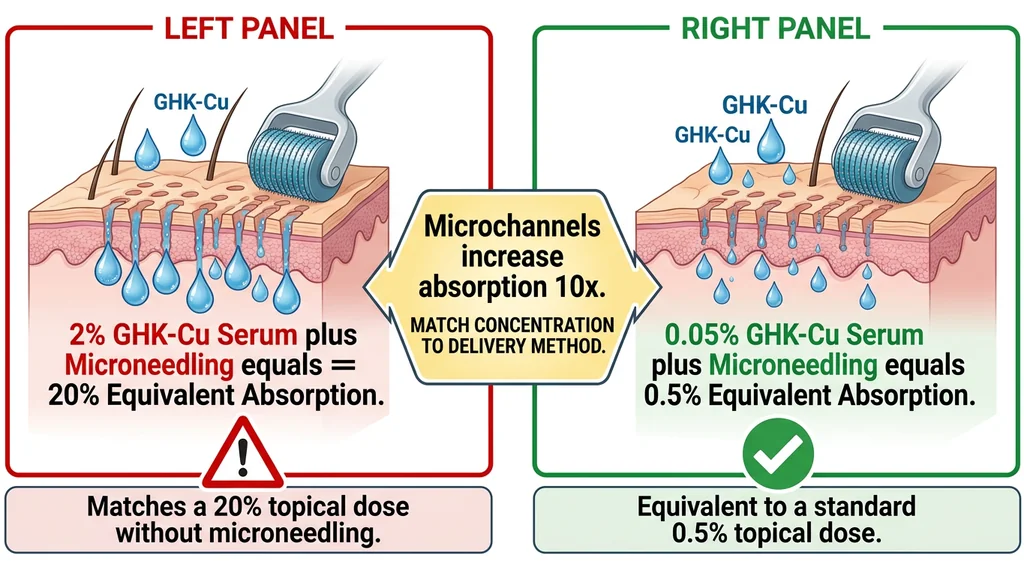
The critical timing detail: absorption through open channels is up to 10-fold higher than on intact skin. A standard concentration behaves like a much stronger product on freshly needled skin. More is not better here.
Needle Depth, Frequency, and Goal
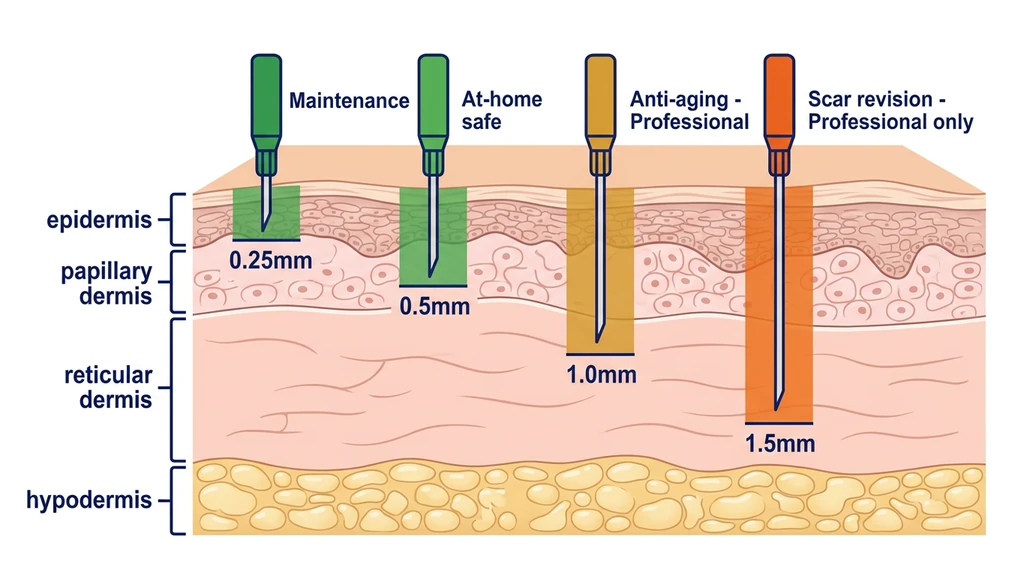
The depth you choose determines what you are treating and who should be holding the device.
| Goal | Needle Depth | Frequency | Sessions | Notes |
|---|---|---|---|---|
| Maintenance / glow | 0.25 to 0.5 mm | Every 4 weeks | Ongoing | Safe for at-home dermaroller |
| Anti-aging / fine lines | 0.5 to 1.0 mm | Every 4 to 6 weeks | 4 to 6 sessions | Professional dermapen recommended |
| Acne scars / deep scars | 1.0 to 1.5 mm | Every 6 to 8 weeks | 6+ sessions | Professional only |
| Stretch marks | 1.5 to 2.0 mm | Every 8 weeks | 6+ sessions | Professional only |
| Hair restoration (scalp) | 0.5 to 1.0 mm | Every 4 weeks | 5+ sessions | Combine with minoxidil per Kuceki et al. |
At-home users should stay at 0.5 mm or below. Depths above that increase risk of scarring and infection without professional training and sterile technique.
The hair restoration row deserves attention. A 2025 study published in JAAD International by Kuceki, Wambier, and colleagues found 26.5% hair regrowth and 93% shedding reduction over 5 monthly microneedling sessions using copper peptides combined with minoxidil and dutasteride. Scalp needling at 0.5 to 1.0 mm depth was the standard. This is one of the first controlled studies validating copper peptide microneedling for hair specifically.
Dermaroller vs Dermapen for GHK-Cu
Both devices create micro-channels. The difference is precision, consistency, and how they interact with a copper peptide protocol.
A dermaroller is a handheld cylinder covered in fixed-length needles. You roll it across the skin. The needles enter at an angle on the way in and tear slightly on the way out, creating a wider channel than necessary. Cost: $10 to $40. No training required for shallow depths. The limitation is that you cannot adjust needle length without buying a different roller.
A dermapen (or automated microneedling pen) drives needles straight in and straight out at high speed. The penetration angle is perpendicular to the skin surface, creating cleaner channels with less tissue trauma. Depth is adjustable in 0.25 mm increments on most models. Professional dermapens (Dr. Pen, Dermapen 4) cost $100 to $300. Entry-level automated pens start around $50.
| Factor | Dermaroller | Dermapen |
|---|---|---|
| Needle entry angle | Angled (more tissue drag) | Perpendicular (cleaner puncture) |
| Depth control | Fixed per roller | Adjustable 0.25 to 2.5 mm |
| Best depth range | 0.25 to 0.5 mm | 0.25 to 2.5 mm |
| Pain level | Lower at shallow depths | Lower at deep depths (faster) |
| GHK-Cu serum absorption | Good at shallow depths | More consistent at all depths |
| Cost | $10 to $40 | $50 to $300 |
| Needle replacement | Replace entire roller every 3-5 uses | Replace cartridge every 1-2 uses |
| At-home use | Safe at 0.5 mm and below | Safe at 0.5 mm and below |
| Professional use | Rarely used professionally | Industry standard |
For GHK-Cu specifically: the dermapen is the better choice if you are treating anti-aging or scars at 0.5 mm and above. The perpendicular needle entry creates more uniform channels, which means more even absorption of the peptide across the treated area. For maintenance-level treatments at 0.25 mm, a dermaroller works fine and costs a fraction of the price.
One practical advantage of the dermapen for scalp treatments: the pen tip reaches the scalp through hair more easily than a roller, which tends to catch and pull on hair strands. For the hair growth protocol, a dermapen is strongly preferred.
Replace dermaroller needles every 3 to 5 uses. Replace dermapen cartridges every 1 to 2 uses. Dull needles create jagged tears instead of clean channels, increasing inflammation without improving absorption. Never share needling devices between people.
GHK-Cu Microneedling for Hair Growth
Scalp microneedling with copper peptides is one of the fastest-growing applications in hair restoration. The evidence is early but specific.
The landmark study is from 2025: Kuceki, Wambier, and colleagues published in JAAD International a trial using microneedling at 0.5 to 1.0 mm depth combined with a topical mixture of copper peptides, minoxidil 5%, and dutasteride 0.25%. Over 5 monthly sessions, participants saw 26.5% hair regrowth and a 93% reduction in shedding. The combination outperformed each component alone.
Why copper peptides help hair specifically. Hair follicles miniaturize in androgenetic alopecia because of chronic perifollicular inflammation and insufficient blood supply. GHK-Cu addresses both: it suppresses pro-inflammatory cytokines (IL-6, TNF-alpha) and upregulates VEGF for angiogenesis around the follicle. The copper ion is also a cofactor for superoxide dismutase, the antioxidant enzyme that protects follicle stem cells from oxidative damage (Pickart & Margolina, 2018).
Scalp microneedling protocol with GHK-Cu:
- 1.Wash hair and towel dry. Part the hair to expose the thinning area.
- 2.Apply numbing cream (lidocaine 5%) to the scalp. Wait 20 minutes. Scalp skin is thinner than facial skin and more sensitive at depth.
- 3.Microneedle at 0.5 to 1.0 mm using a dermapen. Move in systematic rows across the thinning zone. Slight pinpoint bleeding is normal and expected at 1.0 mm.
- 4.Apply GHK-Cu serum immediately. Pat into the scalp. Follow with minoxidil 5% if your protocol includes it.
- 5.Do not wash hair for 12 to 24 hours. Let the peptide absorb.
- 6.Repeat monthly. Minimum 5 sessions. Meaningful density change requires 4 to 6 months.
Timeline for hair results: Reduced shedding at 4 to 8 weeks. Fine vellus hairs visible at 8 to 12 weeks. Thicker terminal hairs and visible density improvement at 16 to 24 weeks. The inflection point where results become obvious is around month 4. Stopping before this misses the payoff.
For injectable GHK-Cu hair protocols (which provide systemic rather than topical delivery), see the GHK-Cu injection frequency guide. For the hair-specific dosing data, see our GHK-Cu dosage guide. If you are concerned about hair shedding during treatment, see does GHK-Cu cause hair loss for reassurance on the reactivation shedding phase.
Choosing Your GHK-Cu Serum for Microneedling
Not all GHK-Cu serums are formulated for post-microneedling use. The wrong product on open channels causes irritation, copper overload, or both. Here is what to look for and what to avoid.
Concentration matters most. For post-microneedling application, use 0.05% GHK-Cu (500 ppm). This is lower than the 0.1% to 1.0% concentrations sold for daily topical use on intact skin. The reason: microneedling increases absorption up to 10-fold. A 0.05% serum on needled skin delivers the equivalent of 0.5% on intact skin. Starting higher risks copper overload and the copper uglies.
Formulation checklist:
| Feature | Required | Why |
|---|---|---|
| GHK-Cu concentration | 0.05% for post-needling | 10x absorption on open channels |
| Fragrance-free | Yes | Fragrances irritate open wounds |
| Alcohol-free | Yes | Alcohol causes stinging and barrier damage |
| Vitamin C free | Yes | Ascorbic acid oxidizes copper on contact |
| pH 5.0 to 6.5 | Yes | Copper dissociates below pH 4.0 |
| Preservative | Minimal (phenoxyethanol OK) | Open channels absorb preservatives too |
| Hyaluronic acid base | Preferred | Hydrates without irritation |
What to avoid: Products that combine GHK-Cu with retinol, niacinamide above 2%, AHA/BHA, or vitamin C in a single serum. These combination products are designed for daily use on intact skin. On freshly needled skin, the acids and actives overwhelm the compromised barrier.
DIY option. Some users reconstitute injectable-grade GHK-Cu powder in sterile water and apply it topically after needling. This is technically purer than most commercial serums, but carries two risks: no preservative (bacterial growth on open wounds) and no pH buffering (the solution may be too acidic or alkaline). If you go this route, reconstitute fresh for each session, confirm pH with a test strip, and use within hours. See the reconstitution guide for preparation steps. For solvent guidance, see bacteriostatic water vs sterile water.
For users who prefer the injectable route over topical, the GHK-Cu dosage guide covers subcutaneous injection protocols that bypass the skin barrier entirely.
What Happens If You Use the Wrong Depth or Concentration
Two concrete scenarios show what goes wrong and how to fix it.
Scenario 1: Too deep at home. You set your dermapen to 1.5 mm for facial anti-aging, a depth that should only be used by professionals for scar revision. The needle penetrates into the reticular dermis, causing excessive bleeding, prolonged redness lasting 5 to 7 days instead of 1 to 2, and increased risk of post-inflammatory hyperpigmentation. The applied GHK-Cu reaches deeper tissue layers than intended, where copper concentration spikes unpredictably. Fix: stay at 0.5 mm or below for at-home use. If you went too deep once, do not panic. Apply a gentle barrier cream, avoid all actives for 72 hours, and wait 8 weeks before your next session to allow full healing.
Scenario 2: Too high a concentration on needled skin. You use a 1.0% GHK-Cu serum (the kind sold for daily topical use) immediately after microneedling at 0.5 mm. With 10-fold absorption through open channels, your skin effectively receives the equivalent of 10% copper peptide concentration. Within 24 to 48 hours, you develop the copper uglies: intense redness, stinging, and small breakouts across the treated area. The excess copper drives MMP overexpression, breaking down the very collagen you were trying to build. Fix: wash the serum off immediately if you realize the mistake. Apply plain hyaluronic acid or a barrier cream. Stop all copper products for 2 to 4 weeks. When you resume, use 0.05% concentration only.
Both errors share the same root cause: treating microneedled skin like intact skin. Open channels change the absorption math by an order of magnitude. Respect the difference.
Combining GHK-Cu Microneedling with Other Treatments
GHK-Cu microneedling pairs well with several complementary treatments. The key is timing: some can be used in the same session, others need separation.
Same session (compatible): - Red LED light therapy (630-660 nm). Apply immediately after serum absorption. Red light amplifies collagen synthesis and reduces post-procedure inflammation. 10 minutes is the standard duration. This is the single best add-on to a GHK-Cu microneedling session. - Hyaluronic acid serum. Apply after GHK-Cu serum has absorbed (5 minutes post-application). Provides hydration and supports wound healing without interfering with copper peptide activity. - Growth factor serums (EGF, FGF). Compatible with GHK-Cu on freshly needled skin. The growth factors complement copper's collagen cross-linking with direct fibroblast stimulation.
Same week, different days: - PRP (Platelet-Rich Plasma). Some clinics perform PRP and microneedling in the same session, but applying GHK-Cu and PRP simultaneously has not been studied. A safer approach: PRP on day 1, GHK-Cu microneedling one week later. Both stimulate collagen, but through different pathways. Alternating sessions over 6 months may produce superior results to either alone. - Minoxidil (for scalp). Apply minoxidil 12 to 24 hours after scalp microneedling, not immediately after. Minoxidil on freshly needled scalp can cause systemic absorption and cardiovascular side effects (heart palpitations, dizziness). The Kuceki study protocol applied minoxidil the day after needling.
Wait 48 to 72 hours minimum: - Retinoids (tretinoin, retinol). Resume retinoid use 48 to 72 hours after microneedling. Retinoids on open channels cause excessive irritation and can trigger persistent redness lasting weeks. - Vitamin C serums. Wait 48 hours. L-ascorbic acid oxidizes copper ions on contact, neutralizing both the vitamin C and the residual GHK-Cu in your skin. - Chemical peels and AHA/BHA. Wait at least one full week. Acid exfoliation on healing micro-wounds delays recovery and increases scarring risk.
The safest combination protocol for facial anti-aging: microneedle with GHK-Cu every 4 to 6 weeks, use retinoids on non-needling weeks, and save vitamin C for mornings when your skin barrier is fully intact. This rotation maximizes collagen stimulation from three different angles without ingredient conflicts.
What to Avoid After GHK-Cu Microneedling
Open micro-channels absorb everything, including ingredients that will damage healing skin. Here is the incompatibility list.
Do not apply within 24 to 48 hours: - Vitamin C (L-ascorbic acid): Oxidizes copper and destabilizes both actives. The two cancel each other out on open channels. - Retinol and retinoids: Too aggressive on compromised barrier. Wait 48 to 72 hours minimum. - AHA, BHA, and glycolic acid: Exfoliating acids on micro-wounds cause prolonged irritation and delayed healing. - Alcohol-based products, fragrances, and essential oils: Unnecessary chemical stress on open skin.
Do not do within 24 to 48 hours: - Direct sun exposure for 48 to 72 hours (mineral SPF if you must go outside) - Heavy exercise or sweating for 24 to 48 hours - Makeup for 12 to 24 hours
Safe to apply immediately after needling: GHK-Cu serum (0.05%), plain hyaluronic acid, and mineral sunscreen. That is the complete list. Everything else waits.
Results Timeline
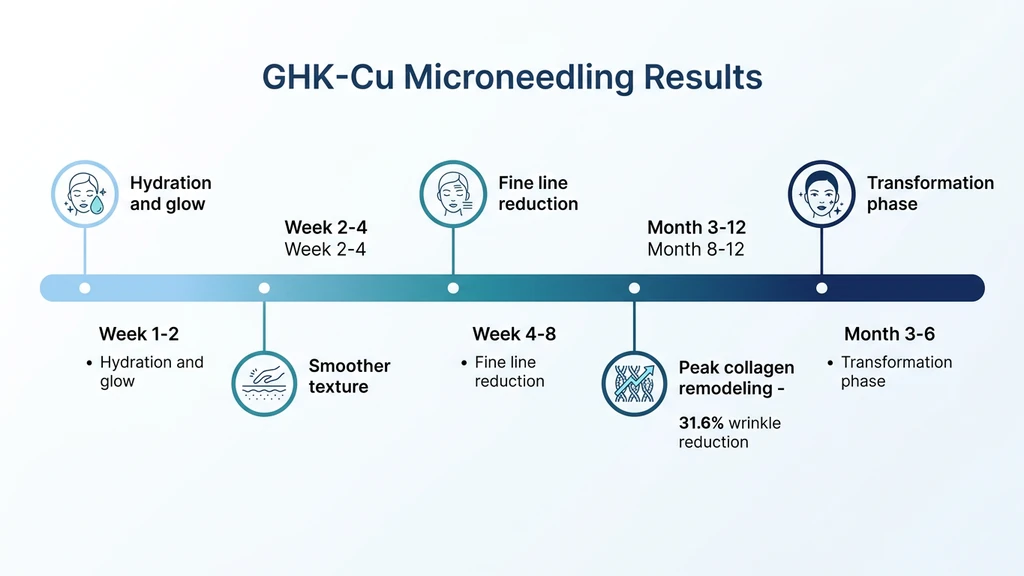
GHK-Cu rebuilds dermal architecture from the collagen level up. The results are cumulative, not overnight.
Week 1 to 2: Redness subsides. Improved hydration and a subtle glow emerge as the skin heals from the procedure itself.
Week 2 to 4: Smoother texture. Any peeling resolves. Early firmness becomes noticeable, especially around the jawline and under eyes.
Week 4 to 8: Fine line reduction. Improved elasticity. Scar fading begins for those treating acne scars or stretch marks. This is when collagen remodeling enters its productive phase.
Week 8 to 12: Peak collagen remodeling. Significant improvement in skin density. A nano-lipid GHK-Cu formulation achieved 31.6% wrinkle volume reduction at 8 weeks in one study (Pickart & Margolina 2018).
Month 3 to 6: Cumulative results from multiple sessions produce the transformation phase. Each session compounds on the last. This is where patience pays off most.
The Copper Uglies Warning
No competitor article mentions this. Community experience does, and it matters.
"Copper uglies" is the colloquial name for what happens when you overuse copper peptides after microneedling. The temptation is understandable: if GHK-Cu works well once a week after needling, surely using it daily will produce faster results. It does not. It produces the opposite.
Continuous copper peptide application increases matrix metalloproteinases (MMPs). These enzymes break down collagen and extracellular matrix. In controlled doses, MMPs are part of healthy tissue remodeling. With daily, uninterrupted copper peptide use, they accumulate to the point of doing more harm than good. Symptoms include persistent redness, new breakouts, and skin sensitivity that worsens over time instead of improving.
Prevention is simple: use GHK-Cu serum 1 to 2 times per week in the days following your microneedling session, not daily. Cycle 4 to 6 weeks on, then take a break. If you are already experiencing persistent irritation, stop copper peptides entirely and allow 2 to 4 weeks of recovery with a bare-minimum skincare routine.
For a full troubleshooting guide, see our copper peptide irritation guide.
Frequently Asked Questions
Can you apply GHK-Cu immediately after microneedling?
Yes. Apply within 10 to 15 minutes while micro-channels remain open. Use a sterile, fragrance-free formulation at 0.05% concentration. Higher concentrations are not recommended on freshly needled skin because absorption increases up to 10-fold.
What needle depth is safe for at-home GHK-Cu microneedling?
0.25 to 0.5 mm is safe for home use with a dermaroller or dermapen. Depths above 0.5 mm should be performed by a trained professional due to increased risk of scarring and infection.
How often should you microneedle with GHK-Cu?
Every 4 to 6 weeks for most skin goals. Deeper treatments (1.0 mm and above) require 6 to 8 weeks between sessions for full healing. Do not microneedle weekly. The skin needs time to complete its collagen remodeling cycle.
Does GHK-Cu microneedling work for hair growth?
Yes. A 2025 JAAD International study by Kuceki, Wambier, and colleagues found 26.5% hair regrowth and 93% shedding reduction over 5 monthly microneedling sessions using copper peptides with minoxidil and dutasteride. Scalp needling at 0.5 to 1.0 mm depth is the standard protocol.
Is GHK-Cu microneedling better than PRP?
They work differently. PRP delivers growth factors from your own blood. GHK-Cu delivers copper for collagen cross-linking and gene expression modulation. One London clinic's split-face comparison found copper peptide microneedling produced more consistent results with less downtime than PRP. They can also be combined for enhanced outcomes.
What concentration of GHK-Cu serum should I use after microneedling?
Use 0.05% concentration on freshly needled skin. Micro-channels increase absorption up to 10-fold, so a standard concentration behaves like a much stronger product. Higher concentrations (0.1% or above) risk copper overload on compromised skin, which can trigger the copper uglies: persistent redness, breakouts, and worsening sensitivity.
Should I use a dermaroller or dermapen for GHK-Cu microneedling?
A dermapen is preferred for depths above 0.5 mm because it creates perpendicular, cleaner micro-channels for more consistent peptide absorption. A dermaroller works fine for maintenance-level treatments at 0.25 mm and costs a fraction of the price. For scalp treatments, the dermapen reaches through hair more easily.
Can I use vitamin C with GHK-Cu after microneedling?
No. Wait at least 48 hours. L-ascorbic acid oxidizes the copper(II) ion in GHK-Cu, neutralizing both actives. On freshly needled skin with open channels, this reaction is amplified. Use vitamin C on non-needling days when the skin barrier is fully intact.
The Bottom Line
GHK-Cu microneedling works because it solves a delivery problem. The peptide cannot cross intact skin. Microneedling opens the door, and GHK-Cu walks through it carrying the copper your fibroblasts need to build collagen.
The protocol is straightforward: select the right depth for your goal, apply the serum while channels are open, avoid incompatible actives for 48 hours, and space sessions 4 to 6 weeks apart. Do not use copper peptides daily. The copper uglies are real and entirely preventable.
Results compound over months. Each session layers new collagen remodeling on top of the last. Give the protocol 3 to 6 months before judging whether it works for you.
For injectable GHK-Cu protocols, see our GHK-Cu dosage guide. For the full research profile and mechanism of action, visit the GHK-Cu peptide page.
Related Guides: - Does GHK-Cu Cause Liver Damage? - copper safety data for users concerned about long-term exposure - GHK-Cu Nasal Spray - an alternative delivery route for cognitive benefits - GHK-Cu + BPC-157 + TB-500 Blend - combining microneedling with injectable blend protocols - Peptide Safety Guide - comprehensive safety overview for all peptide users - How to Store Peptides - storage guidance for your GHK-Cu serum and vials - Peptide Reconstitution Calculator - precise math for DIY serum preparation
Helpful Tools
Related Articles
Where to Inject GHK-Cu: Sites by Goal
Where to inject GHK-Cu for skin, hair, wounds, and anti-aging. Subcutaneous site map by goal, rotation patterns, needle depth, and angle guidance.
GHK-Cu Benefits: 8 Research-Backed Effects
8 GHK-Cu benefits: skin rejuvenation, wound healing, hair growth, anti-inflammatory, and antioxidant effects. PubMed-cited research with dosages.
GHK-Cu Dosage: Protocols & Charts
GHK-Cu dosage guide with injection protocols by goal (skin, hair, healing), reconstitution steps, dosage charts, side effects, and before/after timeline.
GHK-Cu for Hair Growth: Protocols
GHK-Cu promotes hair growth through Wnt/beta-catenin activation and TGF-beta1 suppression. Protocols for topical, microneedling, and injectable delivery.