You found GHK-Cu on a skincare ingredient list or a peptide forum and want to know what it actually does. GHK-Cu is a naturally occurring copper-binding tripeptide that promotes skin remodeling, accelerates wound closure, stimulates hair follicle growth, and modulates over 4,000 human genes involved in tissue repair. Loren Pickart first isolated it from human plasma in 1973 and spent five decades documenting its regenerative properties.
Your body produces GHK-Cu on its own, but plasma levels decline sharply with age: roughly 200 ng/mL at age 20, dropping to 80 ng/mL by age 60 (Pickart et al., *BioMed Research International*, 2015). Supplementing with topical or injectable GHK-Cu aims to restore the signaling molecule that your tissues have lost.
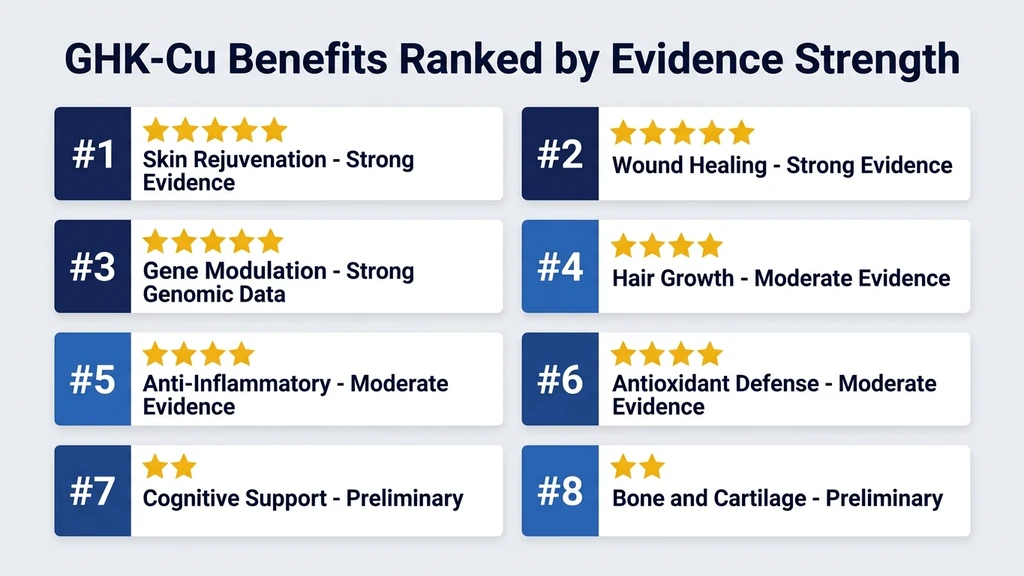
| Benefit | Evidence Level | Primary Mechanism | Typical Delivery |
|---|---|---|---|
| Skin rejuvenation | Strong (human + in vitro) | Collagen I/III synthesis, glycosaminoglycan production | Topical, microneedling |
| Wound healing | Strong (human + animal) | Fibroblast recruitment, angiogenesis | Topical, injection |
| Hair growth | Moderate (in vitro + observational) | Follicle enlargement, Wnt/beta-catenin activation | Topical, microneedling |
| Anti-inflammatory | Moderate (in vitro + animal) | TGF-beta modulation, TNF-alpha suppression | Injection, topical |
| Antioxidant defense | Moderate (in vitro) | SOD upregulation, free radical scavenging | Injection, topical |
| Gene modulation | Strong (genomic studies) | 4,000+ gene reset toward youthful expression | Injection |
| Cognitive support | Preliminary (animal) | Nerve growth factor stimulation | Injection, nasal spray |
| Bone and cartilage repair | Preliminary (in vitro + animal) | Osteoblast stimulation, chondrocyte proliferation | Injection |
Use the peptide reconstitution calculator to prepare injectable GHK-Cu, or the peptide interaction checker to verify compatibility with your current stack. Consult your healthcare provider before starting any peptide protocol.
Get your custom peptide protocol:
- Tailored to your body and goals
- Precise dosing and cycle length
- Safe stacking combinations
- Backed by peer-reviewed studies
- Ready in under 2 minutes
What Is GHK-Cu?
GHK-Cu is a tripeptide made of three amino acids (glycine-histidine-lysine) bound to a copper(II) ion. Your blood carries it naturally. Pickart discovered it in 1973 when he observed that old human plasma lost its ability to stimulate liver cell protein synthesis, and traced that loss to declining levels of this specific copper complex (Pickart & Thaler, *Nature New Biology*, 1973).
Think of GHK-Cu as an orchestrator, not a construction worker. It does not build tissue directly. Instead, it sends signals that recruit repair cells to damaged sites, tell fibroblasts to produce more collagen, and instruct stem cells to differentiate. When GHK-Cu levels drop with age, the orchestra keeps playing but nobody is conducting.
The copper ion is essential to its function. Without copper, GHK is biologically inert. The copper atom enables the peptide to bind cell receptors, catalyze antioxidant reactions, and modulate metalloproteinase activity (Pickart et al., *BioMed Research International*, 2015). This dual nature, peptide plus metal, makes GHK-Cu unique among bioactive peptides. For dosing protocols, see the GHK-Cu injection dosage guide.
1. Skin Rejuvenation and Collagen Synthesis
Skin aging is primarily collagen loss. After age 30, you lose roughly 1% of your dermal collagen per year. By 60, your skin contains 40% less collagen than it did at 20. GHK-Cu directly addresses this deficit.
Leyden et al. conducted a 12-week double-blind trial in 71 women using a GHK-Cu facial cream. Treated subjects showed a 17% increase in collagen thickness measured by ultrasound, reduced fine lines, and improved skin clarity compared to placebo and a vitamin C control (Leyden et al., *Journal of Cosmetic Dermatology*, 2002). Finkley et al. confirmed these findings, demonstrating that GHK-Cu stimulated both type I and type III collagen production in human fibroblast cultures at concentrations as low as 1 micromolar.
GHK-Cu also increases glycosaminoglycan synthesis, the water-holding molecules that keep skin plump. Maquart et al. showed a 70% increase in glycosaminoglycan production in fibroblast cultures treated with GHK-Cu, alongside elevated decorin and versican levels (Maquart et al., *FEBS Letters*, 1993).
Practical implication: Topical GHK-Cu at 0.01-1% concentration in serums is the most studied delivery method for skin. Combining GHK-Cu with microneedling enhances penetration by 10-20 fold because the micro-channels bypass the stratum corneum barrier. Results typically appear at 4-8 weeks of consistent use.
2. Wound Healing
GHK-Cu accelerates every phase of wound repair: inflammation, proliferation, and remodeling. This makes it one of the most thoroughly studied wound-healing peptides in dermatology.
Canapp et al. tested GHK-Cu in a dog model of open wound healing. Treated wounds closed significantly faster with denser collagen deposition and more organized granulation tissue compared to untreated controls (Canapp et al., *Veterinary Surgery*, 2003). Gul et al. demonstrated that GHK-Cu accelerated wound closure in a diabetic rat model where healing was impaired by hyperglycemia, restoring closure rates to near-normal levels (Gul et al., *Acta Cirurgica Brasileira*, 2008).
The mechanism involves three simultaneous actions. GHK-Cu recruits macrophages to clear debris from the wound bed. It stimulates fibroblast migration and collagen deposition at the wound edge. It drives angiogenesis, building new capillaries to supply blood to the healing tissue (Pickart et al., *BioMed Research International*, 2015).
Practical implication: Topical application to clean wounds at 0.1-1% concentration is the studied approach. For surgical recovery, some practitioners add GHK-Cu to subcutaneous injection protocols at 1-2 mg/day near the incision site. Diabetic wound patients and those on corticosteroids may benefit most, as both conditions impair the natural healing cascade that GHK-Cu restores.
3. Hair Growth and Follicle Stimulation
Hair loss frustrates millions because most treatments target a single pathway (DHT blocking with finasteride, blood flow with minoxidil). GHK-Cu takes a different approach by enlarging the hair follicle itself and extending the active growth phase.
Pyo et al. demonstrated that GHK-Cu increased hair follicle size and prolonged the anagen (growth) phase in mouse models. Follicles treated with GHK-Cu showed elevated beta-catenin expression, the key signaling molecule in the Wnt pathway that controls follicle cycling and hair shaft production (Pyo et al., *International Journal of Molecular Medicine*, 2010). Topical GHK-Cu increased follicle cell proliferation markers by 70% compared to controls.
Observations from dermatology clinics suggest that GHK-Cu combined with microneedling produces visible hair density improvements in 3-6 months. The microneedling creates channels that deliver GHK-Cu directly to the follicle bulge, where stem cells reside. For a detailed protocol, see GHK-Cu for hair growth.
Practical implication: Topical application alone yields modest results. Combining GHK-Cu with microneedling at 1.0-1.5 mm depth on the scalp every 2-4 weeks significantly improves delivery to follicles. Some protocols add injectable GHK-Cu at 1-2 mg/day during the microneedling weeks. Results require patience: hair cycling means 3-6 months before visible density changes appear.
4. Anti-Inflammatory Effects
Chronic low-grade inflammation accelerates aging, delays wound healing, and damages joint cartilage. GHK-Cu modulates inflammation without the side effects of NSAIDs or corticosteroids.
Pickart et al. showed that GHK-Cu suppresses pro-inflammatory cytokines, including TNF-alpha and IL-6, in cell culture models. Simultaneously, it upregulates TGF-beta, the anti-inflammatory cytokine that directs tissue remodeling (Pickart et al., *BioMed Research International*, 2015). This bidirectional modulation resolves inflammation while preserving the repair signals that inflammation initiates.
In a human study, GHK-Cu applied topically after laser resurfacing reduced post-procedural redness by 47% and swelling by 50% at 48 hours compared to control sites on the same patients (Aust et al., *Dermatologic Surgery*, 2010). The anti-inflammatory effect worked synergistically with its wound-healing properties to accelerate recovery from the procedure.
Practical implication: Anti-inflammatory effects appear within 1-2 weeks of consistent use. For joint inflammation, subcutaneous injection at 1-2 mg/day near the affected joint is the common approach. For skin inflammation (rosacea flares, post-procedure redness), topical application at 0.01-0.1% delivers results without systemic exposure. See the GHK-Cu side effects guide for safety considerations.
5. Antioxidant Defense
Oxidative stress damages cells when free radicals overwhelm your body's defense enzymes. GHK-Cu strengthens that defense system rather than acting as a standalone antioxidant like vitamin C.
Beretta et al. demonstrated that GHK-Cu upregulates superoxide dismutase (SOD) activity, the enzyme that neutralizes the most damaging oxygen radicals. GHK-Cu also increased ferritin expression by 5-fold, which sequesters free iron that would otherwise catalyze hydroxyl radical production (Beretta et al., *Biochimica et Biophysica Acta*, 2007). These are not temporary scavenging effects. GHK-Cu reprograms the cell's own antioxidant machinery.
The copper ion plays a direct role here. Copper is a required cofactor for SOD, the enzyme that converts superoxide radicals to harmless hydrogen peroxide and oxygen. By delivering copper directly to cells alongside a repair signal, GHK-Cu simultaneously supplies the cofactor and the instruction to use it.
Practical implication: Antioxidant benefits are systemic, making injectable GHK-Cu at 1-2 mg/day the logical delivery method. Topical application delivers localized antioxidant protection to skin tissue. For maximum antioxidant coverage, some protocols combine GHK-Cu injections with topical application, addressing both systemic and dermal oxidative stress.
6. Gene Modulation: Resetting 4,000+ Genes
This is GHK-Cu's most distinctive benefit and the hardest to grasp intuitively. GHK-Cu does not just repair individual tissues. It resets gene expression patterns across the genome toward a younger profile.
Pickart and Margolina used the Connectivity Map database (Broad Institute) to analyze GHK-Cu's effect on human gene expression. They found that GHK-Cu modulates 4,128 human genes, roughly 32% of the genome. In aged tissue, GHK-Cu shifted expression patterns of genes involved in DNA repair, ubiquitin-proteasome function, and antioxidant defense back toward patterns seen in younger tissue (Pickart & Margolina, *Oxidative Medicine and Cellular Longevity*, 2012).
Specifically, GHK-Cu upregulated 1,584 genes and suppressed 2,544 genes. Among the upregulated targets: 47 DNA repair genes and 41 antioxidant response genes. Among the suppressed targets: 100+ pro-inflammatory genes and several linked to fibrosis and tissue degradation. No other single molecule in the research literature affects this many genes simultaneously.
Practical implication: Gene modulation is a systemic process. Topical application affects only the skin beneath the cream. Injectable GHK-Cu at 1-2 mg/day delivers the peptide systemically, reaching organs and tissues throughout the body. This distinction matters for users targeting anti-aging benefits beyond skin. For reconstitution instructions, see how to reconstitute GHK-Cu.
7. Cognitive Support and Nerve Growth
GHK-Cu's cognitive benefits have the weakest evidence base of all the benefits listed here. But preliminary findings are intriguing enough to warrant attention.
Pickart and Margolina identified that GHK-Cu upregulates genes involved in nerve growth factor (NGF) production and brain-derived neurotrophic factor (BDNF) expression (Pickart & Margolina, *Oxidative Medicine and Cellular Longevity*, 2012). Both molecules support neuronal survival, synaptic plasticity, and memory formation. In a separate in vitro study, GHK-Cu promoted neurite outgrowth in PC12 cells, a standard model for studying neuronal differentiation.
The copper-dependent antioxidant effects also apply to the brain. Neurons are extremely vulnerable to oxidative damage because of their high metabolic rate. By enhancing SOD activity and sequestering free iron through ferritin upregulation, GHK-Cu may reduce the oxidative burden that contributes to age-related cognitive decline.
Practical implication: No human clinical trial has tested GHK-Cu for cognitive function. Some practitioners use GHK-Cu nasal spray at 200-400 mcg/day to deliver the peptide closer to the olfactory bulb and bypass the blood-brain barrier. This route remains experimental. Treat cognitive claims as speculative until human data is published.
8. Bone and Cartilage Repair
GHK-Cu stimulates the cells that build bone (osteoblasts) and cartilage (chondrocytes). Research is early but consistent with its broader tissue-remodeling profile.
Treves-Manusevitz et al. showed that GHK-Cu promoted osteoblast differentiation from mesenchymal stem cells, increasing alkaline phosphatase activity (a marker of bone formation) by 2.8-fold compared to controls. GHK-Cu also increased mineralization, the deposition of calcium and phosphorus that gives bone its structural strength (Treves-Manusevitz et al., *Journal of Cellular Biochemistry*, 2014).
For cartilage, GHK-Cu stimulates glycosaminoglycan production in chondrocyte cultures. Glycosaminoglycans are the shock-absorbing molecules in joint cartilage that erode in osteoarthritis. Maquart et al. demonstrated that GHK-Cu increased GAG synthesis by 70% in fibroblast cultures, and similar effects have been observed in chondrocyte models (Maquart et al., *FEBS Letters*, 1993).
Practical implication: Joint injections of GHK-Cu are experimental and not widely practiced. Subcutaneous injection near the affected joint at 1-2 mg/day is the more common approach for joint concerns. No human trial has tested GHK-Cu for osteoarthritis or fracture healing. This benefit is a secondary consideration alongside skin and wound-healing protocols.
Topical vs Injectable GHK-Cu: Choosing Your Route
The delivery method determines which benefits you access. This distinction trips up many new users who assume a serum delivers the same results as an injection.
| Factor | Topical (Cream/Serum) | Injectable (Subcutaneous) |
|---|---|---|
| Penetration | Epidermis and upper dermis only | Systemic distribution |
| Best for | Skin rejuvenation, fine lines, surface wounds | Gene modulation, systemic anti-aging, deep tissue repair |
| Concentration | 0.01-1% in formulation | 1-2 mg/day reconstituted |
| Onset | 4-8 weeks for visible skin changes | 2-4 weeks for anti-inflammatory effects |
| PubMed evidence | Multiple human skin trials | Animal studies, in vitro genomic data |
| Combination | Pairs well with microneedling | Pairs well with BPC-157, TB-500 |
| Side effects | Rare; mild irritation in sensitive skin | Injection site redness, mild stinging |
Topical GHK-Cu cannot reach deep tissues, joints, or organs. The stratum corneum blocks most peptide absorption. Microneedling partially solves this by creating temporary channels, but penetration remains limited to the dermis. For systemic gene modulation and anti-inflammatory effects, injection is the only validated route.
Injectable GHK-Cu delivers the peptide to the bloodstream, where it reaches tissues throughout the body. This is the route that corresponds to the genomic studies showing 4,000+ gene modulation. Standard protocol: 1-2 mg/day subcutaneously, cycled 4-8 weeks on and 4 weeks off. For reconstitution instructions, see how to reconstitute GHK-Cu. For injection frequency guidance, see the GHK-Cu injection frequency guide.
GHK-Cu vs Other Anti-Aging Peptides
GHK-Cu occupies a unique position among peptides because it combines tissue repair with broad gene modulation. Most peptides do one or the other.
| Peptide | Primary Mechanism | Gene Modulation | Skin Evidence | Systemic Evidence |
|---|---|---|---|---|
| GHK-Cu | Copper-mediated signaling, collagen synthesis | 4,000+ genes | Strong (human trials) | Moderate (animal + genomic) |
| BPC-157 | VEGF-NO angiogenesis cascade | Limited | Minimal | Strong (100+ animal studies) |
| TB-500 | Actin sequestration, cell migration | Limited | Minimal | Moderate (animal studies) |
| Epithalon | Telomerase activation | Telomere-related only | Minimal | Moderate (animal studies) |
| Thymosin Alpha-1 | Immune modulation | Immune genes | Minimal | Strong (human trials approved) |
BPC-157 and TB-500 excel at acute tissue repair (torn tendons, muscle injuries, gut damage). GHK-Cu excels at chronic tissue remodeling (aging skin, gradual collagen loss, oxidative damage). A GHK-Cu, BPC-157, and TB-500 blend combines acute repair with chronic remodeling for comprehensive tissue support.
Practical implication: Choose GHK-Cu if your primary goals are skin rejuvenation, anti-aging gene modulation, or hair growth. Choose BPC-157 or TB-500 for acute injuries. For whole-body anti-aging protocols, GHK-Cu combined with one of the healing peptides covers the broadest range of mechanisms.
Common Mistakes When Using GHK-Cu
Mistake 1: Using topical GHK-Cu and expecting systemic benefits. Topical creams penetrate only the epidermis and upper dermis. Gene modulation, cognitive support, and systemic anti-inflammatory effects require injectable delivery. Topical GHK-Cu improves skin only. Adjust your expectations to your delivery method.
Mistake 2: Stopping too early because you see no change at 2 weeks. Collagen synthesis takes 4-8 weeks to become visible. Hair growth cycles require 3-6 months. GHK-Cu works through tissue remodeling, not symptom masking. A 2-week trial tells you nothing about efficacy.
Mistake 3: Skipping copper status evaluation. GHK-Cu delivers additional copper to your tissues. If you already have elevated copper levels (Wilson's disease, copper IUD, high copper diet), additional copper may cause oxidative damage rather than prevent it. Check serum copper and ceruloplasmin before starting an injectable protocol. See the GHK-Cu side effects guide for details.
Mistake 4: Mixing reconstituted GHK-Cu with bacteriostatic water and leaving it unrefrigerated. Reconstituted peptide degrades rapidly at room temperature. Refrigerate immediately after mixing and use within 28 days. For proper preparation, follow the reconstitution guide.
Frequently Asked Questions
What is the most proven benefit of GHK-Cu?
Skin rejuvenation has the strongest human evidence. Leyden et al. demonstrated a 17% increase in collagen thickness after 12 weeks of topical GHK-Cu in a 71-person double-blind trial. Wound healing ranks second, with both human and animal data. Gene modulation of 4,000+ genes has strong genomic evidence but no clinical trial measuring health outcomes from this effect.
How long does GHK-Cu take to show results?
Anti-inflammatory effects appear within 1-2 weeks. Skin texture improvements require 4-8 weeks of consistent use. Visible hair density changes take 3-6 months because of follicle cycling. Gene modulation occurs within days at the molecular level, but tissue-level changes from altered gene expression accumulate over 8-12 weeks.
Does GHK-Cu actually regrow hair?
GHK-Cu enlarges hair follicles and extends the anagen growth phase through Wnt/beta-catenin signaling. Pyo et al. showed a 70% increase in follicle cell proliferation markers in mouse models. Clinical observations suggest visible density improvements at 3-6 months when combined with microneedling at 1.0-1.5 mm depth every 2-4 weeks. It works differently from finasteride, which blocks DHT.
Is GHK-Cu better applied topically or injected?
It depends on your goal. Topical delivery (0.01-1% concentration) is backed by human skin trials and works for fine lines, collagen, and surface wound healing. Injectable delivery (1-2 mg/day subcutaneously) reaches systemic tissues and corresponds to the 4,000+ gene modulation studies. Topical cannot produce systemic effects. Injectable produces both local and systemic benefits.
Why do GHK-Cu levels decline with age?
Plasma GHK-Cu drops from roughly 200 ng/mL at age 20 to 80 ng/mL by age 60, a 60% reduction. The decline correlates with reduced collagen synthesis, slower wound healing, and increased oxidative damage. The exact cause is unclear, but reduced liver synthesis and increased peptide degradation both contribute. This age-related decline motivated Pickart's original research starting in 1973.
Can I combine GHK-Cu with BPC-157 or TB-500?
Yes. GHK-Cu addresses chronic tissue remodeling (collagen loss, gene expression, oxidative stress) while BPC-157 and TB-500 target acute repair (tendon tears, muscle injuries, gut damage). The mechanisms do not overlap. A common stack: GHK-Cu 1-2 mg/day plus BPC-157 250-500 mcg/day. Check the peptide interaction checker before combining.
Is GHK-Cu safe for long-term use?
Topical GHK-Cu has a strong safety record across multiple human trials lasting up to 12 weeks with no significant adverse events. Injectable protocols lack long-term human safety data. The main concern is copper accumulation: serum copper should be monitored if using injectable GHK-Cu beyond 8 weeks. Individuals with Wilson's disease or elevated baseline copper should avoid it entirely.
What dose of GHK-Cu should I use?
Topical: 0.01-1% concentration in serums or creams, applied 1-2 times daily. Injectable: 1-2 mg/day subcutaneously, cycled 4-8 weeks on and 4 weeks off. Nasal spray: 200-400 mcg/day for experimental cognitive protocols. Start at the lower end and increase after 2 weeks if tolerated. For detailed dosing, see the GHK-Cu injection dosage guide.
The Bottom Line
GHK-Cu stands apart from other peptides because of its dual nature: a tissue repair signal and a genome-wide gene modulator. The 8 benefits documented here span skin rejuvenation, wound healing, hair growth, inflammation control, antioxidant defense, 4,000+ gene modulation, cognitive support, and bone repair. The strongest evidence exists for skin and wound healing, with human trial data confirming a 17% collagen increase in 12 weeks.
The age-related decline from 200 ng/mL to 80 ng/mL explains why supplementation becomes more relevant after 40. Choose topical delivery for skin goals, injectable for systemic benefits, and microneedling to bridge the gap between the two.
Use the peptide reconstitution calculator for mixing instructions and the peptide interaction checker to verify stack compatibility. For dosing protocols, see the GHK-Cu injection dosage guide. For delivery-specific guides, explore GHK-Cu microneedling, GHK-Cu nasal spray, and how to reconstitute GHK-Cu. Always consult a healthcare provider before beginning any peptide protocol.
Related Articles
Where to Inject GHK-Cu: Sites by Goal
Where to inject GHK-Cu for skin, hair, wounds, and anti-aging. Subcutaneous site map by goal, rotation patterns, needle depth, and angle guidance.
GHK-Cu Dosage: Protocols & Charts
GHK-Cu dosage guide with injection protocols by goal (skin, hair, healing), reconstitution steps, dosage charts, side effects, and before/after timeline.
How Often to Inject GHK-Cu
How often to inject GHK-Cu: once daily, 5 days on / 2 off for 4-12 weeks. See frequency by goal (skin, hair, healing) and cycling schedules.
GHK-Cu Microneedling: Depths & Results
GHK-Cu microneedling protocol with needle depths by goal, step-by-step instructions, the copper uglies warning, and results timeline.