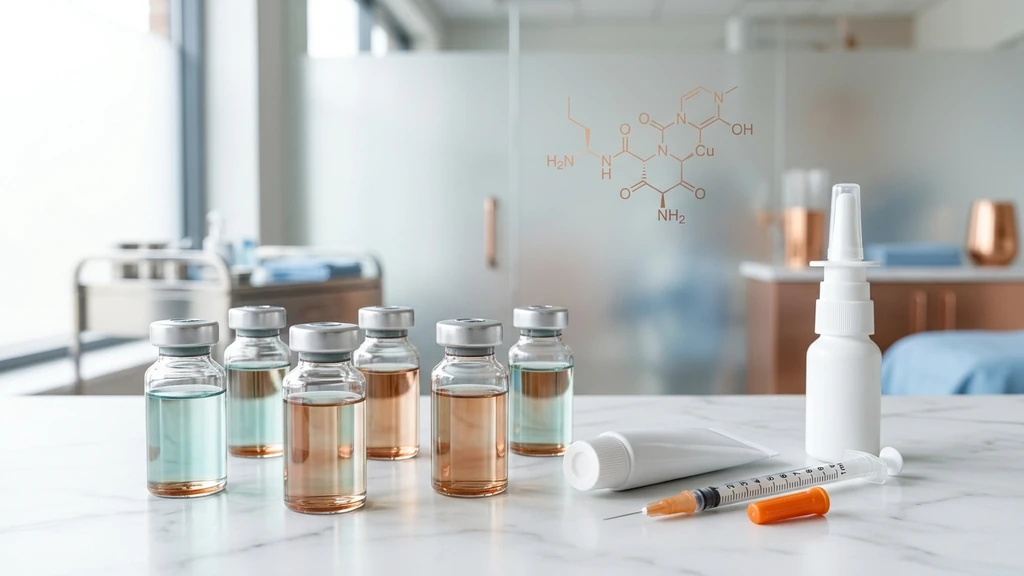
You are reading studies, scanning forums, and weighing whether GHK-Cu is safe before you start. The short answer: topical GHK-Cu has decades of cosmetic use with a mild side effect profile, mostly limited to skin irritation in 5 to 15% of users. Injectable and nasal forms carry additional risks because they bypass the skin barrier and enter systemic circulation, but serious adverse events remain rare in the published literature.
GHK-Cu (glycyl-L-histidyl-L-lysine copper) is a naturally occurring copper-binding tripeptide first isolated from human plasma by Loren Pickart in 1973 (Pickart, Nature, 1973). Your body produces it. Plasma levels average about 200 ng/mL at age 20 and decline to roughly 80 ng/mL by age 60 (Pickart & Margolina, Oxid Med Cell Longev, 2012). Supplementing it through creams, injections, or nasal sprays restores levels, but each route carries its own risk profile.
| Side Effect | Frequency | Severity | Topical | Injection | Nasal |
|---|---|---|---|---|---|
| Skin irritation / redness | 5-15% | Mild | Yes | N/A | N/A |
| Contact dermatitis | 1-3% | Mild-Moderate | Yes | N/A | N/A |
| Injection site reaction | 10-20% | Mild | N/A | Yes | N/A |
| Headache | 5-10% | Mild | N/A | Yes | Yes |
| Lightheadedness / dizziness | 3-8% | Mild | N/A | Yes | Yes |
| Nasal irritation / burning | 10-15% | Mild | N/A | N/A | Yes |
| Metallic taste | 2-5% | Mild | N/A | Yes | Yes |
| Nausea | 1-3% | Mild | N/A | Yes | Rare |
For dosing protocols, see the GHK-Cu injection dosage guide. For preparation, see how to reconstitute GHK-Cu. Use the peptide interaction checker to screen for conflicts with your current medications. Last updated: March 2026.
Get your custom peptide protocol:
- Tailored to your body and goals
- Precise dosing and cycle length
- Safe stacking combinations
- Backed by peer-reviewed studies
- Ready in under 2 minutes
Topical GHK-Cu Side Effects: The Best-Studied Route
Topical GHK-Cu has the longest safety track record of any route. Cosmetic formulations containing copper peptides have been sold commercially since the 1990s. Thousands of users apply them daily. The side effect profile is mild and well characterized.
Skin Irritation and Redness
The most common topical side effect is transient redness at the application site. It affects roughly 5 to 15% of new users during the first two weeks. The irritation is dose-dependent: higher concentrations (above 1%) and more frequent application increase the risk.
Pickart's research showed that GHK-Cu accelerates skin remodeling by upregulating collagen synthesis and stimulating glycosaminoglycan production (Pickart et al., Biomed Res Int, 2015). This remodeling process can temporarily sensitize the skin barrier, producing redness and mild stinging that resolves within 7 to 14 days of continued use.
If you are combining GHK-Cu with microneedling, expect stronger initial irritation. Microneedling creates micro-channels that increase peptide absorption by 10 to 20 fold. Start with lower concentrations (0.1 to 0.5%) when pairing with needling.
Contact Dermatitis
True allergic contact dermatitis from GHK-Cu occurs in 1 to 3% of users. Symptoms include persistent itching, raised welts, and spreading redness beyond the application site. This differs from simple irritation, which stays localized and resolves with continued use.
If you develop spreading redness, blistering, or itching that worsens over 48 hours, discontinue use. A patch test before full application reduces this risk: apply a small amount behind the ear or on the inner wrist, wait 24 hours, and check for reaction.
Purging Phase
Some users experience a "purging" phase during the first 2 to 4 weeks of topical GHK-Cu use. Small breakouts or flaking appear as accelerated cell turnover brings congested skin to the surface faster than normal. This is a sign the peptide is active, not a sign of harm.
The purging phase is self-limiting. It differs from a genuine adverse reaction in two ways: it improves after 3 to 4 weeks (adverse reactions worsen), and it stays within the application area (allergic reactions spread). For more on GHK-Cu and hair growth effects, see our dedicated guide.
Injectable GHK-Cu Side Effects: Less Data, More Caution
Injectable GHK-Cu bypasses the skin barrier and enters systemic circulation directly. This changes the risk profile. While topical GHK-Cu acts locally, subcutaneous injections deliver copper peptide throughout the body. The published human safety data for injectable GHK-Cu is limited compared to topical formulations.
Injection Site Reactions
Injection site reactions are the most frequently reported side effect of subcutaneous GHK-Cu. Community reports suggest 10 to 20% of users experience redness, minor swelling, or a small lump at the injection point. These typically resolve within 24 to 48 hours.
The reactions are mechanical as much as chemical. Subcutaneous injection of any substance produces some local response. Rotating injection sites between the abdomen, upper thigh, and upper arm minimizes cumulative irritation. For proper injection frequency and rotation, see the GHK-Cu injection frequency guide.
Headache and Lightheadedness
Headache affects an estimated 5 to 10% of injectable GHK-Cu users, typically within the first hour after injection. Lightheadedness or brief dizziness occurs in 3 to 8%. Both effects are transient, lasting 30 minutes to a few hours.
GHK-Cu has documented effects on vascular tone. Pickart's research demonstrated that GHK-Cu modulates the expression of vascular endothelial growth factor (VEGF) and promotes angiogenesis (Pickart et al., Biomed Res Int, 2015). These vascular effects may explain the transient blood pressure fluctuations that produce headache and dizziness in some users.
If headaches persist beyond the first week of use, reduce the dose. Staying well hydrated before and after injection helps.
Metallic Taste and Nausea
A metallic taste in the mouth occurs in 2 to 5% of injectable users, typically within minutes of injection. This is a copper-specific effect. Free copper ions have a distinct metallic flavor that some people detect at very low circulating levels.
Mild nausea accompanies the metallic taste in 1 to 3% of cases. Both resolve within 1 to 2 hours. If nausea persists or worsens, it may indicate excessive copper intake from combined sources (supplements, diet, and GHK-Cu together).
Nasal Spray GHK-Cu Side Effects
GHK-Cu nasal spray delivers the peptide through the nasal mucosa, which provides rapid absorption into systemic circulation while bypassing first-pass liver metabolism. The nasal route has its own distinct side effect profile.
Nasal Irritation and Burning
The most common nasal side effect is a burning or stinging sensation in the nostrils immediately after spraying. This affects 10 to 15% of users. The nasal mucosa is thin and highly vascularized, making it sensitive to any non-native solution.
The preservatives and pH of the formulation matter. Bacteriostatic water, commonly used for reconstitution, contains 0.9% benzyl alcohol, which itself causes nasal stinging. Saline-based formulations are gentler. The burning typically lasts 1 to 5 minutes and diminishes with repeated use as the mucosa adapts.
Nasal Congestion and Dryness
Some users report increased nasal congestion or, conversely, dryness after 2 to 3 weeks of daily nasal spray use. GHK-Cu's tissue remodeling properties affect nasal mucosal tissue just as they affect skin. Alternating nostrils with each dose and using a saline rinse 30 minutes after application reduces both congestion and dryness.
Systemic Effects via Nasal Route
Because the nasal mucosa sits close to the blood-brain barrier, nasal GHK-Cu achieves higher CNS bioavailability than subcutaneous injection. This means systemic side effects like headache (5 to 10%) and lightheadedness (3 to 8%) may appear at lower doses than with injection. Start with the lowest effective spray concentration and titrate upward.
Copper-Specific Concerns: When the Metal Matters
GHK-Cu delivers copper ions into your body. Copper is an essential trace mineral, but it has a narrow therapeutic window. Too little causes deficiency. Too much causes toxicity. Understanding copper metabolism is critical for safe GHK-Cu use.
Wilson's Disease: An Absolute Contraindication
Wilson's disease is a genetic disorder affecting approximately 1 in 30,000 people. The body cannot excrete copper properly, leading to toxic accumulation in the liver, brain, and other organs. If you have Wilson's disease, any exogenous copper source, including GHK-Cu, is contraindicated. No exceptions.
Symptoms of undiagnosed Wilson's disease include unexplained liver enzyme elevations, tremors, difficulty speaking, and a characteristic brown ring around the iris (Kayser-Fleischer ring). Wilson's disease is typically diagnosed between ages 5 and 35. If you have a family history of Wilson's disease, get tested (serum ceruloplasmin and 24-hour urinary copper) before using GHK-Cu in any form (EASL Clinical Practice Guidelines, J Hepatol, 2012).
Copper Overload Without Wilson's Disease
Even without Wilson's disease, excessive copper intake is harmful. The tolerable upper intake level for copper is 10 mg per day for adults (Institute of Medicine, 2001). A typical injectable GHK-Cu dose delivers 0.1 to 0.5 mg of elemental copper, well below this threshold.
The risk increases when you combine GHK-Cu with copper-rich foods (liver, shellfish, dark chocolate), copper supplements, or copper IUDs. Total copper intake from all sources is what matters, not GHK-Cu alone. Signs of copper excess include nausea, abdominal pain, and dark or greenish stools. If these appear, reduce or stop GHK-Cu and check serum copper and ceruloplasmin levels.
Quantified Danger: Two Copper Scenarios
Scenario 1: You inject 2 mg of GHK-Cu daily (delivering roughly 0.3 mg copper) while also taking a multivitamin with 2 mg copper and eating 100 g of beef liver (15 mg copper). Total daily copper: approximately 17.3 mg, exceeding the 10 mg upper limit by 73%. Sustained for weeks, this combination could produce liver enzyme elevations and GI symptoms. The fix: choose one copper source. Drop the supplement or reduce liver consumption while using GHK-Cu.
Scenario 2: You use topical GHK-Cu cream twice daily. Transdermal copper absorption from topical application is minimal, estimated at less than 0.01 mg per application. Total copper from topical use: negligible. Copper overload from topical GHK-Cu alone is effectively impossible. This is why the topical route has the widest safety margin.
Is GHK-Cu Safe for Your Liver?
Liver safety is one of the most searched concerns about GHK-Cu, partly because copper toxicity targets the liver. The research tells a more nuanced story than forums suggest. For a deep dive, see does GHK-Cu cause liver damage.
What the Research Shows
GHK-Cu appears to be hepatoprotective, not hepatotoxic, at physiological and standard supplemental doses. Pickart and Margolina documented that GHK-Cu suppresses the expression of genes associated with liver fibrosis and inflammation while upregulating genes involved in antioxidant defense (Pickart & Margolina, Oxid Med Cell Longev, 2012).
A 2014 gene expression study found that GHK-Cu modulated 127 genes relevant to aggressive metastatic colon cancer, many of which are also expressed in liver tissue. The peptide shifted gene expression patterns toward a healthier baseline (Pickart et al., Biomed Res Int, 2014). These are in vitro and gene expression studies, not clinical trials in humans. The distinction matters.
The Copper Paradox in the Liver
Copper is both essential for liver function and toxic in excess. The liver uses copper for cytochrome c oxidase activity, iron metabolism, and dozens of enzymatic reactions. It also stores copper and excretes it through bile.
GHK-Cu delivers copper bound to a peptide carrier, not as free copper ions. Bound copper is handled differently by hepatocytes than free copper. Pickart's work suggests that the GHK tripeptide acts as a copper shuttle, delivering ions to enzymatic sites where they are needed rather than allowing uncontrolled accumulation (Pickart, J Biomater Sci Polym Ed, 2008).
No human clinical trial has demonstrated liver damage from GHK-Cu at standard doses (1 to 3 mg subcutaneously). If you have pre-existing liver disease, baseline liver enzyme testing (ALT, AST, GGT) before starting GHK-Cu and retesting at 4 and 12 weeks provides a safety net.
GHK-Cu and Hair: Growth, Loss, and What to Expect
Hair-related effects are among the most discussed GHK-Cu outcomes. The peptide affects hair through multiple mechanisms, and the effects are overwhelmingly positive.
Hair Growth Stimulation
GHK-Cu stimulates hair growth through two pathways: increasing follicle size and extending the anagen (growth) phase of the hair cycle. Topical application of GHK-Cu enlarged hair follicles by 29% in a study comparing it to minoxidil, the gold standard topical treatment (Pyo et al., Arch Pharm Res, 2007).
GHK-Cu also inhibits 5-alpha reductase, the enzyme that converts testosterone to DHT (dihydrotestosterone). DHT is the primary driver of androgenetic alopecia (pattern hair loss). By reducing local DHT, GHK-Cu may slow the miniaturization process that thins hair over time. For a full analysis, see GHK-Cu for hair growth.
Does GHK-Cu Cause Hair Loss?
A small number of users report initial hair shedding when starting GHK-Cu. This is likely a shedding phase analogous to the "dread shed" seen with minoxidil: weak, miniaturized hairs fall out as the follicle resets to produce a thicker shaft. It is a temporary response, not permanent loss.
No published study has demonstrated that GHK-Cu causes net hair loss. The totality of evidence points toward hair preservation and regrowth. If shedding persists beyond 6 to 8 weeks, it warrants evaluation for other causes. See does GHK-Cu cause hair loss for a complete breakdown.
Drug Interactions and Contraindications
GHK-Cu's interaction profile is relatively clean compared to pharmaceutical drugs, but several important interactions and contraindications exist.
Known Drug Interactions
Zinc supplements: Zinc competes with copper for absorption in the GI tract. High-dose zinc supplementation (above 40 mg daily) can induce copper deficiency over time. Conversely, it may blunt the effects of oral or injectable GHK-Cu. If you take zinc, separate dosing by at least 4 hours.
Penicillamine and trientine: These copper-chelating drugs are used to treat Wilson's disease. They bind copper and remove it from the body. Taking GHK-Cu while on copper chelation therapy is both pointless (the chelator removes the copper you just added) and potentially harmful (it adds copper load the chelator must handle).
NSAIDs: Some evidence suggests GHK-Cu modulates inflammatory pathways shared with NSAIDs, including COX-2 and NF-kB signaling. While no dangerous interaction has been documented, combining high-dose GHK-Cu injections with daily NSAID use may alter inflammatory responses unpredictably. Screen your full regimen with the peptide interaction checker.
Contraindications
Wilson's disease: Absolute contraindication. No form of exogenous copper, period.
Hemochromatosis: Iron overload disorders may be exacerbated because copper and iron metabolism are interconnected. Consult your hematologist.
Active liver disease: While GHK-Cu appears hepatoprotective, adding copper to a liver already under stress is not advisable without medical supervision and monitoring.
Pregnancy and breastfeeding: No safety data exists for GHK-Cu in pregnancy. Copper crosses the placenta. Until human data emerges, avoid GHK-Cu during pregnancy and lactation.
Copper allergy: Rare but documented. If you have known copper sensitivity (green skin from copper jewelry does not qualify; that is a normal oxidation reaction), avoid GHK-Cu.
Topical vs Injectable vs Nasal: Which Route Is Safest?
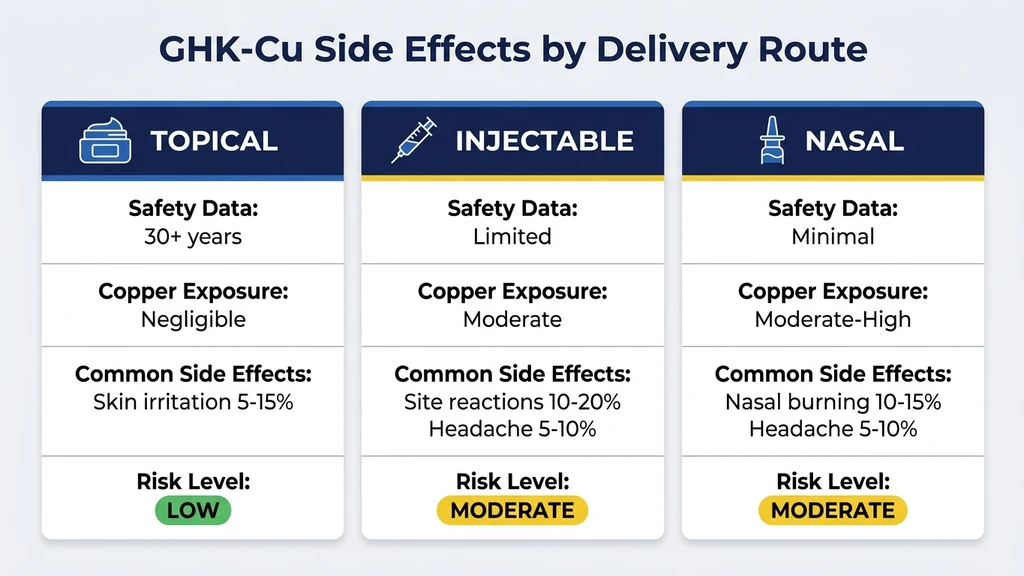
The safety profiles differ substantially by route. Choosing the right route depends on your goals and risk tolerance.
| Factor | Topical | Injectable (SubQ) | Nasal Spray |
|---|---|---|---|
| Safety data available | 30+ years | Limited | Minimal |
| Systemic copper exposure | Negligible | Moderate | Moderate-High |
| Risk of copper overload | Near zero | Low at standard doses | Low at standard doses |
| Local side effects | Mild irritation | Injection site reactions | Nasal burning |
| Systemic side effects | Rare | Headache, dizziness | Headache, dizziness |
| Best for | Skin, local hair growth | Systemic tissue repair | Cognitive, systemic |
Topical GHK-Cu is the safest choice for anyone concerned about side effects. Decades of cosmetic use, negligible systemic copper absorption, and mild local effects make it suitable for long-term daily use. For targeted skin rejuvenation and local hair growth, topical is the first-line route.
Injectable GHK-Cu is appropriate when systemic effects are the goal: tissue repair, wound healing, or anti-inflammatory benefits throughout the body. It requires proper reconstitution (see how to reconstitute GHK-Cu), sterile technique, and awareness of copper intake from all sources.
Nasal spray GHK-Cu offers the highest CNS bioavailability. It is the least studied route and carries the most uncertainty. Use it only if the intended benefit (cognitive support, neuroprotection) specifically requires CNS delivery.
Long-Term Safety: What We Know and Do Not Know
GHK-Cu's long-term safety picture depends entirely on the route.
Topical: Strong Long-Term Data
Topical copper peptide formulations have been used daily by consumers since the 1990s. No signal of long-term harm has emerged in three decades of widespread use. The systemic copper exposure from topical application is too low to produce cumulative toxicity. For the topical route, the long-term safety profile is well established and reassuring.
Injectable and Nasal: Insufficient Long-Term Data
No published study has followed injectable or nasal GHK-Cu users for more than 12 months. The longest case series in the literature tracked subcutaneous GHK-Cu for wound healing over 8 to 12 weeks. What happens to serum copper levels, liver enzymes, and kidney function after years of injectable use remains unknown.
This does not mean long-term injectable use is dangerous. It means the data to confirm safety does not exist yet. If you use injectable GHK-Cu for extended periods, periodic blood work (serum copper, ceruloplasmin, liver enzymes, CBC) every 3 to 6 months is prudent risk management.
Frequently Asked Questions
Is GHK-Cu safe for the liver?
Published research suggests GHK-Cu is hepatoprotective at standard doses of 1 to 3 mg subcutaneously. Pickart and Margolina (2012) found GHK-Cu suppresses genes associated with liver fibrosis while activating antioxidant defense genes. No human clinical trial has demonstrated liver damage from GHK-Cu. Copper is delivered bound to the peptide, not as free ions, reducing hepatotoxicity risk. Pre-existing liver disease warrants baseline ALT/AST testing before starting.
What are the side effects of GHK-Cu injections?
The most common GHK-Cu injection side effects are injection site reactions (redness, swelling) in 10 to 20% of users, headache in 5 to 10%, lightheadedness in 3 to 8%, and metallic taste in 2 to 5%. Mild nausea occurs in 1 to 3%. All are transient, typically resolving within a few hours. Rotating injection sites and staying hydrated minimizes these effects. Serious adverse events from injectable GHK-Cu are rare in published literature.
Is GHK-Cu safe to use long term?
Topical GHK-Cu has 30+ years of commercial use with no long-term safety signals. Systemic copper absorption from creams is negligible. Injectable and nasal GHK-Cu lack long-term data beyond 12 months. No study has tracked serum copper levels or organ function in injectable users over years. If injecting long-term, check serum copper, ceruloplasmin, and liver enzymes every 3 to 6 months.
Can GHK-Cu cause hair loss?
GHK-Cu does not cause net hair loss in any published study. It enlarged hair follicles by 29% compared to minoxidil in one study (Pyo et al., 2007) and inhibits 5-alpha reductase, reducing local DHT. Some users experience temporary shedding in the first 4 to 6 weeks as weak hairs are replaced by thicker growth. This is a shedding phase, not permanent loss. If shedding persists beyond 8 weeks, investigate other causes.
Who should not use GHK-Cu?
GHK-Cu is contraindicated in Wilson's disease (genetic copper accumulation disorder affecting 1 in 30,000 people), hemochromatosis (iron overload), active liver disease without medical supervision, pregnancy and breastfeeding, and documented copper allergy. People taking copper-chelating drugs (penicillamine, trientine) should also avoid GHK-Cu. If you have a family history of Wilson's disease, test serum ceruloplasmin before starting.
Is topical GHK-Cu safer than injectable?
Yes. Topical GHK-Cu delivers negligible systemic copper (less than 0.01 mg per application) and has 30+ years of commercial safety data. Injectable GHK-Cu delivers 0.1 to 0.5 mg of copper per dose into systemic circulation, requires sterile technique, and has limited published safety data. For skin and local hair benefits, topical is the first-line choice. Injectable is reserved for systemic goals like tissue repair.
Does GHK-Cu interact with medications?
GHK-Cu interacts with copper-chelating drugs (penicillamine, trientine), which bind and remove the copper GHK-Cu delivers. High-dose zinc supplements (above 40 mg daily) compete with copper for absorption and may reduce GHK-Cu efficacy. No dangerous interaction with common medications has been documented, but combining high-dose injections with daily NSAIDs may alter inflammatory signaling. Screen your regimen with a peptide interaction checker.
Can GHK-Cu cause copper toxicity?
At standard supplemental doses (1 to 3 mg subcutaneously), GHK-Cu delivers 0.1 to 0.5 mg copper per dose, well below the 10 mg daily tolerable upper limit. Copper toxicity risk increases when GHK-Cu is combined with copper supplements, copper-rich foods (beef liver: 15 mg per 100 g), and copper IUDs. Total copper from all sources matters. Symptoms of excess include nausea, abdominal pain, and dark stools.
The Bottom Line
GHK-Cu's safety profile is defined by its route of delivery. Topical application carries three decades of evidence and negligible systemic risk. Injectable and nasal routes deliver meaningful copper loads and require awareness of total copper intake, liver status, and contraindications like Wilson's disease.
The principle is straightforward: match the route to the goal. Topical for skin and local hair growth. Injectable for systemic repair. Nasal for CNS-targeted effects. Monitor copper levels if you inject. Avoid all forms if you carry Wilson's disease or take copper chelators.
Calculate your reconstitution volumes with the peptide reconstitution calculator. For dosing schedules, see the GHK-Cu injection dosage guide. For preparation technique, see how to reconstitute GHK-Cu. Check drug interactions with the peptide interaction checker. Explore the full GHK-Cu peptide profile for mechanism, benefits, and research summaries.
Related Articles
Does GHK-Cu Cause Liver Damage?
GHK-Cu delivers only 0.3 mg copper per 1 mg dose, far below toxic thresholds. Learn what research says about GHK-Cu liver safety and who should avoid it.
Does GHK-Cu Cause Hair Loss?
GHK-Cu does not cause hair loss. Research shows it promotes hair growth by activating the Wnt/beta-catenin pathway and enlarging miniaturized follicles.
BPC-157 TB-500 Side Effects: Stack Safety Data
BPC-157 TB-500 stack side effects: headaches, fatigue weeks 1-2, anaphylaxis risk, cancer screening tips. Week-by-week timeline inside.
Peptide Therapy Side Effects: Complete Guide (2026)
Peptide therapy side effects by category: GLP-1, GH-releasing, healing, and immune. Severity matrix, incidence rates, and management strategies.