You are holding a nasal spray bottle labeled GHK-Cu and wondering whether spraying a peptide up your nose actually reaches the brain. It does. GHK-Cu nasal spray delivers the copper tripeptide glycyl-L-histidyl-L-lysine through the nasal mucosa, bypassing the blood-brain barrier via the olfactory pathway. The typical dosage is 1 to 2 sprays per nostril once daily, delivering 625 to 1,250 mcg total per session.
Two 2023 University of Washington studies found that intranasal GHK improved spatial memory in aging mice and reduced amyloid plaque formation in Alzheimer's model mice (Tucker et al., 2023, PMID: 38046716). Most GHK-Cu research focuses on injection and topical routes for skin, hair, and wound healing. The nasal route opens a different target: the brain. No human clinical trial has confirmed these cognitive benefits. The evidence is preclinical, specific, replicated, and mechanistically coherent.
| Parameter | Standard Nasal Spray Protocol |
|---|---|
| Dose per spray | 625 mcg (commercial 5 mg/mL solution) |
| Daily dose | 625 to 1,250 mcg (1 to 2 sprays per nostril) |
| Cycle length | 4 to 8 weeks |
| Brain delivery | Olfactory + trigeminal perineural pathway |
| Onset (subjective) | 2 to 4 weeks |
| Shelf life (refrigerated) | 28 days reconstituted |
Get your custom peptide protocol:
- Tailored to your body and goals
- Precise dosing and cycle length
- Safe stacking combinations
- Backed by peer-reviewed studies
- Ready in under 2 minutes
What Is GHK-Cu Nasal Spray?
GHK-Cu is a tripeptide: glycine, histidine, and lysine bound to a copper(II) ion. Dr. Loren Pickart first isolated it from human plasma in 1973. It circulates naturally in your blood at roughly 200 ng/mL around age 20, then declines by more than half by age 60.
A GHK-Cu nasal spray is this same peptide dissolved in saline and delivered through a metered-dose nasal sprayer. Commercial products typically contain 50 mg per 10 mL bottle, yielding approximately 80 sprays at 625 mcg per spray. Compounding pharmacies prepare solutions at 0.1 to 0.5% concentration.
The peptide modulates over 4,000 human genes, influencing collagen synthesis, antioxidant defense, and inflammatory signaling (Pickart et al., 2015). Those systemic effects are shared across all delivery routes. What makes the nasal route distinct is where the peptide goes first.
How Intranasal GHK-Cu Reaches the Brain
The blood-brain barrier blocks most peptides from entering brain tissue. Subcutaneous injection delivers GHK-Cu throughout the body, but very little crosses into the central nervous system. Oral delivery is worse: stomach acid and liver metabolism destroy most of the peptide before it reaches any tissue at all.
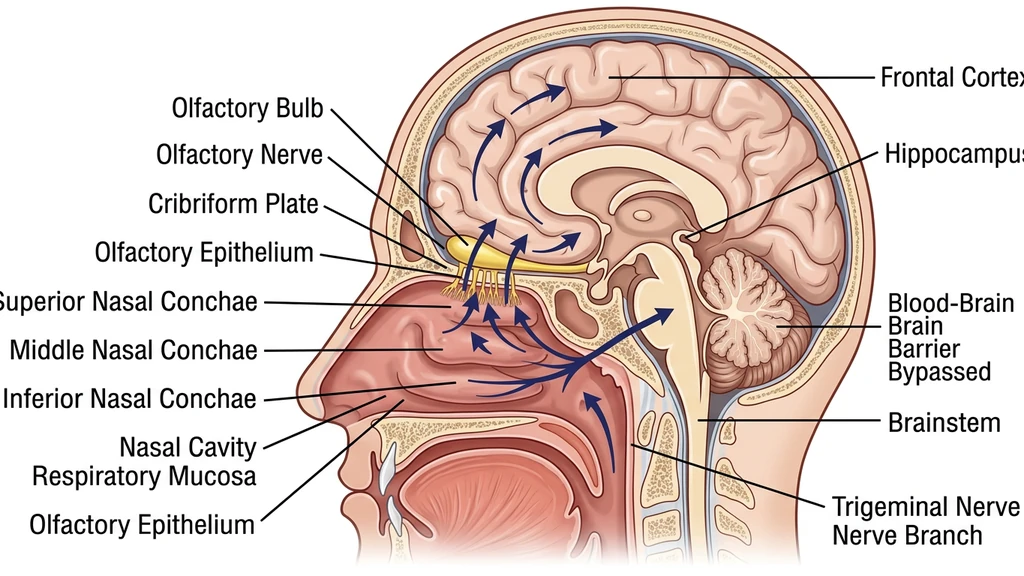
The nasal route bypasses both problems. Picture two highways running from the roof of your nasal cavity directly into the brain. One follows the olfactory nerve axons to the frontal cortex. The other follows the trigeminal nerve toward the brainstem and hippocampus. GHK-Cu molecules travel through perineural spaces alongside these nerves, arriving in brain tissue within minutes (Lochhead & Thorne, 2012).
This is the same delivery principle used by Semax and Selank nasal sprays. The olfactory pathway avoids first-pass metabolism, requires lower doses than systemic injection for brain effects, and delivers peptide to the frontal cortex and hippocampus with particular efficiency.
GHK-Cu Nasal Spray Benefits
The nasal route shares the systemic benefits of injectable GHK-Cu: collagen synthesis, anti-inflammatory signaling, antioxidant upregulation. The unique advantage is direct brain access, which opens cognitive and neuroprotective applications that other routes cannot match.
Cognitive Protection and Memory
The strongest evidence for nasal GHK-Cu comes from a 2023 study at the University of Washington. Aging C57BL/6 mice received intranasal GHK at 15 mg/kg daily for 8 weeks. Treated mice showed improved Y-maze spontaneous alternation, a standard measure of working memory. They also performed better on box maze spatial learning tasks.
Beyond behavior, the researchers measured biomarkers. Treated mice had lower NFL-1 (neurofilament light, a marker of axonal damage) and reduced MCP-1 (a chemokine that drives neuroinflammation) in the frontal cortex (Tucker et al., 2023). The peptide did not merely slow decline. It improved cognitive performance in already-aging animals.
Alzheimer's Disease Markers (Preclinical)
A companion study used 5xFAD transgenic mice, an aggressive Alzheimer's disease model that develops amyloid plaques early. These mice received intranasal GHK at 15 mg/kg three times per week for 12 weeks. The treatment reduced amyloid plaque formation in both the frontal cortex and hippocampus and lowered neuroinflammatory markers (Tucker et al., 2023).
Both studies were preclinical. No human trial has tested intranasal GHK-Cu for cognitive outcomes. The results are promising, but the distance from mouse to human remains significant.
Systemic Anti-Aging and Tissue Repair
GHK-Cu absorbed through nasal mucosa also enters systemic circulation. You get some of the same gene-modulation effects seen with injection: upregulation of collagen I and III, glycosaminoglycan synthesis, and stem cell recruitment. Systemic bioavailability is lower than subcutaneous injection but higher than topical application.
For users whose primary goal is skin, hair, or wound healing, injection remains the stronger route. For a detailed injection protocol, see the GHK-Cu injection dosage guide. For hair-specific applications, see our GHK-Cu hair growth guide.
Anti-Inflammatory and Antioxidant Effects
GHK-Cu reduces IL-6 and TNF-alpha (pro-inflammatory cytokines) while increasing superoxide dismutase and glutathione (antioxidant defenses). These effects are relevant to both brain and systemic inflammation (Pickart & Margolina, 2018).
For a broader view of peptides for cognitive function, including Semax, Selank, and Dihexa, see the dedicated guide.
GHK-Cu Nasal Spray Dosage
The standard dosage is 1 to 2 sprays per nostril, once daily. With a typical 625 mcg per spray product, that delivers 625 to 1,250 mcg total per session.
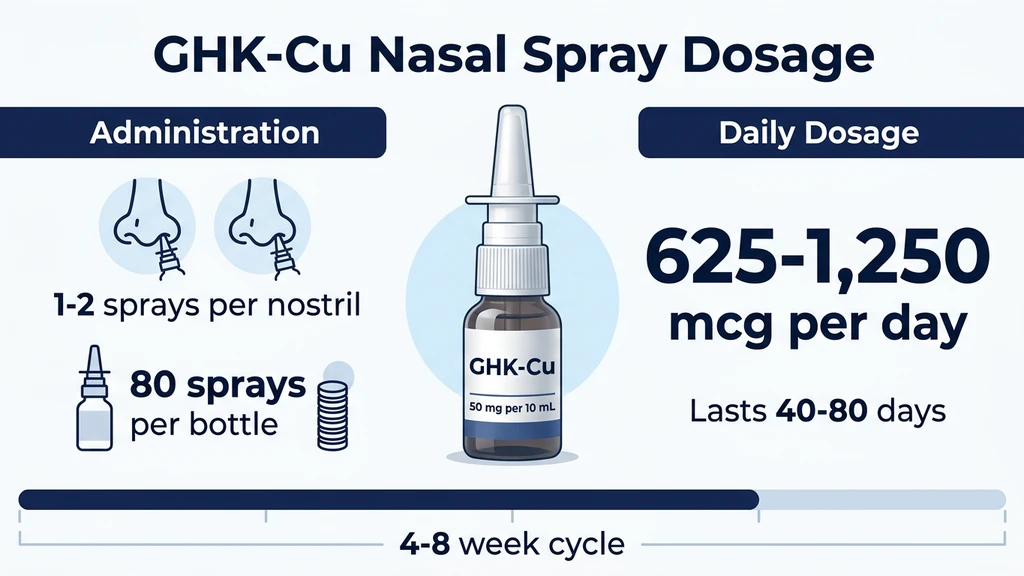
Compounding pharmacies prepare solutions at 0.1 to 0.5% concentration. A 50 mg bottle with 80 sprays lasts 40 to 80 days depending on your dose. Clear your nose before application. Spray onto clean, dry nasal mucosa. Do not blow your nose for 5 to 10 minutes afterward. If using a single spray, alternate nostrils each day.
A typical cycle runs 4 to 8 weeks, then reassess. No established cycling protocol exists for the nasal route. The mouse studies used 15 mg/kg daily, a dose not directly translatable to humans. Current human dosing is extrapolated from preclinical data and compounding pharmacy practice. No human clinical trial has established an optimal nasal dose.
Nasal Spray vs Injection vs Topical: Which Route Is Best?
Each route serves a different purpose. The choice depends on your primary goal.
| Factor | Nasal Spray | Subcutaneous Injection | Topical (Serum/Cream) |
|---|---|---|---|
| Best for | Brain/cognitive, needle-free systemic | Systemic anti-aging, deep tissue repair | Facial skin, hair, localized areas |
| Typical dose | 625 to 1,250 mcg/day | 1 to 2 mg/day | 1 to 3% concentration |
| Brain access | Direct (olfactory pathway) | Limited (BBB blocks most) | None |
| Bioavailability | Moderate (mucosal absorption) | High (systemic) | Low (dermal penetration) |
| Onset | Minutes (brain), hours (systemic) | Hours (systemic) | Weeks (skin structural changes) |
| Convenience | Easy, no needles | Requires reconstitution and injection | Easiest (apply like skincare) |
| Side effects | Mild nasal irritation, metallic taste | Injection site redness, bruising | Skin tingling, possible purging |
| FDA status (2026) | Compoundable (pharmacy) | Category 2 (restricted from 503A) | Category 1 (eligible) |
| Monthly cost | $40 to $80 | $40 to $120 | $30 to $80 |
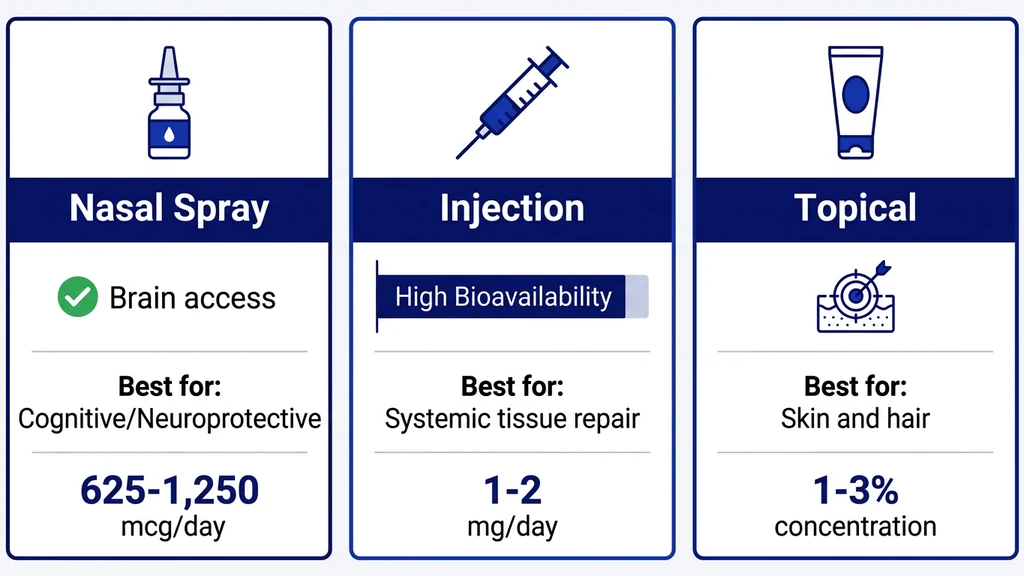
Choose nasal spray if your primary goal is cognitive or neuroprotective, or if you want systemic benefits without needles. Choose injection if you need maximum systemic bioavailability for deep tissue repair, wound healing, or bone and joint recovery. Choose topical if your target is facial skin aging, hair growth, or another localized application.
Some practitioners combine routes: nasal spray for brain benefits, subcutaneous injection for systemic tissue repair. The mechanisms are complementary, and the total copper load at standard doses stays well within safe limits.
For injection protocol details, see the GHK-Cu injection dosage guide. For users who choose the injection route, the Peptide Reconstitution Calculator handles the math.
How to Use GHK-Cu Nasal Spray Properly
Technique matters. A poorly aimed spray deposits peptide on the nasal septum where absorption is minimal. A well-aimed spray coats the olfactory region at the roof of the nasal cavity where absorption is highest.
Step-by-step technique:
- 1.Clear your nose. Blow gently or use a saline rinse 10 minutes before application. Mucus blocks the olfactory epithelium and reduces absorption.
- 2.Prime the bottle. If using for the first time or after storage, pump 2 to 3 times into the air until a fine mist appears. This clears the dip tube.
- 3.Tilt your head slightly forward. Do not tilt backward. A forward tilt directs the spray upward toward the olfactory region rather than straight back into the throat.
- 4.Insert the nozzle into one nostril. Angle it slightly outward, toward the ear on the same side. This aims the spray at the lateral nasal wall and olfactory cleft rather than the septum.
- 5.Spray while inhaling gently through the nose. A slow, steady sniff carries the mist upward. A hard sniff pulls the spray past the olfactory region and into the throat, wasting it.
- 6.Hold your breath for 5 seconds after spraying. This gives the mist time to settle onto the mucosal surface.
- 7.Repeat in the other nostril if your protocol calls for 2 sprays total.
- 8.Do not blow your nose for at least 10 minutes. Do not sniff aggressively. Let the peptide absorb passively.
Timing: Most users spray in the morning. No data favors morning over evening for the nasal route. Consistency matters more than clock position. If you experience a metallic taste after spraying, the solution is reaching your throat. Adjust the angle next time.
Storage: Refrigerate the bottle between uses. GHK-Cu solutions degrade faster at room temperature. The blue-green tint should remain consistent throughout the bottle's life. If the solution turns colorless or cloudy, discard it. See how to store peptides for general guidance. For information on solvent shelf life, see how long does bacteriostatic water last.
Stacking GHK-Cu Nasal Spray with Semax or Selank
Three peptide nasal sprays dominate the cognitive and neuroprotective space: GHK-Cu, Semax, and Selank. Each works through a different mechanism, and they can be combined.
| Peptide | Primary Mechanism | Best For | Typical Nasal Dose | Onset |
|---|---|---|---|---|
| GHK-Cu | Copper delivery, gene modulation, anti-inflammatory | Neuroprotection, long-term cognitive maintenance | 625-1,250 mcg/day | Weeks (structural) |
| Semax | BDNF upregulation, melanocortin receptor activation | Focus, memory, acute cognitive enhancement | 200-600 mcg/day | Minutes to hours |
| Selank | GABA modulation, anti-anxiety, immune regulation | Anxiety reduction, calm focus, immune support | 250-500 mcg/day | Minutes to hours |
GHK-Cu + Semax is the most common cognitive stack. GHK-Cu provides the structural foundation: reducing neuroinflammation, lowering neurofilament light (a marker of axonal damage), and supporting long-term brain health. Semax provides the acute performance boost: increasing brain-derived neurotrophic factor (BDNF) and enhancing attention and working memory within hours. The combination addresses both maintenance and performance.
GHK-Cu + Selank suits users whose cognitive concerns include anxiety. Selank modulates GABA receptors and has anxiolytic effects comparable to low-dose benzodiazepines without sedation or dependence. GHK-Cu adds the anti-inflammatory and neuroprotective layer. Together, they address the inflammation-anxiety feedback loop that accelerates cognitive decline.
All three together is used by some practitioners for comprehensive cognitive optimization. Spray each peptide at least 5 minutes apart to allow mucosal absorption before the next application. GHK-Cu first (thicker molecule, needs clean mucosa), then Semax, then Selank.
No published study evaluates these specific combinations. The rationale is mechanistic: each peptide acts through distinct pathways with no known interference. The olfactory delivery route is shared, which means all three reach the brain through the same perineural highway. For a full comparison of cognitive peptides, see peptides for cognitive function.
Making Your Own GHK-Cu Nasal Spray (DIY)
Some users prefer to prepare their own nasal spray from injectable-grade GHK-Cu powder. This is straightforward but requires attention to sterility and concentration math.
What you need: - GHK-Cu lyophilized powder (50mg vial) - Bacteriostatic water or preserved nasal saline - Empty sterile nasal spray bottle (10 mL, metered-dose) - Sterile syringe for transfer - Alcohol swabs
Concentration calculation. A standard commercial nasal spray delivers 625 mcg per spray in approximately 0.125 mL per actuation. To match this, you need a concentration of 5 mg/mL. Dissolve 50 mg of GHK-Cu in 10 mL of solvent. Each 0.125 mL spray delivers 625 mcg.
| Vial Size | Solvent Volume | Concentration | mcg per Spray (0.125 mL) | Sprays per Bottle |
|---|---|---|---|---|
| 50 mg | 10 mL | 5 mg/mL | 625 mcg | ~80 |
| 50 mg | 5 mL | 10 mg/mL | 1,250 mcg | ~40 |
| 100 mg | 10 mL | 10 mg/mL | 1,250 mcg | ~80 |
Important note on solvent: Commercial GHK-Cu nasal sprays often use saline as the base. For nasal delivery, saline is acceptable because the goal is mucosal absorption, not maintaining the copper-peptide bond in solution for weeks. The contact time with sodium chloride is brief. However, for maximum stability during the 28-day shelf life, bacteriostatic water is still the safer choice. If you use saline, prepare smaller batches and use within 14 days.
Steps: 1. Reconstitute the GHK-Cu vial with your chosen volume of solvent using standard technique. See the reconstitution guide for detailed steps. 2. Draw the entire reconstituted solution into a sterile syringe. 3. Transfer into the empty nasal spray bottle through the opening (remove the spray mechanism first). 4. Replace the spray mechanism. Prime with 2 to 3 pumps. 5. Label with concentration, date, and expiration (28 days from reconstitution). 6. Refrigerate between uses.
The DIY approach saves 40 to 60% compared to pre-made nasal sprays. The trade-off is handling time and the need for sterile technique. If sterility is a concern, buy a commercial product from a compounding pharmacy.
What to Expect: Week-by-Week Timeline
GHK-Cu nasal spray effects divide into two categories: acute mucosal effects you notice immediately and structural neurological changes that develop over weeks. Set your expectations accordingly.
Day 1 to 3. Mild nasal tingling or slight metallic taste after spraying. These are normal and typically diminish by day 3. Some users report a subtle sense of mental clarity within the first few days, though this may be placebo at such an early stage.
Week 1 to 2. Nasal irritation, if present, resolves. No dramatic cognitive changes yet. The peptide is beginning to accumulate in brain tissue and initiate gene expression changes. The Tucker et al. mouse studies used 8 to 12 weeks of treatment, so meaningful neurological effects at week 1 would not be expected.
Week 2 to 4. Some users report improved sleep quality and reduced brain fog. These are anecdotal and not confirmed by clinical data, but they align with the anti-inflammatory mechanism: reduced neuroinflammation can improve sleep architecture and daytime mental clarity. Systemic effects (skin hydration, mild anti-aging) may become noticeable as GHK-Cu absorbed through nasal mucosa enters general circulation.
Week 4 to 8. This is the window where the preclinical data becomes relevant. In the Tucker et al. aging mouse study, 8 weeks of intranasal GHK produced measurable improvements in Y-maze performance (working memory) and reduced neurofilament light chain levels (axonal damage marker). The human equivalent timeline is uncertain, but 4 to 8 weeks of consistent use represents the minimum commitment for a fair assessment.
Week 8 to 12. If you are going to notice cognitive benefits, this is when they become most apparent. Assess whether brain fog has decreased, whether working memory feels sharper, and whether the benefits justify continuing. Reassess your protocol and decide whether to continue, take a break, or adjust the dose.
No human trial data exists to validate these timelines. They are extrapolated from the preclinical studies and practitioner observation. Individual responses will vary significantly.
Side Effects of GHK-Cu Nasal Spray
The most common side effect is mild nasal irritation or dryness. Some users report a transient metallic taste. Occasional sneezing after application is normal. Systemic side effects are rare at standard nasal doses.
The same contraindications apply across all GHK-Cu routes: Wilson's disease or any copper metabolism disorder, active cancer (due to pro-angiogenic properties), and pregnancy or breastfeeding. Copper toxicity risk is negligible at nasal spray doses. The therapeutic dose in animal models sits roughly 300 times below the toxic threshold (Pickart & Margolina, 2018).
For a complete side effect and safety profile, see the GHK-Cu peptide profile.
Frequently Asked Questions
Does GHK-Cu nasal spray cross the blood-brain barrier?
Yes. Intranasal delivery bypasses the blood-brain barrier via the olfactory epithelium. GHK-Cu molecules travel through perineural spaces around olfactory nerve axons directly to the frontal cortex and hippocampus. This is the same delivery principle used by Semax and Selank nasal sprays. Subcutaneous injection delivers very little GHK-Cu to brain tissue.
What is the recommended GHK-Cu nasal spray dosage?
The typical dosage is 1 to 2 sprays per nostril once daily, delivering 625 to 1,250 mcg total. Commercial products usually contain 50 mg per 10 mL bottle at approximately 80 sprays. No human clinical trial has established an optimal dose. For comparison with the injection protocol, see the GHK-Cu injection dosage guide.
Is GHK-Cu nasal spray better than injection?
They serve different purposes. Nasal spray provides direct brain access for cognitive and neuroprotective benefits without needles. Injection delivers higher systemic bioavailability for deep tissue repair, wound healing, and bodywide anti-aging. For cognitive goals, nasal is preferred. For skin and hair, see GHK-Cu hair growth protocols and how often to inject GHK-Cu.
Can you use GHK-Cu nasal spray and injection together?
Yes. Some practitioners prescribe nasal spray for brain benefits alongside subcutaneous injection for systemic tissue repair. No published study evaluates this specific combination, but the mechanisms are complementary. The total copper load at standard doses (625 to 1,250 mcg nasal plus 1 to 2 mg injected) remains within safe limits. Verify with the peptide interaction checker.
Are there human clinical trials on GHK-Cu nasal spray?
Not yet. Current evidence comes from two 2023 preclinical studies at the University of Washington using aging C57BL/6 mice and 5xFAD Alzheimer's model mice. Both showed improved cognitive performance and reduced neuroinflammation with intranasal GHK. Human trials are anticipated but not published as of May 2026. For the full mechanism, see GHK-Cu benefits: 8 research-backed effects.
How long does a GHK-Cu nasal spray bottle last?
A standard 50 mg bottle contains approximately 80 sprays at 625 mcg per spray. At 1 spray per nostril daily (2 sprays total, 1,250 mcg), the bottle lasts 40 days. At 1 spray per nostril alternating daily, it lasts 80 days. Store refrigerated between uses. See how to store peptides for general guidance on temperature stability.
Can I make my own GHK-Cu nasal spray from injectable powder?
Yes. Dissolve 50 mg of injectable-grade GHK-Cu in 10 mL of bacteriostatic water to get 5 mg/mL. Transfer to a sterile metered-dose nasal spray bottle. Each 0.125 mL actuation delivers 625 mcg. Label with the date and refrigerate. Use within 28 days. See how to reconstitute GHK-Cu for step-by-step reconstitution technique.
Can I stack GHK-Cu nasal spray with Semax?
Yes. GHK-Cu provides structural neuroprotection (reducing neuroinflammation and axonal damage markers) while Semax provides acute cognitive enhancement via BDNF upregulation. Spray GHK-Cu first to coat the mucosa, wait 5 minutes, then spray Semax. See peptides for cognitive function for the full nootropic stacking framework.
The Bottom Line
GHK-Cu nasal spray delivers 625 to 1,250 mcg of copper tripeptide directly to the brain via the olfactory pathway, bypassing the blood-brain barrier that limits injection and oral routes. Preclinical evidence from two University of Washington studies shows improved spatial memory and reduced amyloid plaque formation in mouse models.
The nasal route is the logical choice when the target is cognitive or neuroprotective. For systemic skin, hair, and tissue repair, injection remains superior. The two routes are complementary, not competing.
Human clinical trials have not yet been published. The preclinical data is specific and replicated, but the gap between mouse models and human outcomes is real. Dose accordingly: start at 625 mcg per day, assess over 4 to 8 weeks, and adjust based on response.
Explore protocols, calculators, and peptide profiles at PeptidesExplorer.
Related Guides: - How to Reconstitute GHK-Cu: step-by-step preparation for DIY nasal spray - GHK-Cu Microneedling Protocol: topical delivery route for skin and hair goals - Does GHK-Cu Cause Liver Damage?: copper safety data at standard doses - GHK-Cu + BPC-157 + TB-500 Blend: combining nasal spray with injectable blend protocols - Peptide Safety Guide: comprehensive safety reference for all peptide routes - Where to Buy Peptides: sourcing guidance for research-grade GHK-Cu
Related Articles
BPC-157 Nasal Spray: Dosage, Preparation & Benefits
BPC-157 nasal spray delivers 200-500 mcg per dose to the brain via the olfactory pathway. Preparation steps, nasal vs injectable, and CNS benefits.
12 Nootropic Peptides Ranked (2026)
12 nootropic peptides ranked by evidence: Semax, Selank, Cerebrolysin, Dihexa, BPC-157. Mechanisms, dosages, and which ones actually work for focus and memory.
Where to Inject GHK-Cu: Sites by Goal
Where to inject GHK-Cu for skin, hair, wounds, and anti-aging. Subcutaneous site map by goal, rotation patterns, needle depth, and angle guidance.
GHK-Cu Benefits: 8 Research-Backed Effects
8 GHK-Cu benefits: skin rejuvenation, wound healing, hair growth, anti-inflammatory, and antioxidant effects. PubMed-cited research with dosages.