
You turned 40 and noticed the recovery from a hard gym session now takes three days instead of one. The best peptides for men over 40 are CJC-1295/Ipamorelin for muscle and fat loss, BPC-157 for joint recovery, PT-141 for sexual function, and Tesamorelin for visceral fat. Testosterone drops 1-2% per year after age 30, and growth hormone falls roughly 14% per decade (Ho et al., J Clin Endocrinol Metab, 1987). Peptide therapy targets these exact deficits.
| Quick Reference | Details |
|---|---|
| #1 Overall | CJC-1295 / Ipamorelin (GH release) |
| #1 Recovery | BPC-157 (tendons, joints) |
| #1 Sexual Function | PT-141 / Bremelanotide |
| #1 Fat Loss | Tesamorelin (FDA-approved) |
| Testosterone decline | 1-2% per year after age 30 |
| GH decline | ~14% per decade |
| Blood work needed | Yes, before starting any protocol |
| Results timeline | 4-12 weeks depending on peptide |
For dosing specifics on any peptide below, use our peptide dosage calculator. If you are new to peptides, start with our getting started guide.
Get your custom peptide protocol:
- Tailored to your body and goals
- Precise dosing and cycle length
- Safe stacking combinations
- Backed by peer-reviewed studies
- Ready in under 2 minutes
Why Men Over 40 Need Peptides
After 40, your body runs on a declining hormonal budget. The deficits compound each year, and the typical symptoms (slower recovery, stubborn belly fat, lower libido, poor sleep) trace back to measurable biological changes.
Testosterone Decline After 30
Total testosterone drops 1-2% per year starting around age 30. By 45, many men sit 20-30% below their peak levels. Free testosterone declines even faster because sex hormone-binding globulin (SHBG) rises with age, binding more of the available testosterone (Feldman et al., J Clin Endocrinol Metab, 2002).
The practical result: reduced muscle protein synthesis, higher body fat percentage, and lower drive. These are not symptoms of laziness. They are biochemistry.
Growth Hormone Drop: 14% Per Decade
Growth hormone secretion peaks in your twenties and declines roughly 14% per decade thereafter. By age 40, your GH output is roughly half of what it was at 20 (Ho et al., J Clin Endocrinol Metab, 1987). IGF-1, the downstream marker of GH activity, follows the same trajectory.
Lower GH means less overnight tissue repair, slower wound healing, and reduced ability to build lean mass even with consistent training.
Slower Recovery and Increased Injury Risk
Tendons and ligaments lose elasticity with age. Collagen turnover slows. A rotator cuff strain that resolved in two weeks at 25 can linger for months at 42. This is where healing peptides like BPC-157 and TB-500 fill a gap that no amount of rest alone can close.
Joint cartilage also thins, particularly in knees, hips, and shoulders. Men over 40 who train hard face a genuine tradeoff between intensity and injury risk.
Metabolic Slowdown and Visceral Fat
Resting metabolic rate drops approximately 2-4% per decade after 20. Insulin sensitivity declines. Visceral fat, the deep abdominal fat surrounding organs, accumulates preferentially in men after 40. This fat is metabolically active and increases cardiovascular risk (Tchernof & Despres, Physiol Rev, 2013).
Peptides like Tesamorelin and MOTS-c target visceral fat through different pathways than diet alone.
Top 10 Peptides for Men Over 40: Ranked
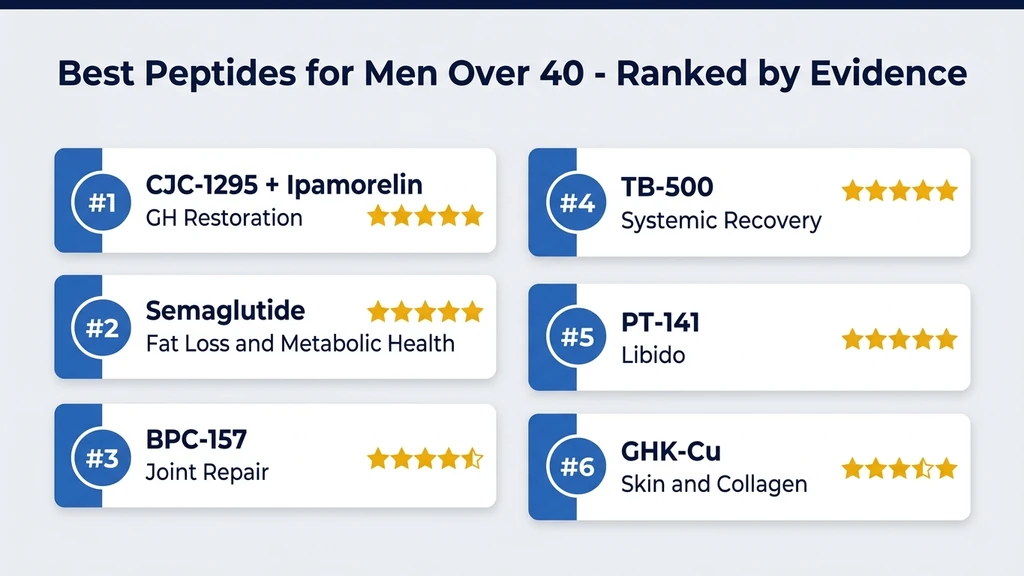
Each peptide below is ranked by evidence quality, relevance to men over 40, and practical accessibility. The ranking favors peptides with human clinical data over those with animal-only research.
1. CJC-1295 / Ipamorelin: GH Release for Muscle and Fat
CJC-1295 with DAC extends growth hormone release over days rather than minutes. Paired with Ipamorelin, a selective GH secretagogue that does not spike cortisol or prolactin, the combination delivers the most favorable GH boost available through peptides (Teichman et al., J Clin Endocrinol Metab, 2006).
A single dose of CJC-1295 elevated GH levels 2-10 fold and IGF-1 by 1.5-3x in healthy adults aged 21-61. The effects lasted up to 6 days. Men over 40 typically start at 100 mcg of each peptide, injected subcutaneously before bed, 5 days per week.
| CJC-1295/Ipamorelin | Details |
|---|---|
| Mechanism | GHRH analog + selective GH secretagogue |
| Key benefit | Increased lean mass, reduced body fat, deeper sleep |
| Starting dose | 100 mcg each, subcutaneous, before bed |
| Results timeline | 4-8 weeks for sleep; 8-12 weeks for body composition |
| Side effects | Mild: flushing, headache, water retention |
| Evidence level | Human clinical trials |
For full dosing protocols, see our CJC-1295 dosage guide. Ipamorelin was the first GH secretagogue shown to be truly selective, meaning it does not raise ACTH or cortisol (Raun et al., Endocrinology, 1998).
2. BPC-157: Joint and Tendon Recovery
BPC-157 (Body Protection Compound-157) is a 15-amino-acid peptide derived from human gastric juice. It accelerates tendon, ligament, and muscle healing in over 20 animal models. The mechanism involves upregulation of growth hormone receptors, VEGF-mediated angiogenesis, and nitric oxide signaling (Sikiric et al., Curr Pharm Des, 2018).
For men over 40, BPC-157 addresses the nagging injuries that accumulate with age: tendinitis, partial tears, and joint inflammation. The standard protocol is 250-500 mcg per day, injected subcutaneously near the injury site, for 4-8 weeks.
No human clinical trials exist for BPC-157 as of 2026. All data comes from animal models and clinical observation. USADA has classified it as a prohibited substance in sports (USADA, 2024). Explore the full evidence in our BPC-157 benefits overview.
3. Tesamorelin: FDA-Approved Visceral Fat Reduction
Tesamorelin is a GHRH analog FDA-approved for HIV-associated lipodystrophy. It reduces visceral adipose tissue by 15-18% over 26 weeks in clinical trials without significant changes in subcutaneous fat (Falutz et al., JAMA, 2007). Off-label, it targets the visceral fat that accumulates around the midsection in men after 40.
The standard dose is 2 mg subcutaneous injection daily. Tesamorelin also improved cognitive function in older adults in a preliminary trial, reducing amyloid-beta levels (Stanley et al., J Clin Invest, 2015). For dosing details, read our tesamorelin for fat loss guide.
4. PT-141 / Bremelanotide: Sexual Function
PT-141 works through the central nervous system, not blood vessels. It activates melanocortin-4 receptors in the brain to trigger a dopamine cascade that produces both desire and physiological arousal. In men who failed to respond to Viagra, PT-141 produced erections in 34% versus 9% on placebo (Wessells et al., Urology, 2003).
PT-141 is FDA-approved for women (as Vyleesi for HSDD) and used off-label for men. The standard dose is 1.75 mg subcutaneous, taken 45 minutes before sexual activity, no more than once per 24 hours. Side effects include nausea (40%) and flushing (20%). For the complete profile, see our PT-141 for men guide.
5. TB-500: Tissue Repair
TB-500 is a synthetic fragment of Thymosin Beta-4, a protein involved in cell migration, blood vessel formation, and tissue repair. It promotes healing of muscle, tendon, and ligament injuries through actin binding and upregulation of anti-inflammatory cytokines (Goldstein & Kleinman, Expert Opin Biol Ther, 2015).
TB-500 pairs well with BPC-157 for a comprehensive recovery protocol. The loading dose is typically 5-10 mg per week for 4-6 weeks, followed by a maintenance dose of 2-5 mg every two weeks. It works systemically rather than requiring local injection near the injury site.
6. Sermorelin: Beginner-Friendly GH Release
Sermorelin is a 29-amino-acid analog of GHRH that was previously FDA-approved for pediatric GH deficiency. It provides a milder GH release than CJC-1295, making it ideal for men over 40 who want to start conservatively. GH pulses remain within physiological range, reducing the risk of side effects (PMC5632578).
Typical dose: 200-300 mcg subcutaneous before bed, 5 days per week. Effects include improved sleep quality within 2-4 weeks and gradual body composition changes over 3-6 months. Sermorelin has a strong safety record spanning decades of clinical use.
7. MOTS-c: Metabolic Optimization
MOTS-c is a mitochondrial-derived peptide that activates AMPK, the master metabolic regulator. In human studies, MOTS-c improved insulin sensitivity and glucose metabolism in obese subjects (Lee et al., Cell Metab, 2015).
For men over 40 dealing with metabolic slowdown, MOTS-c offers a direct pathway to improved energy utilization. The standard protocol is 5-10 mg subcutaneous injection, 3-5 times per week. Read the full breakdown in our MOTS-c dosage guide.
8. GHK-Cu: Skin and Hair Rejuvenation
GHK-Cu is a naturally occurring copper peptide that modulates over 4,000 human genes, many involved in tissue repair and collagen synthesis. In clinical studies, it reduced wrinkle volume by 55.8% and wrinkle depth by 32.8% over 12 weeks (Pickart et al., Int J Mol Sci, 2018).
Beyond skin, GHK-Cu supports hair follicle health through Wnt/beta-catenin signaling and delivers copper ions that inhibit type 1 5-alpha reductase by up to 90%. Men over 40 noticing skin thinning and early hair changes benefit most. See our GHK-Cu benefits guide for dosing.
9. Epithalon: Telomere and Longevity Support
Epithalon (Epitalon) is a synthetic tetrapeptide that activates telomerase, the enzyme responsible for maintaining telomere length. In a 6-year observational study of elderly patients receiving epithalon, mortality decreased by 1.6-fold compared to controls (Khavinson, Neuroendocrinol Lett, 2003).
The protocol is typically 5-10 mg per day for 10-20 days, repeated every 4-6 months. Epithalon remains in the research compound category with limited human trial data. It is the most speculative peptide on this list, though the longevity mechanism is biologically plausible.
10. DSIP: Sleep Optimization
Delta Sleep Inducing Peptide (DSIP) was first isolated in 1977 from rabbit brain tissue. It promotes delta-wave sleep, the deep restorative phase when GH release peaks. Poor sleep is one of the most underrated problems in men over 40, directly suppressing testosterone production and recovery.
DSIP is typically dosed at 100-200 mcg subcutaneous, 30 minutes before bed. Evidence remains limited to older studies and clinical observation. It is best considered an adjunct to sleep hygiene rather than a standalone solution.
How to Choose: Decision Matrix by Goal
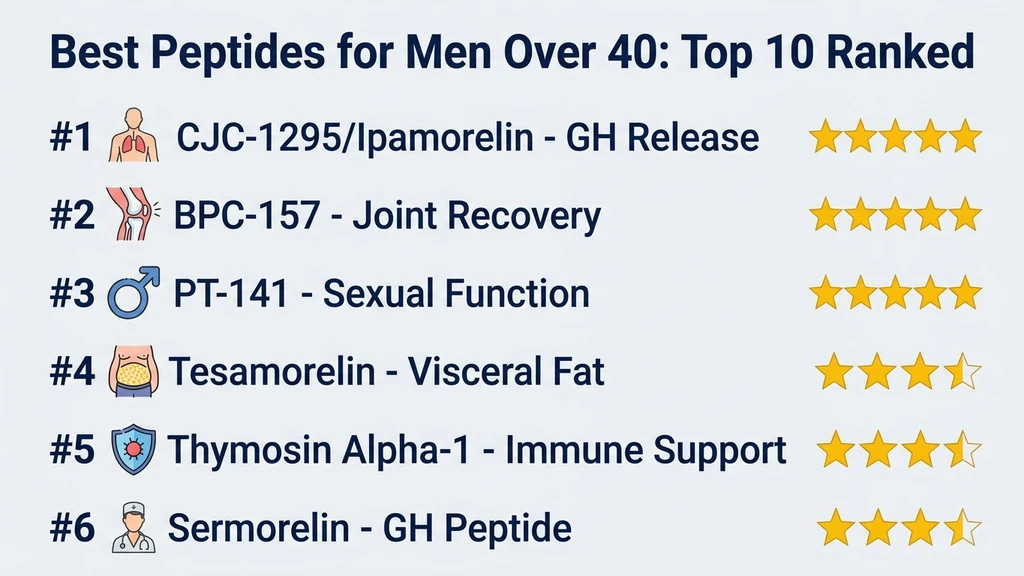
Your choice depends on your primary concern. Most men over 40 have overlapping goals, but starting with the peptide that addresses the biggest problem keeps the protocol simple.
| Primary Goal | Best Peptide(s) | Timeline to Results |
|---|---|---|
| Muscle gain + fat loss | CJC-1295/Ipamorelin | 8-12 weeks |
| Joint/tendon recovery | BPC-157 + TB-500 | 2-6 weeks |
| Visceral fat (belly) | Tesamorelin | 12-26 weeks |
| Sexual function | PT-141 | Same day (acute) |
| Sleep quality | CJC-1295/Ipamorelin or DSIP | 2-4 weeks |
| Skin/hair rejuvenation | GHK-Cu | 8-12 weeks |
| Metabolic health | MOTS-c | 4-8 weeks |
| Longevity/anti-aging | Epithalon + GHK-Cu | Months (long-term) |
| General beginner protocol | Sermorelin | 4-12 weeks |
Start with one peptide for 4-8 weeks before adding a second. Stacking three or more simultaneously makes it impossible to identify which peptide causes any side effect. Review our peptide stacking guide for combination protocols.
Peptide Stacking Protocols for Men Over 40
Stacking means combining two or more peptides to address multiple goals. The protocols below are commonly reported in clinical practice. All require physician oversight and baseline blood work.
Muscle + Recovery Stack: CJC-1295/Ipamorelin + BPC-157
This is the most popular stack for active men over 40. CJC-1295/Ipamorelin boosts overnight GH release for muscle repair and fat metabolism. BPC-157 accelerates tendon and joint healing from training stress.
Protocol: CJC-1295/Ipamorelin 100 mcg each before bed, 5 nights per week. BPC-157 250 mcg near the injury site, daily for 4-8 weeks. Run the GH peptides continuously; cycle BPC-157 as needed for injuries.
Fat Loss + Energy Stack: Tesamorelin + MOTS-c
Tesamorelin targets visceral fat through GH-mediated lipolysis. MOTS-c improves insulin sensitivity and cellular energy production. Together, they address the metabolic decline that makes losing belly fat increasingly difficult after 40.
Protocol: Tesamorelin 2 mg subcutaneous daily, morning. MOTS-c 5 mg subcutaneous, 3 times per week. Run for 12-26 weeks with quarterly blood monitoring (IGF-1, fasting glucose, HbA1c).
Complete Anti-Aging Stack: CJC-1295/Ipamorelin + GHK-Cu + Epithalon
This advanced stack covers three pillars of aging: GH decline (CJC-1295/Ipamorelin), tissue repair and gene expression (GHK-Cu), and telomere maintenance (Epithalon). It requires the most monitoring and the highest commitment.
Protocol: CJC-1295/Ipamorelin 100 mcg each before bed, ongoing. GHK-Cu 1-2 mg subcutaneous daily or topical application. Epithalon 5-10 mg daily for a 10-20 day course, repeated every 6 months. Monitor IGF-1 quarterly.
Safety Considerations for Men Over 40
Peptides are not supplements. They are bioactive compounds that alter hormonal signaling. Men over 40 carry higher baseline risks for cardiovascular events, metabolic disease, and occult malignancy. Proper monitoring is mandatory.
Blood Work Before Starting
Get baseline labs before your first injection. The minimum panel includes:
- Testosterone (total and free)
- IGF-1 (growth hormone marker)
- Complete metabolic panel (liver, kidney, glucose)
- CBC (complete blood count)
- PSA (prostate-specific antigen for men over 40)
- Lipid panel (LDL, HDL, triglycerides)
- Fasting insulin and HbA1c
Repeat IGF-1 at 4-6 weeks after starting any GH-releasing peptide. If IGF-1 exceeds the upper range for your age, reduce the dose. Check our peptide safety guide for monitoring schedules.
Contraindications
GH-releasing peptides are contraindicated in men with active or recent cancer. Growth hormone stimulation can accelerate tumor growth in theory. Men with a history of any malignancy within the past 5 years should consult an oncologist before starting GH peptides.
Other contraindications include uncontrolled diabetes, active heart disease, and pituitary disorders. PT-141 requires cardiovascular screening due to its transient blood pressure effects (approximately +6 mmHg systolic).
FDA Status of Each Peptide
| Peptide | FDA Status |
|---|---|
| CJC-1295/Ipamorelin | Research compound; not FDA-approved |
| BPC-157 | Research compound; not FDA-approved |
| Tesamorelin | FDA-approved (HIV lipodystrophy) |
| PT-141 | FDA-approved for women (Vyleesi); off-label for men |
| TB-500 | Research compound; not FDA-approved |
| Sermorelin | Previously FDA-approved; withdrawn for commercial reasons |
| MOTS-c | Research compound; not FDA-approved |
| GHK-Cu | Research compound; cosmetic use widespread |
| Epithalon | Research compound; not FDA-approved |
| DSIP | Research compound; not FDA-approved |
Most peptides used for anti-aging are research compounds without FDA approval for this indication. This does not mean they are unsafe, but it does mean long-term safety data is limited.
Common Mistakes Men Over 40 Make with Peptides
Starting too many peptides at once. Running three or four peptides simultaneously from day one makes it impossible to attribute benefits or side effects to any single compound. Start with one. Add a second after 4-8 weeks if tolerating well.
Skipping blood work. Men over 40 cannot assume healthy baselines. Undiagnosed insulin resistance, elevated PSA, or high IGF-1 change which peptides are appropriate and which are risky. Blood work is not optional.
Using GH peptides without monitoring IGF-1. Elevated IGF-1 is associated with increased cancer risk in epidemiological studies. GH-releasing peptides raise IGF-1 by 1.5-3x. Quarterly monitoring keeps levels in the therapeutic range.
Expecting pharmaceutical-grade results from research peptides. Peptides purchased from research suppliers vary in purity. Third-party testing certificates (COAs) are essential. A peptide that is 85% pure is 15% something else.
Frequently Asked Questions
What is the best peptide for men over 40?
CJC-1295 combined with Ipamorelin is the most versatile option for men over 40, addressing growth hormone decline, body composition, and sleep quality. It elevated GH 2-10 fold in clinical trials. For joint-specific issues, BPC-157 is preferred. The choice depends on your primary goal.
Are peptides safe for men over 40?
When used under medical supervision with baseline blood work and ongoing monitoring, peptides have favorable short-term safety profiles. Most are not FDA-approved for anti-aging use. Men over 40 should check IGF-1, PSA, and metabolic markers before starting and at regular intervals.
How long until I see results from peptides?
GH-releasing peptides like CJC-1295 improve sleep within 2-4 weeks and body composition within 8-12 weeks. BPC-157 can reduce joint pain in 2-4 weeks. PT-141 works within 30-45 minutes for sexual function. Tesamorelin shows measurable visceral fat reduction at 12-26 weeks.
Can I take peptides with testosterone replacement therapy?
Yes. GH secretagogues like CJC-1295 and Ipamorelin complement TRT by addressing the GH axis, which TRT does not affect. A study in hypogonadal males found GH secretagogues improved body composition beyond what testosterone alone achieved (PMC7108996). Coordinate with your prescriber.
Do I need a prescription for peptides?
FDA-approved peptides like Tesamorelin and PT-141 (Vyleesi) require prescriptions. Research peptides (CJC-1295, BPC-157, GHK-Cu) exist in a regulatory gray area and are sold for research purposes. The FDA has increased enforcement against unapproved peptide products since 2024.
What is the safest peptide to start with?
Sermorelin has the longest safety track record among GH-releasing peptides, having been previously FDA-approved. It provides a gentle GH boost within physiological range. BPC-157 and GHK-Cu also have mild side-effect profiles in reported clinical use. All three are reasonable starting points.
How much do peptides cost per month for men over 40?
Research-grade CJC-1295/Ipamorelin typically costs 80-150 USD per month. BPC-157 runs 60-120 USD per month. Tesamorelin is the most expensive at 300-600 USD per month due to its FDA-approved status. Compounding pharmacies with a prescription offer intermediate pricing.
Can peptides replace hormone replacement therapy?
Peptides cannot replace TRT for men with clinically low testosterone. GH secretagogues address the GH axis, not testosterone production. Gonadorelin can stimulate endogenous testosterone but is less potent than exogenous TRT. Peptides work best as complements to, not replacements for, hormone therapy.
The Bottom Line
Men over 40 face measurable declines in growth hormone, testosterone, recovery capacity, and metabolic rate. Peptides target each of these deficits through specific biological pathways: CJC-1295/Ipamorelin for GH release, BPC-157 for tissue repair, Tesamorelin for visceral fat, and PT-141 for sexual function.
Start with one peptide that addresses your primary concern. Get baseline blood work including IGF-1, testosterone, PSA, and a metabolic panel. Monitor at 4-6 weeks and adjust. Stack only after you understand how you respond to each compound individually.
Use our peptide dosage calculator to plan your protocol. For a safety-first approach to peptides at 50 and beyond, see our peptides for men over 50 guide. Consult a physician before starting any peptide protocol, especially if you have cardiovascular risk factors or a history of malignancy.
Helpful Tools
Related Articles
Best Peptides for Men Over 50: Protocols
Top 8 peptides for men over 50 ranked by safety. Sermorelin, BPC-157, Tesamorelin protocols with adjusted dosing and blood work requirements.
Best Peptides for Women Over 40: Guide
Top 8 peptides for women over 40: GHK-Cu, collagen peptides, BPC-157, PT-141. Perimenopause vs menopause protocols, dosing, and safety guide.
Peptides for Men: Best Options by Goal (2026 Guide)
Best peptides for men ranked by goal: muscle growth, fat loss, libido, testosterone, sleep, hair loss, and longevity. Protocols with doses.
Thymosin Alpha-1 Benefits Guide
Thymosin Alpha-1 (Ta1) benefits backed by clinical trials: immune support, cancer adjunct therapy, vaccine enhancement, and anti-aging. Dosage and safety.