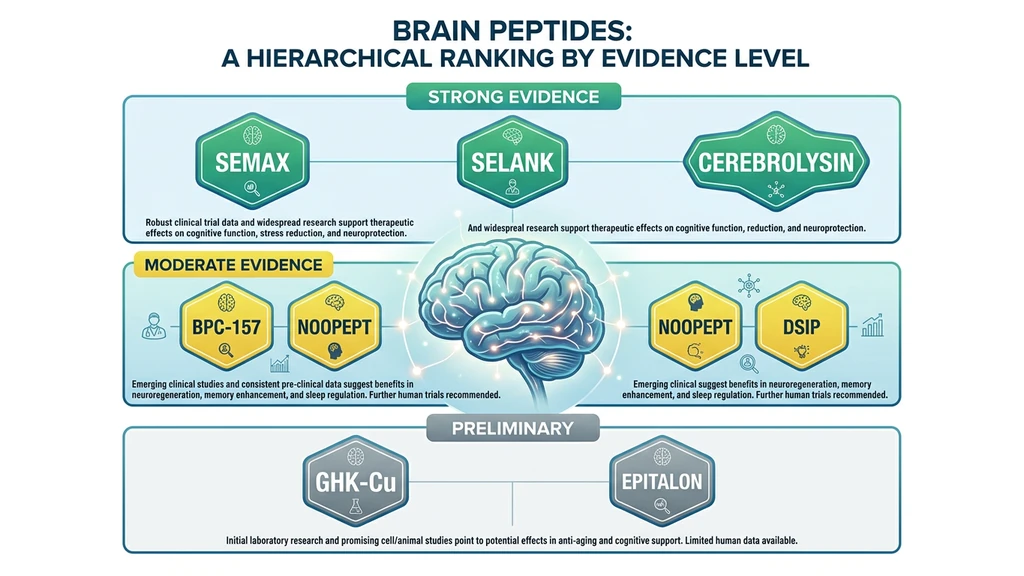
You are scrolling vendor pages, and every peptide "boosts cognition." Semax, Selank, Dihexa, Noopept, BPC-157: same claims, same confidence, zero evidence grading. Here is what the research actually shows. The three peptides for cognitive function with the strongest human data are Semax (approved in Russia since 1994), Selank (clinical anxiolytic with nootropic effects), and Cerebrolysin (tested in 6 Alzheimer's RCTs across 784 patients).
Everything else falls into lower evidence tiers. One popular compound, Dihexa, had its foundational paper retracted in April 2025 for data fabrication. The table below ranks all 12 by evidence quality so you can make decisions based on data, not marketing.
| Peptide | Evidence Level | Primary Mechanism | Route | Key Cognitive Effect |
|---|---|---|---|---|
| Semax | Strong (human trials + approval) | BDNF/NGF upregulation | Intranasal | Focus, memory, neuroprotection |
| Selank | Strong (human trials + approval) | GABA modulation, enkephalin | Intranasal | Anxiety-related cognitive impairment |
| Cerebrolysin | Strong (RCTs, meta-analyses) | Neurotrophic factor mixture | IV/IM injection | Dementia, stroke recovery |
| BPC-157 | Moderate (animal studies) | Dopamine/serotonin system repair | SC injection, oral | Neuroprotection, neurotransmitter balance |
| Noopept | Moderate (limited human data) | BDNF/NGF, glutamate modulation | Oral, sublingual | Memory consolidation |
| DSIP | Moderate (human trials) | Delta sleep regulation | SC injection | Sleep-dependent memory consolidation |
| Dihexa | Contested (retracted study) | HGF/c-Met pathway | Oral | Synaptogenesis (evidence compromised) |
| GHK-Cu | Preliminary (preclinical) | Gene expression modulation | Intranasal, SC | Neuroprotection |
| Epitalon | Preliminary (preclinical) | Melatonin/telomerase | SC injection | Circadian rhythm, indirect cognitive |
| PE-22-28 | Preliminary (preclinical) | TREK-1 channel, BDNF | Intranasal | Antidepressant, potential cognitive |
| P21 (Cerebrolysin-derived) | Preliminary (preclinical) | CNTF pathway mimicry | Intranasal | Neurogenesis |
| FGL | Preliminary (preclinical) | NCAM/FGFR pathway | Injection | Synaptic plasticity, memory |
If you need help with peptide preparation, see the reconstitution calculator and injection guide.
Get your custom peptide protocol:
- Tailored to your body and goals
- Precise dosing and cycle length
- Safe stacking combinations
- Backed by peer-reviewed studies
- Ready in under 2 minutes
How Peptides Enhance Cognitive Function
Think of your brain like a garden. Some compounds act as fertilizer: they help existing neurons grow stronger connections (that is BDNF upregulation). Others act as weed killer: they remove the anxiety, inflammation, or sleep disruption that chokes cognitive performance. The best cognitive peptides do both. Here are the four pathways they use.
1. Neurotrophin upregulation (BDNF, NGF, CNTF) Brain-derived neurotrophic factor (BDNF) is the protein that strengthens synaptic connections when you learn something new. Higher BDNF means faster memory formation and better recall. Semax increases BDNF mRNA in the hippocampus within 30 minutes of intranasal dosing (Dolotov et al. 2006, PubMed 16996037). Noopept and PE-22-28 raise BDNF through different receptor pathways.
2. Neurotransmitter modulation (dopamine, serotonin, GABA) If your brain fog comes from anxiety, the problem is often overactive stress signaling drowning out your working memory. Selank calms GABA-A receptor sensitivity, reducing that noise without sedation. BPC-157 repairs dopamine and serotonin turnover disrupted by stress, substances, or neurodegeneration.
3. Synaptogenesis and dendritic spine growth New synapse formation is the physical basis of learning. Cerebrolysin provides a cocktail of neurotrophic peptides that build new connections between neurons. Dihexa was claimed to do this through HGF/c-Met activation, but the key study has been retracted.
4. Neuroprotection and repair Some peptides protect neurons from oxidative damage, excitotoxicity, or inflammation. GHK-Cu modulates genes involved in antioxidant defense. BPC-157 protects against traumatic brain injury and drug-induced neurotoxicity in animal models (Sikiric et al. 2021, PMC8504390).
Tier 1: Strong Evidence (Human Trials or Clinical Approval)
These three compounds have something rare in the peptide world: human clinical data. Two are approved medications. One has been tested in randomized controlled trials across multiple countries. If you want the safest bet for cognitive enhancement, start here.
Semax: The Focus and Memory Peptide
You spray Semax into your nostrils, and within 15-30 minutes, BDNF levels in your hippocampus start climbing. That is not marketing copy. A rat study measured significant BDNF mRNA increases within 30 minutes of intranasal delivery, with effects persisting 24 hours (Dolotov et al. 2006, PubMed 16996037).
Semax is a synthetic fragment of ACTH(4-10), the piece of adrenocorticotropic hormone responsible for nootropic effects without hormonal activity. Russian regulators approved it in 1994 for cognitive disorders, stroke recovery, and optic nerve atrophy. It also modulates dopamine and serotonin, contributing to the focused, clear-headed feeling users report.
What you can expect: - Sharper attention and faster memory consolidation - Neuroprotection during ischemic events (standard Russian stroke protocol) - Enhanced learning in both healthy subjects and cognitively impaired patients
How to dose: 200-600 mcg/day intranasal, split into 2-3 administrations. Use a 0.1% solution: 1-2 drops per nostril, 2-3 times daily. Run 10-14 day cycles with equal time off. You will feel the onset within 15-30 minutes.
For full protocols, see the Semax profile page.
Selank: The Anti-Anxiety Cognitive Enhancer
Your brain fog might not be a focus problem. It might be an anxiety problem wearing a focus-shaped mask. Stress floods your prefrontal cortex with noise, drowning out working memory and executive function. Selank addresses this root cause.
Developed at the same Moscow institute as Semax, Selank is a synthetic analogue of tuftsin (an immunomodulatory peptide). It modulates GABA-A receptor sensitivity and blocks enkephalinase, the enzyme that breaks down your body's natural calming peptides. The result: more enkephalin availability without sedation. A clinical trial in generalized anxiety disorder patients found anxiolytic effects comparable to medazepam (a benzodiazepine) with zero sedation or cognitive impairment (Zozulya et al. 2008, PubMed 18454096).
What sets Selank apart from benzodiazepines: - No tolerance buildup after repeated use - No dependence or withdrawal symptoms - Cognitive performance improves rather than deteriorates
How to dose: 250-500 mcg/day intranasal (2-3 drops of 0.15% solution per nostril, 2-3 times daily). Cycles of 14-21 days. You can stack it with Semax for combined focus and calm.
For protocols, see the Selank profile page and our guide on peptides for anxiety.
Cerebrolysin: The Clinical Neurotrophic Mixture
Cerebrolysin is not a single peptide. It is a standardized mixture of low-molecular-weight neuropeptides derived from porcine brain tissue, containing fragments that mimic BDNF, GDNF, NGF, and CNTF activity simultaneously. Over 40 countries have approved it for Alzheimer's disease, traumatic brain injury, and stroke. The US and UK have not.
The clinical evidence is substantial. A meta-analysis of 6 RCTs (784 Alzheimer's patients) found significant improvement in clinical global impression scores versus placebo (Plosker & Gauthier 2009, PubMed 25832905). Individual trials showed improved ADAS-cog scores, the gold standard cognitive assessment in Alzheimer's research.
How to dose: 10-30 mL IV infusion or IM injection daily for 20-28 days. This requires medical supervision. Some practitioners use 5-10 mL IM in wellness protocols, though that represents off-label use.
Limitations you should know: Requires injection (IV preferred for larger doses). Not available as a consumer peptide in most Western markets. Expensive. Porcine origin concerns some users. Counterfeit products exist, so sourcing matters.
Best for: Age-related cognitive decline, post-stroke recovery, Alzheimer's disease as adjunct to standard care.
Tier 2: Moderate Evidence (Animal Studies or Limited Human Data)
These peptides have animal research and limited human data supporting cognitive effects. You will find them in nootropic protocols, but they lack the clinical validation of Tier 1 compounds. Honest assessment: promising, not proven.
BPC-157: Neuroprotection and Neurotransmitter Repair
You know BPC-157 for tissue healing. Its neurological effects deserve separate attention. In animal models, BPC-157 counteracts dopamine and serotonin system damage caused by various toxins and drugs (Sikiric et al. 2021, PMC8504390).
If your cognitive issues stem from a concussion, chronic substance use, or neuroinflammation, BPC-157 targets the repair pathway. It protected against MPTP-induced dopaminergic neurotoxicity (a Parkinson's model) and alcohol-induced brain damage in rats.
How to dose for cognitive use: 250-500 mcg/day subcutaneous, or 500 mcg oral (BPC-157 is one of few peptides with oral bioactivity). Cycles of 4-8 weeks.
Honest limitation: BPC-157 is not a primary nootropic for healthy brains. If you want sharper focus without an underlying injury, Semax is the better choice.
See our guide on BPC-157 side effects for safety data.
Noopept (GVS-111): Memory Consolidation
Noopept is technically a dipeptide-derived small molecule, not a traditional peptide. It appears here because users search for it alongside nootropic peptides and its mechanism involves the same BDNF/NGF pathways.
You take 10-30 mg orally or sublingually, and it enhances long-term potentiation (LTP) in the hippocampus by modulating AMPA and NMDA glutamate receptors. LTP is the cellular mechanism behind memory formation. A small study in patients with mild cognitive disorders reported improved memory and attention, but large-scale RCTs do not exist.
How to dose: 10-30 mg, 2-3 times daily, oral or sublingual. Cycles of 6-12 weeks. Expect 1-2 weeks before noticeable effects, as BDNF accumulation is gradual.
Best for: Students and professionals facing sustained learning demands.
DSIP: Sleep-Dependent Cognitive Enhancement
If your cognitive problems trace back to poor sleep, fixing cognition directly is treating the symptom. DSIP (Delta Sleep-Inducing Peptide) targets the root cause.
Deep sleep is when your hippocampus transfers short-term memories into long-term neocortical storage. Without adequate delta wave activity, that transfer stalls. DSIP promotes delta wave sleep without daytime sedation. A double-blind study in chronic insomnia patients confirmed improved sleep quality and architecture (Schneider-Helmert & Schoenenberger 1983, PubMed 1299794).
How to dose: 100-200 mcg subcutaneous, 30-60 minutes before bed. Cycles of 10-14 days.
Best for: Shift workers, jetlag, age-related sleep deterioration, anyone whose brain fog worsens after poor nights.
The Dihexa Problem: When Evidence Collapses
You will find Dihexa on every vendor's "top nootropic peptides" list. It deserves its own section because the story illustrates exactly why evidence grading matters.
The foundational 2014 paper claimed Dihexa was "seven orders of magnitude more potent than BDNF" at promoting synaptogenesis through HGF/c-Met receptor activation (Benoist et al. 2014, originally in J Pharmacol Exp Ther). That single claim built the compound's reputation.
In April 2025, the paper was retracted for image manipulation. Athira Pharma, founded to commercialize Dihexa-related compounds, paid a $4.07 million settlement to resolve data falsification allegations involving the lead researcher (Retraction Watch, January 2025).
What this means if you are considering Dihexa:
Scenario 1: You order Dihexa based on vendor claims of "millions of times more potent than BDNF." That claim comes from a retracted paper. No independent lab has replicated the synaptogenesis findings. You are paying for a compound whose extraordinary cognitive claims rest on fabricated data.
Scenario 2: You stack Dihexa with other nootropics based on forum protocols. The safety profile is unknown. The foundational research that would define therapeutic windows, dose-response curves, and risk factors has been invalidated. You are running a self-experiment with no validated safety floor.
Dihexa may still have some biological activity. The compound exists and binds HGF. But the magnitude and specificity of its cognitive effects are unvalidated. Every vendor page repeating the potency claim is citing retracted data.
The fix: Use Semax, Selank, or Cerebrolysin instead. All three have intact evidence bases, known safety profiles, and decades of clinical use.
Tier 3: Preliminary Evidence (Preclinical Only)
These peptides show cognitive effects in animal models. No controlled human cognitive data exists. Vendor sites list them alongside Semax and Selank as if the evidence is equivalent. It is not.
GHK-Cu: Neuroprotective Gene Modulation
You probably know GHK-Cu for skin and tissue repair. Researchers are now testing intranasal delivery for brain applications. A 2023 mouse study showed that intranasal GHK-Cu modulated antioxidant gene expression and reduced neuroinflammatory markers (PMC10680828).
No study has measured actual cognitive outcomes in animals or humans after GHK-Cu administration. The neuroprotective potential is real but unquantified. For GHK-Cu dosage protocols, see the dedicated guide.
Epitalon: Circadian Rhythm and Indirect Cognitive Effects
Epitalon stimulates melatonin production from your pineal gland and activates telomerase. Its cognitive relevance is indirect: melatonin regulates circadian rhythm, and circadian disruption impairs cognition.
A 2025 review covered Epitalon's effects on pineal function and telomere maintenance (PMC11943447). No studies have directly measured cognitive outcomes from Epitalon use. If circadian disruption is your problem, Epitalon might help. For direct cognitive enhancement, Tier 1 peptides are the better choice.
PE-22-28, P21, and FGL: Research-Stage Compounds
PE-22-28 blocks TREK-1 potassium channels and upregulates BDNF. Animal studies show antidepressant effects comparable to fluoxetine, with onset in 4 days versus 3 weeks for SSRIs (PMC5601071). Cognitive effects have not been measured. Available as intranasal research peptide.
P21 is a fragment derived from Cerebrolysin that mimics ciliary neurotrophic factor (CNTF). In mice, intranasal P21 promoted hippocampal neurogenesis and improved spatial memory. No human data exists.
FGL (FG Loop peptide) activates the FGFR receptor via neural cell adhesion molecule. Rodent models showed enhanced hippocampal memory formation (Bhatt et al. 2004, PubMed 15115815). A 2018 review flagged FGL as one of the most promising cognitive peptides (Asua et al. 2018, PubMed 29030286). Still no human trials.
These compounds are actively researched. They are not ready for evidence-based protocols.
Choosing the Right Cognitive Peptide by Goal
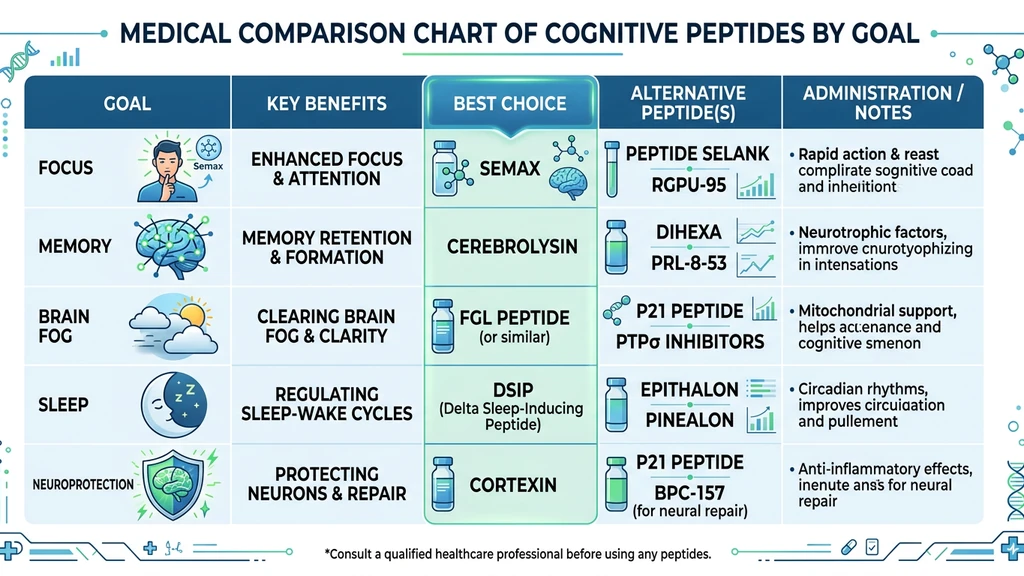
Your cognitive complaint determines your peptide. Picking Semax for sleep-related brain fog misses the problem. Picking DSIP for focus misses it too. Use this table to match your situation to the right compound.
| Your Problem | Best Peptide | Alternative | Why It Works | Evidence Level |
|---|---|---|---|---|
| Poor focus, slow recall | Semax | Noopept | BDNF upregulation + dopamine modulation | Strong |
| Weak memory formation | Semax | Cerebrolysin | BDNF + synaptogenesis | Strong |
| Brain fog from anxiety | Selank | Semax + Selank stack | GABA + enkephalin modulation | Strong |
| Brain fog from poor sleep | DSIP | Epitalon | Delta wave sleep promotion | Moderate |
| Post-concussion recovery | BPC-157 | Cerebrolysin | Neuroprotection + neurotransmitter repair | Moderate |
| Age-related cognitive decline | Cerebrolysin | Semax | Multi-neurotrophic factor cocktail | Strong |
| Neurotransmitter damage | BPC-157 | Selank | Dopamine/serotonin system repair | Moderate |
| Learning speed | Noopept | Semax | LTP enhancement at glutamate synapses | Moderate |
The Semax + Selank stack is the most common cognitive combination. Semax provides the accelerator (focus, memory, BDNF). Selank removes the brake (anxiety, stress-driven cognitive suppression). Both are intranasal sprays you administer from separate bottles in the same session. No pharmacological overlap.
Standard stacking protocol: - Morning: Semax 200-400 mcg intranasal + Selank 250-500 mcg intranasal - Afternoon: Semax 200 mcg intranasal (optional, for extended focus) - Duration: 10-14 day cycles, equal time off
Verify compatibility with the peptide interaction checker before combining compounds. Use the peptide stack calculator for dose guidance.
Dosage Quick Reference
All dosages below come from clinical practice and published research. None of these compounds are FDA-approved for cognitive enhancement in the United States.
| Peptide | Route | Typical Dose | Frequency | Cycle Length | Onset |
|---|---|---|---|---|---|
| Semax | Intranasal | 200-600 mcg/day | 2-3x daily | 10-14 days on, 10-14 off | 15-30 min |
| Selank | Intranasal | 250-500 mcg/day | 2-3x daily | 14-21 days | 15-30 min |
| Cerebrolysin | IV/IM | 5-30 mL/day | 1x daily | 20-28 days | 1-2 weeks |
| BPC-157 | SC or oral | 250-500 mcg/day | 1-2x daily | 4-8 weeks | 1-2 weeks |
| Noopept | Oral/sublingual | 10-30 mg/day | 2-3x daily | 6-12 weeks | 1-2 weeks |
| DSIP | SC injection | 100-200 mcg | 1x before bed | 10-14 days | Same night |
| GHK-Cu | Intranasal/SC | 200-600 mcg/day | 1-2x daily | 2-4 weeks | Unknown |
| PE-22-28 | Intranasal | 50-100 mcg/day | 1-2x daily | 10-14 days | 4-7 days (animal) |
For peptide preparation, use the reconstitution calculator. For storage, see how to store peptides.
Common Mistakes with Cognitive Peptides
Mistake 1: Choosing Dihexa because vendor sites rank it first. You spend $80-120 on a compound whose "millions of times more potent than BDNF" claim comes from a retracted paper. No independent replication exists. Meanwhile, Semax costs $30-50 per cycle and has 30 years of clinical use behind it. The fix: check whether your compound's key study is still published before ordering.
Mistake 2: Using Semax for anxiety-driven brain fog. Semax upregulates dopamine, which can increase alertness but also amplify anxiety in some users. If stress is the root cause of your cognitive issues, Semax alone makes the underlying problem worse while masking it with stimulation. You end up focused but wired. The fix: start with Selank if anxiety is a factor. Add Semax after the anxiety component is controlled.
Mistake 3: Skipping cycles on intranasal peptides. You run Semax continuously for 6 weeks instead of the recommended 10-14 day cycles. Receptor sensitivity diminishes with uninterrupted exposure. Your day-10 dose feels like your day-1 dose felt. The fix: follow the cycling protocol. Equal time on and off preserves receptor sensitivity.
Mistake 4: Expecting preclinical peptides to perform like Tier 1 compounds. You order PE-22-28 or P21 based on a forum post and expect Semax-level results. These compounds have zero human cognitive data. Animal study results do not translate reliably to human outcomes, especially for subjective cognitive effects. The fix: start with Tier 1 compounds. Move to Tier 2 if needed. Treat Tier 3 as experimental.
Safety Considerations
Cognitive peptides have favorable safety profiles in the available data. Semax and Selank carry decades of Russian clinical use with no serious adverse events in published literature. Cerebrolysin's safety is documented across multiple RCTs. Here are the specific risks.
Intranasal peptides (Semax, Selank): Mild nasal irritation, occasional headache. No tolerance, dependence, or withdrawal effects reported in any study. This distinguishes them from every other class of cognitive enhancer.
Injectable peptides (BPC-157, DSIP): Standard injection site reactions. See the injection guide for proper technique.
Noopept: Occasional irritability at doses above 30 mg/day. Headache reported at higher ranges. Well-tolerated at recommended doses.
Specific cautions you need to know: - Cerebrolysin: Derived from porcine brain tissue. Contraindicated if you have epilepsy (may lower seizure threshold) or porcine allergy. Counterfeit products exist. - BPC-157: Avoid with active cancer (growth factor modulation). Monitor interactions if you take psychiatric medications affecting dopamine or serotonin. - Dihexa: Unknown safety profile. The retracted research invalidated the data that would define therapeutic windows and risk factors. - Stacking Semax + Selank: No documented adverse interactions. Theoretical risk of overstimulation with high doses of both, but clinical practice has not confirmed this.
Sourcing matters. The peptide market lacks pharmaceutical regulation. Buy from suppliers providing third-party certificates of analysis (COA) with mass spectrometry data. This applies especially to Cerebrolysin and Dihexa.
See the getting started with peptides guide for sourcing and quality verification.
Frequently Asked Questions
What is the best peptide for brain function?
Semax has the strongest evidence for cognitive enhancement in healthy individuals. It upregulates BDNF within 30 minutes of intranasal dosing, improves focus and memory, and has been approved in Russia since 1994. For anxiety-driven brain fog, Selank is more appropriate. For age-related decline, Cerebrolysin has the strongest RCT data, including a 784-patient meta-analysis showing improvement in Alzheimer's patients.
What peptide clears brain fog?
Match the peptide to the cause. Anxiety-driven brain fog: Selank, 250-500 mcg/day intranasal (GABA modulation). Sleep-related brain fog: DSIP, 100-200 mcg before bed (delta wave promotion). Post-concussion brain fog: BPC-157, 250-500 mcg/day (neurotransmitter repair). General cognitive dullness: Semax, 200-600 mcg/day intranasal (BDNF upregulation plus dopamine modulation).
Is Dihexa safe to use?
Unknown. The foundational research paper was retracted in April 2025 for image manipulation. Athira Pharma paid a $4.07 million settlement over data falsification. Without validated research, the therapeutic window, dose-response curve, long-term effects, and risk profile are all undefined. Semax, Selank, and Cerebrolysin offer proven cognitive effects with established safety data.
Can you stack Semax and Selank together?
Yes. Semax and Selank are the most common cognitive peptide stack. Semax upregulates BDNF and sharpens focus. Selank modulates GABA and removes anxiety-driven cognitive suppression. Both are intranasal sprays used in the same session. Standard protocol: Semax 200-400 mcg plus Selank 250-500 mcg, 2-3 times daily, for 10-14 day cycles with equal time off.
Do nootropic peptides cause tolerance or dependence?
Semax and Selank show no tolerance, dependence, or withdrawal in clinical studies. Selank was compared directly to medazepam (a benzodiazepine) for anxiety and matched its efficacy without dependence liability. Noopept shows no tolerance in available data. Cycling protocols of 10-21 days on, equal time off, are recommended as standard precaution, not because tolerance has been documented.
What is the difference between Semax and Selank?
Semax is a stimulatory nootropic: sharper focus, faster recall, more mental energy via BDNF and dopamine. Selank is a calming nootropic: better cognition through anxiety reduction via GABA and enkephalin pathways. Choose Semax for concentration-heavy tasks. Choose Selank when stress impairs your performance. Many users combine both for balanced cognitive enhancement without overstimulation.
Is Cerebrolysin available in the United States?
Cerebrolysin is not FDA-approved and not commercially sold in the US. It is approved in 40+ countries including Russia, China, and several EU nations for Alzheimer's, stroke, and TBI. US access typically involves international pharmacies or clinical trials. It requires IV or IM injection and medical supervision for the 10-30 mL/day doses used in published trials.
How long do cognitive peptides take to work?
Intranasal peptides are fast: Semax and Selank produce noticeable effects in 15-30 minutes via rapid nasal absorption. Noopept and BPC-157 need 1-2 weeks of daily use because they work through gradual BDNF accumulation and neurotransmitter remodeling. DSIP improves sleep quality from the first night. Cerebrolysin shows measurable cognitive improvement after 2-4 weeks of daily infusions in clinical studies.
The Bottom Line
Three peptides for cognitive function have real human data: Semax, Selank, and Cerebrolysin. Three more have meaningful animal evidence: BPC-157, Noopept, and DSIP. Everything else is preclinical at best. One popular option, Dihexa, had its key paper retracted for fabrication.
If you want the safest starting point, the Semax + Selank intranasal stack gives you both the accelerator (BDNF, dopamine) and the brake release (GABA, enkephalin). Both compounds are well-characterized, self-administered, and have complementary mechanisms with no documented adverse interactions.
Take the peptide quiz for personalized recommendations, or explore profiles for Semax, Selank, BPC-157, and DSIP. For dosing references, see the peptide dosage chart. For stacking strategies, see the peptide stacking guide. For sourcing, see where to buy peptides in 2026. For safe handling, see how to store peptides and the peptide safety guide. For reconstitution, see how to reconstitute peptides.
Related Articles: - Peptides for Anxiety - Peptide Stacking Guide - Peptide Dosage Chart - Getting Started with Peptides - Peptide Safety Guide
Helpful Tools
Related Articles
Peptides for Depression: The Evidence
What research shows about peptides for depression: Selank, Semax, BPC-157, DSIP, and GLP-1. None are FDA-approved antidepressants. Evidence and safety inside.
Peptides for Anxiety: 6 Ranked
Explore the best peptides for anxiety, including Selank, Semax, BPC-157, and DSIP. Evidence-based guide covering mechanisms, dosages, and safety profiles.
GHK-Cu Nasal Spray: Dosage & Benefits
GHK-Cu nasal spray delivers copper peptide to the brain via the olfactory pathway. Dosage (625-1,250 mcg/day) and cognitive benefits from 2023 studies.
How to Store Peptides: Full Guide
Learn how to store peptides correctly. Temperature guide, shelf life chart for 29 peptides, reconstituted storage, travel tips, and signs of degradation.