You are holding a vial of BPC-157 and a nasal spray bottle, wondering whether squirting a peptide up your nose is a real delivery method or an internet gimmick. It is real. BPC-157 nasal spray delivers 200 to 500 mcg of peptide through the nasal mucosa, partially bypassing the blood-brain barrier via the olfactory and trigeminal nerve pathways to reach brain tissue within minutes. The route is gaining traction for traumatic brain injury recovery, neurological support, and situations where injection is impractical.
| Quick Reference | Details |
|---|---|
| Standard nasal dose | 200 to 500 mcg per session |
| Sprays per dose | 1 to 2 sprays per nostril |
| Frequency | Once or twice daily |
| Brain access | Direct via olfactory/trigeminal pathways |
| Cycle length | 4 to 8 weeks |
| Preparation | Reconstitute lyophilized BPC-157, transfer to nasal spray bottle |
| Storage | Refrigerate at 2 to 8 degrees Celsius |
| Shelf life (reconstituted) | 28 days refrigerated |
The nasal route does not replace subcutaneous injection for musculoskeletal injuries. It adds a different capability: direct access to the central nervous system. For the standard injection protocol covering dose, cycle length, and stacking, see how to take BPC-157. Use the BPC-157 dosage calculator for exact syringe volumes.
BPC-157 is not FDA-approved for any medical use. All dosing information reflects preclinical research and clinical practice observations. Consult a licensed healthcare provider before using any peptide.
Get your custom peptide protocol:
- Tailored to your body and goals
- Precise dosing and cycle length
- Safe stacking combinations
- Backed by peer-reviewed studies
- Ready in under 2 minutes
How BPC-157 Nasal Spray Reaches the Brain
BPC-157 is a 15-amino-acid synthetic peptide derived from a protective protein in human gastric juice. It promotes tissue repair through VEGF upregulation, nitric oxide modulation, and FAK-paxillin pathway activation (Chang et al., Life Sci, 2011). Subcutaneous injection delivers these benefits systemically, but very little peptide crosses the blood-brain barrier to reach the central nervous system.
The nasal route changes that equation. Picture two express lanes running from the roof of your nasal cavity straight into the brain. One follows olfactory nerve axons to the frontal cortex. The other follows trigeminal nerve branches toward the brainstem and hippocampus. BPC-157 molecules travel through the perineural spaces surrounding these nerves, arriving in brain tissue within 15 to 30 minutes of application (Lochhead & Thorne, Adv Drug Deliv Rev, 2012).
This nose-to-brain transport mechanism is the same principle used by Semax and Selank nasal sprays for cognitive enhancement. The olfactory epithelium sits just centimeters from the brain. Molecules deposited there skip first-pass liver metabolism, avoid the gut entirely, and reach the CNS at concentrations that systemic injection cannot match at standard doses.
Nasal vs. Injectable vs. Oral BPC-157: Route Comparison
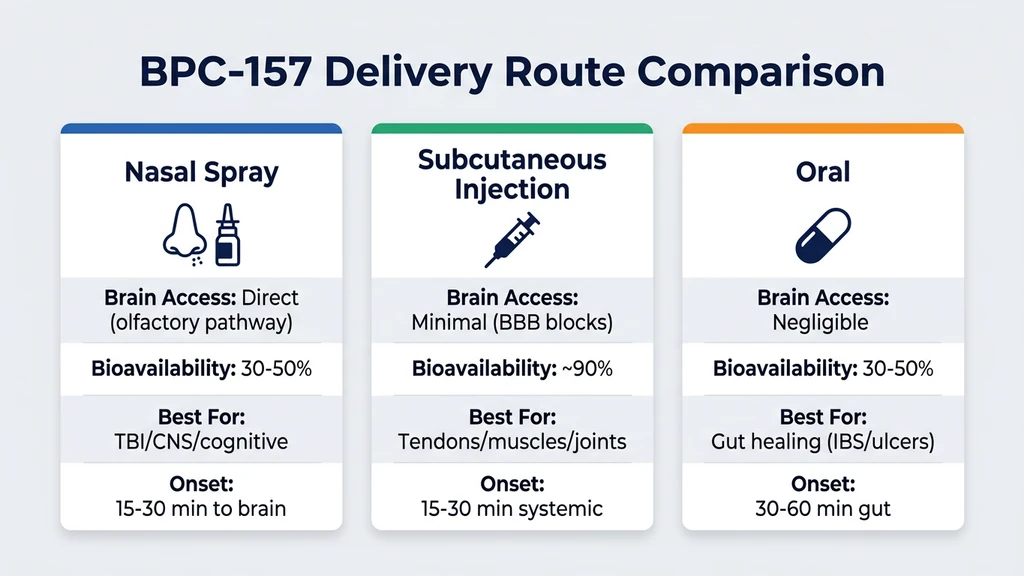
Each administration route serves a different purpose. Choosing the wrong one for your goal wastes peptide and time.
| Factor | Nasal Spray | Subcutaneous Injection | Oral |
|---|---|---|---|
| Best for | Brain/CNS, TBI recovery, cognitive support, needle-free use | Tendon, muscle, joint injuries, systemic repair | Gut healing (IBS, ulcers, leaky gut) |
| Typical dose | 200 to 500 mcg per session | 250 to 500 mcg per day | 500 to 1000 mcg per day |
| Bioavailability (systemic) | Moderate (~30 to 50%) | High (~90%) | Low to moderate (~30 to 50%) |
| Brain access | Direct (olfactory/trigeminal pathways) | Minimal (BBB blocks most) | Negligible |
| Peak onset | 15 to 30 minutes (brain), 30 to 60 minutes (systemic) | 15 to 30 minutes (systemic) | 30 to 60 minutes (gut), variable (systemic) |
| Convenience | Easy, no needles, portable | Requires syringe, sterile technique | Easiest (capsule or liquid) |
| Monthly cost estimate | $40 to $80 | $40 to $100 | $50 to $120 |
Think of it like delivering a package. Injectable is a courier who drives through the entire city (systemic circulation) but rarely gets past the security gate at the brain. Oral is a courier who unloads at the warehouse (gut) first, with some packages reaching the city later. Nasal is a drone that flies over the gate and drops the package directly on the rooftop of the brain.
The literal fact: BPC-157 administered intranasally reaches brain tissue at higher concentrations per milligram dosed than either subcutaneous injection or oral administration. This matters for neurological targets. It does not matter for a torn Achilles tendon.
For musculoskeletal injuries, subcutaneous injection remains the gold standard. For gut conditions, oral delivery wins. See the how to take BPC-157 guide for full protocol details on all three routes.
BPC-157 Nasal Spray Dosage
No human clinical trial has established an optimal nasal BPC-157 dose. Current dosing derives from preclinical studies, established intranasal peptide pharmacokinetics, and compounding pharmacy practice. The standard range is 200 to 500 mcg per session, administered once or twice daily.
| Goal | Dose per Session | Frequency | Cycle Length |
|---|---|---|---|
| Mild cognitive support | 200 mcg | Once daily | 4 to 6 weeks |
| TBI recovery or neurological repair | 400 to 500 mcg | Twice daily | 6 to 8 weeks |
| General neuroprotection | 200 to 400 mcg | Once daily | 4 to 8 weeks |
| Combined with injection (neurological + musculoskeletal) | 200 to 300 mcg nasal + 250 to 500 mcg injected | Once daily each route | 4 to 8 weeks |
Start at 200 mcg per day for the first 3 to 5 days. If you tolerate it without nasal irritation or headache, increase to 400 mcg. Most commercial nasal spray bottles deliver 100 to 125 mcg per actuation. Two sprays per nostril delivers 400 to 500 mcg total.
Animal studies of intranasal BPC-157 for brain injury used doses of 10 mcg/kg in rats (Sikiric et al., J Physiol Paris, 1999). FDA body surface area conversion to humans yields approximately 1.6 mcg/kg, or roughly 100 to 130 mcg for a 70 to 80 kg adult. The 200 to 500 mcg clinical range provides a margin above this minimum. The BPC-157 dosage calculator can help you convert between dose and syringe volume during preparation.
How to Prepare BPC-157 Nasal Spray from Powder
BPC-157 does not come pre-loaded in nasal spray bottles (unless purchased from a compounding pharmacy). Most users prepare their own from lyophilized BPC-157 powder. The process requires careful concentration math and sterile technique.
What You Need
- BPC-157 lyophilized powder (5 mg or 10 mg vial)
- Bacteriostatic water (30 mL vial, 0.9% benzyl alcohol). See where to buy bacteriostatic water.
- Empty sterile nasal spray bottle (10 mL, metered-dose, delivering approximately 0.1 mL per actuation)
- Sterile syringe (3 mL or 5 mL, with needle for drawing)
- Alcohol swabs
- Permanent marker for labeling
Do not use saline solution for reconstitution. BPC-157 is more stable in bacteriostatic water than in saline. Saline is acceptable for short-term use (under 14 days), but bacteriostatic water provides the full 28-day shelf life. For details on solvent differences, see bacteriostatic water vs sterile water.
Concentration Math
Your target concentration depends on the dose you want per spray. A standard metered-dose nasal spray bottle delivers approximately 0.1 mL per actuation. Set the concentration so that 1 or 2 sprays delivers your target dose.
| Vial Size | Water Volume | Concentration | mcg per Spray (0.1 mL) | Sprays per Bottle (10 mL) |
|---|---|---|---|---|
| 5 mg | 10 mL | 500 mcg/mL | 50 mcg | ~100 |
| 5 mg | 5 mL | 1000 mcg/mL | 100 mcg | ~50 |
| 10 mg | 10 mL | 1000 mcg/mL | 100 mcg | ~100 |
| 10 mg | 5 mL | 2000 mcg/mL | 200 mcg | ~50 |
For a 200 mcg dose per nostril (400 mcg total per session), use a 10 mg vial dissolved in 5 mL of bacteriostatic water (2000 mcg/mL). One spray per nostril delivers 200 mcg each, 400 mcg total. Two sprays per nostril delivers 800 mcg total. This concentration gives you the flexibility to dose between 200 and 800 mcg per session.
Use the peptide reconstitution calculator to verify your math before proceeding.
Step-by-Step Preparation
- 1.Swab the BPC-157 vial stopper with an alcohol pad. Let it dry for 10 seconds.
- 2.Draw your chosen volume of bacteriostatic water into a sterile syringe (e.g., 5 mL for a 10 mg vial).
- 3.Insert the needle through the stopper at an angle, aiming the tip at the glass wall.
- 4.Release the water slowly down the vial wall. Never spray directly onto the powder. Direct impact shears peptide bonds.
- 5.Gently swirl the vial in circular motions until the powder dissolves completely. This takes 30 to 60 seconds. The solution should be clear and colorless. Never shake.
- 6.Draw the entire reconstituted solution into the syringe.
- 7.Remove the spray mechanism from the empty nasal spray bottle.
- 8.Transfer the solution into the bottle through the opening.
- 9.Replace the spray mechanism. Prime by pumping 2 to 3 times into the air until a fine mist appears.
- 10.Label the bottle with the peptide name, concentration, date, and expiration (28 days from today).
- 11.Refrigerate immediately at 2 to 8 degrees Celsius.
The entire preparation takes under 5 minutes. For a more detailed reconstitution walkthrough, see how to reconstitute peptides. For storage rules, see how to store peptides. For information on how long your prepared solution stays potent, see how long reconstituted peptides last.
How to Use BPC-157 Nasal Spray Properly
Where the spray lands inside your nose determines whether the peptide reaches your brain or drains into your throat. A poorly aimed spray hits the nasal septum, where absorption is minimal. A well-aimed spray coats the olfactory epithelium at the roof of the nasal cavity, where nerve pathways to the brain begin.
Step-by-step technique:
- 1.Clear your nose. Blow gently or use a saline rinse 10 minutes before application. Mucus blocks the olfactory epithelium and reduces absorption.
- 2.Prime the bottle if it has not been used in more than 24 hours. Pump 1 to 2 times into the air until a fine mist appears.
- 3.Tilt your head slightly forward. Do not tilt backward. A forward tilt directs the spray upward toward the olfactory region. Tilting back sends the spray straight down the throat.
- 4.Insert the nozzle into one nostril. Angle it slightly outward, toward the ear on the same side. This aims the mist at the lateral nasal wall and olfactory cleft.
- 5.Spray while inhaling gently through the nose. A slow, controlled sniff carries the mist upward. A hard sniff pulls the spray past the olfactory region into the pharynx, wasting most of it.
- 6.Hold your breath for 5 seconds after spraying.
- 7.Repeat in the other nostril if your protocol calls for bilateral dosing.
- 8.Do not blow your nose for at least 10 minutes after application. Let the peptide absorb passively.
Timing: Morning application is most common. BPC-157 interacts with the dopaminergic system and may increase alertness (Sikiric et al., J Physiol Paris, 1999). Evening dosing may cause mild sleep disruption in sensitive individuals. For more on this effect, see does BPC-157 cause insomnia.
If you taste a bitter or metallic flavor after spraying, the solution is dripping into your throat. Adjust your head angle and spray pressure next time. A faint taste is normal. A strong, immediate taste means most of the dose missed the olfactory region.
CNS and Brain Benefits of Nasal BPC-157
The neurological effects of BPC-157 are among the most extensively studied aspects of this peptide in animal models. The nasal route makes these effects more accessible by delivering the peptide where it is needed most: directly to brain tissue.
Traumatic Brain Injury Recovery
BPC-157 reduced brain edema, improved neurological function scores, and lowered mortality in rat TBI models. The peptide modulates the nitric oxide system, which plays a central role in secondary brain injury after trauma (Sikiric et al., Curr Pharm Des, 2018). It also counteracted neurobehavioral deficits caused by cuprizone-induced demyelination in mice, a model relevant to traumatic white matter injury (Sikiric et al., J Physiol Paris, 1999).
Nasal delivery places BPC-157 in the frontal cortex and hippocampus, two regions consistently damaged in concussive and blast-related TBI. Systemic injection can deliver BPC-157 to the brain, but in far lower concentrations per milligram dosed. No human TBI trial has tested intranasal BPC-157. The rationale is mechanistic and preclinical.
Dopamine System Modulation
BPC-157 interacts with dopamine D2 receptors and modulates the dopaminergic pathway. In animal studies, it counteracted the neurobehavioral effects of dopamine agonists and antagonists, normalized dopamine turnover in the striatum, and protected against dopamine-related neurotoxicity (Sikiric et al., Curr Neuropharmacol, 2016).
These effects are relevant to conditions involving dopaminergic dysfunction: Parkinson's disease prodrome, ADHD-related dopamine imbalance, and the dopamine depletion seen after chronic stimulant use. Nasal delivery concentrates BPC-157 in the basal ganglia and prefrontal cortex, the dopamine-rich regions where these conditions manifest. No human clinical data confirms these applications.
Serotonin System Interaction
BPC-157 also modulates the serotonergic system. It counteracted the behavioral effects of serotonin-depleting agents in rats and normalized serotonin metabolism in the hippocampus and cortex (Sikiric et al., Curr Neuropharmacol, 2016). These findings suggest a role in mood regulation and anxiety, though all evidence remains preclinical.
For a broader overview of peptides targeting brain health, see peptides for cognitive function. For peptides targeting anxiety specifically, see peptides for anxiety.
Neuroprotection and VEGF in the Brain
BPC-157 upregulates vascular endothelial growth factor (VEGF) wherever it reaches tissue. In the brain, VEGF promotes angiogenesis (new blood vessel formation), supports neuronal survival, and enhances synaptic plasticity. A 2011 study showed BPC-157 activated the FAK-paxillin pathway and increased VEGF expression in damaged tissue (Chang et al., Life Sci, 2011).
When BPC-157 reaches brain tissue via the nasal route, VEGF upregulation occurs locally in the CNS rather than systemically. This localized neurovascular repair is the theoretical basis for using nasal BPC-157 after concussion, stroke recovery, or any condition involving reduced cerebral blood flow.
When Nasal BPC-157 Is Preferred Over Injection
The nasal route is not universally better than injection. It fills specific gaps where injection falls short.
Traumatic brain injury and post-concussion syndrome. The target tissue is the brain. Injectable BPC-157 reaches brain tissue in low concentrations because the blood-brain barrier blocks most peptides. Nasal delivery bypasses the barrier and concentrates the peptide in the frontal cortex and hippocampus, the regions most vulnerable to concussive damage.
Neurological and cognitive goals. If your primary interest is dopamine system support, mood regulation, or neuroprotection, the nasal route delivers more peptide to the relevant brain regions per milligram than any other route. Users targeting brain fog, cognitive recovery after substance use, or age-related cognitive decline may prefer nasal over systemic.
Needle avoidance. Some users cannot or will not inject. Phobia, travel restrictions, or lack of access to syringes and sterile supplies make injection impractical. Nasal spray eliminates every piece of injection equipment. The trade-off is lower systemic bioavailability for musculoskeletal targets.
Convenience and portability. A nasal spray bottle fits in a pocket. No refrigeration is needed for the few hours of daily carry (though overnight refrigeration remains essential). No alcohol swabs, no sharps container, no finding a private space to inject. For people who travel frequently or dose at work, nasal spray simplifies the logistics.
Combined protocols. Some practitioners prescribe nasal BPC-157 for brain benefits alongside subcutaneous injection near a musculoskeletal injury. The two routes address different targets simultaneously. A user recovering from both a concussion and a torn rotator cuff, for example, could spray 200 to 400 mcg nasally for the brain and inject 500 mcg near the shoulder for the tendon.
For musculoskeletal injuries alone, subcutaneous injection remains superior. See how to inject BPC-157 for the full injection protocol. For women-specific considerations, see BPC-157 benefits for women.
What Happens When You Get the Preparation Wrong
Two categories of error carry real consequences when preparing nasal BPC-157: contamination and concentration mistakes. Both are preventable.
Contamination from Poor Sterile Technique
A user reconstitutes BPC-157 with tap water because bacteriostatic water is not available. Tap water contains bacteria, chlorine, and dissolved minerals. Within 48 hours, the bacterial colony count in the nasal spray bottle exceeds safe limits. The user sprays a contaminated solution directly into the nasal mucosa, which has a rich blood supply and sits adjacent to the brain.
The result: bacterial sinusitis or, in severe cases, a nasal or paranasal abscess. The nasal mucosa is a direct conduit to the central nervous system. Contaminated nasal products carry infection risk that exceeds contaminated subcutaneous injections. A 2014 review documented cases of bacterial meningitis from contaminated intranasal drug preparations (Bauman & Wang, Int Forum Allergy Rhinol, 2014).
The fix: always use bacteriostatic water or preserved nasal saline. Never use tap water, distilled water without preservative, or opened vials of unknown age. If the solution turns cloudy or develops an unusual smell, discard the entire bottle.
Concentration Errors Leading to Overdose or Waste
A user dissolves a 10 mg vial of BPC-157 in 10 mL of bacteriostatic water, creating a 1000 mcg/mL solution. Each 0.1 mL spray delivers 100 mcg. They intend to take 400 mcg per session (2 sprays per nostril) but misread their notes and think the concentration is 2000 mcg/mL. They use 1 spray per nostril, receiving 200 mcg instead of 400 mcg. Over a 6-week cycle, they receive half the intended dose.
The reverse error: a user dissolves 10 mg in 5 mL (2000 mcg/mL) but calculates as if the concentration were 1000 mcg/mL. They spray 4 times per nostril, delivering 1600 mcg per session instead of the intended 800 mcg. The excess is not dangerous (BPC-157 has shown no lethal dose in any published study, with human IV doses up to 20 mg producing no adverse events (Staresinic et al., 2025)), but it depletes the bottle twice as fast, doubling the cost.
The fix: write the concentration on the bottle with a permanent marker at the time of preparation. Double-check with the reconstitution calculator. Keep the math simple: round to concentrations that produce easy-to-calculate doses per spray.
Stacking Nasal BPC-157 with Other Peptide Nasal Sprays
Three peptide nasal sprays are commonly used for cognitive and neurological goals: BPC-157, Semax, and Selank. Each operates through distinct mechanisms, and they can be combined.
| Peptide | Primary Mechanism | Best For | Typical Nasal Dose | Onset |
|---|---|---|---|---|
| BPC-157 | VEGF, NO modulation, dopamine/serotonin regulation | TBI recovery, neuroprotection, tissue repair | 200 to 500 mcg/day | Days to weeks (structural) |
| Semax | BDNF upregulation, melanocortin receptor activation | Focus, working memory, acute cognitive boost | 200 to 600 mcg/day | Minutes to hours |
| Selank | GABA modulation, anxiolytic, immune regulation | Anxiety reduction, calm focus | 250 to 500 mcg/day | Minutes to hours |
| GHK-Cu | Copper delivery, gene modulation, anti-inflammatory | Long-term neuroprotection, anti-aging | 625 to 1250 mcg/day | Weeks (structural) |
BPC-157 + Semax provides both structural neuroprotection and acute cognitive enhancement. BPC-157 handles the slow rebuild: VEGF-driven angiogenesis, dopamine normalization, neuroinflammation reduction. Semax provides the immediate performance signal: BDNF elevation, increased attention span, improved working memory.
BPC-157 + Selank suits users dealing with anxiety alongside cognitive or neurological recovery. Selank modulates GABA receptors without the sedation or dependence risk of benzodiazepines. BPC-157 addresses the underlying neuroinflammation that often drives the anxiety.
BPC-157 + GHK-Cu combines two structural neuroprotectants. BPC-157 promotes vascular repair and neurotransmitter normalization. GHK-Cu nasal spray reduces neuroinflammatory markers and supports gene expression changes linked to cognitive maintenance. This combination is long-term maintenance, not acute performance.
When stacking nasal sprays, space each application 5 minutes apart to allow mucosal absorption before the next peptide coats the surface. No published study evaluates these specific combinations. The rationale is mechanistic: distinct receptor targets with no known interference. For a full review of cognitive peptides, see peptides for cognitive function.
Common Mistakes with BPC-157 Nasal Spray
Mistake 1: Tilting the head backward during application. Backward tilt sends the spray down the throat and into the stomach. You get some oral absorption, but you miss the olfactory region entirely. The brain benefit is lost. Fix: tilt your head slightly forward and angle the nozzle toward the ear on the same side as the nostril.
Mistake 2: Blowing the nose immediately after spraying. This expels the peptide before absorption occurs. The nasal mucosa needs 5 to 10 minutes of undisturbed contact time. Fix: do not blow your nose, sniff aggressively, or sneeze (if avoidable) for at least 10 minutes after application.
Mistake 3: Using the nasal route for a torn tendon. Nasal BPC-157 delivers lower systemic bioavailability than subcutaneous injection. For a musculoskeletal injury, you want maximum peptide in systemic circulation reaching the damaged tissue. The nasal route is the wrong tool for this job. Fix: inject subcutaneously near the injury for musculoskeletal targets. Reserve nasal for brain and CNS goals. See where to inject BPC-157 for knee pain for site-specific injection guidance.
Mistake 4: Spraying into a congested nose. Mucus and swollen turbinates block the olfactory epithelium. The peptide sits in mucus, drains into the throat, and never contacts the nerve pathways to the brain. Fix: clear congestion with a saline rinse 10 minutes before spraying. If you have chronic nasal congestion, address that before starting a nasal peptide protocol.
What to Expect: Week-by-Week Timeline
Nasal BPC-157 effects divide into two categories: immediate mucosal sensations and gradual neurological changes that develop over weeks. Manage your expectations accordingly.
| Timeframe | What Happens | What You May Notice |
|---|---|---|
| Day 1 to 3 | Peptide contacts olfactory epithelium, begins nose-to-brain transport | Mild nasal tingling, possible bitter taste, subtle alertness |
| Week 1 to 2 | VEGF upregulation initiates in brain tissue, dopamine modulation begins | Reduced brain fog in some users (anecdotal), nasal irritation resolves |
| Week 2 to 4 | Neuroinflammation markers begin declining, new capillary formation in affected brain regions | Improved sleep quality, clearer thinking, mood stabilization |
| Week 4 to 8 | Structural neurovascular repair progresses, neurotransmitter systems normalize | Measurable cognitive improvements reported by some users, sustained mood benefits |
These timelines are extrapolated from animal studies and clinical observation. BPC-157 improved neurological function scores within 2 weeks of administration in rat TBI models (Sikiric et al., Curr Pharm Des, 2018). Human response may differ. Plan for a minimum 4-week commitment before evaluating results.
If you experience persistent nasal dryness, irritation, or nosebleeds beyond the first week, reduce the concentration or frequency. A saline nasal spray used 30 minutes after BPC-157 application can help maintain mucosal hydration without interfering with peptide absorption.
Safety Profile and Side Effects
A 2025 systematic review of 36 animal studies found no lethal dose of BPC-157 across any tested species or route (Kang et al., 2025). The first human safety data showed no adverse effects from 10 mg and 20 mg intravenous BPC-157 infusions in healthy adults (Staresinic et al., 2025). No human trial has specifically tested intranasal BPC-157.
Reported side effects of nasal BPC-157 (from clinical observation and community reports):
| Side Effect | Frequency | Severity | Management |
|---|---|---|---|
| Nasal tingling or irritation | 20 to 30% | Mild | Resolves within 3 to 5 days; use saline rinse afterward |
| Bitter or metallic taste | 15 to 20% | Mild | Adjust spray angle to reduce throat drainage |
| Mild headache | 5 to 10% | Mild | Reduce dose, hydrate |
| Nasal dryness | 5 to 10% | Mild | Saline spray 30 minutes after application |
| Increased alertness or restlessness | 5 to 10% | Mild | Switch to morning dosing |
| Nosebleed (with prolonged use) | Rare | Mild | Reduce frequency, alternate nostrils, check humidity |
BPC-157 interacts with blood pressure regulation through the nitric oxide system. Users taking blood pressure medications should consult a healthcare provider before starting. For detailed safety information, see does BPC-157 cause high blood pressure and does BPC-157 cause liver damage. For a comprehensive safety reference, see the peptide safety guide.
Frequently Asked Questions
Does BPC-157 nasal spray cross the blood-brain barrier?
BPC-157 delivered nasally bypasses the blood-brain barrier entirely. It travels through perineural spaces around the olfactory and trigeminal nerves, reaching the frontal cortex and hippocampus within 15 to 30 minutes. Subcutaneous injection delivers less than 1 to 2% of the dose to brain tissue because the BBB blocks most peptides. For neurological targets, nasal is the more efficient route.
What is the correct BPC-157 nasal spray dosage?
The standard range is 200 to 500 mcg per session, administered once or twice daily. Start at 200 mcg per day for the first 3 to 5 days, then increase to 400 mcg if tolerated. A typical nasal spray bottle delivers 100 to 125 mcg per actuation. Two sprays per nostril provides 400 to 500 mcg per session. No human clinical trial has established an optimal nasal dose.
Can I use BPC-157 nasal spray for a tendon injury?
Nasal spray is not the ideal route for musculoskeletal injuries. Systemic bioavailability is lower than subcutaneous injection (approximately 30 to 50% vs. 90%). For a torn tendon, sprained ligament, or muscle strain, inject subcutaneously near the injury site at 250 to 500 mcg per day. Reserve nasal spray for brain, CNS, or neurological goals.
How do I make BPC-157 nasal spray at home?
Reconstitute a 10 mg vial of BPC-157 with 5 mL of bacteriostatic water (producing 2000 mcg/mL). Transfer the solution into a sterile 10 mL metered-dose nasal spray bottle. Each 0.1 mL actuation delivers 200 mcg. Prime with 2 to 3 pumps, label with concentration and date, and refrigerate. Use within 28 days of preparation.
Is nasal BPC-157 better than injectable for brain injuries?
For brain-specific targets, yes. Nasal delivery places BPC-157 directly in the frontal cortex and hippocampus via the olfactory pathway, achieving higher CNS concentrations per milligram than injection. Injectable BPC-157 is limited by the blood-brain barrier, which blocks most peptides. No human TBI trial has tested intranasal BPC-157, but the pharmacokinetic rationale and preclinical data support the nasal route for neurological goals.
Can I combine nasal and injectable BPC-157?
Yes. Some practitioners prescribe nasal spray for brain benefits (200 to 300 mcg) alongside subcutaneous injection for musculoskeletal injury (250 to 500 mcg). The two routes address different targets. A user recovering from a concussion and a torn tendon can treat both simultaneously. The total daily dose stays within the ranges studied in preclinical research.
How long does a BPC-157 nasal spray bottle last?
A 10 mg vial reconstituted in 10 mL (1000 mcg/mL) produces approximately 100 sprays at 100 mcg per actuation. At 400 mcg per day (4 sprays total), the bottle lasts 25 days. At 200 mcg per day (2 sprays total), it lasts 50 days. Use within 28 days of reconstitution regardless of remaining volume, as potency degrades beyond that point.
Can I stack BPC-157 nasal spray with Semax or Selank?
Yes. BPC-157, Semax, and Selank act through different receptor systems with no known interference. Space each nasal spray application 5 minutes apart to allow mucosal absorption. BPC-157 provides structural neuroprotection, Semax provides acute cognitive enhancement via BDNF, and Selank provides anxiolytic effects via GABA modulation. No clinical study evaluates this triple combination.
The Bottom Line
BPC-157 nasal spray delivers 200 to 500 mcg of peptide directly to brain tissue via the olfactory and trigeminal nerve pathways, bypassing the blood-brain barrier that limits injectable delivery to the CNS. The route is best suited for traumatic brain injury recovery, neurological support, dopamine system modulation, and situations where injection is impractical.
Preparation is straightforward: reconstitute lyophilized BPC-157 with bacteriostatic water, transfer to a metered-dose nasal spray bottle, and refrigerate. Aim the spray toward the olfactory region by tilting your head forward and angling the nozzle outward. Two sprays per nostril with a 2000 mcg/mL solution delivers 400 mcg per session.
For musculoskeletal injuries (tendons, ligaments, muscles, joints), subcutaneous injection remains the superior route. For gut healing, oral delivery wins. Nasal fills the gap that neither of those routes can reach: the brain. Use the BPC-157 dosage calculator to plan your preparation, and the reconstitution calculator to verify your concentration math.
Related guides: - How to Take BPC-157 - complete protocol covering injection, oral, dose, cycle, and stacking - How to Inject BPC-157 - step-by-step injection technique and site selection - GHK-Cu Nasal Spray - another peptide nasal spray for neuroprotection and cognitive support - Peptides for Cognitive Function - full comparison of brain-targeting peptides - BPC-157 and Alcohol - interaction safety during your protocol - GHK-Cu + BPC-157 + TB-500 Blend - combining nasal with injectable blend protocols - Peptide Safety Guide - comprehensive safety reference for all routes - Where to Buy Peptides - sourcing research-grade BPC-157
Related Articles
GHK-Cu Nasal Spray: Dosage & Benefits
GHK-Cu nasal spray delivers copper peptide to the brain via the olfactory pathway. Dosage (625-1,250 mcg/day) and cognitive benefits from 2023 studies.
How to Take BPC-157: Dosage and Timing
How to take BPC-157: inject 250-500 mcg subcutaneously near the injury once daily for 4-8 weeks. Reconstitution, dosing, and cycle length.
Peptides for Healing: What the Evidence Shows
Peptides for healing by tissue: tendon, bone, wound, gut, post-surgery. Which claims rest on human trials, which rest on rat studies, and what is unsafe.
VIP Peptide: Benefits, Evidence, and Real Risks
VIP peptide (vasoactive intestinal peptide): real physiology, the CIRS nasal spray protocol, what the trials actually found, doses used, and side effects.