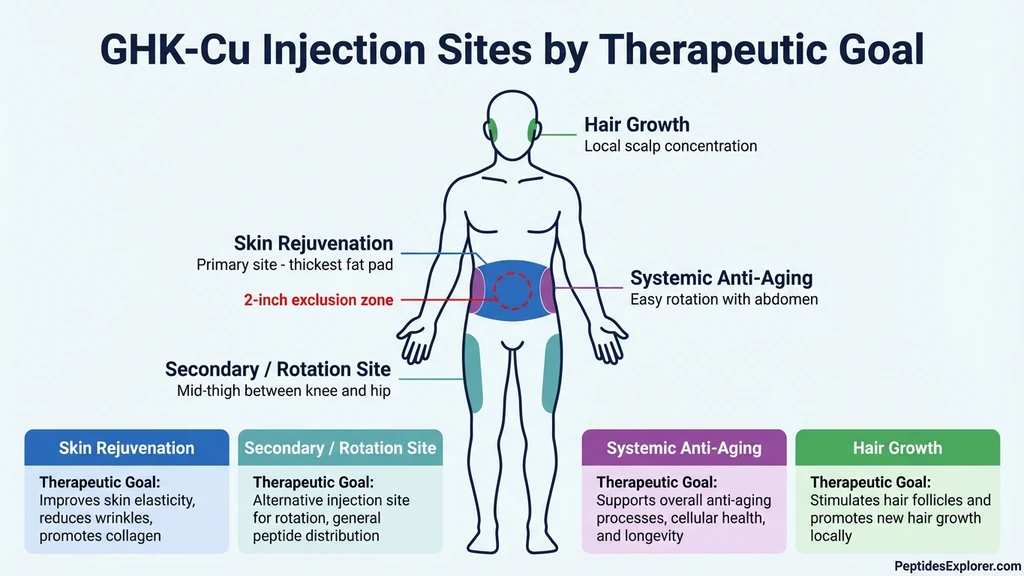
You have a reconstituted vial of GHK-Cu in the fridge, a loaded insulin syringe, and one question: where on your body does the needle go? The answer depends on your goal. For systemic anti-aging and skin rejuvenation, inject subcutaneously into the lower abdomen. For hair restoration, inject in the abdominal fat or the subcutaneous tissue adjacent to the scalp. For wound healing, inject as close to the injury as possible. For general wellness, rotate between the abdomen and outer thigh.
GHK-Cu distributes systemically after subcutaneous injection, but local tissue concentrations remain highest near the injection site for the first 30 to 60 minutes. Dr. Loren Pickart's research demonstrated that GHK-Cu injected into one area of the body (thigh muscles in rats) improved healing at distant sites (ears), confirming systemic distribution. Yet the same research showed that local tissue concentration near the injection site drives the strongest immediate response (Pickart & Margolina, 2018).
| Goal | Primary Site | Secondary Site | Why This Site |
|---|---|---|---|
| Skin rejuvenation | Lower abdomen | Outer thigh | Fastest absorption, largest fat pad |
| Hair growth | Lower abdomen | Scalp-adjacent (behind ears) | Systemic delivery + local scalp concentration |
| Wound healing | Subcutaneous fat nearest the wound | Opposite side of injury | Maximizes local tissue concentration |
| Systemic anti-aging | Lower abdomen | Flanks (love handles) | Consistent absorption, easy rotation |
| Scar reduction | Subcutaneous tissue bordering the scar | Abdomen (systemic support) | Direct delivery to remodeling tissue |
No form of GHK-Cu is FDA-approved for any medical use. Consult a healthcare provider before acting on any information here. For dosage protocols, see the complete GHK-Cu dosage guide. For injection scheduling, see how often to inject GHK-Cu.
Get your custom peptide protocol:
- Tailored to your body and goals
- Precise dosing and cycle length
- Safe stacking combinations
- Backed by peer-reviewed studies
- Ready in under 2 minutes
Subcutaneous vs. Intramuscular: Which Route for GHK-Cu?
Subcutaneous injection is the standard route for GHK-Cu. Intramuscular injection works but offers no advantage and introduces unnecessary risk.
Think of subcutaneous tissue like a sponge sitting just beneath your skin. When you deposit GHK-Cu into this sponge, the peptide absorbs slowly through local capillaries over 30 to 60 minutes, creating a sustained release effect. Intramuscular injection bypasses the sponge entirely, dumping the peptide into highly vascularized muscle tissue where it absorbs faster but clears the blood sooner.
For GHK-Cu, slower absorption is better. The peptide's mechanism of action is gene expression modulation: it triggers transcription factor cascades across over 4,000 human genes, roughly 31% of the genome (Pickart & Margolina, 2018). These cascades do not benefit from a rapid blood spike. They benefit from sustained local tissue exposure that allows GHK-Cu to bind fibroblasts, deliver copper to lysyl oxidase, and initiate collagen cross-linking before clearing systemically.
| Factor | Subcutaneous | Intramuscular |
|---|---|---|
| Absorption speed | Gradual (30-60 min) | Rapid (10-20 min) |
| Needle gauge | 29-31 gauge (insulin syringe) | 25-27 gauge |
| Needle length | 0.5 inch (12.7 mm) | 1-1.5 inch (25-38 mm) |
| Pain level | Low | Moderate to high |
| Self-injection | Easy | Difficult at most sites |
| Local tissue exposure | High (sustained) | Low (rapid clearance) |
| Risk of nerve/vessel damage | Minimal | Higher |
| Recommended for GHK-Cu | Yes | No |
GHK-Cu has a plasma half-life of approximately 0.5 to 1 hour (Pickart et al., 2015). The short circulating half-life makes the sustained-release profile of subcutaneous delivery even more important. Rapid intramuscular absorption would shorten the effective tissue exposure window without increasing the cumulative gene expression effect.
Verdict: Use subcutaneous injection. A 29 to 31 gauge insulin syringe with a 0.5-inch needle is the correct tool. Intramuscular injection is not wrong, but it is harder, more painful, and pharmacologically inferior for this peptide.
Injection Site Map by Goal
Each therapeutic goal has an optimal injection location. The site you choose determines how much GHK-Cu reaches the target tissue in the critical first hour after injection.
Skin Rejuvenation and Anti-Aging
Primary site: Lower abdomen, at least 2 inches (5 cm) from the navel in any direction.
Why this site works: The abdomen has the thickest subcutaneous fat layer on most body types (1.5 to 3 cm). A 1991 study on growth hormone absorption found that subcutaneous injection in the abdomen produced faster and more consistent absorption compared to the thigh (Beshyah et al., 1991). The same pharmacokinetic principle applies to small peptides like GHK-Cu.
For skin rejuvenation, systemic delivery matters more than local placement. GHK-Cu stimulates fibroblasts throughout the dermis, upregulating collagen types I and III, glycosaminoglycans, and decorin. These effects are systemic: injecting in your abdomen improves skin quality on your face, neck, and hands. A 12-week study on 71 women found that GHK-Cu increased collagen production in 70% of participants, outperforming both vitamin C (50%) and retinoic acid (40%) (Pickart et al., 2015).
Secondary site: Outer thigh, middle third between knee and hip. Use this as part of a rotation pattern to prevent lipodystrophy at any single site.
What to avoid: Do not inject directly into facial skin. The face has minimal subcutaneous fat, and the risk of hitting superficial nerves or blood vessels is high. Systemic delivery from the abdomen reaches facial tissue through normal blood circulation.
Hair Growth and Restoration
Primary site: Lower abdomen for systemic delivery.
Secondary site: Subcutaneous tissue behind the ears or at the base of the occipital scalp. These areas have enough subcutaneous fat to accept a shallow injection and sit adjacent to the scalp's vascular network.
Hair follicles depend on dermal papilla cells for growth signaling. GHK-Cu stimulates VEGF and HGF secretion from fibroblasts, which in turn feed the dermal papilla. A Phase II clinical trial found that 72% of male participants saw greater than 20% hair density increase using a GHK-Cu lotion. A preclinical comparison showed a GHK-Cu microemulsion entered the anagen (growth) phase at 6 days versus minoxidil at 9 days (PMC10643103).
Systemic injection (abdomen) delivers GHK-Cu to every follicle on the scalp through blood circulation. The scalp-adjacent secondary site adds a local concentration boost to follicles in the vertex and temporal regions. Some practitioners combine injectable GHK-Cu with topical application (1 to 3% concentration) directly on the scalp for maximum follicular exposure. See the GHK-Cu hair growth guide for topical protocols.
What to avoid: Do not inject directly into the scalp. The subcutaneous layer on top of the skull is extremely thin (2 to 3 mm in most areas). Injecting here risks hitting the periosteum, which is painful and provides no absorption advantage.
Wound Healing and Scar Reduction
Primary site: Subcutaneous tissue within 1 to 3 cm of the wound or scar.
Wound healing is the one scenario where injection site selection makes a dramatic difference. GHK-Cu wound chamber studies in rats showed that local delivery increased collagen content 9-fold in healthy tissue and accelerated organized collagen fiber alignment rather than random scarring (Pickart & Margolina, 2018).
The logic mirrors what Cerovecki et al. demonstrated with BPC-157 in MCL transection models: local delivery consistently outperformed systemic delivery for tissue repair outcomes. The peptide's concentration at the injury site determines how many fibroblasts activate, how much collagen cross-links, and how fast the wound matrix reorganizes.
How to position the injection: Identify the wound border. Move 1 to 3 cm outward into healthy tissue. Pinch the skin, insert at 45 degrees, and deposit the dose in the subcutaneous layer. For linear scars, alternate between opposite sides of the scar on successive days. For circular wounds, rotate clockwise around the perimeter.
Secondary site: Abdomen (for systemic support). Some practitioners split the dose: 60 to 70% near the wound, 30 to 40% in the abdomen. No published study has tested this split approach for GHK-Cu specifically, but the pharmacological reasoning holds: maximize local concentration while maintaining systemic signaling.
Post-surgical wounds: Wait until the incision has closed (typically 10 to 14 days post-surgery) before injecting near the surgical site. Injecting into or near an open wound introduces infection risk. For the initial post-operative period, use abdominal injection for systemic delivery.
Systemic Anti-Aging and General Wellness
Primary site: Lower abdomen, rotating between left and right sides.
Secondary sites: Outer thigh and flanks (love handles).
For general wellness and systemic anti-aging, injection site matters less than consistency. GHK-Cu modulates over 4,000 genes systemically, including 47 DNA repair genes, antioxidant defense pathways (superoxide dismutase, glutathione), and anti-inflammatory cascades (suppression of IL-6 and TNF-alpha) (Pickart & Margolina, 2018). These effects operate through blood circulation, not local tissue proximity.
The abdomen is preferred because it provides the most consistent absorption kinetics. Use the flanks and thighs as rotation sites to distribute injection stress across a wider area. At the standard wellness dose of 0.5 to 1.5 mg daily, you are injecting small volumes (0.05 to 0.15 mL at 10 mg/mL concentration) that any subcutaneous site handles easily.
For complete dosing protocols by goal, see the GHK-Cu dosage guide.
Needle Depth and Angle: Getting Into the Right Layer
The target layer for GHK-Cu is the subcutaneous fat. Too shallow (intradermal) causes pain, welting, and poor absorption. Too deep (intramuscular) wastes the sustained-release advantage of subcutaneous delivery.
Think of your skin as a three-layer cake. The top layer (epidermis and dermis) is 1 to 4 mm thick. The middle layer (subcutaneous fat) ranges from 5 mm in lean individuals to 30 mm or more in the abdomen. The bottom layer is muscle. Your needle needs to pass through the top layer and stop in the middle layer.
For a standard 0.5-inch (12.7 mm) insulin syringe needle:
| Body Composition | Technique | Angle | Pinch Skin? |
|---|---|---|---|
| Average or higher body fat | Insert straight in | 90 degrees | Optional |
| Lean (visible abdominal definition) | Pinch a skin fold, insert at angle | 45 degrees | Yes, always |
| Very lean (under 12% body fat) | Pinch a skin fold at the thigh or flank | 45 degrees | Yes, always |
A study on injection technique and needle length found that injection depths in the 5 to 8 mm range consistently deliver medication into subcutaneous tissue across body compositions (Frid et al., 2016). The 0.5-inch insulin syringe needle (12.7 mm) is the safest choice because even at 90 degrees in the abdomen, it rarely penetrates past subcutaneous fat.
Step-by-step technique: 1. Swab the injection site with an alcohol wipe. Let it air dry for 10 seconds. 2. If pinching: gather a 1 to 2 inch fold of skin and fat between your thumb and index finger. Hold firmly throughout the injection. 3. Insert the needle smoothly at the chosen angle (45 or 90 degrees). Do not jab. A controlled insertion reduces pain. 4. Push the plunger steadily over 5 to 10 seconds. Slow injection reduces pressure-related discomfort. 5. Hold for 5 seconds after the plunger bottoms out. This prevents backflow of the solution through the needle track. 6. Withdraw the needle and release the skin fold. Do not rub the site. Rubbing can disperse the peptide from the subcutaneous depot and increase bruising.
For the full reconstitution process (converting powder to injectable solution), see how to reconstitute GHK-Cu. For volume calculations at any concentration, use the Peptide Reconstitution Calculator.
Rotation Patterns That Prevent Tissue Damage
Repeated injection at the same spot causes lipodystrophy: localized changes in fat tissue that create lumps, pits, or fibrous pockets. These pockets slow GHK-Cu absorption and reduce the effective dose reaching your bloodstream. A systematic rotation pattern prevents this entirely.
The 4-quadrant rotation for a 5-on/2-off schedule:
| Day | Injection Site |
|---|---|
| Monday | Left abdomen (2 inches left of navel) |
| Tuesday | Right abdomen (2 inches right of navel) |
| Wednesday | Left outer thigh (middle third) |
| Thursday | Right outer thigh (middle third) |
| Friday | Left flank (love handle area) |
| Saturday | Rest |
| Sunday | Rest |
This pattern ensures no single area receives more than one injection per week. Each site gets 6 to 7 full days of recovery before the next injection.
The spacing rule: Keep at least 1 inch (2.5 cm) between consecutive injection points within the same general area. If Monday's injection went 2 inches left and 1 inch below the navel, the following Monday's injection should shift at least 1 inch in any direction from that spot. Some users mark previous sites with a small dot from a washable marker during the first few weeks until the rotation becomes automatic.
For wound healing protocols: Rotation works differently. You are injecting near a specific target, not rotating for systemic delivery. Circle the wound: inject at the 12 o'clock position on day one, 3 o'clock on day two, 6 o'clock on day three, 9 o'clock on day four. This distributes GHK-Cu evenly around the wound perimeter while preventing tissue damage at any single point.
For 3x/week maintenance schedules: Use a simpler 3-site rotation. Monday: left abdomen. Wednesday: right abdomen. Friday: left thigh. The following week, shift to right thigh, left flank, right flank. Alternate between the two sets weekly.
Research on injection site rotation in insulin-dependent patients found that systematic rotation reduces lipohypertrophy incidence from approximately 40% (no rotation) to under 5% (structured rotation) (Frid et al., 2016). The same principle applies to any repeatedly injected peptide.
Sites to Avoid
Certain body areas are poor choices for subcutaneous GHK-Cu injection. Some are simply uncomfortable. Others carry genuine risk.
Within 2 inches of the navel. The periumbilical area has dense vascular and nerve networks. Injecting here increases pain, bruising, and unpredictable absorption rates. Stay at least 5 cm from the navel center in every direction.
Directly over bone. The shins, kneecaps, spine, and clavicles have almost no subcutaneous fat. A needle aimed at these areas will hit periosteum, producing sharp pain and zero peptide absorption. There is no reason to inject here.
Scar tissue and stretch marks. Existing scars contain dense fibrotic tissue with poor vascular supply. GHK-Cu deposited into a scar absorbs erratically and may pool rather than distribute. Inject adjacent to scars (1 to 3 cm away), not into them. The exception is when using GHK-Cu specifically for scar remodeling, and even then, inject in the healthy tissue bordering the scar.
Areas with visible veins. Surface veins are easy to identify in the forearms, backs of hands, and inner thighs. Hitting a vein produces a hematoma and dumps GHK-Cu directly into venous blood, bypassing the slow subcutaneous absorption that produces optimal tissue exposure.
The inner thigh. While the outer thigh is an excellent injection site, the inner thigh contains the femoral artery, femoral vein, and saphenous nerve. Even subcutaneous injection in this region risks uncomfortable contact with superficial nerve branches.
Areas with active skin conditions. Eczema, psoriasis plaques, active infections, rashes, or sunburns compromise the skin barrier. Injecting through compromised skin introduces bacteria into subcutaneous tissue. Wait for the condition to resolve or inject at a distant healthy site.
The face and neck. Both have minimal subcutaneous fat and dense neurovascular structures. Systemic GHK-Cu from an abdominal injection reaches facial and cervical tissue through normal circulation. Topical GHK-Cu at 1 to 3% concentration is the correct delivery method for localized facial rejuvenation. See the GHK-Cu microneedling guide for enhanced topical delivery.
What Happens When You Inject in the Wrong Place
Two scenarios illustrate why site selection matters beyond comfort.
Scenario 1: Intramuscular injection instead of subcutaneous. You skip the skin pinch on your thigh and push the needle straight in at 90 degrees. At low body fat, the 12.7 mm needle penetrates past the subcutaneous layer and enters the quadriceps. GHK-Cu absorbs in under 15 minutes instead of 30 to 60. Your plasma spike is higher but shorter. The gene expression cascades that depend on sustained tissue exposure get a truncated signal. Over a 12-week skin rejuvenation cycle, this reduced tissue exposure time accumulates. The result: slower collagen synthesis, weaker results at the same dose. The fix: pinch the skin on the thigh and inject at 45 degrees, or switch to the abdomen where the fat pad is thick enough to absorb a 90-degree insertion.
Scenario 2: Abdominal injection for a knee wound. You are using GHK-Cu to accelerate healing of a post-surgical knee incision. You inject 2 mg subcutaneously in your abdomen because it is comfortable and familiar. The peptide distributes through 5 liters of blood volume. By the time it reaches your knee, the local concentration is a fraction of the injected dose. GHK-Cu's wound healing effects are concentration-dependent: collagen content increased 9-fold in rat wound chambers with local delivery (Pickart & Margolina, 2018). That 9-fold increase requires high local tissue concentration, not diluted systemic delivery. After 6 weeks, healing is slower than expected. The fix: inject in the subcutaneous tissue within 1 to 3 cm of the knee incision (once the wound has sealed), and split 30 to 40% of the dose to the abdomen for systemic support.
Injection Site Selection When Stacking GHK-Cu
GHK-Cu is frequently combined with other peptides. Site selection for stacks follows two rules: inject both peptides at the same site if they target the same tissue, or inject at separate sites if they target different goals.
GHK-Cu + BPC-157 + TB-500 (GLOW blend). The pre-mixed blend at a 5:1:1 ratio delivers all three peptides in a single injection. For wound healing, inject the blend near the injury. For general wellness, inject in the abdomen. The blend follows the same site rotation principles as standalone GHK-Cu. See the GHK-Cu + BPC-157 + TB-500 blend guide for complete protocols.
GHK-Cu + BPC-157 (separate vials, same syringe). Draw GHK-Cu first, then BPC-157 into the same syringe. Inject at a single site. For tendon or joint injuries, inject near the affected structure. For systemic use, inject in the abdomen. No interaction between the two peptides alters site selection.
GHK-Cu (abdomen) + growth hormone secretagogue (abdomen, different site). If you are running GHK-Cu alongside Ipamorelin, CJC-1295, or MK-677, inject each peptide at a separate abdominal site, at least 2 inches apart. These peptides operate through entirely different receptors. There is no pharmacological interaction, but injecting at separate sites prevents volume overload at a single point and allows independent absorption kinetics.
GHK-Cu (injectable) + GHK-Cu (topical). For hair growth and skin rejuvenation, some users combine subcutaneous injection (systemic delivery) with topical application (local delivery). The injection goes in the abdomen. The topical serum (1 to 3% concentration) goes directly on the scalp or face. This is not double-dosing: topical GHK-Cu has minimal systemic absorption, so the two routes complement rather than overlap (Badenhorst et al., 2019).
Common Mistakes with GHK-Cu Injection Sites
Mistake 1: Same spot every day. The most common error. You find a comfortable spot on the left abdomen and use it five days in a row. After 4 to 6 weeks, a small lump forms. This is lipodystrophy: the subcutaneous fat at that site has changed structure from repeated trauma. The lump absorbs GHK-Cu erratically, sometimes faster, sometimes slower, making your effective dose unpredictable. The fix: follow the 4-quadrant rotation described above. No site should receive more than one injection per week.
Mistake 2: Injecting too shallow (intradermal). You barely insert the needle, depositing GHK-Cu into the dermis instead of the subcutaneous layer. A visible welt forms, the site stings for 10 to 20 minutes, and the peptide absorbs poorly because dermal capillary density is lower than subcutaneous capillary density. The fix: insert the full length of a 0.5-inch needle at 45 to 90 degrees (depending on body composition). The welt test is definitive: if a raised bump appears immediately after injection, you went too shallow.
Mistake 3: Rubbing the injection site afterward. A natural instinct. Rubbing disperses the subcutaneous depot, scattering GHK-Cu across a wider tissue area and reducing local concentration. It also ruptures small capillaries, causing bruises. The fix: withdraw the needle and leave the site alone. Light pressure with a cotton ball for 5 seconds is acceptable. Rubbing is not.
Mistake 4: Injecting near a wound before it has sealed. You are eager to accelerate healing after knee surgery and inject near the incision on day 3 post-op. The wound edges have not fully closed. You introduce bacteria through the needle track into compromised tissue. Infection risk in freshly surgical tissue is significantly elevated. The fix: use abdominal injection (systemic delivery) for the first 10 to 14 days. Switch to local injection only after the wound has visibly sealed and there is no drainage, redness, or warmth at the incision.
Frequently Asked Questions
Where is the best place to inject GHK-Cu for anti-aging?
The lower abdomen is the best injection site for systemic anti-aging. Inject subcutaneously at least 2 inches from the navel. The abdomen offers the thickest fat pad (1.5 to 3 cm), the fastest absorption, and the easiest self-access. GHK-Cu distributes systemically from this site, reaching skin, joints, and organs through blood circulation. Rotate between left and right abdomen on alternate days.
Should I inject GHK-Cu near my scalp for hair growth?
Abdominal injection is the primary site for hair growth because GHK-Cu reaches all scalp follicles through systemic circulation. Some practitioners add a secondary injection behind the ears or at the occipital hairline where subcutaneous tissue is thicker (5 to 8 mm). Do not inject directly into the top of the scalp. The subcutaneous layer there is only 2 to 3 mm, making the injection painful and risking periosteal contact.
Can I inject GHK-Cu into muscle instead of fat?
Intramuscular injection works but is not recommended. GHK-Cu has a plasma half-life of 0.5 to 1 hour. Subcutaneous delivery creates a sustained-release effect over 30 to 60 minutes that maximizes tissue exposure time. Intramuscular delivery absorbs in under 15 minutes, producing a higher but shorter plasma spike. The gene expression modulation that drives GHK-Cu's benefits depends on sustained tissue contact, not peak blood levels.
How close to a wound should I inject GHK-Cu?
Inject 1 to 3 cm from the wound border, in healthy subcutaneous tissue. GHK-Cu diffuses inward from the injection point. Rat wound chamber studies showed 9-fold increases in collagen content with local delivery. For linear scars, alternate sides daily. For circular wounds, rotate clockwise around the perimeter. Wait 10 to 14 days post-surgery before injecting near an incision to avoid introducing bacteria into an unsealed wound.
What needle size should I use for GHK-Cu injections?
Use a 29 to 31 gauge insulin syringe with a 0.5-inch (12.7 mm) needle. This is thin enough to minimize pain and short enough to stay in the subcutaneous layer across most body compositions. At typical GHK-Cu concentrations (10 mg/mL from a 50 mg vial reconstituted with 5 mL bacteriostatic water), a 2 mg dose is only 0.2 mL (20 units), well within the capacity of a standard 1 mL insulin syringe.
How far apart should GHK-Cu injection sites be?
Keep at least 1 inch (2.5 cm) between injection points within the same general area. On a 5-on/2-off schedule, the 4-quadrant rotation (left abdomen, right abdomen, left thigh, right thigh, left flank) ensures each site gets 6 to 7 days of recovery. Within a single area like the abdomen, shift at least 1 inch from the previous week's mark to prevent lipodystrophy and scar tissue formation.
Can I inject GHK-Cu and BPC-157 at the same site?
Yes. GHK-Cu and BPC-157 can be drawn into the same syringe and injected at a single site. For injury repair, inject the combined dose near the affected tissue. For systemic use, inject in the abdomen. No pharmacological interaction between the two peptides alters absorption. The GLOW blend (GHK-Cu + BPC-157 + TB-500 at a 5:1:1 ratio) is a pre-mixed version of this approach.
Is it safe to inject GHK-Cu into the face or neck?
No. The face and neck have minimal subcutaneous fat (2 to 4 mm) and dense networks of superficial nerves and blood vessels. Subcutaneous injection risks hitting the facial nerve branches, parotid duct, or superficial temporal artery. Inject GHK-Cu in the abdomen for systemic delivery to facial skin. For localized facial rejuvenation, topical GHK-Cu at 1 to 3% concentration is the correct route, optionally combined with microneedling for enhanced penetration.
The Bottom Line
The right GHK-Cu injection site depends on your goal. For skin rejuvenation and systemic anti-aging, inject subcutaneously in the lower abdomen. For wound healing and scar reduction, inject within 1 to 3 cm of the target tissue. For hair growth, use abdominal injection as the primary route with optional scalp-adjacent supplementation. For general wellness, rotate across the abdomen, thighs, and flanks.
The principles are consistent regardless of goal: stay subcutaneous (0.5-inch needle, 45 to 90 degrees depending on body fat), rotate sites on a structured schedule (no site more than once per week), and keep at least 1 inch between injection points within the same area. Avoid the navel zone, bony prominences, scar tissue, visible veins, and the face.
For the complete dosing protocol by goal, see the GHK-Cu dosage guide. For injection scheduling and cycling, see how often to inject GHK-Cu. For reconstitution instructions and concentration math, see how to reconstitute GHK-Cu. To calculate exact volumes for any vial size, use the Peptide Reconstitution Calculator.
Related Guides: - GHK-Cu Benefits - full mechanism and research bibliography - GHK-Cu Microneedling Protocol - topical delivery for face and scalp - GHK-Cu Hair Growth - injectable and topical hair protocols - GHK-Cu + BPC-157 + TB-500 Blend - stacking protocols - Peptide Safety Guide - injection hygiene and risk management
Helpful Tools
Related Articles
GHK-Cu Benefits: 8 Research-Backed Effects
8 GHK-Cu benefits: skin rejuvenation, wound healing, hair growth, anti-inflammatory, and antioxidant effects. PubMed-cited research with dosages.
GHK-Cu Dosage: Protocols & Charts
GHK-Cu dosage guide with injection protocols by goal (skin, hair, healing), reconstitution steps, dosage charts, side effects, and before/after timeline.
How Often to Inject GHK-Cu
How often to inject GHK-Cu: once daily, 5 days on / 2 off for 4-12 weeks. See frequency by goal (skin, hair, healing) and cycling schedules.
GHK-Cu Microneedling: Depths & Results
GHK-Cu microneedling protocol with needle depths by goal, step-by-step instructions, the copper uglies warning, and results timeline.