You have finished your first week of GHK-Cu injections. The vial is in the fridge, the syringe routine is second nature, and now you need a plan. The standard GHK-Cu injection frequency is once daily, five days on and two days off, for 4 to 12 weeks followed by a 2 to 4 week break. Reduced-frequency alternatives include 2 to 3 mg three times per week or 2 mg every other day, producing similar weekly exposure with fewer injections.
The right schedule depends on your goal, your phase (loading or maintenance), and how long you have been injecting. Below you will find frequency tables by goal, a side-by-side comparison of three common schedules, loading versus maintenance protocols, and the specific reason cycling matters for a copper-bound peptide. For full dosage charts and stacking protocols, see the complete GHK-Cu dosage guide. For the peptide's mechanism and research bibliography, visit the GHK-Cu peptide page.
No form of GHK-Cu is FDA-approved for any medical use. Consult a healthcare provider before acting on any information here.
Get your custom peptide protocol:
- Tailored to your body and goals
- Precise dosing and cycle length
- Safe stacking combinations
- Backed by peer-reviewed studies
- Ready in under 2 minutes
Frequency Table by Goal
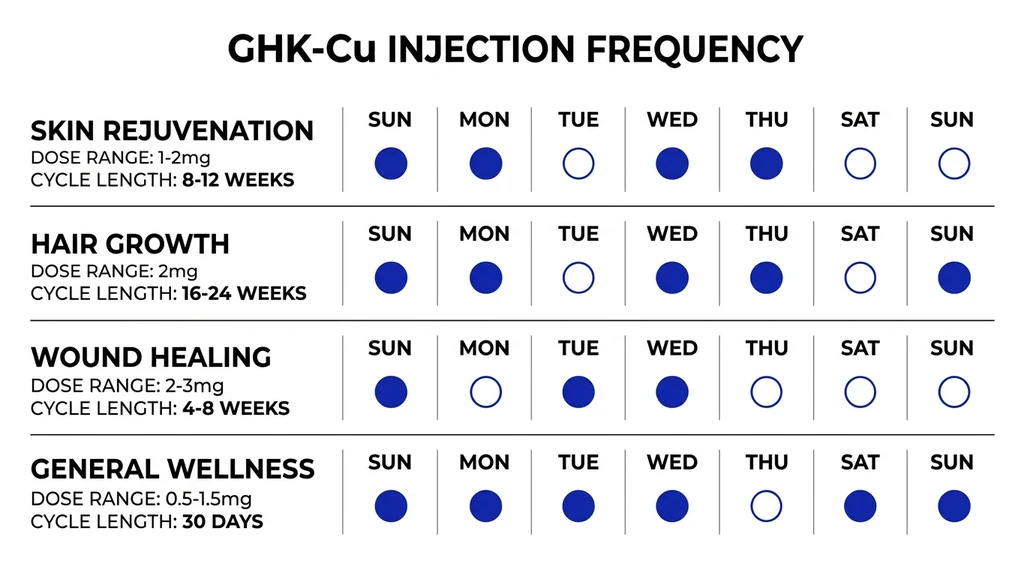
Every goal demands a different rhythm. Skin rejuvenation and hair growth both follow the classic 5-on/2-off pattern, but hair requires twice the patience. Wound healing tolerates daily injection seven days a week because the treatment window is short. General wellness sits at the gentle end of the spectrum.
| Goal | Dose per Injection | Frequency | Cycle Length | Rest Period |
|---|---|---|---|---|
| Skin rejuvenation | 1-2 mg | Daily (5 on / 2 off) | 8-12 weeks | 4 weeks |
| Hair growth | 2 mg | Daily (5 on / 2 off) | 16-24 weeks | 4-6 weeks |
| Wound healing | 2-3 mg | Daily (7 days/week) | 4-8 weeks or until healed | 2-4 weeks |
| General wellness | 0.5-1.5 mg | Daily or every other day | 30 days | 30 days |
| Acute injury (short burst) | 1.5-2.5 mg | Daily | 10-14 days | Re-evaluate |
Hair growth deserves a special note. Follicles operate on multi-month cycles. The earliest sign of response is reduced shedding at 4 to 8 weeks, but visible new growth requires 8 to 16 weeks and meaningful density change takes 4 to 6 months. Stopping before 16 weeks means quitting before the inflection point where results become obvious.
For wound healing protocols, GHK-Cu pairs well with BPC-157 and TB-500 in stacking protocols covered in the GHK-Cu dosage guide.
Source data cross-referenced from Pickart & Margolina 2018, iPharmacy clinical protocols, and PeptideInitiative dosing guidelines.
Daily vs. Three Times a Week vs. Every Other Day
Three scheduling approaches dominate practitioner protocols. Each delivers a comparable weekly dose of GHK-Cu through a different injection cadence. The right choice depends on your phase, your tolerance for daily injections, and how aggressively you want to pursue results.
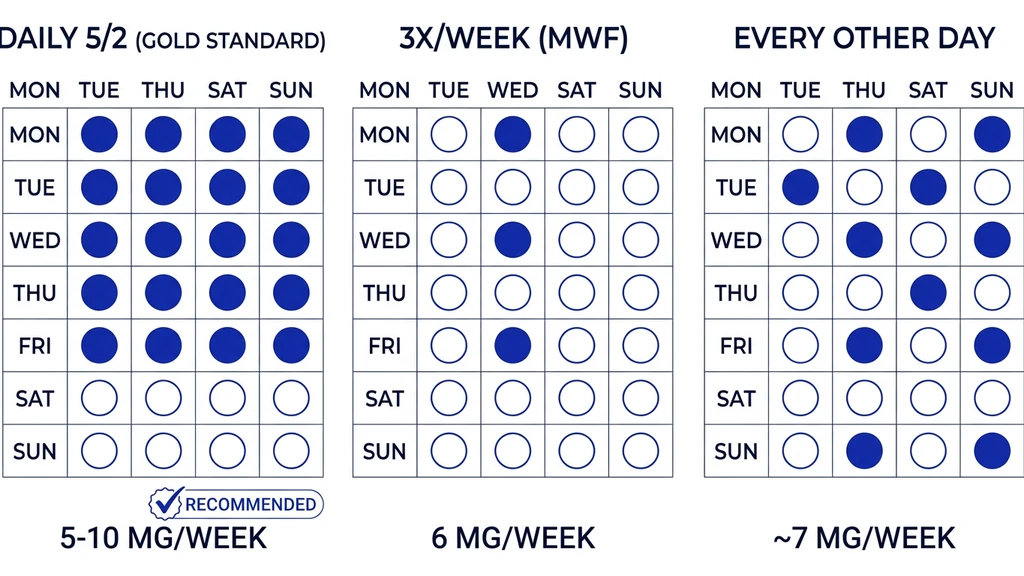
Daily, 5 days on / 2 off. This is the gold standard. At 1 to 2 mg per injection, you deliver 5 to 10 mg per week. It carries the strongest evidence base because most published protocols describe this exact schedule. If you are prioritizing results and do not mind daily subcutaneous injections, this is where you start.
Three times per week (Monday, Wednesday, Friday). At 2 mg per injection, you deliver 6 mg per week. The weekly exposure is comparable to the daily 5/2 schedule. This approach suits people who dislike daily injections or who have transitioned into a maintenance phase after an initial loading cycle.
Every other day. At 2 mg per injection, you average roughly 3.5 injections per week for approximately 7 mg. Some practitioners use this as a taper during weeks 9 to 12 of longer protocols, easing the body out of daily frequency before a full rest period.
No head-to-head study compares these three schedules. The 5/2 daily protocol is what most published research describes. Reduced-frequency alternatives are practitioner-derived, built on pharmacokinetic reasoning: GHK-Cu has a short circulating half-life, but its tissue remodeling effects are cumulative. The peptide triggers gene expression changes in over 4,000 genes that persist beyond the moment of injection (Pickart & Margolina, 2018).
If you are new to peptide injections, start with the daily 5/2 schedule. It is the most studied, the most recommended, and the simplest to track. For complete beginner guidance, see getting started with peptides.
Loading Phase vs. Maintenance Phase
Think of GHK-Cu frequency in two stages. The loading phase builds tissue-level saturation. The maintenance phase sustains what you have built with fewer injections.
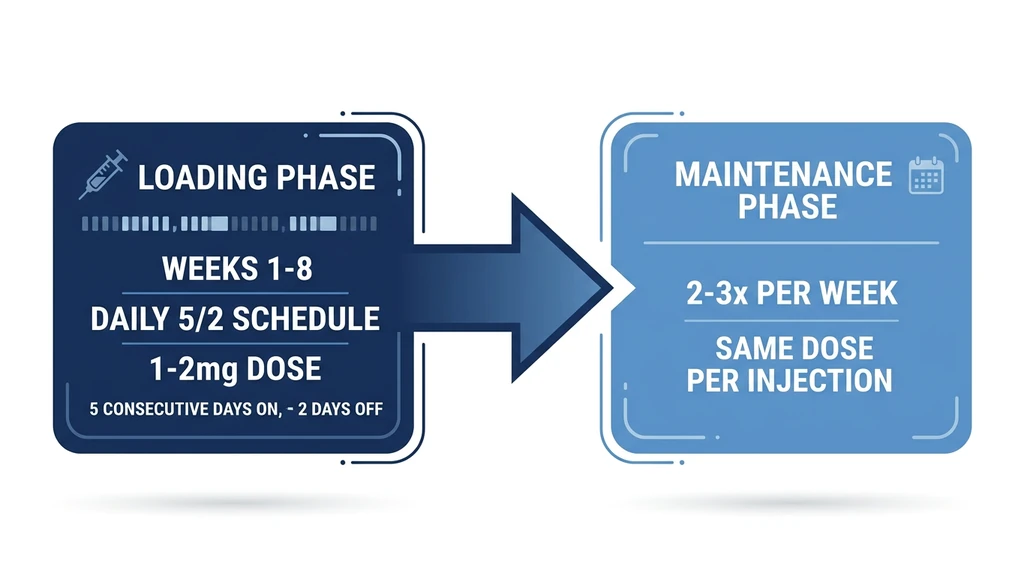
Loading phase (weeks 1 to 8). Daily injection at full dose, 1 to 2 mg, five days on and two days off. This period establishes the gene expression changes that drive collagen synthesis, inflammation reduction, and tissue remodeling. Dr. Loren Pickart's research documents that GHK-Cu modulates over 4,000 human genes, roughly 31% of the genome. Consistent daily signaling during loading is what initiates this cascade. Collagen types I and III begin accumulating. Antioxidant enzymes like superoxide dismutase trend upward. Pro-inflammatory cytokines trend downward.
Maintenance phase (post week 8). Reduce to 2 to 3 injections per week at the same per-injection dose. The structural changes from loading do not disappear overnight. Maintenance keeps the signal alive without the daily commitment. Some practitioners recommend this phase indefinitely after the initial loading cycle. Others prefer a full rest period followed by a new loading cycle.
The transition. After 8 to 12 weeks of daily use, you have two options. Option one: switch to maintenance frequency and continue. Option two: take a full rest period of 2 to 4 weeks, then start a new loading cycle. Both approaches are used in practice. Neither has been formally tested in a clinical trial comparing the two.
The terms "loading" and "maintenance" are practitioner-coined. No published study has tested a two-phase GHK-Cu protocol against a continuous daily protocol. The rationale is borrowed from other compounds where tissue saturation and receptor dynamics justify phased dosing. For GHK-Cu specifically, the logic is sound even without direct evidence: cumulative copper exposure is lower with reduced frequency, and the gene expression changes initiated during loading persist during maintenance.
How Long Should a GHK-Cu Cycle Last?
Cycle length depends on the goal. The table above gives the ranges, but here is the reasoning behind each one.
Skin rejuvenation: 8 to 12 weeks on, 4 weeks off. A 12-week study on 71 women using GHK-Cu cream showed progressive improvement in collagen, with 70% of participants responding positively compared to 50% with vitamin C and 40% with retinoic acid (Pickart et al., 2015). Injectable protocols mirror this timeline because the biological process is the same: fibroblast stimulation, collagen deposition, and tissue remodeling all operate on a multi-week timescale.
Hair growth: 16 to 24 weeks minimum. Hair follicles cycle through anagen (growth), catagen (regression), and telogen (rest) over months. GHK-Cu must sustain its signal long enough for miniaturized follicles to re-enter anagen and produce terminal hairs. Cutting the cycle short at 8 weeks may produce reduced shedding but will miss the density gains that come at 4 to 6 months.
Wound healing: 4 to 8 weeks or until healed. This is symptom-driven. Once the wound has closed and scar remodeling is underway, the cycle ends. There is no reason to continue beyond clinical resolution.
General wellness: 30 days on, 30 days off. A conservative schedule for people using GHK-Cu as a maintenance peptide rather than targeting a specific condition.
Why cycle at all? Two reasons are commonly cited: preventing receptor desensitization and avoiding copper accumulation. The evidence for GHK-Cu receptor desensitization is weak. GHK-Cu does not operate through a single receptor pathway the way a growth hormone secretagogue does. It acts primarily through gene expression modulation, delivering copper to enzymes and triggering transcription factor cascades rather than saturating one receptor.
The stronger rationale is copper accumulation management. GHK-Cu contains a copper(II) ion. At standard doses of 1 to 2 mg per day for a 70 kg person, the copper load is approximately 300-fold below the toxic threshold (Pickart & Margolina, 2018). Cycling is precautionary, not strictly necessary at standard doses. But for longer protocols or higher doses, periodic rest reduces cumulative copper exposure to near zero.
Topical GHK-Cu does not require cycling. Systemic copper absorption from creams and serums is minimal. If you are reading about copper peptide side effects, the concern applies almost exclusively to injectable use. For copper safety data, see does GHK-Cu cause liver damage.
Injection Site Rotation for GHK-Cu
Subcutaneous injections deposit GHK-Cu in the fat layer beneath the skin. The peptide absorbs into local capillaries over 30 to 60 minutes, then distributes systemically. Rotating injection sites prevents lipodystrophy (localized fat tissue changes) and reduces scar tissue formation that can slow absorption over time.
Primary sites (ranked by absorption speed):
| Site | Absorption Speed | Pain Level | Notes |
|---|---|---|---|
| Lower abdomen (2+ inches from navel) | Fastest | Low | Most popular site. Avoid the midline and any stretch marks |
| Outer thigh (middle third) | Moderate | Low to moderate | Large surface area. Good for rotation |
| Upper arm fat pad (triceps area) | Moderate | Low | Harder to self-inject. Some users need a partner |
| Love handles (flanks) | Moderate | Very low | Underused. Plenty of subcutaneous fat in most people |
Rotation pattern. Use a different site each day on a 4-site rotation. Monday: left abdomen. Tuesday: right abdomen. Wednesday: left thigh. Thursday: right thigh. Friday: left love handle. This ensures no single area receives more than one injection per week during a 5-on/2-off schedule.
Spacing rule. Keep at least 1 inch (2.5 cm) between consecutive injection spots within the same general area. Scar tissue from repeated injections in the exact same spot can reduce GHK-Cu absorption by creating a fibrous pocket that slows capillary uptake.
For localized goals. If you are using GHK-Cu for a specific injury or scar, inject near the target area. BPC-157 and GHK-Cu both produce higher local tissue concentrations near the injection site even though they distribute systemically. For joint or tendon targets, inject in the subcutaneous fat closest to the affected structure. See best peptides for tendon repair for injury-specific protocols.
What Happens If You Skip a Dose
You will miss a dose eventually. Travel, illness, or simply forgetting will break the streak. The question is whether a missed day undermines your results.
Short answer: one missed day changes nothing measurable. GHK-Cu works through cumulative gene expression changes, not acute blood levels. The peptide's circulating half-life is short (minutes to hours), but the transcription factor cascades it triggers persist for days. Missing Monday does not erase what happened Sunday.
Two to three consecutive missed days are also inconsequential in most cases. This is, in fact, exactly what the 5-on/2-off schedule already builds in. Your rest days are pre-planned missed doses. An unplanned 3-day gap during a loading phase is equivalent to an extended weekend break.
Five or more consecutive missed days during a loading phase may slow progress. The gene expression changes GHK-Cu initiates are cumulative and benefit from sustained signaling. A week-long gap during weeks 1 through 4 of loading could delay the tissue saturation that makes maintenance effective. If you miss a full week, do not double the dose to compensate. Resume at your normal dose on the next available day.
What NOT to do: - Do not inject a double dose to make up for a missed day. GHK-Cu copper load is the constraint, and doubling it provides no additional benefit while increasing copper exposure unnecessarily. - Do not restart the cycle count. If you were on day 18 and missed day 19, continue counting from day 20. One gap does not reset the biological clock. - Do not panic. The 4,000+ gene modulation changes documented by Pickart are not fragile. They build gradually and persist through brief interruptions.
When to actually restart a cycle. If you miss more than 10 consecutive days during loading, consider restarting from week 1. At that point, tissue-level GHK-Cu has likely returned to baseline, and the cumulative signaling advantage of the loading phase is largely lost.
Adjusting Frequency When Stacking GHK-Cu
GHK-Cu is frequently stacked with other peptides. Each combination creates a different frequency consideration.
GHK-Cu + BPC-157 + TB-500 (GLOW blend). The blend is pre-mixed at a 5:1:1 ratio. Frequency follows the blend protocol: daily injection for 4 weeks, 2 to 4 weeks off. This is shorter than standalone GHK-Cu cycles because BPC-157 and TB-500 receptors desensitize faster than GHK-Cu's gene modulation pathway. The blend cycle is driven by the shortest-acting component. See the GHK-Cu + BPC-157 + TB-500 blend guide for complete dosing charts.
GHK-Cu + BPC-157 (without TB-500). Follow the BPC-157 cycle length: 4 to 6 weeks on, 2 to 4 weeks off. Inject both peptides at the same time, either from separate vials into a single syringe or as two separate injections at different sites. GHK-Cu frequency stays daily (5/2). BPC-157 frequency matches at daily or twice daily depending on the injury.
GHK-Cu + growth hormone secretagogues (MK-677, Ipamorelin, CJC-1295). These operate through completely different pathways. GHK-Cu modulates gene expression. Secretagogues stimulate GH release via ghrelin or GHRH receptors. There is no interaction that would require adjusting GHK-Cu frequency. Run both at their standard frequencies. The combination is popular for anti-aging protocols where GHK-Cu handles collagen and tissue repair while the secretagogue addresses muscle, sleep, and fat metabolism.
| Stack | GHK-Cu Frequency | Stack Partner Frequency | Cycle Length | Notes |
|---|---|---|---|---|
| GHK-Cu + BPC-157 + TB-500 | Daily (5/2) | Same injection | 4 weeks on, 2-4 off | Blend cycle drives timing |
| GHK-Cu + BPC-157 only | Daily (5/2) | Daily or 2x daily | 4-6 weeks on, 2-4 off | BPC-157 cycle drives timing |
| GHK-Cu + MK-677 | Daily (5/2) | Daily (continuous) | 8-12 weeks on, 4 off | Independent cycles |
| GHK-Cu + Ipamorelin/CJC | Daily (5/2) | 1-3x daily | 8-12 weeks on, 4 off | GH secretagogue at night |
| GHK-Cu + Semax (nasal) | Daily (5/2) injection | Daily nasal spray | 8-12 weeks on, 4 off | Different routes, no conflict |
General stacking rule. GHK-Cu frequency does not change when you add other peptides. It stays at daily 5/2 during loading and 2 to 3 times per week during maintenance. The cycle length may shorten to match a more sensitive stack partner (BPC-157 at 4 weeks rather than GHK-Cu's typical 8 to 12 weeks), but the injection cadence for GHK-Cu itself remains constant.
Signs Your GHK-Cu Protocol Is Working
GHK-Cu does not produce the dramatic overnight changes of a corticosteroid or the acute sensation of a growth hormone pulse. Its effects accumulate quietly over weeks. Knowing what to look for prevents premature abandonment of a protocol that is actually working.
Week 1 to 2: baseline markers. The earliest signal is injection site behavior. Mild redness that resolves within an hour indicates normal subcutaneous absorption. If you are also using the peptide for a specific injury, you may notice a subtle reduction in localized swelling or stiffness. Sleep quality sometimes improves slightly, likely due to systemic anti-inflammatory effects.
Week 2 to 4: skin and recovery changes. Skin begins to feel more hydrated and elastic. This is not placebo: GHK-Cu upregulates glycosaminoglycan synthesis, including hyaluronic acid and dermatan sulfate, which directly increase skin hydration at the dermal level. Recovery from workouts, minor injuries, and daily wear improves. Bruises heal faster. Small cuts close more quickly.
Week 4 to 8: visible structural changes. Fine lines soften. Skin tone becomes more even as collagen types I and III accumulate in the dermis. Existing scars may flatten or soften, particularly newer scars (less than 2 years old). Joint stiffness decreases. Nails grow faster and may feel stronger, a secondary indicator of systemic collagen metabolism improvement.
Week 8 to 12: hair and deep tissue. If you are targeting hair growth, reduced shedding becomes noticeable around week 4 to 8, but new hair growth typically does not appear until week 8 to 16. Tendon and ligament injuries that were nagging at week 4 may show meaningful improvement. Wound healing is largely complete by this point for most injuries.
Red flags that something is wrong. Persistent injection site lumps (lipodystrophy from poor rotation). Copper taste in the mouth (potential copper accumulation, though rare at standard doses). Worsening inflammation at an injury site rather than improvement. Any of these warrant a protocol reassessment and potentially a conversation with a healthcare provider.
Objective tracking methods. Take progress photos under consistent lighting every 2 weeks. Measure joint range of motion with a goniometer if treating a specific injury. Track sleep quality with a wearable. These objective markers are more reliable than subjective assessments, which are susceptible to expectation bias.
Frequently Asked Questions
How much GHK-Cu should I inject daily?
The standard daily dose is 1 to 2 mg subcutaneously. For wound healing, 2 to 3 mg daily is common. Start at 1 mg if you are new to peptides and increase after 1 to 2 weeks if tolerated well. For getting started with peptides, our beginner guide covers the fundamentals.
Can I inject GHK-Cu every day?
Yes. Most protocols use daily injection five days per week (5 on, 2 off). Some wound-healing protocols use seven consecutive days. The two rest days are not strictly necessary but are a common precaution to manage cumulative copper exposure over longer cycles.
How many mg of GHK-Cu per day is safe?
Standard protocols use 1 to 2 mg per day. The therapeutic dose is approximately 300-fold below the toxic threshold according to animal studies. Doses above 3 mg per day lack additional evidence of benefit and are not generally recommended.
How long is a GHK-Cu cycle?
Most cycles run 4 to 12 weeks depending on the goal. Skin rejuvenation cycles are typically 8 to 12 weeks. Hair growth requires 16 to 24 weeks minimum. Follow each cycle with a 2 to 4 week rest period.
Do I need to cycle GHK-Cu or can I use it continuously?
Cycling is recommended for injectable GHK-Cu to manage cumulative copper exposure, even though standard doses are well below the toxic range. Topical GHK-Cu does not require cycling because systemic copper absorption from creams and serums is minimal.
What is the best time of day to inject GHK-Cu?
Morning or evening both work. No published data favors one over the other. Some practitioners suggest morning injection to align with daytime repair processes, but consistency matters more than specific timing. Pick a time you can maintain and stick with it.
Where should I inject GHK-Cu subcutaneously?
The lower abdomen (2 or more inches from the navel) is the most popular site due to fast absorption and low pain. The outer thigh, upper arm fat pad, and flanks are also suitable. Rotate between at least 3 to 4 sites to prevent lipodystrophy and scar tissue buildup that can slow absorption over time.
Can I stack GHK-Cu injections with BPC-157 or TB-500?
Yes. GHK-Cu is commonly stacked with BPC-157 and TB-500 in a pre-mixed blend (GLOW, 5:1:1 ratio) or from separate vials. GHK-Cu injection frequency stays at daily 5/2, but the overall cycle length shortens to 4 weeks to match BPC-157 and TB-500 receptor sensitivity. See the blend dosage guide for complete protocols.
The Bottom Line
GHK-Cu injection frequency follows a simple default: once daily, five days on, two days off, for 4 to 12 weeks. That covers most goals. Adjust the cycle length for your specific target, reduce frequency during maintenance, and cycle off periodically to manage copper exposure.
The three variables that matter most are consistency, cycle length, and rest periods. Daily frequency during loading builds the foundation. Maintenance frequency preserves it. Rest periods reset copper levels and give your body time to consolidate the tissue remodeling that GHK-Cu initiated.
For reconstitution math, injection technique, stacking protocols, and side effect data, see the complete GHK-Cu dosage guide. For precise volume calculations with any vial size, use the Peptide Reconstitution Calculator. For proper vial storage between injections, see how to store peptides.
Related Guides: - How to Reconstitute GHK-Cu - step-by-step preparation with concentration tables - GHK-Cu Microneedling Protocol - topical delivery route for skin and hair - GHK-Cu Nasal Spray - alternative delivery for cognitive benefits - Does GHK-Cu Cause Hair Loss? - hair safety data for long-term cycling - Peptide Dosage Chart - cross-reference GHK-Cu with other peptide schedules
Helpful Tools
Related Articles
GHK-Cu Dosage: Protocols & Charts
GHK-Cu dosage guide with injection protocols by goal (skin, hair, healing), reconstitution steps, dosage charts, side effects, and before/after timeline.
Where to Inject GHK-Cu: Sites by Goal
Where to inject GHK-Cu for skin, hair, wounds, and anti-aging. Subcutaneous site map by goal, rotation patterns, needle depth, and angle guidance.
GHK-Cu Benefits: 8 Research-Backed Effects
8 GHK-Cu benefits: skin rejuvenation, wound healing, hair growth, anti-inflammatory, and antioxidant effects. PubMed-cited research with dosages.
How Often to Inject Peptides: Frequency Guide
How often to inject peptides: daily for BPC-157 and ipamorelin, weekly for semaglutide and CJC-1295 DAC. Frequency table by half-life, cycling, missed doses.