You are choosing between two GHRH analogs and want hard numbers. CJC-1295 with DAC has a half-life of 6-8 days, allowing weekly injections, while sermorelin has a half-life of just 10-20 minutes, requiring daily injections. In clinical studies, a single CJC-1295 dose produced 2-10-fold GH increases sustained for 6+ days (Teichman et al., J Clin Endocrinol Metab, 2006). Sermorelin produces shorter, physiologic GH pulses that most closely mimic the body's natural GHRH rhythm (Walker et al., Curr Opin Investig Drugs, 2006). Choose CJC-1295 for maximum potency and dosing convenience. Choose sermorelin for natural pulsatility and a historical FDA safety record.
| Feature | CJC-1295 With DAC | CJC-1295 No DAC (Mod GRF 1-29) | Sermorelin |
|---|---|---|---|
| Structure | Modified GRF(1-29) + DAC | Modified GRF(1-29) | GHRH(1-29) |
| Half-life | 6-8 days | ~30 minutes | 10-20 minutes |
| Dosing | 1-2 mg weekly | 100-200 mcg 2-3x daily | 200-500 mcg daily |
| GH pattern | Continuous elevation (GH bleed) | Pulsatile | Pulsatile (most natural) |
| FDA history | Never approved | Never approved | Previously approved (Geref) |
| IGF-1 increase | 1.5-3x for 9-11 days | Moderate, transient | Moderate, transient |
| Monthly cost (compounded) | $150-300 | $100-200 | $100-300 |
| Best for | Maximum GH/IGF-1; weekly dosing | Stacking with ipamorelin | Beginners; natural GH rhythm |
Use our CJC-1295/ipamorelin dosage calculator for protocol planning.
Neither compound is FDA-approved for human use in their research forms. Consult a healthcare provider before use.
Get your custom peptide protocol:
- Tailored to your body and goals
- Precise dosing and cycle length
- Safe stacking combinations
- Backed by peer-reviewed studies
- Ready in under 2 minutes
What Is CJC-1295?
CJC-1295 is a synthetic analog of growth hormone-releasing hormone (GHRH) with four amino acid substitutions that protect it from enzymatic degradation. It exists in two forms with dramatically different pharmacokinetics. Understanding which form you are using matters enormously because the side effects, dosing schedules, and clinical evidence differ substantially between them.
CJC-1295 With DAC (Drug Affinity Complex)
The DAC moiety contains a reactive maleimidoproprionic acid (MPA) group that covalently binds to serum albumin after injection. Albumin has a half-life of approximately 19 days in humans. The peptide benefits from this extended circulation, achieving a functional half-life of 6-8 days (Jette & LeBlanc, Bioconjug Chem, 2005).
A single subcutaneous injection of 30-60 mcg/kg produced 2-10-fold GH increases for over 6 days in the Teichman 2006 trial. IGF-1 rose 1.5-3-fold and remained elevated for 9-11 days. After multiple weekly doses, mean IGF-1 stayed elevated for 28 days. The DAC version creates what researchers call a "GH bleed": continuous GHRH receptor stimulation that elevates baseline GH rather than producing distinct pulses.
For a complete guide to the DAC variant, see our CJC-1295 with DAC guide.
CJC-1295 Without DAC (Mod GRF 1-29)
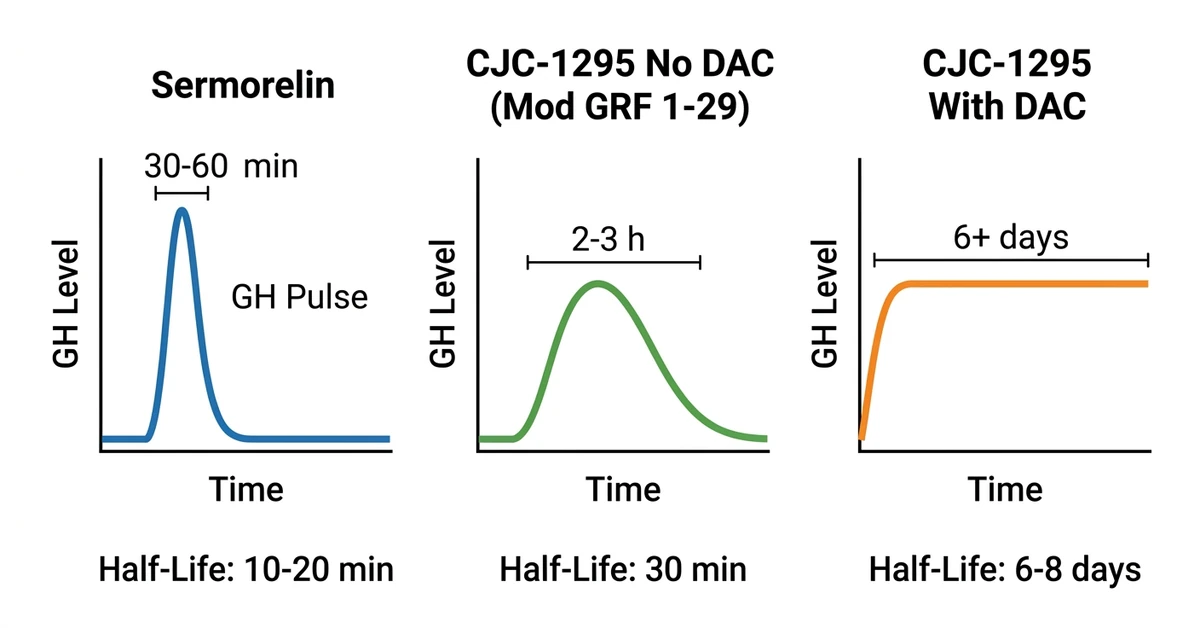
Without the DAC attachment, the half-life drops to approximately 30 minutes. It produces a GH pulse that rises and falls within 2-3 hours, much closer to the body's natural secretion pattern. Most users inject 100-200 mcg two to three times daily, often combined with ipamorelin for synergistic GH release across two receptor pathways.
The no-DAC version is the more commonly prescribed form in clinical practice because pulsatile release is better tolerated and easier to titrate. For a dedicated comparison between the two CJC-1295 forms, see our DAC vs no-DAC guide. For the full CJC-1295 dosage guide, see our dedicated resource.
What Is Sermorelin?
Sermorelin is a truncated form of natural GHRH, consisting of the first 29 amino acids of the 44-amino-acid endogenous hormone. These 29 amino acids contain the full biological activity needed to stimulate GH release from the pituitary gland.
Sermorelin was previously FDA-approved under the brand name Geref for diagnosis and treatment of growth hormone deficiency in children (Prakash & Goa, BioDrugs, 1999). The manufacturer discontinued it due to production difficulties, not safety concerns. It remains available through compounding pharmacies with a prescription.
Its 10-20 minute half-life means each injection produces a single, sharp GH pulse that mirrors natural pituitary secretion during deep sleep. Walker et al. confirmed that sermorelin preserves the pituitary neuroendocrine axis and actually stimulates endogenous hGH mRNA production (Walker et al., 2006). Sermorelin does not just trigger GH release; it supports the pituitary's capacity to make GH independently. For safety data, see is sermorelin safe. For body composition effects, see sermorelin for fat loss.
Half-Life and Pharmacokinetics: The Core Difference
Think of GH secretion like a water delivery system. Sermorelin is a garden hose you turn on briefly and shut off. CJC-1295 no-DAC is a sprinkler on a 3-hour timer. CJC-1295 with DAC is a drip irrigation system running for a full week.
| Compound | Half-Life | GH Pulse Duration | Injections Per Week |
|---|---|---|---|
| Sermorelin | 10-20 minutes | 30-60 minutes | 7 (daily) |
| CJC-1295 no DAC | ~30 minutes | 2-3 hours | 14-21 (2-3x daily) |
| CJC-1295 with DAC | 6-8 days | Continuous for 6+ days | 1-2 (weekly) |
Sermorelin's short half-life is both its limitation and its advantage. The limitation: daily injections are required. The advantage: each pulse replicates the body's natural GH secretion pattern. The pituitary normally releases GH in 6-12 bursts per day, with the largest pulse during stage 3-4 sleep. Sermorelin injected before bed amplifies this natural surge without creating continuous elevation.
CJC-1295 with DAC eliminates daily injections but creates continuous GHRH receptor stimulation. This may increase pituitary desensitization risk over time and produces more side effects from sustained GH elevation: water retention, insulin sensitivity changes, and tingling that are harder to manage because the compound remains active for days after each injection.
GH and IGF-1 Elevation: Which Produces More?
CJC-1295 wins on raw GH and IGF-1 output. The question is whether more is better for your specific goals.
CJC-1295 (Teichman et al., 2006): 21 healthy adults received a single CJC-1295 DAC dose at 30-60 mcg/kg. GH increased 2-10-fold and remained elevated for 6+ days. IGF-1 rose 1.5-3-fold for 9-11 days. After multiple weekly doses, mean IGF-1 stayed elevated for 28 days (PMID: 16352683).
Sermorelin (Walker et al., 2006; Prakash & Goa, 1999): Sermorelin at 30 mcg/kg produced significant but shorter GH pulses. In pediatric studies, sermorelin increased growth velocity from 3.0 cm/year to 7.0 cm/year over 12 months, confirming clinically meaningful GH stimulation (PMID: 18031173). Walker et al. showed sermorelin preserves the pituitary neuroendocrine axis, supporting long-term GH production capacity (PMID: 18046908).
The tradeoff: CJC-1295 produces higher, more sustained GH and IGF-1. Sermorelin produces more physiologic pulses that preserve pituitary function. For short-term body composition goals, CJC-1295 may be more effective. For long-term GH axis health, sermorelin has the stronger argument.
Dosing Protocols Compared
Each compound requires a different injection schedule and cycle structure.
| Parameter | Sermorelin | CJC-1295 No DAC | CJC-1295 With DAC |
|---|---|---|---|
| Standard dose | 200-500 mcg/day | 100-200 mcg per injection | 1-2 mg/week |
| Injection frequency | Once daily (before bed) | 2-3x daily | 1-2x weekly |
| Injection timing | 30 min before sleep | Morning, pre-workout, bedtime | Any consistent day |
| Common stack | + ipamorelin 100-200 mcg | + ipamorelin 200-300 mcg | + ipamorelin 200-300 mcg daily |
| Cycle length | 3-6 months | 8-12 weeks | 8-16 weeks |
| Off-cycle | 1-2 months | 4-6 weeks | 4-6 weeks |
Sermorelin's once-daily bedtime injection is the simplest protocol. The peptide amplifies your natural nighttime GH pulse and is cleared from your system by morning. CJC-1295 no-DAC demands 2-3 daily injections, the most demanding schedule of the three. CJC-1295 with DAC offers maximum convenience: one or two injections per week.
For reconstitution instructions and volume calculations, use our peptide reconstitution calculator.
Side Effect Profiles Compared
Both compounds are well-tolerated GHRH analogs. Neither elevates cortisol or prolactin, distinguishing them from GHRPs like GHRP-6. Side effects are GH-class effects rather than compound-specific toxicities.
| Side Effect | Sermorelin | CJC-1295 No DAC | CJC-1295 With DAC |
|---|---|---|---|
| Injection site reactions | Common (daily injections) | Common (multiple daily) | Less frequent (weekly) |
| Facial flushing | Mild, brief | Mild, brief | Mild-moderate |
| Water retention | Mild | Mild-moderate | Moderate |
| Tingling/numbness | Rare | Mild (10-15%) | More common (15-25%) |
| Headache | Occasional | Occasional | Occasional |
| Insulin sensitivity impact | Minimal | Mild | Greatest (continuous GH) |
Sermorelin has the mildest profile due to its short half-life and physiologic GH pulse pattern. CJC-1295 with DAC has the most pronounced side effects because sustained GH elevation drives more water retention and metabolic effects. For detailed side effect management protocols, see our CJC-1295/ipamorelin side effects guide.
Cost Comparison
Peptide pricing varies by source, purity, and region. The following ranges reflect compounded pharmacy pricing in the United States as of 2026.
| Compound | Monthly Cost (Compounded) | Notes |
|---|---|---|
| Sermorelin (300 mcg/day) | $100-300 | Single vial may last 4-6 weeks |
| CJC-1295 no DAC (150 mcg 2x/day) | $100-200 | More frequent purchases needed |
| CJC-1295 with DAC (2 mg/week) | $150-300 | Higher per-vial cost; fewer injections |
All three options land in a similar monthly range. The hidden cost difference is injection supplies. Sermorelin and CJC-1295 no-DAC require 30-90 syringes per month compared to 4-8 for CJC-1295 with DAC. Bacteriostatic water, alcohol swabs, and sharps disposal add $15-30/month regardless of the compound.
For sourcing information, see where to buy sermorelin. Sermorelin's historical FDA approval means some insurance plans and clinics can prescribe it more readily than research-only CJC-1295.
FDA Status and Legal Considerations
This is where the two compounds diverge sharply.
Sermorelin was FDA-approved in 1997 under the brand name Geref. It has a documented FDA safety review on record, which gives it a credibility baseline that CJC-1295 lacks. EMD Serono voluntarily discontinued Geref due to manufacturing challenges, not safety signals. Compounding pharmacies legally produce sermorelin as a compounded medication with a valid prescription.
CJC-1295 was developed by ConjuChem Biotechnologies (now dissolved) and progressed through Phase I/II trials but was never submitted for FDA approval. It is classified as a research compound. Compounding pharmacies produce it under the 503B framework.
The 2024 FDA PCAC (Pharmacy Compounding Advisory Committee) meetings addressed compounded peptides broadly. Both compounds remain available through licensed compounding pharmacies, but regulatory changes could affect access. Users who value regulatory certainty have reason to prefer sermorelin. For context on sermorelin's regulatory history, see is sermorelin a steroid.
Why Sermorelin Was Discontinued
This is a gap in most competitor content. The reason Geref (brand sermorelin) was withdrawn matters for users deciding between sermorelin and CJC-1295.
Sermorelin was not withdrawn for safety failures, clinical failures, or post-market adverse event signals. EMD Serono discontinued production due to manufacturing and commercial viability challenges. The pediatric GH deficiency market shifted toward recombinant HGH, which was more profitable and easier to manufacture at scale. Sermorelin's market dried up, not its safety record.
The compound remains available through compounding pharmacies and is prescribed by many longevity and anti-aging physicians. Its prior FDA approval means it has more regulatory documentation than any other peptide currently available through compounding channels. This is a meaningful distinction for safety-conscious users.
Who Should Choose Which?
Your primary goal determines the better option. The following framework accounts for goals, risk tolerance, and practical preferences.
Choose Sermorelin If:
You want the most natural GH pulse pattern. Sermorelin mimics endogenous GHRH better than any synthetic alternative. Sleep optimization is your primary goal. Bedtime sermorelin amplifies the natural nighttime GH surge that drives deep sleep and tissue repair. You are a peptide beginner. The mild side effect profile and historical FDA approval make sermorelin the lowest-risk entry point.
You prefer a compound with documented regulatory history. You want to preserve long-term pituitary function. Walker et al. showed sermorelin stimulates hGH mRNA, actively supporting the pituitary's ability to produce GH independently over the long term.
Choose CJC-1295 If:
Maximum GH and IGF-1 elevation is your priority. CJC-1295 with DAC produces 2-10x GH increases versus sermorelin's more moderate pulses. Injection convenience matters significantly. The DAC version requires only 1-2 weekly injections versus sermorelin's daily schedule. Body composition change is your primary goal.
You plan to stack with ipamorelin. CJC-1295 no-DAC paired with ipamorelin is the most widely prescribed GH secretagogue stack: combining GHRH and GHRP pathways for synergistic release. See CJC-1295/ipamorelin benefits for the full stack analysis.
Can You Stack CJC-1295 and Sermorelin Together?
Stacking CJC-1295 and sermorelin is not standard practice. Both compounds target the GHRH receptor on pituitary somatotrophs. Using two GHRH agonists creates redundancy: the receptor can only respond a set number of times per hour regardless of how many agonists are present.
Productive stacks pair a GHRH analog with a GHRP, activating two distinct receptor pathways for genuine synergy.
| Stack | Synergy Type | Notes |
|---|---|---|
| CJC-1295 no DAC + Ipamorelin | GHRH + GHRP | Most popular clinical stack |
| Sermorelin + Ipamorelin | GHRH + GHRP | Natural pulse + selective release |
| CJC-1295 DAC + Ipamorelin | GHRH + GHRP | Weekly base + daily pulse |
| CJC-1295 + Sermorelin | GHRH + GHRH | Redundant; not recommended |
For a broader view of how CJC-1295 compares to other GH analogs, see our tesamorelin vs CJC-1295 comparison. For the comprehensive three-way breakdown, see tesamorelin vs sermorelin vs ipamorelin. For stacking strategy, see our peptide stacking guide.
Frequently Asked Questions
Which is better, CJC-1295 or sermorelin?
Neither is universally better. CJC-1295 with DAC produces 2-10x GH increases sustained for 6+ days with weekly injections. Sermorelin produces shorter, more natural GH pulses with daily injections. Choose CJC-1295 for maximum GH elevation and dosing convenience. Choose sermorelin for natural pulsatility, a historical FDA safety record, and sleep optimization. Use our CJC-1295/ipamorelin dosage calculator to plan your protocol.
Is CJC-1295 stronger than sermorelin?
Yes. CJC-1295 with DAC produces higher and more sustained GH and IGF-1 elevation. In the Teichman 2006 study, a single dose raised GH 2-10-fold for over 6 days and IGF-1 1.5-3-fold for 9-11 days. Sermorelin produces a single sharp GH pulse lasting 30-60 minutes per injection. More potent does not mean better for every goal. Sermorelin's natural pulsatility has distinct advantages for pituitary health and sleep quality.
Can you take CJC-1295 and sermorelin together?
Not recommended. Both target the GHRH receptor on pituitary somatotrophs. Using two GHRH agonists creates redundancy, not synergy. A better approach is pairing either one with ipamorelin, a ghrelin receptor agonist that activates a distinct receptor pathway. See our CJC-1295/ipamorelin benefits guide for the synergistic stacking rationale.
Is sermorelin FDA approved?
Sermorelin was FDA-approved in 1997 under the brand name Geref for pediatric GH deficiency. The manufacturer voluntarily discontinued it due to production challenges, not safety concerns. It is now available through compounding pharmacies with a prescription. CJC-1295 has never been FDA-approved. This distinction matters for users who value regulatory history as a safety proxy.
What is the half-life of CJC-1295 vs sermorelin?
Sermorelin: 10-20 minutes. CJC-1295 without DAC (Mod GRF 1-29): approximately 30 minutes. CJC-1295 with DAC: 6-8 days. The DAC moiety binds covalently to serum albumin after injection, extending circulation time from minutes to nearly a week. This 500-fold half-life difference drives every practical distinction between the two compounds: dosing frequency, GH pattern, and side effect profile.
Which has fewer side effects?
Sermorelin has the mildest side effect profile. Its short half-life and physiologic GH pulse pattern produce minimal water retention, tingling, and metabolic effects. CJC-1295 with DAC causes the most pronounced side effects because it maintains continuous GH elevation for 6-8 days. Neither elevates cortisol or prolactin. See our CJC-1295/ipamorelin side effects guide for detailed management protocols.
How long until results from CJC-1295 or sermorelin?
Both compounds show initial effects (improved sleep, recovery) within 1-2 weeks. Body composition changes appear at 4-8 weeks, with full results at 8-16 weeks. CJC-1295 with DAC may produce faster body composition changes due to higher sustained GH/IGF-1 levels. Sermorelin users often report sleep improvement as the first noticeable benefit within days of starting.
Is sermorelin or CJC-1295 better for sleep?
Sermorelin is preferred for sleep optimization. Its short half-life produces a single GH pulse when injected before bed, amplifying the natural nighttime GH surge during stage 3-4 sleep. CJC-1295 with DAC provides continuous GH elevation that does not align with the body's pulsatile sleep-related secretion pattern. For more sleep-focused peptide options, see our peptides for sleep guide.
The Bottom Line
CJC-1295 and sermorelin are both GHRH analogs that stimulate the pituitary to release GH. They share a mechanism class but differ in half-life by a factor of roughly 500: sermorelin at 10-20 minutes versus CJC-1295 DAC at 6-8 days. This single pharmacokinetic difference drives every practical distinction: dosing frequency, GH pattern, side effect intensity, and suitability for different goals.
Sermorelin is the lower-risk starting point for most users. Its historical FDA approval, natural pulsatile GH release, and mild side effect profile make it ideal for sleep optimization, general wellness, and long-term pituitary health. CJC-1295 is the more potent option for users who need maximum GH and IGF-1 elevation for body composition goals and value weekly dosing convenience.
Use our CJC-1295/ipamorelin dosage calculator to plan your protocol. For reconstitution, see our peptide reconstitution calculator. For the three-way GH peptide comparison, see our tesamorelin vs sermorelin vs ipamorelin guide.
Related Articles
Ipamorelin vs Sermorelin: Mechanism, Safety, Cost
Ipamorelin vs sermorelin: ghrelin-receptor agonist vs GHRH analog, 2-hour vs 4-minute half-life, cortisol selectivity, FDA history, cost, and who picks which.
Tesamorelin vs Ipamorelin: Key Differences
Tesamorelin vs ipamorelin: GHRH analog vs ghrelin mimetic. Fat loss data, dosing, side effects, cost, and stacking protocols. PubMed-cited guide.
CJC-1295 DAC vs No DAC: How to Choose
CJC-1295 DAC (6-8 day half-life, weekly injection) vs no DAC/Mod GRF 1-29 (30-min half-life, 2-3x daily). Compare dosing, GH patterns, and cost.
CJC-1295/Ipamorelin Side Effects: Manage Them
CJC-1295/ipamorelin side effects: injection reactions 20-30%, water retention 15-25%, flushing 15-20%. DAC comparison and management.