You have tried melatonin, magnesium, and blue-light blockers. Sleep still fractures at 2 a.m. The issue may not be your habits. It may be the signaling molecules that regulate your sleep architecture. The six most effective peptides for sleep are DSIP, Selank, Epitalon, ipamorelin + CJC-1295 (bedtime protocol), BPC-157 (gut-sleep axis), and GHRP-6. Each targets a different mechanism behind poor sleep.
DSIP (Delta Sleep-Inducing Peptide) holds the strongest direct evidence for sleep improvement. Isolated from rabbit brain in 1977, it modulates delta-wave activity during slow-wave sleep, the phase responsible for physical repair and memory consolidation (Graf & Kastin, Neurosci Biobehav Rev, 1984). No peptide listed here is FDA-approved for sleep disorders. Consult a healthcare provider before using any peptide.
Quick-reference ranking:
| Rank | Peptide | Primary Sleep Mechanism | Evidence Level | Onset | Typical Dose |
|---|---|---|---|---|---|
| 1 | DSIP | Delta-wave enhancement, cortisol modulation | Moderate (human EEG trials) | 20-40 min | 100-250 mcg before bed |
| 2 | Selank | GABA modulation, anxiolytic | Moderate (human anxiolytic trials) | 15-30 min | 250-500 mcg intranasal |
| 3 | Epitalon | Melatonin restoration via pineal gland | Moderate (human melatonin data) | 2-3 weeks | 5-10 mg/day for 10-20 days |
| 4 | Ipamorelin + CJC-1295 | GH pulse amplification during sleep | Moderate (human GH data) | 1-2 weeks | 200-300 mcg + 100 mcg before bed |
| 5 | BPC-157 | Gut-brain axis, serotonin normalization | Emerging (animal models) | 1-2 weeks | 250-500 mcg before bed |
| 6 | GHRP-6 | GH release, sleep-stage modulation | Moderate (human GH/sleep data) | 30-60 min | 100-200 mcg before bed |
For dosing specifics on individual peptides, see the peptide dosage chart. For combination strategies, see the peptide stacking guide.
Get your custom peptide protocol:
- Tailored to your body and goals
- Precise dosing and cycle length
- Safe stacking combinations
- Backed by peer-reviewed studies
- Ready in under 2 minutes
How Peptides Improve Sleep (and Why They Differ from Melatonin)
Melatonin tells your brain it is nighttime. Benzodiazepines force GABA receptors open. Both approaches override your sleep system from the outside. Peptides work differently. They restore or amplify the internal signals your brain already uses to initiate and maintain sleep.
Think of sleep architecture like a symphony orchestra. Melatonin is a conductor who sets the tempo but cannot play instruments. Benzodiazepines silence the entire brass section (alertness circuits) by brute force, which is why you feel groggy the next morning. Peptides are section leaders: DSIP strengthens the cellos (delta waves), Selank quiets the timpani (anxiety), and ipamorelin cues the horns to play louder at the right moment (growth hormone pulses). The literal biology: each peptide modulates a specific neurotransmitter or hormonal pathway that governs one phase of the sleep cycle.
Three sleep mechanisms matter most for peptide users.
Delta-wave generation. Slow-wave sleep (stages 3-4) is when physical repair happens. Growth hormone peaks here. DSIP increases delta-wave power density, extending the time your brain spends in this phase (Schneider-Helmert & Schoenenberger, Eur Neurol, 1983). Poor delta-wave activity correlates directly with next-day fatigue, impaired immune function, and slower muscle recovery.
GABAergic tone. GABA is the brain's primary inhibitory neurotransmitter. Low GABAergic tone means your brain cannot downshift from alertness to drowsiness. Selank enhances GABA receptor sensitivity without directly binding the receptor, producing anxiolytic effects without sedation or dependency (Seredenin et al., Bull Exp Biol Med, 2002).
Growth hormone pulsatility. GH is not just for muscles. The largest natural GH pulse occurs 60-90 minutes after sleep onset, during the first bout of slow-wave sleep. This pulse drives tissue repair, fat metabolism, and immune cell production overnight. Ipamorelin and CJC-1295 amplify this pulse without disrupting the sleep stages that trigger it (Raun et al., Eur J Endocrinol, 2005).
The 6 Best Peptides for Sleep (Ranked by Evidence)
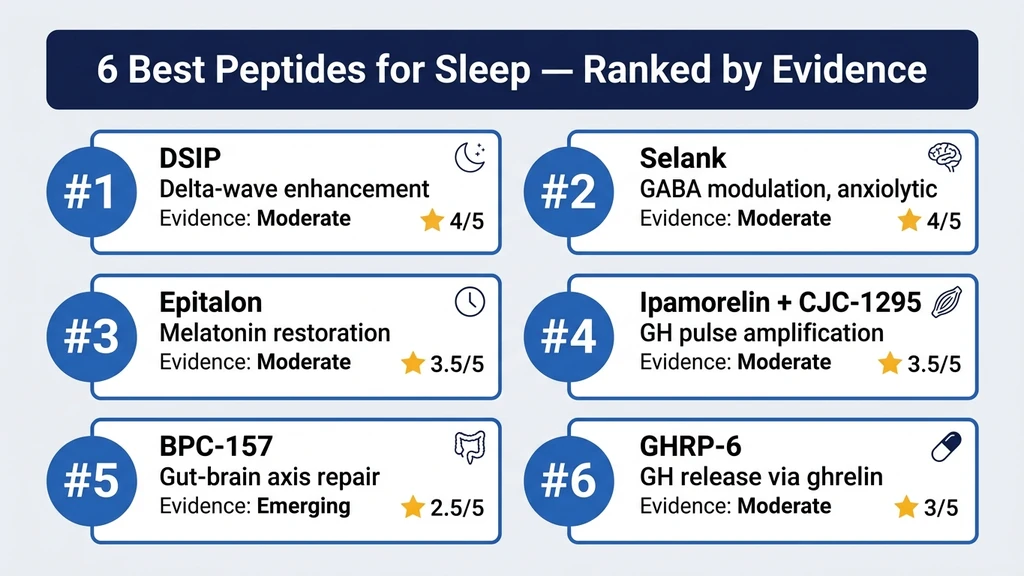
Ranked by strength of sleep-specific evidence, mechanism directness, and practical user outcomes. The top three (DSIP, Selank, Epitalon) directly target sleep or its prerequisite pathways. The remaining three support sleep through growth hormone modulation and gut-brain signaling.
1. DSIP: The Delta-Wave Peptide
Evidence level: MODERATE (human EEG studies, clinical trials in insomnia patients)
DSIP (Delta Sleep-Inducing Peptide) is a nine-amino-acid neuropeptide first isolated from cerebral venous blood of sleeping rabbits. It is the only peptide on this list originally identified for its direct sleep-promoting activity. The name is literal: it induces delta-wave sleep.
How it improves sleep. DSIP modulates the firing rate of neurons in the raphe nuclei and locus coeruleus, brain regions that regulate transitions between wakefulness and sleep. A human EEG study showed DSIP administration increased slow-wave sleep duration and reduced sleep latency (time to fall asleep) in chronic insomnia patients (Schneider-Helmert & Schoenenberger, 1983). DSIP also lowers nocturnal cortisol, which is significant. Elevated nighttime cortisol is one of the most common causes of 2-3 a.m. awakenings (Graf & Kastin, 1984).
A separate clinical study in patients with disrupted sleep found DSIP normalized sleep patterns over a 5-day course, with effects persisting after discontinuation (Kafi et al., Neuropsychobiology, 1979). This carry-over effect distinguishes DSIP from sedatives, which stop working the night you stop taking them.
Sleep protocol: - Dose: 100-250 mcg subcutaneous or intranasal, 30-40 minutes before bed - Cycle: 10 days on, 10 days off (effects carry over during off-days) - Best for: Difficulty falling asleep, frequent nighttime awakenings, light sleepers
For complete dosing details, see the DSIP dosage guide.
Pros: Direct delta-wave enhancement. Cortisol reduction. Carry-over effects persist after discontinuation. No morning grogginess reported in clinical studies.
Cons: Short half-life (approximately 15-25 minutes in plasma) means timing matters. Limited availability from research peptide vendors. Larger human trials are needed.
Why it ranks first. No other peptide has direct human EEG evidence for delta-wave enhancement. DSIP targets the core of poor sleep: insufficient time in restorative deep sleep.
2. Selank: The Anxiety-to-Sleep Bridge
Evidence level: MODERATE (human anxiolytic trials, approved in Russia as an anxiolytic medication)
Selank is a synthetic analogue of the immunomodulatory peptide tuftsin, developed at the Institute of Molecular Genetics in Moscow. It is approved in Russia as an intranasal anxiolytic. Its sleep benefit is indirect but powerful: Selank dissolves the pre-sleep anxiety that keeps millions awake.
How it improves sleep. Selank modulates GABA-A receptor function, increases brain-derived neurotrophic factor (BDNF) expression, and stabilizes enkephalin metabolism. A clinical trial in patients with generalized anxiety disorder showed Selank reduced anxiety scores by 50-60% over 14 days, comparable to benzodiazepines but without sedation, cognitive impairment, or dependence (Zozulya et al., Bull Exp Biol Med, 2008). Anxiety is the number-one self-reported cause of sleep-onset insomnia. Removing it clears the path.
Selank also influences serotonin metabolism. An animal study demonstrated that Selank stabilized serotonin turnover in the brain, preventing the fluctuations that contribute to both anxiety and disrupted sleep architecture (Narkevich et al., Bull Exp Biol Med, 2008).
Sleep protocol: - Dose: 250-500 mcg intranasal, 30 minutes before bed - Cycle: 14-21 days on, 14 days off - Best for: Sleep-onset insomnia caused by racing thoughts, anxiety-related awakenings, stress-induced sleep disruption
Pros: Fast onset (15-30 minutes intranasal). No sedation or cognitive blunting. No dependence risk. Approved medication status in Russia provides a level of safety validation not available for most research peptides.
Cons: Indirect sleep benefit (anxiolytic, not a direct sleep promoter). Less effective for sleep issues not driven by anxiety. Limited Western clinical data.
Why it ranks second. For the 40% of insomnia sufferers whose primary barrier is anxiety and mental chatter, Selank removes the obstacle rather than forcing sleep through sedation. It also stacks well with DSIP for a combined anxiolytic-plus-delta-wave approach.
3. Epitalon: The Melatonin Restorer
Evidence level: MODERATE (human melatonin and pineal studies, aging research)
Epitalon (epithalon) is a synthetic tetrapeptide (Ala-Glu-Asp-Gly) based on epithalamin, a polypeptide extract from the pineal gland. Where melatonin supplements deliver the hormone from outside, Epitalon stimulates your own pineal gland to produce it naturally. The distinction matters: exogenous melatonin can suppress endogenous production over time. Epitalon restores it.
How it improves sleep. Epitalon activates telomerase and stimulates pineal gland function, increasing endogenous melatonin production. A study in elderly patients (60-80 years) showed Epitalon restored evening melatonin peaks to levels comparable with younger adults, alongside reported improvements in sleep quality (Korkushko et al., Bull Exp Biol Med, 2006). Pineal calcification and declining melatonin production are well-documented features of aging. By age 60, melatonin output is roughly 50% of age-20 levels (Karasek & Reiter, Neuro Endocrinol Lett, 2002).
The professor who developed Epitalon, Vladimir Khavinson, demonstrated that epithalamin administration in aging primates increased melatonin secretion and normalized circadian rhythms over a 10-day course (Khavinson et al., Neuro Endocrinol Lett, 2003).
Sleep protocol: - Dose: 5-10 mg subcutaneous daily for 10-20 days - Cycle: One course every 4-6 months (effects persist for months after the course) - Best for: Age-related melatonin decline, circadian rhythm disruption, shift workers rebuilding their sleep clock
Pros: Restores endogenous melatonin rather than replacing it. Long-lasting effects (months) from a short course (10-20 days). Additional anti-aging and telomere-protective properties.
Cons: Slow onset (2-3 weeks for sleep effects). Not useful for acute insomnia. Limited Western clinical trials. Requires subcutaneous injection (not available intranasally).
Why it ranks third. Epitalon is the best peptide for long-term sleep quality restoration, particularly in adults over 40 whose melatonin production has declined. The short-course, long-effect profile is unique. But the 2-3 week onset means it cannot help tonight.
4. Ipamorelin + CJC-1295: The Bedtime GH Protocol
Evidence level: MODERATE (human pharmacokinetic and GH release data; indirect sleep evidence through GH-sleep coupling)
Ipamorelin and CJC-1295 are not sleep peptides. They are growth hormone secretagogues. Their sleep benefit comes from amplifying the natural GH pulse that occurs during the first bout of slow-wave sleep. Larger GH pulse means deeper slow-wave sleep. Deeper slow-wave sleep means a larger GH pulse. The cycle reinforces itself.
How they improve sleep. Ipamorelin stimulates GH release from the pituitary in a dose-dependent manner without raising cortisol or prolactin (Raun et al., 2005). CJC-1295 (no DAC, also called Mod GRF 1-29) amplifies and extends the GH release window. Administered together before bed, they produce a GH pulse 3-5 times larger than the natural nocturnal pulse. Sleep researchers have documented that exogenous GH administration increases slow-wave sleep duration by 20-30% in older adults (Van Cauter et al., JAMA, 2000).
Users consistently report improved sleep depth, more vivid dreams (a marker of healthy REM cycling), and waking feeling more rested within 7-14 days of starting bedtime dosing.
Sleep protocol: - Ipamorelin: 200-300 mcg subcutaneous before bed (empty stomach, no food for 2 hours) - CJC-1295 no DAC: 100-200 mcg subcutaneous before bed (same injection) - Cycle: 8-12 weeks on, 4 weeks off - Best for: Light sleepers, adults over 35 with declining GH, anyone seeking recovery benefits alongside better sleep
For precise dosing, use the peptide stack calculator. For reconstitution, use the reconstitution calculator.
Pros: Well-studied GH secretagogues. Dual benefit: sleep improvement plus overnight tissue repair, fat metabolism, and immune support. No cortisol or prolactin elevation. Synergistic pairing.
Cons: Indirect sleep mechanism (GH-mediated, not neurotransmitter-mediated). Requires fasting for 2 hours before injection. May increase hunger in the first week. Not effective for anxiety-driven insomnia.
Why it ranks fourth. The bedtime GH protocol is the most popular peptide sleep stack because users get two benefits at once: better sleep and accelerated recovery. The limitation: it works by amplifying an existing sleep mechanism, not by correcting the root cause of insomnia.
5. BPC-157: The Gut-Sleep Axis Peptide
Evidence level: EMERGING (animal models for gut-brain signaling; strong animal data for GI repair; human sleep-specific data lacking)
BPC-157 (Body Protection Compound-157) is a 15-amino-acid peptide derived from human gastric juice. It appears on this list not as a direct sleep agent but because of the gut-brain axis: the bidirectional signaling pathway between the enteric nervous system and the central nervous system. Gut dysfunction disrupts sleep. Fixing the gut can restore it.
How it may improve sleep. BPC-157 modulates the dopamine and serotonin systems in the gut and brain. Over 90% of the body's serotonin is produced in the gut. Serotonin is the precursor to melatonin. BPC-157 has been shown to normalize serotonin transporter function and counteract the sleep-disrupting effects of both serotonin excess and depletion in animal models (Sikiric et al., Curr Pharm Des, 2018). BPC-157 also accelerates healing of gastric ulcers, intestinal inflammation, and leaky gut, all of which are associated with disrupted sleep in clinical studies (Vanheel et al., Aliment Pharmacol Ther, 2014).
Users with GI issues (IBS, GERD, bloating) frequently report improved sleep quality within 1-2 weeks of starting BPC-157, even though they began the peptide for gut healing.
Sleep protocol: - Dose: 250-500 mcg subcutaneous before bed - Cycle: 4-8 weeks - Best for: Sleep disruption linked to gut issues (bloating, GERD, IBS), serotonin imbalance, individuals who wake with digestive discomfort
See the peptide safety guide for BPC-157 contraindications.
Pros: Addresses a root cause of sleep disruption (gut dysfunction) that no other peptide on this list targets. Extensive safety data in animal models. Oral bioavailability makes it accessible for gut-specific effects.
Cons: No direct human sleep study exists. The gut-sleep connection is established, but BPC-157's specific role in that connection is extrapolated from mechanism data, not measured in sleep trials. Slower onset than DSIP or Selank.
Why it ranks fifth. BPC-157 fills a niche for people whose sleep problems originate in the gut. If you fall asleep fine but wake with stomach discomfort at 3 a.m., or if GI inflammation is keeping your nervous system in a low-grade alert state, BPC-157 addresses the upstream problem.
6. GHRP-6: The Hunger-GH-Sleep Triad
Evidence level: MODERATE (human GH release and sleep-stage data; less selective than ipamorelin)
GHRP-6 (Growth Hormone Releasing Peptide-6) is a first-generation growth hormone secretagogue. It stimulates GH release through the ghrelin receptor (GHS-R1a), the same receptor activated by the hunger hormone ghrelin. GHRP-6 produces a robust GH pulse, but it comes with appetite stimulation and mild cortisol elevation that ipamorelin avoids.
How it improves sleep. GHRP-6 increases GH release 3-6 fold within 30 minutes of injection. A study measuring sleep architecture after GHRH administration (which shares downstream effects with GHRP-6) found increased slow-wave sleep and reduced nighttime awakenings in healthy young men (Steiger et al., Neuroendocrinology, 1992). Ghrelin receptor activation itself has sleep-promoting properties: endogenous ghrelin levels rise during nighttime fasting and correlate with slow-wave sleep onset (Weikel et al., Am J Physiol Endocrinol Metab, 2003).
Sleep protocol: - Dose: 100-200 mcg subcutaneous before bed (empty stomach) - Cycle: 8-12 weeks on, 4 weeks off - Best for: Underweight individuals who benefit from appetite stimulation, users seeking GH release on a budget (GHRP-6 is less expensive than ipamorelin)
Pros: Strong GH release. Ghrelin pathway activation has independent sleep-promoting effects. Lower cost than ipamorelin. Well-studied pharmacology.
Cons: Stimulates intense hunger 20-30 minutes after injection (difficult for evening dosing). Raises cortisol and prolactin at higher doses, both of which can disrupt sleep. Less selective than ipamorelin. The hunger effect can be counterproductive for people trying to avoid late-night eating.
Why it ranks sixth. GHRP-6 produces a larger raw GH pulse than ipamorelin, but the side effects (hunger, cortisol, prolactin) make it a less practical bedtime peptide. It ranks last because the same GH-sleep benefit is available from ipamorelin + CJC-1295 with fewer trade-offs.
Stacking Peptides for Sleep: Protocols That Work Together
Single peptides improve sleep. Stacks address multiple failure points simultaneously. The key is combining peptides that target different parts of the sleep cycle rather than doubling up on the same pathway.
Use the peptide interaction checker to verify compatibility before combining any peptides.
The Deep Sleep Stack: DSIP + Ipamorelin + CJC-1295
This stack targets both sleep initiation and sleep depth. DSIP enhances delta-wave activity directly. Ipamorelin and CJC-1295 amplify the GH pulse that rides on top of delta waves. The result: faster sleep onset and longer time in restorative slow-wave sleep.
Protocol: - DSIP: 100-200 mcg intranasal or subcutaneous, 30 minutes before bed - Ipamorelin: 200 mcg subcutaneous at bedtime (empty stomach) - CJC-1295 no DAC: 100 mcg subcutaneous at bedtime (same injection as ipamorelin) - Cycle: DSIP 10 days on / 10 days off. Ipamorelin + CJC-1295 continuous for 8-12 weeks.
Best for: People who fall asleep but do not feel rested. Light sleepers who wake at every sound. Adults over 40 with declining GH and delta-wave activity.
The Anxious Sleeper Stack: Selank + DSIP
Racing thoughts and physical tension prevent sleep onset. This stack addresses both layers: Selank reduces the mental noise through GABA modulation, and DSIP promotes the delta-wave transition once the brain is calm enough to accept it.
Protocol: - Selank: 250-500 mcg intranasal, 30 minutes before bed - DSIP: 100-200 mcg intranasal or subcutaneous, 20 minutes before bed (after Selank) - Cycle: Both peptides 14 days on, 14 days off
Best for: Anxiety-driven insomnia. People who lie awake replaying the day. Stress-related sleep disruption during high-pressure work periods.
The Long-Term Restoration Stack: Epitalon + Ipamorelin
This stack rebuilds the two hormonal pillars of sleep that decline with age: melatonin and growth hormone. Epitalon restores endogenous melatonin production from the pineal gland. Ipamorelin restores the nocturnal GH pulse. Together, they reverse two decades of hormonal sleep degradation.
Protocol: - Epitalon: 5-10 mg subcutaneous daily for 10-20 days (one course) - Ipamorelin: 200-300 mcg subcutaneous before bed, ongoing for 8-12 weeks - Cycle: Epitalon once every 4-6 months. Ipamorelin 8 weeks on, 4 weeks off.
Best for: Adults over 50. Anyone with documented low melatonin or IGF-1 levels. Long-term sleep quality optimization rather than acute insomnia relief.
What to Expect: Sleep Improvement Timeline
Sleep peptides work on different timescales depending on their mechanism. Direct neuroactive peptides (DSIP, Selank) produce effects within the first night. Hormonal restorers (Epitalon) and indirect agents (BPC-157) require weeks. The following timeline reflects typical user reports, not controlled clinical trial endpoints.
| Timeframe | What Changes | Which Peptides |
|---|---|---|
| Night 1-3 | Faster sleep onset, calmer pre-sleep state | DSIP, Selank |
| Week 1 | Deeper sleep feeling, fewer nighttime awakenings | DSIP, Selank, GHRP-6 |
| Week 2-3 | More vivid dreams (healthy REM marker), waking refreshed | Ipamorelin + CJC-1295, BPC-157 |
| Week 3-4 | Measurable improvement in sleep duration and consistency | All peptides reaching steady-state |
| Week 4-8 | Restored melatonin rhythm, normalized circadian cycle | Epitalon, BPC-157 (gut healing complete) |
| Month 2-3 | Sustained improvements even during off-cycles | DSIP (carry-over), Epitalon (persistent melatonin restoration) |
Three factors that amplify peptide sleep benefits:
Light discipline. Peptides restore internal sleep signals, but those signals compete with artificial light. Dim lights 90 minutes before bed. No screens in the bedroom. Morning sunlight exposure within 30 minutes of waking resets the circadian clock that Epitalon is trying to repair.
Temperature. Core body temperature must drop 1-2 degrees Fahrenheit to initiate sleep. A cool bedroom (65-68°F / 18-20°C) works with DSIP and Selank rather than against them. A warm room forces your body to fight the very transition these peptides promote.
Meal timing. Ipamorelin, CJC-1295, and GHRP-6 require an empty stomach. Eating within 2 hours of injection blunts GH release by up to 80%. If you dose at 10 p.m., finish your last meal by 8 p.m.
Common Mistakes with Sleep Peptides
Mistake 1: Dosing GHRP-6 before bed without planning for hunger. GHRP-6 activates the ghrelin receptor. Within 20-30 minutes, you will feel intense hunger. If you eat to satisfy it, the food blunts the GH pulse that was supposed to improve your sleep. The result: you consumed calories, disrupted the fasting window, and lost the GH benefit. The fix: if you cannot tolerate the hunger, switch to ipamorelin, which does not activate ghrelin receptors.
Mistake 2: Taking exogenous melatonin alongside Epitalon. Epitalon works by stimulating your pineal gland to produce melatonin. Supplementing exogenous melatonin simultaneously sends a negative feedback signal that suppresses pineal activity, undercutting the very mechanism Epitalon uses. The fix: stop melatonin supplements 1 week before starting Epitalon. Resume only if Epitalon fails to restore adequate melatonin levels after 4-6 weeks.
Mistake 3: Expecting immediate results from Epitalon or BPC-157. DSIP and Selank can improve sleep on the first night. Epitalon requires 2-3 weeks to restore melatonin production. BPC-157 needs 1-2 weeks to calm gut inflammation enough to affect sleep. Starting a slow-onset peptide and quitting after 5 days because "it's not working" wastes the peptide and the investment. The fix: match your expectations to the peptide's mechanism. Check the timeline table above.
Mistake 4: Ignoring reconstitution and storage. Sleep peptides are administered in small doses (100-500 mcg). A dosing error from incorrect reconstitution can double or halve your dose. DSIP in particular is fragile and degrades rapidly at room temperature. The fix: use the reconstitution calculator and store reconstituted peptides at 2-8°C (standard refrigerator). Never freeze reconstituted vials.
Safety Considerations for Sleep Peptides
Sleep peptides carry a favorable safety profile relative to pharmaceutical sleep aids (benzodiazepines, Z-drugs), but "favorable" does not mean "zero risk." No peptide on this list has completed a large-scale Western clinical trial for sleep disorders. For comprehensive safety information, see the peptide safety guide.
DSIP has no reported dependency or withdrawal. Clinical studies up to 5 nights showed no tolerance development and no rebound insomnia upon discontinuation (Schneider-Helmert & Schoenenberger, 1983). This contrasts sharply with benzodiazepines, which produce physical dependency within 2-4 weeks. Still, long-term safety data beyond 10-day cycles does not exist.
Selank does not impair cognition or motor function. Unlike benzodiazepines, Selank reduced anxiety without affecting reaction time, memory, or coordination in human trials (Zozulya et al., 2008). No dependency has been reported. Its safety profile is the reason it received regulatory approval in Russia as an OTC anxiolytic.
Ipamorelin and CJC-1295 affect blood glucose. Growth hormone raises fasting blood glucose. Most healthy adults tolerate this without issue. Diabetic individuals or those on insulin should monitor blood glucose closely and discuss GH secretagogue use with their endocrinologist.
GHRP-6 raises cortisol and prolactin at higher doses. At 100-200 mcg, cortisol elevation is minimal. Above 300 mcg, cortisol rises meaningfully, which is counterproductive for sleep. Keep GHRP-6 doses at or below 200 mcg when using it for sleep.
Quality control matters. Research peptides are not regulated as pharmaceuticals. Verify third-party certificates of analysis showing >98% purity. DSIP is particularly vulnerable to degradation. Only purchase from vendors who ship with cold packs and provide batch-specific testing.
Frequently Asked Questions
What is the best peptide for sleep?
DSIP (Delta Sleep-Inducing Peptide) is the best single peptide for sleep. It directly enhances delta-wave activity during slow-wave sleep, reduces nighttime cortisol, and shows carry-over effects that persist after discontinuation. Dose: 100-250 mcg subcutaneous or intranasal, 30 minutes before bed, cycled 10 days on and 10 days off.
Can peptides replace melatonin for sleep?
Epitalon can replace melatonin supplements by restoring your body's own melatonin production. A 10-20 day course of 5-10 mg/day stimulates the pineal gland to produce melatonin at youthful levels, with effects lasting months. Unlike supplemental melatonin, Epitalon does not suppress endogenous production through negative feedback.
How long do sleep peptides take to work?
DSIP and Selank produce effects within 20-40 minutes of the first dose. Ipamorelin and CJC-1295 improve sleep depth within 1-2 weeks as GH pulsatility increases. Epitalon requires 2-3 weeks to restore melatonin production. BPC-157 needs 1-2 weeks to reduce gut inflammation enough to affect sleep quality.
Are sleep peptides addictive?
No sleep peptide on this list has demonstrated dependency potential. DSIP clinical studies showed no tolerance or rebound insomnia after 5-night courses. Selank is approved in Russia as a non-addictive anxiolytic. This contrasts with benzodiazepines, which produce physical dependency within 2-4 weeks. Long-term data beyond standard cycles is limited.
Can I stack DSIP with ipamorelin?
Yes. DSIP and ipamorelin target different mechanisms (delta-wave enhancement vs. GH pulse amplification) and complement each other. Take DSIP 30 minutes before bed intranasally, then ipamorelin subcutaneously at bedtime on an empty stomach. No adverse interaction has been reported between these two peptides.
Do sleep peptides cause morning grogginess?
DSIP and Selank do not produce morning grogginess in clinical studies, unlike benzodiazepines and Z-drugs. GHRP-6 can cause grogginess if dosed too high (above 200 mcg) due to cortisol elevation. Ipamorelin and CJC-1295 typically leave users feeling more refreshed upon waking because of enhanced slow-wave sleep quality.
What is the cheapest peptide for better sleep?
GHRP-6 is the least expensive option at approximately $15-25 per vial (5 mg), lasting 25-50 doses at 100-200 mcg per night. DSIP costs more ($30-50 per vial) but requires only 10-day cycles. Ipamorelin + CJC-1295 runs $80-150/month. Factor in effectiveness per dollar: DSIP's carry-over effects make it cost-efficient despite higher vial price.
Should I take sleep peptides every night?
Most sleep peptides perform best when cycled. DSIP: 10 days on, 10 days off (carry-over effects bridge the gap). Selank: 14-21 days on, 14 days off. Ipamorelin + CJC-1295: 8-12 weeks on, 4 weeks off. Epitalon: one 10-20 day course every 4-6 months. Continuous nightly use without cycling is not recommended for any peptide.
The Bottom Line
The six best peptides for sleep target different failure points in sleep architecture. DSIP enhances the delta waves that define restorative slow-wave sleep. Selank dissolves the anxiety that prevents sleep onset. Epitalon restores the melatonin production that declines with age. Ipamorelin and CJC-1295 amplify the overnight GH pulse that deepens sleep and drives tissue repair. BPC-157 repairs the gut dysfunction that disrupts the serotonin-to-melatonin pipeline. GHRP-6 provides a budget GH option with the trade-off of hunger and cortisol.
For most people, start with DSIP alone (100-250 mcg before bed, 10 days on, 10 off). If anxiety is the primary barrier, add Selank (250-500 mcg intranasal). If you want sleep improvement plus recovery benefits, use ipamorelin (200-300 mcg) + CJC-1295 no DAC (100 mcg) before bed instead.
Plan your stack with the peptide stack calculator and verify interactions with the peptide interaction checker. For reconstitution, use the reconstitution calculator. For safe sourcing and storage, see the peptide safety guide and peptide dosage chart.
Related Articles
DSIP Peptide Dosage: Sleep Protocols
DSIP dosage guide: 100-300 mcg protocols, reconstitution steps, timing before bed, cycling schedule, cortisol modulation, and delta-wave research.
Peptides for Energy: 7 Best Ranked by Evidence
Top 7 peptides for energy ranked: MOTS-c, CJC-1295 + ipamorelin, 5-Amino-1MQ, thymosin alpha-1, BPC-157, epitalon, SS-31. Doses and protocols.
Peptides for Anxiety: 6 Ranked
Explore the best peptides for anxiety, including Selank, Semax, BPC-157, and DSIP. Evidence-based guide covering mechanisms, dosages, and safety profiles.
CJC-1295 & Ipamorelin Benefits Explained
CJC-1295 and ipamorelin benefits: fat loss, muscle recovery, sleep, anti-aging, bone density, cognition, and immune support. PubMed-cited guide.