You are staring at the ceiling at 2 a.m., cortisol humming through your bloodstream, and the melatonin you took an hour ago has done nothing. The standard DSIP dosage is 100 to 300 mcg injected subcutaneously 30 to 60 minutes before bed, cycled 2 to 4 weeks on and 2 weeks off.
DSIP (Delta Sleep-Inducing Peptide) is a nine-amino-acid neuropeptide first isolated from rabbit brain tissue in 1977 by Schoenenberger and Monnier. They infused cerebral venous blood from sleeping rabbits into awake rabbits and observed a specific pattern: delta-wave EEG activity, the hallmark of the deepest stage of sleep (Schoenenberger & Monnier, Proc Natl Acad Sci USA, 1977; PMID 270680). DSIP does not sedate. It triggers the brain's own slow-wave sleep architecture, the phase where growth hormone peaks, tissue repair accelerates, and memory consolidation occurs.
| Protocol | Dose | Timing | Cycle | Best For |
|---|---|---|---|---|
| Beginner | 100 mcg | 30-60 min before bed | 2 weeks on, 2 off | First-time users, mild sleep issues |
| Standard | 200 mcg | 30-60 min before bed | 3-4 weeks on, 2 off | Chronic poor sleep, shift work |
| Enhanced | 300 mcg | 30-60 min before bed | 4 weeks on, 2 off | Severe insomnia, high-stress recovery |
| Stack (+ Ipamorelin) | 200 mcg DSIP + 200 mcg Ipa | 30 min before bed | 4-8 weeks | Sleep + GH optimization |
DSIP is not FDA-approved for any indication. Human clinical data remains limited in volume, though the existing studies are encouraging. Consult a healthcare provider before starting any peptide protocol. For the full DSIP overview including mechanism, benefits, and stacking options, see the DSIP peptide profile. For all peptide dosages in one place, see the peptide dosage chart.
Get your custom peptide protocol:
- Tailored to your body and goals
- Precise dosing and cycle length
- Safe stacking combinations
- Backed by peer-reviewed studies
- Ready in under 2 minutes
What Is DSIP and How Does It Induce Sleep?
DSIP works nothing like a sleeping pill. Benzodiazepines and Z-drugs suppress cortical activity broadly, knocking you unconscious but actually reducing deep sleep. DSIP does the opposite: it promotes the brain's natural delta-wave oscillations (0.5 to 4 Hz) without suppressing consciousness.
Think of it like tuning a radio. A sleeping pill jams all the frequencies to silence. DSIP turns the dial to one specific station: the slow, synchronized neural rhythm of stage 3 sleep. Your brain still cycles through all sleep stages naturally, but spends more time in the deep, restorative phase.
The peptide's plasma half-life is approximately 15 minutes (Graf & Kastin, Neurosci Biobehav Rev, 1984; PMID 6514861). Yet a single pre-bed injection improves sleep quality for the entire night. This paradox suggests DSIP acts as a biochemical trigger: it initiates a cascade of neuroendocrine changes that persist long after the molecule itself is cleared.
Delta-Wave Sleep Induction
DSIP promotes synchronization of thalamic and cortical neurons into slow oscillation patterns. It modulates GABAergic and glutamatergic signaling in the regions that generate sleep spindles and delta waves. An early clinical study in chronic insomnia patients showed increased delta-wave power on overnight EEG recordings after DSIP administration (Schneider-Helmert & Schoenenberger, Eur Neurol, 1983; PMID 6653901).
Deep sleep is when your body does its most critical repair work. Growth hormone secretion peaks during delta-wave episodes, immune cell production surges, and the brain's glymphatic system clears metabolic waste at 10 to 20 times the waking rate.
Cortisol and Stress Modulation
Elevated evening cortisol is one of the most common reasons people cannot fall asleep. The hypothalamic-pituitary-adrenal (HPA) axis is supposed to wind down at night, but chronic stress keeps it firing. DSIP directly modulates this axis.
A study in human volunteers demonstrated that DSIP administration normalized cortisol secretion patterns and reduced stress-related sleep disruption (Polleri et al., Psychopharmacology, 1985; PMID 3923513). DSIP does not suppress cortisol outright. You still need morning cortisol for alertness. It restores the natural diurnal curve: high in the morning, low at night.
Growth Hormone Enhancement
The largest growth hormone pulse of the day occurs during the first deep sleep episode, typically 60 to 90 minutes after falling asleep. By increasing time spent in delta-wave sleep, DSIP amplifies this natural GH surge.
For users seeking maximum overnight recovery, stacking DSIP with Ipamorelin creates synergy. DSIP deepens the sleep; Ipamorelin directly stimulates the pituitary to release more GH during that deeper sleep. Two mechanisms, one window. Use the Peptide Stack Calculator to map the protocol.
DSIP Dosage Protocols by Goal
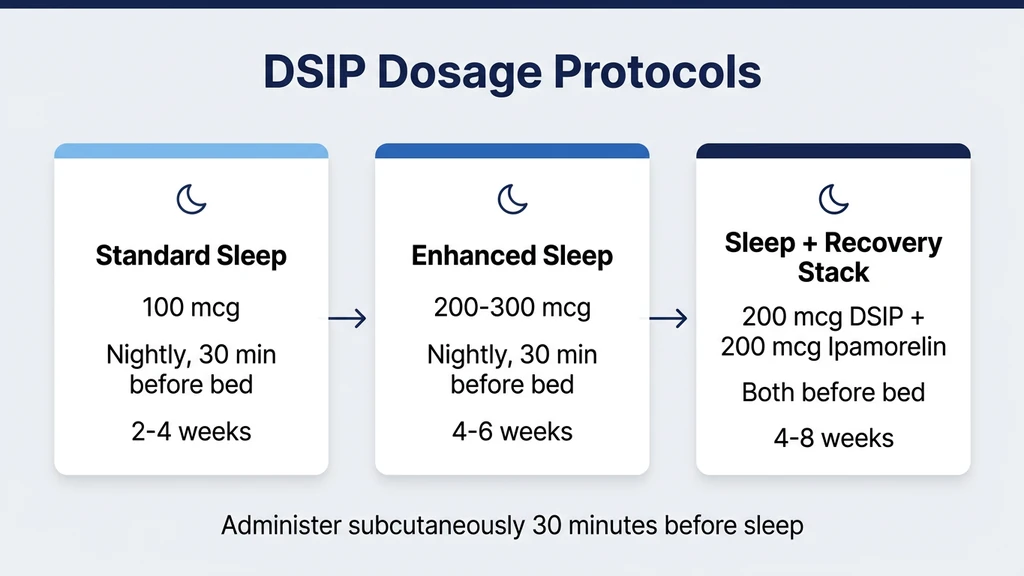
Three protocols cover the range of use cases. All use subcutaneous injection 30 to 60 minutes before bed. The dosing window matters: inject too early and the signaling cascade may initiate before you are ready to sleep. Inject at the bedside, within the 30-to-60-minute window, for best results.
Beginner Protocol (100 mcg/night)
Dose: 100 mcg subcutaneously, once nightly Timing: 30 to 60 minutes before bed Cycle: 2 weeks on, 2 weeks off Best for: First-time DSIP users, mild sleep difficulties, jet lag
Start here. Most users notice improved sleep quality within the first 2 to 3 nights: falling asleep faster, fewer mid-night awakenings, and a distinct sense of "deeper" rest upon waking. A clinical study using DSIP in chronic insomnia patients reported significant improvements in sleep onset latency and subjective sleep quality at doses as low as 25 nmol (approximately 90 mcg) (Schneider-Helmert & Schoenenberger, 1983; PMID 6653901).
If 100 mcg produces noticeable improvement, stay at this dose. More is not automatically better with DSIP. The peptide triggers a cascade; once the cascade is triggered, additional peptide adds diminishing returns.
Standard Protocol (200 mcg/night)
Dose: 200 mcg subcutaneously, once nightly Timing: 30 to 60 minutes before bed Cycle: 3 to 4 weeks on, 2 weeks off Best for: Chronic poor sleep, shift workers, high-stress periods
This is the most widely used protocol. The additional 100 mcg over the beginner dose deepens the delta-wave response for users who found 100 mcg insufficient or whose sleep disruption stems from elevated cortisol.
Shift workers benefit particularly. DSIP does not force a circadian rhythm change, but it enhances the quality of whatever sleep window you have. A night-shift nurse sleeping from 8 a.m. to 3 p.m. can inject DSIP 30 minutes before that window and get more restorative sleep from fewer hours. For anxiety-driven insomnia, consider adding Selank intranasally 1 to 2 hours before the DSIP injection.
Enhanced Protocol (300 mcg/night)
Dose: 300 mcg subcutaneously, once nightly Timing: 30 to 60 minutes before bed Cycle: 4 weeks on, 2 weeks off Best for: Severe insomnia, recovery from overtraining, high-cortisol states
The upper end of the dosing range. Reserve this for cases where 200 mcg produced partial but insufficient improvement. A study examining DSIP's neuroendocrine effects administered doses up to 300 mcg in human subjects without significant adverse effects (Kafi et al., Neuropsychobiology, 1979; PMID 514474).
At 300 mcg, morning drowsiness becomes more common. If you wake feeling groggy, reduce to 200 mcg. The grogginess typically clears within 20 to 30 minutes but can interfere with early-morning obligations.
DSIP + Ipamorelin Stack Protocol
Dose: 200 mcg DSIP + 200 mcg Ipamorelin Timing: Both injected 30 minutes before bed Cycle: 4 to 8 weeks on, 2 to 4 weeks off Best for: Athletes, recovery-focused users, anti-aging protocols
This is the sleep-and-recovery stack. DSIP extends delta-wave time; Ipamorelin releases a GH bolus during that extended deep sleep window. The combination targets two mechanisms with one bedtime injection session.
Draw each peptide into separate syringes. Do not mix them in the same vial; stability data for this combination does not exist. Inject both subcutaneously in the abdomen, rotating sites. Check compatibility before combining peptides using the Peptide Interaction Checker.
For users who also want circadian rhythm support, a low dose of Epitalon (5 mg every other day for 10 to 20 days) can be layered on top. Epitalon regulates pineal melatonin production through a separate pathway.
Why Cycle Length Matters with DSIP
No formal tolerance study has been published for DSIP. This is a gap in the literature. However, the peptide's mechanism offers a theoretical basis for cycling: sustained nightly stimulation of the same neuroendocrine cascade could lead to receptor downregulation or diminished signaling over time.
The analogy is straightforward. Drink coffee every day for six months and your adenosine receptors upregulate. You need more coffee for the same effect. Neuropeptide receptors follow similar dynamics. Cycling off for 2 weeks allows receptor sensitivity to reset.
Community reports and practitioner protocols converge on the same structure: 2 to 4 weeks on, 2 weeks off. Some users extend to 6 weeks when using the lower 100 mcg dose. No published data contradicts these timelines, but no published data specifically validates them either. The cautious approach is the correct one when data is limited.
Suggested Cycling Schedules
| Dose | On Period | Off Period | Annual Cycles |
|---|---|---|---|
| 100 mcg | 2-4 weeks | 2 weeks | 8-12 cycles |
| 200 mcg | 3-4 weeks | 2 weeks | 7-9 cycles |
| 300 mcg | 4 weeks | 2-3 weeks | 6-7 cycles |
| Stack (DSIP + Ipa) | 4-8 weeks | 2-4 weeks | 4-6 cycles |
During off-periods, sleep quality often remains improved for the first 5 to 7 days. Some users bridge the gap with low-dose melatonin (0.3 to 0.5 mg) or Selank for anxiety-related sleep maintenance.
How to Reconstitute and Inject DSIP
DSIP ships as a lyophilized (freeze-dried) powder, typically in 2 mg or 5 mg vials. You must reconstitute it with bacteriostatic water before injection.
Reconstitution Step-by-Step
For a 2 mg vial (most common):
Add 1 mL of bacteriostatic water. This produces a concentration of 2 mg/mL, which equals 2,000 mcg/mL. On a U-100 insulin syringe:
| Desired Dose | Volume to Draw | Syringe Units (U-100) |
|---|---|---|
| 100 mcg | 0.05 mL | 5 units |
| 200 mcg | 0.10 mL | 10 units |
| 300 mcg | 0.15 mL | 15 units |
For a 5 mg vial:
Add 2.5 mL of bacteriostatic water for the same 2 mg/mL concentration. Or add 1 mL for a more concentrated 5 mg/mL solution (useful if you prefer smaller injection volumes).
Steps: 1. Bring the vial and bacteriostatic water to room temperature. 2. Wipe both rubber stoppers with an alcohol swab. 3. Draw the bacteriostatic water with an insulin syringe. 4. Insert the needle into the DSIP vial at an angle. Let the water trickle down the glass wall. Do not squirt directly onto the powder. 5. Do not shake. Swirl gently or let the vial sit until the powder dissolves. The solution should be clear. 6. Refrigerate immediately. Use within 28 days.
For exact measurements with any vial size, use the Peptide Reconstitution Calculator. For guidance on water types, see bacteriostatic water vs sterile water.
Injection Technique
Route: Subcutaneous (into the fat layer beneath the skin) Syringe: Insulin syringe, 29 to 31 gauge, 0.5 mL or 1 mL Sites: Abdomen (2 inches from the navel), outer thigh, or upper arm
Pinch a fold of skin at the injection site. Insert the needle at a 45-degree angle. Push the plunger slowly and steadily. Wait 3 to 5 seconds before withdrawing. Rotate injection sites each night to prevent irritation and scar tissue.
Some users prefer intranasal administration for convenience. Nasal sprays avoid needles but deliver less predictable absorption, especially when nasal congestion is present. Subcutaneous injection remains the standard when consistent dosing matters. For a full injection walkthrough, see the peptide injection guide.
Storage After Reconstitution
Reconstituted DSIP must be refrigerated at 2 to 8 degrees Celsius. Do not freeze reconstituted solution. Keep the vial upright and away from light.
Shelf life after reconstitution: approximately 28 days when stored properly. If the solution becomes cloudy, discolored, or contains particles, discard it. For detailed storage protocols for all peptides, see how to store peptides and how long reconstituted peptides last.
What Happens If You Get the Dose Wrong
DSIP has a favorable safety profile compared to pharmaceutical sleep aids. Dosing errors are unlikely to cause serious harm. But getting the dose wrong in either direction wastes money or creates unnecessary side effects.
Scenario 1: Underdosing (50 mcg or less)
You inject 50 mcg thinking less is safer. This is below the threshold used in clinical studies. The signaling cascade may not fully initiate. You sleep the same as before, conclude DSIP does not work, and abandon the protocol.
The fix: Start at 100 mcg for at least 3 nights before judging effectiveness. The clinical literature begins at approximately 90 mcg (25 nmol). Going lower is untested territory.
Scenario 2: Overdosing (500 mcg or more)
You assume more peptide means deeper sleep and inject 500 mcg. The next morning, you wake groggy, disoriented, and with a dull headache that takes an hour to clear. This morning sedation effect has been reported at higher doses and can impair driving or early-morning work.
The fix: Cap your dose at 300 mcg. The dose-response curve flattens well before 500 mcg. Increasing beyond 300 mcg adds side effects without proportional sleep improvement. If 300 mcg is insufficient, the problem likely requires a different intervention, not more DSIP.
Scenario 3: Wrong Reconstitution Math
You add 2 mL to a 2 mg vial instead of 1 mL. Your concentration drops to 1 mg/mL. You draw 5 units thinking you have 100 mcg, but you actually inject 50 mcg. Half the intended dose, for the entire cycle.
The fix: Always verify your concentration math before the first injection. Write it down or use the Peptide Reconstitution Calculator. Double-check: vial content (mg) divided by water volume (mL) equals your concentration (mg/mL). Convert to mcg/mL by multiplying by 1,000.
Timing: Why 30 to 60 Minutes Before Bed Matters
DSIP's plasma half-life is 15 minutes, but the neuroendocrine cascade it triggers takes 20 to 40 minutes to fully engage. Injecting 30 to 60 minutes before you intend to be in bed, lights off, places the peak signaling effect right at sleep onset.
Inject too early (2 to 3 hours before bed) and the cascade may begin winding down before you fall asleep. Inject too late (at the moment you lie down) and you may fall asleep before the delta-wave promotion has fully engaged, reducing the benefit during the critical first sleep cycle.
The practical routine: finish your evening tasks, prepare for bed, inject DSIP, then complete your remaining pre-sleep routine (brushing teeth, dimming lights, reading). By the time you close your eyes, the peptide has done its work.
Timing Adjustments for Specific Situations
Jet Lag: Inject at your destination's target bedtime, regardless of what your body clock says. A 3 to 5 day course upon arrival accelerates circadian adjustment.
Shift Work: Inject 30 to 60 minutes before your designated sleep window, whether that is 8 a.m. or 2 p.m. DSIP does not care about the clock. It promotes delta-wave sleep whenever sleep occurs.
Stacking with Ipamorelin: Inject both peptides at the same time, 30 minutes before bed. Ipamorelin's GH release aligns with the deep sleep window DSIP creates. Staggering the injections offers no proven advantage.
With Melatonin: If using low-dose melatonin (0.3 to 0.5 mg), take melatonin 60 to 90 minutes before bed, then DSIP at 30 minutes. Melatonin signals "time to sleep" to the circadian system; DSIP deepens the sleep that follows. They target different mechanisms and complement each other.
What Does the Research Say About DSIP and Sleep Quality?
DSIP's research base spans nearly five decades. The peptide has been studied for sleep, stress, pain, and opioid withdrawal. The sleep data, while not as extensive as pharmaceutical sleep aids, is consistent in its findings.
Key Human Studies
Schneider-Helmert & Schoenenberger (1983): Chronic insomnia patients received DSIP intravenously over 5 consecutive evenings. EEG recordings showed increased delta-wave power and improved subjective sleep quality. Sleep onset latency decreased. No significant adverse effects were observed (PMID 6653901).
Kafi et al. (1979): Healthy volunteers receiving DSIP showed measurable changes in sleep EEG architecture, with increased slow-wave sleep and altered sleep stage distribution. The effects persisted beyond the peptide's pharmacokinetic half-life, supporting the "trigger" hypothesis (PMID 514474).
Polleri et al. (1985): DSIP administration modulated cortisol and ACTH secretion in human subjects, demonstrating the peptide's interaction with the HPA axis. Cortisol rhythms shifted toward normalization in stressed subjects (PMID 3923513).
Larbig et al. (1984): DSIP showed analgesic properties in chronic pain patients, with effects mediated through opioid receptor interactions. Improved sleep was a secondary outcome in patients whose pain had been disrupting sleep (PMID 6281420).
Limitations of the Evidence
The honesty matters. DSIP's clinical research has real gaps. Most human studies were conducted in the 1980s with small sample sizes (10 to 30 subjects). No large-scale, placebo-controlled, randomized trial has been published. The peptide never entered pharmaceutical development pipelines, so the kind of Phase III data that exists for sleeping pills does not exist for DSIP.
What the existing data shows: DSIP consistently increases delta-wave sleep on EEG, modulates cortisol, and improves subjective sleep quality. What it does not show: optimal dosing for different populations, long-term safety profiles, or comparative efficacy against modern sleep interventions. Users should weigh these limitations against the favorable safety data that does exist.
DSIP and the Opioid System
One of DSIP's more unexpected research applications involves opioid withdrawal. Studies in both animals and humans suggest DSIP modulates endogenous opioid peptide levels, stabilizing the beta-endorphin fluctuations that contribute to withdrawal symptoms (Dick et al., Eur J Pharmacol, 1984; PMID 6281420).
A clinical case series reported that DSIP administration during opioid detoxification reduced withdrawal severity and improved sleep quality in patients undergoing tapering protocols (Iyer et al., Neurosci Biobehav Rev, 1988; PMID 2555650). This application remains experimental and should only be considered under medical supervision.
Common Mistakes with DSIP Dosing
1. Expecting Sedation DSIP is not a knockout pill. If you take it and lie in bed scrolling your phone under blue light, it will not overcome that stimulus. DSIP promotes natural sleep architecture. You need to give it the conditions to work: dark room, no screens, and a consistent bedtime.
2. Skipping the Cycle Break Running DSIP nightly for months without breaks is tempting when it works well. But neuropeptide receptors can downregulate under chronic stimulation. Respect the 2-week off period. Use low-dose melatonin or sleep hygiene practices to bridge the gap. For broader strategies, read about peptides for anxiety, since anxiety and poor sleep share pathways.
3. Storing Reconstituted Vials Improperly Leaving a reconstituted vial on your nightstand at room temperature degrades the peptide within days. DSIP must be refrigerated after reconstitution. A vial left at room temperature overnight should be discarded. See how to store peptides for the full protocol.
4. Combining with Sedatives or Alcohol DSIP modulates GABAergic signaling. Combining it with benzodiazepines, Z-drugs, or alcohol creates additive CNS depressant effects. The result: excessive sedation, respiratory depression risk, and morning impairment far beyond what either substance produces alone. Do not stack DSIP with sedative medications without medical supervision.
DSIP Stacking Options for Sleep and Recovery
DSIP pairs well with peptides that target complementary pathways. Each stack below addresses a different root cause of poor sleep or recovery.
| Stack | Protocol | Target |
|---|---|---|
| DSIP + Ipamorelin | 200 mcg + 200 mcg before bed | Sleep depth + GH release |
| DSIP + Selank | 200 mcg DSIP SC + 250-500 mcg Selank IN | Anxiety-driven insomnia |
| DSIP + Epitalon | 200 mcg DSIP + 5 mg Epi EOD | Circadian rhythm + pineal health |
| DSIP + BPC-157 | 200 mcg DSIP + 250-500 mcg BPC-157 | Sleep + injury recovery |
DSIP + Selank for Anxiety-Driven Insomnia
Selank is an anxiolytic heptapeptide that modulates GABA and serotonin without sedation. For people whose insomnia stems from racing thoughts and evening anxiety, Selank addresses the cause while DSIP improves the sleep itself.
Protocol: Selank 250 to 500 mcg intranasally, 1 to 2 hours before bed. DSIP 200 mcg subcutaneously, 30 minutes before bed. Run both for 2 to 4 weeks, then cycle off together. Check compatibility at the Peptide Interaction Checker.
DSIP + BPC-157 for Injury Recovery Sleep
Injuries heal fastest during deep sleep. BPC-157 accelerates tissue repair through VEGF upregulation and angiogenesis. Stacking with DSIP creates a longer deep-sleep window for that healing to occur.
Protocol: DSIP 200 mcg subcutaneously before bed. BPC-157 250 to 500 mcg subcutaneously, either near the injury or in the abdomen, once daily. Both can be injected at the same pre-bed session. See the BPC-157 dosage guide for weight-based protocols and the peptide stacking guide for general combination principles.
DSIP for Athletes: Recovery Protocol
Athletes lose sleep quality during heavy training blocks. Cortisol stays elevated from afternoon sessions. Muscle repair demands more deep sleep than the body is getting. DSIP addresses both problems: it normalizes evening cortisol and extends the delta-wave recovery window.
A practical protocol for training athletes: 200 mcg DSIP nightly during the 3 to 4 most intense training weeks of a mesocycle. Cycle off during deload weeks when sleep demand is lower. For peptide options focused on muscle performance, see peptides for bodybuilding.
DSIP Side Effects and Safety
DSIP has one of the milder side effect profiles among peptides. The compound is derived from an endogenous neuropeptide that exists naturally in human cerebrospinal fluid, which may explain its favorable tolerability.
Common Side Effects
Morning grogginess (10 to 15% of users at 200+ mcg): Usually resolves within 20 to 30 minutes of waking. More common at 300 mcg. Reduce dose if it persists beyond the third night.
Vivid dreams (15 to 25% of users): Altered sleep architecture changes dream content. Most users find this neutral or positive. Rarely, dreams become unpleasant enough to warrant dose reduction.
Mild headache upon waking (5 to 10%): Typically occurs during the first 2 to 3 nights and resolves spontaneously. Hydration before bed reduces incidence.
Injection site irritation (5%): Standard for any subcutaneous peptide. Rotate sites. See the peptide injection guide for technique refinement.
Contraindications
Do not use DSIP if you are taking benzodiazepines, barbiturates, or other CNS depressants without physician oversight. The additive effects on GABAergic signaling create unpredictable sedation depth.
Individuals with clinical depression should use DSIP cautiously. Altered sleep architecture can theoretically affect mood regulation. Monitor mood closely during the first cycle.
Pregnant or breastfeeding women should not use DSIP. No safety data exists for these populations.
DSIP may have mild hypotensive effects. People with uncontrolled low blood pressure should start at 100 mcg and monitor symptoms. For a broader view of peptide safety considerations, see the peptide safety guide.
Frequently Asked Questions
What is the standard DSIP dosage for sleep?
The standard dose is 100 to 300 mcg injected subcutaneously 30 to 60 minutes before bed. Most users start at 100 mcg for 2 to 3 nights, then increase to 200 mcg if needed. Clinical studies used doses in the 90 to 300 mcg range with consistent improvements in delta-wave sleep.
How long does DSIP take to work?
Most users notice improved sleep quality within the first 1 to 3 nights. The peptide's signaling cascade engages within 20 to 40 minutes of injection, despite a plasma half-life of only 15 minutes. Full effects on sleep architecture build over the first week of nightly use.
Can you build tolerance to DSIP?
No formal tolerance study exists, but neuropeptide receptors can downregulate under sustained stimulation. The standard approach cycles 2 to 4 weeks on and 2 weeks off. Some users run 100 mcg nightly for up to 6 weeks without reported tolerance, but cycling remains the cautious default.
Is DSIP safe to combine with melatonin?
Yes, DSIP and melatonin work through different mechanisms. Melatonin signals circadian timing (when to sleep); DSIP promotes delta-wave depth (how well you sleep). Take melatonin at 0.3 to 0.5 mg about 60 to 90 minutes before bed, then inject DSIP at 30 minutes before bed.
How do you reconstitute a 2 mg DSIP vial?
Add 1 mL of bacteriostatic water to produce a 2 mg/mL (2,000 mcg/mL) concentration. For 100 mcg, draw 5 units on a U-100 insulin syringe. For 200 mcg, draw 10 units. Refrigerate after mixing and discard after 28 days. Use the reconstitution calculator for other vial sizes.
Can you take DSIP intranasally instead of injecting?
Intranasal DSIP is used by some practitioners and avoids needles. However, absorption varies with nasal congestion, spray technique, and mucosal condition. Subcutaneous injection delivers more predictable and consistent dosing. If using intranasal, expect to need a slightly higher dose for equivalent effect.
Does DSIP increase growth hormone?
DSIP indirectly increases nocturnal GH by deepening delta-wave sleep, the phase where the largest daily GH pulse occurs. For direct GH stimulation alongside better sleep, stack DSIP with Ipamorelin (200 mcg each, both injected 30 minutes before bed). This combination targets two distinct GH-promoting mechanisms.
What is the difference between DSIP and sleeping pills?
Sleeping pills (benzodiazepines, Z-drugs) suppress cortical activity and actually reduce deep sleep despite increasing total sleep time. DSIP promotes natural delta-wave sleep architecture without sedation. You can wake up if needed, and morning grogginess is minimal. DSIP targets sleep quality; sleeping pills target sleep quantity.
The Bottom Line
The core protocol: 100 to 300 mcg subcutaneously, 30 to 60 minutes before bed, cycled 2 to 4 weeks on and 2 weeks off. Start at 100 mcg. Increase only if needed. Most users settle at 200 mcg.
DSIP works because it triggers the brain's own delta-wave sleep machinery rather than forcing sedation. That distinction matters for long-term sleep quality, morning alertness, and the overnight recovery processes (GH release, tissue repair, immune function) that depend on genuine deep sleep.
Use the Peptide Reconstitution Calculator for precise mixing math, the Peptide Stack Calculator for combination protocols with Ipamorelin or Selank, and the Peptide Half-Life Tracker for clearance timing. For proper handling, see how to store peptides and how long reconstituted peptides last. For sourcing, see where to buy peptides in 2026. New to peptides? Start with our getting started with peptides guide, or review the peptide safety guide.
Related Articles: - Peptide Dosage Chart - Peptides for Anxiety - Peptides for Cognitive Function - Peptide Stacking Guide - Hexarelin Dosage Guide - MOTS-c Dosage Guide - Epitalon Dosage Guide - How to Inject Peptides - Bacteriostatic Water vs Sterile Water
Helpful Tools
Related Articles
Peptides for Sleep: 6 Best Ranked by Evidence
Top 6 peptides for sleep ranked: DSIP, Selank, Epitalon, ipamorelin + CJC-1295, BPC-157, GHRP-6. Protocols, doses, and stacking.
CJC-1295 Dosage: Complete Protocol Guide
CJC-1295 dosage guide: DAC and no-DAC protocols. Dosing by goal (anti-aging, fat loss, muscle, sleep), ipamorelin stacking, and injection timing.
Hexarelin Dosage Guide: Protocols
Hexarelin dosage by goal: 100-200 mcg protocols, dose-response data, desensitization timeline, GHRP comparison table, and cycling guide.
MOTS-c Dosage: Protocols & Timing
Complete MOTS-c dosage guide: 5-10mg/week protocols, reconstitution steps, week-by-week results timeline, side effects, and stacking options backed by research.