
You slept eight hours and still woke up tired. Coffee stopped working months ago. The fatigue is not laziness. It is a molecular problem: declining mitochondrial output, blunted growth hormone pulses, or depleted NAD+ reserves. The seven most effective peptides for energy are MOTS-c, CJC-1295 + ipamorelin, 5-Amino-1MQ, thymosin alpha-1, BPC-157, epitalon, and SS-31. Each targets a different cause of fatigue at the cellular level.
MOTS-c leads the ranking because it acts directly on the organelle responsible for 90% of your body's energy production: the mitochondrion. A 2015 study in Cell Metabolism demonstrated that MOTS-c activates AMPK and promotes mitochondrial biogenesis, restoring metabolic homeostasis in mice fed a high-fat diet (Lee et al., Cell Metab, 2015).
No peptide listed here is FDA-approved for treating fatigue. Consult a healthcare provider before using any peptide.
Quick-reference ranking:
| Rank | Peptide | Primary Energy Mechanism | Evidence Level | Onset | Dose Range |
|---|---|---|---|---|---|
| 1 | MOTS-c | Mitochondrial biogenesis via AMPK | Strong (human exercise data) | 1-2 weeks | 5-10 mg/week |
| 2 | CJC-1295 + Ipamorelin | GH-driven metabolic recovery | Moderate (human PK/PD data) | 1-3 weeks | 100-200 mcg + 200-300 mcg/day |
| 3 | 5-Amino-1MQ | NAD+ restoration via NNMT inhibition | Moderate (preclinical) | 2-4 weeks | 50-100 mg/day oral |
| 4 | Thymosin Alpha-1 | Immune-driven energy recovery | Strong (human clinical trials) | 1-2 weeks | 1.6 mg 2x/week |
| 5 | BPC-157 | Gut-energy axis repair | Strong (extensive animal data) | 1-2 weeks | 250-500 mcg/day |
| 6 | Epitalon | Circadian rhythm regulation | Moderate (human pineal data) | 2-4 weeks | 5-10 mg/day for 10-20 days |
| 7 | SS-31 (Elamipretide) | Direct mitochondrial membrane targeting | Strong (human clinical trials) | 1-2 weeks | 40 mg/day subcutaneous |
For dosing protocols, see our peptide dosage chart. For combination strategies, see the peptide stacking guide.
Get your custom peptide protocol:
- Tailored to your body and goals
- Precise dosing and cycle length
- Safe stacking combinations
- Backed by peer-reviewed studies
- Ready in under 2 minutes
Why You Are Tired: Fatigue at the Molecular Level
Your body runs on ATP. Every muscle contraction, every thought, every heartbeat burns adenosine triphosphate produced inside mitochondria. A single human cell contains 1,000 to 2,500 mitochondria. When these organelles decline in number or efficiency, energy output drops before any blood test shows an abnormality.
Think of mitochondria as generators in a factory. When you are 25, the factory runs 2,000 generators at full capacity. By 50, a third of those generators are sputtering, producing less power and more exhaust (reactive oxygen species). The lights stay on, but the factory cannot run a full shift. That is the fatigue you feel at 3 p.m. The literal biology: mitochondrial DNA accumulates mutations at roughly 10 times the rate of nuclear DNA, and mitochondrial mass declines approximately 8% per decade after age 30 (Short et al., Proc Natl Acad Sci, 2005).
Three molecular pathways drive most non-disease fatigue.
Mitochondrial decline. Fewer mitochondria and reduced electron transport chain efficiency lower total ATP output. MOTS-c and SS-31 target this pathway directly.
Growth hormone deficiency. GH pulses during sleep drive overnight cellular repair and metabolic regulation. After age 30, GH secretion declines roughly 14% per decade (Iranmanesh et al., J Clin Endocrinol Metab, 1991). CJC-1295 and ipamorelin restore those pulses.
NAD+ depletion. Nicotinamide adenine dinucleotide is a coenzyme required for mitochondrial function, DNA repair, and sirtuin activation. NAD+ levels drop approximately 50% between ages 40 and 60 (Massudi et al., PLoS One, 2012). 5-Amino-1MQ raises NAD+ by inhibiting the enzyme that degrades it.
The 7 Best Peptides for Energy (Ranked)
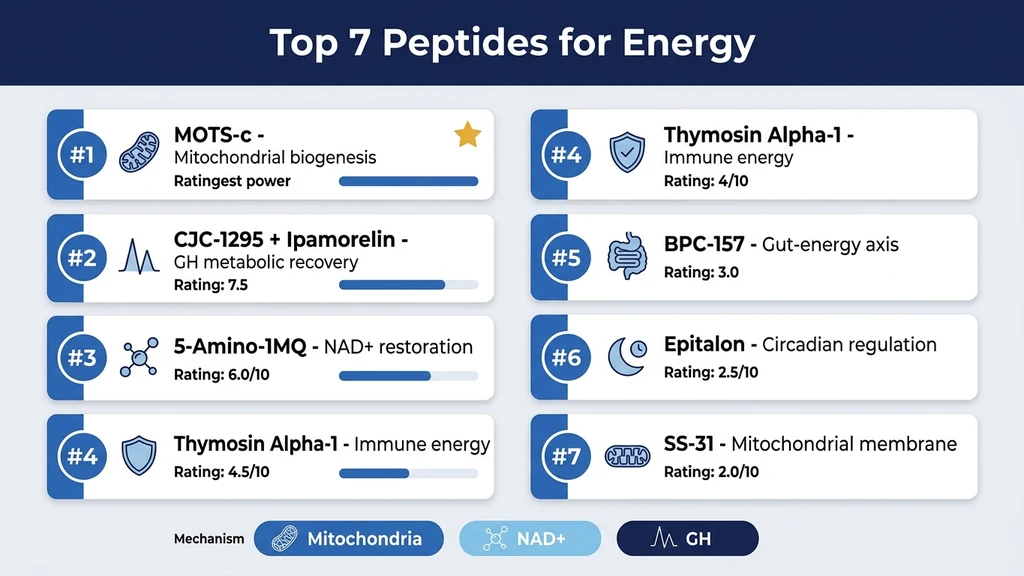
Ranked by strength of evidence, mechanism specificity, and practical impact on energy levels. The top three target the core energy machinery: mitochondria, growth hormone, and NAD+. The remaining four address fatigue through immune function, gut health, circadian rhythm, and mitochondrial membrane integrity.
1. MOTS-c: The Mitochondrial Builder
Evidence level: STRONG (human exercise physiology data, emerging clinical trials)
MOTS-c is a 16-amino-acid peptide encoded by mitochondrial DNA. It is the only known peptide that signals directly from the mitochondria to the nucleus, activating AMPK, the master energy regulator in every human cell.
How it restores energy. MOTS-c triggers mitochondrial biogenesis: the creation of new mitochondria. More mitochondria means more ATP production capacity. A 2015 study showed MOTS-c prevented diet-induced obesity and insulin resistance in mice by activating AMPK and improving glucose metabolism (Lee et al., Cell Metab, 2015). In humans, circulating MOTS-c levels correlate with exercise capacity, and physically active adults maintain higher MOTS-c concentrations than sedentary controls (Reynolds et al., Peptides, 2021).
For complete dosing, see our MOTS-c dosage guide.
Energy protocol: - General fatigue: 5 mg subcutaneous, 3 times per week - Metabolic energy optimization: 10 mg subcutaneous once weekly - Duration: 4-8 weeks - Onset: Most users report increased afternoon energy within 7-14 days
Why it ranks first. MOTS-c addresses the root cause of age-related fatigue: mitochondrial decline. Every other peptide on this list either supports energy production indirectly or targets a secondary pathway. MOTS-c builds more generators. The limitation: most data comes from animal models and correlational human studies. No large-scale human energy trial has been completed.
2. CJC-1295 + Ipamorelin: The GH-Driven Energy Pair
Evidence level: MODERATE (human pharmacokinetic and GH release data, no direct fatigue trials)
CJC-1295 is a synthetic GHRH analogue that sustains growth hormone elevation for days. Ipamorelin is a selective GH secretagogue that triggers acute GH pulses without raising cortisol. Together, they restore the GH pattern of a 25-year-old.
How they restore energy. Growth hormone drives fat oxidation, muscle protein synthesis, and cellular repair during sleep. When GH declines, the body shifts toward glucose dependence and stores more visceral fat, both of which cause daytime fatigue. CJC-1295 with DAC raised mean GH levels 2-10 fold and IGF-1 by 1.5-3 fold over 14 days in healthy adults (Teichman et al., J Clin Endocrinol Metab, 2006). Ipamorelin increased GH release dose-dependently without affecting cortisol or prolactin (Raun et al., Eur J Endocrinol, 2005).
Energy protocol: - Ipamorelin: 200-300 mcg subcutaneous before bed - CJC-1295 no DAC (Mod GRF 1-29): 100-200 mcg subcutaneous before bed, combined in the same syringe - Duration: 8-12 weeks on, 4 weeks off - Inject on an empty stomach. Carbohydrates blunt GH release - Onset: Improved sleep quality within 3-7 days. Energy and body composition changes within 2-4 weeks
Why it ranks second. This pair addresses the GH decline that accelerates after 30. Users consistently report deeper sleep and higher morning energy within the first week. The combination produces larger GH pulses than either peptide alone. The limitation: GH supports energy indirectly through improved sleep and metabolism. It does not repair mitochondria.
3. 5-Amino-1MQ: The NAD+ Restorer
Evidence level: MODERATE (strong preclinical data, no completed human energy trials)
5-Amino-1MQ is a small molecule that inhibits nicotinamide N-methyltransferase (NNMT), the enzyme responsible for degrading NAD+ into inactive methylated nicotinamide. By blocking NNMT, 5-Amino-1MQ raises intracellular NAD+ levels without requiring direct NAD+ supplementation.
How it restores energy. NAD+ is the electron shuttle in every mitochondrion. Without adequate NAD+, the electron transport chain stalls and ATP output drops. NNMT inhibition by 5-Amino-1MQ increased NAD+ content and activated sirtuin-1 in adipocyte models, reducing fat accumulation and improving metabolic markers (Neelakantan et al., Biochem Pharmacol, 2018). In diet-induced obese mice, 5-Amino-1MQ reversed metabolic dysfunction and reduced body weight by 7% over 11 days without appetite suppression (Neelakantan et al., 2018).
For dosage specifics, see the 5-Amino-1MQ dosage guide.
Energy protocol: - Standard: 50-100 mg oral capsule, once daily - Duration: 4-8 weeks - Take with food to improve absorption - Onset: Gradual energy improvement over 2-4 weeks as NAD+ pools rebuild
Why it ranks third. 5-Amino-1MQ solves the NAD+ depletion problem from a unique angle. Instead of flooding the body with NAD+ precursors (like NMN or NR), it stops the drain. The result is sustained NAD+ elevation rather than transient spikes. The limitation: all efficacy data comes from animal models. Human trials are ongoing but unpublished.
4. Thymosin Alpha-1: The Immune Energy Peptide
Evidence level: STRONG (FDA orphan drug designation, human clinical trials across multiple conditions)
Thymosin alpha-1 is a 28-amino-acid peptide produced by the thymus gland. Marketed as Zadaxin in 37 countries, it is the most clinically validated peptide on this list. Its energy application targets a specific fatigue cause: chronic immune activation.
How it restores energy. When the immune system runs in a persistent low-grade inflammatory state (from chronic infections, autoimmune activity, or post-viral syndromes), it consumes enormous metabolic resources. Thymosin alpha-1 restores immune balance by maturing T-cells and activating dendritic cells, reducing the energy cost of chronic inflammation. In clinical trials, it restored T-cell function in immunocompromised patients within 5-7 days (Romani et al., Blood, 2004). A meta-analysis in sepsis patients showed it reduced mortality by 40% when added to standard care, partly through reduced systemic inflammation (Wu et al., Int Immunopharmacol, 2015).
Energy protocol: - Immune-related fatigue: 1.6 mg subcutaneous twice weekly - Post-viral fatigue: 1.6 mg subcutaneous twice weekly for 4-8 weeks - Chronic fatigue with elevated inflammatory markers: 1.6 mg twice weekly, reassess at 8 weeks - Onset: Reduced brain fog and improved afternoon energy within 7-14 days in users with immune-driven fatigue
Why it ranks fourth. Thymosin alpha-1 is the right choice when fatigue stems from immune dysfunction. If blood work shows elevated CRP, ESR, or abnormal lymphocyte panels, immune-driven fatigue is likely. The limitation: if your mitochondria are the problem, not your immune system, thymosin alpha-1 will not help.
5. BPC-157: The Gut-Energy Connector
Evidence level: STRONG (extensive animal data across gut, nerve, and vascular models)
BPC-157 (Body Protection Compound-157) is a 15-amino-acid gastric peptide. Its energy application is indirect but significant: gut health determines nutrient absorption, neurotransmitter production, and systemic inflammation. All three affect energy.
How it restores energy. The gut produces approximately 95% of the body's serotonin and 50% of its dopamine. Damaged gut lining reduces absorption of B vitamins, iron, and magnesium, three nutrients essential for mitochondrial function. BPC-157 upregulates VEGF and nitric oxide synthesis, accelerating mucosal repair in the gastrointestinal tract (Seiwerth et al., J Physiol Pharmacol, 2018). It also modulates the dopaminergic system, with animal studies showing protective effects on dopamine receptors (Sikiric et al., Curr Pharm Des, 2018).
Energy protocol: - Gut-related fatigue: 500 mcg/day oral or subcutaneous, 4-8 weeks - General energy support: 250 mcg/day subcutaneous - Best combined with digestive enzyme support and dietary optimization - Onset: Improved digestion within 3-7 days. Energy improvements within 1-2 weeks as nutrient absorption normalizes
Why it ranks fifth. BPC-157 addresses the often-overlooked gut-energy connection. Chronic bloating, food sensitivities, and post-meal fatigue all point to gut-mediated energy loss. The limitation: if your gut is healthy, BPC-157 will not meaningfully improve energy. It solves a specific bottleneck.
6. Epitalon: The Circadian Regulator
Evidence level: MODERATE (human pineal gland data, limited clinical trials)
Epitalon (epithalamin) is a synthetic tetrapeptide (Ala-Glu-Asp-Gly) that stimulates melatonin production from the pineal gland. Its energy application centers on circadian rhythm restoration. Disrupted circadian cycles are one of the most common causes of persistent fatigue that blood tests miss.
How it restores energy. Melatonin does more than regulate sleep. It sets the clock for cortisol rhythm, growth hormone release, and mitochondrial repair cycles. Epitalon restored nocturnal melatonin peaks in elderly patients whose pineal function had declined, normalizing sleep architecture (Korkushko et al., Bull Exp Biol Med, 2006). The peptide also activated telomerase in human somatic cells, suggesting a broader anti-aging mechanism (Khavinson et al., Bull Exp Biol Med, 2003).
Energy protocol: - Standard: 5-10 mg subcutaneous daily for 10-20 days - Repeat cycle every 4-6 months - Inject in the evening, 1-2 hours before bed - Onset: Improved sleep quality within 5-7 days. Daytime energy improvement within 2-4 weeks as circadian rhythm normalizes
Why it ranks sixth. Epitalon targets the circadian disruption that underlies fatigue in shift workers, frequent travelers, and adults over 50 with declining pineal function. The limitation: it works through melatonin restoration. If your melatonin levels are normal and your sleep architecture is intact, epitalon adds little.
7. SS-31 (Elamipretide): The Mitochondrial Shield
Evidence level: STRONG (human clinical trials in mitochondrial myopathy and heart failure)
SS-31 (marketed as elamipretide) is a cell-permeable tetrapeptide that concentrates on the inner mitochondrial membrane. Unlike MOTS-c, which builds new mitochondria, SS-31 protects existing ones by stabilizing cardiolipin, a phospholipid critical for electron transport chain efficiency.
How it restores energy. Cardiolipin anchors the respiratory chain complexes in the inner mitochondrial membrane. When cardiolipin oxidizes (a process accelerated by aging and oxidative stress), the complexes destabilize and ATP production drops. SS-31 binds selectively to cardiolipin, preventing oxidation and restoring electron transport efficiency. In a phase II trial for primary mitochondrial myopathy, elamipretide improved 6-minute walk distance and reduced fatigue scores versus placebo (Karaa et al., Neurology, 2018). A heart failure trial showed improved cardiac energetics after 4 weeks of treatment (Daubert et al., Circ Heart Fail, 2017).
Energy protocol: - Research dosing: 40 mg subcutaneous daily (clinical trial dose) - Duration: 4-12 weeks - Onset: Improvements in exercise tolerance within 7-14 days
Why it ranks seventh. SS-31 has the strongest human clinical data of any peptide on this list, with completed phase II and III trials. It ranks last because it is not widely available as a research peptide (it is in pharmaceutical development). For those with access, it directly stabilizes the energy-producing machinery. The limitation: availability and cost place it out of reach for most users.
Matching Peptides to Your Fatigue Type
Not all fatigue feels the same because not all fatigue has the same cause. Physical exhaustion after a staircase, mental fog during a meeting, and the bone-deep tiredness of chronic fatigue syndrome each point to different broken pathways. Choosing the right peptide requires identifying which pathway is failing.
Physical Fatigue (Muscle Weakness, Exercise Intolerance)
Physical fatigue manifests as heavy legs, reduced exercise capacity, and longer recovery between sessions. The root cause is usually mitochondrial: not enough ATP to meet muscular demand.
Best peptides: MOTS-c (5-10 mg/week) + SS-31 (if available)
MOTS-c builds new mitochondria in muscle tissue. SS-31 makes existing mitochondria more efficient. Together, they increase total ATP output. Add CJC-1295 + ipamorelin if you are over 40, because declining GH contributes to muscle fatigue through reduced protein synthesis.
Timeline: Improved exercise tolerance within 2-3 weeks. Noticeable endurance gains by week 6.
Mental Fatigue (Brain Fog, Concentration Difficulty)
Mental fatigue presents as difficulty concentrating, word-finding problems, and the sensation of thinking through wet cement. The brain consumes 20% of the body's ATP despite representing 2% of body weight. Even small drops in mitochondrial efficiency affect cognition disproportionately.
Best peptides: 5-Amino-1MQ (50-100 mg/day oral) + epitalon (5-10 mg/day for 10-20 days)
5-Amino-1MQ raises NAD+ in neural tissue, supporting both mitochondrial function and sirtuin-mediated DNA repair in neurons. Epitalon restores circadian melatonin, which regulates the glymphatic system (the brain's waste clearance mechanism that operates primarily during deep sleep).
Timeline: Reduced brain fog within 2-3 weeks. Sustained cognitive clarity by week 6-8.
Chronic Fatigue (Persistent, Unrelenting Exhaustion)
Chronic fatigue that persists despite adequate sleep, nutrition, and stress management often involves immune dysregulation and gut dysfunction. Post-viral fatigue, post-infection syndromes, and autoimmune-related exhaustion fall into this category.
Best peptides: Thymosin alpha-1 (1.6 mg 2x/week) + BPC-157 (500 mcg/day) + MOTS-c (5 mg 3x/week)
Thymosin alpha-1 addresses immune imbalance driving the inflammation-fatigue loop. BPC-157 repairs gut lining to restore nutrient absorption and neurotransmitter production. MOTS-c rebuilds mitochondria that chronic inflammation has damaged. This three-peptide approach covers the three systems most frequently impaired in chronic fatigue.
Timeline: Gradual improvement over 4-8 weeks. Many chronic fatigue cases require 12+ weeks for significant progress.
Stacking Peptides for Maximum Energy
Single peptides improve energy. Stacks multiply the effect by targeting multiple fatigue pathways simultaneously. The key is combining peptides with complementary mechanisms rather than doubling up on the same pathway.
For comprehensive stacking strategies, see our peptide stacking guide. Use the peptide stack calculator to plan your protocol and the peptide interaction checker to verify compatibility.
The Mitochondrial Stack: MOTS-c + 5-Amino-1MQ
This is the foundation energy stack. MOTS-c builds new mitochondria. 5-Amino-1MQ provides the NAD+ those mitochondria need to function. One creates the generators. The other supplies the fuel line.
Protocol: - MOTS-c: 5 mg subcutaneous, 3 times per week - 5-Amino-1MQ: 50-100 mg oral, once daily - Duration: 6-8 weeks
Expected outcome: Improved physical and mental energy within 2-3 weeks. Enhanced exercise capacity and reduced afternoon crashes by week 4-6.
The Sleep-Energy Stack: CJC-1295 + Ipamorelin + Epitalon
Poor sleep is the most common energy thief. This stack restores both the hormonal and circadian foundations of restorative sleep.
Protocol: - Ipamorelin: 200-300 mcg subcutaneous before bed - CJC-1295 no DAC: 100-200 mcg subcutaneous before bed (same injection) - Epitalon: 5-10 mg subcutaneous in the evening, for 10-20 days at the start of the cycle - Duration: 8-12 weeks for CJC-1295 + ipamorelin; epitalon runs a short 10-20 day course
Expected outcome: Deeper sleep within the first week. Increased morning energy and improved body composition over 4-8 weeks.
The Full Energy Stack: MOTS-c + CJC-1295 + Ipamorelin + 5-Amino-1MQ
For severe or multi-factorial fatigue, this four-peptide stack covers mitochondrial biogenesis, NAD+ restoration, and GH optimization simultaneously.
Protocol: - MOTS-c: 5 mg subcutaneous, 3 times per week (morning) - 5-Amino-1MQ: 50-100 mg oral, once daily (with food) - Ipamorelin: 200-300 mcg subcutaneous before bed - CJC-1295 no DAC: 100-200 mcg subcutaneous before bed - Duration: 8-12 weeks
Important: Start with the mitochondrial stack (MOTS-c + 5-Amino-1MQ) for 2 weeks before adding CJC-1295 + ipamorelin. Introducing all four simultaneously makes it impossible to identify which peptide is working and which might cause side effects.
Energy Timeline: What to Expect Week by Week
Energy restoration is gradual. Mitochondrial biogenesis takes weeks. NAD+ pools rebuild slowly. GH-driven metabolic changes accumulate over months. The following timeline reflects the mitochondrial stack (MOTS-c + 5-Amino-1MQ) combined with CJC-1295 + ipamorelin. These are community-reported averages, not clinical trial endpoints.
| Week | What to Expect | Notes |
|---|---|---|
| 1 | Deeper sleep, slight improvement in morning alertness | CJC-1295 + ipamorelin effects appear first |
| 2-3 | Reduced afternoon crashes, better exercise tolerance | MOTS-c mitochondrial effects begin |
| 4-6 | Sustained energy throughout the day, improved mental clarity | NAD+ pools from 5-Amino-1MQ stabilize |
| 6-8 | Measurable improvement in exercise capacity and body composition | Cumulative mitochondrial biogenesis |
| 8-12 | Peak energy levels, many users report needing less sleep | Full stack benefits compound |
Three factors that amplify peptide energy effects:
Exercise. Physical activity is the strongest natural stimulus for mitochondrial biogenesis. MOTS-c and exercise produce synergistic effects on AMPK activation. Even 20 minutes of moderate-intensity activity 3-4 times per week doubles the energy benefits of MOTS-c alone.
Sleep hygiene. CJC-1295 and ipamorelin amplify GH pulses during deep sleep. A dark, cool room (65-68°F), consistent bedtime, and no screens 60 minutes before bed maximize the hormonal benefits. The peptides provide the signal. Your sleep environment determines how well the body responds.
Protein intake. Mitochondrial biogenesis requires raw materials. Amino acids from dietary protein supply the building blocks for new mitochondrial proteins. Minimum 1.2 g protein per kg body weight. For a 160-pound person, that is approximately 87 g protein daily.
Common Mistakes That Sabotage Energy Peptides
Mistake 1: Expecting caffeine-like speed. Peptides do not work like stimulants. Caffeine blocks adenosine receptors within 30 minutes. MOTS-c builds mitochondria over weeks. Users who quit at day 5 because they "don't feel anything" abandon the protocol before it can work. Minimum commitment: 4 weeks.
Mistake 2: Injecting CJC-1295 + ipamorelin after eating. Food, especially carbohydrates, triggers insulin release that blunts GH secretion by up to 70%. A bedtime injection with food in the stomach wastes most of the dose. Fast for at least 2 hours before the injection. Inject before bed on an empty stomach.
Mistake 3: Ignoring the fatigue cause. MOTS-c cannot fix thyroid dysfunction. CJC-1295 cannot treat iron deficiency. Before starting energy peptides, get baseline blood work: complete metabolic panel, thyroid panel (TSH, free T3, free T4), ferritin, vitamin D, and B12. Peptides optimize functional systems. They do not replace missing nutrients or treat endocrine disease.
Mistake 4: Stacking too many peptides from day one. Running five peptides simultaneously makes troubleshooting impossible. If you develop insomnia, headaches, or GI issues, you cannot identify the cause. Start with one or two peptides. Add one new compound every 2 weeks. Track energy levels daily with a simple 1-10 scale to identify what is working.
Safety Considerations for Energy Peptides
Energy peptides carry generally favorable safety profiles in available data, but each class has specific risks worth understanding. For detailed safety profiles across all peptides, see our peptide safety guide.
MOTS-c and metabolic effects. MOTS-c activates AMPK, which influences glucose metabolism. Diabetic individuals or those on metformin should monitor blood glucose carefully. MOTS-c may enhance metformin's glucose-lowering effects, increasing hypoglycemia risk. No adverse metabolic events were reported in preclinical studies, but human metabolic safety data remains limited.
CJC-1295 + ipamorelin and blood glucose. Growth hormone raises fasting blood glucose. Healthy adults tolerate this well. Individuals with insulin resistance, prediabetes, or diabetes should monitor blood glucose and consult their endocrinologist before using GH secretagogues.
5-Amino-1MQ is orally active. Unlike most peptides that require injection, 5-Amino-1MQ is taken as an oral capsule. This makes it accessible but also means it undergoes first-pass liver metabolism. Individuals with liver conditions should exercise caution. Long-term human safety data does not yet exist.
Quality control is non-negotiable. Research peptides are not regulated as pharmaceuticals. Purity varies between vendors. Always verify third-party certificates of analysis showing >98% purity and endotoxin testing. See our peptide safety guide for sourcing guidance and quality verification steps.
Frequently Asked Questions
What is the best peptide for energy and fatigue?
MOTS-c is the strongest single peptide for energy because it directly stimulates mitochondrial biogenesis via AMPK activation. Mitochondria produce 90% of cellular ATP. At 5-10 mg per week subcutaneous, most users report improved energy within 1-2 weeks. For GH-related fatigue, CJC-1295 + ipamorelin before bed is the best alternative.
How long do energy peptides take to work?
CJC-1295 + ipamorelin improve sleep quality within 3-7 days. MOTS-c increases afternoon energy within 1-2 weeks as new mitochondria form. 5-Amino-1MQ requires 2-4 weeks for NAD+ pools to rebuild. Epitalon normalizes circadian rhythm over 2-4 weeks. Full energy optimization across all pathways takes 6-8 weeks.
Can you take peptides for energy with caffeine?
Yes. No known interaction exists between caffeine and MOTS-c, 5-Amino-1MQ, or thymosin alpha-1. For CJC-1295 + ipamorelin, avoid caffeine within 2 hours of injection because stimulants can interfere with the sleep-phase GH pulse. Morning caffeine use is compatible with all energy peptide protocols.
What is the difference between MOTS-c and SS-31 for energy?
MOTS-c builds new mitochondria through AMPK-driven biogenesis. SS-31 protects existing mitochondria by stabilizing cardiolipin in the inner membrane. MOTS-c expands energy capacity. SS-31 prevents energy loss from oxidative damage. They target complementary mechanisms and can be stacked for maximum mitochondrial support.
Are energy peptides safe for daily use?
MOTS-c at 5 mg three times weekly and 5-Amino-1MQ at 50-100 mg daily have shown no adverse effects in preclinical studies. CJC-1295 + ipamorelin are typically cycled 8-12 weeks on, 4 weeks off to prevent GH receptor desensitization. No energy peptide has completed long-term human safety trials exceeding 12 months.
Do peptides for energy help with chronic fatigue syndrome?
Thymosin alpha-1 (1.6 mg twice weekly) plus BPC-157 (500 mcg daily) address two hallmarks of chronic fatigue: immune dysregulation and gut dysfunction. MOTS-c (5 mg three times weekly) targets the mitochondrial impairment documented in CFS patients. Results are gradual, typically requiring 8-12 weeks. No peptide is FDA-approved for CFS treatment.
How much do energy peptides cost per month?
MOTS-c runs approximately $80-150 per month at 5 mg three times weekly. CJC-1295 + ipamorelin costs $80-130 per month. 5-Amino-1MQ oral capsules cost $60-120 per month. The full four-peptide stack totals $250-400 monthly from reputable vendors. Use the Peptide Cost Calculator for your specific protocol estimate.
Should I take energy peptides in the morning or at night?
MOTS-c and 5-Amino-1MQ are best taken in the morning to align with the body's natural metabolic peak. CJC-1295 + ipamorelin must be taken before bed on an empty stomach to amplify the sleep-phase GH pulse. Epitalon is injected 1-2 hours before bed to support melatonin production. Never inject GH peptides after meals.
The Bottom Line
Energy is manufactured in mitochondria, regulated by hormones, and maintained by NAD+. When any of these systems falters, fatigue follows. MOTS-c rebuilds the generators. CJC-1295 + ipamorelin restore the overnight repair pulses. 5-Amino-1MQ keeps the fuel line open. Thymosin alpha-1 stops the immune system from draining the reserves. BPC-157 repairs the gut so nutrients reach the cells that need them.
For most age-related fatigue, start with MOTS-c (5 mg three times weekly) and 5-Amino-1MQ (50-100 mg daily oral). Add CJC-1295 + ipamorelin before bed if sleep quality is poor. Run the protocol for 8-12 weeks minimum, with blood work at baseline and week 8 to track progress.
Three things matter as much as the peptides: 20 minutes of moderate exercise 3-4 times per week (the strongest natural AMPK activator), 7-9 hours of sleep in a dark room (the window for GH-driven repair), and at least 1.2 g protein per kg body weight daily (the raw material for new mitochondria). Plan your protocol with the peptide stack calculator, estimate costs with the peptide cost calculator, and verify compatibility with the peptide interaction checker. For safe handling and sourcing, see the peptide safety guide.
NAD+ appears on every energy protocol and it is not a peptide. NAD peptide explains what it is, and what the precursor trials do and do not show.
Related Articles
Peptides for Recovery: 7 Best Ranked by Evidence
Top 7 peptides for recovery ranked: BPC-157, TB-500, GHK-Cu, ipamorelin, CJC-1295, MOTS-c, thymosin alpha-1. Post-workout and injury protocols.
Peptides for Sleep: 6 Best Ranked by Evidence
Top 6 peptides for sleep ranked: DSIP, Selank, Epitalon, ipamorelin + CJC-1295, BPC-157, GHRP-6. Protocols, doses, and stacking.
MOTS-c Dosage: Protocols & Timing
Complete MOTS-c dosage guide: 5-10mg/week protocols, reconstitution steps, week-by-week results timeline, side effects, and stacking options backed by research.
Peptides for Inflammation: 7 Best Ranked
Top 7 anti-inflammatory peptides ranked: BPC-157, KPV, LL-37, thymosin alpha-1, GHK-Cu, TB-500, Selank. Mechanisms, dosage protocols, and 10+ PubMed citations.