You have a bottle of 5-Amino-1MQ capsules on your desk. No syringes, no reconstitution, no injection sites to rotate. The standard dosage is 50 to 150 mg per day taken orally in one or two doses for cycles of 8 to 12 weeks. Start at 50 mg in the morning, hold for two weeks, then escalate to 100 mg if tolerated.
| Parameter | Recommended Range |
|---|---|
| Daily dose | 50 to 150 mg |
| Route | Oral (capsule) |
| Frequency | 1 to 2 times daily |
| Timing | Morning, with or without food |
| Cycle length | 8 to 12 weeks |
| Time off between cycles | 4 to 6 weeks |
| FDA status | Not approved; research compound |
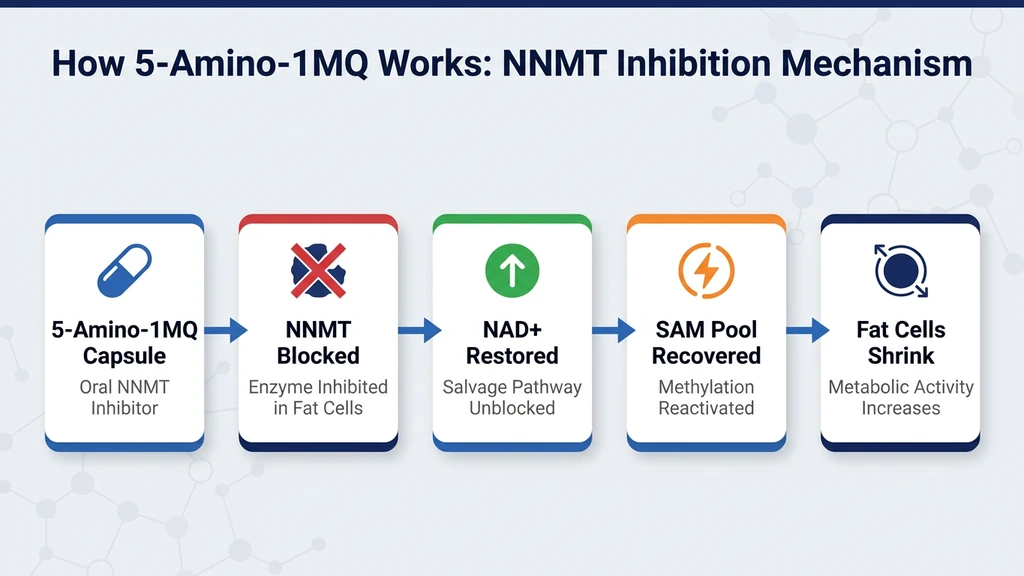
5-Amino-1MQ is a small-molecule inhibitor of nicotinamide N-methyltransferase (NNMT), an enzyme overexpressed in adipose tissue that drains cellular NAD+ and shifts fat metabolism toward storage. Blocking NNMT restores NAD+, reactivates mitochondrial energy pathways, and forces fat cells to burn fuel instead of hoarding it (Kraus et al., Nature 2014, PMID: 24670636).
Every protocol below derives from preclinical research and practitioner-reported use. No completed human clinical trial exists as of 2026. For the broader compound profile, see the 5-Amino-1MQ peptide page. For dosage cross-reference across compounds, see the complete peptide dosage chart and the peptide safety guide.

Get your custom peptide protocol:
- Tailored to your body and goals
- Precise dosing and cycle length
- Safe stacking combinations
- Backed by peer-reviewed studies
- Ready in under 2 minutes
What Is 5-Amino-1MQ and How Does It Burn Fat?
Think of NNMT as a drain at the bottom of your bathtub. NAD+ is the water. Your body constantly produces NAD+ to power energy metabolism, DNA repair, and mitochondrial function. But in overweight individuals, NNMT activity surges in fat tissue, draining NAD+ faster than the body can replenish it. The tub never fills. Fat cells sit in an energy-depleted state where they store lipids instead of oxidizing them. 5-Amino-1MQ plugs that drain.
Here is the literal biochemistry. NNMT is a cytosolic enzyme that methylates nicotinamide (a form of vitamin B3) using S-adenosyl-L-methionine (SAM) as a methyl donor. This reaction produces 1-methylnicotinamide and S-adenosyl-L-homocysteine. The problem: nicotinamide is a precursor to NAD+ through the salvage pathway. When NNMT diverts nicotinamide away from NAD+ synthesis, cellular NAD+ levels drop. Lower NAD+ means reduced sirtuin activity, impaired fatty acid oxidation, and a metabolic environment that favors fat accumulation (Kraus et al., Nature 2014, PMID: 24670636).
NNMT is not uniformly distributed across the body. It is highly expressed in white adipose tissue, liver, and muscle. In obese mice, adipose NNMT expression is 2- to 3-fold higher than in lean controls. Knocking down NNMT genetically in mice protected them from diet-induced obesity even on a high-fat diet (Kraus et al., Nature 2014).
5-Amino-1MQ is a selective, cell-permeable NNMT inhibitor. It was first characterized by Neelakantan et al. in 2017, who demonstrated that the compound reduced NNMT activity in cultured adipocytes, shrank fat cell size, and decreased lipid content without cytotoxicity (Neelakantan et al., Biochem Pharmacol 2017, PMID: 28687137). In diet-induced obese mice, 5-Amino-1MQ treatment for 11 days reduced body weight and white adipose tissue mass while increasing NAD+ and SAM levels in fat depots.
The NAD+ Connection: Why NNMT Inhibition Matters Beyond Fat Loss
NAD+ is not only a fat metabolism molecule. It is a central coenzyme in over 500 enzymatic reactions. Sirtuins (SIRT1 through SIRT7), the enzymes linked to longevity and metabolic regulation, require NAD+ as a substrate. When NNMT drains the nicotinamide pool, sirtuin activity declines across tissues.
Restoring NAD+ through NNMT inhibition produces downstream effects that extend beyond adipose tissue. In preclinical models, NNMT knockdown improved insulin sensitivity, reduced hepatic lipid accumulation, and increased energy expenditure (Kraus et al., Nature 2014). These findings suggest that 5-Amino-1MQ may benefit metabolic syndrome broadly, not just body fat percentage.
For users already supplementing with NAD+ precursors like NMN or NR, 5-Amino-1MQ addresses the problem from the opposite direction. NMN and NR add raw material to the NAD+ synthesis pipeline. 5-Amino-1MQ stops the pipeline from leaking. The two approaches are complementary.
5-Amino-1MQ Dosage Protocols by Goal
Three protocols cover the range of practitioner-reported use. All are oral, which makes 5-Amino-1MQ one of the simplest compounds to administer on this site. No reconstitution, no injection, no cold storage chain required.
Conservative Protocol: 50 mg/day
| Parameter | Value |
|---|---|
| Daily dose | 50 mg |
| Frequency | Once daily (morning) |
| Cycle length | 8 to 12 weeks |
| Time off | 4 to 6 weeks |
| Best for | First-time users, general metabolic support |
Start here. Take one 50 mg capsule in the morning. This dose is sufficient to produce measurable NNMT inhibition based on the preclinical pharmacokinetic data. In the original mouse study, the treatment dose (expressed as roughly 10 mg/kg/day intraperitoneally) produced significant reductions in adipose tissue mass within 11 days (Neelakantan et al., 2017).
Run this protocol for at least 4 weeks before assessing results. NNMT inhibition works through metabolic reprogramming, not acute appetite suppression. Changes in body composition develop gradually as fat cells shift from lipid storage to oxidation mode.
Standard Protocol: 100 mg/day
| Parameter | Value |
|---|---|
| Daily dose | 100 mg |
| Frequency | Once daily or split 50 mg twice daily |
| Cycle length | 8 to 12 weeks |
| Time off | 4 to 6 weeks |
| Best for | Active fat loss, body recomposition |
This is the most commonly reported dose in practitioner protocols. Splitting into two 50 mg doses (morning and early afternoon) may provide more consistent NNMT inhibition throughout the day, though no comparative data exists.
At 100 mg/day for 12 weeks, total compound use is approximately 8,400 mg. Use the Peptide Cost Calculator to estimate total cycle expense.
Aggressive Protocol: 150 mg/day
| Parameter | Value |
|---|---|
| Daily dose | 150 mg |
| Frequency | Split into 2 to 3 doses (e.g., 50 mg three times daily) |
| Cycle length | 8 weeks maximum |
| Time off | 6 weeks minimum |
| Best for | Advanced users with prior 5-Amino-1MQ experience |
The upper end of the reported dosing range. No preclinical study has established a ceiling for efficacy, and higher doses increase the likelihood of side effects without a guarantee of proportionally better results. If 100 mg/day produced no meaningful change after 6 weeks, increasing to 150 mg is reasonable. Jumping directly to 150 mg without trying lower doses is not.
Shorter cycle length (8 weeks) and longer recovery (6 weeks) are prudent at this dose. Long-term NNMT suppression has not been studied in any species.
5-Amino-1MQ Dosage for Women
Women use the same dosage ranges as men. No sex-specific dose adjustments have been established in the research. NNMT expression in adipose tissue does not differ significantly between sexes (Kannt et al., PLoS One 2015, PMID: 25647512).
Start with the conservative protocol (50 mg/day) regardless of body weight. The compound targets an enzyme, not a receptor that varies by lean mass or hormonal status. If well tolerated after 2 weeks, escalation to 100 mg/day is appropriate.
How Long Should You Cycle 5-Amino-1MQ?
Cycle length matters more than daily dose. NNMT is a constitutively expressed enzyme, meaning your body produces it continuously. Chronic suppression could trigger compensatory upregulation. Cycling allows the system to reset.
The standard cycle is 8 to 12 weeks on, followed by 4 to 6 weeks off. This pattern is derived from practitioner experience, not clinical trial data, because no human trials exist.
| Cycle Phase | Duration | Notes |
|---|---|---|
| Active phase | 8 to 12 weeks | Full daily dosing |
| Washout phase | 4 to 6 weeks | No 5-Amino-1MQ |
| Assessment | End of each cycle | Track weight, body composition, energy |
| Repeat | As needed | Adjust dose based on prior cycle results |
During the washout phase, the metabolic improvements from restored NAD+ levels and reduced fat cell size persist for some time. NNMT activity will return to baseline gradually. Users report that fat loss slows but does not fully reverse during the off period, provided diet and exercise remain consistent.
For users combining 5-Amino-1MQ with other metabolic peptides, stagger the cycles so at least one compound is active during any recovery window. See our peptide stacking guide for cycling strategies.
What Happens if You Take 5-Amino-1MQ Continuously?
No data exists on continuous NNMT inhibition beyond 12 weeks in any species. Two concerns arise from first principles.
First, NNMT has functions beyond fat metabolism. It participates in xenobiotic (drug) metabolism and cellular stress responses. Chronic suppression could impair detoxification pathways in the liver, where NNMT is also expressed (Rini et al., Clin Pharmacol Ther 1990, PMID: 2225569).
Second, enzymatic compensation. The body often upregulates an enzyme when it detects persistent inhibition. If NNMT expression increases in response to chronic blockade, the same dose of 5-Amino-1MQ would become less effective over time. Cycling prevents this adaptation from taking hold.
What Happens When You Underdose or Overdose 5-Amino-1MQ?
Two common dosing errors produce opposite problems.
Scenario 1: Taking 25 mg/day (half the minimum). At this dose, NNMT inhibition may be incomplete. Some fraction of the enzyme remains active, continuing to drain the nicotinamide pool. NAD+ levels rise marginally. Fat cell metabolism shifts slightly but not enough to produce measurable body composition changes over 8 weeks. The user concludes the compound does not work and abandons the protocol. The fix: start at 50 mg/day minimum.
Scenario 2: Taking 200 mg/day or more. No preclinical study has tested chronic oral doses this high. The original Neelakantan et al. study used intraperitoneal injection in mice, which has higher bioavailability than oral administration. At 200 mg orally, systemic exposure is uncertain, but the risk of off-target methyltransferase inhibition increases. NNMT shares structural similarity with other SAM-dependent methyltransferases. At high enough concentrations, selectivity may erode. The user gains no additional benefit but risks liver enzyme elevation and gastrointestinal distress. The fix: cap oral dosing at 150 mg/day and extend cycle length rather than increasing dose.
Both scenarios underscore the same principle: 5-Amino-1MQ works through sustained, moderate enzyme inhibition. Dose enough to block the target. Do not dose so much that you hit neighboring targets.
How to Take 5-Amino-1MQ: Practical Guide
5-Amino-1MQ is one of the few compounds in the peptide space that requires no injection training, no bacteriostatic water, and no refrigeration. This simplicity is its primary advantage over injectable metabolic peptides.
Step 1: Source and storage. 5-Amino-1MQ is typically sold as capsules (25 mg or 50 mg) or as raw powder. Capsules are preferred for dosing accuracy. Store at room temperature in a dry, dark location. Unlike reconstituted peptides, 5-Amino-1MQ capsules do not require refrigeration and remain stable for 12 or more months in sealed containers. For comparison with injectable peptide storage requirements, see how to store peptides.
Step 2: Timing. Take your dose in the morning. Some users split the daily dose, taking half in the morning and half in the early afternoon. Avoid evening dosing if you experience any stimulatory effects (reported by a minority of users).
Step 3: Food. 5-Amino-1MQ can be taken with or without food. No absorption studies compare fed and fasted states. Anecdotal reports suggest taking it on an empty stomach may cause mild nausea in sensitive individuals. If this occurs, take it with a small meal.
Step 4: Tracking. Measure waist circumference, body weight, and if possible, body fat percentage at the start of each cycle and every 2 weeks. NNMT inhibition works subtly. Without objective measurements, you may not notice the gradual shift in body composition.
5-Amino-1MQ Stacking Options
5-Amino-1MQ targets NNMT exclusively. This narrow mechanism makes it an ideal stacking candidate because it does not overlap with the pathways targeted by most other metabolic compounds. Use the Peptide Interaction Checker before combining any compounds.
5-Amino-1MQ + MOTS-c (Dual Metabolic Stack)
5-Amino-1MQ 50 to 100 mg/day (oral) plus MOTS-c 5 to 10 mg/week (subcutaneous). Duration: 8 to 12 weeks.
Why this works: 5-Amino-1MQ blocks NNMT to restore NAD+ and reactivate fat cell metabolism. MOTS-c activates AMPK to increase mitochondrial biogenesis and fat oxidation. Two different metabolic bottlenecks, addressed simultaneously. This is the most frequently discussed 5-Amino-1MQ stack in practitioner communities.
5-Amino-1MQ + Semaglutide or Tirzepatide (Appetite + Metabolism Stack)
5-Amino-1MQ 50 to 100 mg/day (oral) plus semaglutide (dose per provider protocol) or tirzepatide (dose per provider protocol). Duration: align with GLP-1 prescription timeline.
Why this works: GLP-1 agonists reduce caloric intake through appetite suppression. 5-Amino-1MQ increases basal metabolic rate by restoring NAD+-dependent energy pathways. One compound restricts energy in. The other increases energy out. The combination may help preserve lean mass, which GLP-1 agonists alone tend to sacrifice. For more on weight loss peptide strategies, see our weight loss peptide guide.
5-Amino-1MQ + AOD-9604 (Fat-Targeted Stack)
5-Amino-1MQ 50 to 100 mg/day (oral) plus AOD-9604 300 mcg/day (subcutaneous). Duration: 8 to 12 weeks.
Why this works: AOD-9604 stimulates lipolysis through beta-3 adrenergic receptor activation. 5-Amino-1MQ ensures the freed fatty acids are oxidized rather than re-esterified by maintaining high NAD+ levels for mitochondrial beta-oxidation. AOD-9604 releases the fat. 5-Amino-1MQ makes sure the body burns it.
5-Amino-1MQ + Tesamorelin (GH-Mediated Fat Loss Stack)
5-Amino-1MQ 50 to 100 mg/day (oral) plus tesamorelin 2 mg/day (subcutaneous). Duration: 12 to 26 weeks (aligning with tesamorelin trial durations).
Why this works: Tesamorelin stimulates pulsatile growth hormone release, which preferentially mobilizes visceral fat. 5-Amino-1MQ supports the downstream oxidation of mobilized lipids by maintaining the NAD+ pool required for mitochondrial fatty acid metabolism. Two mechanisms, one targeting fat release, the other targeting fat burning.
Side Effects and Safety Profile
The safety profile of 5-Amino-1MQ is incompletely characterized. No human clinical trial has been completed. All safety data derives from in vitro studies and the 11-day mouse study by Neelakantan et al. (2017).
In the mouse study, 5-Amino-1MQ at the tested dose did not produce observable toxicity, organ damage, or behavioral changes over the treatment period (Neelakantan et al., 2017). In cell culture, the compound showed no cytotoxicity at concentrations up to 100 micromolar, which is well above the expected plasma levels from oral dosing.
Practitioner-reported side effects in humans (anecdotal, not from controlled trials):
| Side Effect | Frequency (Estimated) | Severity | Management |
|---|---|---|---|
| Mild headache | 10 to 15% of users | Mild | Resolve within first week; hydrate |
| Nausea | 5 to 10% | Mild | Take with food |
| Gastrointestinal discomfort | 5 to 10% | Mild | Reduce dose; take with food |
| Slight stimulatory effect | 5 to 8% | Mild | Dose in morning; avoid evening |
| Insomnia | Rare (<3%) | Mild | Morning dosing only |
No serious adverse events have been documented in practitioner reports. Liver function, kidney function, and blood glucose markers have not shown clinically significant changes in monitored users, though systematic data collection is lacking.
Safety Concerns from First Principles
Three theoretical risks deserve mention even without clinical confirmation.
Methylation balance. NNMT consumes SAM as a methyl donor. Inhibiting NNMT could elevate SAM levels and shift the methylation balance in cells. Whether this has functional consequences at therapeutic doses is unknown. In the Neelakantan study, SAM levels did increase in adipose tissue, but downstream methylation markers were not comprehensively assessed.
Liver NNMT. The liver expresses NNMT at high levels. NNMT participates in the metabolism of certain drugs and endogenous compounds. Chronic inhibition could theoretically impair hepatic xenobiotic processing (Aksoy et al., Drug Metab Dispos 1994, PMID: 7956738). Users taking prescription medications should consult a physician before adding 5-Amino-1MQ.
Reproductive tissue. NNMT is expressed in reproductive tissues. No study has evaluated the effects of systemic NNMT inhibition on fertility or hormonal signaling. Until data exists, caution is appropriate for individuals planning conception.
For a comprehensive review of peptide safety considerations, see the peptide safety guide.
What Does the Research Say? Key Studies on NNMT and 5-Amino-1MQ
Four studies form the scientific foundation for 5-Amino-1MQ use. Understanding their scope and limitations is essential for calibrating expectations.
Kraus et al. (2014): NNMT as a Metabolic Regulator
Published in Nature, this study established NNMT as a key regulator of energy metabolism in adipose tissue. The researchers demonstrated that NNMT expression is elevated in obese mice and that knockdown of NNMT (using antisense oligonucleotides) protected mice from diet-induced obesity, improved glucose tolerance, and increased energy expenditure (Kraus et al., Nature 2014, PMID: 24670636).
Key finding: NNMT knockdown in white adipose tissue reduced body weight by approximately 7% in 10 days and increased SAM and NAD+ levels in fat tissue. This was the paper that made NNMT a viable drug target for obesity.
Neelakantan et al. (2017): 5-Amino-1MQ Characterization
This is the primary pharmacological study on 5-Amino-1MQ itself. The researchers screened a series of quinolinium derivatives for NNMT inhibition and identified 5-Amino-1MQ as the most potent and selective candidate. In 3T3-L1 adipocytes (mouse fat cells), 5-Amino-1MQ reduced NNMT activity, shrank fat cell size, and decreased lipid content (Neelakantan et al., Biochem Pharmacol 2017, PMID: 28687137).
In diet-induced obese mice, 11 days of 5-Amino-1MQ treatment (intraperitoneal) reduced body weight, total fat mass, and plasma cholesterol without affecting food intake or lean mass. The compound was non-cytotoxic at tested concentrations.
Limitation: the treatment duration was only 11 days, and the route was intraperitoneal injection, not oral. Oral bioavailability in humans has not been formally established in a published study.
Kannt et al. (2015): NNMT in Human Obesity
This study measured NNMT expression in human adipose tissue biopsies. The researchers found that NNMT mRNA and protein levels were significantly higher in visceral and subcutaneous adipose tissue of obese subjects compared to lean controls. NNMT expression correlated positively with BMI and inversely with insulin sensitivity (Kannt et al., PLoS One 2015, PMID: 25647512).
This study bridges the gap between mouse models and human relevance. It confirms that the NNMT overexpression pattern seen in obese mice also occurs in obese humans, supporting the rationale for NNMT inhibition as a therapeutic approach.
Neelakantan et al. (2018): Stem Cell and Muscle Data
A follow-up study from the same group showed that 5-Amino-1MQ increased myogenic differentiation (muscle cell formation) in mesenchymal stem cells and reduced adipogenic differentiation (fat cell formation). This suggests that NNMT inhibition may shift progenitor cell fate away from fat and toward muscle (Neelakantan et al., Biochem Pharmacol 2018, PMID: 30076841).
For bodybuilders and athletes, this finding is noteworthy: 5-Amino-1MQ may not only reduce fat but actively support muscle tissue formation at the cellular level. This dual effect differentiates it from compounds that only mobilize or oxidize fat. For more on peptides for athletic performance, see our peptides for bodybuilding guide.
How Does 5-Amino-1MQ Compare to Other Fat Loss Compounds?
5-Amino-1MQ occupies a unique niche: oral administration, NNMT-specific mechanism, no appetite suppression, no hormonal manipulation. Here is how it compares to the alternatives.
| Compound | Mechanism | Route | Fat Loss Magnitude | Muscle Preservation | FDA Status |
|---|---|---|---|---|---|
| 5-Amino-1MQ | NNMT inhibition (NAD+ restoration) | Oral | Moderate | Yes (preclinical) | Research only |
| Semaglutide | GLP-1 agonist (appetite suppression) | SubQ weekly | High (15-17% body weight) | Poor (lean mass loss) | FDA-approved |
| Tirzepatide | GIP/GLP-1 dual agonist | SubQ weekly | Very high (20-26% body weight) | Moderate | FDA-approved |
| Tesamorelin | GHRH analog (GH release) | SubQ daily | Moderate (visceral-specific) | Good | FDA-approved (HIV lipodystrophy) |
| AOD-9604 | Beta-3 adrenergic lipolysis | SubQ daily | Mild to moderate | Neutral | GRAS (food ingredient) |
| MOTS-c | AMPK activation | SubQ 1-2x/week | Moderate | Good | Research only |
The key differentiator: 5-Amino-1MQ does not suppress appetite. Users eat normally. Fat loss occurs because fat cells metabolize stored lipids more efficiently, not because caloric intake drops. For individuals who want to preserve lean mass and do not want the nausea, food aversion, or muscle wasting associated with GLP-1 agonists, 5-Amino-1MQ is the most direct metabolic alternative.
For a deeper comparison of weight management strategies, see the semaglutide vs tirzepatide comparison. For stacking principles, see the peptide stacking guide.
Common Mistakes with 5-Amino-1MQ
1. Expecting GLP-1-level weight loss. 5-Amino-1MQ does not suppress appetite. If you maintain the same caloric surplus you had before starting, fat loss will be modest. The compound optimizes fat cell metabolism. It does not override a caloric surplus. Pair it with a slight caloric deficit or maintenance-level intake for visible results.
2. Stopping after 3 weeks because nothing happened. NNMT inhibition works through metabolic reprogramming, not an acute pharmacological effect. Fat cells need weeks to shift from storage-dominant to oxidation-dominant metabolism. Most users report noticeable changes at weeks 5 to 8. Stopping at week 3 is like pulling a plant from the soil to check if the roots are growing.
3. Taking the full dose at night. A small percentage of users report mild stimulatory effects. Taking 5-Amino-1MQ in the evening can disrupt sleep. Morning dosing avoids this issue entirely.
4. Skipping the off-cycle. No data supports continuous NNMT inhibition beyond 12 weeks. The 4 to 6 week washout between cycles is not optional. It allows NNMT expression to normalize and prevents potential compensatory upregulation that could reduce the compound's effectiveness over time.
Frequently Asked Questions
What is the recommended 5-Amino-1MQ dosage for fat loss?
The standard fat loss dosage is 50 to 150 mg per day taken orally. Most practitioners start at 50 mg/day for 2 weeks, then increase to 100 mg/day if tolerated. Take it in the morning with or without food. Run 8 to 12 week cycles with 4 to 6 weeks off. Cross-check with the peptide dosage chart before stacking.
Does 5-Amino-1MQ require injections?
No. 5-Amino-1MQ is taken orally as a capsule, one of the few metabolic compounds in this space that does not require subcutaneous injection, reconstitution, or refrigeration. Store capsules at room temperature in a sealed container for up to 12 months. Compare with injectable workflows in how to store peptides.
How long does 5-Amino-1MQ take to work?
Most users report initial body composition changes at weeks 4 to 6, with peak results between weeks 8 and 12. The compound works through metabolic reprogramming of fat cells, not appetite suppression, so changes are gradual. Track waist circumference and body fat percentage biweekly. The peptide half-life tracker helps map steady-state timing.
Can you stack 5-Amino-1MQ with semaglutide?
Yes. 5-Amino-1MQ (NNMT inhibition) and semaglutide (GLP-1 appetite suppression) target separate pathways. The combination addresses both energy intake and energy expenditure. No known drug interaction exists between the two, though no formal study has evaluated the combination. Verify safety in the peptide interaction checker before starting.
What are the side effects of 5-Amino-1MQ?
Reported side effects are mild and uncommon: headache (10 to 15 percent of users), nausea (5 to 10 percent), mild GI discomfort (5 to 10 percent), and occasional stimulatory effects (5 to 8 percent). No serious adverse events have been documented. Taking the capsule with food and dosing in the morning reduces most side effects. See the peptide safety guide for management protocols.
Is 5-Amino-1MQ FDA-approved?
No. 5-Amino-1MQ is classified as a research compound. No human clinical trial has been completed as of 2026. All dosage protocols derive from preclinical mouse studies and practitioner-reported use. Consult a healthcare provider before starting. Review are peptides legal for the regulatory landscape on research compounds.
How does 5-Amino-1MQ differ from NMN or NR for NAD+ support?
NMN and NR are NAD+ precursors that add raw material to the synthesis pipeline. 5-Amino-1MQ blocks NNMT, the enzyme that drains the nicotinamide pool away from NAD+ production. NMN fills the tank. 5-Amino-1MQ plugs the leak. The two approaches are complementary and can be used together. See the peptide stack calculator for pairing logic.
Can women take 5-Amino-1MQ at the same dosage as men?
Yes. NNMT expression in adipose tissue does not differ significantly between sexes (Kannt et al., 2015). Women use the same 50 to 150 mg/day range. Start at 50 mg/day and assess for 2 weeks before increasing. No sex-specific dose adjustments have been established. See peptides for women for female-specific cluster considerations.
The Bottom Line
5-Amino-1MQ is a selective NNMT inhibitor dosed at 50 to 150 mg per day orally, cycled 8 to 12 weeks on and 4 to 6 weeks off. It restores NAD+ levels in adipose tissue, reactivates fat cell metabolism, and may support lean mass preservation based on preclinical data.
The compound fills a gap that injectable metabolic peptides cannot: oral convenience with a mechanism that targets the metabolic root cause of stubborn fat. It stacks cleanly with MOTS-c, GLP-1 agonists, AOD-9604, and tesamorelin because NNMT inhibition does not overlap with any of their pathways.
No human trials exist. All dosing derives from mouse data and practitioner observation. Start at 50 mg/day, track body composition objectively, and respect the off-cycle. Use the Peptide Stack Calculator to plan multi-compound protocols, or take the Peptide Quiz to find the right compound for your goals. For all peptide dosages in one reference, see the peptide dosage chart.
Helpful Tools
Related Articles
Tesamorelin Dosage for Fat Loss
Tesamorelin dosage guide for fat loss. FDA-approved 2 mg/day protocol, visceral fat reduction data, cycling strategies, and GH peptide comparisons.
MOTS-c Dosage: Protocols & Timing
Complete MOTS-c dosage guide: 5-10mg/week protocols, reconstitution steps, week-by-week results timeline, side effects, and stacking options backed by research.
CJC-1295 Dosage: Complete Protocol Guide
CJC-1295 dosage guide: DAC and no-DAC protocols. Dosing by goal (anti-aging, fat loss, muscle, sleep), ipamorelin stacking, and injection timing.
Tesamorelin Dosage Chart: Clinical Doses
Full tesamorelin dosage chart: the 2 mg/day clinical dose, research tiers, reconstitution math in syringe units, timing, titration, and cycle length.