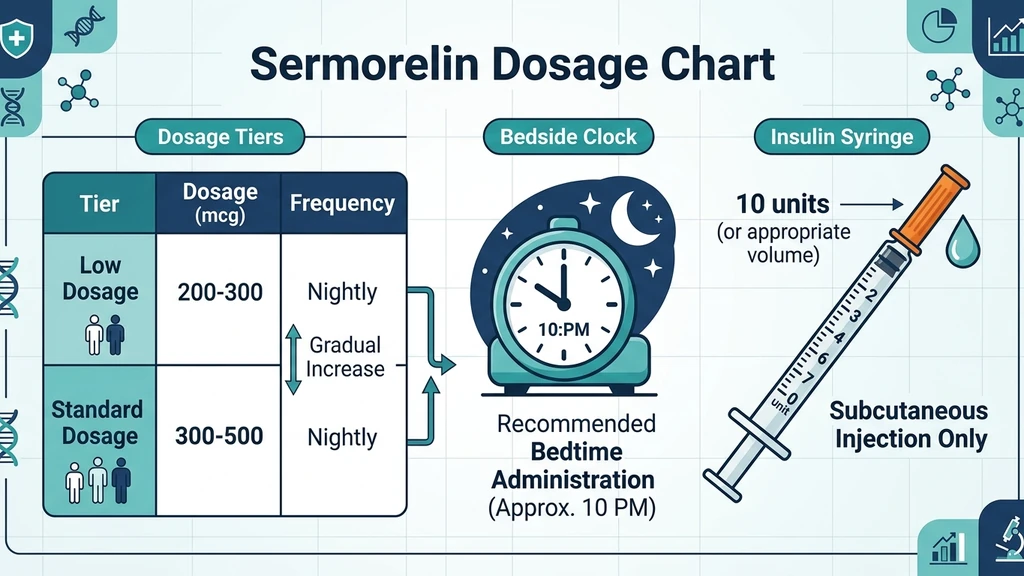
You are holding a vial of sermorelin and wondering exactly how many micrograms to draw into the syringe tonight. The standard sermorelin dose is 200-500 mcg per day, injected subcutaneously 30-60 minutes before bedtime. Most practitioners start adults at 200-300 mcg nightly and titrate upward based on IGF-1 blood work at 6-8 weeks. Women often begin at 100-200 mcg; men at 200-300 mcg.
This guide covers the precise daily amounts, the clinical reasoning behind each dose tier, how your prescriber adjusts your protocol based on lab results, and the specific mistakes that blunt results or create side effects. If you are comparing sermorelin against similar peptides, read CJC-1295 vs. sermorelin or tesamorelin vs. sermorelin vs. ipamorelin for a head-to-head breakdown.
| Patient Profile | Starting Dose | Therapeutic Range | Injection Timing | Cycle Pattern |
|---|---|---|---|---|
| Men (under 50) | 200-300 mcg/day | 300-500 mcg/day | 30-60 min before bed | 5 days on, 2 off |
| Men (over 50) | 100-200 mcg/day | 200-400 mcg/day | 30-60 min before bed | 5 days on, 2 off |
| Women (under 50) | 100-200 mcg/day | 200-300 mcg/day | 30-60 min before bed | 5 days on, 2 off |
| Women (over 50) | 100 mcg/day | 100-200 mcg/day | 30-60 min before bed | 5 days on, 2 off |
| Weight loss focus | 200-300 mcg/day | 300-500 mcg/day | 30-60 min before bed | Daily or 5/2 |
| Anti-aging/wellness | 100-200 mcg/day | 200-300 mcg/day | 30-60 min before bed | 5 days on, 2 off |
Use our CJC-1295/ipamorelin dosage calculator if you are comparing growth hormone secretagogue protocols side by side.
Get your custom peptide protocol:
- Tailored to your body and goals
- Precise dosing and cycle length
- Safe stacking combinations
- Backed by peer-reviewed studies
- Ready in under 2 minutes
How Sermorelin Works: The Thermostat Analogy
Sermorelin is a synthetic version of growth hormone-releasing hormone (GHRH), the 29-amino-acid fragment your hypothalamus already produces. Think of your pituitary gland as a furnace and sermorelin as the thermostat dial. Turning the dial up sends a signal to produce more growth hormone (GH), but the furnace has a built-in safety limit. It cannot overheat the way direct GH injections can.
This distinction matters for dosing. Exogenous growth hormone floods your system with a fixed amount regardless of what your body needs. Sermorelin asks your pituitary to release more GH within its natural feedback loop. Your somatostatin system (the furnace's safety valve) still throttles output when levels climb too high. A 2008 review in Clinical Interventions in Aging confirmed that sermorelin increases IGF-1 and GH while preserving the physiological pulsatile secretion pattern, avoiding the supraphysiological spikes seen with direct GH therapy (Walker, 2006).
This built-in ceiling is why sermorelin dosing is more forgiving than GH dosing. Overshooting by 50-100 mcg does not create the dangerous IGF-1 spikes that overshooting GH by 1 IU would. But "forgiving" does not mean "imprecise." Getting the dose right still determines whether you see measurable results or waste product and time.
Standard Sermorelin Dosage: 200-500 mcg Per Day
The therapeutic window for sermorelin sits between 200 and 500 mcg daily. Where you land within that range depends on four variables: your age, biological sex, baseline IGF-1 levels, and treatment goals. Every prescriber starts conservatively and increases based on lab data, not symptoms alone.
Starting Dose: 200-300 mcg Nightly
Most adults begin at 200-300 mcg per day, injected subcutaneously in the abdomen 30-60 minutes before sleep. This dose reliably stimulates the pituitary without triggering the side effects (facial flushing, headache, nausea) that higher initial doses can cause.
The bedtime timing is not arbitrary. Your pituitary releases its largest GH pulse during the first 90 minutes of deep slow-wave sleep. Sermorelin amplifies this natural pulse rather than creating an artificial one at the wrong time of day. Injecting in the morning wastes the drug's mechanism of action by missing the nocturnal GH window entirely.
A clinical study on growth hormone secretagogue treatment found that patients receiving sermorelin-based therapy raised IGF-1 from a baseline of 159.5 ng/mL to 239.0 ng/mL (p < 0.0001) over a mean treatment period of 134 days (Howell et al., 2017). That 50% increase occurred within standard dosing ranges.
Therapeutic Dose: 300-500 mcg for Optimized Protocols
After 6-8 weeks at the starting dose, your prescriber orders IGF-1 blood work. If IGF-1 remains below the age-adjusted optimal range (typically 200-350 ng/mL for adults under 60), the dose increases by 50-100 mcg increments every 4 weeks until IGF-1 reaches the target window.
Most men settle between 300-500 mcg daily. Most women respond well at 200-300 mcg. The ceiling of 500 mcg exists not because higher doses are dangerous (the pituitary feedback loop protects against GH excess), but because doses above 500 mcg rarely produce additional IGF-1 elevation. You hit diminishing returns. A 16-week longitudinal study reported that optimized GH secretagogue dosing raised lean mass by an estimated 1.26 kg and increased circulating IGF-1 by approximately 28% (PMC7108996).
If you are considering adding ipamorelin to your sermorelin protocol for enhanced GH release, the combination typically allows a lower sermorelin dose (200-300 mcg) because ipamorelin stimulates GH through a complementary GHRP pathway.
Weight Loss Protocol: Dose Adjustments
For patients using sermorelin primarily for fat loss, prescribers often push toward the higher end of the range (400-500 mcg nightly) once IGF-1 labs confirm the patient tolerates the peptide well. Growth hormone mobilizes free fatty acids from adipose tissue, and higher GH pulses correlate with greater lipolysis during overnight fasting.
The weight loss protocol frequently runs daily (7 days per week) rather than the standard 5-on/2-off cycle. The rationale: consistent nightly GH pulses maximize the cumulative metabolic effect. Some practitioners combine sermorelin with CJC-1295 (a longer-acting GHRH analog) to maintain elevated GH throughout the day, not just at night. Read the CJC-1295 dosage guide for details on that combination.
Sermorelin Dosage by Gender and Age
Biological sex and age affect both starting dose and ceiling dose. This is not about body weight alone. Hormonal milieu, receptor density, and baseline GH secretion all shift the dose-response curve.
Men Under 50
Start at 200-300 mcg nightly. Men in this age bracket typically have moderate residual GH secretion, so sermorelin has a strong substrate to amplify. Expect IGF-1 to respond within 4-6 weeks. Target range: 300-500 mcg daily after titration. The 5-day-on, 2-day-off schedule helps prevent pituitary receptor desensitization over long treatment courses.
Younger men with higher baseline GH often see results faster at lower doses. If your baseline IGF-1 is already above 200 ng/mL, 200 mcg nightly may be sufficient for anti-aging and recovery goals without further increases.
Men Over 50
Start at 100-200 mcg nightly. GH secretion declines roughly 14% per decade after age 30, a process called somatopause. By 50, most men produce 50-70% less GH than they did at 25. The pituitary still responds to sermorelin, but it responds more slowly and with a lower ceiling.
Titrate by 50 mcg increments every 4-6 weeks. Target range: 200-400 mcg daily. Men over 50 are more susceptible to joint pain, fluid retention, and carpal tunnel symptoms at higher doses because their bodies have adapted to lower GH levels for years. Gradual increases matter more in this group than any other.
Women Under 50
Start at 100-200 mcg nightly. Women naturally produce GH in a different pattern than men: fewer large pulses, more frequent smaller pulses. Sermorelin amplifies whatever pattern exists, so women typically need lower absolute doses to achieve the same proportional IGF-1 increase.
Target range: 200-300 mcg daily. Menstrual cycle phase can affect GH secretion (higher in the luteal phase), but this does not require dose adjustments. Maintain a consistent nightly dose regardless of cycle timing. If you are exploring peptide options broadly, peptides for women over 40 covers how sermorelin fits into a larger wellness protocol.
Women Over 50
Start at 100 mcg nightly. Post-menopausal women experience compounded GH decline from both aging and estrogen withdrawal (estrogen supports GH secretion). Starting low prevents the flushing and headaches that higher initial doses commonly trigger in this population.
Target range: 100-200 mcg daily. Some women over 50 achieve optimal IGF-1 at just 100 mcg nightly, which is the lowest effective dose in the sermorelin range. Monitor IGF-1 at 6 and 12 weeks before increasing. If response is blunted at 200 mcg, your prescriber may consider combining sermorelin with ipamorelin rather than pushing sermorelin higher.
When and How to Inject Sermorelin

Timing and technique determine whether sermorelin works at full potency or loses 30-50% of its effect before reaching the pituitary. These are not suggestions. They are protocol requirements backed by pharmacokinetic data.
Injection Timing: 30-60 Minutes Before Bed
Sermorelin peaks in blood within 5-20 minutes after subcutaneous injection and clears within 30 minutes. That short half-life is by design. The peptide triggers a GH pulse and exits, allowing the normal pulsatile rhythm to continue through the night.
Inject 30-60 minutes before you plan to fall asleep. Earlier than 60 minutes risks the GH pulse firing before you reach deep sleep. Later than 30 minutes risks falling asleep before the full dose absorbs. Set an alarm if your bedtime varies.
Your stomach must be empty. Food (especially carbohydrates and fats) triggers insulin release, and insulin directly suppresses GH secretion. A meal within 60-90 minutes of injection can blunt the sermorelin-induced GH pulse by 30-50%. Stop eating at least 90 minutes before injecting.
Injection Technique: Subcutaneous Protocol
Sermorelin is injected subcutaneously (into the fat layer beneath the skin), not intramuscularly. Use a 29-31 gauge insulin syringe, 0.5 mL or 1 mL volume.
Step-by-step: 1. Wash hands. Clean the injection site with an alcohol swab and let it air dry. 2. Pinch a fold of skin on the abdomen (2 inches from the navel) or outer thigh. 3. Insert the needle at a 45-degree angle into the skin fold. 4. Inject slowly over 5-10 seconds. 5. Withdraw the needle and apply gentle pressure with a cotton ball. Do not rub. 6. Rotate injection sites each night. Alternate left and right sides of the abdomen.
For a complete visual walkthrough of subcutaneous technique, read how to inject peptides. If you are reconstituting sermorelin from lyophilized powder, see how to store peptides for refrigeration and stability guidelines.
Reconstitution: Getting the Concentration Right
Sermorelin typically ships as a lyophilized (freeze-dried) powder in 3 mg, 6 mg, or 9 mg vials. You reconstitute it with bacteriostatic water before drawing doses.
Reconstitution math for a 6 mg vial: - Add 2 mL bacteriostatic water = 3,000 mcg per mL (3 mg/mL) - For a 300 mcg dose, draw 0.10 mL (10 units on an insulin syringe) - For a 500 mcg dose, draw 0.167 mL (approximately 17 units)
Reconstitution math for a 9 mg vial: - Add 3 mL bacteriostatic water = 3,000 mcg per mL (3 mg/mL) - For a 300 mcg dose, draw 0.10 mL (10 units) - For a 500 mcg dose, draw 0.167 mL (approximately 17 units)
| Vial Size | Bacteriostatic Water | Concentration | 200 mcg Dose | 300 mcg Dose | 500 mcg Dose |
|---|---|---|---|---|---|
| 3 mg | 1 mL | 3,000 mcg/mL | 0.067 mL (7 units) | 0.10 mL (10 units) | 0.167 mL (17 units) |
| 6 mg | 2 mL | 3,000 mcg/mL | 0.067 mL (7 units) | 0.10 mL (10 units) | 0.167 mL (17 units) |
| 9 mg | 3 mL | 3,000 mcg/mL | 0.067 mL (7 units) | 0.10 mL (10 units) | 0.167 mL (17 units) |
Use our peptide reconstitution calculator to verify your concentration before drawing the first dose. A wrong dilution is the number one cause of under- or over-dosing.
The 5-Day-On, 2-Day-Off Cycle
Most prescribers recommend injecting sermorelin 5 nights per week with 2 rest days (for example, Monday through Friday, weekends off). The rest days serve a specific purpose: preventing pituitary desensitization.
When GHRH receptors on somatotroph cells receive continuous stimulation without breaks, they downregulate. Fewer receptors are available on the cell surface, and each injection produces a weaker GH pulse. The 2-day break allows receptor recycling, restoring full sensitivity by Monday.
Not every practitioner uses this cycle. Some prescribe daily injections for the first 3 months (the "loading" phase) and then switch to 5/2 cycling for maintenance. Others use a 6-on/1-off schedule. Clinical evidence does not definitively favor one pattern over another. The principle is consistent: some form of cyclical rest maintains long-term receptor sensitivity.
If your prescriber uses daily dosing, ask when the protocol transitions to cycling. Indefinite daily use without breaks risks diminishing returns after 4-6 months. Review is sermorelin safe for the full safety and cycling considerations.
IGF-1 Monitoring: How Your Prescriber Adjusts the Dose
Sermorelin dosing is not "set and forget." Your prescriber uses IGF-1 blood tests as the primary feedback mechanism to calibrate the dose over time. IGF-1 (insulin-like growth factor 1) reflects average GH activity over the previous 24-48 hours, making it far more reliable than a single GH measurement (which fluctuates minute to minute).
Monitoring schedule: - Baseline: IGF-1 drawn before starting sermorelin (fasting morning blood draw) - Week 6-8: First follow-up IGF-1 to assess response to the starting dose - Week 12-16: Second follow-up after any dose titration - Every 6 months: Ongoing monitoring once the dose stabilizes
| Age Range | Low-Normal IGF-1 | Optimal Target | Upper Limit |
|---|---|---|---|
| 30-40 | 115-180 ng/mL | 200-300 ng/mL | 350 ng/mL |
| 40-50 | 100-160 ng/mL | 180-280 ng/mL | 320 ng/mL |
| 50-60 | 90-140 ng/mL | 160-250 ng/mL | 290 ng/mL |
| 60-70 | 80-120 ng/mL | 140-220 ng/mL | 260 ng/mL |
If IGF-1 at week 6 is below target, the dose increases by 50-100 mcg. If IGF-1 exceeds the upper limit, the dose decreases or rest days increase. If IGF-1 does not budge despite 500 mcg nightly, the issue may be poor pituitary reserve (common over age 65), and your prescriber may suggest switching to a GHRP like ipamorelin or combining both pathways.
Understanding your IGF-1 trajectory also helps distinguish sermorelin from direct GH replacement. Sermorelin cannot push IGF-1 above your pituitary's ceiling. If you need to know whether sermorelin is a steroid (it is not), that article explains the pharmacological classification.
Danger Scenarios: When the Wrong Dose Causes Real Problems
Sermorelin's pituitary feedback loop makes true overdose unlikely. You cannot force-produce dangerous GH levels the way you can with exogenous GH injections. But "unlikely" does not mean "impossible," and dosing errors create distinct clinical problems that require attention.
Scenario 1: Chronic Underdosing (Below 100 mcg/Day)
A dose below 100 mcg daily sits beneath the activation threshold for most adults. The pituitary receives a GHRH signal too weak to trigger a meaningful GH pulse. You pay for the peptide, inject nightly, and get no measurable IGF-1 increase after 8 weeks.
This scenario is common in two groups: patients who reconstituted incorrectly (diluted the vial with too much bacteriostatic water) and patients who self-reduced the dose after experiencing mild initial flushing. Flushing at 200-300 mcg is a normal vasodilatory response that typically resolves within 1-2 weeks. Dropping to 50-100 mcg to avoid it eliminates the therapeutic effect entirely.
The fix: Verify reconstitution math using a peptide reconstitution calculator. If flushing is intolerable, drop to 150 mcg for 2 weeks rather than 50 mcg, then resume the standard starting dose.
Scenario 2: Exceeding 500 mcg Without Monitoring
Some users push past 500 mcg nightly without blood work, reasoning that more sermorelin equals more GH. At best, doses above 500 mcg produce no additional IGF-1 elevation because the pituitary has already released its maximum pulse. At worst, supraphysiological GH stimulation over months can produce fluid retention, joint pain, carpal tunnel symptoms, and potential insulin resistance.
A study on GH excess symptoms noted that even moderately elevated IGF-1 (above 350-400 ng/mL in adults over 40) correlates with increased joint pain and fluid retention within weeks (Colao et al., 2004). These symptoms reverse when the dose decreases, but patients who dose blindly without labs may not recognize the connection until symptoms become disruptive.
The fix: Never exceed 500 mcg nightly without IGF-1 lab confirmation. If your prescriber orders a dose increase beyond 500 mcg (rare), request follow-up labs within 4 weeks.
Scenario 3: Injecting After a Large Meal
You eat dinner at 9 PM, inject sermorelin at 9:30 PM, and go to bed at 10 PM. Insulin from the meal is still elevated. Insulin directly suppresses GH release at the pituitary level. The sermorelin-induced pulse that should fire during deep sleep is blunted by 30-50%, and you receive a fraction of the therapeutic benefit.
Over weeks, this pattern mimics underdosing. Your prescriber sees low IGF-1, increases the dose, and you still do not respond because the timing problem remains unsolved. One clinical practice guideline noted that postprandial insulin elevations lasting 90-120 minutes after moderate carbohydrate meals significantly reduce GH secretion in response to GHRH stimulation (Hartman et al., 1992).
The fix: Stop eating 90 minutes before injection. If you cannot manage a 90-minute fast, aim for at least 60 minutes and avoid carbohydrates and fats in the last meal. Protein has the smallest insulin impact.
Step-by-Step: Starting Sermorelin From Day One
This protocol assumes you have a prescription and a reconstituted vial of sermorelin ready. If you need to source the peptide, read where to buy sermorelin for verified provider options.
Week 1-2: Establish Baseline 1. Get baseline blood work: IGF-1, comprehensive metabolic panel, fasting glucose. Record your baseline sleep quality score (0-10) and body composition (weight, waist circumference). 2. Reconstitute your vial following the concentration table above. Confirm your math with the peptide reconstitution calculator. 3. Inject 200 mcg subcutaneously, 30-60 minutes before bed, on an empty stomach (90-minute fast minimum). 4. Inject 5 nights per week (Monday through Friday). Rest Saturday and Sunday. 5. Track side effects: mild flushing and tingling at the injection site are normal and resolve in 1-2 weeks.
Week 3-4: Assess Tolerance 6. If no significant side effects, continue 200-300 mcg nightly. 7. If persistent headaches or nausea occur at 300 mcg, drop to 200 mcg and hold for 2 more weeks. 8. Note any changes in sleep quality, morning energy, and recovery from exercise. Subjective improvements often appear before lab markers shift.
Week 6-8: First Lab Check 9. Get IGF-1 blood work (fasting morning draw, at least 8 hours after the last injection for accurate measurement). 10. Compare to baseline. If IGF-1 increased by at least 20-30% and sits within the age-adjusted target range, maintain the current dose. 11. If IGF-1 remains below target, increase by 50-100 mcg. If IGF-1 exceeds the upper limit, decrease by 50 mcg or add a third rest day per week.
Week 12+: Optimize and Maintain 12. Repeat IGF-1 every 3 months during the first year. 13. Once the dose stabilizes (consistent IGF-1 within range for 2 consecutive checks), switch to every-6-month monitoring. 14. Consider cycling: some practitioners recommend 3 months on, 1 month off to preserve long-term pituitary sensitivity.
Review the peptide dosage chart for a side-by-side view of how sermorelin dosing compares to other growth hormone secretagogues.
Sermorelin vs. Other GH Secretagogues: Dosage Comparison
Sermorelin is one of several peptides that stimulate growth hormone release, but each works through a different receptor and requires different daily amounts. This table helps you understand where sermorelin fits and why your prescriber may recommend one over another.
| Peptide | Daily Dose Range | Mechanism | Half-Life | Injection Frequency | Best For |
|---|---|---|---|---|---|
| Sermorelin | 200-500 mcg | GHRH receptor agonist | 10-20 min | Nightly before bed | GH optimization, anti-aging |
| CJC-1295 (no DAC) | 100-300 mcg | GHRH receptor agonist | 30 min | Nightly before bed | Short-acting GH pulse |
| CJC-1295 (with DAC) | 1,000-2,000 mcg | GHRH receptor agonist | 6-8 days | 1-2x per week | Sustained GH elevation |
| Ipamorelin | 200-300 mcg | GHRP (ghrelin receptor) | 2 hours | 2-3x daily | Clean GH release, fewer side effects |
| Tesamorelin | 2,000 mcg (2 mg) | GHRH receptor agonist | 26 min | Daily | Visceral fat reduction (FDA-approved) |
Key distinction: Sermorelin and CJC-1295 work on the same GHRH receptor. Stacking them at full doses is redundant. Combining sermorelin (GHRH pathway) with ipamorelin (GHRP pathway) activates two complementary mechanisms and produces a synergistic GH pulse larger than either peptide alone. This sermorelin + ipamorelin stack is the most prescribed GH protocol in clinical anti-aging practice. Use the CJC-1295/ipamorelin dosage calculator to model combined dosing.
Common Sermorelin Dosing Mistakes

These four errors account for the majority of poor outcomes in sermorelin therapy. Each one is preventable with correct information.
Mistake 1: Injecting in the Morning Sermorelin's entire mechanism depends on amplifying the nocturnal GH pulse during deep sleep. Morning injections trigger a GH release that competes with cortisol (which peaks at 6-8 AM and suppresses GH) and misses the slow-wave sleep window entirely. You get a fraction of the effect. Always inject 30-60 minutes before bedtime.
Mistake 2: Eating Too Close to Injection A meal within 60 minutes of injection raises insulin, which directly suppresses GH release at the pituitary. This is the single most common reason patients do not respond to standard doses. Fast for at least 90 minutes before injecting. If you must eat, choose a small protein-only snack (no carbs, no fats).
Mistake 3: Skipping Doses Then Doubling Up Missing Monday's injection and injecting 600 mcg on Tuesday does not produce a compensatory GH pulse. It produces an exaggerated single pulse followed by refractory period suppression. The pituitary becomes temporarily resistant to the next night's injection. Consistency beats intensity. If you miss a dose, resume the normal amount the next scheduled night.
Mistake 4: Storing Reconstituted Sermorelin at Room Temperature Reconstituted sermorelin degrades rapidly outside refrigeration. At room temperature, potency drops measurably within 48 hours. Within 7 days, the peptide may be largely inactive. Refrigerate the vial immediately after reconstitution and keep it between 36-46 degrees F (2-8 degrees C). Never freeze reconstituted sermorelin. For full storage protocols, read how to store peptides.
Sermorelin Side Effects by Dose Level
Side effects from sermorelin correlate directly with dose. Understanding which effects appear at which dose helps you and your prescriber distinguish normal adjustment responses from signals that the dose is too high.
| Side Effect | Dose Range | Frequency | Duration | Action Required |
|---|---|---|---|---|
| Injection site redness | Any dose | 30-40% of users | 10-20 minutes | None; normal reaction |
| Facial flushing | 200-300 mcg | 15-25% of users | 5-15 minutes | None; resolves in 1-2 weeks |
| Headache | 300-500 mcg | 10-15% of users | 1-3 hours | Reduce dose by 50 mcg; reassess |
| Nausea | 300-500 mcg | 5-10% of users | 30-60 minutes | Take on fully empty stomach |
| Dizziness | 400-500 mcg | 5-8% of users | 5-20 minutes | Inject while sitting; stay seated 10 min |
| Joint pain | 500+ mcg (chronic) | Rare | Ongoing | Check IGF-1; likely too high; reduce dose |
| Fluid retention | 500+ mcg (chronic) | Rare | Ongoing | Check IGF-1; reduce dose or add rest day |
The first three effects (injection site redness, flushing, headache) are transient adjustment responses that typically resolve within 2 weeks of consistent use. Joint pain and fluid retention at high doses signal excessive GH stimulation and require dose reduction and lab confirmation. For a comprehensive safety overview, read is sermorelin safe.
Combining Sermorelin With Other Peptides
Sermorelin is rarely used in isolation in clinical practice. The two most common combination protocols pair it with either ipamorelin or CJC-1295.
Sermorelin + Ipamorelin Stack
This is the gold standard GH-releasing stack. Sermorelin activates the GHRH receptor; ipamorelin activates the ghrelin (GHRP) receptor. Together, they produce a GH pulse roughly 2-3 times larger than either alone. The synergy means you can use lower doses of each peptide and still achieve superior results.
Typical combined protocol: - Sermorelin: 200-300 mcg nightly - Ipamorelin: 200-300 mcg nightly (same injection, or separate injections within 5 minutes) - Timing: Both injected 30-60 minutes before bed on an empty stomach - Cycle: 5 days on, 2 days off
This combination is sometimes sold pre-mixed by compounding pharmacies. If you are purchasing separate vials, they can be drawn into the same syringe. Read the CJC-1295/ipamorelin benefits guide for clinical data on the GHRH + GHRP synergy.
Sermorelin + CJC-1295 (No DAC): Redundant or Useful?
Both sermorelin and CJC-1295 (no DAC) target the same GHRH receptor. Stacking them does not produce the synergy seen with sermorelin + ipamorelin. However, some practitioners prescribe low doses of both (e.g., 100 mcg sermorelin + 100 mcg CJC-1295 no DAC) on the theory that CJC-1295's slightly longer half-life extends the GH release window.
Clinical evidence for this combination is thin compared to the sermorelin + ipamorelin stack. If your prescriber recommends it, follow their protocol. If you are choosing your own stack, sermorelin + ipamorelin has stronger clinical support. For an in-depth comparison, see CJC-1295 vs. sermorelin.
Frequently Asked Questions
How much sermorelin should I inject per day?
The standard dose is 200-500 mcg per day, injected subcutaneously 30-60 minutes before bedtime. Most adults start at 200-300 mcg nightly and increase based on IGF-1 blood work at 6-8 weeks. Your prescriber determines your specific dose based on age, sex, and lab results. For detailed dosing tables, see our peptide dosage chart.
Can I inject sermorelin twice a day?
Twice-daily injections are not standard practice and provide no proven benefit over once-nightly dosing. Sermorelin's mechanism depends on amplifying the natural nocturnal GH pulse during deep sleep. A second daytime injection competes with cortisol and misses the sleep window. Stick to one nightly injection. If results are insufficient, your prescriber will increase the nightly dose or add ipamorelin rather than split the dose.
What happens if I take too much sermorelin?
Sermorelin's pituitary feedback loop provides a built-in safety ceiling. Your body cannot produce dangerous GH levels through GHRH stimulation alone. However, chronic doses above 500 mcg without monitoring can cause fluid retention, joint pain, and carpal tunnel symptoms. These resolve when the dose decreases. Always confirm your IGF-1 stays within range through regular blood work.
Does sermorelin work better on an empty stomach?
Yes. Food triggers insulin release, and insulin directly suppresses GH secretion at the pituitary. Eating within 60-90 minutes of injection can reduce the GH pulse by 30-50%. Fast for at least 90 minutes before injecting. If you must eat, choose a small protein-only snack. Carbohydrates and fats produce the strongest insulin response and the greatest GH suppression. See how to inject peptides for the full pre-injection protocol.
How long does sermorelin take to show results?
Subjective improvements (better sleep quality, morning energy, recovery) typically appear within 2-4 weeks. Measurable IGF-1 increases show up on blood work at 6-8 weeks. Body composition changes (fat loss, lean mass gains) require 3-6 months of consistent use. A clinical study showed IGF-1 increases of approximately 50% over 4.5 months of treatment. Read sermorelin for fat loss for detailed timelines.
Is sermorelin the same as HGH?
No. Sermorelin stimulates your pituitary to produce its own growth hormone. HGH (human growth hormone) injects synthetic GH directly into your body, bypassing the pituitary entirely. Sermorelin preserves natural pulsatile GH secretion and carries lower overdose risk because pituitary feedback limits production. HGH requires much more careful dosing and monitoring. Learn more about the classification in is sermorelin a steroid.
Can I use sermorelin with a GHRP like ipamorelin?
Yes, and this is the most common clinical combination. Sermorelin (GHRH pathway) and ipamorelin (GHRP pathway) produce synergistic GH release 2-3 times greater than either alone. Typical combined dosing is 200-300 mcg of each, injected together 30-60 minutes before bed. Use the CJC-1295/ipamorelin dosage calculator to model your protocol.
Should I cycle sermorelin or take it every day?
Most prescribers recommend a 5-day-on, 2-day-off cycle to prevent pituitary receptor desensitization. Some protocols use daily dosing for the first 3 months, then transition to cycling. Indefinite daily use without breaks risks diminishing returns after 4-6 months. For long-term protocols, consider 3-months-on, 1-month-off cycling. Read where to buy sermorelin for sourcing verified product.
The Bottom Line
Sermorelin dosing is straightforward once you understand the framework: start at 200-300 mcg nightly, inject on an empty stomach before bed, check IGF-1 at 6-8 weeks, and adjust by 50-100 mcg increments until labs confirm you are in the optimal range. Most adults land between 200-500 mcg daily on a 5-on/2-off cycle.
The three non-negotiable rules are bedtime injection timing, a 90-minute pre-injection fast, and IGF-1 monitoring. Skip any of these and the peptide underperforms regardless of dose. Side effects at standard doses are mild and transient. Serious complications come from chronic high-dose use without blood work, which is entirely preventable.
If you are unsure which growth hormone peptide fits your goals, take the peptide quiz for a personalized recommendation based on your age, objectives, and experience level.
Related Articles: - Is Sermorelin Safe? - safety profile, contraindications, and long-term data - Sermorelin for Fat Loss - weight loss protocols and clinical results - CJC-1295 vs. Sermorelin - head-to-head comparison of GHRH peptides - Tesamorelin vs. Sermorelin vs. Ipamorelin - choosing the right GH secretagogue - Is Sermorelin a Steroid? - pharmacological classification explained - Peptide Dosage Chart - all peptide doses in one reference
Helpful Tools
Related Articles
CJC-1295 Dosage: Complete Protocol Guide
CJC-1295 dosage guide: DAC and no-DAC protocols. Dosing by goal (anti-aging, fat loss, muscle, sleep), ipamorelin stacking, and injection timing.
Tesamorelin Dosage for Fat Loss
Tesamorelin dosage guide for fat loss. FDA-approved 2 mg/day protocol, visceral fat reduction data, cycling strategies, and GH peptide comparisons.
Does Sermorelin Increase Testosterone?
Sermorelin does not directly increase testosterone. It stimulates GH release, which supports testosterone indirectly via IGF-1 and improved sleep. Clinical evidence reviewed.
How Long Does Sermorelin Take to Work?
Sermorelin improves sleep in 1-2 weeks, boosts energy by week 3-4, shifts body composition at month 2-3, and delivers full results at 3-6 months.