Your endocrinologist confirmed what your bloodwork suggested: growth hormone output has dropped below the 10th percentile for your age. She writes a prescription for sermorelin. You take it to your pharmacy and they tell you they do not carry it. You search online and find a landscape of telehealth clinics, compounding pharmacies, and grey-market research vendors, each claiming to sell the same 29-amino-acid peptide at wildly different prices. You can buy sermorelin legally in the United States through telehealth peptide clinics and compounding pharmacies with a valid prescription, typically for $99 to $400 per month depending on the source and dosing protocol.
| Quick Reference | Details |
|---|---|
| Legal status | Category 1 compoundable peptide (prescription required) |
| Telehealth clinics | $150-400/month (consultation + peptide included) |
| Compounding pharmacy | $99-250/month (prescription from your doctor required) |
| Research vendors | $40-120/month (grey-market, no prescription needed) |
| Key quality marker | HPLC purity 98%+ with batch-specific COA |
| FDA history | Approved 1997 (Geref Diagnostic); brand withdrawn 2008 for commercial reasons |
| Typical dose | 100-300 mcg/day subcutaneous (peptide dosage chart) |
| Common stacking partners | Ipamorelin, CJC-1295 |
Sermorelin sits in a unique position in the peptide market. Unlike BPC-157 or TB-500, which remain on the FDA's Category 2 list, sermorelin is already Category 1, meaning licensed compounding pharmacies can legally prepare it right now with a physician's prescription. This makes it one of the most accessible peptides in the current regulatory environment. For a broader overview of peptide sourcing across all compounds, see where to buy peptides in 2026.
*This article is for research and educational purposes only. It is not medical advice. Consult a licensed healthcare provider before starting any peptide protocol.*
Get your custom peptide protocol:
- Tailored to your body and goals
- Precise dosing and cycle length
- Safe stacking combinations
- Backed by peer-reviewed studies
- Ready in under 2 minutes
Sermorelin's Legal Advantage: Why It Is Easier to Buy Than Most Peptides
The FDA peptide crackdown of 2025-2026 reshaped access to nearly every research peptide. Vendors shut down. Peptide Sciences disappeared. Import seizures spiked. But sermorelin sailed through the storm relatively unscathed, and the reason is regulatory classification.
Think of the FDA's peptide categories like airport security lanes. Category 1 peptides have TSA PreCheck: they move through the system with minimal friction because the FDA has reviewed them and determined they can be safely compounded. Category 2 peptides are stuck in the regular line, flagged for additional screening, and currently barred from compounding entirely.
Sermorelin earned its Category 1 status because of its pharmaceutical history. The FDA approved it in 1997 as Geref Diagnostic for evaluating pituitary function in children with suspected growth hormone deficiency. Serono voluntarily withdrew the brand in 2008, not because of safety concerns, but because it was not commercially profitable (Prakash & Bhatt, 2009). The withdrawal was a business decision, not a safety signal. That approval history gives sermorelin a regulatory pedigree that peptides like BPC-157, which have never been through an FDA review, simply do not have.
The practical consequence: while users of other peptides scramble through shrinking grey-market channels or wait for the RFK reclassification to move their compounds to Category 1, sermorelin buyers have a legal, regulated pathway that exists right now.
Three Routes to Buy Sermorelin: Comparison Table
Each route offers a different combination of cost, quality assurance, and legal protection. Your choice depends on whether you have a prescribing physician, your budget, and your comfort with regulatory risk.
| Factor | Telehealth Peptide Clinic | Compounding Pharmacy (with your own Rx) | Research Peptide Vendor |
|---|---|---|---|
| Prescription required | Yes (provided during consultation) | Yes (bring your own) | No |
| Monthly cost | $150-400 | $99-250 | $40-120 |
| Quality standard | USP 797 compounding | USP 797 compounding | Varies (COA dependent) |
| Endotoxin testing | Yes | Yes | Rarely |
| Legal standing | Fully legal | Fully legal | Grey area |
| Medical oversight | Yes (ongoing) | Depends on your physician | None |
| Purity guarantee | 99%+ | 99%+ | Varies (98%+ if reputable) |
| Convenience | High (virtual visits, shipped to door) | Moderate (doctor visit + pharmacy) | High (online ordering) |
| Supply continuity | Stable (licensed operations) | Stable | Uncertain (vendor closures) |
The first two routes are legal and regulated. The third is not illegal to purchase, but it exists in a grey area that has been narrowing since the FDA escalated enforcement in late 2025. For a full breakdown of the legal landscape, see our peptide safety guide.
Route 1: Telehealth Peptide Clinics
Telehealth clinics are the fastest path from "I want sermorelin" to a vial in your refrigerator. The process typically takes 5-10 business days from consultation to delivery.
How the Process Works
You schedule a virtual consultation with a licensed physician who specializes in peptide therapy or hormone optimization. During the visit, you discuss your symptoms, health history, and goals. The physician orders bloodwork (IGF-1, comprehensive metabolic panel, thyroid panel) if you have not had recent labs. Once your labs confirm that sermorelin is clinically appropriate, the physician writes a prescription that is sent directly to a partnered compounding pharmacy.
The pharmacy compounds your sermorelin, typically as a lyophilized (freeze-dried) powder in multi-dose vials. They ship it to your door with cold packs, syringes, bacteriostatic water, and reconstitution instructions. Many clinics include everything in a single monthly fee.
The physician monitors your progress through follow-up consultations (usually every 4-8 weeks initially, then quarterly). They adjust your dose based on IGF-1 levels, symptom response, and side effects. This ongoing medical oversight is the primary advantage over self-directed research peptide use.
What Telehealth Sermorelin Programs Cost
Pricing varies by clinic, but the structure is consistent. Most clinics bundle everything into a monthly subscription.
| Cost Component | Typical Range |
|---|---|
| Initial consultation | $0-150 (often waived if you subscribe) |
| Monthly peptide + supplies | $150-350 |
| Follow-up consultations | $0-75 (often included) |
| Bloodwork | $0-200 (sometimes included, sometimes ordered through Quest/LabCorp) |
| Total first month | $150-400 |
| Total ongoing monthly | $150-350 |
Some clinics offer discounts for prepaying 3-6 months. Others bundle sermorelin with complementary peptides like ipamorelin or CJC-1295 in stack protocols. A sermorelin + ipamorelin combination through telehealth typically runs $250-450 per month. Use our peptide cost calculator to compare pricing across protocols.
Red Flags in Telehealth Peptide Services
Not every telehealth service prescribing sermorelin is practicing legitimate medicine. Four warning signs separate real clinics from storefronts wearing lab coats.
No real medical evaluation. If a service lets you select sermorelin from a dropdown menu, enter your credit card, and check out without speaking to a physician, it is not a medical practice. It is a vendor using a prescriber's license as a rubber stamp. Legitimate clinics require a consultation, health history review, and bloodwork before prescribing.
No bloodwork requirement. Sermorelin stimulates growth hormone release. Prescribing it without measuring baseline IGF-1 levels is like adjusting a thermostat without reading the current temperature. Any physician who prescribes sermorelin without labs is cutting a corner that directly affects your safety.
Pressure to add unnecessary peptides. A good physician recommends what is clinically indicated. A sales operation pushes a "platinum stack" of five peptides when you came in asking about one. If the upsell feels more like a supplement store than a doctor's office, trust that instinct.
No follow-up protocol. Sermorelin requires monitoring. IGF-1 should be checked at 8-12 weeks to confirm the protocol is working and to screen for excessive GH elevation. A clinic that ships your vials and disappears until your subscription renews is not providing medical care.
Route 2: Compounding Pharmacies with Your Own Prescription
If you already have a physician who is willing to prescribe sermorelin, going directly to a compounding pharmacy is typically the most cost-effective legal route.
How to Get a Sermorelin Prescription from Your Doctor
Sermorelin is a recognized pharmaceutical compound with an FDA approval history. Most physicians are willing to prescribe it when clinical indicators support the decision. The conversation goes more smoothly when you bring data, not requests.
Start with bloodwork. Ask your doctor to order IGF-1, a comprehensive metabolic panel, and a morning cortisol. If your IGF-1 is below the age-adjusted reference range, you have an objective basis for the conversation. Symptoms like poor sleep quality, increased visceral fat despite consistent exercise, and slow recovery from injury support the clinical picture.
Frame the request around growth hormone deficiency, not bodybuilding or anti-aging. Sermorelin was FDA-approved for diagnosing GH deficiency, and its off-label use for treating adult GH decline is well-documented in endocrinology literature. A 2013 review in Endocrine Practice found that GHRH analogs like sermorelin produced clinically meaningful improvements in body composition, sleep quality, and exercise capacity in adults with age-related GH decline (Merriam et al., 2013).
If your primary care physician is not comfortable prescribing sermorelin, ask for a referral to an endocrinologist. Endocrinologists prescribe GH-related therapies routinely and are more likely to be familiar with GHRH analogs.
Finding a Compounding Pharmacy That Carries Sermorelin
Not every compounding pharmacy prepares peptides. You need one that specializes in sterile compounding and specifically carries sermorelin in its formulary.
Two accreditation bodies certify compounding pharmacies for sterile preparations. The Pharmacy Compounding Accreditation Board (PCAB) and the Accreditation Commission for Health Care (ACHC) both audit facilities for compliance with USP 797 and USP 800 standards. A pharmacy with either accreditation has passed inspection for sterile compounding practices.
When you call a pharmacy, ask three questions. First, do they compound sermorelin? Not all sterile compounding pharmacies carry every peptide. Second, do they test each batch for purity and endotoxins? This goes beyond the HPLC testing that research vendors perform. Third, what is their turnaround time? Most compounding pharmacies fill peptide prescriptions within 3-7 business days.
Pricing for compounded sermorelin through a pharmacy (with your own prescription) typically runs $99-250 per month, depending on the dose and vial size. This is often 30-50% less than the all-inclusive telehealth model because you are not paying for the bundled consultation.
Quality Standards: USP 797 and What It Means for You
USP 797 is the United States Pharmacopeia chapter that governs sterile compounding. It sets requirements for facility design, environmental monitoring, personnel training, and beyond-use dating that directly affect the quality of your sermorelin vial.
A USP 797-compliant pharmacy prepares sermorelin in an ISO Class 5 clean room with HEPA-filtered laminar airflow. Technicians wear sterile gowns, gloves, and masks. The air, surfaces, and personnel are tested regularly for microbial contamination. Each batch undergoes sterility testing, endotoxin testing (LAL assay), and potency verification.
Compare this to a research peptide vendor, which may synthesize or repackage peptides in a facility with no regulatory oversight, no environmental monitoring, and no endotoxin testing. The HPLC purity might be identical at 98%, but the sterility and endotoxin profile can be vastly different. A peptide can be chemically pure and still contain bacterial toxins that cause fever, inflammation, or worse.
This distinction matters more for injectable peptides than for any other route of administration. When you inject something subcutaneously, you bypass every defense your body has against contamination: skin, stomach acid, liver metabolism. What goes in the syringe goes directly into your tissue. Quality is not a luxury here. It is a safety requirement.
Route 3: Research Peptide Vendors
Research vendors sell sermorelin as a lyophilized powder labeled "for research use only, not for human consumption." This route offers the lowest cost and broadest access, but carries the highest uncertainty in quality and legal standing.
The Current State of Research Peptide Vendors in 2026
The vendor landscape contracted sharply after the FDA crackdown and the Peptide Sciences shutdown. Several established names disappeared in a span of months. Users who relied on a single vendor found themselves without a source overnight. If you were affected, see Peptide Sciences alternatives and is Peptide Sciences coming back for current status.
The vendors that remain operate under increased scrutiny. Some have improved their practices, adding more rigorous testing and clearer compliance language. Others are new entrants that appeared to fill the gap, and new vendors carry higher uncertainty because they lack a track record.
For sermorelin specifically, the research vendor route is harder to justify than it used to be. Because sermorelin is already Category 1, the legal compounding pathway exists right now. The price difference between a compounding pharmacy ($99-250/month) and a research vendor ($40-120/month) is often less than $100. Whether that savings justifies the quality uncertainty and legal ambiguity is a calculation each buyer must make.
If You Choose a Research Vendor: Non-Negotiable Quality Checks
If the compounding pharmacy route is not accessible to you, and you choose to purchase from a research vendor, these quality verification steps are not optional. They are the minimum barrier between a legitimate product and an unknown powder in a vial.
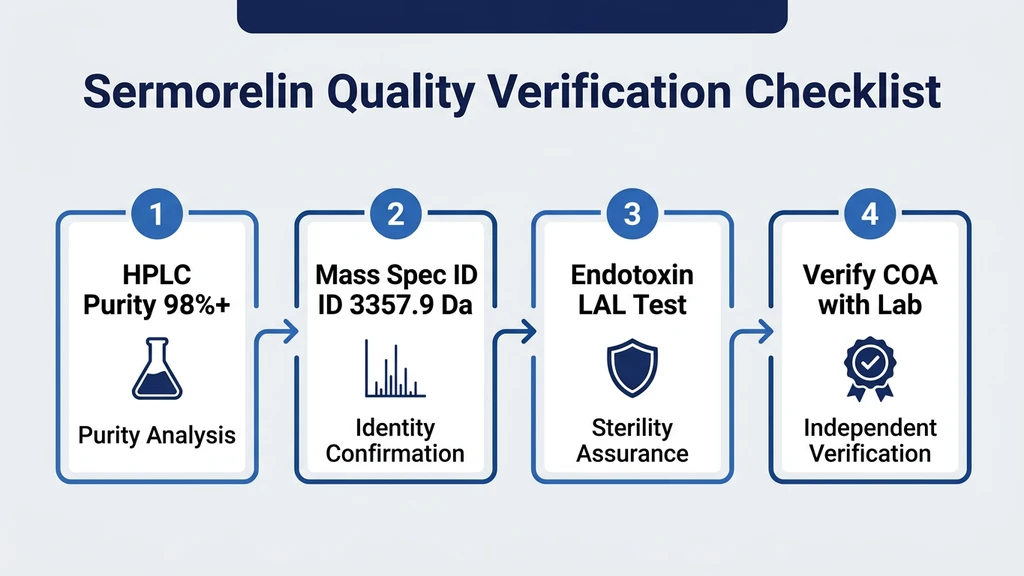
1. Batch-specific Certificate of Analysis (COA). Request a COA for the specific batch you are purchasing, not a generic document that covers the product line. The COA must come from a recognized third-party lab, not the vendor's own internal testing. Janoshik Analytical and Finnrick Labs are the two most widely recognized independent testing services for research peptides.
2. HPLC purity above 98%. High Performance Liquid Chromatography separates the target peptide from impurities and degradation fragments. A purity reading below 98% means more than 2% of the vial's contents are something other than sermorelin. Below 95%, the product is not worth using.
3. Mass spectrometry identity confirmation. HPLC tells you purity. Mass spectrometry tells you identity. It confirms that the peptide in the vial is actually sermorelin (GHRH 1-29) and not a truncated fragment, a different GHRH analog, or an entirely different compound. A COA without mass spec data is incomplete.
4. Verify the COA independently. Contact the lab listed on the COA. Provide the batch number. Ask them to confirm they tested that batch. This takes five minutes and eliminates the risk of fabricated documents. If the vendor's COA cannot be independently verified, treat the document as worthless.
For a complete decision checklist covering all quality markers, see our peptide safety guide.
Sermorelin Pricing Breakdown: What You Should Actually Pay
Sermorelin pricing varies by a factor of 10 depending on the source and what is included. This breakdown strips away the bundling to show the actual cost of the peptide itself.
| Source | Sermorelin Cost (per 5mg vial) | Monthly Cost at 300 mcg/day | Includes |
|---|---|---|---|
| Telehealth clinic (bundled) | N/A (bundled pricing) | $150-400 | Consultation, peptide, supplies, follow-ups |
| Compounding pharmacy | $35-80 per vial | $99-250 | Peptide only (you arrange Rx and supplies) |
| Research vendor | $25-60 per vial | $40-120 | Peptide only (no medical oversight) |
| Telehealth + ipamorelin stack | N/A (bundled) | $250-450 | Both peptides + consultation + supplies |
The math at 300 mcg/day: A 5mg vial of sermorelin reconstituted with 2 mL of bacteriostatic water yields a concentration of 2,500 mcg/mL. At 300 mcg per injection (0.12 mL per dose), one vial lasts approximately 16 days. You need roughly two vials per month. Use our peptide reconstitution calculator for your exact dose.
Hidden costs to factor in: Bacteriostatic water ($5-15 per 30 mL vial, lasts months). Insulin syringes ($10-20 for 100 count). Alcohol swabs ($5-10 for 200 count). Bloodwork ($50-200 if not included in your clinic plan). See where to buy bacteriostatic water for injection for sourcing.
The stacking premium: Many users combine sermorelin with ipamorelin or CJC-1295 for a synergistic GH pulse. Stacking through a telehealth clinic adds $100-200 per month to the base sermorelin cost. Through a compounding pharmacy, the additional peptide runs $50-150 per month. For stacking protocols, see the peptide stacking guide and the CJC-1295 + ipamorelin dosage calculator.
Quality Markers: How to Verify Your Sermorelin Is Real
Sermorelin is a 29-amino-acid peptide (GRF 1-29) with a molecular weight of 3,357.9 daltons. That specificity is your friend when verifying quality, because analytical testing can confirm both identity and purity with high precision.
HPLC: The Purity Standard
High Performance Liquid Chromatography separates a peptide sample into its component parts and measures the relative proportion of the target compound versus impurities. For sermorelin, a reputable source should deliver 98% purity or higher.
What occupies the remaining 2%? Typically truncated peptide fragments created during synthesis (e.g., GHRH 1-27 instead of the full 1-29 sequence), deletion sequences where one amino acid is missing, oxidized methionine variants, and residual trifluoroacetic acid (TFA) from the synthesis process.
At 95-97% purity, these impurities are present but unlikely to cause problems beyond slightly reduced potency. Below 95%, the impurity profile becomes more concerning, and you cannot predict how those fragments will interact with GHRH receptors or other biological targets. Below 90%, you are injecting a mixture rather than a peptide.
Mass Spectrometry: Identity Confirmation
HPLC tells you what percentage of the vial is the target compound. Mass spectrometry (MS) tells you whether the target compound is actually sermorelin. The mass spec reading should show a primary peak at 3,357.9 daltons, matching sermorelin's known molecular weight.
Why does this matter? Because peptide synthesis can produce the wrong sequence at the right purity. A vendor could sell you a vial that is 99% pure by HPLC, but the peptide inside is GHRH 1-26 (a truncated version missing three C-terminal amino acids) rather than the full GHRH 1-29 sequence. Without mass spec, you would never know. The truncated version binds the GHRH receptor with lower affinity, meaning you would get a weaker GH response at the same dose.
A COA that includes both HPLC purity and mass spectrometry confirmation is the baseline for any injectable peptide. Accept nothing less.
Endotoxin Testing: The Gap Between Research and Pharmaceutical Grade
Endotoxins are fragments of bacterial cell walls (lipopolysaccharides) that trigger potent immune responses even at nanogram quantities. The FDA limit for injectable drugs is 5 endotoxin units (EU) per kilogram of body weight per hour. For an 80 kg adult, that is 400 EU per dose.
Compounding pharmacies test every batch for endotoxins using the Limulus Amebocyte Lysate (LAL) assay. Research peptide vendors almost never perform this test. The HPLC chromatogram does not detect endotoxins, so a peptide can be 99% pure by HPLC while containing dangerous levels of bacterial contamination.
This is the single largest quality difference between compounding pharmacy sermorelin and research vendor sermorelin. Chronic low-level endotoxin exposure from contaminated injectable peptides can drive systemic inflammation, which is the opposite of what someone using sermorelin for health optimization should be accepting. A 2012 review in Frontiers in Bioscience documented that subclinical endotoxemia contributes to insulin resistance, chronic fatigue, and cardiovascular inflammation (Gnauck et al., 2016).
If you purchase from a research vendor, ask for endotoxin test results. If they cannot provide them, understand that you are injecting a compound with an unknown bacterial contamination profile.
Red Flags: How to Spot Unreliable Sermorelin Sources
Seven warning signs indicate a source that is not worth your money or your health risk. Any single red flag warrants caution. Two or more mean walk away.
1. No COA available. A source that cannot provide batch-specific third-party testing results either does not test their products or does not want you to see the results. This is disqualifying.
2. Prices far below market. Sermorelin synthesis requires solid-phase peptide synthesis, HPLC purification, and quality testing. The raw material cost for a 5mg vial from a reputable synthesizer is $15-25. If a vendor sells the finished product for $12-15 per vial, they are cutting corners on synthesis, purification, testing, or all three.
3. Medical claims on the website. A research vendor that lists dosing instructions, describes clinical benefits, or suggests sermorelin "treats" any condition has crossed the line from chemical supplier to unregulated pharmacy. This also makes them a target for FDA enforcement, which means your supply could vanish overnight.
4. No verifiable business identity. No physical address, no corporate registration, no phone number. Just a domain name and a cryptocurrency payment option. If you cannot verify who is behind the company, you cannot hold anyone accountable for what is in the vial.
5. COA from an unrecognizable lab. The COA lists "ABC Analytics" as the testing facility, but you cannot find ABC Analytics online. Or worse, ABC Analytics turns out to be a subsidiary of the vendor itself. Internal testing is quality control, not independent verification.
6. Inconsistent appearance. Lyophilized sermorelin should appear as a white to off-white powder or cake at the bottom of the vial. Yellow discoloration, liquid in a vial that should contain lyophilized powder, or a puck that has separated from the vial wall are signs of degradation or improper handling.
7. Pressure tactics. "Limited stock." "Price increasing tomorrow." "Last batch before we close." Urgency-driven sales language is a hallmark of operators who know their product or their business may not survive scrutiny. Legitimate suppliers do not need to create artificial scarcity.
How to Store and Handle Sermorelin After Purchase
Buying quality sermorelin is only half the equation. Improper storage and handling can degrade a 99% pure peptide into an ineffective or contaminated product within days.
Before Reconstitution: Lyophilized Powder
Unreconstituted sermorelin (lyophilized powder) is relatively stable when stored correctly. Keep it refrigerated at 36-46 degrees Fahrenheit (2-8 degrees Celsius). At this temperature, lyophilized sermorelin remains stable for months past the manufacture date.
For long-term storage beyond 3 months, freezing at -4 degrees Fahrenheit (-20 degrees Celsius) extends stability further. Avoid repeated freeze-thaw cycles. If you purchase multiple vials, freeze the ones you will not use immediately and thaw each one individually when you are ready to reconstitute.
Keep vials away from direct light. Sermorelin's methionine residue is susceptible to photo-oxidation, which reduces binding affinity to the GHRH receptor. Store vials in their original packaging or wrap them in aluminum foil if exposed to ambient light during refrigerator access. For comprehensive storage protocols, see how to store peptides.
Reconstitution and Post-Reconstitution Storage
Add bacteriostatic water slowly down the side of the vial, letting it trickle onto the lyophilized cake. Do not inject the stream directly into the powder. Do not shake. Gentle swirling is acceptable if the powder does not dissolve within 2-3 minutes. Aggressive agitation can shear the peptide chain and create inactive fragments.
Standard reconstitution: 2 mL of bacteriostatic water into a 5 mg vial produces a concentration of 2,500 mcg/mL. At 300 mcg per injection, draw 0.12 mL (12 units on a 100-unit insulin syringe). For different vial sizes or desired concentrations, the peptide reconstitution calculator handles the math.
After reconstitution, store sermorelin in the refrigerator at 36-46 degrees Fahrenheit. Do not freeze reconstituted solution. Freezing can cause the peptide to precipitate out of solution, and thawing may not fully resolubilize it.
Reconstituted sermorelin remains stable for 2-3 weeks under proper refrigeration when mixed with bacteriostatic water. If mixed with sterile water (no preservative), use within 24-48 hours. For more on reconstituted peptide stability, see how long do reconstituted peptides last.
Sermorelin vs. Other GH Secretagogues: Should You Buy Something Else Instead?
Before committing to sermorelin, consider whether a different GH secretagogue might better serve your goals. The market offers several options, each with distinct mechanisms, availability profiles, and cost structures.
| Peptide | Mechanism | Half-Life | Monthly Cost (compounding) | Availability | Best For |
|---|---|---|---|---|---|
| Sermorelin | GHRH receptor agonist | 10-20 min | $99-250 | Category 1 (legal now) | Pulsatile GH restoration, fat loss, sleep |
| CJC-1295 (no DAC) | GHRH analog (modified) | 30 min | $100-300 | Category pending | Higher potency GHRH stimulation |
| Ipamorelin | Ghrelin receptor agonist | 2 hours | $100-250 | Category pending | Clean GH pulse, no cortisol/prolactin spike |
| GHRP-6 | Ghrelin receptor agonist | 15-60 min | $80-200 | Research only | Strong GH pulse, appetite increase |
| Hexarelin | Ghrelin receptor agonist | 70 min | $100-250 | Research only | Potent GH release (but desensitizes) |
| Tesamorelin | GHRH analog | 26 min | $300-600 | Prescription (Egrifta) | FDA-approved for HIV lipodystrophy |
The case for sermorelin: It is the only GH secretagogue currently available through legal compounding without waiting for the RFK reclassification. If you want a regulated, physician-supervised protocol you can start this week, sermorelin is the answer. Its 10-20 minute half-life produces a clean, physiological GH pulse that mimics natural secretion patterns. No desensitization has been observed even in two-year studies (Vittone et al., 1997).
The case for stacking: Sermorelin (GHRH agonist) combined with ipamorelin (ghrelin agonist) activates two separate receptor pathways simultaneously, producing a GH pulse 3-5 times larger than either peptide alone. This is the most popular GH secretagogue protocol in the peptide community. For dosing details, use the CJC-1295 + ipamorelin dosage calculator or see the peptide stacking guide.
The case against sermorelin: Its short half-life means the GH pulse is brief. Users seeking a more sustained GH elevation may prefer CJC-1295, whose modified amino acid backbone resists enzymatic degradation and produces a longer GH wave. However, CJC-1295 is not yet confirmed on the Category 1 list, which limits its availability to research channels for now.
For a detailed analysis of how sermorelin supports fat loss specifically, see sermorelin for fat loss.
Legal Considerations: What You Need to Know Before Buying
Sermorelin occupies a clearer legal position than most peptides, but "clearer" does not mean "simple." Three legal dimensions affect your purchase.
Federal Law: The Compounding Framework
Under federal law, sermorelin can be legally compounded by a 503A pharmacy (traditional compounding pharmacy) with a valid patient-specific prescription, or by a 503B outsourcing facility that registers with the FDA and follows current Good Manufacturing Practice (cGMP) standards.
The distinction matters. A 503A pharmacy compounds on a patient-by-patient basis and requires a prescription for each individual. A 503B facility can produce larger batches without individual prescriptions, but must register with the FDA, submit to inspections, and report adverse events. Both routes are fully legal.
What is not legal: a company that manufactures sermorelin in bulk and sells it without a prescription, regardless of whether they label it "for research use only." The FDA has made this boundary increasingly clear through warning letters and enforcement actions throughout 2025-2026.
State-Level Variations
Compounding pharmacy regulations vary by state. Some states impose additional requirements beyond the federal framework. A few key variations that affect sermorelin access:
Some states require an in-person physician visit before a prescription can be written. Others allow telehealth-only prescriptions for compounded peptides. If your state requires an in-person visit, a telehealth-only clinic cannot legally serve you until you have established a patient relationship through an office visit.
State pharmacy boards also vary in how aggressively they inspect compounding facilities. A pharmacy accredited by PCAB or ACHC has voluntarily submitted to a higher standard of inspection, which provides additional assurance regardless of your state's baseline requirements.
The Research Chemical Grey Area
Purchasing sermorelin labeled "for research use only" is not explicitly prohibited by federal statute. The legal ambiguity exists in the intent. If a reasonable person would conclude that the buyer intends to self-administer the product, both the buyer and seller exist in a grey zone.
The FDA has historically focused enforcement on sellers rather than individual buyers. No individual has been prosecuted for purchasing a research peptide for personal use. However, the enforcement landscape is shifting. The SAFE Drugs Act, if passed, would expand the FDA's tools for addressing the peptide supply chain. Medical boards in several states have begun investigating physicians who direct patients to research vendors rather than licensed pharmacies.
Given that sermorelin is legally available through compounding pharmacies at a cost that is often within $50-100 per month of research vendor pricing, the risk-reward calculation for the research route is less favorable than it was before the legal pathway existed. If you are considering the research route, see our getting started with peptides guide for foundational safety practices.
Step-by-Step: Buying Sermorelin Through the Safest Route
This walkthrough covers the telehealth-to-compounding pathway, which provides the best balance of convenience, quality, and legal standing.
Step 1: Choose a telehealth peptide clinic. Look for licensed physicians (MD or DO), transparent pricing, bloodwork requirements, and follow-up protocols. Avoid services that skip the medical evaluation.
Step 2: Schedule your consultation. The initial visit takes 20-40 minutes. Come prepared with your health goals, any prior bloodwork, current medications, and medical history. Mention if you have a history of pituitary disorders, active malignancy, or diabetes, as these affect prescribing decisions.
Step 3: Complete bloodwork. The physician will order IGF-1, a comprehensive metabolic panel, and possibly a thyroid panel and lipid panel. Some clinics include lab costs in the subscription. Others send orders to Quest Diagnostics or LabCorp for separate billing.
Step 4: Receive your prescription. If clinically appropriate, the physician prescribes sermorelin (typically 200-300 mcg/day) and sends the prescription to their partnered compounding pharmacy.
Step 5: Receive your shipment. The pharmacy compounds your sermorelin and ships it with cold packs. Your kit typically includes the lyophilized sermorelin vial(s), bacteriostatic water, insulin syringes, alcohol swabs, and reconstitution instructions.
Step 6: Reconstitute and begin. Follow the included instructions or use our peptide reconstitution calculator. Inject subcutaneously 30 minutes before bed on an empty stomach. For injection technique fundamentals, see how to inject BPC-157, which covers the same subcutaneous technique used for sermorelin.
Step 7: Follow up. Recheck IGF-1 at 8-12 weeks. Adjust dose based on response and lab values. Continue with quarterly monitoring while on protocol.
For information on supplies you will need, see where to buy bacteriostatic water for injection and how much bacteriostatic water for semaglutide (the reconstitution principles are identical across peptides).
Important Safety Warnings
Sermorelin is a pharmaceutical compound with a documented safety profile, but it is not risk-free. The following warnings apply regardless of your source.
Do not use without medical evaluation if you have active cancer, a history of malignancy within the past 5 years, or a known pituitary tumor. Growth hormone is a mitogenic signal that does not discriminate between healthy and malignant cells. A 2004 meta-analysis found no increased cancer risk from GH replacement therapy in adults without prior malignancy, but recommended caution in cancer survivors (Swerdlow et al., 2017).
Monitor blood glucose if you have diabetes or pre-diabetes. GH increases insulin resistance through its effects on hepatic glucose output and peripheral glucose uptake. A 2009 review documented that GH therapy produced transient increases in fasting glucose in GH-deficient adults, though HbA1c remained stable in most cases (Moller & Jorgensen, 2009).
Do not combine with exogenous GH injections. Using a GHRH analog alongside synthetic growth hormone creates unpredictable supraphysiological GH spikes that increase the risk of carpal tunnel syndrome, joint pain, insulin resistance, and edema.
Report injection site reactions. Redness, swelling, or induration at the injection site that persists beyond 24 hours or worsens over time warrants medical evaluation. While mild site reactions occur in approximately 10-15% of users and resolve spontaneously, persistent reactions can indicate contamination or an allergic response to a vial component.
Do not exceed the prescribed dose. More sermorelin does not produce proportionally more GH. The pituitary has a ceiling for GH release per pulse, and doses above 300-500 mcg hit diminishing returns while increasing side effect risk. Overdosing on GHRH analogs can cause headache, facial flushing, dizziness, and nausea (Walker et al., 1994).
This article is educational content for research purposes. Consult a qualified healthcare provider before starting, adjusting, or discontinuing any peptide protocol.
Frequently Asked Questions
Do I need a prescription to buy sermorelin?
You need a prescription to buy sermorelin from a compounding pharmacy or telehealth clinic, which are the legal routes. Research peptide vendors sell sermorelin without a prescription under 'for research use only' labeling, but this exists in a legal grey area. Since sermorelin is Category 1, the prescription pathway is straightforward and most physicians familiar with peptide therapy will prescribe it when bloodwork supports it.
How much does sermorelin cost per month?
Through a telehealth clinic with bundled services, expect $150-400 per month. Through a compounding pharmacy with your own prescription, $99-250 per month. Through a research vendor, $40-120 per month. The telehealth price includes consultations and supplies. The compounding pharmacy and research vendor prices cover the peptide only. Use the peptide cost calculator for detailed breakdowns.
Is sermorelin legal to buy in the United States?
Yes. Sermorelin is a Category 1 compoundable peptide, meaning licensed pharmacies can legally prepare it with a valid prescription. This distinguishes it from Category 2 peptides like BPC-157 and TB-500, which cannot currently be compounded. The prescription route through a physician and compounding pharmacy is fully legal. Research purchases exist in a grey area that is narrowing under current FDA enforcement.
What is the difference between compounding pharmacy sermorelin and research-grade sermorelin?
Compounding pharmacy sermorelin is prepared under USP 797 sterile conditions, tested for endotoxins and sterility, and dispensed with a prescription. Research-grade sermorelin may have equivalent HPLC purity but is not tested for endotoxins, not prepared in a regulated cleanroom, and not subject to FDA-registered facility inspections. The chemical may be identical, but the manufacturing oversight and contamination testing are fundamentally different.
Can I buy sermorelin online without seeing a doctor?
Research peptide vendors sell sermorelin online without requiring a doctor visit, but this is the grey-market route. Telehealth clinics allow you to see a doctor virtually from home, which satisfies the medical evaluation requirement while preserving online convenience. The telehealth path gives you a legal purchase, medical oversight, and pharmaceutical-grade product for roughly $100-200 more per month than the research route.
How do I verify that my sermorelin is real and not fake?
Request a batch-specific Certificate of Analysis showing HPLC purity above 98% and mass spectrometry confirming molecular weight at 3,357.9 daltons. Verify the COA independently by contacting the lab listed on the document. Check that the lyophilized powder is white to off-white with no yellow discoloration. If the vendor cannot provide a verifiable COA, find a different source.
Should I buy sermorelin alone or stacked with ipamorelin?
The sermorelin-ipamorelin combination produces a GH pulse 3-5 times larger than either peptide alone because they activate different receptors (GHRH and ghrelin, respectively). If your budget allows the extra $100-200 per month and your physician approves, the stack delivers superior GH elevation. If cost is a concern, sermorelin alone still produces meaningful GH restoration. See the peptide stacking guide for protocols.
What happens if I buy sermorelin from a vendor that gets shut down?
You lose your supply chain, any pending orders may not ship, and refunds are unlikely. This has already happened to thousands of users after the Peptide Sciences and other vendor closures in 2025-2026. The compounding pharmacy route is insulated from this risk because licensed pharmacies operate under state regulation and do not face the same enforcement exposure as grey-market vendors. Diversify your supply or switch to the legal route.
The Bottom Line
Sermorelin is one of the few peptides where the legal, regulated buying route is available right now, not pending reclassification, not waiting for legislative changes, not dependent on a single vendor staying open. Category 1 status means any licensed compounding pharmacy can prepare it with a physician's prescription, and telehealth clinics make the entire process possible without leaving your home.
The pricing gap between legal and grey-market sermorelin has narrowed. Compounding pharmacy sermorelin runs $99-250 per month. Research vendor sermorelin runs $40-120 per month. For an extra $50-150, you get USP 797 sterile compounding, endotoxin testing, batch accountability, and zero legal ambiguity. For most users, that trade-off is clear.
If you choose the research vendor path, the quality verification steps in this guide are not suggestions. They are requirements. Batch-specific COA from an independent lab. HPLC purity above 98%. Mass spectrometry identity confirmation. Independent verification of the COA by contacting the lab. Skip any of these steps and you are trusting an anonymous powder in a glass vial with your endocrine system.
For those exploring sermorelin for fat loss, the buying decision is step one. Step two is proper reconstitution (use the peptide reconstitution calculator), proper storage (how to store peptides), and a dosing protocol guided by bloodwork and physician oversight.
Check our peptide interaction checker before combining sermorelin with other compounds, and use the peptide stack calculator to plan multi-peptide protocols.
Related articles: - Where to Buy Peptides in 2026 - comprehensive guide to all peptide sourcing routes - Peptide Sciences Alternatives - current vendor landscape after shutdowns - FDA Peptide Crackdown 2026 - regulatory changes affecting peptide access - Peptide Safety Guide - comprehensive quality and safety framework - Peptide Dosage Chart - dosing reference across all major peptides - Peptides for Immune System - immune-supporting peptide protocols - Thymosin Alpha-1 Benefits - another Category 2-to-1 reclassification candidate - MOTS-c Peptide Dosage - metabolic peptide for stacking consideration - Hexarelin Dosage - alternative GH secretagogue comparison
Helpful Tools
Related Articles
Where to Buy Peptides in 2026
Legitimate routes to buy research peptides in 2026: telehealth, compounding pharmacies, quality verification, and legal status.
Sermorelin Dosage Chart by Goal & Weight
Sermorelin dosage chart: 200-500 mcg nightly before bed. Doses by goal and body weight, unit conversions for every vial size, timing, and titration.
Peptide Sciences Alternatives (2026)
Peptide Sciences shut down March 2026. Safest alternatives: telehealth clinics ($150-500/mo), 503B compounding pharmacies, and clinical trials.
Does Sermorelin Increase Testosterone?
Does sermorelin increase testosterone? Not directly. It boosts GH, which supports testosterone via IGF-1 and improved sleep. Evidence reviewed.