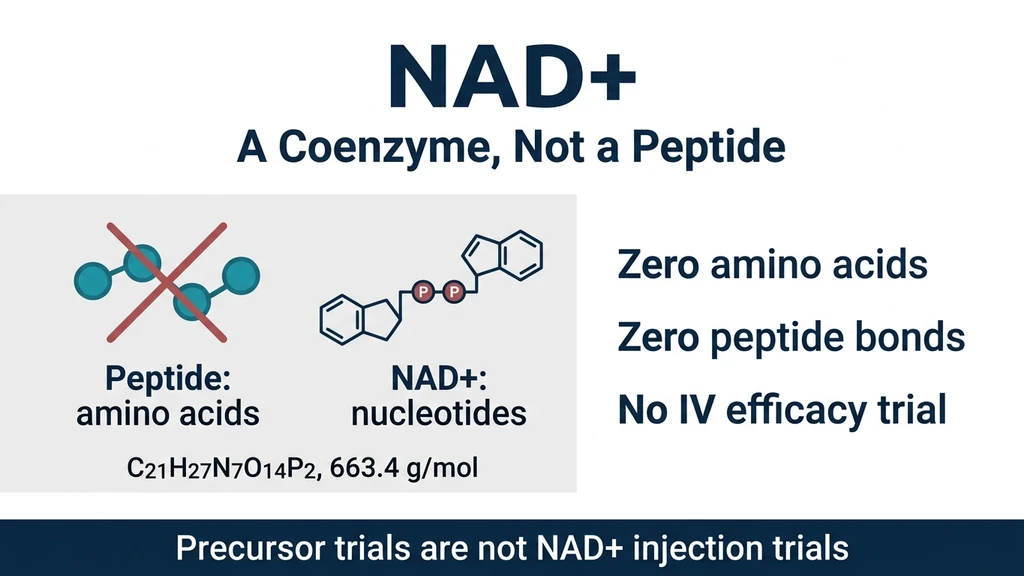
You searched for a NAD peptide and landed on a clinic page selling injections. Check the chemistry before you book. NAD+ (nicotinamide adenine dinucleotide) is a coenzyme, not a peptide. Its molecular formula is C21H27N7O14P2 and its molecular weight is 663.4 g/mol (PubChem CID 5892). It contains zero amino acids and zero peptide bonds. Any vendor selling it as a peptide has the biochemistry wrong.
| Quick Reference | NAD+ |
|---|---|
| Is it a peptide? | No |
| Chemical class | Dinucleotide coenzyme |
| Molecular formula | C21H27N7O14P2 |
| Molecular weight | 663.4 g/mol |
| Amino acids | 0 |
| Peptide bonds | 0 |
| Built from | Adenine, nicotinamide, 2 riboses, 2 phosphates |
| Common clinic routes | IV infusion, subcutaneous injection |
| Placebo-controlled efficacy trials in injected NAD+ | None published |
| Where the human evidence lives | Oral precursors (NR, NMN) |
That last row is the one that decides whether you spend money. The NAD+ profile page covers the molecule itself. What follows is the part clinics skip: what happens to an NAD+ molecule after it leaves the IV bag, and which studies actually measured a benefit.
This is educational content, not medical advice. Review our peptide safety guide before injecting anything.
Get your custom peptide protocol:
- Tailored to your body and goals
- Precise dosing and cycle length
- Safe stacking combinations
- Backed by peer-reviewed studies
- Ready in under 2 minutes
NAD+ Is a Dinucleotide. Peptides Are Chains of Amino Acids.
A peptide is two or more amino acids joined by peptide bonds. The bond is an amide link between the carboxyl group of one residue and the amino group of the next. GHK-Cu has 3 amino acids and 2 peptide bonds. BPC-157 has 15 residues and 14 peptide bonds. Semaglutide has 31 residues and 30 bonds.
NAD+ has none of that. Take it apart and you get two nucleotides bolted together through a pyrophosphate bridge. One half is nicotinamide mononucleotide: a nicotinamide ring, a ribose sugar, a phosphate. The other half is adenosine monophosphate: an adenine base, a ribose sugar, a phosphate. Two nucleotides, hence "di-nucleotide."
There is one amide group in NAD+, the carboxamide hanging off the nicotinamide ring. It links a carbon to a nitrogen. It does not join two amino acids to each other, which is the only thing that makes an amide bond a peptide bond. The count stands at zero.
Think of a coenzyme as a rechargeable battery pack that plugs into hundreds of different machines on a factory floor. It carries no instructions. It carries charge. NAD+ accepts two electrons and a proton at one enzyme, becomes NADH, hands the electrons off at the mitochondrial electron transport chain, and returns as NAD+ to do it again. Literally: NAD+ is a redox cofactor cycling between oxidized and reduced forms, and it also serves as a consumed substrate for sirtuins, PARPs, and CD38 in DNA repair, gene expression, calcium signalling, and immunoregulation (Braidy & Liu, Exp Gerontol, 2020).
Peptides do a different job entirely. They dock into receptors and change what a cell does next. MOTS-c is a 16-amino-acid mitochondrial peptide that alters metabolic signalling; Epitalon is a four-residue tetrapeptide. NAD+ carries no message. It carries electrons. Grouping it with peptides because both arrive in a vial is like filing motor oil under "spark plugs" because both go under the hood.
Why "Just Inject It" Runs Into the Cell Membrane
NAD+ weighs 663.4 g/mol and carries two phosphate groups that sit negatively charged at blood pH. Cell membranes are lipid bilayers. Large charged molecules do not drift across a lipid bilayer without a dedicated transporter, and no established plasma-membrane transporter for intact NAD+ has been identified in humans.
So what happens to the bag? One published human study infused NAD+ intravenously at 3 micromoles per minute for 6 hours, roughly 717 mg of NAD+ delivered over the session. Plasma NAD+ and its metabolites showed no change at all for the first 2 hours. The authors concluded that at that infusion rate NAD+ is "rapidly and completely removed from the plasma," with a metabolite profile consistent with NAD+ glycohydrolase and NAD+ pyrophosphatase activity (Grant et al., Front Aging Neurosci, 2019).
Translation: the molecule gets cleaved in circulation before most of it reaches a cell. At the 6-hour mark the study detected increased urinary excretion of NAD+ itself and of methylnicotinamide. Part of what you paid for leaves in your urine intact.
That study measured where the molecule went. It did not measure whether anyone felt better, thought more clearly, or aged more slowly. Those endpoints have not been tested against placebo in an injected-NAD+ trial. Anyone quoting Grant 2019 as evidence that IV NAD+ works has read the title and not the abstract.
Precursors sidestep the membrane problem by being smaller and, in the case of nicotinamide riboside, uncharged. Blood NAD+ rose as much as 2.7-fold after a single oral dose of NR in a pilot report on one individual, and doses of 100, 300, and 1,000 mg produced dose-dependent increases in the blood NAD+ metabolome in the first human pharmacokinetic trial (Trammell et al., Nat Commun, 2016). Small molecule, oral route, measurable biomarker. That is the whole trick.
Two Expensive Mistakes, Priced Out
Scenario 1: You buy a 12-month IV protocol.
Clinic pricing in 2026 clusters around $299 for a 250 mg drip, $399 for 500 mg, and $599 for 1,000 mg, with the full national range running $250 to $1,500 per session. A standard "loading then maintenance" protocol is 8 infusions of 1,000 mg across 4 weeks, then monthly top-ups.
Run the arithmetic. Loading: 8 x $599 = $4,792. Maintenance: 11 x $599 = $6,589. Year one total: $11,381. Sessions run 90 to 180 minutes each because the drip has to be slowed to keep the burning and chest tightness tolerable, so you also spend roughly 30 hours in a chair.
Oral NR at 1,000 mg/day costs about $50 a month, near $600 a year. The IV protocol costs 19 times more than the precursor that has the randomized controlled trials. The fix: price the protocol in the peptide cost calculator before you sign, then ask the clinic to name one placebo-controlled trial showing injected NAD+ improves a clinical outcome. There is not one. Benchmark the number against our how much do peptides cost breakdown, where a year of most protocols lands under $2,000.
Scenario 2: You accept a citation that swapped four variables.
A clinic hands you the Science 2021 paper as proof. That trial gave 250 mg/day of oral NMN for 10 weeks to postmenopausal women with prediabetes who were overweight or obese, and measured insulin-stimulated glucose disposal with a hyperinsulinemic-euglycemic clamp. Muscle insulin sensitivity and muscle insulin signalling increased (Yoshino M et al., Science, 2021).
To get from that result to "a 1,000 mg IV NAD+ drip will give you energy," you have to substitute the molecule (NMN becomes NAD+), the route (oral becomes intravenous), the population (prediabetic postmenopausal women become you), and the endpoint (a glucose clamp becomes a feeling). Four substitutions. Any one of them alone breaks the inference.
The counterweight is published too. Forty obese, insulin-resistant men took 2,000 mg/day of NR for 12 weeks and showed no improvement in insulin sensitivity, endogenous glucose production, glucose disposal, resting energy expenditure, lipolysis, or body composition (Dollerup et al., Am J Clin Nutr, 2018). Twelve aged men took 1 g/day of NR for 21 days: the muscle NAD+ metabolome rose and circulating inflammatory cytokines fell, while mitochondrial bioenergetics did not change (Elhassan et al., Cell Rep, 2019).
Raising the biomarker is settled. Changing how you feel is not. The fix: before you pay, ask two questions. Which endpoint did the study measure? Is the molecule in the syringe the molecule in the paper? A clinic that cannot answer both in one sentence is selling the citation, not the compound.
How to Tell a Coenzyme From a Peptide on Any Product Label
Four checks, in order. Each takes under ten seconds and none require a chemistry degree.
1. Look for a residue count or a sequence. Peptides get defined by their amino acids. Vendors list them: "pentadecapeptide," "tripeptide-1," "31 amino acids." NAD+ never carries a residue count because it has no residues. If the label says "dinucleotide," "mononucleotide," or "riboside," you are in nucleotide chemistry.
2. Read the molecular formula for phosphorus. Peptides are built from carbon, hydrogen, nitrogen, oxygen, and sometimes sulfur. They do not carry phosphorus in the backbone. The P2 at the end of C21H27N7O14P2 is the pyrophosphate bridge holding the two nucleotides together. Phosphorus in the backbone is a coenzyme or nucleotide tell.
3. Check the suffix. Names ending in -tide, -relin, or -morelin (semaglutide, sermorelin, ipamorelin) are peptides by naming convention. Names ending in -riboside, -mononucleotide, or -dinucleotide are not.
4. Divide the molecular weight by 110. Amino acid residues average roughly 110 daltons. NAD+ at 663.4 g/mol would work out to about 6 residues if it were a peptide. Ask the vendor to name those six. They cannot, because there are none.
| Compound | Class | Amino acids | Peptide bonds | Phosphorus in structure |
|---|---|---|---|---|
| NAD+ | Dinucleotide coenzyme | 0 | 0 | Yes (2 atoms) |
| GHK-Cu | Copper-bound tripeptide | 3 | 2 | No |
| BPC-157 | Pentadecapeptide | 15 | 14 | No |
| MOTS-c | Mitochondrial peptide | 16 | 15 | No |
| Semaglutide | GLP-1 analog peptide | 31 | 30 | No |
What "NAD+ therapy" actually delivers. Once the infusion starts, extracellular enzymes cleave NAD+ into nicotinamide, NMN, and ADP-ribose, and the liver methylates nicotinamide into methylnicotinamide. Those are the species Grant and colleagues measured appearing in plasma and urine. You are paying clinic rates for a slow, parenteral, partially excreted route to nicotinamide, which is over-the-counter vitamin B3.
That distinction matters when you plan a stack. A coenzyme and a receptor-binding peptide do not interact the way two peptides do. Read the peptide stacking guide before mixing NAD+ with 5-Amino-1MQ, which raises intracellular NAD+ by inhibiting the NNMT enzyme rather than by supplying substrate from outside the cell.
NAD+ vs NR vs NMN vs NAM vs Niacin: The Reference Table
Five molecules get sold under the same longevity banner. Only two of them have randomized controlled trials measuring anything past a blood level, and neither of those two is injected NAD+.
| Compound | What it is | Typical route | What human trials measured | Evidence tier |
|---|---|---|---|---|
| NAD+ (nicotinamide adenine dinucleotide) | Dinucleotide coenzyme, 663.4 g/mol, C21H27N7O14P2 | IV infusion, subcutaneous, nasal | Plasma and urine metabolite kinetics during a 6-hour infusion. No efficacy endpoint. | No placebo-controlled efficacy trial |
| NMN (nicotinamide mononucleotide) | Nucleotide, one-step NAD+ precursor | Oral | Muscle insulin sensitivity by glucose clamp; blood NAD+, 4-metre walking time, sleep quality | Small RCTs, mixed results |
| NR (nicotinamide riboside) | Nucleoside, vitamin B3 form | Oral | Blood NAD+ up to 2.7-fold single dose; muscle NAD+ metabolome; inflammatory cytokines; no insulin sensitivity change | Multiple RCTs, biomarker positive, outcomes thin |
| NAM (nicotinamide) | Vitamin B3 amide | Oral | NAD+ salvage substrate; the metabolite your IV NAD+ becomes anyway | Well characterized as a vitamin |
| NA (nicotinic acid / niacin) | Vitamin B3 acid | Oral | Raises NAD+; flushing at gram doses | Long-established vitamin |
| Peptides (for contrast) | Amino acid chains, 2 to 40+ residues | Subcutaneous, topical, oral | Receptor-mediated outcomes | Varies by peptide |
What the human evidence supports, stated precisely. Oral NR at 1,000 mg/day for 6 weeks was well tolerated and stimulated NAD+ metabolism in healthy middle-aged and older adults, with the authors calling for future trials on blood pressure and arterial stiffness rather than claiming the effect (Martens et al., Nat Commun, 2018). Oral NMN at 250 mg/day for 12 weeks in 60 older adults raised blood NAD+, shortened 4-metre walking time, and improved sleep quality scores, while missing its primary endpoint on a stepping test (Morifuji et al., Geroscience, 2024).
A systematic review of the field screened 1,545 articles and included 147, of which only 34 were clinical. Most of the favourable signal came from NAM, NR, and NMN, with NAD+ and NADH themselves contributing "to a lesser extent" (Braidy & Liu, Exp Gerontol, 2020). The molecule with the loudest marketing has the quietest evidence base.
If your goal is energy rather than a specific molecule, the MOTS-c dosage protocol at least deals in a receptor-level mechanism with published human dosing. Mitochondrial function has more than one lever, and NAD+ substrate supply is the one with the thinnest injectable evidence.
Four Mistakes That Cost People Money
Mistake 1: Ordering "NAD peptide" from a research chemical vendor. No such molecule exists. What arrives is NAD+ disodium salt, NMN powder, or NR chloride, priced as if it were exotic. The fix: open the certificate of analysis and read the formula line. C21H27N7O14P2 is NAD+. Anything with a residue sequence is a peptide. Vet the source using where to buy peptides in 2026 before ordering.
Mistake 2: Stacking NAD+ with three real peptides and crediting NAD+. You start IV NAD+, BPC-157, and a growth hormone secretagogue in the same week, feel better, and re-book the drip at $599. Four variables changed and you attributed the result to the most expensive one. The fix: change one variable at a time, hold it for 4 weeks, log the outcome. Screen combinations in the peptide interaction checker first.
Mistake 3: Reading "raised blood NAD+" as "reversed aging." A 2.7-fold rise in blood NAD+ is a pharmacokinetic result, and every trial above that measured a biomarker also failed to demonstrate a matching functional outcome, except the two small studies noted in the table. Blood NAD+ is what got measured. Aging is what got advertised. The fix: separate biomarker studies from outcome studies whenever you evaluate a longevity claim, the same discipline applied in our SLU-PP-332 analysis.
Mistake 4: Switching to subcutaneous NAD+ because it is cheaper. Same molecule, same 663.4 g/mol, same two negative charges, same extracellular cleavage before it reaches a cell. The only thing that changed is the price and the injection site burn. No controlled efficacy trial supports either route. The fix: if the goal is raising NAD+, oral precursors have the trial data at roughly 5% of the cost. Review peptide therapy side effects before you inject anything, coenzyme or otherwise.
Frequently Asked Questions
Is NAD a peptide?
No. NAD+ is a dinucleotide coenzyme with the formula C21H27N7O14P2 and a molecular weight of 663.4 g/mol. It contains 0 amino acids and 0 peptide bonds, which is the definitional requirement for a peptide. It is built from adenine, nicotinamide, two riboses, and two phosphates. See the NAD+ profile.
What is NAD peptide?
"NAD peptide" is a marketing term with no chemical meaning. Vendors group NAD+ with injectable peptides because both get sold by the vial and both get injected. Chemically NAD+ is a coenzyme, closer to a vitamin B3 derivative than to any amino acid chain. Read getting started with peptides for the real categories.
What are NAD peptide benefits, and are they proven?
Oral precursors reliably raise blood NAD+: up to 2.7-fold after a single 1,000 mg NR dose (Trammell, Nat Commun, 2016). Functional benefits are thin. A 12-week NMN trial in 60 older adults improved 4-metre walking time and sleep quality but missed its primary endpoint. Injected NAD+ has no placebo-controlled efficacy trial. Compare peptides for energy.
What is a typical NAD peptide dosage?
Clinics infuse 250 to 1,000 mg IV over 90 to 180 minutes, or 50 to 100 mg subcutaneously. Neither dose comes from a controlled efficacy trial. Trial-backed doses exist only for oral precursors: NR at 1,000 to 2,000 mg/day and NMN at 250 mg/day. Convert units with the peptide unit converter.
Does an NAD peptide injection actually work?
The one published human infusion study found NAD+ is rapidly and completely cleared from plasma, with no change in plasma metabolites for the first 2 hours and increased urinary excretion by hour 6 (Grant, Front Aging Neurosci, 2019). It measured where the molecule went, not whether patients improved. Price the alternative in the peptide cost calculator.
Is NAD+ better than NMN or NR?
The evidence points the other way. NR and NMN are smaller, orally bioavailable, and carry the randomized controlled trials. NAD+ at 663.4 g/mol carries two negative charges and cannot cross a cell membrane intact, so it gets cleaved into nicotinamide before arrival. Oral precursors cost near $600 a year against roughly $11,000 for IV. See peptide therapy cost.
Is "NAD plus peptide" the same as NAD+?
Yes, the product is the same molecule. "NAD plus" is how vendors spell the plus sign in NAD+, which denotes the oxidized form that accepts electrons and becomes NADH. Adding the word "peptide" changes nothing about the chemistry. It contains 0 peptide bonds either way. The NAD+ profile page covers the redox cycle.
Can you stack NAD+ with real peptides?
People do, commonly with Epitalon or MOTS-c. A coenzyme and a receptor-binding peptide act through different pathways, so a direct interaction is unlikely. Stacking four compounds at once still makes attribution impossible. Add one variable, hold it 4 weeks, log the result before adding the next.
The Bottom Line
NAD+ is a coenzyme. Formula C21H27N7O14P2, molecular weight 663.4 g/mol, zero amino acids, zero peptide bonds. Calling it a peptide is a category error that survives only because it helps sell $599 infusions.
The evidence follows the chemistry. Small oral precursors like NR and NMN cross membranes, raise blood NAD+, and have randomized controlled trials behind them. A large, doubly charged dinucleotide dripped into a vein gets cleaved before it arrives, and no placebo-controlled trial has shown that the drip improves a single clinical outcome. Trials measured NAD+ blood levels. Clinics advertise energy, cognition, and aging. Those are different endpoints.
If a vendor calls NAD+ a peptide, ask which amino acids it contains. Then price the year of infusions against a bottle of oral precursor before you commit. Start with the peptide cost calculator, read the NAD+ profile, and explore verified peptide research at PeptidesExplorer.com. Work with a healthcare provider before starting any injectable protocol.
Helpful Tools
Related Articles
Humanin Peptide: Benefits, Dosing, Safety
Humanin is a 24-amino-acid mitochondrial peptide studied for neuroprotection since 2001. What the research shows, reported protocols, and the safety gaps.
Where to Inject IGF-1 LR3: Sites, SubQ vs IM, Rotation
Where to inject IGF-1 LR3: abdomen, thigh or glute, subcutaneous, 29-31G needle. Why site-specific growth is a myth, a rotation map, and the hypoglycemia rule.
When to Take IGF-1 LR3: Best Time & Fed vs Fasted
When to take IGF-1 LR3: post-workout with carbs on training days, morning with breakfast on rest days, never fasted. Half-life, spacing from GH peptides, FAQ.
Where to Inject BPC-157 for Back Pain: Lower Back Sites
Where to inject BPC-157 for lower back pain, herniated disc, sciatica and SI joint pain: abdomen vs paraspinal sites, landmarks, zones to avoid, red flags.