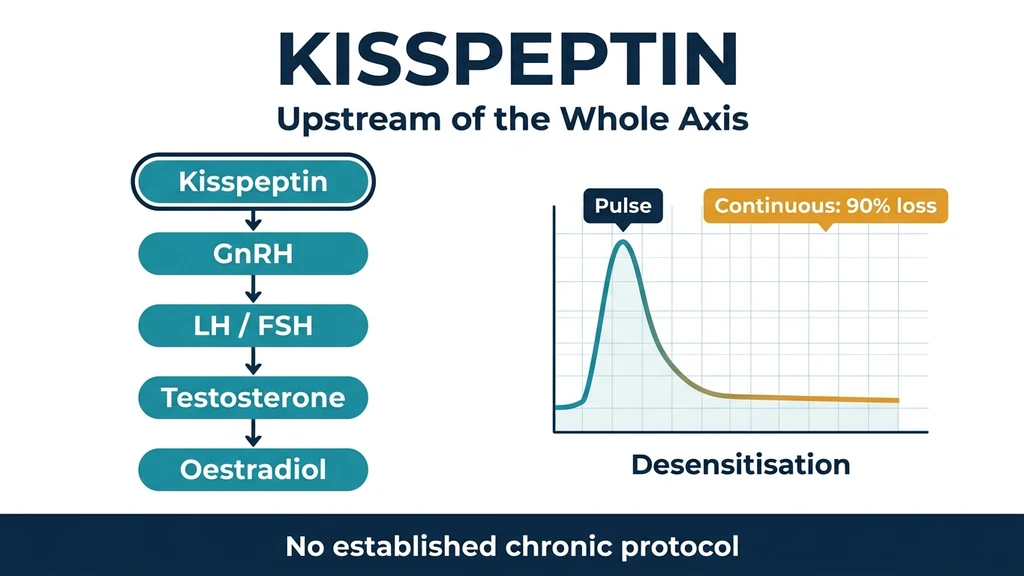
You are holding a vial labeled kisspeptin-10 and reading a forum post that promises a testosterone jump. Here is the answer: kisspeptin is a hypothalamic peptide that switches on GnRH neurons, which release LH and FSH, which drive testosterone and estradiol. It raises LH within 30 minutes in men. Every human dose on record came from a supervised intravenous infusion, and no chronic dosing protocol exists.
That gap between "it works acutely" and "nobody knows how to dose it for weeks" is the whole story. Kisspeptin is the strongest single lever on the reproductive axis that has ever been put into a human vein. Pull it the wrong way and the axis goes quiet instead of loud.
| Quick Reference | Details |
|---|---|
| What it is | Product of the KISS1 gene, acts on the KISS1R receptor (also called GPR54) |
| Where it acts | Hypothalamus, one step above GnRH neurons |
| Cascade order | Kisspeptin → GnRH → LH and FSH → testosterone / estradiol |
| Main forms | Kisspeptin-10 (C-terminal decapeptide), kisspeptin-54 (metastin) |
| Circulating half-life | ~4 minutes (KP-10) vs ~32 minutes (KP-54) |
| Human evidence | IV research infusions, IVF triggering, diagnostic HPG testing |
| Established chronic protocol | None |
| Main pharmacological risk | Receptor desensitization under continuous exposure |
| FDA approval | None, for any indication |
Nothing here is a protocol. This is educational, not medical advice, and every number below is a research infusion dose recorded under monitoring. See our peptide safety guide before you touch anything that moves a hormone axis.
Get your custom peptide protocol:
- Tailored to your body and goals
- Precise dosing and cycle length
- Safe stacking combinations
- Backed by peer-reviewed studies
- Ready in under 2 minutes
Where Kisspeptin Sits in the Hormone Chain
A car engine has a governor that sets how often the spark fires, and it has a throttle that sets how much fuel reaches the cylinder. Testosterone therapy grabs the fuel line. Kisspeptin puts a hand on the governor and changes how often the spark fires.
Literally: kisspeptin binds KISS1R on GnRH neurons in the hypothalamus. Those neurons release GnRH in pulses. GnRH reaches the anterior pituitary, which secretes LH and FSH. LH tells Leydig cells to make testosterone; FSH supports Sertoli cells and spermatogenesis. Kisspeptin acts at the top of that chain and nowhere else.
Kisspeptin was identified as the natural ligand of the orphan receptor GPR54 in 2001, isolated from human placenta as peptides of 54, 14, and 13 amino acids (Kotani et al., J Biol Chem, 2001, PMID 11457843). Two years later, loss-of-function mutations in GPR54 were shown to cause idiopathic hypogonadotropic hypogonadism in humans, proving the receptor is required for puberty (Seminara et al., N Engl J Med, 2003, PMID 14573733).
That genetic evidence is why kisspeptin gets called a master switch. Without a working KISS1R, puberty does not start. This puts kisspeptin in a different category from the growth hormone secretagogues most people mean when they say "peptides for testosterone," and our best peptides for testosterone breakdown explains why sermorelin, CJC-1295, and ipamorelin move IGF-1 without moving your testosterone number.
Kisspeptin-10 vs Kisspeptin-54: Same Signal, Different Clock
Both fragments come from the same KISS1 precursor and bind the same receptor. Kisspeptin-54 is the full-length form originally named metastin. Kisspeptin-10 is the C-terminal decapeptide, the shortest sequence that still activates KISS1R.
The difference is duration. Kisspeptin-54 circulates with a half-life of roughly 32 minutes, kisspeptin-10 with a half-life of roughly 4 minutes, an eight-fold gap that explains why KP-54 sustains LH release far longer per dose (d'Anglemont de Tassigny et al., PLoS One, 2017, PMID 28464043).
Four minutes is shorter than the time it takes to swab a vial and draw a syringe. A peptide that clears that fast cannot produce a steady blood level from an intermittent subcutaneous injection, which is one reason the research literature runs it as a controlled IV infusion rather than a shot. You can model comparative clearance for any compound with the peptide half-life tracker.
Kisspeptin-54 carried the fertility work: it triggers final oocyte maturation in IVF (Jayasena et al., J Clin Invest, 2014, PMID 25036713). Kisspeptin-10 carried most of the male LH-pulse work. Vendors sell both under one "kisspeptin peptides" label as though they were interchangeable, then cite a KP-54 trial on a KP-10 product page.
What Human Trials Actually Measured
Almost all human kisspeptin data comes from one research lineage: the Imperial College London group led by Waljit Dhillo, working in healthy volunteers, fertility patients, and diagnostic settings. These are research infusions under monitoring, not take-home protocols.
In the first human study, six healthy men received kisspeptin-54 by intravenous infusion at 4 pmol/kg/min for 90 minutes. Mean 90-minute LH rose to 10.8 U/L against 4.2 U/L on saline, FSH to 3.9 U/L against 3.2 U/L, and mean 180-minute testosterone to 24.9 nmol/L against 21.7 nmol/L (Dhillo et al., J Clin Endocrinol Metab, 2005, PMID 16174713).
Kisspeptin-10 was then mapped by IV bolus across 0.01 to 3.0 mcg/kg in six healthy men. At 1 mcg/kg, LH climbed from 4.1 to 12.4 IU/L within 30 minutes. A 22.5-hour infusion at 4 mcg/kg/h raised LH from 5.4 to 20.8 IU/L and testosterone from 16.6 to 24.0 nmol/L, while a 1.5 mcg/kg/h infusion increased LH pulse frequency from 0.7 to 1.0 pulses per hour (George et al., J Clin Endocrinol Metab, 2011, PMID 21632807).
Kisspeptin-10 also raised LH pulse frequency and testosterone in men with type 2 diabetes and mild biochemical hypogonadism, which is the closest the literature comes to a clinical population of interest (George et al., Clin Endocrinol (Oxf), 2013, PMID 23153270).
Read those numbers as what they are: hours of intravenous exposure in a research unit with serial blood draws. None of them tell you what a subcutaneous injection does on week six. Anyone selling you a weekly kisspeptin schedule is extrapolating past the edge of the data, the same way vendors do with the compounds covered in where to buy peptides.
Danger Scenario 1: Continuous Dosing Shuts Down the Axis You Meant to Start
This is the point most kisspeptin pages skip entirely, and it inverts the intended effect.
Receptors that read a pulsed signal go deaf to a constant one. It is the mechanism behind GnRH agonist therapy: pulsatile GnRH stimulates the pituitary, while continuous GnRH agonism desensitizes it and suppresses LH, which is precisely how these drugs are used to shut down testosterone in prostate cancer (Conn & Crowley, N Engl J Med, 1991, PMID 1984190). KISS1R obeys the same rule.
The human number is unambiguous. Women with hypothalamic amenorrhea received kisspeptin-54 at 6.4 nmol/kg subcutaneously, twice daily, for two weeks. On day 1 the mean maximal LH increment was 24.0 IU/L. By day 14, the identical injection produced 2.5 IU/L. FSH fell from a 9.1 IU/L increment to 0.5 IU/L (Jayasena et al., J Clin Endocrinol Metab, 2009, PMID 19820030).
Run the arithmetic. The LH response retained 10% of its day-1 size, a 90% loss. The FSH response retained 5%, a 95% loss. Two weeks of twice-daily dosing turned a potent stimulator into an inert injection, and the axis it was meant to drive was quieter at the end than at the start.
A man dosing kisspeptin-10 daily to "keep levels up" is running that experiment on himself with a peptide that clears in four minutes and no LH assay to catch the collapse. Lowering the dose does not solve it, because the problem is exposure time rather than amount. No published human schedule preserves the response beyond acute administration, which is why this belongs with an endocrinologist or nowhere. If the goal is protecting testicular function on TRT, gonadorelin has real pulsatile dosing precedent, described in peptides for men over 40.
Danger Scenario 2: An LH Spike Proves Almost Nothing About Testosterone
The second failure is reading a headline LH number as a testosterone result.
Go back to the Dhillo 2005 figures. LH rose from 4.2 to 10.8 U/L, an increase of 157%. Testosterone over the same window rose from 21.7 to 24.9 nmol/L, an increase of 14.7%. In US units, that is 626 ng/dL moving to 718 ng/dL: a gain of 92 ng/dL, in men who already sat mid-range, measured 180 minutes into a monitored infusion.
A 157% LH surge bought a 15% testosterone bump that lasted hours. Even George's 22.5-hour continuous infusion at 4 mcg/kg/h, a dose no one is replicating at home, moved testosterone from 479 ng/dL to 692 ng/dL and stopped when the drip stopped.
Here is how the mistake plays out. A man injects kisspeptin-10, draws labs 45 minutes later, sees LH at 12 IU/L against his usual 4, and concludes the compound is working. He has measured a receptor firing. The Leydig cell response lags LH by hours, testosterone synthesis runs against its own ceiling, and by the next morning both numbers sit back at baseline.
The fix is a trough draw, not a peak draw. Measure total testosterone on a separate morning at least 24 hours after any dose, twice, before you believe anything changed. Compare against the framing in peptides vs steroids, where the difference between stimulating your own production and replacing it decides the entire risk profile.
How to Read an LH, FSH, and Total Testosterone Panel
Nobody teaches this, and it is the one skill that separates people who understand their HPG axis from people who buy vials.
Order all three together. Total testosterone alone cannot tell you where the problem lives. Typical adult male reference ranges: LH 1.7 to 8.6 IU/L, FSH 1.5 to 12.4 IU/L, total testosterone 300 to 1,000 ng/dL. Draw before 10 a.m., fasted, and repeat on a second morning, because a single testosterone value misclassifies roughly a third of men.
Read the pattern, not the numbers in isolation.
- 1.Low testosterone, high LH and FSH. The pituitary is shouting and the testes are not answering. This is primary hypogonadism. Kisspeptin cannot help; the signal is already maximal.
- 2.Low testosterone, low or inappropriately normal LH and FSH. The signal itself is missing. This is secondary hypogonadism, the only pattern where an upstream compound is even mechanistically plausible.
- 3.Normal testosterone, normal LH. There is nothing for kisspeptin to fix, and desensitization is the only outcome available.
Now the part that matters. GnRH arrives in pulses roughly every 60 to 120 minutes, and LH follows it. Your LH value at 8:14 a.m. can differ two-fold to three-fold from your LH value at 9:02 a.m. on the same morning without anything changing.
That is why a single post-injection LH spike is worthless as evidence. The research groups measuring kisspeptin's real effect on pulse frequency sampled blood every 10 minutes for 8 to 10 hours and applied deconvolution analysis to LH secretory bursts. One venipuncture 45 minutes after a shot captures noise. Bring the full panel and the timing to a physician who reads endocrine labs, and use peptide therapy side effects to frame what else to monitor.
Kisspeptin vs Gonadorelin vs hCG vs Enclomiphene
Five compounds, four different entry points into the same axis. The higher up the chain a compound acts, the more of the natural feedback loop stays intact, and the more the pulsatility problem matters.
| Compound | What it does | Where it acts | Human evidence | Key limit |
|---|---|---|---|---|
| Kisspeptin-10 | Activates KISS1R on GnRH neurons | Hypothalamus, above GnRH | IV bolus and infusion in healthy men; LH 4.1 → 12.4 IU/L at 1 mcg/kg (George 2011) | ~4 min half-life; no chronic protocol |
| Kisspeptin-54 | Same receptor, longer exposure | Hypothalamus, above GnRH | IVF oocyte trigger; LH and testosterone rise in men (Dhillo 2005; Abbara 2015) | Tachyphylaxis by day 14 of twice-daily dosing (Jayasena 2009) |
| Gonadorelin | Synthetic GnRH, pulsatile LH/FSH release | Pituitary | Established endocrine use; pulse-pump therapy for hypothalamic hypogonadism | Continuous exposure suppresses LH (Conn 1991) |
| hCG | Mimics LH directly at the testis | Testis (Leydig cells) | Long clinical history for fertility and TRT adjunct | Bypasses pituitary; no feedback preserved |
| Enclomiphene | Blocks estrogen negative feedback | Pituitary / hypothalamus | Phase II: raised morning testosterone and LH while preserving sperm counts (Wiehle et al., Fertil Steril, 2014, PMID 25044085) | Oral SERM, not a peptide; estrogenic side effects |
Kisspeptin-54 triggering is the most convincing clinical result in the whole file. At 3.2 to 12.8 nmol/kg, oocyte maturation occurred in 95% of women, and no woman developed moderate, severe, or critical ovarian hyperstimulation syndrome (Abbara et al., J Clin Endocrinol Metab, 2015, PMID 26192876). Note what that trial is: one dose, one moment, one supervised outcome. That is where kisspeptin shines and where the evidence stops.
For how these fit alongside everything else men reach for, see peptides for men.
Desire, Fertility, and the Brain
Kisspeptin does something the pure endocrine story misses. It changes limbic brain activity, and it does so at doses that also move LH.
In 29 healthy men, intravenous kisspeptin at 1 nmol/kg/h for 75 minutes enhanced activity in limbic structures during sexual and couple-bonding imagery, with changes that tracked mood and reduced sexual aversion (Comninos et al., J Clin Invest, 2017, PMID 28112678).
A randomized trial then took 32 men with hypoactive sexual desire disorder through the same 75-minute kisspeptin-54 infusion. Penile tumescence in response to sexual stimuli increased by up to 56% over placebo, alongside modulation of the sexual-processing network (Mills et al., JAMA Netw Open, 2023, PMID 36735255).
That is a genuinely central mechanism, and a different one from PT-141, which works through melanocortin receptors, or oxytocin, which works through bonding and smooth-muscle pathways. Compare the routes in peptides for libido.
The catch repeats. Both trials were single 75-minute intravenous infusions in a scanner suite. Neither says a syringe of kisspeptin-10 at home on Tuesday does anything on Friday.
Common Mistakes
Mistake 1: Dosing kisspeptin daily or continuously. Twice-daily kisspeptin-54 for 14 days cut the LH response by 90% and the FSH response by 95% (Jayasena 2009). Desensitization is the default outcome of steady exposure rather than a rare complication. The fix: no chronic schedule, because no validated one exists.
Mistake 2: Treating kisspeptin-10 and kisspeptin-54 as the same product. A 4-minute half-life and a 32-minute half-life behave nothing alike. The fix: check which fragment a study used before you cite it, and model clearance with the peptide half-life tracker.
Mistake 3: Judging results from a post-injection LH draw. LH swings two-fold to three-fold across a single morning on its own. The fix: two trough morning total testosterone draws, 24 hours clear of any dose, with LH and FSH on the same tube. Never stack an axis-active compound blind, and check combinations in the peptide stacking guide.
Mistake 4: Assuming research-grade means human-grade. Every kisspeptin dose in the literature was a sterile, weight-adjusted IV preparation given under monitoring. A vendor vial is none of those things. The fix: understand the legal and quality landscape in are peptides legal before you order anything.
Frequently Asked Questions
What is kisspeptin peptide used for?
In research, kisspeptin is used to stimulate the reproductive axis: triggering oocyte maturation in IVF, testing hypothalamic-pituitary function, and probing sexual brain processing. It has no FDA approval for any indication. Recreational use for testosterone rests entirely on acute infusion data. See best peptides for testosterone for how it compares.
Does kisspeptin 10 raise testosterone?
Acutely, yes. A 1 mcg/kg intravenous bolus raised LH from 4.1 to 12.4 IU/L within 30 minutes in healthy men, and a 22.5-hour infusion raised testosterone from 479 to 692 ng/dL (George 2011). The rise stops when the infusion stops. No study shows durable gains. See peptides for men over 40.
What is the kisspeptin dose used in studies?
Kisspeptin-10 was given as IV boluses of 0.01 to 3.0 mcg/kg, or infusions of 1.5 to 4 mcg/kg/h. Kisspeptin-54 was given at 4 pmol/kg/min IV for 90 minutes, or 3.2 to 12.8 nmol/kg for IVF triggering. These are monitored research infusions, not self-administration protocols. Review the peptide safety guide.
Kisspeptin-10 or kisspeptin-54: which is stronger?
Kisspeptin-54 produces a longer LH response because it survives roughly 32 minutes in circulation against about 4 minutes for kisspeptin-10 (d'Anglemont de Tassigny 2017). Potency per molecule is similar; exposure time differs eight-fold. Model that difference with the peptide half-life tracker.
Can kisspeptin suppress testosterone instead of raising it?
Yes. Twice-daily kisspeptin-54 for two weeks cut the LH response from a 24.0 IU/L increment to 2.5 IU/L, a 90% loss through receptor desensitization (Jayasena 2009). Continuous KISS1R stimulation silences the axis, the same way continuous GnRH agonism does. Pulsatile alternatives are discussed under gonadorelin.
Is kisspeptin the same as gonadorelin?
No. Gonadorelin is synthetic GnRH and acts on the pituitary to release LH and FSH. Kisspeptin acts one level higher, on the hypothalamic GnRH neurons themselves, through the KISS1R receptor. Gonadorelin has decades of established pulsatile clinical use; kisspeptin has none outside research settings. Compare both in the gonadorelin profile.
Does kisspeptin increase libido?
In 32 men with hypoactive sexual desire disorder, a 75-minute kisspeptin-54 infusion increased penile tumescence to sexual stimuli by up to 56% versus placebo (Mills, JAMA Netw Open, 2023). That was a single supervised IV dose. For compounds with take-home dosing data, see PT-141 for men.
Is kisspeptin FDA approved?
No. Kisspeptin has no FDA approval for testosterone, fertility, or libido, and every vial sold online is labeled research-use-only. There is no established chronic dosing protocol and no long-term human safety data. Understand the regulatory position in are peptides legal before buying anything.
The Bottom Line
Kisspeptin acts on KISS1R on hypothalamic GnRH neurons, one step above GnRH, and drives LH, FSH, and then testosterone or estradiol. That is the most upstream lever on the reproductive axis that has been given to humans, and it works within 30 minutes of an intravenous dose.
The same position that makes it powerful makes it fragile. A receptor built to read pulses stops answering a constant signal, and two weeks of twice-daily kisspeptin-54 cut the LH response by 90%. There is no published schedule that avoids that, which is why no honest page can hand you a dosing protocol.
If your total testosterone is low, get LH and FSH drawn on two separate mornings before you consider any compound, and take the results to a physician who reads endocrine panels. Then compare the mechanisms in best peptides for testosterone, price the realistic options with the peptide cost calculator, and read the full kisspeptin profile at PeptidesExplorer.com.
Helpful Tools
Related Articles
Kisspeptin Dosage: Every Human Study Dose Explained
Kisspeptin dosage from human trials: KP-10 at 0.01-3 mcg/kg, KP-54 at 3.2-12.8 nmol/kg. Doses for men and women, mcg conversions, and why they desensitize.
Where to Inject IGF-1 LR3: Sites, SubQ vs IM, Rotation
Where to inject IGF-1 LR3: abdomen, thigh or glute, subcutaneous, 29-31G needle. Why site-specific growth is a myth, a rotation map, and the hypoglycemia rule.
When to Take IGF-1 LR3: Best Time & Fed vs Fasted
When to take IGF-1 LR3: post-workout with carbs on training days, morning with breakfast on rest days, never fasted. Half-life, spacing from GH peptides, FAQ.
How to Reconstitute Tesamorelin: Water Volumes & Units
How to reconstitute tesamorelin: bacteriostatic water volumes for 2, 5, 10 and 20 mg vials, U-100 unit math, mixing steps, storage window, and bad-vial signs.