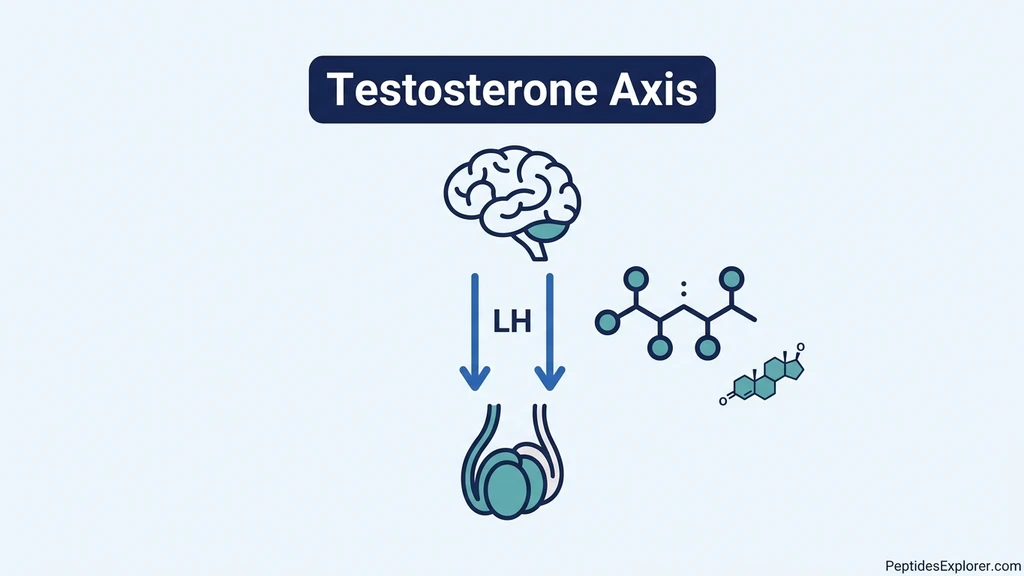
You read that peptides "boost testosterone," bought a vial of CJC-1295, and your follow-up labs barely moved. Here is the honest answer most vendors skip: the peptides that actually raise your own testosterone are gonadorelin and kisspeptin, because they act on the testosterone axis directly. The popular growth hormone peptides do not reliably raise serum testosterone at all.
Two different signaling systems get marketed under one label. One stimulates luteinizing hormone and tells your testes to produce testosterone. The other releases growth hormone and changes body composition, with no dependable effect on your testosterone number. If you are weighing that growth-hormone route against injectable HGH, see HGH or peptides.
Quick-reference: peptides and testosterone, by mechanism
| Peptide | Axis | Raises Serum Testosterone? | Evidence |
|---|---|---|---|
| Kisspeptin | HPG | Yes, acutely | Human trials (George et al.) |
| Gonadorelin (GnRH) | HPG | Yes, when pulsatile | Established endocrine use |
| Sermorelin | GH/IGF-1 | No (indirect at most) | GH-axis trials |
| CJC-1295 | GH/IGF-1 | No | GH-axis trials |
| Ipamorelin | GH/IGF-1 | No | GH-axis trials |
| MK-677 | GH/IGF-1 | No | Oral secretagogue trials |
For protocol context, see does sermorelin increase testosterone, and for the broader picture read peptides for men.
Get your custom peptide protocol:
- Tailored to your body and goals
- Precise dosing and cycle length
- Safe stacking combinations
- Backed by peer-reviewed studies
- Ready in under 2 minutes
The HPG Axis vs the GH Axis: Why It Matters
Your testosterone is governed by the hypothalamic-pituitary-gonadal (HPG) axis. The hypothalamus releases gonadotropin-releasing hormone (GnRH) in pulses. GnRH tells the pituitary to release luteinizing hormone (LH), and LH tells the Leydig cells in the testes to make testosterone.
Growth hormone runs on a separate circuit. GH-releasing peptides like sermorelin and CJC-1295 act on the pituitary to release growth hormone, which raises IGF-1. That pathway changes fat and muscle. It does not pull the LH lever that drives testosterone.
Think of it like two breaker switches on the same panel. One switch powers the testosterone circuit (GnRH to LH to Leydig cells). The other powers growth hormone. Flipping the GH switch lights up body composition, but the testosterone circuit stays exactly where you left it. A peptide raises your testosterone only if it acts on the HPG breaker.
Kisspeptin: The Most Direct Testosterone Signal
Kisspeptin sits upstream of GnRH and is the master trigger for the entire reproductive axis. When kisspeptin neurons fire, they drive GnRH release, which raises LH, which raises testosterone. This is the most direct peptide mechanism for endogenous testosterone available.
In healthy men, intravenous kisspeptin-54 increased LH and raised serum testosterone, confirming kisspeptin as a potent stimulator of the gonadotropic axis (Dhillo et al., J Clin Endocrinol Metab, 2005). Subsequent human work mapped the dose-response of kisspeptin on LH pulsatility and testosterone in men (George JT et al., J Clin Endocrinol Metab, 2011). Kisspeptin also stimulated testosterone secretion in men with hypogonadotropic conditions (George JT et al., Clin Endocrinol, 2013).
The catch is duration. Most human data measures acute hours-long rises, not months of stable elevation. Kisspeptin preserves the natural pulsatile signal rather than overriding it, which is why it draws interest from men who want to protect fertility. For where it fits among male protocols, see peptides for men over 40.
Gonadorelin: GnRH on Demand
Gonadorelin is synthetic GnRH, the exact hormone your hypothalamus uses to start the testosterone cascade. Delivered in pulses, it stimulates the pituitary to release LH and FSH, which raises testosterone and supports sperm production. This is established endocrinology, used clinically to test and drive the HPG axis.
Pulsatility is the rule that makes or breaks it. Natural GnRH arrives in pulses every 60 to 120 minutes. Steady continuous exposure does the opposite of what you want: it desensitizes the pituitary and shuts LH down, which is exactly how GnRH agonists are used to suppress testosterone in prostate cancer (Conn & Crowley, N Engl J Med, 1991). Pulsatile gonadorelin restored normal LH pulses and testosterone in men with hypothalamic hypogonadism (Crowley et al., Recent Prog Horm Res, 1985).
In practice, gonadorelin is dosed in small, frequent amounts (often around 100 to 200 mcg, two or more times daily) to mimic that pulse. It is widely used to maintain testicular function and fertility alongside TRT. See gonadorelin for the full profile and how to inject peptides for technique.
Gonadorelin replaced an older drug, hCG, in many men's protocols because it works one step higher on the axis. hCG mimics LH directly at the testes. Gonadorelin instead asks the pituitary to make its own LH, which keeps more of the natural feedback loop intact, which is why younger men trying to protect fertility favor it.
The GH Peptides: Body Composition, Not Testosterone
This is where most marketing goes wrong. Sermorelin, CJC-1295, ipamorelin, tesamorelin, and the oral secretagogue MK-677 all raise growth hormone and IGF-1. None of them reliably raises serum testosterone.
Sermorelin restores GH pulsatility through the GH-releasing hormone receptor, with no LH-driven testosterone mechanism (Walker, Clin Interv Aging, 2006). The honest breakdown lives in does sermorelin increase testosterone. CJC-1295 and ipamorelin together raise GH and IGF-1 but act outside the HPG axis, covered in CJC-1295 + ipamorelin benefits and compared in tesamorelin vs ipamorelin.
Why People Confuse the Two
GH peptides make men feel better. Sleep deepens, fat drops, recovery speeds up, and energy improves. Those changes feel like a testosterone bump, so the effect gets misattributed.
There is also a weak indirect link. Healthy sleep and lower body fat support better testosterone over time, and GH peptides can help both. That is real, but it is slow, small, and not a direct testosterone mechanism. MK-677 raises IGF-1 and appetite without touching LH, so expecting it to fix low testosterone leads to disappointment.
Where GH Peptides Still Fit
For libido and erectile quality, the lever is often neurological, not testosterone at all. PT-141 for men acts on melanocortin receptors in the brain, and the wider topic is covered in libido.
If your goal is body composition and recovery, the GH stack is a legitimate tool. If your goal is a higher testosterone number on a blood test, it is the wrong tool. Match the molecule to the actual target.
Who Actually Uses These Peptides
The men reaching for HPG-axis peptides usually fall into three groups. The first is younger men with secondary hypogonadism who want to raise testosterone without shutting down their own production, which exogenous testosterone tends to do. Gonadorelin and kisspeptin keep the testes signaling rather than going dormant.
The second group is men already on TRT who add gonadorelin to preserve testicular size and fertility, since standard testosterone replacement suppresses LH and sperm output. This is a maintenance role, not a testosterone-raising one, and it sits alongside the broader options in peptides for men over 50.
The third group is men chasing recovery, sleep, and fat loss who are better served by GH peptides and should stop expecting a testosterone change. None of these peptides is FDA-approved to raise testosterone in healthy men, and all carry the usual research-compound caveats around purity and sourcing. Bloodwork comes first in every case.
Quantified Reality Check
Scenario 1: The misdirected stack. A man with total testosterone at 320 ng/dL runs CJC-1295 + ipamorelin for 12 weeks expecting his number to climb. IGF-1 rises and waist size drops, but LH never moves and testosterone stays near 320 ng/dL. Twelve weeks lost on the wrong axis. The fix is bloodwork that includes LH and FSH before choosing a compound.
Scenario 2: Continuous instead of pulsatile. A man dosing gonadorelin once daily as a steady "boost" sees LH and testosterone fall instead of rise, because constant GnRH exposure desensitizes the pituitary the same way prostate-cancer therapy intentionally does. The fix is small, frequent pulses, and physician oversight to time them. Confirm dosing logic against the peptide dosage chart.
Comprehensive Reference Table
One sentence of context: the only column that answers "best peptide to increase testosterone" is the direct-testosterone column.
| Peptide | Axis | Mechanism | Direct Testosterone Effect | Evidence Strength | Key Citation |
|---|---|---|---|---|---|
| Kisspeptin | HPG | Drives GnRH, raises LH | Yes, acute rise documented | Moderate (human) | Dhillo 2005; George 2011 |
| Gonadorelin (GnRH) | HPG | Pulsatile LH/FSH release | Yes, when pulsatile | Strong (established) | Crowley 1985 |
| Sermorelin | GH/IGF-1 | GHRH receptor, GH release | No (indirect at most) | Strong for GH only | Walker 2006 |
| CJC-1295 | GH/IGF-1 | Long-acting GHRH analog | No | Strong for GH only | Teichman 2006 |
| Ipamorelin | GH/IGF-1 | Ghrelin-receptor GH pulse | No | Strong for GH only | Raun 1998 |
| Tesamorelin | GH/IGF-1 | GHRH analog, visceral fat | No | Strong for GH only | Falutz 2007 |
| MK-677 | GH/IGF-1 | Oral ghrelin mimetic | No | Strong for IGF-1 only | Murphy 1998 |
Cross-check men's protocols in peptides for men over 50 and verify draw volumes with the reconstitution calculator.
Common Mistakes
Mistake 1: Buying a GH peptide to raise testosterone. Sermorelin, CJC-1295, and MK-677 do not pull the LH lever. You can run a full 12-week cycle and see no change in serum testosterone. Choose an HPG-axis peptide if testosterone is the goal, and read does sermorelin increase testosterone first.
Mistake 2: Dosing gonadorelin continuously. Steady GnRH exposure suppresses LH instead of raising it. Pulsatile dosing is the entire point. Use small, frequent doses under medical supervision and confirm the schedule against the peptide dosage chart.
Mistake 3: Skipping LH and FSH on labs. Total testosterone alone cannot tell you whether the problem is your testes or your pituitary signal. Without LH and FSH you cannot tell whether kisspeptin or gonadorelin would even help.
Mistake 4: Treating peptides as a TRT replacement. For diagnosed hypogonadism, testosterone replacement remains the medical standard. Peptides on the HPG axis are investigational for raising testosterone, and clinical decisions belong with a physician. See peptides for men for where each option fits.
Frequently Asked Questions
What is the best peptide to increase testosterone?
Kisspeptin and gonadorelin are the most direct. Both act on the HPG axis: kisspeptin drives GnRH, and gonadorelin is GnRH itself, so each raises LH and then testosterone. Growth hormone peptides do not. See gonadorelin for the profile.
Does CJC-1295 or ipamorelin raise testosterone?
No. Both raise growth hormone and IGF-1, which changes body composition and recovery, but neither acts on LH or the testosterone axis. Any testosterone benefit is small and indirect through better sleep and lower body fat. See CJC-1295 + ipamorelin benefits.
Does sermorelin increase testosterone?
Not directly. Sermorelin restores growth hormone pulsatility through the GHRH receptor and has no LH-driven mechanism for testosterone. Some men report indirect gains from improved sleep and fat loss. The full breakdown is in does sermorelin increase testosterone.
How does kisspeptin raise testosterone?
Kisspeptin sits upstream of GnRH and triggers its release, which raises LH, which signals the testes to produce testosterone. Human trials showed an acute rise in LH and testosterone after dosing (George et al., 2011). Read more in peptides for men over 40.
Why does gonadorelin need pulsatile dosing?
Natural GnRH arrives in pulses every 60 to 120 minutes. Continuous exposure desensitizes the pituitary and lowers LH, the same mechanism used to suppress testosterone in prostate cancer. Small, frequent doses keep LH and testosterone up. Confirm timing with the peptide dosage chart.
Can peptides replace testosterone replacement therapy?
No. For diagnosed hypogonadism, TRT prescribed by a physician remains the medical standard. HPG-axis peptides like kisspeptin and gonadorelin are investigational for raising endogenous testosterone. They are not a substitute for treatment. See peptides for men over 50.
Will peptides help low libido if testosterone is normal?
Often the lever is neurological, not hormonal. PT-141 acts on brain melanocortin receptors and addresses desire independent of testosterone. If your testosterone is normal but libido is low, that pathway matters more. See PT-141 for men and libido.
Should I get bloodwork before using these peptides?
Yes. Test total testosterone, free testosterone, LH, and FSH before starting. LH and FSH reveal whether the problem is your testes or your pituitary signal, which determines whether an HPG peptide could help. Verify dosing with the reconstitution calculator.
The Bottom Line
The best peptide to increase testosterone is one that acts on the HPG axis: kisspeptin or gonadorelin. Both raise LH and then testosterone, while growth hormone peptides like sermorelin, CJC-1295, ipamorelin, and MK-677 change body composition without moving your testosterone number.
The principle is simple. Match the molecule to the axis. If testosterone is the target, an LH-driving peptide is the only honest answer, and pulsatile dosing plus full labs (including LH and FSH) decide whether it fits.
This is educational content. Low testosterone should be diagnosed and treated by a physician. Plan dosing with the CJC-1295 + ipamorelin calculator, review the full lineup in peptides for men, and learn more at https://peptidesexplorer.com.
Kisspeptin sits at the top of that axis, and continuous dosing desensitises it. Kisspeptin peptide covers the pharmacology and the research infusion data.
Related Articles
Where to Inject IGF-1 LR3: Sites, SubQ vs IM, Rotation
Where to inject IGF-1 LR3: abdomen, thigh or glute, subcutaneous, 29-31G needle. Why site-specific growth is a myth, a rotation map, and the hypoglycemia rule.
When to Take IGF-1 LR3: Best Time & Fed vs Fasted
When to take IGF-1 LR3: post-workout with carbs on training days, morning with breakfast on rest days, never fasted. Half-life, spacing from GH peptides, FAQ.
Where to Inject BPC-157 for Back Pain: Lower Back Sites
Where to inject BPC-157 for lower back pain, herniated disc, sciatica and SI joint pain: abdomen vs paraspinal sites, landmarks, zones to avoid, red flags.
Best Time to Take Retatrutide: Morning or Night?
Best time to take retatrutide: any hour, same weekday. Evening blunts nausea, morning suits diarrhea. Missed-dose rule, day switching, food, travel, alcohol.