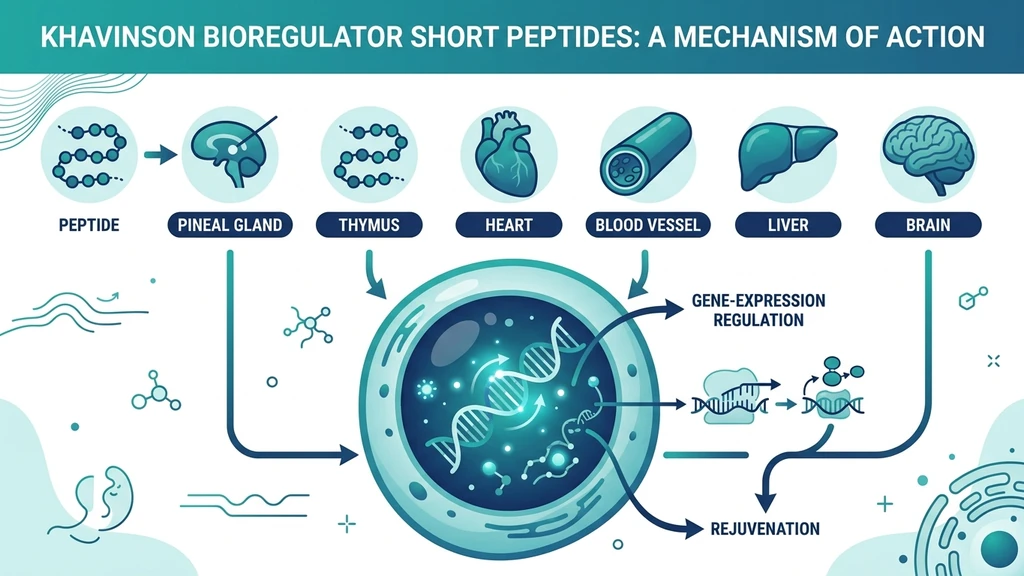
You are staring at a research-chemical catalog with a dozen odd names stacked in a column: Epitalon, Thymalin, Cardiogen, Vesugen. Each one claims a different organ and a vague promise of "regulation." A single Russian name sits behind all of them. Here is the honest answer. Bioregulator peptides, often called Khavinson peptides, are very short chains of two to four amino acids developed by Professor Vladimir Khavinson's group at the Saint Petersburg Institute of Bioregulation and Gerontology. Each peptide is proposed to target one tissue and adjust which genes that tissue's cells switch on. Almost all of the evidence is preclinical, run in cell cultures and animals, and published by that single Russian network. Large Western clinical trials do not exist. They are not FDA-approved and are sold for research use only.
| Bioregulator | Target Tissue | What Research Suggests |
|---|---|---|
| Epitalon | Pineal gland | Telomere and aging endpoints in cells and rodents |
| Vilon | Immune system | Immune modulation in aged animals |
| Thymalin | Thymus | Immune restoration; the most human-observed of the group |
| Cardiogen | Heart | Cardiac cell protection in models |
| Vesugen | Blood vessels | Vascular wall support in vitro |
| Livagen | Liver | Liver cell and chromatin activity in cultures |
| Cortagen | Brain cortex | Neuroprotection in animal work |
| Bronchogen | Lung/bronchi | Bronchial tissue regulation in models |
| Ovagen | Liver and gut | Digestive and liver cell effects in vitro |
| Pinealon | Brain neurons | Neuron survival under oxidative stress |
Think of the whole program as a set of labeled keys, each cut for one lock. The theory says each short peptide is addressed to a specific tissue, slips into the cell, and nudges a few genes back toward a younger pattern. The theory reads cleanly. The human proof is thin. Treat this guide as a map of what the literature reports, not a set of instructions, and talk to a qualified physician before you experiment with any research peptide. If you are new to this whole category, start with getting started with peptides.
Get your custom peptide protocol:
- Tailored to your body and goals
- Precise dosing and cycle length
- Safe stacking combinations
- Backed by peer-reviewed studies
- Ready in under 2 minutes
What Are Bioregulator Peptides? The Khavinson Story
You keep seeing one name attached to every product in this category, so start there. Vladimir Khavinson was a Soviet and then Russian gerontologist who spent his career on a single idea: that very short peptides, extracted from animal organs or synthesized from scratch, can act as tissue-specific signals. He led the Saint Petersburg Institute of Bioregulation and Gerontology, and his group published on these compounds for more than four decades (Peptides and Ageing, Neuro Endocrinol Lett, 2002).
The program began in the 1970s with Soviet military research. The stated goal was to protect and restore the health of soldiers and, later, aging workers. The team ground down organs like the thymus and pineal gland, pulled out short peptide fractions, and reported that these fractions could restore function in the same organ they came from. The oral extract products were named "cytamins." The purified or synthetic injectable versions were named "cytogens."
Over time the group moved from crude extracts to defined synthetic sequences. Epitalon is four amino acids (Ala-Glu-Asp-Gly). Vilon is two (Lys-Glu). Pinealon is three (Glu-Asp-Arg). These are among the shortest bioactive peptides anyone studies, which is exactly why they draw skepticism. A chain this small was long assumed to be too simple to carry specific instructions.
The reach of these peptides is worth stating plainly. Nearly all of the primary research comes from that institute and a small circle of allied Russian labs, published largely in Russian-language or Russian-affiliated journals such as Advances in Gerontology and Bulletin of Experimental Biology and Medicine. That does not make the work wrong. It does mean the evidence has not passed through the independent replication that Western pharmacology treats as the price of admission. For the pineal member studied most for aging, see the Epitalon profile.
The Proposed Mechanism, and an Honest Analogy
Picture the DNA inside a cell as a long library shelf, most of it wrapped and inaccessible. Gene expression is the act of pulling specific books off the shelf to be read. The bioregulator theory says these short peptides act like a librarian who walks to a few exact spots and slides those particular books forward, making certain genes easier to read.
Now the literal claim. The Russian group reports that short peptides enter the cell nucleus, bind to specific short sequences in the DNA or to histone proteins, and change the activity of genes tied to that tissue's function and aging. A systematic review from the group lays out this model across multiple sequences (Peptide Regulation of Gene Expression, Molecules, 2021). Related papers extend the idea to cell differentiation (Stem Cell Rev Rep, 2020) and to the epigenetic control of neurons (Int J Mol Sci, 2022).
Here is the catch a Western pharmacologist raises immediately. A free peptide two to four amino acids long usually gets chopped apart by enzymes in the blood within minutes, and small peptides do not easily cross into cells, let alone reach the nucleus and recognize a specific DNA sequence. The proposed mechanism would rewrite part of the rulebook if confirmed by independent labs using modern genomic tools. So far, that independent confirmation is missing. Read the mechanism as a hypothesis with supporting data from one network, not as settled biology.
The Evidence Base, Assessed Honestly
If you are deciding whether to spend money and inject an unapproved compound, the quality of the evidence matters more than any single reported benefit. Treat this section as a credit report on the science, not a sales page.
One research network. The overwhelming majority of bioregulator research traces back to the institute in Saint Petersburg and a handful of collaborating Russian groups. In mainstream pharmacology, a set of findings that only one network can produce is treated as provisional until outside labs reproduce it. That is the single most important fact about this entire category.
Preclinical-heavy. Most of the data is in vitro (cultured cells) or in vivo in rodents. Reported endpoints include changes in gene expression, reduced markers of cell aging, and improved survival of stressed cells. One study reported that short peptides shifted gene expression in human mesenchymal stem cells during aging in culture (Mol Biol Rep, 2020). These are cell-and-animal signals. They may or may not translate to a living person.
Limited, non-replicated human data. Some clinical observation exists, especially for Thymalin and Epitalon, reported by the originating institute. What does not exist is a body of large, randomized, placebo-controlled trials run by independent teams and published in high-impact international journals. You cannot point to a Phase III dataset because none has been published.
Publication in Russian-affiliated journals. Much of the work appears in Advances in Gerontology, Bulletin of Experimental Biology and Medicine, and similar venues. Several review papers do appear in indexed international journals (Molecules, Stem Cell Rev Rep, Int J Mol Sci), but these are largely authored by the same group summarizing its own program.
Here is what this means for you. The reported benefits may be real, may work through a simpler route than the DNA-binding story, or may not hold up in humans at all. Some practitioners look at the low reported harm signal and treat bioregulators as a low-stakes personal experiment made with clear eyes. That is a defensible choice. It is not evidence-based medicine, and it should not be dressed up as such. For the broader safety framework before any experiment, read the peptide safety guide.
The Main Bioregulator Peptide Families
You want to know what each name in the catalog is supposed to do. Below is the honest one-paragraph version for each major bioregulator. Every claim traces to the preclinical, single-network literature described above, so read each as "the research reports," not "science has shown."
Pineal and Brain: Epitalon, Pinealon, Cortagen
Epitalon (Ala-Glu-Asp-Gly) is the flagship of the program, studied for telomere length, melatonin rhythm, and aging endpoints in cells and rodents. It is the peptide most often discussed for lifespan, and it carries the same thin, Russian-dominated evidence base as the rest. See the full Epitalon profile.
Pinealon (Glu-Asp-Arg) targets brain neurons and was reported to protect them from oxidative stress and oxygen starvation in cell and rodent models. Our Pinealon peptide benefits guide covers its mechanism and dosing in detail. Cortagen is the cortex-targeted member, reported to support neuron survival in animal injury models. Peptide regulation of neuronal gene activity in Alzheimer's models is one of the group's more recent lines of work (Int J Mol Sci, 2022).
Immune: Vilon and Thymalin
Thymalin is a thymus-derived preparation and the most human-observed member of the family, reported in Russian clinical work to restore immune markers in older and ill patients. It sits closest to a real clinical story, though still without independent Western trials. The mechanism overlaps conceptually with a better-Western-studied thymic peptide, so compare it against thymosin alpha-1 benefits.
Vilon (Lys-Glu) is a two-amino-acid immune bioregulator, reported to modulate immune-cell gene activity and improve immune measures in aged animals (Bull Exp Biol Med, 2016). It is one of the shortest peptides in the program, and our Vilon guide covers it in depth. See Vilon peptide benefits.
Vascular, Cardiac, and Organ Peptides
Cardiogen is the heart-targeted peptide, reported to protect cardiac cells and support the aging myocardium in models. See Cardiogen peptide benefits. Vesugen targets the vascular wall and is proposed to support the cells lining blood vessels; our Vesugen peptide benefits guide walks through the vascular claims.
Livagen (Lys-Glu-Asp-Ala) is the liver-targeted bioregulator, reported to influence chromatin activity and gene expression in liver and lymphocyte cultures. Read the Livagen peptide benefits guide for the detail. Bronchogen targets bronchial and lung tissue, and Ovagen is proposed to act on the liver and digestive tract. All of them share the same single-network, preclinical evidence problem, differing mainly in which tissue they claim.
Bioregulator Peptides vs Conventional Peptides
If you already know BPC-157 or the GLP-1 weight-loss drugs, you are probably trying to place bioregulators on the same map. They belong to a different category with a different evidence status, and mixing them up leads to bad expectations.
Bioregulators vs BPC-157. BPC-157 is a 15-amino-acid peptide studied for tissue and gut healing, mostly in rodent models, and it acts largely through growth-factor and angiogenesis pathways rather than a proposed direct gene-switching mechanism. It is longer, its mechanism is more conventional, and its animal literature is broader, though it also lacks large human trials. Bioregulators are shorter and rest on the more exotic gene-expression claim.
Bioregulators vs GLP-1 drugs. Semaglutide and tirzepatide are large, receptor-targeted drugs with tens of thousands of patients in randomized Phase III trials and full FDA approval. That is the opposite end of the evidence spectrum. A GLP-1 drug is a proven medicine with a known effect size. A bioregulator is an experimental compound with preclinical data and no approval. Do not reason about them the same way.
Bioregulators vs functional peptides like NAD-related compounds. Peptides and cofactors marketed for energy and cellular metabolism, such as those covered in our NAD peptide guide and the peptides for energy overview, target metabolism through more established pathways. Bioregulators aim upstream at gene expression itself, which is a bolder claim carrying a weaker independent evidence base.
The practical takeaway. The bar of proof rises as you move from bioregulators to research peptides like BPC-157 to fully approved drugs like the GLP-1s. Bioregulators sit at the most speculative end. That does not make them worthless. It does mean your confidence should scale with the evidence, which here is preliminary.
How Bioregulators Are Used and Formulated
You are looking at two very different product types and wondering which one the catalog is selling. This section is research context, not medical advice, and no regulator has validated any human protocol for these compounds.
Cytamins (oral). These are the original organ-extract preparations, sold in Russia as oral capsules or tablets, one branded per organ. The proposed logic is that the extract delivers a mix of peptides addressed to that tissue. Oral peptides face an obvious problem: the digestive tract breaks most peptides down before absorption, which is a standing objection to the whole oral cytamin approach.
Cytogens (injectable). These are the purified or fully synthetic single sequences, such as Epitalon, Vilon, and Pinealon, shipped as a lyophilized powder for subcutaneous injection after reconstitution. Research protocols reported by the originating group tend to use small doses, often in the microgram-to-few-milligram range, given once daily in short cycles of 10 to 20 days, then stopped for months.
The cycling logic. The bioregulator model argues that once gene expression is nudged, continuous dosing is unnecessary and you let the tissue run on the new pattern. That is the reverse of how most drugs work, where you hold blood levels steady. Whether the cycling logic is right depends entirely on whether the underlying mechanism story is right, which independent labs have not confirmed.
Reconstitution matters because doses are tiny. A microgram-scale target means a small misread on the syringe can swing your dose several-fold. Before drawing anything, run the numbers with the peptide reconstitution calculator and read how to reconstitute a peptide so the concentration on the vial matches the units on the syringe.
Heavy caveat, stated once and meant fully. None of this is a treatment recommendation. These are descriptions of what appears in the research literature and in vendor protocols. The compounds are not FDA-approved, human safety data is thin, and anyone considering them should involve a physician who knows their history. Start from the peptide safety guide before you go further.
Safety and What We Still Do Not Know
You are about to handle a class of compounds no Western regulator has reviewed. The reported safety signal is mild, and the gaps behind that signal are wide. Both facts are true at once, and you should hold them together.
What the studies report. In the small published studies, side effects are described as rare and mild, with no serious adverse event clearly attributed to the peptides. That signal rests on a tiny database, short follow-up, and very little human exposure. It is not proof of long-term safety. It is an absence of reported harm in a small, non-independent dataset.
The gene-expression question. The proposed mechanism touches gene regulation, which raises a theoretical concern in anyone with active or recent cancer, since you do not want to nudge cell-growth genes in an uncontrolled setting. No study rules this in or out. That uncertainty alone is reason for caution.
Who should not experiment at all. - Pregnant or breastfeeding people, because there is no safety data - Anyone with active or recent cancer, because of the mechanism concern above - Anyone under 18, because there is no safety data - Anyone with a diagnosed condition who has not cleared it with their physician
The biggest practical risk is the product itself. Because bioregulators move through research-chemical channels with little third-party testing, the vial may not contain what the label claims, at the purity it claims. Counterfeit and underdosed product is a real and common problem in this market. Independent lab testing of a vial is the only way to know what you actually have.
What we do not know, plainly. We do not know if these peptides do anything measurable in healthy humans. We do not know the long-term effects of cycling them for years. We do not know whether the DNA-binding mechanism is real or whether any effect works through a simpler route. Those are large unknowns for a compound you inject, and honesty about them is the point. For safe handling practices that apply to any research peptide, use the peptide safety guide and the reconstitution calculator.
Frequently Asked Questions
Are bioregulator peptides FDA approved?
No. Bioregulator peptides, including Epitalon, Thymalin, and Vilon, have no FDA approval for any use, and no large randomized human trial supports them. In the US they move through research-chemical channels and are sold for laboratory use only, not as drugs or supplements. Before handling any of them, read the peptide safety guide.
Is there real human evidence for Khavinson peptides?
Limited and non-replicated. Some clinical observation exists, most notably for Thymalin, reported by the originating Russian institute. What does not exist is a body of large, independent, placebo-controlled trials in international journals. Compare the thymic evidence against the better-Western-studied thymosin alpha-1 benefits.
Are bioregulator peptides safe?
Reported side effects in the small existing studies are rare and mild, with no serious adverse event clearly attributed to them. The database is tiny, human exposure is minimal, and long-term data is absent. Avoid use in pregnancy, in active cancer, and under age 18. For safe handling, see how to reconstitute a peptide.
Oral cytamins or injectable cytogens, which is better?
Cytamins are oral organ extracts, and cytogens are purified or synthetic single sequences given by subcutaneous injection. Oral peptides face heavy digestive breakdown, which is a standing objection to cytamins. Neither route has validated human dosing. If you explore the injectable route, use the peptide reconstitution calculator for accuracy.
Do bioregulator peptides actually slow aging?
The research reports aging-related effects, such as telomere and gene-expression changes, mostly in cell cultures and rodents from one Russian network. No large human trial confirms an anti-aging effect in people. For the pineal peptide studied most for this, see the Epitalon profile.
What is the difference between bioregulators and BPC-157 or GLP-1 drugs?
Bioregulators are two-to-four amino acid peptides resting on a proposed gene-switching mechanism with preclinical, single-network data. BPC-157 is a longer healing peptide with broader animal work, and GLP-1 drugs are FDA-approved with large trials. Confidence should scale with evidence. Start with getting started with peptides.
How are bioregulator peptides dosed in research?
Reported research protocols use small doses, often microgram-to-few-milligram, subcutaneously once daily in 10 to 20 day cycles spaced months apart. These are not clinically validated human doses. Because the amounts are tiny, calculate your exact syringe units with the peptide reconstitution calculator before drawing.
Which bioregulator peptide has the most evidence?
Thymalin, the thymus preparation, has the most human observation, reported in Russian clinical work on immune restoration. Epitalon has the most aging-focused preclinical data. Both still lack independent Western trials. For the individual immune and vascular members, see Vilon peptide benefits and Vesugen peptide benefits.
The Bottom Line
Bioregulator peptides are a serious, decades-long research program from one Russian group, built on a bold idea: that very short peptides can address a single tissue and adjust its gene expression toward a younger state. The honest summary is that the theory is coherent and the preclinical data is real, but the whole evidence base traces to a single network, human trials are limited and non-replicated, and no Western regulator has approved any of it.
Confidence should scale with evidence, and here the evidence is early. If you have a diagnosed condition, your foundation stays the same: validated treatment, sleep, exercise, and vascular health. A bioregulator, if you use one, is an experiment layered on top of that, cleared with a physician, dosed by careful math, and treated as uncertain rather than proven.
To go deeper on individual members, start with the Epitalon profile, Pinealon peptide benefits, Cardiogen peptide benefits, and the Vilon, Vesugen, and Livagen guides. Not sure where you fit? Take the quiz to map your goals to the research.
This is educational content. These peptides are not FDA-approved; consult a healthcare provider before acting on anything here. Explore more peptide research and tools at https://peptidesexplorer.com.
References
- 1.Peptide Regulation of Gene Expression: A Systematic Review. Molecules, 2021. PMID 34834147
- 2.Short Peptides Regulate Gene Expression. Bull Exp Biol Med, 2016. PMID 27909961
- 3.Peptide Regulation of Cell Differentiation. Stem Cell Rev Rep, 2020. PMID 31808038
- 4.Gene expression in human mesenchymal stem cell aging cultures: modulation by short peptides. Mol Biol Rep, 2020. PMID 32399807
- 5.Peptides and Ageing. Neuro Endocrinol Lett, 2002. PMID 12374906
- 6.Neuroepigenetic Mechanisms of Action of Ultrashort Peptides in Alzheimer's Disease. Int J Mol Sci, 2022. PMID 35457077
Helpful Tools
Related Articles
Vilon Peptide: Benefits, Research, and Dosage
Vilon (Lys-Glu) is a Russian immune bioregulator dipeptide. Review the mechanism, research evidence, dosage context, and an honest look at the limits.
Vesugen Peptide: Vascular Bioregulator Research
Vesugen (Lys-Glu-Asp / KED) is a Russian vascular bioregulator studied for endothelial and vascular aging. Review the mechanism, dosing context, and evidence.
Livagen Peptide: Liver Bioregulator Research
Livagen (Lys-Glu-Asp-Ala) is a Russian liver bioregulator tetrapeptide. Review the mechanism, research, dosage context, and honest evidence quality.
Pinealon Peptide: Benefits & Dosage
Pinealon (Glu-Asp-Arg) is a Russian bioregulator tripeptide studied for neuroprotection. Review the mechanism, benefits, dosing, and honest evidence quality.